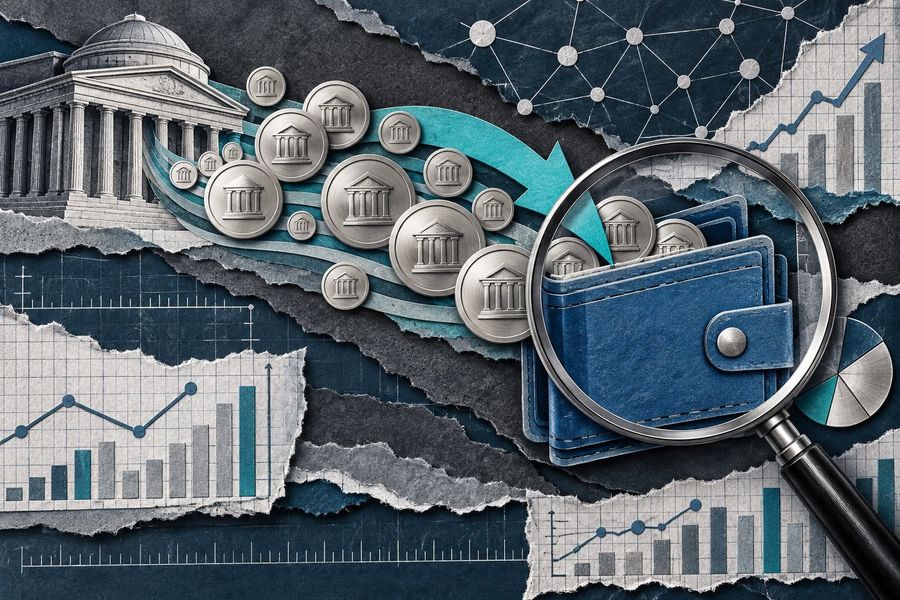
The RWA (Real World Asset) tokenization market hit $26.4 billion in March 2026, surging over 300% year-over-year. Assets once reserved for institutional capital — from Manhattan apartments to U.S. Treasuries and museum-grade art — can now be owned fractionally starting at $50. Over 40 major financial institutions including BlackRock and Franklin Templeton have already deployed billions on-chain.
As of April 18, 2026 at 11:00 KST, Bitcoin trades at $77,201 (+3.31%) on Binance with $1.9B in 24-hour volume, while Ethereum — the primary settlement layer for most RWA protocols — sits at $2,421 (+3.68%) with $5.6B in open interest on Binance futures. The Crypto Fear & Greed Index reads 26 (Fear), yet demand for real-asset exposure remains strong: gold-backed XAUT ranked 4th on Binance by volume at $868.3M, outpacing SOL by more than 2x. BTC futures show a heavily bearish lean with only 37.9% of positions long and a negative funding rate of -0.0081%, reinforcing the risk-off tone — while RWA inflows remain structurally decoupled from crypto sentiment.
What Is RWA Tokenization?
Quick Answer: RWA tokenization converts ownership rights of real-world assets — property, government bonds, gold, fine art — into blockchain tokens. The market reached $26.4B in March 2026 (excluding stablecoins), enabling fractional investment from as little as $50, with smart contracts automating income distribution 24/7.
RWA tokenization represents ownership or income rights of physical assets on a blockchain. When you hold a token backed by a Detroit rental property or a U.S. Treasury bill, a smart contract automatically routes rent or interest to your wallet — no broker, no settlement delay, no six-figure minimum. BlackRock CEO Larry Fink captured the scale of the shift in his 2026 Annual Chairman's Letter: "Half the world's population carries a digital wallet on their phone. Imagine if that same digital wallet could also let you invest in a broad mix of companies for the long term — as easily as sending a payment. Tokenization could help accelerate that future by updating the plumbing of the financial system." In a separate op-ed with Rob Goldstein, Fink added: "We believe that tokenization today may be roughly where the internet was in 1996."
The RWA Market in 2026: 380% Growth in Three Years
The on-chain RWA market grew from roughly $5B in 2022 to $26.4B by March 2026 — 380% growth in three years, comparable to early mobile payments between 2010 and 2013. Tokenized U.S. Treasuries alone expanded from $380M in Q1 2023 to over $14B in Q1 2026, a ~37x surge at a 230% CAGR. The broader market including private credit surpassed $36B by end-2025 (Canton Network). Long-range forecasts: McKinsey projects $2T by 2030, Standard Chartered $30T by 2034, and Ripple/BCG $18.9T by 2033. More than 200 active projects are live across 40+ major global financial institutions.
Tokenized Bonds & Treasuries: 2026 Platform Comparison
Tokenized government bonds are the fastest-growing RWA vertical. A joint report by RedStone, Gauntlet, and RWA.xyz concluded that "asset tokenization has decisively transitioned from experimental pilots to scaled institutional adoption in 2024–2025." Here is how the leading platforms compare:
| Platform | Product | AUM | Min. Investment | Yield | Target Investor |
|---|---|---|---|---|---|
| BlackRock (Securitize) | BUIDL | $2.8–2.9B | $5,000,000 | ~3.5–4% | Institutions only |
| Franklin Templeton | BENJI | $800M+ | Low (retail) | Market-linked | Retail + institutions |
| Ondo Finance | OUSG | Public | $5,000 | 2.42% (7d) / 2.82% (30d) | Qualified institutions |
| Ondo Finance | USDY | Public | Small | 5.3% APY | Non-US individuals |
BlackRock's BUIDL leads with $2.8–2.9B AUM but requires a $5M minimum, effectively locking out all but institutional players. For non-U.S. retail investors, Ondo's USDY offers 5.3% APY (as of September 2025) at a low entry point. Franklin Templeton's BENJI operates across 7 blockchain networks and maintains shareholder records on-chain — a meaningful milestone for traditional finance. For broader DeFi yield context, see our DeFi coverage on SpotedCrypto.
Tokenized Real Estate: Own U.S. Property From $50
Real estate tokenization removes the biggest barrier to property investment: capital requirements. Two platforms currently lead this space:
- RealT: 700+ U.S. rental properties tokenized, ~$130M total value, 16,000 investors across 70 countries. Minimum entry: $50. Rental income distributed in USDC within 24 hours.
- Lofty.ai: 160+ U.S. rental properties, ~$89M AUM, minimum $50. Pursuing DeFi integrations targeting 12–15% APR.
The tokenized real estate market is forecast to expand from $300B in 2024 to $4T by 2035 — a 27%+ CAGR driven by global demand for yield-bearing hard assets without the liquidity lock-up of physical ownership. Learn how blockchain infrastructure powers this shift in our Ethereum guides and blockchain explainers.
Art & Commodities: The Next Frontier
Art tokenization has evolved from speculative JPEG trading to genuine fractional ownership of physical masterworks. The global tokenized art market is forecast at $60.82B in 2026 (Beinsure), with 30%+ of institutional NFT transactions now structured as fractional ownership. High-net-worth individuals plan to allocate 8.6% of their portfolios to tokenized RWA by end-2026, while institutional investors target 5.6% (KuCoin Research).
On-chain commodity exposure is already mainstream: XAUT (Tether Gold) generated $868.3M in 24-hour Binance volume on April 18, more than double SOL's $368.1M — a clear signal that institutional demand for tokenized hard assets holds firm even during Fear-index markets.
Live Market Data: April 18, 2026 (11:00 KST)
ETH, the dominant RWA settlement layer, trades at $2,421 on both Binance and OKX with $5.6B in Binance futures open interest and a -0.0023% funding rate. BTC carries stronger bearish pressure: 37.9% long positions, -0.0081% funding rate, and $8.2B in open interest. SOL and XRP futures lean bullish at 64.1% and 66.0% long respectively. ORDI stands out as a notable mover on both Binance (-32.93%, $128.3M volume) and OKX (-15.18%, $79.9M volume).
| # | Coin | Price | 24h Change | Volume(24h) | High | Low |
|---|---|---|---|---|---|---|
| 1 | USDC | $1.00 | -0.01% | $3.7B | $1.00 | $1.00 |
| 2 | BTC | $77,201 | +3.31% | $1.9B | $78,333.00 | $74,529.40 |
| 3 | ETH | $2,421 | +3.68% | $1.2B | $2,464.91 | $2,317.43 |
| 4 | XAUT | $4,818 | +1.01% | $868.3M | $4,865.08 | $4,765.00 |
| 5 | SOL | $89 | +0.71% | $368.1M | $90.73 | $87.34 |
| 6 | XRP | $1.48 | +3.29% | $220.1M | $1.51 | $1.42 |
| 7 | USD1 | $1.00 | +0.00% | $173.6M | $1.00 | $1.00 |
| 8 | DOGE | $0.10 | +0.81% | $131.7M | $0.10 | $0.10 |
| 9 | ORDI | $6.10 | -32.93% | $128.3M | $9.36 | $5.53 |
| 10 | 币安人生 | $0.44 | +28.37% | $105.8M | $0.46 | $0.32 |
| Coin | Funding Rate | Open Interest | Long/Short |
|---|---|---|---|
| ADA | 0.0100% | $100.6M | N/A |
| AVAX | 0.0023% | $94.5M | N/A |
| BNB | 0.0015% | $358.6M | N/A |
| BTC | -0.0081% | $8.2B | 37.9% / 62.1% |
| DOGE | 0.0100% | $248.5M | 70.2% / 29.8% |
| DOT | 0.0048% | $49.0M | N/A |
| ETH | -0.0023% | $5.6B | 55.4% / 44.6% |
| LINK | 0.0100% | $89.5M | N/A |
| SOL | 0.0003% | $856.7M | 64.1% / 35.9% |
| XRP | 0.0081% | $430.5M | 66.0% / 34.0% |
The Fear & Greed Index at 26 reflects broad crypto anxiety, but RWA assets are structurally decoupled from speculative sentiment — tokenized Treasury yields and rental income don't fluctuate with BTC funding rates. This insulation is precisely the institutional investment thesis driving RWA adoption. Track daily conditions at our market data hub.
Key Risks Before You Invest
- Regulatory risk: Tokens may be classified as securities under local law, potentially triggering platform shutdowns or liquidity freeze. Rules vary sharply by jurisdiction.
- Smart contract risk: Code vulnerabilities can result in fund loss. Always verify independent audit history before depositing.
- Legal ownership gap: Holding a token does not automatically confer airtight legal ownership of the underlying asset. Review each platform's legal structure carefully — who actually holds the deed or bond certificate?
- Cross-chain friction: Bridging RWA tokens across chains incurs 2–5% cost friction and 1–3% price discrepancies between chains (Canton Network). Factor this into yield calculations.
- Liquidity risk: Secondary markets for RWA tokens can be thin — rapid exits at fair value are not guaranteed.
Start small, diversify across asset types and platforms, and prioritize audited, legally compliant platforms over those offering the highest headline yields. Visit our Learn section for more risk frameworks applicable to digital assets.
Frequently Asked Questions
What is the minimum investment for RWA tokenization?
It depends on the asset class. Real estate platforms like RealT and Lofty.ai start at $50, with rental income paid in USDC. For tokenized Treasuries: Ondo Finance USDY has a low retail minimum with 5.3% APY (non-U.S. investors); OUSG starts at $5,000 for qualified institutions; BlackRock BUIDL requires $5,000,000 and is institutional-only.
How does tokenized real estate differ from REITs?
REITs trade during stock exchange hours only, expose you to a full portfolio rather than individual properties, and typically distribute income quarterly. Tokenized real estate offers 24/7 trading, property-level selection, and automated daily or weekly income via smart contract at far lower minimums. The trade-off: REITs operate under decades of regulatory maturity, while RWA platforms carry higher regulatory and platform-specific risks that must be weighed carefully.
Sources
- Real World Asset Tokenization Market Has Grown Almost Fivefold in 3 Years, CoinDesk
- Larry Fink's 2026 Annual Chairman's Letter, BlackRock
- State of RWA Tokenization 2026, Canton Network
- RWA Tokenization 2026 Guide, blocklr.com
- Real Estate Tokenization Market Forecast, 4irelabs
- Tokenized US Treasuries Hit $7.3B in 2025, Yellow.com
This article is for informational purposes only and does not constitute financial or investment advice. All investment decisions should be made based on your own research and risk tolerance.
Related Articles
- Solana vs Ethereum 2026: Speed, Fees, TVL, and Ecosystem Fully Compared
- Bitcoin vs Ethereum 2026: The Definitive Comparison
- The Complete 2026 Crypto DCA Guide: Profiting Through Extreme Fear Markets
- Crypto DCA Strategy Guide 2026: +1,648% Backtest Results Proven
- BTC Dominance at 57%: What It Means and When Altcoin Season Begins