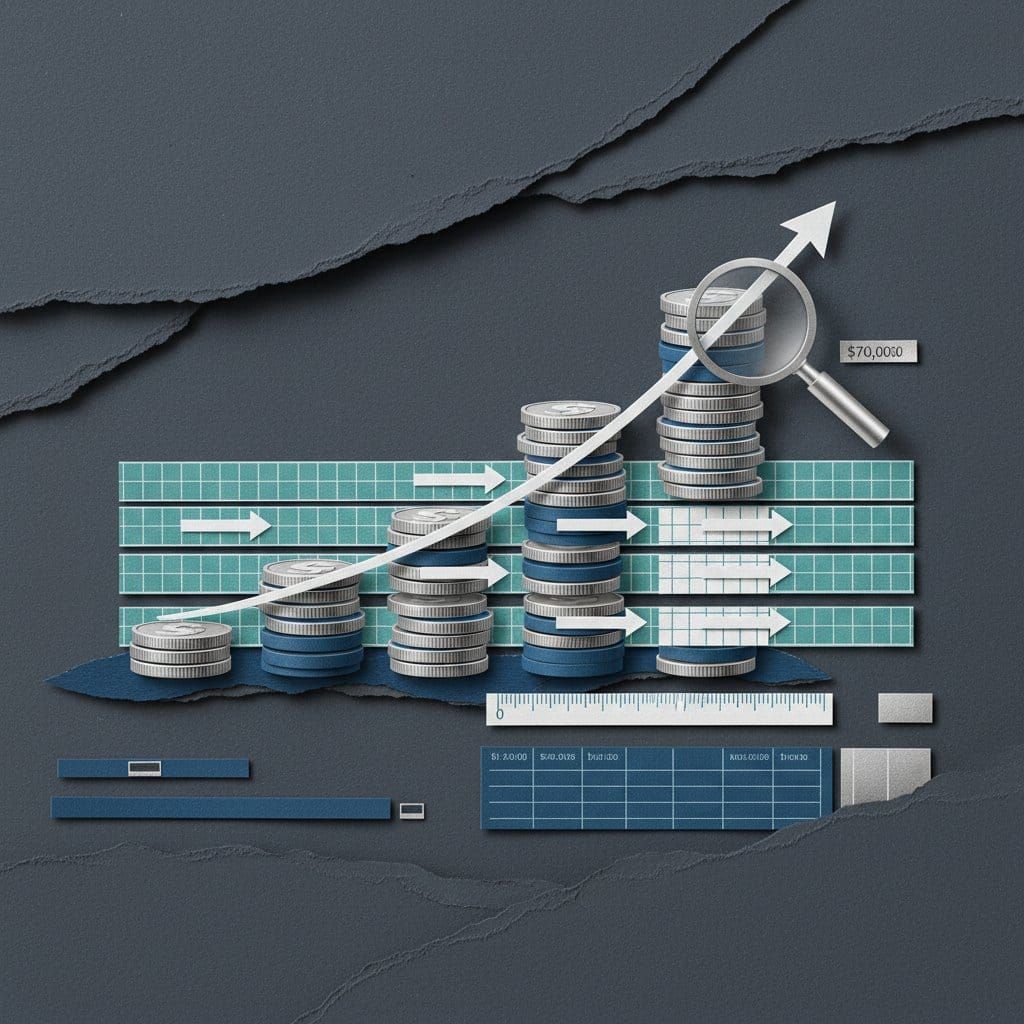
If you had invested $100 per month in Bitcoin from 2014 through 2024, your $35,700 total investment would have grown to approximately $589,000 — a verified return of +1,648%. Not a projection. Real transaction backtest data.
As of April 13, 2026 (17:00 KST), Bitcoin trades at $70,779 on Binance with 24-hour volume of $843.7M. ETH sits at $2,186 (-1.46%), and total crypto market cap stands at $2.49 trillion with BTC dominance at 56.8%. Against this backdrop, long-term investors are revisiting Dollar-Cost Averaging as a proven alternative to timing the market.
The adoption data is clear: 83.53% of crypto investors have used DCA at least once, and 59% currently deploy it as a primary strategy. (Yellow.com Research, 2026)
What Is Dollar-Cost Averaging in Crypto?
Quick Answer: Dollar-Cost Averaging (DCA) means investing a fixed amount at regular intervals regardless of market price. In crypto, volatility becomes an advantage — you buy more when prices fall and less when they rise. Verified backtests show returns up to +1,648% over 10 years, with a Sharpe ratio of 1.38 versus lump sum's 0.88.
DCA originates from Benjamin Graham's 1949 concept of systematic investing. In crypto, extreme price swings automatically lower your average cost over time when you buy consistently. The single requirement is showing up on schedule.
Michael Saylor, Executive Chairman of Strategy (formerly MicroStrategy), has directly described his company's 720,000+ BTC accumulation: "You can think of us as dollar cost averaging." Strategy holds 3.43% of Bitcoin's total supply after six uninterrupted years of buying without a single sale. Macro analyst Lyn Alden reinforces the approach: "I dollar-cost average in over time. Long-term holders who DCA help build up a supply crunch." (Lyn Alden Investment Strategy)
DCA Backtest Returns: The Hard Numbers
All figures below come from verified BTC transaction datasets. The pattern is consistent: longer duration and fear-amplified buying produce dramatically higher returns. (Sources: SpotedCrypto, Yellow.com Research, 2026)
| Period | Strategy | Total Invested | Final Value | Return |
|---|---|---|---|---|
| 2019–2024 (5yr) | $10/week standard DCA | $2,620 | $7,913 | +202% |
| 2019–2023 (5yr) | $500/month standard DCA | $30,000 | ~$156,000 | +420% |
| 2014–2024 (10yr) | $100/month standard DCA | $35,700 | ~$589,000 | +1,648% |
| 2018–2025 (7yr) | Fear index-based DCA | — | — | +1,145% |
| ~2012–2024 (12yr) | Bear market-focused DCA | — | — | +6,712% |
| 2018–2025 (7yr) | Simple HODL (benchmark) | — | — | +1,046% |
Over the same 2019–2024 window, BTC DCA's +202% far outpaced Apple stock (+79%), gold (+34%), and the Dow Jones (+23%) — 2.5x to 8.6x better. (SpotedCrypto, 2026)
DCA vs. Lump Sum: What the Data Shows
Vanguard's official study covering 1926 to the present found lump-sum investing beats DCA in traditional markets 66% of the time by an average of +2.4 percentage points. Crypto's volatility profile changes this calculus significantly.
| Scenario | Strategy | Return | Notes |
|---|---|---|---|
| 2022 bear market entry | Weekly DCA | +192.47% | Avg. cost ~$35,000 |
| 2022 Jan lump sum | Lump sum | +159% | Entry ~$43,000 |
| 2021–2025, $24K total | Monthly DCA | +154% | Final value $60,881 |
| 2021–2025, $24K total | Annual lump sum | +106% | Final value $49,363 |
| Dec 2017 ATH entry | $100/week DCA | +299% by Jan 2021 | Started at peak price |
| Dec 2017 ATH entry | Lump sum at peak | -$8,000 after 2yr | Underwater for years |
Risk metrics reinforce DCA's edge. Fear-based DCA carries a maximum drawdown (MDD) of -52% versus -78% for lump sum, and a Sharpe ratio of 1.38 vs. 0.88 — 56% better risk-adjusted return. During the 2022 crash, 92% of DCA investors held their position versus just 54% of lump-sum investors. Swan Bitcoin CEO Cory Klippsten puts it plainly: "You'll end up owning way more bitcoin if you 'set it and forget it.'" (CoinDesk)
For deeper analysis, see SpotedCrypto's DCA vs. lump sum comparison and fear-based DCA backtest data.
Live Market Snapshot: Binance & OKX, April 13, 2026
As of 17:00 KST, BTC trades at $70,779 on Binance (-1.26%) and $70,777 on OKX. ETH at $2,186 (-1.46% Binance, -0.25% OKX). SOL at $82.11. Total market cap: $2.49T. These conditions provide useful baseline context for evaluating DCA entry points.
| # | Coin | Price | 24h Change | Volume (24h) | High | Low |
|---|---|---|---|---|---|---|
| 1 | BTC | $70,779 | -1.26% | $843.7M | $71,805.85 | $70,505.88 |
| 2 | ETH | $2,186 | -1.46% | $436.9M | $2,219.04 | $2,175.00 |
| 3 | SOL | $82 | -0.13% | $145.2M | $82.88 | $81.27 |
| 4 | XRP | $1.32 | -0.38% | $80.4M | $1.34 | $1.32 |
| 5 | ZEC | $360 | -1.01% | $76.5M | $378.96 | $357.80 |
| 6 | BNB | $597 | +0.48% | $50.8M | $599.67 | $589.10 |
| 7 | DOGE | $0.09 | -0.66% | $47.7M | $0.09 | $0.09 |
Futures data adds important context for DCA timing. BTC open interest stands at $6.5B with a 55.2% / 44.8% long/short split — relatively neutral. ETH shows more bullish positioning at 64.5% long. SOL leads at 75.1% long with $720.8M OI. BTC's funding rate of -0.0002% signals mild short pressure; DOT's extreme -0.1643% signals heavy short positioning.
| Coin | Funding Rate | Open Interest | Long % | Short % |
|---|---|---|---|---|
| BTC | -0.0002% | $6.5B | 55.2% | 44.8% |
| ETH | +0.0030% | $4.8B | 64.5% | 35.5% |
| SOL | -0.0009% | $720.8M | 75.1% | 24.9% |
| XRP | +0.0028% | $363.8M | 71.7% | 28.3% |
| DOGE | -0.0047% | $216.0M | 71.6% | 28.4% |
| DOT | -0.1643% | $50.3M | — | — |
Optimal DCA Timing: River Financial's Research
River Financial's large-scale dataset analysis identified theoretical timing edges — along with a critical finding about their real-world impact:
- Best weekday: Monday — +14.36% theoretical BTC accumulation, but only ~$55 more over 5 years in practice
- Best month dates: 1st–2nd — 6.83% and 3.73% higher probability of hitting daily lows
- Best time of day: 12–1am Eastern — 6.28% probability of daily low vs. 1.91% for highs
- Avoid: Last 3 days of month — 3.1–6.8% elevated high-price risk
- Extreme Fear amplification: Fear & Greed Index below 15 → 78% profit probability within 30 days, average +121% within 180 days
The key lesson: timing optimization delivers marginal gains. The 14.36% theoretical Monday advantage collapses to roughly $55 over five years. Consistent execution beats perfect timing by a wide margin.
Setting Up Auto-DCA: 4 Steps
- Set your budget: Allocate 5–10% of monthly disposable income. Only invest amounts you can hold through multi-year drawdowns without panic-selling.
- Choose your assets: Beginners: BTC only. Intermediate: BTC 70% / ETH 20% / altcoins 10%.
- Configure auto-buy: On Binance — Auto-Invest → select asset → enter amount and frequency → link payment method → activate. Monday or 1st–2nd of month are the theoretically optimal settings. Coinbase recurring buys offer more coin variety at a higher 1.49% fee. River Financial charges 0% for BTC-only DCA with a "Supercharged DCA" feature that automatically increases purchases during Extreme Fear.
- Quarterly rebalancing: Review allocation every 3 months. When the Fear & Greed Index drops below 15, temporarily increase your DCA amount by 1.5–2x to amplify accumulation during panic conditions.
Fee differences compound over years. $500/month at Coinbase's 1.49% costs ~$894 in fees over 5 years. Binance Auto-Invest at 0.1% costs ~$60 for the same volume. See SpotedCrypto's full Bitcoin DCA setup and fee guide and 2026 backtesting analysis for complete platform breakdowns.
Frequently Asked Questions
Does DCA work during crypto bear markets?
Bear markets are where DCA performs best. During the 2022 crash (-75%), DCA investors averaged a cost basis of ~$35,000 versus ~$43,000 for lump-sum investors — an 18.6% lower entry price that produced a 33-percentage-point return advantage during the recovery. When the Fear & Greed Index falls below 15 (Extreme Fear), backtests show a 78% probability of profit within 30 days and average +121% returns within 180 days. (SpotedCrypto, 2026)
What is the minimum amount to start crypto DCA?
Binance Auto-Invest accepts as little as $1 per purchase. The $10/week strategy over 5 years turned $2,620 into $7,913 (+202%). Amount matters far less than consistency — small, regular investments compound significantly over multi-year time horizons. (SpotedCrypto, 2026)
Sources
- Bitcoin DCA Strategy Guide — Backtest Data, SpotedCrypto
- DCA vs. Lump Sum: Which Strategy Wins Long-Term?, Yellow.com Research
- Best Time and Day to DCA Bitcoin, River Financial
- Michael Saylor's Corporate BTC DCA Operation, Blockonomi
- Dollar-Cost Averaging (DCA) Explained, CoinDesk
Disclaimer: This article is for informational purposes only and does not constitute investment advice. All investment decisions should be made based on your own research and risk tolerance. Past performance does not guarantee future results.
Related Articles
- BTC Dominance at 57%: What It Means and When Altcoin Season Begins
- Korea Crypto Exchanges 2026: Upbit vs Bithumb vs Coinone Compared
- Best Crypto Wallets in 2026: Cold Wallet vs Hot Wallet Complete Guide
- AI Crypto Coins: The Complete 2026 Guide to Top Projects
- What Is RWA Tokenization? The Complete 2026 Investor's Guide