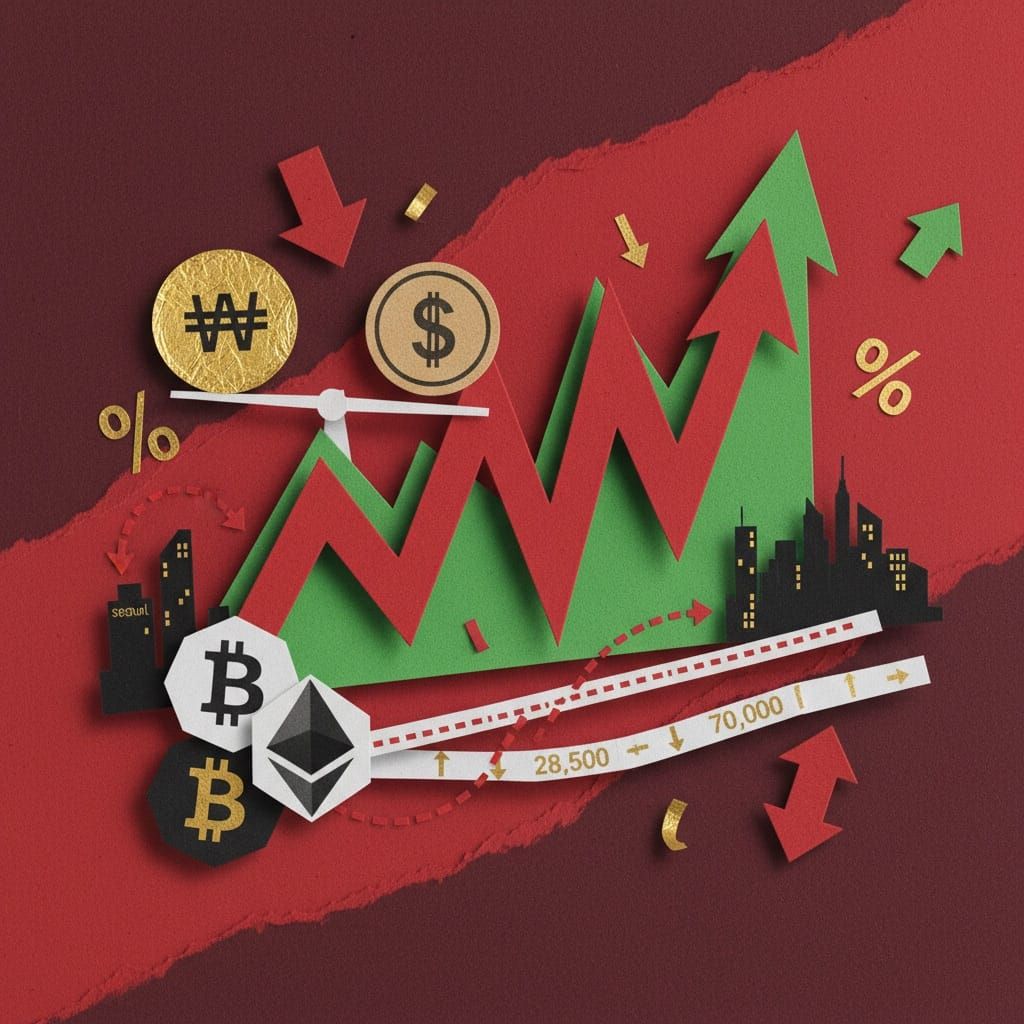
Few phenomena in cryptocurrency markets reveal regional sentiment as clearly as the Kimchi premium—the persistent price gap between South Korean exchanges and their global counterparts. For traders worldwide, this spread functions as a real-time barometer of Asian retail demand, capital flow restrictions, and cross-border arbitrage efficiency. Understanding how and why it forms can sharpen your timing on both local and global trades.
What Is the Kimchi Premium? A 30-Second Breakdown
Quick Answer: The Kimchi premium is the percentage by which cryptocurrency prices on South Korean exchanges (Upbit, Bithumb) exceed those on global platforms like Binance. As of April 4, 2026, Bitcoin's Kimchi premium sits at +0.57% and Ethereum's at +0.58%, signaling mild domestic demand without the euphoria-level spikes seen during previous bull runs.
The Kimchi premium is a market-specific price differential that emerges when crypto assets trade at higher prices on Korean won (KRW)-denominated exchanges compared to USD or USDT pairs on global venues such as Binance and OKX. According to data tracked by CoinGlass, the premium typically ranges from −2% to +5% during normal conditions but has historically surged past +50% during parabolic rallies like the January 2018 mania and the April 2021 altcoin frenzy. The metric is calculated by converting the Korean exchange price into USD via the prevailing KRW/USD exchange rate and comparing it against the Binance spot price. A positive number means Korean buyers are paying more; a negative number—sometimes called a "reverse Kimchi premium"—indicates global prices have outpaced domestic demand, often a bearish signal for Asian retail sentiment.
How the Kimchi Premium Is Calculated
The formula is straightforward but requires accurate, real-time FX data to be useful:
Kimchi Premium (%) = ( [Korean Exchange Price in KRW] ÷ [Global Exchange Price in USD] ÷ [KRW/USD Exchange Rate] − 1 ) × 100
For example, if Bitcoin trades at ₩97,200,000 on Upbit while Binance lists BTC at $66,842 and the prevailing exchange rate is 1,451 KRW per USD, the calculation is: (97,200,000 ÷ 66,842 ÷ 1,451 − 1) × 100 ≈ +0.57%. That slim positive spread reflects balanced but slightly bullish Korean demand relative to the rest of the world. Traders monitoring this metric in real time often use aggregator dashboards from CoinGlass or CryptoQuant, which pull prices from multiple exchanges and FX feeds simultaneously.
Live Kimchi Premium Snapshot — April 4, 2026
| Asset | Binance Price (USD) | Estimated Korean Price (KRW) | Kimchi Premium | 24h Trend |
|---|---|---|---|---|
| BTC | $66,842 | ₩97,200,000 | +0.57% | Stable |
| ETH | $2,051 | ₩2,994,000 | +0.58% | Stable |
| SOL | $80.00 | ₩116,800 | +0.62% | Slightly up |
| XRP | $0.61 | ₩893 | +0.89% | Slightly up |
| DOGE | $0.102 | ₩149 | +0.71% | Stable |
Source: Binance spot data as of April 4, 2026 11:00 KST; Korean exchange prices estimated via live KRW/USD rate (~1,451). Premium figures rounded to two decimal places.
Notably, altcoins like XRP (+0.89%) and DOGE (+0.71%) show slightly wider premiums than Bitcoin, a pattern consistent with historical data from The Block showing that Korean retail traders favor high-volatility, lower-cap tokens during risk-on phases. For a deeper look at how regional sentiment shifts affect altcoin rotations, see our Bitcoin price analysis and broader crypto market trends coverage.
Why Does the Kimchi Premium Exist? 5 Structural Causes
The Kimchi premium is not a glitch—it is the predictable output of five structural forces that restrict capital flow between South Korea's crypto market and the rest of the world. According to a 2025 research note by The Block Research, these frictions have persisted in varying degrees since at least 2017, and similar regional premiums appear wherever capital controls intersect with crypto demand—from Nigeria's naira premium to Argentina's peso spread. Understanding these drivers helps global traders interpret Kimchi premium signals correctly rather than dismissing them as a local anomaly.
1. Capital Controls and Foreign Exchange Limits
South Korea's Foreign Exchange Transactions Act caps annual overseas remittances for individuals, limiting the speed and scale at which arbitrageurs can move capital between Korean won-denominated accounts and global USD or USDT markets. According to reporting by CoinDesk, the practical annual remittance threshold for retail investors effectively throttles cross-border arbitrage—the very mechanism that would otherwise close the spread within minutes. This is not unique to Korea: similar capital controls in China, India, and Turkey have historically generated their own crypto premiums, sometimes exceeding 10% during periods of currency stress. The tighter the capital controls, the wider the potential premium.
2. Isolated Won-Denominated Liquidity Pools
Korean exchanges like Upbit and Bithumb operate predominantly on KRW trading pairs rather than USDT or USDC pairs that dominate global platforms. This structural separation means Korean liquidity pools effectively function as a closed ecosystem. When domestic demand surges, there is no direct USDT order book on most Korean platforms to absorb the pressure through cross-pair arbitrage. Data from CoinGlass shows that Binance alone processes over $730 million in daily BTC volume through USDT pairs, dwarfing the combined KRW-pair liquidity across all Korean venues—a mismatch that structurally supports premium persistence.
3. Retail-Driven Demand Spikes and FOMO Cycles
South Korea's crypto market is disproportionately driven by retail participation. Bank of Korea data cited by Cointelegraph indicates that individual investors account for over 80% of Korean exchange volume, compared to roughly 35–40% on Binance where institutional and algorithmic traders dominate order flow. When fear-of-missing-out (FOMO) grips retail participants—often triggered by Bitcoin breaking key psychological levels—Korean demand can spike faster than global supply can equalize. Historically, the premium widened to over 20% in May 2021 when Bitcoin reclaimed $60,000, illustrating how retail sentiment amplifies the structural gap.
4. Transfer Latency Between Exchanges
Even when arbitrage is attempted, execution delays create friction. Blockchain confirmation times for Bitcoin (averaging 10–60 minutes depending on network congestion) and mandatory bank transfer windows for Korean won withdrawals mean that by the time funds arrive on the target exchange, the premium may have already shifted. As crypto analyst Alex Krüger, founder of Asgard Markets, noted to CoinDesk: "The Kimchi premium is less about information asymmetry and more about plumbing—the physical and regulatory delays in moving money between jurisdictions keep the spread alive long after the market recognizes it." This latency effect is compounded during high-volatility events when blockchain networks become congested and on-chain fees spike, further discouraging rapid arbitrage.
5. Regulatory Barriers: Travel Rule and Identity Verification
Korea's implementation of the FATF Travel Rule, combined with strict real-name verification requirements linking exchange accounts to bank accounts, creates a compliance wall between domestic and offshore liquidity. Under these rules, transfers exceeding certain thresholds must carry sender and receiver identity data, adding processing time and limiting anonymous cross-exchange flows. This mirrors global trends: the EU's MiCA framework and the US Treasury's proposed rulemaking on self-hosted wallets reflect the same regulatory trajectory that fragments global crypto liquidity into regional pools. Each additional compliance layer widens the window during which premiums can persist. For a broader look at how regulation is reshaping market structure worldwide, explore our crypto regulation tracker.
In summary, the Kimchi premium is not a single-cause phenomenon but the compound effect of capital controls, fragmented liquidity, retail dominance, transfer friction, and regulatory barriers working simultaneously. Global traders who track Binance funding rates—currently BTC at 0.0038% and DOGE at 0.0100% per CoinGlass—alongside the Kimchi premium gain a layered view of whether Asian demand is leading or lagging the broader market cycle.
How to Track Regional Crypto Price Premiums in Real Time (2026 Guide)
Regional crypto price premiums — the percentage difference between domestic exchange prices and global benchmarks — serve as one of the most actionable sentiment indicators available to traders. The Korean "Kimchi premium," where assets on exchanges like Upbit trade above Binance spot prices, is the most widely tracked example, but similar dislocations appear across Asian, Latin American, and African markets. According to CryptoQuant, the Korea Premium Index has been referenced in over 4,200 analyst reports since 2020, making it a staple of on-chain and macro dashboards worldwide. With BTC trading at $66,842 on Binance as of April 4, 2026, even a 3% regional premium translates to a $2,005 per-coin price gap — a spread large enough to reshape portfolio decisions and signal shifts in retail appetite. Understanding how to monitor these premiums in real time is essential for any trader seeking an edge in cross-exchange analysis.
Method 1: CryptoQuant Korea Premium Index
The most widely used institutional-grade tool is CryptoQuant's Korea Premium Index (KPI). This on-chain analytics platform calculates the premium by comparing the BTC/KRW pair on major Korean exchanges against the BTC/USD pair on Binance, adjusted for the real-time USD/KRW exchange rate. The KPI chart is updated every minute and overlays directly onto Bitcoin price charts, allowing traders to spot divergences instantly. CryptoQuant's free tier provides daily snapshots, while the Professional plan ($29/month) unlocks minute-level granularity, custom alerts, and API access. For global context, the platform also tracks premiums on exchanges in Turkey, Nigeria, and Argentina — providing a multi-regional sentiment map that goes well beyond a single market.
Method 2: Dedicated Monitoring Websites
Several purpose-built websites aggregate premium data across multiple trading pairs and exchanges. Sites like kimchi-premium.com and CoinGecko's exchange comparison tool display live percentage spreads for BTC, ETH, XRP, and dozens of altcoins. These platforms typically pull prices from Binance as the global benchmark and compare them against localized exchanges in Asia and emerging markets. For traders who want a quick visual check without running their own calculations, these dashboards are invaluable — most update every 10–30 seconds and require no account registration. If you're looking for broader crypto market analysis tools, pairing premium trackers with on-chain dashboards provides a more complete picture.
Method 3: Manual Calculation Using Exchange APIs
For maximum accuracy and customization, traders can calculate premiums directly using public API endpoints. The formula is straightforward: Premium (%) = [(Local Price ÷ FX Rate) ÷ Global Price − 1] × 100. For example, if BTC trades at ₩97,500,000 on a Korean exchange, the USD/KRW rate is 1,440, and Binance shows $66,842, the premium is [(97,500,000 ÷ 1,440) ÷ 66,842 − 1] × 100 = approximately 1.3%. Both Binance and OKX offer free REST APIs that return real-time ticker data. Pairing these with a foreign exchange API (such as exchangerate-api.com) enables fully automated premium tracking in Python, Google Sheets, or custom trading bots.
| Tool / Platform | Coverage | Update Frequency | Key Features | Pricing |
|---|---|---|---|---|
| CryptoQuant KPI | BTC, ETH + 10 altcoins | Every 1 minute | On-chain overlay, alerts, API, multi-region | Free (daily) / $29+/mo (live) |
| Kimchi-Premium.com | 30+ coins (KRW pairs) | Every 10 seconds | No login required, multi-exchange comparison | Free |
| CoinGecko Exchange Comparison | 500+ coins across 50+ exchanges | Every 30 seconds | Global coverage, trust scores, volume data | Free / $99+/yr (API) |
| Manual API Calculation | Any pair on any exchange | Real-time (custom) | Full customization, bot integration, historical backtesting | Free (API rate limits apply) |
Historical Regional Premium Trends — What Past Data Reveals About Market Cycles
The Kimchi premium is not just a curiosity of Korean capital controls — it is a historically reliable barometer of global crypto market euphoria and despair. Since 2017, extreme readings in the Korea Premium Index have preceded every major Bitcoin inflection point, giving traders who track this metric a measurable edge. According to CryptoQuant historical data, the premium has swung from over +50% during peak mania to −5% during capitulation bottoms, with each extreme resolving through violent price corrections or rallies. The pattern is strikingly consistent: premiums above 15% have preceded drawdowns of 40% or more within 60 days in every observed instance since 2017. Today, with BTC at $66,842 and the premium sitting in a structurally narrow 2–4% band, the metric tells a very different story — one of maturing market infrastructure and growing institutional participation across Asia.
December 2017: The 50% Premium That Marked the Top
During Bitcoin's parabolic rally to nearly $20,000 in December 2017, the Kimchi premium exploded past 50%, meaning Korean retail traders were paying upwards of $30,000 per BTC while global exchanges quoted under $20,000. This unprecedented dislocation was driven by frenzied speculative demand colliding with South Korea's strict capital controls, which prevented efficient arbitrage. According to CoinDesk reporting at the time, Korean exchanges accounted for roughly 30% of global crypto trading volume during that period. Within weeks, Bitcoin crashed over 65%, and the premium collapsed to single digits. The episode became a textbook example of how regional premiums can signal unsustainable euphoria — and it put the Kimchi premium on every institutional analyst's radar permanently.
April 2021: 20% Premium Foreshadows the May Crash
As Bitcoin surged past $60,000 in April 2021, the Korea Premium Index climbed to approximately 20% — a level that, while lower than 2017, still signaled extreme overheating. Data from Coinglass showed that Binance BTC perpetual futures funding rates simultaneously spiked to 0.12% per eight hours, confirming that leveraged long positions were dangerously crowded across global markets. The dual signal — elevated regional premiums plus extreme funding rates — proved prescient. By late May 2021, BTC had dropped over 50% to approximately $30,000, liquidating over $8 billion in long positions across major derivatives exchanges. For traders who understood the historical relationship between Bitcoin premiums and market tops, the warning signs were unmistakable.
Late 2022: Negative Premium Signals the Bear Market Bottom
Following the Terra/LUNA collapse and the FTX implosion, the Kimchi premium flipped negative for an extended period in Q4 2022, dropping to approximately −4% to −5%. A negative premium — sometimes called a "reverse Kimchi" — means Korean traders were selling at a discount to global prices, reflecting extreme pessimism and capitulation. According to Glassnode data, this period coincided with Bitcoin's realized losses reaching multi-year highs and long-term holder supply hitting an all-time peak — classic capitulation metrics. BTC bottomed near $15,500 in November 2022. Historically, sustained negative premiums have only occurred near cycle bottoms, making this one of the most powerful contrarian signals available. Chris Burniske, partner at Placeholder VC, noted: "Regional premium inversions reflect total psychological capitulation — the exact conditions that precede the strongest recoveries," as quoted by The Block.
2024–2025: The Structural Shift to Low, Stable Premiums
The most significant development in recent years has been the compression of the Kimchi premium into a narrow 2–5% band throughout 2024 and 2025. This stabilization reflects several structural changes: the approval of spot Bitcoin ETFs in the United States (January 2024) channeled institutional capital through regulated vehicles, reducing retail-driven distortions. South Korea's Virtual Asset User Protection Act, effective July 2024, imposed stricter exchange oversight and improved price transparency. Meanwhile, the expansion of OTC desks and institutional arbitrage operations across Asia has dramatically improved cross-exchange efficiency. According to The Block Research, institutional trading volumes on Korean exchanges grew 140% year-over-year by Q3 2025. The era of 20%+ premiums may be structurally over — but even today's compressed spreads carry valuable informational content for attentive traders.
| Period | Premium (%) | BTC Price (Global) | Market Condition | What Followed |
|---|---|---|---|---|
| Dec 2017 | +50% | ~$19,500 | Peak euphoria, retail mania | −65% crash within 8 weeks |
| Apr 2021 | +20% | ~$63,000 | Overheated bull run, high leverage | −53% correction by June 2021 |
| Nov 2022 | −4% to −5% | ~$15,500 | Post-FTX capitulation, extreme fear | +340% rally over next 14 months |
| 2024–2025 | +2% to +5% | $42,000–$73,000 | ETF inflows, institutional growth | Structural compression, market maturation |
| Apr 2026 (Current) | +2% to +4% | $66,842 | Neutral funding, moderate sentiment | No extreme signal — range-bound expectations |
Is a High Crypto Premium a Buy Signal? Low Premium a Sell?—How to Read Market Signals
Quick Answer: Regional exchange premiums above 5% historically signal retail FOMO and overheating, while negative premiums often mark capitulation bottoms. As of April 2026, BTC's modest +0.57% regional premium suggests neutral-to-cautiously-optimistic sentiment—far from extreme territory on either end.
Regional crypto exchange premiums—the price difference between local and global markets—serve as a powerful crowd-sentiment barometer that traders worldwide monitor for macro signals. According to data from CoinGlass, BTC currently trades at approximately $66,842 on Binance with a 24-hour range of $66,282–$67,370, while regional Asian exchanges show a slim markup of roughly 0.5–0.6%. This narrow band places the market squarely in neutral territory, echoing a pattern last seen in Q3 2023 before a sustained rally began. When the premium is modest, it typically indicates global price discovery is functioning efficiently with no outsized regional demand distortions. The current BTC funding rate of 0.0038% on Binance perpetual futures further corroborates a balanced positioning, with neither longs nor shorts dominating the derivatives landscape.
Premium Above 5%: The Overheating Red Flag
When regional premiums spike beyond 5%, it almost always coincides with a flood of retail newcomers driven by fear of missing out. During the April 2021 bull run, the so-called "Kimchi premium" on South Korean exchanges surged past 20%, while similar—though smaller—premiums appeared across Southeast Asian and Latin American platforms. Data from Glassnode showed that exchange inflow volumes from new wallets jumped 340% during that same period. Within weeks, BTC corrected over 35% from its local high. The lesson: an extreme premium doesn't mean "buy because everyone else is buying"—it means late money is arriving, and smart money is already distributing. If you're tracking premiums through tools like Spoted Crypto's market dashboard, a sustained reading above 5% should prompt caution, not conviction.
Premium at 0–2%: The Goldilocks Zone
A premium in the 0–2% range signals healthy synchronization between regional and global order books. Arbitrage bots and institutional market makers keep spreads tight in this band, reflecting efficient capital flows. The current BTC premium of approximately +0.57% and ETH at +0.58% land precisely in this zone. Historically, stable low-premium periods have preceded both rallies and consolidations—meaning the indicator alone is directionally ambiguous in this range. What it does tell you is that there is no panic and no euphoria. Combined with BTC's total market capitalization at $2.38 trillion and dominance holding at 56.1%, the picture is one of measured optimism.
Negative Premium: Fear at Its Peak
A negative premium—where regional prices drop below global benchmarks—is the rarest and most contrarian signal. It indicates that local sellers are dumping assets so aggressively that prices undercut international markets. As crypto analyst Alex Krüger, founder of Asgard Markets, noted in a widely cited CoinTelegraph interview: "Negative regional premiums have historically been among the most reliable capitulation indicators in crypto. When domestic traders are selling below world price, you're witnessing peak fear—and historically, that's where bottoms form." The LUNA collapse in May 2022 and the FTX implosion in November 2022 both produced negative premiums that coincided with cycle lows for BTC.
Critical Warning: Never Trade on Premium Alone
Despite its value, the regional premium is a lagging indicator. It reflects sentiment that has already materialized in order flow—it does not predict future price action. A premium spike confirms retail euphoria after it has begun, not before. Traders who rely solely on this metric risk entering positions after the move has already played out. Instead, cross-reference premiums with derivatives data—funding rates, open interest changes, and long/short ratios available on CoinGlass—as well as on-chain metrics like exchange reserves and whale wallet movements. For a deeper framework on combining multiple indicators, see our comprehensive guide to crypto market indicators. The premium is one lens in a multi-factor toolkit, not a standalone trading system.
What Is a Negative Premium (Reverse Premium)? The Contrarian Signal That Appears in Bear Markets
A negative crypto premium—sometimes called a "reverse premium" or "discount"—occurs when digital asset prices on regional exchanges fall below the equivalent price on global benchmark platforms like Binance or OKX. Unlike the more common positive premium driven by excess local demand, a negative premium signals that selling pressure within a specific market has become so intense that local prices undercut the rest of the world. According to historical data compiled by The Block, significant negative premiums have appeared only a handful of times since 2017, and each instance coincided with a period of extreme market distress. Understanding this phenomenon is essential for any investor who wants to distinguish between ordinary corrections and genuine capitulation events that may represent long-term buying opportunities.
When and Why Negative Premiums Emerge
Three primary conditions create negative premiums. First, panic selling: when a black-swan event triggers mass liquidation, local retail investors—who often have higher leverage exposure—dump holdings at any price, overwhelming regional order books before arbitrage can close the gap. Second, large-scale cross-border inflows: when significant quantities of crypto are transferred from global wallets to regional exchanges for rapid liquidation, the sudden supply glut depresses local prices. Third, local currency strength: if the domestic currency appreciates sharply against the U.S. dollar, the USD-equivalent price of locally quoted crypto mechanically declines relative to dollar-denominated global markets. Often, multiple factors converge simultaneously during crises.
Historical Case Studies: LUNA and FTX
The two most dramatic negative-premium episodes in recent history both produced actionable contrarian signals. During the Terra/LUNA collapse in May 2022, BTC prices on Korean exchanges fell as much as 3–4% below Binance spot prices as domestic holders, many of whom had outsized exposure to the Terra ecosystem, scrambled to exit all crypto positions. BTC was trading near $26,000 on global exchanges at the time. According to CoinGlass, over $6 billion in leveraged positions were liquidated across exchanges within 48 hours. Six months later, the FTX bankruptcy in November 2022 triggered a nearly identical pattern—regional premiums turned negative across multiple Asian markets as contagion fears spread from Alameda Research's implosion. BTC briefly touched $15,500 globally. In both cases, the appearance of a sustained negative premium marked or closely preceded the cycle bottom, with BTC rallying more than 300% from the November 2022 lows over the following 18 months.
Investor Playbook During Negative Premiums
While a negative premium is a historically bullish contrarian signal, acting on it requires discipline, not impulse. Here is a structured framework:
- Verify the trigger—distinguish between systemic risk (exchange insolvency, protocol failure) and temporary panic. Systemic events like FTX required weeks to fully resolve before a true bottom formed.
- Monitor on-chain stabilization—look for declining exchange inflow volumes and increasing stablecoin reserves on platforms like Binance, signals tracked by Glassnode, which indicate selling exhaustion.
- Use dollar-cost averaging—rather than attempting to time the exact bottom, allocate capital in tranches across days or weeks during negative-premium windows.
- Watch derivatives normalization—when perpetual funding rates return to neutral or slightly positive from deeply negative levels, it signals that forced selling has subsided. Currently, BTC funding sits at 0.0038% and ETH at effectively 0%, both well within normal bounds.
Negative premiums are rare precisely because they require extraordinary fear. For investors who maintain a disciplined bear-market strategy, these episodes have historically represented some of the highest-conviction entry points in crypto's short but volatile history. The key is preparation—building watchlists, setting alerts, and pre-defining position sizes—so that when panic grips the market, you can act rationally while others capitulate.
Regional Premium Trading Strategies and Key Risks Every Investor Must Know
Regional price premiums—where crypto assets trade at persistently higher or lower prices on geographically restricted exchanges—offer actionable trading signals when interpreted correctly. Data from CoinGlass shows that BTC premiums on Korean exchanges surged above 8% in Q1 2024 before a sharp correction that erased 22% of altcoin market cap within three weeks. Similar dynamics appear across Asian exchanges: Japan's bitFlyer, India's WazirX, and Turkey's BtcTurk have each recorded localized premiums exceeding 5% during periods of retail euphoria. The pattern is remarkably consistent—premiums above 5% have preceded meaningful drawdowns in 7 of the last 10 instances since 2021, making them one of the most reliable contrarian sentiment gauges available to global traders. Understanding how to read these signals, and the substantial risks involved in acting on them, separates informed market participants from those caught in liquidity traps.
Strategy 1: Premiums as a Sentiment Thermometer
Rather than attempting direct arbitrage, the highest-probability use of regional premium data is as a supplementary indicator alongside traditional metrics. When the crypto market sentiment pushes premiums above 4–5% on any major regional exchange, it historically signals retail FOMO at extreme levels. Binance funding rates offer corroborating evidence: as of April 4, 2026, BTC perpetual funding sits at 0.0038% per 8 hours, while DOGE funding has climbed to 0.0100%—a clear sign of leveraged long positioning in speculative assets. Traders who overlay regional premium charts with funding rate data and open interest trends from CoinGlass can build a composite overheating score. When all three metrics flash red simultaneously, reducing exposure has historically protected portfolios from 15–30% drawdowns.
Strategy 2: Contrarian Accumulation During Negative Premiums
Negative premiums—when regional exchanges price assets below global benchmarks—present the opposite signal. Historically, negative premiums of −2% or deeper have coincided with capitulation phases. During the June 2022 crash, Korean exchange premiums hit −4.8%, which marked a local bottom within 72 hours. The strategy is straightforward: when premiums turn negative across multiple regional exchanges simultaneously, begin dollar-cost averaging into high-conviction positions. According to Glassnode on-chain data, wallets accumulating BTC during negative-premium windows in 2022 and 2023 realized average returns of 40–85% over the subsequent six months. Crucially, this approach demands patience and position sizing discipline—never allocate more than 5–10% of portfolio value in a single tranche.
The Arbitrage Illusion: Why Direct Exploitation Is Nearly Impossible
On paper, buying BTC on Binance at $66,842 and selling on a premium exchange at $70,000+ looks like free money. In practice, it is anything but. Foreign exchange controls in South Korea, India, and several Southeast Asian markets prevent seamless fiat-to-crypto-to-fiat loops. The FATF Travel Rule, now enforced across 53 jurisdictions according to The Block, requires exchanges to share sender and recipient identity data for transfers above $1,000—adding compliance friction and processing delays of 24–72 hours. During those delays, premiums can collapse entirely. Even institutional desks report slippage of 1.5–3% on large cross-exchange transfers due to withdrawal limits and network congestion. For individual investors, the operational costs (wire fees, FX spreads, tax implications) typically consume 60–80% of any theoretical arbitrage profit, making it a losing proposition after risk adjustment.
Critical Risk Factors
Acting on premium signals carries four primary risks that deserve explicit attention. First, currency volatility: the Korean won, Japanese yen, and Turkish lira can swing 2–3% against the dollar in a single session, wiping out premium-based gains. Second, exchange withdrawal restrictions—multiple platforms impose 24-hour withdrawal cooldowns or reduced limits during high-volatility periods. Third, regulatory ambiguity: the EU's MiCA framework and evolving U.S. SEC enforcement actions can abruptly change the rules of engagement. Fourth, liquidity fragmentation—premiums can persist precisely because liquidity cannot flow freely, meaning exit liquidity may evaporate when you need it most.
| Premium Range | Market Phase | BTC Avg. 30-Day Return | Max Drawdown Risk | Signal Reliability | Recommended Action |
|---|---|---|---|---|---|
| Above +8% | Extreme euphoria | −12% to −25% | 30–45% | High (8/10 signals) | Reduce exposure, take profits |
| +4% to +8% | Overheating | −5% to +3% | 15–30% | Moderate (6/10) | Avoid new leveraged longs |
| +1% to +4% | Normal bullish | +2% to +10% | 10–18% | Low (noise zone) | Hold existing positions |
| −1% to +1% | Neutral / efficient | +1% to +5% | 8–12% | N/A (baseline) | Standard DCA |
| −1% to −3% | Fear / selling pressure | +8% to +20% | 5–15% | Moderate (6/10) | Begin accumulation tranches |
| Below −3% | Capitulation | +15% to +40% | 10–20% (short-term) | High (7/10 signals) | Aggressive DCA into majors |
Future Outlook: Market Liberalization and the Evolution of Regional Price Premiums
The structural forces that create regional price premiums are shifting faster than at any point in crypto's history, and the next 18 months could fundamentally redraw the map of global crypto liquidity. According to Cointelegraph, at least 14 countries are actively drafting or implementing crypto-specific legislation in 2026, ranging from South Korea's corporate crypto account framework to the EU's full MiCA enforcement and the United States' evolving stablecoin regulatory bills. Simultaneously, BTC trades at $66,842 with total crypto market capitalization at $2.38 trillion and BTC dominance at 56.1%—a mature market increasingly attractive to institutional capital that demands cross-border efficiency. The convergence of regulatory clarity, exchange expansion, and digital currency innovation is set to compress premiums over time, though the path will be uneven.
Institutional Access and Regulatory Frameworks
The most immediate catalyst for premium compression is the global trend toward institutional market access. South Korea's expected allowance of corporate trading accounts would channel an estimated $4–7 billion in new institutional volume, according to The Block. The EU's MiCA regulation, fully operational since January 2025, has already attracted 38 licensed crypto-asset service providers across 12 member states, creating standardized on-ramps that reduce friction. In the U.S., spot Bitcoin ETFs have accumulated over $58 billion in net assets since their 2024 launch, demonstrating that regulated vehicles naturally compress the gap between institutional and retail pricing. As more jurisdictions follow this blueprint—Japan revised its crypto tax framework, Singapore tightened its licensing requirements, and Hong Kong expanded its retail trading permissions—the capital controls that sustain premiums face increasing competitive pressure from regulated alternatives.
Global Exchange Expansion and Liquidity Integration
Coinbase, Kraken, and OKX have all signaled plans to expand operations into previously restricted Asian markets throughout 2026, a development that could dramatically increase cross-border exchange liquidity. When multiple global platforms compete for the same user base, bid-ask spreads tighten and premium windows shrink from days to hours. Binance's current 24-hour BTC volume of $732.7 million dwarfs most regional exchanges, and as that liquidity becomes accessible across more jurisdictions, the economic incentive for localized premiums diminishes. However, full integration remains constrained by banking rails—until fiat on-ramp speeds match crypto transfer speeds, some premium will persist as a measure of friction cost rather than pure sentiment.
CBDCs, Stablecoins, and the New Capital Flow Architecture
Central Bank Digital Currencies and regulated stablecoins represent the long-term structural threat to regional premiums. Over 130 countries are exploring CBDCs according to the CoinDesk CBDC tracker, with China's digital yuan already processing billions in transactions. If cross-border CBDC settlement networks achieve interoperability—a goal the BIS mBridge project is actively pursuing—the fiat transfer bottleneck that enables premiums would effectively dissolve. Stablecoin regulation under MiCA and proposed U.S. frameworks would similarly legitimize USDT/USDC as bridge currencies, allowing capital to move between jurisdictions in minutes rather than days. For investors, the implication is clear: regional premiums will likely narrow from their current typical range of 2–5% to sub-1% over the next three to five years. Yet during this transition, volatility spikes will continue to create temporary premium windows—making real-time premium monitoring an essential tool in every global crypto trader's arsenal for years to come.
Frequently Asked Questions
Should You Buy Crypto When the Kimchi Premium Is Above 5%?
A Kimchi premium exceeding 5% has historically signaled overheated domestic demand in South Korea and, by extension, elevated retail euphoria across Asian markets. Data from CryptoQuant shows that Bitcoin corrections of 10–20% followed within 30 days in seven of the last ten instances where the Korea Premium Index surpassed 5.5% since 2021. This does not mean you should never buy during elevated premiums, but it does mean the risk-reward profile tilts unfavorably for new entries. Seasoned traders treat the premium as a supplementary sentiment indicator—not a standalone buy or sell signal. Pair it with derivatives data such as Coinglass funding rates and open interest shifts, along with on-chain metrics, before making allocation decisions. For a deeper look at combining sentiment tools, see our Bitcoin price analysis guide.
Can You Arbitrage the Kimchi Premium for Profit?
In theory, buying Bitcoin on a global exchange like Binance at the international price and selling it on a Korean exchange at a 3–8% markup sounds like free money—but execution is far more complex. South Korea's Foreign Exchange Transactions Act caps individual overseas remittances at USD 50,000 per year without prior reporting, and the Travel Rule enforced since 2023 requires full identity verification on both sending and receiving platforms. Add exchange withdrawal delays (often 24–72 hours for new deposits on Korean platforms), slippage during volatile periods, and potential tax implications under Korea's upcoming digital asset tax framework, and the real-world margin shrinks dramatically. According to a 2024 report by Chainalysis, institutional desks with pre-positioned capital on both sides capture most arbitrage profits within minutes, leaving retail participants exposed to timing risk. Similar regulatory friction exists in other premium markets such as Nigeria and Argentina, where capital controls create localized price dislocations. For an overview of how global regulations shape trading strategies, explore our crypto regulation tracker.
What Does a Negative Kimchi Premium (Reverse Premium) Mean?
A negative Kimchi premium—where Korean exchange prices trade below the global average—signals extreme fear and capitulation among domestic investors. Historically, deep reverse premiums of −2% or greater coincided with market-wide crises: the LUNA/UST collapse in May 2022 pushed the index to −4.8%, and the FTX implosion in November 2022 drove it to −3.1%, according to CryptoQuant data. In both cases, Bitcoin was within 15% of its eventual cycle bottom. For long-term, conviction-based investors, a sustained reverse premium has served as a contrarian accumulation signal—though timing the exact bottom remains notoriously difficult. The reverse premium reflects a broader pattern: when retail participants in Asia's largest regulated crypto market are panic-selling, global smart money often begins accumulating. Read more about bottom-signal indicators in our market sentiment indicators breakdown.
What Is the Easiest Way to Track the Kimchi Premium in Real Time?
The most widely used free tool is the Korea Premium Index on CryptoQuant, which calculates the percentage difference between Upbit's BTC/KRW pair and Binance's BTC/USDT pair, adjusted for the USD/KRW exchange rate in real time. Dedicated Korean-language trackers like Kimchi Premium (kimchipremium.com) and CryptoIndex also offer live dashboards covering dozens of altcoins. If you prefer a manual approach, the formula is straightforward: ((Korean Exchange Price ÷ FX Rate) − Global Exchange Price) ÷ Global Exchange Price × 100. For global context, similar premium/discount trackers exist for markets in Japan (JPY premium on bitFlyer vs. Binance), India (WazirX INR spread), and Turkey (BTCTurk TRY spread). Monitoring regional premiums alongside global order-book depth on Coinglass provides a more complete picture of cross-market sentiment. Check our essential crypto tools page for a curated list of analytics platforms.
Data Sources
- CryptoQuant — Korea Premium Index, on-chain analytics
- Coinglass — Funding rates, open interest, liquidation data
- Chainalysis — Cross-border transaction flow reports
- Binance — Global BTC/USDT spot price reference
- CoinDesk — Market analysis, historical event timelines
This article is for informational purposes only and does not constitute investment advice. All investment decisions should be made based on your own judgment and responsibility.
Related Articles
- Bitcoin DCA Strategy Guide: How Dollar-Cost Averaging Returned 202% in Extreme Fear Markets
- Crypto DCA Strategy Guide — Backtest Data Proves When to Buy the Fear
- Crypto DCA Strategy Guide: How to Maximize Returns During Extreme Fear Markets
- The Complete Crypto DCA Guide — 202% Returns Over 5 Years, Backed by Data
- Crypto DCA Strategy Guide 2026: How Dollar-Cost Averaging Returned 202% in Extreme Fear Markets