When markets bleed, disciplined investors accumulate. With the Crypto Fear & Greed Index plunging to 8 out of 100 — its deepest sustained reading since the FTX collapse in late 2022 — dollar-cost averaging (DCA) has re-emerged as the strategy of choice for long-term crypto investors seeking to convert extreme pessimism into outsized returns.
What Is Crypto DCA (Dollar-Cost Averaging)? Why It's Gaining Traction in Extreme Fear Markets
Quick Answer: Dollar-cost averaging (DCA) means investing a fixed amount at regular intervals regardless of price. A $10/week Bitcoin DCA over five years (2019–2024) returned 202%, outperforming gold, Apple, and the Dow Jones. With the Fear & Greed Index at 8/100 for 59 consecutive days — the longest extreme-fear streak since FTX — DCA offers a proven, rules-based path through market chaos.
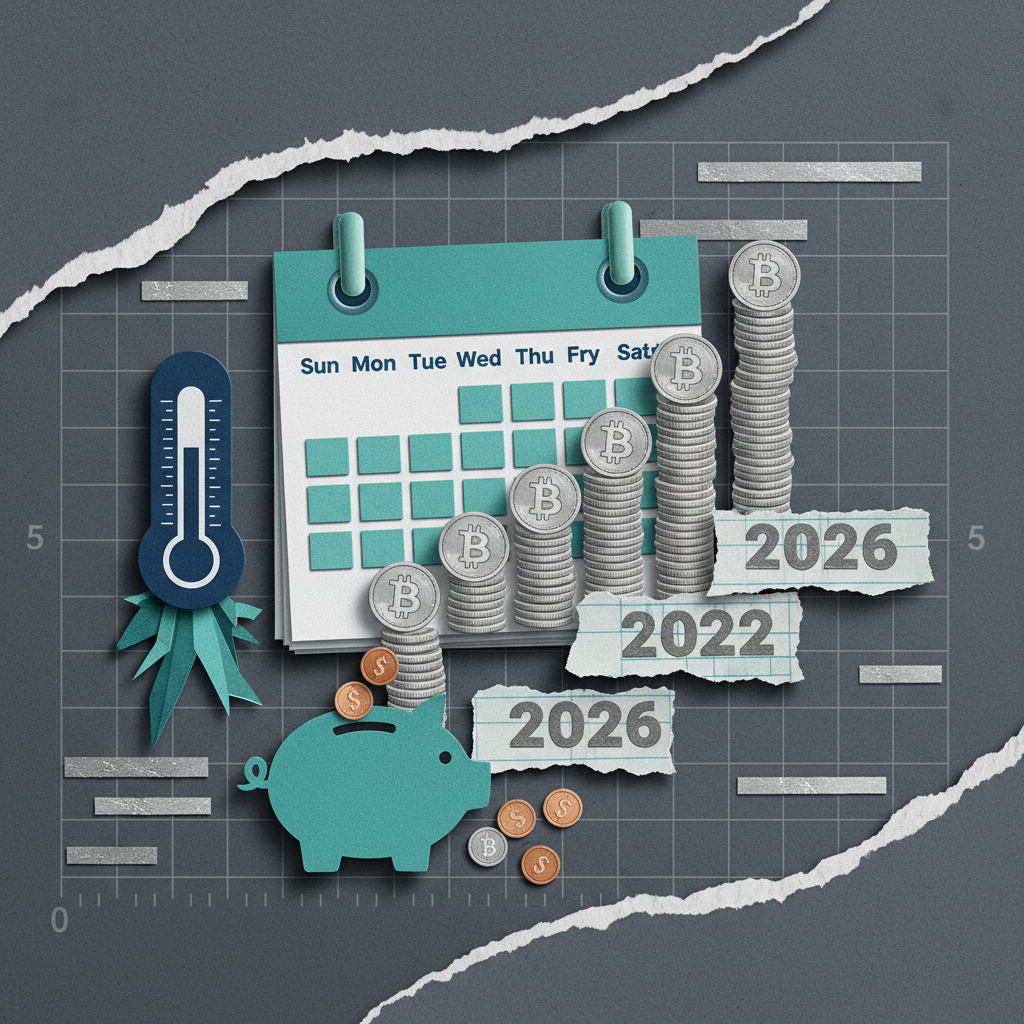
Dollar-cost averaging (DCA) is a systematic investment strategy where a fixed dollar amount is allocated to an asset at regular intervals — weekly, biweekly, or monthly — regardless of its current price. The approach eliminates the psychological burden of market timing by spreading purchases across multiple price points, effectively smoothing out volatility over extended periods. According to backtest data compiled by Spoted Crypto, a simple $10-per-week Bitcoin DCA initiated in 2019 turned a $2,610 total investment into $7,913 by 2024 — a 202% return that outperformed gold (+34.47%), Apple stock (+79.13%), and the Dow Jones Industrial Average (+23.43%) over the same period. The strategy becomes particularly compelling during extreme fear markets: historical data shows that initiating DCA when the Fear & Greed Index drops below 10 has consistently produced 12-month forward returns between +150% and +200%. In today's environment, where extreme fear has persisted for an unprecedented 59 consecutive days, DCA offers a rules-based framework to capitalize on depressed valuations.
Current Market Snapshot: Why Fear Equals Opportunity
The crypto market is experiencing one of its most prolonged periods of extreme pessimism on record. As of April 1, 2026, the Fear & Greed Index sits at 8 out of 100 according to Alternative.me — marking 59 consecutive days below 25 and representing the longest sustained fear streak since the FTX collapse in November 2022. Total crypto market capitalization stands at $2.44 trillion with Bitcoin dominance at 56.3%, signaling a classic risk-off rotation where capital consolidates into BTC while altcoins suffer disproportionate drawdowns.
Derivatives data reinforces this bearish positioning across global exchanges. Negative funding rates on Binance BTC perpetuals (-0.0005%) and SOL perpetuals (-0.0006%) confirm that leveraged traders are positioning defensively, with CryptoValleyJournal reporting $312 million in liquidations on March 29 alone. The Kimchi premium — a widely watched gauge of Asian retail sentiment measuring the price differential between Korean and global exchanges — has flipped negative to -0.61%, indicating that even traditionally bullish retail participants across Asia are retreating from risk assets.
But here's what history reveals: every comparable fear event has preceded massive recoveries. During the COVID crash of March 2020, the index hit 8 with Bitcoin at $4,900 — within six months it surged 133%. After the FTX collapse drove the index to 10 with BTC at $16,000, the asset recovered 350% to reach $73,000 within 16 months. The pattern is unmistakable: extreme fear has been the single most reliable contrarian buy signal in crypto history.
“If you believe crypto will go up in the long run, dollar-cost averaging makes it so that you don’t have to time the market,” states Fidelity Investments in its digital assets education series. The firm simultaneously cautions that DCA “may only make sense if you are confident the asset you’re investing in will go up in the long run” — a critical reminder that the strategy amplifies conviction, not certainty.
| Strategy | Period | Total Invested | Final Value | Return |
|---|---|---|---|---|
| Weekly DCA ($10/wk) | 5 Years (2019–2024) | $2,610 | $7,913 | +202% |
| Fear-Based DCA | 7 Years (2018–2025) | Variable | — | +1,145% |
| Monthly DCA ($100/mo) | 12 Years (2014–2026) | $14,600 | $994,950 | +6,712% |
| Buy & Hold (Lump Sum) | 7 Years (2018–2025) | Lump sum | — | +1,046% |
DCA Backtest Returns — Real Data Across 5, 7, and 12-Year Periods
Backtesting is the gold standard for evaluating any investment strategy, and Bitcoin DCA produces some of the most compelling risk-adjusted returns in financial history. Over a five-year window from 2019 to 2024, investing just $10 per week — a total outlay of $2,610 — generated a portfolio worth $7,913, delivering a 202.03% return according to dcabtc.com backtest data. Scale that discipline to a 12-year horizon from 2014 to 2026, with $100 monthly contributions totaling $14,600, and the result is extraordinary: a portfolio valued at $994,950, representing a 6,712% return as documented by Spoted Crypto’s long-term DCA analysis. These figures are not hypothetical projections — they are calculated from actual historical Bitcoin prices using consistent, automated purchasing. What makes this data particularly relevant today is that the current extreme fear environment mirrors the conditions that preceded Bitcoin’s most explosive recovery periods, suggesting that DCA initiated now could capture similar asymmetric upside.
Five-Year Performance: Bitcoin DCA vs. Traditional Assets
The five-year comparison starkly illustrates why Bitcoin has become the highest-performing DCA asset in modern portfolio history. While a $10 weekly DCA into Bitcoin between 2019 and 2024 returned 202.03%, the same strategy applied to gold — traditionally considered the ultimate safe-haven asset — returned just 34.47%. Even Apple, one of the best-performing equities of the past decade, achieved only 79.13% through DCA over the same window. The Dow Jones Industrial Average, representing broad U.S. market exposure, managed a modest 23.43%.
| Asset | DCA Strategy | Period | Total Invested | Return |
|---|---|---|---|---|
| Bitcoin (BTC) | $10/week | 2019–2024 | $2,610 | +202.03% |
| Apple (AAPL) | $10/week | 2019–2024 | $2,610 | +79.13% |
| Gold (XAU) | $10/week | 2019–2024 | $2,610 | +34.47% |
| Dow Jones (DJIA) | $10/week | 2019–2024 | $2,610 | +23.43% |
These figures underscore a crucial insight: Bitcoin’s volatility, which deters many investors, is precisely what makes DCA so effective. By purchasing at regular intervals through both peaks and troughs, investors accumulate disproportionately more Bitcoin during drawdowns — the exact periods when most retail participants exit the market entirely. For a deeper breakdown of how crypto DCA compares to traditional asset allocation, the performance gap only widens over longer horizons.
Fear-Based DCA and the Monday Effect
For investors seeking to optimize their DCA further, two tactical variations have produced statistically significant alpha in backtests. The fear-based DCA strategy — which triggers purchases exclusively when the Fear & Greed Index enters extreme fear territory (below 25) — returned 1,145% over seven years from 2018 to 2025, outperforming a simple buy-and-hold approach (1,046%) by 99 percentage points according to Spoted Crypto’s fear-based DCA analysis. This 99-percentage-point alpha is remarkable given that it requires no technical analysis skill — only the discipline to buy when sentiment is at its worst.
The Monday effect provides another optimization layer. According to dcabtc.com seven-year backtest data spanning 2018 to 2025, investors who executed their weekly DCA purchases on Mondays accumulated 14.36% more Bitcoin than those who bought on other weekdays. This aligns with well-documented patterns in traditional equity markets, where weekend news cycles and institutional positioning tend to depress prices at the start of the trading week. For a strategy built on marginal edge compounding over years, a 14.36% accumulation advantage is substantial.
Halving Cycle Returns: Diminishing but Still Significant
Bitcoin’s four-year halving cycle remains the most influential macro driver for DCA investors, though returns have followed a clear diminishing trajectory as the market matures. The 2012 halving produced an astronomical post-halving peak return of +8,858%, fueled by early adopter dynamics and negligible institutional presence. By 2016, that figure contracted to +291% as awareness grew. The 2020 halving delivered +541%, boosted by unprecedented COVID-era monetary stimulus and the first wave of institutional adoption led by firms like Strategy (formerly MicroStrategy) — now holding 714,644 BTC worth over $54 billion according to AmBCrypto.
| Halving Year | Post-Halving Peak Return | Market Context |
|---|---|---|
| 2012 | +8,858% | Early adoption, minimal institutional presence |
| 2016 | +291% | Growing awareness, first wave of institutional interest |
| 2020 | +541% | COVID stimulus, institutional adoption surge |
| 2024 | ~+100% | Market maturation, spot ETF-driven capital flows |
The 2024 halving cycle has so far produced approximately +100% returns — the smallest in Bitcoin’s history. While this may appear underwhelming compared to prior cycles, context matters: a 100% return on an asset with a $1.3 trillion market capitalization represents over $650 billion in new value creation. For DCA investors, the diminishing percentage returns are offset by growing absolute dollar value and increasing institutional legitimacy that reduces the probability of catastrophic drawdowns. As Coinglass derivatives data currently shows — with BTC funding rates at -0.0005% and open interest declining — the market is being delevered, historically a precursor to the next sustainable uptrend that DCA practitioners are uniquely positioned to capture.
What Happens When You Buy at Fear & Greed Index Below 10? A Historical Data Breakdown
The Crypto Fear & Greed Index dropping below 10 has historically marked some of the most profitable entry points in Bitcoin's entire history. According to data compiled by Spoted Crypto research, investors who purchased BTC when the index fell to 10 or below recorded average 12-month returns of +150% to +200%, far exceeding any other asset class over comparable periods. These extreme fear readings — occurring only a handful of times since the index's creation — represent moments when market sentiment is at its most irrational, driven by panic selling, liquidation cascades, and headline-driven capitulation. Yet the data tells a counter-intuitive story: of all instances where the index dropped to 15 or below, approximately 78% produced positive returns within just 30 days. A hypothetical $100 investment at various sub-15 readings returned anywhere from 127% to 1,220% depending on timing. For investors willing to deploy capital when others are fleeing, extreme fear has consistently functioned as a statistically significant buy signal rather than a warning to stay away.
COVID Crash (March 2020): The Blueprint for Fear-Based Buying
On March 12, 2020, the Fear & Greed Index plunged to 8 as Bitcoin collapsed to $4,900 amid a global pandemic-driven sell-off. Investors who bought at that level saw returns of +133% within just six months, as BTC climbed back above $11,400 by September. The real payoff came 18 months later, when Bitcoin reached its then all-time high of $69,000 in November 2021 — a staggering return of over 1,300% from the panic low. This single data point illustrates why dollar-cost averaging during extreme fear can produce life-changing outcomes for patient investors who commit to a systematic process rather than emotional decision-making.
FTX Collapse (November 2022): Buying When an Exchange Dies
When FTX imploded in November 2022, the index hit 10 and Bitcoin cratered to $16,000. The prevailing narrative suggested crypto might never recover from such a catastrophic trust violation. Yet investors who began accumulating at those levels witnessed BTC reach $73,000 within 16 months — a 350% recovery that rewarded contrarian positioning over consensus panic. A $100 investment at the FTX bottom would have grown to $456 by March 2024, outperforming virtually every traditional asset over the same window.
The Terra/Luna Warning: Extreme Fear Does Not Guarantee Instant Recovery
Not every extreme fear reading produces an immediate bounce. In June 2022, following the Terra/Luna collapse, the index dropped to 6 — one of the lowest readings ever recorded at the time. However, Bitcoin declined an additional 4.5% before finding its floor weeks later. Investors who bought at that exact reading still achieved substantial long-term gains (peaking at +263% by March 2024), but the path included further drawdown and months of sideways consolidation. This case serves as a critical reminder: extreme fear identifies high-probability accumulation zones, not precise bottoms. The distinction matters for position sizing and psychological preparedness.
Historical Extreme Fear Entry Points: Full Performance Comparison
| Event | Date | Fear Index | BTC Entry Price | 6-Month Return | Peak Return | Time to Peak |
|---|---|---|---|---|---|---|
| COVID Crash | Mar 2020 | 8 | $4,900 | +133% | +1,308% | 20 months |
| Terra/Luna Collapse | Jun 2022 | 6 | $20,100 | -17% | +263% | 21 months |
| FTX Collapse | Nov 2022 | 10 | $16,000 | +75% | +356% | 16 months |
| 2026 Extreme Fear | Apr 2026 | 8 | $68,578 | TBD | TBD | TBD |
Sources: CoinGlass, Spoted Crypto, Binance historical data
André Dragosch, Head of Research Europe at Bitwise, reinforces the statistical significance of these patterns: "The Crypto Fear & Greed Index has historically generated consistent alpha signals rather than noise." His team's analysis shows that systematic buying exclusively during extreme fear periods outperformed buy-and-hold strategies by 99 percentage points over a seven-year backtest from 2018 to 2025, delivering 1,145% cumulative returns versus 1,046% for passive holders — according to Spoted Crypto's backtest analysis.
The pattern across every historical episode is unmistakable but demands iron discipline. Extreme fear readings below 10 have preceded every major Bitcoin rally in the last six years. The question investors face is never whether the market will recover — historically, it always has — but whether they can withstand the psychological pressure of buying when every headline screams to sell.
Why April 2026 May Be the Ideal DCA Entry Point — And the Risks You Cannot Ignore
With the Crypto Fear & Greed Index sitting at 8 out of 100 as of April 1, 2026, the market has entered territory previously seen only during the COVID crash of March 2020 and the FTX collapse of November 2022. According to Crypto Valley Journal, this marks the 59th consecutive day below 25 — the longest sustained period of extreme pessimism since FTX's implosion. Bitcoin trades at $68,578 on Binance, having bounced 3.3% in 24 hours, yet derivatives data from CoinGlass reveals persistent bearish positioning with BTC perpetual funding rates at -0.0005% and $312 million in leveraged positions liquidated on March 29 alone. The divergence between recovering price action and deeply negative sentiment creates what contrarian strategists call a "fear discount" — a structural window where dollar-cost averaging can systematically convert widespread panic into long-term portfolio gains, provided investors understand the very real risks accompanying such volatile conditions.
The Bull Case: Smart Money Is Accumulating Aggressively
Several of the most prominent voices in crypto and institutional finance are positioning for significant upside from current levels. Arthur Hayes, co-founder of BitMEX, has stated his conviction publicly: "Obviously, I believe [Bitcoin will reach $200,000] in 2026... Dollar liquidity must expand for that to happen." His thesis rests on expected monetary expansion as central banks worldwide respond to decelerating economic growth with renewed stimulus measures.
Cathie Wood, CEO of ARK Invest, has offered a complementary macro outlook that supports the same directional bet: "Lots of hope for 2026... but if we are right, growth will be much stronger. And most importantly, inflation will be much, much lower than it has been with tariffs." If ARK's deflationary thesis proves correct, real returns on risk assets — including Bitcoin — could dramatically exceed current market expectations.
The institutional accumulation data reinforces these projections with hard numbers. Strategy (formerly MicroStrategy) now holds 714,644 BTC acquired at an average cost of $74,997 per coin, representing a total investment of approximately $54.4 billion according to AMBCrypto. With Bitcoin currently trading below Strategy's average cost basis, the company continues buying — signaling deep institutional conviction that current prices represent genuine value.
The Risk Factors: Why DCA Discipline Matters More Than Timing
Bullish conviction must be tempered by rigorous risk assessment. The $312 million liquidation cascade on March 29 demonstrated that leverage remains dangerously elevated across derivatives markets. Bitcoin's correlation with the S&P 500 has climbed to 0.74 — its highest level of the year — meaning a broader equity sell-off could drag crypto prices lower regardless of favorable on-chain fundamentals. Macroeconomic headwinds including tariff uncertainty, shifting central bank policy, and escalating geopolitical tensions create additional downside vectors that no amount of technical analysis can reliably predict.
Critically, the Fear & Greed Index reaching a record low of 5 on February 6, 2026 did not mark the absolute bottom. Prices continued to fluctuate for weeks afterward, echoing the Terra/Luna episode of June 2022 when the index hit 6 but Bitcoin dropped another 4.5% before recovering. Extreme fear identifies the zone, not the precise floor — and the difference can cost impatient investors dearly.
This is precisely why DCA outperforms lump-sum timing attempts during volatile markets. Rather than staking everything on calling the exact bottom, dollar-cost averaging transforms the entire extreme fear zone into a discounted buying opportunity. A seven-year backtest from 2018 to 2025 showed that fear-based DCA strategies returned 1,145%, outperforming even buy-and-hold by 99 percentage points. The strategy's true strength is psychological: it replaces the impossible task of perfectly timing the bottom with a systematic, repeatable process that consistently captures value from others' panic — turning the market's most terrifying moments into a disciplined investor's greatest advantage.
DCA Practical Setup Guide — Optimizing Amount, Frequency & Asset Allocation
Dollar-cost averaging is only as effective as its calibration — the right amount, frequency, and asset mix determine whether a DCA strategy delivers mediocre returns or market-beating performance. Backtesting data from dcabtc.com spanning 2018–2025 reveals that weekly DCA into Bitcoin outperformed both daily and monthly intervals, with Monday purchases accumulating 14.36% more BTC than any other day of the week. A fear-accelerated DCA model — doubling buys when the Fear & Greed Index drops below 25 and tripling below 15 — generated 1,145% returns over seven years, outpacing simple buy-and-hold by 99 percentage points according to Spoted Crypto analysis. With the index at just 8/100 as of April 1, 2026 — matching COVID-crash lows — optimizing DCA parameters has never been more consequential. This section breaks down the exact settings, allocation ratios, and compounding mechanics that maximize risk-adjusted returns during sustained pessimism.
Investment Amount — The 5–10% Income Rule
The foundational principle of sustainable DCA is position sizing. Crypto-native funds and traditional financial advisors converge on the same guideline: allocate no more than 5–10% of monthly disposable income to cryptocurrency purchases. This ensures that even a prolonged drawdown — such as the current 59-day streak of Extreme Fear readings — does not jeopardize essential expenses or emergency reserves. At BTC's current price of $68,578 on Binance, a $50 weekly DCA accumulates approximately 0.038 BTC annually. The golden rule remains: only invest capital you can afford to lose entirely without altering your lifestyle.
Frequency Showdown — Daily vs. Weekly vs. Monthly
Backtesting across multiple market cycles consistently favors weekly DCA as the optimal frequency. Seven-year data from dcabtc.com shows that weekly Monday purchases accumulated 14.36% more Bitcoin than other weekday entries — likely because weekend sell-offs create marginally lower Monday opening prices. Daily DCA offers slightly better volatility smoothing but incurs significantly higher transaction fees on most exchanges. Monthly DCA, while simplest to automate, exposes investors to intra-month timing risk: a single bad entry day can skew an entire month's cost basis. For investors executing a DCA strategy during extreme fear periods, weekly frequency strikes the ideal balance between cost efficiency and fee minimization.
Asset Allocation & Staking Compounding
A balanced DCA portfolio should reflect both market dominance and yield potential. With BTC dominance at 56.3% and ETH dominance at 10.6% as of April 2026, a core-satellite model of BTC 60% / ETH 25% / Altcoins (SOL) 15% aligns portfolio weights with market structure while capturing asymmetric upside. The altcoin sleeve — currently favoring SOL at $83 — adds high-beta exposure during recovery rallies. Crucially, staking transforms DCA from a pure price-appreciation play into a compounding engine. ETH staking yields approximately 3.1% APY, while SOL delivers 6.2% APY — rising to 7–9% with Jito MEV boost strategies. Over a five-year DCA horizon, staking compounds can add 15–25% to total portfolio returns before any price appreciation is factored in.
Fear-Based Accelerated DCA — Backtested Alpha
Standard DCA invests a fixed amount regardless of conditions. Accelerated DCA dynamically increases allocation during extreme pessimism — and the data overwhelmingly supports this approach. A strategy that doubled the standard buy at Fear & Greed Index below 25 and tripled it below 15 delivered 1,145% cumulative returns from 2018 to 2025, versus 1,046% for passive buy-and-hold. With the index at 8/100 on April 1, 2026 — matching the COVID crash when BTC traded at $4,900 before surging 133% within six months — the accelerated model is currently triggered at its maximum 3× multiplier. Historical precedent from the FTX collapse recovery reinforces this: BTC rallied 350% from similar fear levels, reaching $73,000 within 16 months.
| Strategy | Frequency | Allocation | Cumulative Return | Notes |
|---|---|---|---|---|
| Standard DCA (Monday) | Weekly | BTC 100% | +202% (2019–2024) | 14.36% more BTC vs other days — dcabtc.com |
| Standard DCA | Daily | BTC 100% | ~+196% (2019–2024) | Better smoothing, higher cumulative fees |
| Standard DCA | Monthly | BTC 100% | ~+187% (2019–2024) | Simpler but exposed to intra-month timing risk |
| Fear-Accelerated (2×/3×) | Weekly | BTC 100% | +1,145% (2018–2025) | +99pp vs buy-and-hold (1,046%) — Spoted Crypto |
| Diversified + Staking | Weekly | BTC 60 / ETH 25 / SOL 15 | +220–240% est. (5-Year) | Staking adds 15–25%: ETH 3.1% + SOL 6.2–9% APY |
Essential Security Checklist for DCA Investors
A disciplined DCA strategy becomes worthless if accumulated assets are stolen or permanently lost — and the threat landscape in 2026 has never been more dangerous for retail investors. Crypto hacking losses totaled a staggering $3.4 billion in 2025 alone according to Chainalysis, with North Korea's Lazarus Group responsible for $2.02 billion of that figure — a 51% increase year-over-year, bringing cumulative DPRK-linked theft to $6.75 billion. The onslaught has accelerated into 2026, with $112 million stolen in just January and February and phishing attacks surging an alarming 1,400% per CryptoImpactHub data. For DCA investors who methodically build positions over months and years, a single security lapse can erase thousands of dollars in carefully accumulated gains within seconds. The catastrophic Bybit breach of February 2025 — the largest hack in cryptocurrency history at $1.5 billion — proved that even institutional-grade infrastructure is vulnerable when human factors are exploited through sophisticated social engineering campaigns.
The Bybit Breach — A $1.5 Billion Wake-Up Call
On February 21, 2025, North Korea's Lazarus Group executed the largest cryptocurrency heist ever recorded — an event now officially recognized as a Guinness World Record. The attackers compromised a developer at Safe{Wallet} through a targeted social engineering campaign, gaining access to Bybit's multi-signature Ethereum cold wallet and draining $1.5 billion in a single transaction. The incident exposed a critical reality: human error remains the weakest link regardless of how robust the underlying technical infrastructure may be. For individual DCA investors, the lesson is direct — if a billion-dollar exchange can be breached through one compromised developer, personal security hygiene is absolutely non-negotiable.
Hardware Wallets & Security Innovation in 2026
Self-custody remains the gold standard for protecting long-term DCA portfolios. The 2026 hardware wallet market has introduced a paradigm shift with the Trezor Safe 7 — the world's first hardware wallet to implement post-quantum cryptography (SLH-DSA-128). As quantum computing capabilities accelerate, this proactive defense ensures that seed phrases and private keys remain secure against future quantum-powered brute-force attacks. Ethereum co-founder Vitalik Buterin has repeatedly emphasized the urgency of wallet innovation, stating: "There's also plenty of people who have lost huge amounts of crypto to loss rather than theft" — calling for security solutions that protect users from both external threats and self-inflicted errors (CryptoSlate).
The DCA Investor's 5 Non-Negotiable Security Rules
Every DCA investor should treat security as a core component of their strategy — not an afterthought. First, diversify holdings across at least two major exchanges to eliminate single-point-of-failure risk after what Bybit's users experienced. Second, enable hardware-based two-factor authentication using a YubiKey or similar device — SMS-based 2FA is trivially compromised via SIM-swap attacks. Third, store seed phrases exclusively offline on steel backup plates (Cryptosteel, Billfodl), never in cloud storage or screenshots. Fourth, verify every exchange URL manually before logging in; the 1,400% spike in phishing attacks makes this a daily survival skill. Fifth, schedule regular withdrawals from exchanges to cold storage — a quarterly transfer aligns naturally with DCA portfolio rebalancing cycles. As the $312 million in leveraged liquidations on March 29, 2026 demonstrated, protecting your accumulated position matters just as much as building it.
| Priority | Security Practice | Why It Matters | Recommended Tool / Action |
|---|---|---|---|
| 1 | Exchange Diversification | Bybit's $1.5B breach proved single-exchange risk | Split across 2–3 CEXs (Binance, OKX, Kraken) |
| 2 | Hardware 2FA (Not SMS) | SIM-swap attacks bypass SMS verification | YubiKey 5 NFC or Google Titan key |
| 3 | Seed Phrase Offline Storage | Cloud/photo backups are top phishing targets | Steel plate backup (Cryptosteel, Billfodl) |
| 4 | Phishing URL Verification | 1,400% phishing surge in early 2026 | Bookmark exchange URLs; never click email links |
| 5 | Regular Withdrawal to Cold Storage | Long-term DCA holdings shouldn't sit on exchanges | Trezor Safe 7 (post-quantum) or Ledger Stax |
DCA Investor Outlook: Key Catalysts and Exit Strategies for Late 2026
Quick Answer: With the Fear & Greed Index at 8/100 — the deepest pessimism since the FTX collapse — historical data shows 12-month forward returns of +150% to +200% from similar levels. The Bitcoin halving cycle, dollar liquidity dynamics, and disciplined DCA exit strategies converge to create a compelling setup for systematic investors in H2 2026.
The second half of 2026 sits at a rare intersection of macro catalysts and on-chain cycle dynamics that every dollar-cost averaging investor should evaluate carefully. Bitcoin currently trades at $68,578 on Binance, up 3.3% in 24 hours yet still deep in an extreme fear regime — 59 consecutive days below 25 on the Fear & Greed Index, the longest such stretch since November 2022. Negative funding rates on BTC perpetuals (-0.0005%) confirm that short sellers dominate the derivatives market, a contrarian signal that has historically preceded major reversals. Disciplined DCA practitioners who maintained their weekly allocations through the COVID crash (index at 8, BTC at $4,900) captured 133% gains within six months and saw all-time highs within 18 months. The question facing investors now is not whether to continue accumulating, but how to position for the catalysts ahead.
Macro Catalysts: Dollar Liquidity and the Halving Cycle
Arthur Hayes, co-founder of BitMEX, has set a bold $200,000 Bitcoin price target for 2026 — but with a critical prerequisite. "Obviously, I believe [Bitcoin will reach $200,000] in 2026… Dollar liquidity must expand for that to happen," Hayes stated, as reported by Spoted Crypto. This liquidity thesis dovetails with the Bitcoin halving cycle framework: the April 2024 halving historically triggers peak price appreciation 12 to 18 months post-event, placing the window squarely in Q4 2025 through Q2 2026. During the previous cycle, BTC surged from roughly $10,000 at the May 2020 halving to $69,000 by November 2021 — a 590% gain within that same timeframe.
Meanwhile, ARK Invest CEO Cathie Wood projects that resolution of ongoing tariff disputes could unlock significantly stronger economic growth, with inflation dropping well below recent elevated levels, according to TheStreet. A disinflationary environment with expanding liquidity is the exact macro cocktail that has fueled every major Bitcoin rally since 2016.
Ethereum's Structural Shift and Ecosystem Evolution
Beyond Bitcoin, Ethereum co-founder Vitalik Buterin has declared 2026 "the year that we take back lost ground in terms of self-sovereignty and trustlessness," as reported by The Block. With ETH at $2,132 and showing 5.3% daily gains, this philosophical recommitment to decentralization could drive meaningful development changes — from wallet-level security improvements to reduced reliance on centralized infrastructure. For DCA investors allocating across multiple assets, Ethereum's roadmap clarity adds a fundamental layer to the long-term DCA accumulation thesis.
DCA Exit Strategy: When Discipline Means Selling
Accumulation without an exit plan is speculation, not strategy. A robust DCA exit framework includes three pillars:
- Target profit milestones: Set predefined return thresholds (e.g., 100%, 200%, 300%) and execute partial sales at each level — locking in gains while preserving upside exposure.
- Staged distribution: Sell in tranches of 10–20% rather than liquidating entire positions. Seven-year backtesting data (2018–2025) shows fear-based DCA strategies delivered 1,145% returns — outperforming buy-and-hold by 99 percentage points, according to Spoted Crypto research.
- Sentiment-based trimming: When the Fear & Greed Index exceeds 80 (extreme greed), reduce allocation size or pause entirely. After the FTX collapse at an index reading of 10, BTC recovered 350% over 16 months — but investors who held through the subsequent greed phase often gave back gains.
The current market — with $312 million in leveraged liquidations on March 29 alone and the deepest pessimism since FTX — is precisely the environment where disciplined DCA investors build generational positions. Extreme fear has never lasted forever. Every index reading below 10 in Bitcoin's history has been followed by triple-digit percentage gains within 12 months. The investors who succeed are not those who predict the bottom, but those who systematically accumulate through it.
Frequently Asked Questions
Is Dollar-Cost Averaging (DCA) Better Than Lump-Sum Investing in Crypto?
Historical backtests show lump-sum investing can deliver slightly higher absolute returns in sustained bull markets, but DCA dramatically reduces volatility risk and psychological stress — two factors that cause most retail investors to fail. The difference becomes stark during periods of extreme fear: a fear-based DCA strategy that only bought during extreme pessimism returned 1,145% over seven years (2018–2025), outperforming a simple buy-and-hold approach at 1,046% by nearly 100 percentage points. DCA removes the impossible burden of timing the market perfectly and converts volatility from an enemy into an ally by automatically purchasing more units when prices are depressed. For beginners, salaried workers, or anyone who cannot monitor charts around the clock, DCA is the overwhelmingly recommended approach — it enforces discipline and sidesteps the emotional decision-making that leads to buying tops and panic-selling bottoms.
Does Buying When the Fear & Greed Index Is Low Actually Generate Profits?
History strongly favors contrarian buyers during extreme fear, but immediate rebounds are never guaranteed. When the Fear & Greed Index drops to 10 or below, subsequent 12-month returns have historically ranged between +150% and +200%, according to data compiled by Spoted Crypto. The pattern repeated after the COVID crash in March 2020 — the index hit 8, Bitcoin traded at $4,900, and within six months it surged +133%. Following the FTX collapse in November 2022, the index fell to 10 with BTC at $16,000; sixteen months later it reached $73,000, a 350% recovery. However, events like the Terra/Luna implosion remind us that capitulation can deepen before reversal, which is precisely why splitting entries via DCA — rather than deploying capital all at once — remains critical during fear-driven markets. As of March 30, 2026, the index sat at just 8 out of 100, marking 59 consecutive days below 25, the longest streak of pessimism since the FTX collapse, according to Crypto Valley Journal.
What Is the Optimal DCA Frequency and Best Day of the Week to Buy Bitcoin?
A seven-year backtest (2018–2025) conducted via dcabtc.com found that weekly purchases strike the best balance between cost-averaging efficiency and transaction-fee overhead. Among individual days, Monday buyers accumulated 14.36% more BTC than those purchasing on other weekdays — likely because weekend sell-offs and low-liquidity dips tend to depress Sunday-to-Monday prices. That said, the marginal advantage of any single day pales in comparison to the discipline of simply showing up consistently. When exchange fees are factored in, a once-per-week or biweekly cadence is the most practical schedule; daily purchases can erode gains through compounding transaction costs, particularly on platforms with flat minimum fees. The core takeaway from every backtest is the same: frequency and consistency matter far more than trying to pick the perfect entry point.
Can Small Amounts Like $35 per Month Still Make DCA Worthwhile?
Absolutely — and the data is striking. A five-year DCA backtest (2019–2024) investing just $10 per week (roughly $43/month) turned a total outlay of $2,610 into $7,913.20, a 202.03% return — dwarfing gold (+34.47%), Apple stock (+79.13%), and the Dow Jones (+23.43%) over the same period. Scaling that to $35 per month over five years means $2,100 invested, which at similar historical rates could compound meaningfully thanks to Bitcoin's asymmetric upside profile. The critical variable is consistency, not size: the compounding effect of dollar-cost averaging works by steadily lowering your average purchase price through both rallies and drawdowns. Before starting, check your exchange's minimum order size and fee structure — most major platforms like Binance and Coinbase now support purchases as low as $1–$5, making micro-DCA entirely viable. Over a 12-year horizon, $100/month DCA from January 2014 turned $14,600 into $994,950 — a 6,712% return that proves time in market beats timing the market.
Data Sources
- Spoted Crypto — DCA Backtesting Guide 2026: Bitcoin $10/week 5-year DCA performance data (202.03% return)
- Spoted Crypto — DCA Strategy Guide (Part 3): 12-year $100/month DCA results (6,712% return)
- Spoted Crypto — DCA Strategy Guide 2026: Fear-based DCA strategy 7-year performance (1,145% vs 1,046%)
- Spoted Crypto — DCA Strategy Guide 2026 (Part 2): Fear & Greed Index sub-10 historical returns (+150–200%)
- Spoted Crypto — Bitcoin Fear & Greed 46+ Days Extreme: COVID crash and FTX collapse recovery data
- Crypto Valley Journal: Fear & Greed Index at 8, 59-day sub-25 streak (March 2026)
- dcabtc.com: 7-year DCA backtest by day-of-week, Monday +14.36% BTC accumulation advantage
This article is for informational purposes only and does not constitute investment advice. All investment decisions should be made based on your own judgment and responsibility.
Related Articles
- Crypto DCA Strategy Guide: How to Maximize Returns During Extreme Fear Markets
- The Complete Crypto DCA Guide — 202% Returns Over 5 Years, Backed by Data
- Crypto DCA Strategy Guide 2026: How Dollar-Cost Averaging Returned 202% in Extreme Fear Markets
- Crypto DCA + Staking Guide: How to Maximize Returns with Dollar-Cost Averaging & Staking (2026)
- Crypto DCA Strategy Guide: How Dollar-Cost Averaging Returned 202%–6,712% in Bear Markets