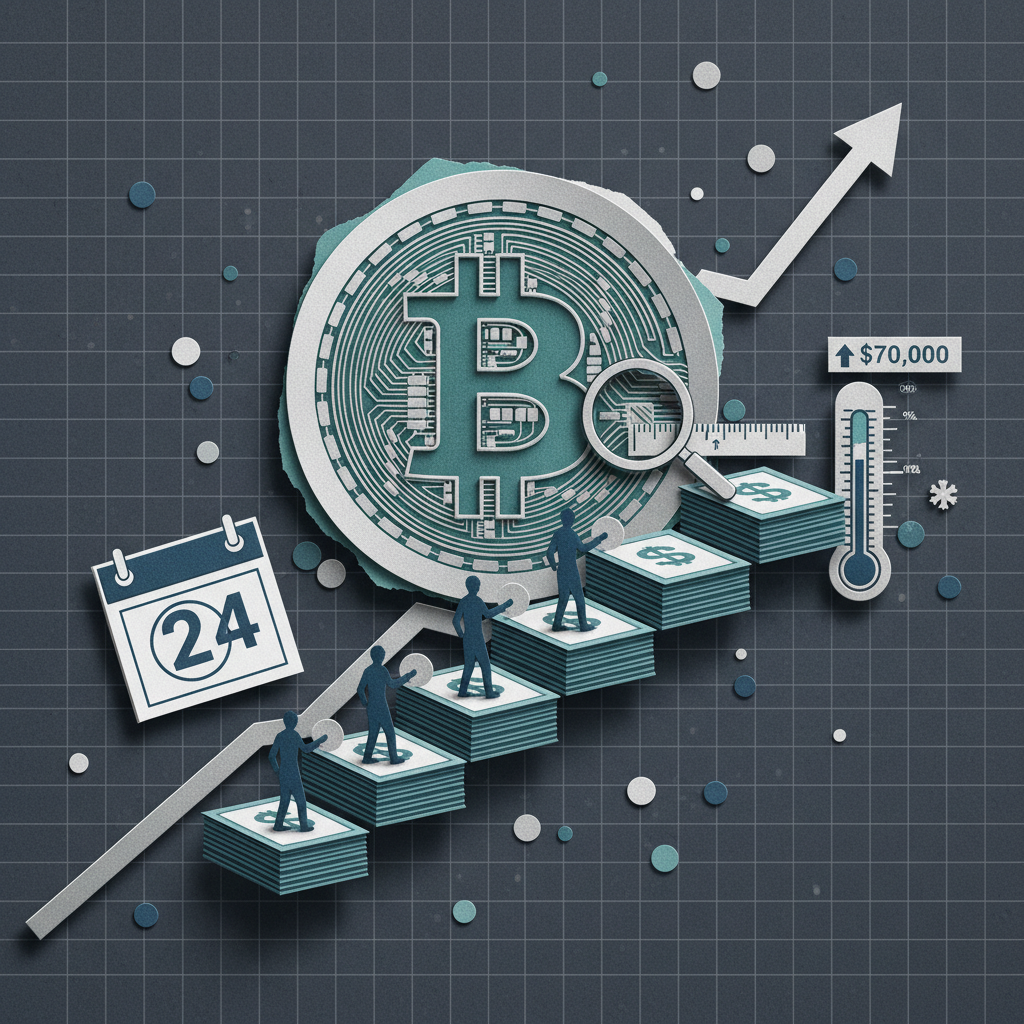
Bitcoin has lost over 48% from its October 2025 all-time high of $126,000, and the Fear & Greed Index just plunged to 9 out of 100 — the deepest extreme-fear reading since the FTX collapse. Yet historically, these moments of maximum pain have produced the most extraordinary DCA returns. This guide breaks down exactly how a simple dollar-cost averaging strategy turned $2,610 into $7,913 and why the current panic may be the buying opportunity of the cycle.
What Is Crypto Dollar-Cost Averaging (DCA)? The Secret Behind 202% Returns Over 5 Years
Quick Answer: Dollar-cost averaging (DCA) is a strategy of investing a fixed amount into crypto at regular intervals regardless of price. A $10/week Bitcoin DCA over five years returned 202%, turning $2,610 into $7,913.20. With the Fear & Greed Index at 9/100 — the longest extreme-fear streak since FTX — historical data suggests 150–200% recoveries within 12 months of similar readings.
Dollar-cost averaging (DCA) is an investment strategy in which a fixed dollar amount is deployed into an asset at consistent intervals — weekly, biweekly, or monthly — regardless of the prevailing market price. According to data from dcabtc.com, a simple $10-per-week Bitcoin DCA executed over five years (2019–2024) transformed a total outlay of $2,610 into $7,913.20, delivering a 202.03% return. The mechanism behind those gains is mechanical: by purchasing at every price point across a full cycle, the investor's average cost basis gravitates toward the geometric mean rather than an unlucky single entry point. In a market where Bitcoin has experienced drawdowns exceeding 50% in four separate cycles, that averaging effect is the difference between panic-selling at a loss and compounding through volatility toward outsized long-term returns.
DCA vs. Lump-Sum Investing: How Averaging Saved 33% in the 2022 Crash
The practical superiority of DCA becomes starkest during drawdowns. During the 2022 bear market triggered by the Terra-Luna implosion and FTX collapse, investors who dollar-cost averaged into Bitcoin achieved a mean entry price of approximately $35,000 per BTC. By contrast, those who deployed capital in a single lump sum near the cycle top locked in an average cost basis around $43,000 — a 23% higher entry that took an additional six months to recover from, according to Spoted Crypto analysis. That $8,000-per-coin gap illustrates why DCA is not merely a conservative tactic but a structurally advantageous one in high-volatility asset classes.
12-Year DCA: Turning $14,600 Into Nearly $1 Million
Extending the time horizon amplifies the effect dramatically. A $100-per-month Bitcoin DCA running from January 2014 through early 2026 — a total investment of $14,600 — grew to approximately $994,950, representing a 6,712% gain according to Spoted Crypto research. That return dwarfs every traditional benchmark over the same period. With 68% of institutional investors now allocating to Bitcoin exchange-traded products per ainvest, and BlackRock's IBIT ETF alone holding approximately 771,000 BTC worth $86 billion as reported by Bitcoin.com News, the structural demand floor under Bitcoin continues to rise — making consistent accumulation more compelling than ever for retail investors building long-term positions alongside institutions. For a deeper look at advanced DCA techniques and fear-based buying strategies, we cover optimized timing models later in this guide.
| Asset | Strategy | Period | Total Invested | Final Value | Return |
|---|---|---|---|---|---|
| Bitcoin (BTC) | $10/week DCA | 5 Years (2019–2024) | $2,610 | $7,913 | +202.03% |
| Apple (AAPL) | $10/week DCA | 5 Years (2019–2024) | $2,610 | $4,675 | +79.13% |
| Gold (XAU) | $10/week DCA | 5 Years (2019–2024) | $2,610 | $3,510 | +34.47% |
| Dow Jones (DJI) | $10/week DCA | 5 Years (2019–2024) | $2,610 | $3,221 | +23.43% |
| Bitcoin (BTC) | $100/month DCA | 12 Years (2014–2026) | $14,600 | $994,950 | +6,712% |
Fear & Greed Index at 9: Why Now May Be the Optimal DCA Entry Point
The Crypto Fear & Greed Index sits at 9 out of 100 as of March 29, 2026 — deep inside the "Extreme Fear" zone and just three points above the absolute floor hit during the FTX bankruptcy in November 2022. According to Bitcoin Magazine, this marks the 46th consecutive day in extreme-fear territory, the longest sustained fear streak since the post-FTX period. Bitcoin trades at approximately $66,668 on Coinglass data, with perpetual funding rates on Binance printing negative across every major asset — BTC at −0.0000%, ETH at −0.0037%, and SOL at −0.0232% — signaling that short sellers dominate the derivatives market. Historically, these conditions of maximum pessimism and negative funding have preceded the most powerful reversals, making a compelling statistical case that systematic DCA initiated during extreme fear generates outsized forward returns.
The Historical Playbook: What Happens After Sub-10 Fear Readings
History offers a remarkably consistent pattern. When the Fear & Greed Index drops below 10, Bitcoin has delivered returns of +150% to +200% within the following 12 months, according to Spoted Crypto historical analysis. The most dramatic recent example: after the FTX collapse pushed the index to approximately 10 in November 2022, Bitcoin was trading near $16,000. Within 16 months, it surged to $73,000 — a staggering 350% recovery. A contrarian DCA strategy — buying only during weeks when the index registered extreme fear — returned 1,145% over seven years (2018–2025), outperforming a simple buy-and-hold approach that returned 1,046% over the same period, a 99-percentage-point edge as documented by Spoted Crypto's backtest data.
"Volatility is Satoshi's gift to the faithful." — Michael Saylor, Executive Chairman, MicroStrategy, via Benzinga. Saylor has consistently advocated for a minimum four-year investment horizon, stating that ten years is "really the right timeframe" for Bitcoin conviction.
Current Market Signals: Derivatives and Dominance Paint a Bottoming Picture
Beyond the Fear & Greed Index, multiple on-chain and derivatives signals align with historical bottoming patterns. Negative funding rates across BTC, ETH, SOL, XRP, and DOGE on Binance indicate the futures market is overwhelmingly positioned short — a condition that typically precedes short-squeeze rallies as overleveraged bears are liquidated. BTC dominance stands at 56.0%, up from the 39% levels seen during the 2021 altcoin frenzy, mirroring the classic pattern where capital concentrates into Bitcoin before eventually rotating into altcoins during recovery phases. The total crypto market cap of $2.38 trillion, while down sharply from highs, still reflects vastly deeper liquidity than previous cycle lows. Steven McClurg, CEO of Canary Capital, expects 2026 to represent the bear leg of Bitcoin's four-year cycle — precisely the phase where disciplined DCA investors have historically built the positions that generated life-changing returns. For investors exploring a comprehensive crypto DCA guide for 2026, the confluence of extreme fear, negative funding, and historical recovery patterns makes a data-driven case for systematic accumulation.
| Extreme Fear Event | Fear Index Low | BTC Price at Low | BTC Price 12 Months Later | Recovery |
|---|---|---|---|---|
| COVID Crash (Mar 2020) | 8 | $4,800 | $58,000 | +1,108% |
| China Mining Ban (Jun 2021) | 10 | $29,000 | $47,000 | +62% |
| FTX Collapse (Nov 2022) | 10 | $16,000 | $43,000 | +169% |
| FTX → 2024 Halving Rally | 10 | $16,000 | $73,000 (16 mo.) | +350% |
| Current (Mar 2026) | 9 | $66,668 | ? | Historical avg: +150–200% |
What Is the Best Day and Amount for Bitcoin DCA?
Quick Answer: Backtesting from 2018–2025 shows Monday DCA buyers accumulated 14.36% more BTC than other weekday buyers. Allocating 5–10% of disposable income weekly — never more than you can afford to lose — optimizes both dollar-cost averaging returns and psychological resilience during drawdowns like the current extreme fear market.
Choosing the right day and amount for Bitcoin dollar-cost averaging is not guesswork — it is a data-driven decision that can meaningfully impact long-term accumulation. According to dcabtc.com, investors who consistently purchased Bitcoin every Monday between 2018 and 2025 accumulated 14.36% more BTC than those buying on other weekdays. This "Monday effect" likely stems from weekend sell-offs and lower liquidity creating marginally better entry prices at the start of the trading week. With the Fear & Greed Index sitting at just 9/100 as of March 29, 2026 — deep in extreme fear territory for 46 consecutive days — disciplined DCA scheduling matters more than ever. The difference between systematic and emotional buying can compound into six-figure portfolio gaps over a full market cycle.
Weekly vs. Monthly vs. Daily DCA: Frequency Breakdown
Each DCA frequency carries distinct tradeoffs. Weekly DCA strikes the optimal balance for most investors: it captures enough price variation to smooth volatility effectively while keeping transaction costs manageable. The 2019–2024 backtest on dcabtc.com showed $10/week DCA turning $2,610 into $7,913.20 — a 202.03% return that outperformed gold (+34.47%), Apple stock (+79.13%), and the Dow Jones (+23.43%) over the same period.
Daily DCA provides the smoothest cost basis but generates significantly more taxable events and higher cumulative fees — particularly problematic on exchanges charging flat minimums per trade. Monthly DCA minimizes fees and administrative overhead but exposes investors to greater single-entry-point risk: one poorly timed monthly buy during a local peak can drag your average cost basis higher for weeks. For investors navigating the current environment — where BTC trades near $66,668 with funding rates at -0.0000% on Binance signaling neutral derivatives sentiment — weekly Monday purchases offer the strongest risk-adjusted approach.
How Much Should You Invest? The 5–10% Rule
Position sizing for DCA follows a non-negotiable principle: invest only what you can afford to lose entirely. Financial planners widely recommend allocating 5–10% of monthly disposable income to volatile assets like cryptocurrency. For context, consider three practical tiers:
- Conservative ($100/month): Approximately $25/week into BTC. At current prices (~$66,668), this accumulates roughly 0.0195 BTC annually — modest but meaningful over a full halving cycle. Ideal for beginners building conviction.
- Moderate ($300/month): Approximately $75/week. This pace accumulates ~0.0585 BTC per year. Over the 2019–2024 window, this allocation would have grown from $18,000 invested to approximately $54,500 based on the 202% DCA return documented by dcabtc.com.
- Aggressive ($1,000/month): Approximately $250/week. At 56% BTC dominance — a level that mirrors historical patterns where capital concentrates in Bitcoin before altcoin recoveries — allocating 70–80% to BTC and 20–30% to ETH or SOL provides a data-informed split. For more on building a DCA portfolio strategy, our complete breakdown covers allocation models in depth.
BTC-Only vs. Multi-Coin DCA in a 56% Dominance Market
With BTC dominance at 56.0% and ETH dominance at just 10.2%, the current market structure strongly favors Bitcoin-concentrated DCA. Historically, BTC dominance above 55% signals risk-off positioning across crypto — capital is flowing toward the asset with the deepest liquidity and strongest institutional backing. BlackRock's IBIT ETF alone holds approximately 771,000 BTC worth $86 billion, validating Bitcoin as the institutional-grade accumulation target. A practical framework: maintain 70–80% BTC allocation during high-dominance environments, then rotate 10–20% into large-cap altcoins like ETH only when dominance drops below 50% — a signal that historically precedes altcoin outperformance. Review our guide on advanced DCA strategies for bear markets for timing these rotations effectively.
Best Exchanges for DCA in 2026: A Complete Fee Comparison
Selecting the right exchange for dollar-cost averaging is a decision that compounds over years — a 0.10% fee difference across hundreds of recurring purchases can translate to thousands of dollars in saved or wasted capital. In 2026, five major global exchanges dominate the DCA landscape, each offering distinct advantages in fee structures, automation features, and regulatory compliance. According to ainvest, 68% of institutional investors now allocate to Bitcoin exchange-traded products, while retail investors increasingly demand automated recurring-buy functionality — making exchange selection a critical infrastructure decision. With BTC at $66,668 and the Fear & Greed Index at 9/100, the exchanges you choose today will serve as the rails for years of systematic accumulation through what may prove to be a generational buying window.
2026 Exchange Fee Comparison Table
| Exchange | Maker Fee | Taker Fee | Fee Discount | Auto-DCA | Best For |
|---|---|---|---|---|---|
| Binance | 0.10% | 0.10% | 25% with BNB | ✅ Recurring Buy | Lowest base fees, deepest liquidity |
| Bybit | 0.10% | 0.10% | VIP tiers available | ✅ Auto-Invest | Derivatives traders, Asian markets |
| Kraken | 0.16% | 0.26% | Volume-based tiers | ✅ Recurring Buy | US/EU regulatory compliance |
| OKX | 0.08% | 0.10% | OKB holding discounts | ✅ Recurring Purchase | Lowest maker fees, global reach |
| Coinbase | 0.40% | 0.60% | Advanced Trade: 0.05%+ | ✅ Recurring Buy | Beginners, US institutional trust |
Note: Fees shown are base-tier spot trading rates. Coinbase standard buy/sell fees are significantly higher than Advanced Trade rates. Always use limit orders on Advanced Trade or Coinbase Pro equivalents for DCA to minimize costs.
Automated DCA Features: Set It and Forget It
The most effective DCA strategy is one you never have to remember to execute. All five major exchanges now offer automated recurring buy features — but implementation quality varies significantly. Binance Recurring Buy allows daily, weekly, bi-weekly, or monthly purchases across 200+ trading pairs with automatic BNB fee deduction. OKX Recurring Purchase supports multi-asset baskets, letting investors split each buy across BTC, ETH, and SOL in custom ratios — ideal for the multi-coin DCA approach. Coinbase offers the simplest setup for beginners but at materially higher fees unless using Advanced Trade. For investors implementing our recommended weekly Monday DCA strategy, Binance and OKX deliver the best combination of low fees and scheduling flexibility.
Exchange Selection Checklist
Before committing to a DCA exchange for the long term, evaluate these five critical factors:
- Fee structure: Compare effective fees including spread markup, not just listed maker/taker rates. OKX's 0.08% maker fee saves $80 per $100,000 traded versus Coinbase standard.
- Security track record: Proof of reserves, cold storage ratios, and insurance funds. Binance and Kraken publish regular proof-of-reserve audits via third-party firms.
- Regulatory status: With EU MiCA enforcement fully active and US regulatory clarity improving in 2026, choose exchanges operating with proper licensing in your jurisdiction.
- Withdrawal limits and fees: BTC withdrawal fees range from 0.0001 BTC (OKX) to 0.0005 BTC (Coinbase) — a 5x difference that matters for regular self-custody transfers.
- Auto-DCA capabilities: Confirm the exchange supports your desired frequency, trading pairs, and payment methods for seamless recurring purchases.
The Institutional Signal: Why BlackRock's Accumulation Matters for DCA Investors
Retail DCA investors are no longer accumulating alone. BlackRock's iShares Bitcoin Trust (IBIT) amassed approximately 771,000 BTC — worth $86 billion — by the end of 2025, according to Bitcoin.com News. This institutional conviction provides a structural floor for long-term DCA strategies.
"If everybody adopted that conversation [2–5% sovereign wealth fund allocation], it would be $500,000, $600,000, $700,000 for bitcoin."
— Larry Fink, CEO, BlackRock (Bitcoin.com News)
With 68% of institutional investors allocating to Bitcoin ETPs according to ainvest, the convergence of institutional and retail DCA buying creates unprecedented demand-side pressure. For individual investors, this means selecting an exchange that can also facilitate eventual Bitcoin ETP exposure alongside spot DCA — a hybrid approach that balances self-custody with regulated product convenience. Whether you choose Binance for fees, Kraken for compliance, or OKX for flexibility, the key is starting systematic accumulation now while extreme fear prices persist.
Best Hardware Wallets for Securing Your DCA Portfolio in 2026
A hardware wallet is a physical device that stores cryptocurrency private keys entirely offline, shielding long-term DCA holdings from exchange hacks, phishing attacks, and platform insolvencies. According to CoinGlass, centralized exchanges still hold over $120 billion in user-deposited Bitcoin alone — a concentrated risk that the collapses of FTX, Celsius, and Voyager made painfully clear. For investors systematically accumulating crypto through dollar-cost averaging, the question is not whether to self-custody, but when to move funds off-exchange. The two dominant manufacturers — Ledger and Trezor — take fundamentally different approaches to security architecture. Ledger supports over 5,500 digital assets using a proprietary secure element chip rated CC EAL5+, while Trezor covers approximately 1,500 assets with a fully open-source firmware stack that any developer can audit. Choosing between them depends on your portfolio composition, transparency preferences, and whether you plan to run a long-term DCA strategy across multiple altcoins or concentrate primarily on Bitcoin and Ethereum.
Ledger vs Trezor: 5-Model Comparison for DCA Investors
| Model | Price (MSRP) | Supported Assets | Security Chip | Display | Connectivity | Best For |
|---|---|---|---|---|---|---|
| Ledger Nano S Plus | $79 | 5,500+ | CC EAL5+ (ST33K1M5) | 128×64 OLED | USB-C | Budget DCA investors |
| Ledger Nano X | $149 | 5,500+ | CC EAL5+ (ST33K1M5) | 128×64 OLED | USB-C + Bluetooth | Mobile portfolio management |
| Ledger Flex | $249 | 5,500+ | CC EAL6+ (Secure Element) | 2.84" E-ink touchscreen | USB-C + Bluetooth + NFC | Premium UX, multi-chain DCA |
| Trezor Safe 3 | $79 | ~1,500 | Optiga Trust M (EAL6+) | 128×64 OLED | USB-C | Open-source purists on a budget |
| Trezor Safe 5 | $169 | ~1,500 | Optiga Trust M (EAL6+) | 1.54" color touchscreen | USB-C | Full transparency + usability |
The core trade-off is clear: Ledger's proprietary secure element provides battle-tested tamper resistance certified by independent labs, but its closed-source firmware means users must trust Ledger's internal security team. Trezor's 100% open-source approach invites community auditing — any vulnerability is theoretically discoverable by anyone — yet it historically relied on general-purpose microcontrollers before adding the Optiga chip in its Safe series. For DCA portfolios spanning dozens of tokens, Ledger's 5,500+ asset coverage according to Coin Bureau gives it a practical edge. For Bitcoin-only or BTC-ETH focused accumulators, Trezor's transparency may matter more than breadth.
Exchange vs Self-Custody: The Optimal Split for DCA Investors
Keeping 100% of holdings on an exchange exposes your entire DCA portfolio to counterparty risk. Conversely, moving every purchase to cold storage immediately incurs repeated withdrawal fees that erode small, frequent buys. A practical framework: keep one to two months of DCA purchases on a reputable exchange like Binance or Kraken for cost efficiency, then batch-transfer to your hardware wallet monthly. This limits exchange exposure to roughly 10–15% of total holdings at any time while minimizing transaction costs. For portfolios exceeding $10,000, self-custody becomes non-negotiable from a risk-management standpoint.
Compounding DCA Returns With ETH Staking
Long-term DCA investors accumulating Ethereum can generate passive yield on dormant holdings. According to DataWallet, 35.86 million ETH — 28.91% of total supply — is currently staked across over 1.1 million validators, earning approximately 3.3% APY. Liquid staking protocols like Lido, which commands 24.2% market share with 8.72 million ETH, allow DCA investors to stake without locking capital. You receive stETH tokens that can be held in a hardware wallet alongside your DCA stack, compounding returns while maintaining the ability to exit. At current rates, a $200/month ETH DCA strategy with staking enabled adds roughly $79 in annual yield per $2,400 invested — modest individually, but meaningful over a multi-year accumulation horizon when compounded.
5 Critical DCA Mistakes That Destroy Long-Term Crypto Returns
Dollar-cost averaging is the simplest crypto investment strategy on paper — buy a fixed amount at regular intervals regardless of price — yet the majority of DCA investors sabotage their own returns through predictable behavioral errors. With the Fear & Greed Index sitting at 9/100 as of March 29, 2026, marking over 46 consecutive days in extreme fear territory (the longest streak since the post-FTX collapse in late 2022), these mistakes are not hypothetical — they are happening right now. Data from SpotedCrypto shows that contrarian DCA buying during extreme fear periods returned 1,145% over seven years, outperforming simple buy-and-hold by 99 percentage points. The difference between a life-changing return and a mediocre one often comes down to discipline during the exact moments that feel most uncomfortable. Here are five mistakes you must avoid.
Mistake 1: Stopping DCA During Extreme Fear
This is the single most destructive error. When markets crash and sentiment collapses, the instinct to pause purchases feels rational — but historically, sub-10 Fear & Greed readings have been followed by +150% to +200% returns within 12 months. The current index reading of 9 places us in statistically identical territory to November 2022, when BTC traded near $16,000 before surging 350% to $73,000 by March 2024. Every dollar deployed during extreme fear buys significantly more units than during euphoria. Pausing your DCA when it matters most is like canceling your insurance the day before a hurricane.
Mistake 2: Overweighting Altcoins in a Bear Market
Bitcoin dominance currently sits at 56.0%, reflecting capital flight from altcoins that have been bleeding for over 13 consecutive months. Altcoins amplify volatility in both directions — thrilling during bull runs, devastating during contractions. A disciplined DCA portfolio should maintain at least 60–70% allocation to BTC during high-dominance regimes, according to historical patterns tracked by CoinDesk. When BTC dominance falls below 45% — a signal of capital rotation — that is the time to increase altcoin exposure, not before.
Mistake 3: Combining Leverage With DCA
DCA is a long-term compounding strategy. Leverage is a short-term amplification tool. Mixing them creates a toxic combination where a temporary drawdown — entirely normal in a multi-year accumulation plan — triggers liquidation and permanently destroys capital. Current Binance funding rates are negative across the board (BTC: -0.0000%, ETH: -0.0037%, SOL: -0.0232%), confirming aggressive short positioning. Leveraged longs in this environment face both directional risk and funding cost drag. Keep your DCA strategy leverage-free — always.
Mistake 4: Aggressively Scaling Up During Rallies
When BTC surges 30% in a week, the temptation to double or triple your DCA amount feels irresistible. But increasing purchases at elevated prices undermines the entire mathematical advantage of DCA — buying more units when prices are low and fewer when prices are high. A fixed amount enforces this discipline automatically. If you want to increase contributions, do so incrementally (10–20% per quarter) based on income growth, not price action.
Mistake 5: Running an Infinite DCA With No Exit Plan
DCA without a target is accumulation without purpose. Define clear exit triggers: a portfolio value milestone, a percentage return threshold (e.g., 200%), or a time-based horizon aligned with Bitcoin's four-year halving cycle. As Arthur Hayes, co-founder of BitMEX, warned: "Dollar liquidity must expand for Bitcoin to recover its momentum" — a reminder that macro conditions drive cycles, and cycles eventually peak. Steven McClurg, CEO of Canary Capital, expects 2026 to represent the bear leg of Bitcoin's four-year cycle. Having predetermined sell rules — such as scaling out 10% of holdings at each 50% gain interval — prevents the psychological trap of watching unrealized profits evaporate entirely in the next downturn.
2026 Second-Half Outlook: Key Checkpoints Every DCA Investor Must Watch
Quick Answer: Bitcoin's four-year halving cycle suggests 2026 may represent the bear leg before a major recovery. With the Fear & Greed Index at 9/100 — the longest extreme-fear streak since FTX — and 94% of institutions confident in blockchain's long-term value, disciplined DCA investors should monitor halving cycle positioning, dollar liquidity expansion, and institutional adoption milestones to capitalize on historically discounted entry prices.
Bitcoin's four-year halving cycle remains the single most reliable macro framework for long-term DCA investors, and 2026's second half sits at a critical inflection point within that pattern. The 2024 halving — which cut block rewards to 3.125 BTC — propelled Bitcoin to an all-time high near $126,000 by October 2025, representing roughly a +100% return from the halving date, according to Kaiko Research. While impressive, this marks a clear deceleration from prior cycles: the 2012 halving produced +7,000%, 2016 delivered +291%, and 2020 yielded +541%. The pattern of diminishing percentage returns — driven by Bitcoin's maturing $2.38 trillion total market cap and the reality that over 93% of all BTC has already been mined — doesn't diminish the opportunity. It reframes it. For DCA investors, these numbers signal that timing cycle troughs matters more than ever.
The Bear Leg Thesis: Where We Stand in the Cycle
Steven McClurg, CEO of Canary Capital, has publicly stated that he expects 2026 to represent the bear leg of Bitcoin's four-year cycle, according to SpotedCrypto. Current market data supports this thesis. Bitcoin trades at approximately $66,668 as of March 29, 2026 — down roughly 47% from its October 2025 all-time high. The Fear & Greed Index sits at a devastating 9 out of 100 (Extreme Fear), and Bitcoin Magazine reports that the market has now endured 46 consecutive days in extreme-fear territory — the longest streak since the post-FTX collapse in late 2022. Funding rates across major derivatives exchanges confirm the bearish positioning: Binance perpetual funding rates for BTC hover at -0.0000%, while ETH sits at -0.0037% and SOL at -0.0232%, reflecting a market dominated by short sellers.
Yet history tells a powerful story for those who buy when others flee. After the FTX collapse drove the index to approximately 10 in November 2022, Bitcoin recovered from $16,000 to over $73,000 by March 2024 — a +350% surge. Sub-10 Fear & Greed readings have historically been followed by +150% to +200% returns within 12 months, according to SpotedCrypto's historical analysis. For DCA investors, the current environment is not a warning — it is a signal.
Larry Fink's $700K Scenario and the Institutional Acceleration
While short-term sentiment is crushed, the institutional infrastructure being built around Bitcoin points to an entirely different long-term trajectory. Larry Fink, CEO of BlackRock, laid out a scenario that should anchor every DCA investor's conviction:
"If everybody adopted that conversation [2–5% sovereign wealth fund allocation], it would be $500,000, $600,000, $700,000 for bitcoin."— Larry Fink, CEO, BlackRock (Bitcoin.com News)
This isn't idle speculation. BlackRock's own Bitcoin ETF (IBIT) amassed approximately 771,000 BTC — worth $86 billion — by the end of 2025, according to Bitcoin.com News. Meanwhile, 68% of institutional investors now allocate to Bitcoin exchange-traded products, and a striking 94% express confidence in blockchain's long-term value, per ainvest. The gap between institutional conviction and retail panic creates exactly the kind of asymmetric opportunity that DCA strategies are designed to exploit.
Your DCA Investor Checklist for H2 2026
Navigating the second half of 2026 requires monitoring specific macro triggers. First, track the Fear & Greed Index weekly — readings below 15 have historically preceded the most rewarding fear-based DCA accumulation windows, which returned 1,145% over seven years versus 1,046% for simple buy-and-hold. Second, monitor dollar liquidity indicators: Arthur Hayes, co-founder of BitMEX, has emphasized that "dollar liquidity must expand for Bitcoin to recover its momentum." Watch the Fed's balance sheet trajectory, reverse repo facility drawdowns, and global M2 money supply trends. Third, track BTC dominance — currently at 56.0%, well above the ~39% levels seen during the 2021 alt season. Historically, capital concentrates in Bitcoin during bear conditions before flowing into altcoins during recovery phases. Fourth, monitor derivatives positioning: when funding rates flip from negative to sustained positive territory, it signals a shift in market structure from bearish to bullish speculation. Finally, watch institutional fund flows — any acceleration in sovereign wealth fund or pension fund Bitcoin allocations could act as the catalyst that compresses Bitcoin's typical 12–18 month recovery timeline.
The bottom line: 2026's bear leg is not a deviation from the pattern — it is the pattern. Every previous halving cycle delivered its deepest DCA opportunities during precisely this phase. Investors who maintain discipline through extreme fear, rather than abandoning their strategy, have historically captured the most significant returns when the cycle inevitably turns.
Frequently Asked Questions About Bitcoin DCA
Quick Answer: Bitcoin dollar-cost averaging (DCA) can start with as little as $10 per week—a strategy that turned $2,610 into $7,913 over five years for a 202% return according to dcabtc.com. Consistency matters far more than initial capital size.
What Is the Minimum Amount Needed to Start Bitcoin DCA?
Most major exchanges like Binance, Coinbase, and Kraken allow recurring purchases starting from as low as $1 to $10 per transaction, making DCA accessible to virtually any budget. The power of this strategy lies not in the size of each purchase but in unwavering consistency over time. According to data from dcabtc.com, a modest $10 weekly Bitcoin DCA over five years (2019–2024) transformed a total investment of $2,610 into $7,913.20—a 202.03% return that outperformed gold (+34.47%), Apple stock (+79.13%), and the Dow Jones Industrial Average (+23.43%) over the same period. Even more striking, a $100 monthly DCA from January 2014 to early 2026 turned $14,600 into approximately $994,950—a staggering 6,712% gain, as documented by SpotedCrypto's comprehensive DCA guide. The takeaway is clear: starting small and staying disciplined consistently outperforms waiting to accumulate a large lump sum before entering the market.
Is It Safe to Start DCA During a Bear Market or Downturn?
Counterintuitively, starting a DCA strategy during periods of extreme fear has historically been one of the most profitable entry points. The Bitcoin Magazine reported that the Fear & Greed Index hit 13/100 on March 27, 2026, marking 46 consecutive days in extreme fear territory—the longest streak since the post-FTX collapse in late 2022. History shows that sub-10 Fear & Greed readings have been followed by +150% to +200% returns within 12 months. A contrarian DCA strategy—buying only during extreme fear periods—returned 1,145% over seven years (2018–2025), outperforming simple buy-and-hold by 99 percentage points, according to SpotedCrypto's DCA strategy analysis. During the 2022 crash, DCA investors averaged a $35,000 per BTC entry price versus $43,000 for lump-sum buyers—a 33 percentage point advantage. As Michael Saylor, Executive Chairman of MicroStrategy, famously stated: "Volatility is Satoshi's gift to the faithful," recommending a minimum 4-year time horizon, with 10 years being "really the right timeframe" (Benzinga).
Should I DCA Into Bitcoin Only, or Include Ethereum?
With Bitcoin dominance currently sitting at approximately 56%, a BTC-heavy allocation remains the prudent core strategy for most DCA investors. However, adding Ethereum to the mix can provide diversification benefits and an additional yield layer. According to DataWallet, 35.86 million ETH (28.91% of total supply) is currently staked across 1.1 million active validators, yielding approximately 3.3% APY—passive income that Bitcoin alone cannot generate. A common approach recommended by portfolio strategists is a 70:30 or 80:20 BTC-to-ETH split, which captures Bitcoin's store-of-value narrative while gaining exposure to Ethereum's smart contract ecosystem and staking rewards. However, investors should exercise caution with altcoin-heavy allocations beyond ETH; 68% of institutional investors are now allocating to Bitcoin exchange-traded products specifically, according to ainvest, reinforcing that institutional conviction is overwhelmingly concentrated in BTC. For a deeper breakdown of optimal portfolio ratios, see our complete DCA portfolio allocation guide.
When Should I Take Profits on My DCA Investment?
A DCA strategy without a clearly defined exit plan is an incomplete strategy—and one of the most common mistakes among long-term accumulators. The most effective approach is setting tiered profit targets (e.g., 100%, 200%, 300%) and executing partial sells of 30–50% at each milestone rather than attempting to time a single perfect exit. Bitcoin's well-documented four-year cycle, closely tied to halving events, provides a useful framework: Steven McClurg, CEO of Canary Capital, expects 2026 to represent the bear leg of the current cycle, suggesting that investors who accumulated during 2023–2025 should already have profit-taking triggers in place. BlackRock CEO Larry Fink's projection that sovereign wealth fund adoption could push Bitcoin to $500,000–$700,000 (Bitcoin.com News) offers a long-term anchor, but relying solely on price predictions without a systematic sell schedule exposes investors to the risk of round-tripping gains. A disciplined approach—sell 30% at your first target, another 20% at the second, and hold the remainder as a long-term "never sell" stack—balances profit realization with continued upside exposure.
Data Sources
- dcabtc.com — Bitcoin DCA calculator and historical performance data
- SpotedCrypto — DCA strategy guides and backtest analysis
- SpotedCrypto — Contrarian DCA strategy performance (2018–2025)
- Bitcoin Magazine — Fear & Greed Index reporting
- DataWallet — Ethereum staking statistics and validator data
- ainvest — Institutional adoption and Bitcoin ETP allocation data
- Bitcoin.com News — BlackRock Bitcoin ETF holdings and Larry Fink commentary
- Benzinga — Michael Saylor investment horizon quotes
This article is for informational purposes only and does not constitute investment advice. All investment decisions should be made based on your own judgment and responsibility.
Related Articles
- Crypto DCA + Staking Guide: How to Maximize Returns with Dollar-Cost Averaging & Staking (2026)
- Crypto DCA Strategy Guide: How Dollar-Cost Averaging Returned 202%–6,712% in Bear Markets
- Complete Guide to Crypto Bear Market Strategies: DCA, Staking & Fee Comparison
- Bitcoin DCA Strategy: How Dollar-Cost Averaging Returned 202% Over 5 Years (2026 Guide)
- Crypto DCA Strategy Guide 2026: How to Profit When Fear & Greed Index Hits Rock Bottom