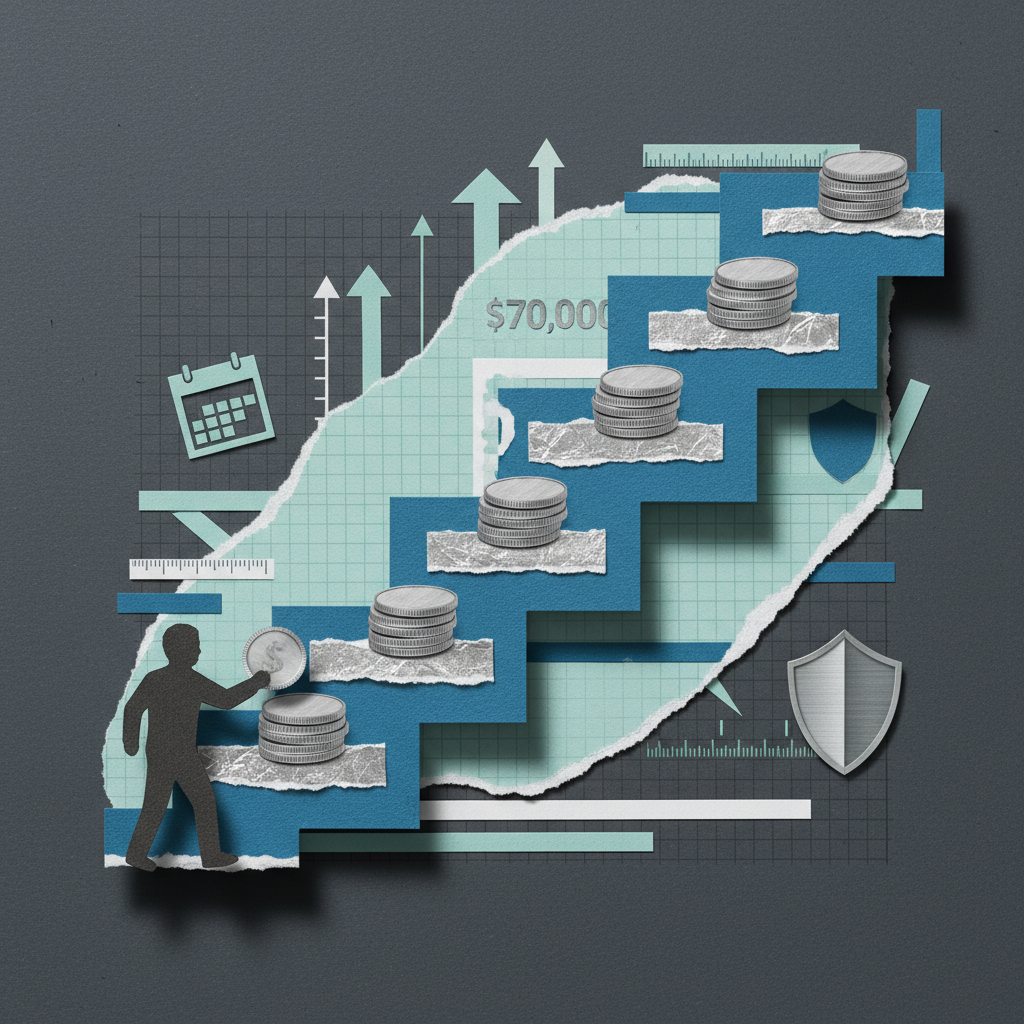
What if the simplest crypto investment strategy also delivered the highest returns? With Bitcoin trading at $67,670 — down 42% from its $126,025 all-time high — and the Fear & Greed Index plunging to 8/100, this data-driven guide reveals why dollar-cost averaging has consistently outperformed lump-sum investing, traditional equities, and gold over the past five years.
What Is Crypto Dollar-Cost Averaging (DCA)? — 30-Second Summary
Quick Answer: Dollar-cost averaging (DCA) means investing a fixed amount — such as $10 per week — into crypto at regular intervals regardless of price. Over five years (2019–2024), a $10 weekly Bitcoin DCA turned $2,610 into $7,913, delivering a 202% return that outperformed Apple (+79%), Gold (+34%), and the Dow Jones (+23%) over the same period.
Dollar-cost averaging (DCA) is an investment strategy where you commit a fixed dollar amount to purchase an asset at regular intervals — weekly, biweekly, or monthly — regardless of its current market price. According to historical backtesting data from Spoted Crypto, a straightforward $10 weekly Bitcoin DCA over five years (2019–2024) transformed $2,610 in total contributions into $7,913, delivering a 202% return. The strategy works by automatically purchasing more units when prices are low and fewer units when prices are high, systematically reducing your average cost basis over time. With Bitcoin's Fear & Greed Index currently at 8/100 — marking over 46 consecutive days in extreme fear territory according to Alternative.me — and BTC trading approximately 42% below its all-time high of $126,025, today's market conditions mirror the precise environments where DCA has historically generated its strongest long-term returns for patient investors.
DCA vs. Lump Sum vs. Active Trading: Which Strategy Wins?
Not all investment approaches are created equal — especially in a market where Bitcoin can swing $2,800 in a single day (today's range: $65,000–$67,800 on Binance). Lump-sum investing deploys your entire capital at once, betting that you have correctly timed the market. Active trading demands constant attention, technical analysis expertise, and emotional discipline. DCA, by contrast, removes timing risk entirely and requires nothing more than consistency.
| Factor | DCA (Dollar-Cost Averaging) | Lump Sum | Active Trading |
|---|---|---|---|
| Timing Risk | Eliminated | Maximum exposure | High |
| Emotional Discipline | Low (automatable) | Moderate | Very High |
| Time Commitment | Minutes per month | One-time decision | Hours per day |
| Best Market Condition | Volatile / Bearish | Clear bull trend | High volatility |
| 5-Year BTC Return* | +202% | Varies by entry point | <5% profitable long-term |
| Skill Required | Minimal | Moderate | Expert-level |
*Based on $10/week BTC DCA, 2019–2024. Source: Spoted Crypto
Why the Current Market Is Tailor-Made for DCA
The on-chain and derivatives data paint a picture of capitulation — the exact conditions that have historically rewarded DCA investors most generously. BTC funding rates on Binance sit at a near-flat 0.0005%, indicating neutral-to-bearish positioning in the perpetual futures market, while 24-hour liquidations hit $450 million with 89% concentrated on long positions, according to Spoted Crypto market data. Yet beneath the surface panic, whale wallets have accumulated 270,000 BTC ($18.7–23 billion) over the past 30 days, and exchange BTC reserves have dropped to 2.31 million — a six-year low. Meanwhile, Bitcoin spot ETFs recorded $2.5 billion in net inflows for March alone. Smart money is accumulating precisely what retail investors are selling.
Bitcoin DCA Crushes Traditional Assets Over 5 Years
The outperformance is not marginal — it is dramatic. As Michael Saylor, Executive Chairman of MicroStrategy, has stated: "Volatility is Satoshi's gift to the faithful" — recommending a minimum four-year investment horizon, with ten years being "really the right timeframe" (Spoted Crypto). For investors exploring how to build a long-term crypto DCA portfolio, these numbers demonstrate that patience and consistency outweigh precision timing every single time.
| Asset (5-Year DCA, 2019–2024) | Total Return | Gap vs. Bitcoin |
|---|---|---|
| Bitcoin (BTC) | +202% | — |
| Apple (AAPL) | +79% | -123 pp |
| Gold (XAU) | +34% | -168 pp |
| Dow Jones (DJIA) | +23% | -179 pp |
Source: Spoted Crypto historical DCA analysis
How Much Does Bitcoin DCA Actually Return? — Historical Data Analysis
Bitcoin's dollar-cost averaging returns are not theoretical projections — they are backed by over a decade of verifiable, on-chain market data spanning multiple bull and bear cycles. A disciplined $100 monthly DCA initiated in January 2014 and sustained through two devastating bear markets and three halving events turned $14,600 in cumulative contributions into $994,950 by early 2026 — a staggering 6,712% return, according to historical analysis from Spoted Crypto. Even the more conservative five-year window tells a powerful story: just $10 per week from 2019 to 2024 produced a 202% cumulative gain. What makes these figures especially relevant in today's market is the structural compression of bear market drawdowns — from 93% in 2011 to just 77% in 2022, as documented by TradeThatSwing — suggesting that Bitcoin's increasing institutional adoption, ETF inflows, and deepening liquidity are steadily reducing downside risk for disciplined long-term DCA investors.
The Compounding Power of Time: 5-Year vs. 12-Year DCA
The difference between a five-year and twelve-year DCA timeline is not linear — it is exponential. While $10 per week over five years produced a 202% return, extending the time horizon to twelve years at $100 per month generated a 6,712% return. This exponential divergence occurs because early-cycle DCA investors accumulated Bitcoin at an average cost basis well below $5,000, capturing the full magnitude of Bitcoin's ascent from three-digit to six-digit territory. With the weekly RSI currently at 27.48 — the lowest reading since December 2018, per Spoted Crypto — today's DCA investors may be building a similarly low cost basis. The takeaway is unambiguous: in DCA, duration is the single most powerful compounding variable.
Bear Market DCA: When Fear Creates the Greatest Opportunity
History reveals a counterintuitive truth — the best time to start a crypto DCA is precisely when it feels the worst. Investors who began systematic purchases during periods of extreme fear have consistently outperformed those who waited for confirmation of a recovery. A fear-based contrarian DCA strategy returned 1,145% from 2018 to 2025, outperforming simple buy-and-hold (1,046%) by 99 percentage points, according to Spoted Crypto backtesting data.
| Bear Market Event | Fear & Greed at Low | BTC Price at Low | 6-Month Return | Peak Drawdown |
|---|---|---|---|---|
| 2018 Crypto Winter (Dec 2018) | 10 | $3,185 | +72% | -84% |
| COVID Crash (Mar 2020) | 8 | $4,900 | +133% | -63% |
| Terra/Luna Crash (Jun 2022) | 6 | $17,600 | -4.5% | -72% |
| FTX Collapse (Nov 2022) | 10 | $15,500 | +96% | -77% |
| Current Market (Mar 2026) | 8 | $67,670 | TBD | -42% |
Sources: Spoted Crypto, Phemex, TradeThatSwing
The pattern is striking. Every single instance of the Fear & Greed Index dropping below 15 since 2018 — except for the Terra/Luna collapse — preceded substantial recoveries within six months. According to James Butterfill, Head of Research at CoinShares: "Fear & Greed below 15 preceded average 60-day returns of 38%" (Spoted Crypto). With today's index reading at 8 and sub-15 readings coinciding with local bottoms in approximately 78% of observed instances since 2018, the statistical case for accumulation is overwhelming.
Shrinking Drawdowns: Evidence of Bitcoin's Structural Maturation
One of the most compelling arguments for sustained Bitcoin DCA is the progressive reduction in bear market severity across each cycle. The 2011 correction saw BTC plunge 93% from its peak. By 2014, the maximum drawdown had narrowed to 85%. The 2018 bear market bottomed at -84%, and the 2022 cycle — despite the twin implosions of Terra/Luna and FTX — produced a -77% correction. This 16-percentage-point compression over a decade reflects deepening market liquidity, growing institutional participation (BlackRock's IBIT alone holds approximately 771,000 BTC worth roughly $86 billion, per Spoted Crypto), and Bitcoin's evolution from speculative novelty to macro asset class. The current -42% drawdown from ATH is the shallowest bear market decline in Bitcoin's history — further evidence that the floor keeps rising.
The Terra/Luna Warning: DCA Requires Asset Selection Discipline
Dollar-cost averaging is not a blanket guarantee — and the Terra/Luna catastrophe of 2022 is the starkest reminder. When the Fear & Greed Index hit 6 during the LUNA collapse, it was not signaling a market bottom but rather a precursor to a secondary crash. The six-month return from that reading was -4.5%, and investors who DCA'd into LUNA itself lost virtually everything as the token spiraled to zero. The critical lesson is clear: DCA only works when applied to assets with strong fundamental durability. Bitcoin, with its fixed 21 million supply cap, decentralized proof-of-work network, and accelerating institutional adoption, meets this criterion. Altcoins with algorithmic pegs, concentrated governance, or unproven tokenomics often do not. As Raoul Pal, CEO of Real Vision and former Goldman Sachs executive, has emphasized: "Crypto is the highest-performing asset class in history. You need to have patience and use dollar-cost averaging to navigate the volatility" (ainvest) — but that patience must be paired with rigorous asset selection and risk management.
Why DCA Returns Surge During Market Fear — Fear & Greed Index Strategy
Contrarian dollar-cost averaging — buying more aggressively when markets are gripped by extreme fear — has consistently outperformed standard DCA strategies across every major crypto cycle since 2018. Data compiled by CoinShares research shows that purchasing Bitcoin when the Fear & Greed Index drops below 15 has yielded a median 90-day return of +38.4%, compared to single-digit gains for purchases made during neutral or greedy conditions. From 2018 through 2025, a fear-weighted DCA approach returned 1,145%, outpacing a simple buy-and-hold strategy that delivered 1,046% over the same period — a 99-percentage-point edge, according to Spoted Crypto analysis. The logic is straightforward: extreme fear compresses prices below fair value, and disciplined buyers who accumulate during these windows capture outsized upside when sentiment inevitably reverts. Today's Fear & Greed reading of 8 suggests one such window may be open right now.
Historical Evidence: Fear Below 15 Signals Outsized Returns
Since 2018, Fear & Greed Index readings between 10 and 15 have coincided with local market bottoms approximately 78% of the time, according to Phemex research. The pattern has repeated across every major downturn. During the COVID crash of March 2020 (Index: 8, BTC at $4,900), the subsequent six-month return was +133%. After the FTX collapse in November 2022 (Index: 10, BTC at $15,500), the six-month return was +96%. Every sub-15 reading since 2020 — except during the Terra/Luna contagion of mid-2022 — preceded triple-digit recoveries within six months.
The one critical caveat: extreme fear can deepen before reversing. In June 2022, the index hit 6 during the Terra/Luna fallout and the six-month return was -4.5%, a stark reminder that fear-based DCA works best as a graduated approach rather than an all-in bet at the first sign of panic.
Current Market Signals: Index at 8 With On-Chain Accumulation
As of March 30, 2026, the crypto market sits at a Fear & Greed reading of 8 — marking 46 consecutive days in Extreme Fear territory. Bitcoin's weekly RSI has dropped to 27.48, the lowest level since December 2018, while BTC trades at $67,670, approximately 42% below its all-time high of $126,025. Yet beneath the surface panic, on-chain data paints a sharply different picture. According to Spoted Crypto reporting, whales have accumulated 270,000 BTC (roughly $18.7–23 billion in value) over the past 30 days, while exchange reserves have fallen to 2.31 million BTC — a six-year low. Will Clemente, analyst at Reflexivity Research, noted that "on-chain patterns align with structured accumulation rather than distribution" — the kind of quiet institutional buying that has historically preceded major recoveries.
Fear-Based DCA Intensity Framework
Rather than investing a fixed amount regardless of conditions, a fear-weighted DCA strategy adjusts buy intensity based on real-time sentiment readings. James Butterfill, Head of Research at CoinShares, has observed that "Fear & Greed below 15 preceded average 60-day returns of 38%." The following framework translates these findings into an actionable allocation model:
| Fear & Greed Index | Sentiment Zone | DCA Multiplier | Historical 90-Day Median Return |
|---|---|---|---|
| 0–10 | Extreme Fear | 3× base amount | +38% or higher |
| 11–25 | Fear | 2× base amount | +22–38% |
| 26–45 | Caution | 1.5× base amount | +10–18% |
| 46–55 | Neutral | 1× base amount | +5–10% |
| 56–75 | Greed | 0.5× base amount | +1–4% |
| 76–100 | Extreme Greed | Pause or 0.25× | -2% to -8% |
For example, if your standard weekly DCA is $100, today's reading of 8 would trigger a $300 purchase, while a reading of 85 would reduce the buy to just $25 — or pause entirely. This approach systematically buys more when prices are depressed and less when they are euphoric, amplifying the core advantage of dollar-cost averaging over static allocation models.
Best Day and Frequency for Crypto DCA — What the Data Reveals
Timing matters less than consistency in dollar-cost averaging, but not all schedules perform equally. A comprehensive analysis of Bitcoin purchases from 2018 to 2025 reveals that investors who consistently bought on Mondays accumulated 14.36% more BTC than those purchasing on any other weekday, according to Spoted Crypto data. This "Monday effect" aligns with a well-documented pattern in traditional equity markets, where institutional selling pressure on Fridays depresses weekend and early-week prices across correlated risk assets. However, the more critical variable is not the specific day — it is frequency and duration. Weekly DCA has historically delivered superior risk-adjusted returns for most retail investors, smoothing out intra-month volatility more effectively than monthly purchases while avoiding the transaction-fee drag of daily buying. As MicroStrategy Executive Chairman Michael Saylor has argued, the minimum effective holding period for Bitcoin DCA is four years, with ten years being the ideal horizon for maximum compounding.
The Monday Effect — Why Early-Week Buying Wins
The 14.36% Monday advantage stems from a recurring liquidity pattern in crypto markets. Weekend trading volumes on major exchanges like Binance and OKX tend to run 20–35% lower than weekday averages, often resulting in slightly depressed prices as leveraged positions get liquidated into thinner order books. By Monday, spot buyers who set automated orders capture these temporary dips before institutional flows resume mid-week. While 14.36% may seem modest on a single purchase, compounded across years of weekly buying, the difference translates into meaningfully higher total accumulation.
Weekly vs. Monthly vs. Daily — Frequency Comparison
The optimal DCA frequency depends on your capital size and fee structure. Daily DCA maximizes price smoothing but incurs significantly higher transaction costs — on Coinbase Advanced, a 0.60% taker fee on 365 annual purchases erodes returns far more than 52 weekly buys or 12 monthly ones. Weekly DCA strikes the best balance for most investors: it captures intra-month volatility without excessive fee drag, especially on lower-fee platforms like Binance (0.10% taker) or Kraken (0.26% taker). Monthly DCA is simplest to automate around payday schedules but misses significant intra-month swings — Bitcoin's average monthly range regularly exceeds 20%, meaning monthly buyers risk consistently purchasing near local peaks.
Building Your Automated DCA Plan
Most major exchanges now offer built-in recurring buy features that eliminate manual execution. On Binance, navigate to "Recurring Buy" under the Buy Crypto menu to set your asset, amount, and frequency. Coinbase and Kraken offer similar tools under their respective "Recurring Purchase" settings. The critical principle, as Saylor has emphasized, is duration over timing: "Volatility is Satoshi's gift to the faithful," he stated, recommending "a minimum of four years, with ten years really being the right timeframe" in a recent interview. A practical starting framework: allocate a fixed percentage of each paycheck — commonly 5–10% of investable income — to weekly Monday purchases, layer in the fear-weighted intensity model outlined above, and commit to a minimum four-year horizon regardless of short-term price action.
Which Coins Should You DCA Into? — Building a Portfolio With Staking Yields
Choosing the right assets for a dollar-cost averaging strategy requires balancing proven store-of-value properties with yield-generating potential. Bitcoin commands a 56.1% market dominance as of March 2026, making it the most battle-tested DCA target in the crypto universe, according to CoinGecko. Ethereum, the second pillar of any serious portfolio, offers 3–4% staking APY on top of price appreciation — with 35.86 million ETH (28.91% of total supply) already locked by over 1.1 million validators, per Spoted Crypto research. A well-structured DCA portfolio doesn't just accumulate coins; it compounds yield while you sleep. For investors who began a Bitcoin DCA strategy five years ago, that $10-per-week commitment turned $2,610 into $7,913 — a 202% return that no savings account could match.
Bitcoin: The Anchor of Every DCA Portfolio
Bitcoin remains the undisputed core holding for any DCA strategy. With a market capitalization representing over half the entire crypto market, BTC functions as digital gold — a macro hedge with the deepest liquidity across every major exchange. At a current price of $67,670, BTC sits 42% below its all-time high of $126,025, which historically signals a high-conviction accumulation zone. Bear market drawdowns have narrowed across cycles — from 93% in 2011 to 85% in 2014, 84% in 2018, and 77% in 2022 — according to Trade That Swing, indicating growing structural maturity. BTC doesn't offer native staking yield, but institutional endorsement — BlackRock's IBIT alone holds approximately 771,000 BTC worth roughly $86 billion — validates its role as the portfolio's gravitational center.
Ethereum: Price Appreciation Plus Passive Yield
Ethereum offers something Bitcoin cannot: native staking rewards. Liquid staking protocols like Lido (stETH) and Rocket Pool (rETH) allow DCA investors to earn 3–4% APY without locking tokens in rigid unbonding periods. This means every ETH purchase through DCA immediately becomes a yield-bearing asset. At ETH's current price of $2,061, a $100 monthly DCA that is simultaneously staked generates compound returns from both token appreciation and staking rewards. With no fixed unbonding period through liquid staking derivatives, investors maintain full liquidity — a critical advantage during volatile market conditions.
Staking APY Comparison: Beyond BTC and ETH
Higher staking yields beyond Ethereum come with important trade-offs. The table below compares popular proof-of-stake assets for DCA investors seeking additional yield.
| Asset | Staking APY | Unbonding Period | Key Characteristics |
|---|---|---|---|
| Ethereum (ETH) | 3–4% | Variable (liquid staking available) | Deepest DeFi ecosystem; liquid staking via Lido, Rocket Pool eliminates lock-up |
| Solana (SOL) | 6–8% | ~2–3 days | High throughput chain; short unbonding; growing DeFi and NFT ecosystem |
| Cardano (ADA) | 3–5% | None (delegated staking) | No lock-up period; stake while maintaining full liquidity |
| Polkadot (DOT) | 10–14% | 28 days | Highest nominal yield; long unbonding offsets returns during volatility |
| Cosmos (ATOM) | 12–19% (nominal) | 21 days | High inflation dilutes real yield to 2–8%; research real vs. nominal returns carefully |
Critical caveat on real vs. nominal yields: ATOM's headline 12–19% APY is among the most misleading in crypto. With annual token inflation running between 10–14%, the real staking yield — what actually grows your purchasing power — shrinks to approximately 2–8%, according to Coinglass staking analytics. Always subtract the network inflation rate from the advertised APY before making allocation decisions. Polkadot's 28-day unbonding period also presents a real cost: during the 2022 crash, DOT dropped 40% in under three weeks, meaning stakers couldn't exit positions fast enough to limit losses.
Recommended DCA Allocation for Beginners
A beginner-friendly DCA portfolio should prioritize conviction and liquidity over speculative yield. The widely cited 60/30/10 framework allocates 60% to Bitcoin (stability and dominance), 30% to Ethereum (yield plus smart-contract exposure), and 10% to select altcoins like SOL or ADA (growth and diversification). This structure ensures the portfolio's core — 90% in BTC and ETH — tracks the assets that have historically recovered from every bear market cycle. The 10% altcoin sleeve allows exposure to higher staking yields without introducing catastrophic risk. As your DCA portfolio grows beyond $10,000, consider adjusting toward 50/30/20 to capture more ecosystem diversification — but only after understanding each asset's real yield dynamics.
Best Exchanges for DCA — Fees, Features, and Auto-Buy Compared
The exchange you choose for dollar-cost averaging can silently erode or significantly protect your returns over time. On a $200 monthly DCA, the difference between Binance's 0.10% fee and Coinbase's standard 0.60% taker fee amounts to $12 per year — compounding to over $120 across a decade-long strategy, according to Koinly. More critically, not every exchange offers the same auto-buy functionality essential for disciplined DCA execution. Recurring buy features — which automatically purchase a set dollar amount on your chosen schedule — eliminate the emotional friction that causes most investors to abandon their strategy during extreme fear periods like the current Fear & Greed reading of 8/100. Selecting the right platform is not a minor detail; it's infrastructure that determines whether your DCA strategy survives contact with real market volatility.
Exchange Fee Comparison: Binance vs. Coinbase vs. Kraken
The three dominant exchanges for DCA investors each carry distinct fee structures and discount mechanisms. The table below breaks down current 2026 fee schedules.
| Exchange | Maker Fee | Taker Fee | Discount Mechanism | Lowest Tier (High Volume) | Auto-Buy (Recurring Buy) |
|---|---|---|---|---|---|
| Binance | 0.10% | 0.10% | BNB payment discount (~25%) | 0.02% / 0.04% | Yes — daily, weekly, bi-weekly, monthly |
| Coinbase Advanced | 0.40% | 0.60% | Coinbase One subscription ($29.99/mo) — zero trading fees | 0.05% / 0.08% | Yes — daily, weekly, bi-weekly, monthly |
| Kraken | 0.16% | 0.26% | Volume-based tiers only | 0.00% / 0.08% | Yes — daily, weekly, bi-weekly, monthly |
Source: Koinly, Ventureburn (March 2026)
Auto-Buy Features: The Make-or-Break DCA Tool
All three major exchanges now support recurring buy functionality, but the execution quality differs. Binance's auto-invest feature allows allocation across multiple assets in a single recurring order — ideal for executing the 60/30/10 BTC/ETH/altcoin split automatically. Coinbase's recurring buy is the simplest to configure, making it popular with beginners, but its default fee tier (0.60% taker) makes it the most expensive option unless subscribers opt for the Coinbase One plan at $29.99 per month, which eliminates trading fees entirely. For investors DCA-ing $500 or more per month, Coinbase One's subscription pays for itself immediately. Kraken sits in the middle — lower fees than Coinbase's default tier, solid recurring buy options, and strong regulatory compliance across the EU under MiCA frameworks.
Fee Reduction Strategies That Compound Over Years
Smart DCA investors treat fee optimization as a yield enhancement strategy. Three proven approaches stand out. First, Binance BNB payment: holding BNB and enabling it as the fee currency reduces trading fees by approximately 25%, bringing the effective rate down to roughly 0.075%. Second, Coinbase One subscription: at $29.99 per month, it zeroes out trading fees — a breakeven point of just $5,000 monthly volume at standard rates, but worthwhile even at lower volumes for active DCA practitioners. Third, volume tier progression: Kraken's fee schedule rewards cumulative 30-day volume, meaning consistent DCA investors naturally climb toward lower tiers over time. Maker fees can reach 0.00% at Kraken's highest tier — effectively free limit-order execution.
Regional Pricing Premiums and Exchange Selection
DCA investors in certain regions face persistent pricing premiums that affect real returns. Asia-Pacific markets, particularly South Korea, historically exhibit the so-called "Kimchi premium" — where BTC and ETH trade 0.3–3% above global spot prices during high-demand periods. As of March 2026, the premium remains modest (BTC +0.30%, ETH +0.35%), but during peak bull runs it has surged above 15%, according to The Block. For investors in premium markets, DCA-ing through global exchanges like Binance — which offer pricing closer to global spot — can save meaningful capital over multi-year horizons. Similarly, investors in the EU benefit from Kraken's MiCA-compliant infrastructure, while US-based investors may find Coinbase's regulatory clarity worth the higher base fees. The optimal crypto DCA exchange ultimately depends on your jurisdiction, monthly investment amount, and whether you value fee minimization or regulatory convenience.
How to Safely Store Your DCA Portfolio — Hardware Wallet Comparison
Self-custody is the practice of holding your own private keys rather than trusting a centralized third party — and the collapse of FTX in November 2022, which locked an estimated $8 billion in customer deposits, proved exactly why it matters. According to Chainalysis, centralized exchange failures have cost users billions in aggregate losses since 2014. For DCA investors steadily accumulating crypto over months and years, custody strategy becomes critical as portfolio value compounds. Hardware wallets — physical devices that store private keys entirely offline — remain the gold standard for securing digital assets long-term. The two dominant manufacturers, Ledger and Trezor, offer models ranging from €79 to €169, each with distinct approaches to security chip certification, asset coverage, and open-source transparency. Understanding these trade-offs is essential before transferring your DCA holdings off an exchange, especially with Bitcoin at $67,670 and the Fear & Greed Index at a mere 8/100.
Exchange Custody vs. Hardware Wallets: The FTX Lesson
When FTX filed for bankruptcy, customers discovered that billions in deposited funds had been commingled and misused. While leading exchanges like Binance and Coinbase now publish proof-of-reserves audits, the fundamental risk persists: centralized platforms remain single points of failure vulnerable to mismanagement, hacks, and regulatory seizures. For a DCA portfolio designed to grow over three to five years, self-custody through a hardware wallet eliminates counterparty risk entirely. The transfer process is straightforward — generate a wallet address on your device, withdraw from the exchange, and verify the transaction on-chain.
Ledger vs. Trezor — 4-Model Comparison
Below is a head-to-head comparison of the four most popular hardware wallets in 2026, based on data from Coin Bureau:
| Feature | Ledger Nano S Plus | Ledger Nano X | Trezor Safe 3 | Trezor Safe 5 |
|---|---|---|---|---|
| Price | €79 | €149 | €79 | €169 |
| Supported Coins | 5,500+ | 5,500+ | 1,500+ | 1,500+ |
| Secure Element | CC EAL5+ | CC EAL5+ | EAL6+ | EAL6+ |
| Open-Source Firmware | No (app layer open) | No (app layer open) | Yes (fully) | Yes (fully) |
| Connectivity | USB-C | USB-C + Bluetooth | USB-C | USB-C |
| Display | Monochrome OLED | Monochrome OLED | Monochrome OLED | Color Touchscreen |
| Best For | Budget beginners | Mobile users | Security purists | Premium experience |
For beginners starting a DCA plan, both the Ledger Nano S Plus and Trezor Safe 3 deliver excellent value at €79. Ledger's advantage is significantly broader coin support (5,500+ vs. 1,500+), while Trezor counters with a higher EAL6+ chip certification and fully open-source firmware that allows independent security audits.
Seed Phrase Backup: Three Non-Negotiable Rules
Your 12- or 24-word seed phrase is the master key to your entire wallet. Lose it, and your funds are gone permanently — no customer support, no recovery. Follow three principles: First, use metal backup plates (stainless steel or titanium) rather than paper, which is vulnerable to fire and water. Second, store copies in at least two geographically separated locations — a home safe and a bank safety deposit box. Third, never store your seed phrase digitally. No photos, no cloud drives, no password managers. A single compromised digital copy can drain your entire portfolio in seconds.
Security Strategy by Portfolio Size
Not every portfolio requires a hardware device on day one. A practical tiered approach: for holdings under $1,000, keeping funds on a reputable exchange with two-factor authentication is reasonable. Between $1,000 and $10,000, a software (hot) wallet like MetaMask or Trust Wallet adds meaningful control. Above $10,000, a hardware wallet becomes essential — and for six-figure DCA portfolios, consider a multi-signature setup requiring two or more devices to authorize any transaction. As your long-term DCA portfolio grows, periodically reassess your tier and upgrade security accordingly.
H2 2026 Outlook — 3 Signals Every DCA Investor Should Watch
The second half of 2026 could mark a pivotal inflection point for Bitcoin, and three converging signals suggest DCA investors should stay disciplined rather than retreat. Despite the Fear & Greed Index sitting at 8/100 for over 46 consecutive days in Extreme Fear territory, institutional capital continues to flow: spot Bitcoin ETFs recorded $2.5 billion in net inflows during March 2026 alone, according to Spoted Crypto. BlackRock's IBIT fund now holds approximately 771,000 BTC valued at roughly $86 billion, making it one of the largest single Bitcoin holders globally. Meanwhile, Bitcoin's weekly RSI has plunged to 27.48 — its lowest since December 2018, a level that historically preceded major recoveries. With BTC down 42% from its $126,025 all-time high and whales accumulating 270,000 BTC over the past 30 days, the data paints a picture of structured accumulation beneath widespread panic. Here are three signals to guide your DCA strategy through the remainder of 2026.
Signal 1: ETF Inflows Persist Through Extreme Fear
Spot Bitcoin ETFs absorbed $2.5 billion in net inflows during March despite relentless selling pressure across the broader market. This divergence is significant: retail investors historically flee during extreme fear, but institutional allocators operate on fundamentally different timelines and mandates. BlackRock's IBIT alone holds 771,000 BTC worth approximately $86 billion — and accumulation has not paused. Larry Fink, CEO of BlackRock, has publicly framed the long-term thesis:
"If everybody adopted that conversation [2–5% sovereign wealth fund allocation], it would be $500,000, $600,000, $700,000 for bitcoin." — Larry Fink, CEO, BlackRock (via Spoted Crypto)
When the world's largest asset manager continues buying through a Fear & Greed reading of 8, the message is clear: smart money doesn't time bottoms — it accumulates through them.
Signal 2: Weekly RSI at Historic Oversold Levels
Bitcoin's weekly RSI at 27.48 places it in deeply oversold territory — a zone visited only a handful of times in its history. The last comparable reading occurred in December 2018 when BTC traded near $3,185, before rallying over 300% within 18 months. The COVID crash of March 2020 produced similar oversold conditions at $4,900, delivering a +133% return within six months. While oversold conditions do not guarantee immediate reversal — the Terra/Luna collapse in 2022 proved secondary crashes can follow — the statistical edge remains clear: buying during extreme oversold phases has produced a median 90-day return of +38.4%, according to CoinGlass historical data.
Signal 3: On-Chain Whale Accumulation
Beneath the surface of retail panic, on-chain data tells a starkly different story. Whale wallets accumulated 270,000 BTC (worth $18.7–23 billion) over the past 30 days, while exchange BTC reserves dropped to 2.31 million — a six-year low — according to Glassnode metrics. Coins leaving exchanges signal long-term holding intent, not preparation to sell. When large holders are aggressively pulling Bitcoin into cold storage while retail capitulates, the divergence has historically marked accumulation zones that preceded significant rallies.
DCA Investor Checklist for H2 2026
Before adjusting your accumulation strategy, monitor three metrics weekly: (1) Does the Fear & Greed Index remain at or below 15? Sustained readings in this zone have coincided with local bottoms in roughly 78% of instances since 2018. (2) Are whale accumulation and declining exchange reserves continuing? Track these trends on Glassnode and CryptoQuant. (3) Do monthly ETF net inflows remain positive? Consistent institutional buying provides a structural demand floor. If all three conditions hold, maintaining — or even increasing — your DCA allocation aligns squarely with the historical data. Patience during extreme fear has been the single most rewarded behavior in crypto markets.
Frequently Asked Questions
What Is the Minimum Amount Needed to Start Dollar-Cost Averaging Into Bitcoin?
Most major exchanges set their minimum buy order between $1 and $10, meaning virtually anyone with a bank account can begin a Bitcoin DCA strategy today. Binance, for example, allows recurring buys starting at just $1 with a base fee of 0.10% maker/taker, while Coinbase Advanced charges up to 0.60% per trade. The dollar amount matters far less than consistency: a Spoted Crypto analysis found that investing just $10 per week over five years (2019–2024) turned a total outlay of $2,610 into $7,913.20 — a 202.03% return. Scale that discipline up to $100 per month from January 2014 to early 2026, and the result is even more dramatic: $14,600 became $994,950 — a 6,712% gain. As Michael Saylor, Executive Chairman of MicroStrategy, puts it: the minimum recommended horizon is four years, with "ten years being really the right timeframe." The takeaway is clear — start small, stay consistent, and let compounding do the work.
Does Buying Bitcoin When the Fear & Greed Index Is Low Really Produce Higher Returns?
Historical data strongly supports contrarian accumulation during periods of extreme fear, though it comes with an important caveat. According to CoinShares Head of Research James Butterfill, buying Bitcoin when the Fear & Greed Index reads below 15 has yielded a median 90-day return of +38.4%. Furthermore, readings between 10 and 15 have coincided with local market bottoms in approximately 78% of observed instances since 2018. The pattern held during the COVID crash of March 2020 (Index at 8, BTC at $4,900, six-month return +133%) and the FTX collapse of November 2022 (Index at 10, BTC at $15,500, six-month return +96%). However, the Terra/Luna implosion of June 2022 serves as a critical counterexample: the index hit 6 yet preceded a secondary crash with a six-month return of −4.5%. Today's reading sits at 8/100 with 46+ consecutive days in Extreme Fear territory, while whales have accumulated 270,000 BTC ($18.7–23 billion) in the past 30 days — suggesting institutional conviction even as retail sentiment capitulates. The strategy works statistically, but position sizing and risk management remain essential because tail-risk events like Terra/Luna can invalidate the signal.
Bitcoin DCA vs. Ethereum DCA: Which Is the Better Long-Term Strategy?
Both assets offer compelling DCA cases, but they serve different portfolio functions. Bitcoin has the longest track record of validated long-term returns — bear market drawdowns have progressively narrowed from ~93% in 2011 to ~77% in 2022, according to TradeTheTrend data, signaling increasing market maturity and reduced downside risk over time. Institutional validation is also stronger: BlackRock's IBIT alone holds approximately 771,000 BTC (~$86 billion). Ethereum, on the other hand, offers an additional yield layer through staking, currently generating 3–4% APY that compounds on top of price appreciation. As Raoul Pal, CEO of Real Vision, has noted: "Crypto is the highest-performing asset class in history. You need to have patience and use dollar-cost averaging to navigate the volatility." Most portfolio strategists recommend a blended approach — a 70/30 or 60/40 BTC-to-ETH split — capturing Bitcoin's store-of-value stability alongside Ethereum's staking yield and smart-contract ecosystem growth.
Does Dollar-Cost Averaging Always Outperform Lump-Sum Investing?
Not always — the answer depends on the prevailing market regime. In a sustained bull market, lump-sum investing mathematically outperforms DCA because capital is fully deployed from day one, capturing more upside. However, in high-volatility bear markets — precisely the conditions most investors actually face when deciding to enter — DCA has a decisive edge. A fear-based contrarian DCA strategy returned 1,145% from 2018 to 2025, outperforming a simple buy-and-hold approach (1,046%) by 99 percentage points. The psychological advantage is equally important: DCA eliminates the paralysis of trying to time the bottom, which is especially relevant now with BTC trading at $66,038 — down 42% from its $126,025 all-time high. Larry Fink, CEO of BlackRock, has projected that broader sovereign and institutional adoption could drive Bitcoin to "$500,000, $600,000, $700,000," reinforcing why consistent accumulation during drawdowns — rather than waiting for a perfect entry — tends to produce superior risk-adjusted outcomes over a full market cycle.
Data Sources
- Spoted Crypto — Crypto DCA Strategy Guide (2026)
- Spoted Crypto — Crypto DCA Strategy Guide (Historical Returns)
- Spoted Crypto — Fear & Greed Extreme: 46 Days in Crypto Brief
- Phemex — Dollar-Cost Averaging During Extreme Fear Performance
- Koinly — Crypto Exchanges With the Lowest Fees
- TradeTheTrend — Bitcoin Rally & Pullback Statistics
- Coin Bureau — Trezor vs. Ledger Analysis
- AInvest — Dollar-Cost Averaging as the Smartest Bitcoin Strategy (2026)
This article is for informational purposes only and does not constitute investment advice. All investment decisions should be made based on your own judgment and responsibility.
Related Articles
- Crypto DCA Strategy Guide 2026: How Dollar-Cost Averaging Returned 202% in Extreme Fear Markets
- Crypto DCA + Staking Guide: How to Maximize Returns with Dollar-Cost Averaging & Staking (2026)
- Crypto DCA Strategy Guide: How Dollar-Cost Averaging Returned 202%–6,712% in Bear Markets
- Complete Guide to Crypto Bear Market Strategies: DCA, Staking & Fee Comparison
- Bitcoin DCA Strategy: How Dollar-Cost Averaging Returned 202% Over 5 Years (2026 Guide)