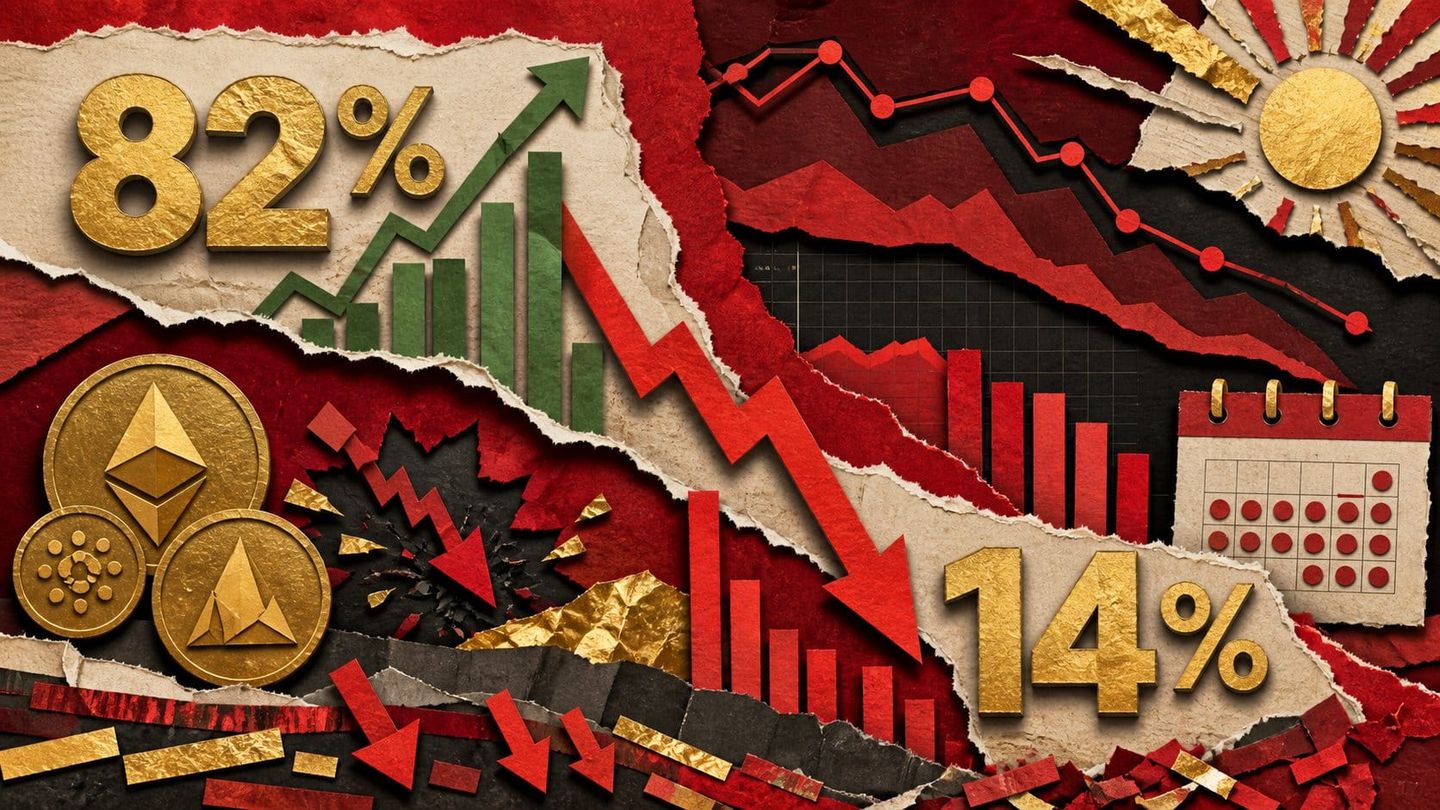
Prediction markets rarely move 68 percentage points on a single piece of legislation in six months. That is exactly what happened to the CLARITY Act, and the collapse tells you more about Washington's calendar than about crypto itself.
What Changed: Polymarket's CLARITY Act Odds Just Collapsed
Polymarket traders now price the Digital Asset Market CLARITY Act (H.R. 3633) becoming law before January 1, 2027 at roughly 17%, after the contract hit a record low near 14% mid-week in early August 2026 on more than $5 million in cumulative volume . That is down from an 82% peak in February, ~74% in May and ~31% at the start of August .
Quick Answer: Polymarket's odds on the CLARITY Act passing before January 1, 2027 fell from an 82% February peak to a record 14% in early August 2026, now near 17%. The trigger: Senate Majority Leader John Thune confirmed on August 6 there would be no pre-recess vote.
The proximate cause was procedural. Thune confirmed on August 6, 2026 that no floor vote would happen before the summer break, with final pre-recess votes held the morning of Friday, August 7 . The Senate returns September 14 and leaves again on October 5 to campaign for the midterms — roughly 14 scheduled working days .
Wall Street broker Bernstein flagged the same trend in an August 3, 2026 note:
"Clarity is the most consequential crypto market structure bill in U.S. history, but the chances of its 2026 passing seems to be dwindling," — Gautam Chhugani, analyst at Bernstein (source: CoinDesk, 2026-08)
What the odds collapse has and hasn't priced in:
- Priced in: no Senate vote before the August recess, confirmed August 6 .
- Priced in: a narrow September–October floor window before campaign season.
- Not priced in: spot price damage — bitcoin held near $64,300 on August 7, flat on the week .
Retail commentary tracked the same slide, with odds falling from 50% in July into a 27–37% Polymarket range before the August lows (video: Crypto Decoded by Pedro Silva).
Why the Bill Stalled — And Why It Isn't the Market Structure Text
The CLARITY Act is not stuck on how to regulate digital assets — it is stuck on who in government is allowed to own them. Senate negotiators had already resolved the contentious market-structure items, including the stablecoin yield rules that split banks and exchanges for months . What broke the talks was a bipartisan ethics provision that would cap crypto holdings for senior government officials above $1 million — a clause read as directed at President Trump, who disclosed more than $1 billion in income from crypto ventures in 2025 .
Sen. Ruben Gallego (D-Ariz.), one of two Democrats who voted the bill out of Senate Banking, has said he will not back it on the floor without a bipartisan ethics clause. He and Republican Sen. Thom Tillis submitted a revised compromise to the White House before August 3 . That draft has not produced a public deal.
The arithmetic behind the stall is straightforward:
- 53 Republican senators in favor, meaning 7 Democratic votes are needed to clear the 60-vote cloture threshold (video: Crypto Decoded by Pedro Silva).
- Seven Democrats rejected the current text in a joint July 22 statement — including Catherine Cortez Masto, Cory Booker, Mark Warner and Raphael Warnock .
- Whether the bill even holds 50 votes is unclear, per CoinDesk's outcome map published August 5 .
- Floor time competed with three other items — the Todd Blanche attorney general nomination, a continuing resolution and a Russia sanctions bill .
Majority Leader John Thune never filed cloture on the motion to proceed, which is the procedural tell: leadership does not burn floor time on a vote it expects to lose . For traders, the distinction matters. A bill blocked on token taxonomy would signal deep disagreement about the asset class. A bill blocked on a disclosure clause is a political negotiation with a defined shape — and one that can be resolved in a single amendment if the White House accepts the Gallego–Tillis language.
Why It Matters: Bernstein's Selloff Warning vs. Its Own Bottom Call
Bernstein's August 3 note argues both sides of the same trade: a Senate failure to pass CLARITY this year would likely trigger "another leg down for Bitcoin and the broader crypto market," but the damage would be temporary because regulators would fill the gap under existing authority . Analysts led by Gautam Chhugani paired the warning with a timing call, per Cointelegraph.
"From a tactical standpoint, we expect the crypto market to bottom and start showing momentum towards late Q3 and early Q4 prior to the mid-terms," — Gautam Chhugani, Senior Analyst at Bernstein (source: Cointelegraph, 2026-08)
The offsetting catalyst is Project Crypto — the framework SEC Chairman Paul Atkins announced in July 2025 and expanded into a joint SEC–CFTC staff initiative in September 2025 . Bernstein expects regulators to accelerate on four fronts without waiting for Congress:
- Token classification and taxonomy — the definitional work CLARITY was written to codify.
- DeFi guidance — clarifying which protocol activities fall under existing registration regimes.
- Self-custody rules — protections for users holding assets outside intermediaries.
- Innovation exemptions for token issuance, alongside continued support for tokenization, crypto derivatives and prediction markets .
Any signal that Project Crypto is being fast-tracked, in Bernstein's framing, could act as a circuit breaker on falling prices. Not every desk shares the patience. Citi has cut its 12-month bitcoin target twice this year on the stalled bill — from $143,000 in January to $112,000 in March, then to $82,000 on July 1, a cumulative 43% reduction . JPMorgan separately called the fading odds a setback for the industry .
On single names, the split is regulatory rather than operational. Bernstein expects Coinbase (COIN) to keep offering stablecoin yield, while Circle (CRCL) stays legally barred from paying yield directly as the issuer — leaving USDC supply growth as the shared catalyst for both . That asymmetry does not resolve without legislation.
The Selloff Bernstein Warned About Hasn't Shown Up Yet
The "another leg down" scenario has not arrived. Bitcoin held near $64,300–$64,970 on August 7, essentially flat on the day and on the week, with the broader crypto market up roughly 0.3% even as the CLARITY vote slipped to September . For a market that had priced legislative risk aggressively all summer, the non-reaction is the data point.
Flows explain part of the calm. Spot bitcoin ETFs absorbed about $626 million between August 3 and August 5, enough to defend the $63,000–$64,000 support band but not enough to clear $66,000–$66,600 resistance . That is a market being held in place rather than one being bid.
Under the surface, dispersion tells a cleaner story than the index. Positioning on August 7 :
- XRP — weakest major: around $1.04, down 5.5% on the week, the asset most directly exposed to token-classification outcomes.
- ETH: roughly $1,920, close to flat.
- SOL: near $75, close to flat.
- DOGE: under 7 cents, with no legislative catalyst either way.
Context matters for how much comfort to take from a flat tape. Bitcoin is still down roughly 50% from its October 2025 all-time high near $126,000 . Much of the disappointment Bernstein modeled may already sit in that drawdown — which would make the September calendar a repricing risk in both directions, not only downward.
What to Watch Next: September 14 and the January 2027 Cliff
The next hard date is September 14, 2026, when the Senate returns from recess . Majority Leader John Thune said CLARITY is "queued up first thing when we come back," but the timing hinges on a procedural detail: whether cloture is filed on the motion to proceed before the break .
- Cloture filed pre-recess: first procedural vote as early as September 15 .
- Not filed: nothing before September 16 at the earliest .
- October 5: lawmakers leave again to campaign for the midterms, leaving roughly 14 scheduled working days .
- Gallego–Tillis ethics text: whether the revised compromise sent to the White House gets a response .
Fourteen working days is thin for a bill that took a year to negotiate. Absent statute, U.S. market structure defaults to agency guidance — including the joint SEC/CFTC staff memo dated March 17, 2026 covering five categories of staking assets (video: Crypto Decoded by Pedro Silva) . Guidance can be rewritten by the next administration; a law cannot.
The real deadline is January 2027, when this Congress term ends and an unpassed H.R. 3633 restarts from zero . Concrete takeaway: track the cloture filing, not the headlines. If no cloture motion appears by late September, the January cliff — not the September calendar — becomes the price-relevant story.
Frequently asked questions
What is the CLARITY Act and why does it matter for crypto?
The CLARITY Act is H.R. 3633, the Digital Asset Market CLARITY Act — the primary U.S. bill defining where SEC jurisdiction over crypto assets ends and CFTC jurisdiction begins. Bernstein analysts led by Gautam Chhugani call it "the most consequential crypto market structure bill in U.S. history" . Without it, U.S. token classification rests on agency guidance rather than statute, which the next administration can rewrite. Details via CoinDesk.
Why did Polymarket's CLARITY Act odds crash from 82% to 14%?
Polymarket's contract on CLARITY becoming law before January 1, 2027 peaked near 82% in February 2026, sat around 74% in May, slid to roughly 47% in June, then fell to 27% ahead of the August 7 recess and hit a record low near 14% mid-week before ticking back to about 17% on more than $5 million cumulative volume . The driver was a bipartisan ethics provision covering officials with crypto holdings above $1 million — not the market-structure text, which negotiators had largely settled . See CoinDesk's odds tracking.
Did Bitcoin actually sell off after the CLARITY Act vote was delayed?
No. Bitcoin held near $64,300–$64,970 on August 7, essentially flat on the day and the week, with the broader market up about 0.3% . Spot bitcoin ETFs absorbed roughly $626 million between August 3 and 5, enough to defend the $63,000–$64,000 support band without clearing $66,000–$66,600 resistance . The gap versus Bernstein's warning is timing: traders had already repriced the delay across seven months of falling odds, so the recess headline carried little new information. Price data via CoinDesk Markets.
When will the Senate vote on the CLARITY Act now?
The Senate returns September 14, 2026. If cloture on the motion to proceed was filed before the recess, the first procedural vote could come as early as September 15; otherwise no earlier than September 16 . Majority Leader John Thune said sponsors are "getting that queued up first thing when we come back" . Lawmakers leave again October 5 to campaign for the midterms, leaving roughly 14 scheduled working days, and an unpassed H.R. 3633 restarts from zero when the current Congress ends in January 2027 . Full calendar at CoinDesk Policy.
What is Project Crypto and how does it offset CLARITY Act delay risk?
Project Crypto is the regulatory framework SEC Chairman Paul Atkins announced in July 2025 and expanded into a joint SEC–CFTC staff initiative in September 2025 . Bernstein expects agencies to use it to move faster on token classifications and taxonomy, DeFi guidance, self-custody rules and innovation exemptions for token issuance, while continuing to support tokenization, crypto derivatives and prediction markets . Any signal that Project Crypto is being fast-tracked could act as a circuit breaker for falling prices — though guidance carries less durability than statute. Coverage at Cointelegraph and CoinMarketCap Academy.
Enjoyed this article? Subscribe to get new stories by email whenever they're published.