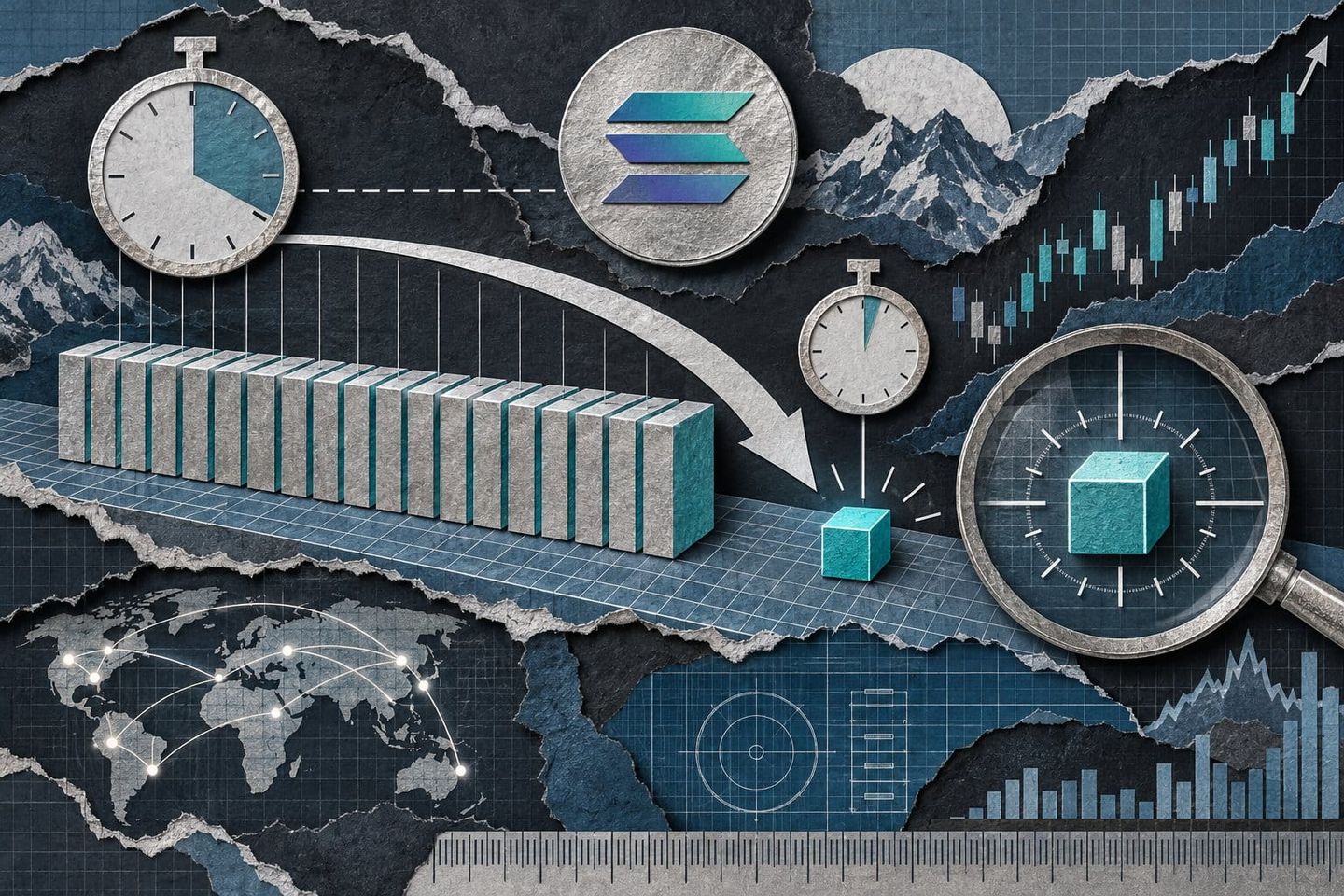
On Wednesday, October 21, 2026, Solana switches out the consensus engine it has run since launch. If it works, the time before a transaction becomes irreversible falls from about 12.8 seconds to about 150 milliseconds. Anza calls it "18 months of work for a migration that happens in one slot" .
What does Alpenglow change on Solana, and when does it go live?
Alpenglow (SIMD-0326) is a new consensus protocol for Solana. It replaces TowerBFT, which Solana has used since mainnet launched in March 2020. It activates on mainnet-beta on Wednesday, October 21, 2026, at epoch 1064. The Solana Foundation puts the start of that epoch at about 15:00 UTC . Anza's announcement gives the time as "~14:50 UTC" . The goal is to cut finality, the point where a transaction can no longer be reversed, from about 12.8 seconds to about 150ms (source: Solana Foundation, 2026-10).
Quick Answer: Alpenglow replaces Solana's TowerBFT consensus on October 21, 2026, at epoch 1064 (about 15:00 UTC). It aims to cut finality from about 12.8 seconds to about 150ms, roughly 85 times faster. Throughput does not rise 85-fold. Fees, transaction formats and the SVM stay the same, so SOL holders don't need to do anything.
The headline number needs some context. The 85-fold improvement applies to finality only, a point the 88BB Trading Labs explainer makes clearly. Solana does not process 85 times more transactions per second (video: 88BB Trading Labs). The 150ms figure is also a design target. Real mainnet performance can only be measured after activation.
Validators approved the change well in advance. SIMD-0326 passed in September 2025 with 98.27% of voting validators in favor , according to Decrypt. Before mainnet, Anza says the upgrade passed 9 large-scale test migrations and review by 115 security researchers. Testnet finished its switch on September 24 and devnet on September 25 (source: Anza, 2026-09).
What ships on October 21:
- Votor (included): the new voting protocol. Validators exchange votes directly instead of posting them as on-chain transactions, and the votes are combined into certificates.
- Rotor (not included): the planned replacement for Turbine, which spreads blocks across the network. It has no announced date .
- Unchanged: transaction formats, fees and the Solana Virtual Machine. Users and SOL holders don't need to do anything (source: Solana Foundation, 2026-10).
Traders should still watch a few things. There will be a short window on activation day with no user transactions. Validators that run Firedancer clients must move to an Agave-based client before the switch. Once votes leave the blocks, transaction-count dashboards will show a large drop even though real activity is the same. The sections below explain each of these and what they mean for a SOL position.
How does Votor reach finality in one round?
Votor is Alpenglow's new voting protocol. Validators send votes directly to each other and bundle them into certificates, so votes no longer go on-chain as transactions. If a block collects 80% of stake, it is final after one round of voting. If it collects between 60% and 80%, a second round makes it final at the 60% threshold . This change takes finality from about 12.8 seconds to a target of about 150 milliseconds (source: Solana Foundation, 2026-10).
The biggest change is where voting happens. Under TowerBFT, each validator vote was a transaction that took up block space. According to the Solana Foundation, Votor moves this exchange off the ledger. A certificate is a compact proof that enough stake agreed on a block . The fast path and the slow path run at the same time, and whichever finishes first decides finality . On a healthy network, the 80% fast path should handle most blocks. The 60% slow path keeps blocks finalizing when some validators are slow or unreachable.
| Property | TowerBFT (since 2020) | Alpenglow / Votor |
|---|---|---|
| Where votes are cast | As on-chain vote transactions | Exchanged directly, combined into certificates |
| Time to finality | ~12.8 seconds | ~150 ms (target) |
| Finality thresholds | Multiple vote rounds | 80% stake in one round, or 60% stake over two rounds |
| Fault tolerance | Below 33% of stake | Up to 40% (20% malicious + 20% offline) |
| "Confirmed" vs "finalized" | Separate states | Same state |
The upgrade also makes the network more resilient. Anza, the team that builds the Agave validator client, says Alpenglow can stay live with up to 40% of stake failing at once: 20% acting maliciously plus 20% offline. TowerBFT's limit was below 33% . Validators approved the design, SIMD-0326, in September 2025 with 98.27% voting in favor .
For traders, the practical result is that "confirmed" and "finalized" now mean the same thing (source: Solana Foundation, 2026-10). Exchanges, bridges and liquidation engines will no longer need to choose between a quick but reversible confirmation and a slow, final one. Anza summed up how compact the switch is:
"18 months of work for a migration that happens in one slot," — Anza, Agave client developer (source: Solana Compass)
This release does not cover everything. Alpenglow has a second component, Rotor, which will replace Turbine as the layer that spreads blocks across the network. Rotor is not part of the October 21 activation and has no announced date . Block propagation stays the same for now. Only the consensus and finality layer changes. Finality is also a separate measure from throughput, so the roughly 85-fold drop in finality time does not mean Solana will process 85 times more transactions (video: 88BB Trading Labs).
What happens during the Oct 21 handoff, minute by minute?
The Alpenglow handoff on October 21 happens in stages. The migration feature gate turns on when epoch 1064 starts, at about 15:00 UTC. TowerBFT keeps producing blocks for about 5,000 slots, and consensus passes to Alpenglow at slot 459,653,000, about 18 minutes into the epoch . In its migration specification, Anza says plainly that "Nothing migrates immediately" .
For traders, the most important part of that delay is the window just before the switch. From the epoch boundary until Alpenglow takes over, blocks carry only validator votes and no user transactions. That makes a pause of about 17 to 18 minutes during which swaps, transfers and liquidations will not settle on-chain. To finish the switch, Alpenglow needs a "genesis certificate" signed by validators holding 82% of stake, according to Solana Compass .
| Stage | Estimated time (UTC, Oct 21) | What happens on-chain |
|---|---|---|
| Epoch 1064 boundary | 14:55–15:10 | Migration feature gate activates; TowerBFT still produces blocks |
| Vote-only window | ~17–18 minutes after the boundary | Blocks carry validator votes only, with no user transactions |
| Handoff at slot 459,653,000 | 15:10–15:30 | Genesis certificate signed by 82% of stake; Alpenglow takes over finality |
The table uses Solana Compass time ranges . Slot times vary, so treat the clock times as estimates. The slot number is the fixed point.
"18 months of work for a migration that happens in one slot," — Anza, developer of the Agave validator client (source: Solana Compass)
Anza's testing record is the main evidence that a short window like this can work. According to Anza, Alpenglow has gone through:
- 9 successful large-scale test migrations
- simulations across 1,500 nodes
- review by 115 security researchers, backed by a bug bounty of more than 25,000 SOL
- completed switches on testnet on September 24 and devnet on September 25
None of those tests involved mainnet traffic or mainnet's full validator set. The practical step is to check notices from your exchange or protocol before about 14:50 UTC. Venues may pause or slow SOL and SPL token deposits and withdrawals until the handoff is confirmed. Avoid leaving time-sensitive transfers or tight liquidation thresholds open during that window.
Base case: Will the handoff go smoothly, and what do validators need to do?
The base case is a clean migration with only a short vote-only pause. This is the most likely outcome because Alpenglow has passed 9 large-scale test migrations, simulations across 1,500 nodes and review by 115 security researchers . The main risk in this scenario is not the protocol design. It is whether enough validators are running a supported client when the handoff happens.
The client requirement is strict. According to the Solana Foundation, "Firedancer and Frankendancer are not supported during the migration." Validators must run an Agave-based client (Agave, Jito-Solana or Harmonic Salsa) built on Agave 4.3.0 . Some coverage has described Alpenglow as part of the Firedancer rollout (video: 88BB Trading Labs). That description is misleading. Firedancer-family clients sit outside the migration path, and their operators have to switch to Agave-based software before activation.
The number of validators affected is large enough to matter. On October 13, Solana Compass counted about 15.8% of stake among the top 500 validators on Firedancer-family clients . Here is the breakdown:
- HarmonicFiredancer: 7.1% of stake
- Firedancer: 6.8%
- FireBAM: 1.6%
- Frankendancer: 0.3%
This matters because Alpenglow cannot start until a genesis certificate is signed by 82% of stake . Suppose most of that 15.8% has not switched, and some Agave validators are also offline or misconfigured. Then the margin above 82% gets thin, and the vote-only window could last longer than planned. In the base case, most of these operators switch before October 21 and the threshold is reached without trouble.
Validators also have a new cost to plan for. The Validator Admission Ticket (VAT) is a 0.8 SOL fee charged each epoch and burned. It replaces about 1 SOL per epoch that validators now spend on vote-transaction fees . Each vote account must hold at least 0.8 SOL to pay it . A validator whose vote account holds less than that cannot take part.
Over the longer term, the economics favor smaller operators. One estimate from Solana Compass puts validator break-even stake falling from about 4,850 SOL to about 450 SOL . This is a projection, not a measured result. If it holds, more independent validators could run profitably. In the base case, that supports decentralization slowly over months and does not move SOL's price on activation day.
Bull case: What could near-instant finality unlock for SOL?
The bull case for SOL is that faster finality cuts settlement time for everyone who moves value on Solana. That includes exchanges, arbitrage desks, lending protocols and bridges. The target is a drop from about 12.8 seconds to about 150 milliseconds . This is a thesis to monitor, not a price promise. The 150ms figure can only be measured on mainnet after October 21.
The gain applies to finality time only. Solana's throughput does not rise by the same factor (video: 88BB Trading Labs). The upside therefore depends on how much of the market currently waits on finality, and on whether that market changes its behavior once the wait is gone.
Under Alpenglow, "confirmed" and "finalized" become the same state, according to the Solana Foundation and Decrypt . That opens several possible channels:
- Faster exchange deposit credits. Exchanges set their own confirmation requirements for SOL and SPL deposits. If venues cut them once finality takes a fraction of a second, capital could move between chain and order book faster. No exchange has announced such a change yet, so this is the clearest signal to watch.
- Tighter arbitrage and liquidations. When finality is near-instant, a trader holds less unsettled risk between actions. In principle, that lets arbitrage close price gaps faster and lets lending protocols clear bad positions with less slippage.
- Cross-chain bridge settlement. Bridges that wait for source-chain finality before releasing funds on another chain could shorten their wait for Solana-origin transfers.
- Broader validator participation. The new Validator Admission Ticket burns 0.8 SOL per epoch. It replaces roughly 1 SOL per epoch in vote-transaction fees . Combined with the lower break-even estimate covered above, cheaper operation supports a long-term decentralization argument.
Resilience adds to the case. Anza says Alpenglow can tolerate up to 40% of stake failing at once: 20% malicious and 20% offline. TowerBFT's limit was below 33% . For institutions judging whether Solana is a reliable settlement layer, that change in fault tolerance gives them something concrete to assess.
The story behind the upgrade also has staying power. Incrypted describes Alpenglow as the biggest mainnet upgrade in Solana's history . It had broad support: SIMD-0326 passed in September 2025 with 98.27% of validators voting in favor . That gives the project a reason to talk about performance beyond October 21, especially if Rotor, the planned replacement for Turbine, later gets a date.
The bull case only holds if usage follows. Watch three things: exchange deposit policies, measured finality times after activation, and DeFi liquidation and arbitrage activity in the weeks that follow. If those don't move, the bull case remains a narrative and not a fundamental change.
Bear case: Why Alpenglow could be a 'sell the news' event
The bear case is that Alpenglow may already be priced in, and October 21 carries more short-term risk than reward. The handoff could stall. Dashboards will show a misleading drop in activity. Faster finality also remains a target until it is measured on mainnet. Each of these can weigh on SOL even if the upgrade works as designed. Coverage has called it the biggest mainnet upgrade in Solana's history (source: Incrypted, 2026-10). Events with that much attention often see traders take profits once the event passes.
The first risk is liveness at the handoff. Alpenglow cannot start until a genesis certificate is signed by 82% of stake . On October 13, about 15.8% of stake among the top 500 validators still ran Firedancer-family clients, which are not supported during the migration (source: Solana Compass, 2026-10). If enough of those validators do not switch, the certificate could be delayed and the vote-only window, with no user transactions, could run longer than planned.
The second risk is how the numbers will look. Votes currently make up about 3,060 transactions per second, roughly 63% of the total, against about 1,780 user transactions per second . Votes will no longer be recorded in blocks, so raw TPS charts will fall sharply even though real activity stays the same (source: Solana Foundation, 2026-10). Headlines that misread this drop as a collapse in usage could cause a brief sell-off.
The third risk is data infrastructure. Proof of History ticks are being removed. A single slot may also hold more than one candidate block, so indexers and bots need to track (slot, bank_id) pairs . Systems that are not updated could produce short-lived data errors that affect trading tools.
| Bear risk | What to watch on Oct 21 | Likely market read |
|---|---|---|
| Delayed genesis certificate | Vote-only window lasting longer than about 18 minutes | Concerns about liveness |
| Drop in TPS dashboards | Raw TPS falling by about 63% | False signal that usage has collapsed |
| Outdated indexers and bots | Price-feed or explorer errors | Short-lived volatility |
| Unproven 150ms finality | Finality measured after activation | Pricing of the narrative fades |
Finally, 150ms is still only a target. The Foundation and Decrypt describe the change as a drop from about 12.8 seconds to about 150 milliseconds . Real mainnet numbers will only be known after activation. That improvement applies to finality, not throughput (video: 88BB Trading Labs). If measured results fall short, or the switch has visible problems, the narrative could unwind faster than it built up.
Portfolio implication: How should traders approach Oct 21?
For traders, Oct 21 is a short window of operational risk, not a buy or sell signal. Avoid time-critical SOL transfers and leveraged positions between roughly 14:50 and 15:30 UTC. After that, judge Alpenglow by measured data, not by the launch headline. Before activation, the useful work is limiting your exposure to that window. After activation, it's checking whether the 150ms finality target holds on mainnet.
Pre-event checklist:
- Read venue notices. Exchanges and protocols may pause or slow SOL and SPL token deposits and withdrawals during the switch. Each venue sets its own policy, so check each one you use.
- Stay out of the 14:50–15:30 UTC window. According to Solana Compass, the epoch boundary should come at about 14:55–15:10 UTC and the completed handoff at about 15:10–15:30 UTC . Blocks in between carry no user transactions.
- Keep SOL off venues that announce pauses. Don't leave funds where they can't be moved if prices swing.
Position sizing: Compare the risk at handoff with the long-term finality thesis, and size your position so you're comfortable with either outcome. A clean switch needs a genesis certificate signed by 82% of stake. On October 13, about 15.8% of stake among the top 500 validators still ran Firedancer-family clients, and those validators must move to an Agave-based client before activation . Avoid taking leveraged positions into the window. A pause in user transactions combined with sharp price moves is a bad setup for margin.
Post-event watchlist:
- Measured finality: Compare real finality times with the 150ms target published by the Solana Foundation .
- Validator client mix: Check whether stake that moved off Firedancer-family clients returns once those clients are supported again.
- Exchange confirmations: Watch whether venues cut the confirmation counts they require for SOL deposits.
- DeFi and bridges: Watch liquidation engines, bridges and indexers. Indexers now have to track (slot, bank_id) pairs, and poorly updated infrastructure could cause short-lived data glitches.
- TPS dashboards: Vote transactions currently run at about 3,060 per second, roughly 63% of all transactions . Once votes leave the blocks, raw transaction counts will fall even if real usage doesn't change. Don't read that drop as users leaving.
Risk disclosure: No outcome on October 21 is certain. This article is market analysis, not financial advice.
Takeaway: Before October 21, focus on protecting yourself during the roughly 40-minute window. After it, base any change to your SOL position on measured finality and how infrastructure actually behaves, not on the launch headline.
Frequently Asked Questions
When exactly does Solana Alpenglow activate on mainnet?
Alpenglow is scheduled to activate on Solana mainnet-beta on Wednesday, October 21, 2026. The Solana Foundation ties the start to epoch 1064, which begins at about 15:00 UTC . Anza gives the time as about 14:50 UTC . TowerBFT keeps running for about the first 5,000 slots. The switch to the new consensus system happens at slot 459,653,000, roughly 18 minutes into the epoch .
Will I need to do anything with my SOL?
No. SOL holders and regular users don't need to do anything for Alpenglow. Transaction formats, fees and the Solana Virtual Machine stay the same . The one practical step is to check notices from your exchange or wallet. Some services may pause or slow SOL and SPL token deposits and withdrawals during the switch on October 21, so avoid planning time-sensitive transfers for that window.
Is Solana really 85x faster after Alpenglow?
Only in finality. Finality is the point where a transaction can no longer be reversed, and Alpenglow aims to cut it from about 12.8 seconds to about 150 milliseconds . That works out to roughly an 85-fold improvement, but Solana's throughput does not rise 85 times (video: 88BB Trading Labs). The 150ms figure is a design target. Real mainnet performance can only be measured after activation.
Does Alpenglow work with Firedancer?
Not during the migration. The Solana Foundation says Firedancer and Frankendancer are not supported while the switch takes place. Validators must run an Agave-based client (Agave, Jito-Solana or Harmonic Salsa) built on Agave 4.3.0 . On October 13, about 15.8% of stake among the top 500 validators ran Firedancer-family clients, according to Solana Compass . Those validators must switch to an Agave-based client before the upgrade or they can't take part.
Why will Solana's TPS look lower after the upgrade?
Under Alpenglow, validator votes no longer go into blocks, so raw transaction counts will fall even if user activity stays the same. Today votes make up about 3,060 transactions per second, or roughly 63% of the total, compared with about 1,780 user transactions per second . Under Votor, validators exchange votes directly instead of posting them on-chain, as the Alchemy and Anza explainers describe. When you read TPS dashboards, look at user transactions only. Don't take the drop in total TPS as a sign that usage collapsed.
Enjoyed this article? Subscribe to get new stories by email whenever they're published.