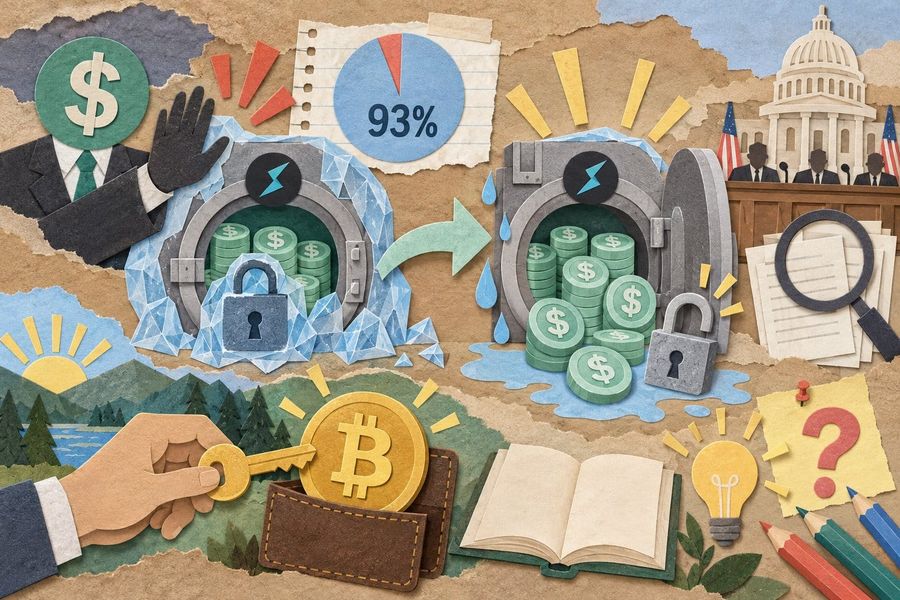
A global regulator has now named the weak spot in how the largest dollar stablecoins are built. Affiliates in different countries can issue the same token, but each holds its own reserves, and those reserves may not be able to cross borders fast enough when holders rush to redeem.
What Did the FSB Say About Multi-Issuer Stablecoins and Cross-Border Runs?
On 12 October 2026 the Financial Stability Board (FSB) sent a note to the G20 . It warned that when affiliated companies in different countries issue the same token, redemption requests can pile up at one affiliate while reserves cannot easily move across borders to meet them. Press coverage names Circle's USDC and the Paxos Global Dollar as examples of this multi-issuer structure . The note does not accuse either issuer of wrongdoing.
Quick Answer: In a multi-issuer stablecoin such as USDC, affiliates in different countries share liability for one token but hold separate reserves. The FSB warned the G20 on 12 October 2026 that in a run, redemptions could hit one affiliate while its reserves sit stuck in another country. The market is worth about $300 billion, and 99% of it is pegged to the U.S. dollar.
The note is titled "Global Stablecoin Arrangements: Cross-border vulnerabilities and financial stability monitoring." The FSB summarises its main point like this: global stablecoins are "an inherently cross-border and cross-sectoral issue that may give rise to financial stability vulnerabilities." A token used in many countries could become systemically important in more than one of them. That makes it harder for any single regulator to judge or contain the risk on its own.
The size of the market shows why this matters. Unchained and Crypto Briefing report the FSB's estimate:
- The stablecoin market is worth about $300 billion as of mid-2026, little changed over the previous 12 months .
- About 99% of that value is pegged to the U.S. dollar .
CoinDesk gives a slightly different path: about $206 billion at the start of 2025, rising to about $306 billion now . This article uses "about $300 billion" as the FSB's figure.
The timing is also important. Coverage says the U.S. G20 presidency requested the note. It went out with a letter from FSB Chair Andrew Bailey, who is also Governor of the Bank of England, to G20 Finance Ministers and Central Bank Governors. They meet on 15 October 2026 . Bailey summed up the problem directly:
"Global stablecoin arrangements are inherently cross-border, yet national regulations are taking shape at different speeds and cross-border cooperation in this area is still in its infancy," — Andrew Bailey, Chair of the Financial Stability Board and Governor of the Bank of England (source: CoinDesk)
Traders should keep the scope in mind. The note creates no new rules. It summarises the FSB's ongoing monitoring work and sets out further work, and FSB recommendations are not legally binding. Reports also quote the note as finding that "global stablecoins and national regulatory frameworks remain untested in severe stress and insolvency" .
One limit on the sources: the FSB's 5-page PDF could not be fully text-extracted . The named issuers, the $300 billion and 99% figures, and the "untested" quote all come from press coverage of the note and Bailey's letter. They have not been checked against the PDF text itself.
How Does Multi-Issuer Stablecoin Structure Actually Work?
A multi-issuer stablecoin is a single token issued by several affiliated companies in different countries. The affiliates share liability for the token, but each one holds its own reserve pool . A holder sees one fungible asset on-chain. Legally and operationally, though, the backing is split across separate firms, separate regulators and separate custody arrangements. That gap between one token on-chain and many balance sheets off-chain is the structure the FSB's 12 October 2026 note warned about.
The FSB was not describing a theoretical design. According to Ledger Insights, the note named Circle's USDC and the Paxos Global Dollar as examples of multi-issuance arrangements . Crypto Briefing points out that naming them is not an accusation of wrongdoing against either issuer . The FSB's point is about the structure, not about how any one firm manages its reserves today. For traders this matters. The concern is how the arrangement behaves under severe stress, not whether reserves exist in normal conditions.
The liability-reserve mismatch
The basic tension was set out a year before the G20 note. The FSB's October 2025 thematic review of its crypto framework warned that liquidity risk can be worse when "each co-issuer could be liable for the entire stock of tokens in circulation while holding only a fraction of the overall reserve of assets" (source: FSB thematic review, 2025-10). Put simply, a holder could ask any affiliate to redeem any token. Each affiliate's vault, however, holds only its own share of the total backing.
In calm markets, redemptions spread out and the mismatch never shows. It matters when redemption demand piles up in one place. If most cash-out requests reach one affiliate, that entity's local reserves may run short, even while the arrangement as a whole is fully backed on paper.
| Feature | Single-issuer stablecoin | Multi-issuer stablecoin |
|---|---|---|
| Issuing entities | One legal issuer | Several affiliates in different jurisdictions |
| Reserve location | One pool under one regulator | Separate pools, one per affiliate |
| Liability to holders | Issuer liable for all tokens | Shared; each co-issuer may be liable for the full token stock |
| Supervisors involved | Mainly one national authority | Several national authorities |
| Main stress risk | Total reserve shortfall or liquidity crunch | Local shortfall at one affiliate while reserves sit elsewhere |
| FSB-cited examples | None named | USDC, Paxos Global Dollar |
Where MiCA meets the multi-issuer model
Europe shows the problem most clearly. Ledger Insights notes that the stablecoin rules of the EU's Markets in Crypto-Assets regulation (MiCA) have applied since 30 June 2024 . Tokens issued both inside and outside the EU by affiliated entities are a known weak point in that regime. An EU-authorised affiliate's reserves sit under European oversight. A sister entity elsewhere answers to a different regulator, yet both put the same token into circulation.
For a trader holding the token, three practical points follow:
- Fungibility hides location: on-chain, you usually cannot tell which affiliate issued the token you hold.
- Redemption path matters: which affiliate you redeem through decides which reserve pool and which legal regime you rely on.
- Full backing overall is not local liquidity: a fully reserved arrangement can still face a shortfall at one affiliate if reserves cannot be moved quickly.
That last point is the reason the FSB focused on whether reserves can actually move across borders during a run.
Why Can't Reserves Simply Move Across Borders During a Run?
Reserves can't simply move across borders during a run because each affiliate's reserves sit inside a separate national legal system. Local rules, supervisors and court processes can stop those assets from being sent abroad quickly, especially when stress hits. The Financial Stability Board's 12 October 2026 note to the G20 warns that redemption requests could pile up at one affiliate while the reserves that would meet them are held by another affiliate in a different jurisdiction . In short, an arrangement can be fully backed overall and still lack cash in the place where holders want it.
This is the trapped-reserve scenario. According to Unchained, the FSB's concern is that demand to cash out can land in one country while the assets sit in another . The idea goes back to the FSB's October 2025 thematic review. That review warned that liquidity risk is worse when "each co-issuer could be liable for the entire stock of tokens in circulation while holding only a fraction of the overall reserve of assets" . Because the token is identical everywhere, each affiliate may have to honour redemptions for the whole supply, while the reserves stay split along legal lines.
Why would a regulator block a transfer between affiliates? This article's inference is that a national supervisor looking at a failing local entity will usually try to protect local holders and creditors first. Letting reserves leave for another country in the middle of a crisis works against that. The FSB note does not spell out this motive. What it does say is that one global stablecoin may fall under several national authorities at once, which limits how well any single jurisdiction can assess or fix the problem alone .
"Global stablecoin arrangements are inherently cross-border, yet national regulations are taking shape at different speeds and cross-border cooperation in this area is still in its infancy," — Andrew Bailey, FSB Chair and Governor of the Bank of England, in his letter to G20 Finance Ministers and Central Bank Governors (source: CoinDesk)
A second problem makes the first worse: issuers may not know where their holders are. Banks run know-your-customer checks on every depositor, so they know which branch and which legal system each claim belongs to. Stablecoin tokens, by contrast, move freely between pseudonymous wallets once issued. Unchained reports the FSB's point that issuers cannot reliably predict where redemption demand will come from . An issuer can't place liquidity ahead of time for a run whose location it can't see.
The same blind spot creates a legal gap. If a multi-issuer arrangement fails, it is unclear which country's insolvency regime would apply. It could be the country of the affiliate that minted a token, the country where the holder lives, or the country where the reserves are held. Different answers could give holders of the same token very different recoveries. The FSB flags this uncertainty directly .
None of these arrangements has been tested under real pressure. According to Ledger Insights, the note finds that "global stablecoins and national regulatory frameworks remain untested in severe stress and insolvency." It also describes supervision, crisis management and cross-border cooperation as underdeveloped . That quote comes from press coverage, not from a full text extraction of the FSB PDF. For traders, the practical points are:
- Where you redeem matters: the affiliate you redeem through decides which reserve pool and which legal process you depend on if something breaks.
- Trading at par is not proof of local liquidity: a token can hold its peg in normal markets and still face a shortfall at one affiliate during a run.
- Legal outcomes are unknown: there is no tested precedent for how a failed multi-jurisdiction stablecoin would be wound down.
What Other Structural Vulnerabilities Did the FSB Flag?
The FSB's note also flags three structural mismatches that go beyond the multi-issuer setup. First, stablecoins trade 24/7, while the markets for their reserve assets keep set hours. Second, pseudonymous transfers hide where holders are and which country's rules apply. Third, redemption demand can move quickly from one jurisdiction to another. CoinDesk reported all three points in its coverage of the note to the G20, published on 12 October 2026 (source: CoinDesk, 2026-10). Each one makes a run harder to manage, whether a token has one issuer or several.
The first problem is timing. A stablecoin can be sold or redeemed at 3 a.m. on a Sunday. The Treasury bills, repo positions and bank deposits behind it only trade or settle during business hours. If a loss of confidence starts over a weekend, the issuer may face redemption requests it cannot fund until markets reopen. On-chain secondary markets then become the only exit, and that is where discounts to par usually show up first.
The second problem is identity. Unchained explains that banks know their depositors, but stablecoin issuers may not know where their holders are or where redemption demand will come from. That makes it unclear which national insolvency regime would apply if an issuer failed (source: Unchained, 2026-10). A bank resolution authority can count insured deposits by country. A stablecoin supervisor looking at pseudonymous wallets often cannot.
The third problem is speed. A token can move from a wallet in one country to an exchange in another within minutes. So redemption pressure can build at an affiliate or market that did not expect it. That links directly to the multi-issuer concern: reserves are split by jurisdiction, but demand is not. The FSB's own summary describes global stablecoins as "an inherently cross-border and cross-sectoral issue" that may fall under several national authorities at once (source: FSB, 2026-10).
What each vulnerability means for traders:
- 24/7 trading vs. reserve markets with set hours: weekend and holiday stress is more likely to show up as a discount on exchanges than as a smooth redemption, so watch the peg most closely when traditional markets are closed.
- Pseudonymous holders: nobody, including regulators, can easily map where a stablecoin's holders are, so official assurances during a crisis may rest on incomplete data.
- Fast-moving redemptions: pressure can move from one region to another within hours, so a calm market in your time zone does not mean calm everywhere.
- Combined effect: the three issues reinforce each other. A run that starts off-hours, in an unclear jurisdiction, through a single affiliate is the scenario current frameworks have not been tested against.
None of these points accuses a particular issuer of doing anything wrong. Crypto Briefing notes that the FSB is describing structural features, not misconduct (source: Crypto Briefing, 2026-10). They are design features of a market that runs nonstop and across borders, sitting on top of a financial system that does neither.
How Could a Stablecoin Run Spread to Traditional Finance and Emerging Markets?
A stablecoin run could reach traditional finance in two main ways. First, issuers could be forced to sell reserve assets quickly. Second, users could pull deposits from banks. Ledger Insights and Crypto Briefing both report this as the FSB's view in its October 2026 note to the G20 . Most stablecoin use is still inside crypto markets, which limits how far stress could spread for now. The main exception is emerging economies, where people hold dollar tokens as savings.
The two channels work in different ways, and each puts pressure on a different part of the financial system:
- Fire sales of reserves: To pay out redemptions faster than reserves mature, an issuer has to sell Treasury bills, repo positions or other holdings in a hurry. Large, fast sales can move prices in the markets that hold those reserves. As noted earlier in this article, those markets keep set hours while redemption requests arrive 24/7 .
- Bank deposit flight: Reserves held as bank deposits can be pulled when issuers need cash. Users can also move their own bank balances as they react to the stress. In both cases, banks lose funding outside the crypto sector .
The multi-issuer setup makes both channels worse. If redemption requests pile up at one affiliate whose reserves are not enough, that affiliate may have to sell assets in its local market. This can happen even when the group as a whole holds enough reserves elsewhere. Stress can therefore land in one country's markets more heavily than the group's total balance sheet would suggest.
For now, the biggest buffer is where stablecoins are used. Ledger Insights reports that, according to the FSB, most stablecoin activity is still trading and settlement inside crypto markets. A run would hit crypto prices and liquidity first, and would only reach the wider economy through the reserve and deposit channels above.
Emerging markets are the exception. In those economies, dollar stablecoins are increasingly used to store value, often as a hedge against a weak local currency. The FSB's July 2024 report on emerging market and developing economies (EMDEs) (source: FSB, 2024-07) warned that global stablecoins pegged to foreign currencies can destabilise financial flows and strain fiscal resources . The underlying problem is capital flight: savings move out of the local banking system and the domestic currency into a dollar token that the local central bank cannot manage. If that token then wobbles, households in those countries carry the losses, and their central banks have little ability to step in.
The size of the market shows why regulators are paying attention now even though the system-wide risk is still limited. Different sources give slightly different numbers:
| Metric | Figure | Source |
|---|---|---|
| Stablecoin market size (FSB estimate, mid-2026) | About $300 billion, little changed over the previous 12 months | Unchained |
| Share of value pegged to the U.S. dollar | 99% | Crypto Briefing |
| Market size, start of 2025 | About $206 billion | CoinDesk |
| Market size, October 2026 | About $306 billion | CoinDesk |
Take "about $300 billion" as the FSB's own figure. CoinDesk's numbers show the growth since early 2025, while the FSB describes the market as roughly flat over the past year. The two do not conflict much, because they cover different time windows. Both show a market made up almost entirely of dollar tokens. That is why the EMDE dollarisation risk and the pressure on U.S. reserve markets are two sides of the same exposure.
How Ready Are Regulators? Gaps in Frameworks, Data and Cooperation
Regulators are not yet ready for a cross-border stablecoin run. The FSB's October 2025 thematic review found that only 11 of 28 surveyed jurisdictions had finalised stablecoin regulatory frameworks , according to Ledger Insights. The 12 October 2026 note to the G20 also says supervision, crisis management, accountability and cross-border cooperation remain underdeveloped . For traders, this means no tested international playbook exists for a large dollar-token failure. In a stress event, outcomes would depend on how each national authority acts on its own, not on any coordinated plan.
The gap is about timing as well as coverage. Even where rules exist, they arrived in different years and follow different designs. The EU's MiCA stablecoin rules, for example, have applied since 30 June 2024 . Many other jurisdictions are still drafting. FSB Chair Andrew Bailey summed up the result in his letter to G20 Finance Ministers and Central Bank Governors:
"Global stablecoin arrangements are inherently cross-border, yet national regulations are taking shape at different speeds and cross-border cooperation in this area is still in its infancy," — Andrew Bailey, Chair of the Financial Stability Board and Governor of the Bank of England (source: CoinDesk)
There is also a limit on enforcement. The FSB's recommendations are not legally binding . Members usually write agreed standards into national law, but the timing and detail are up to each member. The FSB's July 2023 high-level recommendations on global stablecoin arrangements are still being put into practice more than three years later. That gap between agreeing a standard and enforcing it at home is the main reason the FSB is pressing on implementation again.
Data is the third weak point. The FSB note reviews the current sources for stablecoin monitoring and their limits, then proposes metrics . Crypto Briefing describes those metrics as a direction of travel, not a finished template with intervention thresholds . In practice, no agreed number yet tells a supervisor when to step in. Pseudonymous holders make the job harder still, because authorities cannot easily see where redemption demand sits.
| Readiness area | Current state | What it means for a run |
|---|---|---|
| National frameworks | 11 of 28 surveyed jurisdictions finalised (FSB 2025 review) | Many holders sit in jurisdictions with no finished rulebook |
| Cross-border cooperation | "Still in its infancy," per Bailey's 2026 letter | Moving reserves or sharing information under stress is uncertain |
| Legal force | FSB standards are not binding; members implement them in national law | Rules arrive at different speeds and in different forms |
| Monitoring data | Metrics proposed; no intervention thresholds | Early-warning signals are not standardised across authorities |
| Crisis planning | FSB is still gathering information on planning for distress and failure | Untested in severe stress and insolvency |
The table shows why the FSB calls both global stablecoins and national frameworks "untested in severe stress and insolvency." No single gap would decide a crisis on its own. Together, though, they mean the first real test would also be the first time these arrangements are used.
What Does the FSB Want Done Next, and What Should Traders Watch?
The FSB wants more monitoring, better data and more crisis planning, not new rules yet. Its 12 October 2026 note lists further work in four areas . FSB recommendations are not legally binding. Members usually write agreed standards into national law, so any measures that bind issuers will come later and country by country . For traders, the short-term effect is on information, not on how USDC works today.
According to the FSB note and Ledger Insights, the four areas are :
- Cross-border monitoring: tracking where holders, redemption demand and reserves actually sit.
- Implementation of the July 2023 recommendations: putting the FSB's global stablecoin framework into practice, especially cross-border cooperation and information sharing .
- Distress and failure planning: collecting information on how issuers and authorities would handle a failure.
- Data quality: improving the inputs. The proposed metrics are described as a direction of travel, not a finished template with intervention thresholds .
The next checkpoint is the G20 Finance Ministers and Central Bank Governors meeting on 15 October 2026 . The question is whether ministers simply endorse further work or set a timetable for cross-border stablecoin monitoring. A timetable would be the clearer sign that national rules on multi-issuer structures are coming. Stablecoins are only one part of the package. In the same letter from FSB Chair Andrew Bailey, he also flagged volatility in sovereign bond markets, weak spots in private credit, and risks from artificial intelligence . Pressure in sovereign bonds matters directly, because short-dated government debt is a common reserve asset that issuers might have to sell quickly in a run.
Traders who hold or route funds through a dollar stablecoin can use this checklist:
- Issuer structure and reserve location: Find out whether the token is issued by one entity or by affiliates in several jurisdictions, as with USDC and Paxos Global Dollar . Then find out which affiliate holds the reserves backing the tokens you would redeem.
- Redemption terms: Know which entity you would redeem through, the minimum size, the fees, and the banking hours that apply. Reserve-asset markets keep set operating hours while stablecoins trade around the clock .
- Depeg signals: Watch secondary-market discounts that persist, spreads that widen between the same token on different venues or chains, and any delays or pauses in redemptions.
- Jurisdiction exposure: Find out which national insolvency regime would likely apply to you. The FSB notes that in a failure this is still unclear .
Base case: The G20 endorses further FSB work. Over the following quarters, national authorities tighten reporting on where reserves are held and on affiliate liabilities. A market of about $300 billion, 99% of it pegged to the dollar, runs as before . Downside case: A stress event pushes redemptions onto one affiliate whose local reserves are short. Holders on that side then face delays or a discount even though the global balance sheet is fully backed. This scenario has not happened. The FSB's point is that nobody has tested it.
The practical takeaway: treat "fully reserved" and "redeemable where you are, when you need it" as two separate questions. Before you keep large balances in any multi-issuer stablecoin, check which entity you would redeem through and where its reserves sit.
Frequently Asked Questions
What is a multi-issuer stablecoin?
A multi-issuer stablecoin is a single token that affiliated companies in different countries all issue. The affiliates share liability for the token, but each one holds its own separate pool of reserves . The Financial Stability Board (FSB) warned in its October 2025 thematic review that liquidity risk can grow when "each co-issuer could be liable for the entire stock of tokens in circulation while holding only a fraction of the overall reserve of assets" (source: FSB thematic review, 2025-10) .
Did the FSB say USDC is unsafe?
No. According to Ledger Insights, the FSB's 12 October 2026 note names Circle's USDC and the Paxos Global Dollar as examples of multi-issuance arrangements . Crypto Briefing points out that this does not accuse either issuer of wrongdoing. The FSB's concern is structural: in a severe run, redemption requests could build up at one affiliate while reserves held in another country cannot easily be moved to meet them. This identification of named issuers comes from press coverage, not from the FSB PDF text itself.
Does the FSB note create new binding rules?
No. The note sums up the FSB's ongoing work on cross-border stablecoin risks and on monitoring data. It was requested by the U.S. G20 presidency and does not set any new regulations . As CoinDesk reports, FSB recommendations are not legally binding, although member countries usually write agreed standards into national law. Any binding change for USDC or other multi-issuer tokens would have to come from national authorities, for example under the EU's MiCA rules, which have applied since 30 June 2024 .
How big is the stablecoin market according to the FSB?
Press reports say the FSB estimates the stablecoin market at about $300 billion as of mid-2026. That is roughly unchanged over the prior 12 months, and 99% of the value is pegged to the U.S. dollar (source: Unchained, 2026-10) . CoinDesk gives a slightly different path, from about $206 billion at the start of 2025 to about $306 billion now . "About $300 billion" is the figure to attribute to the FSB.
What should traders watch after the 15 October G20 meeting?
Watch whether G20 Finance Ministers and Central Bank Governors endorse more cross-border stablecoin monitoring work or set a timetable for it at their 15 October 2026 meeting, which was reported to be in Bangkok . After that, the signals that matter are national: new rules on reserve location, redemption rights or information sharing for multi-issuer tokens. Also follow the FSB's four work areas on its crypto-assets and global stablecoins page: monitoring, putting its July 2023 recommendations into practice, planning for issuer distress, and better data quality .
Enjoyed this article? Subscribe to get new stories by email whenever they're published.