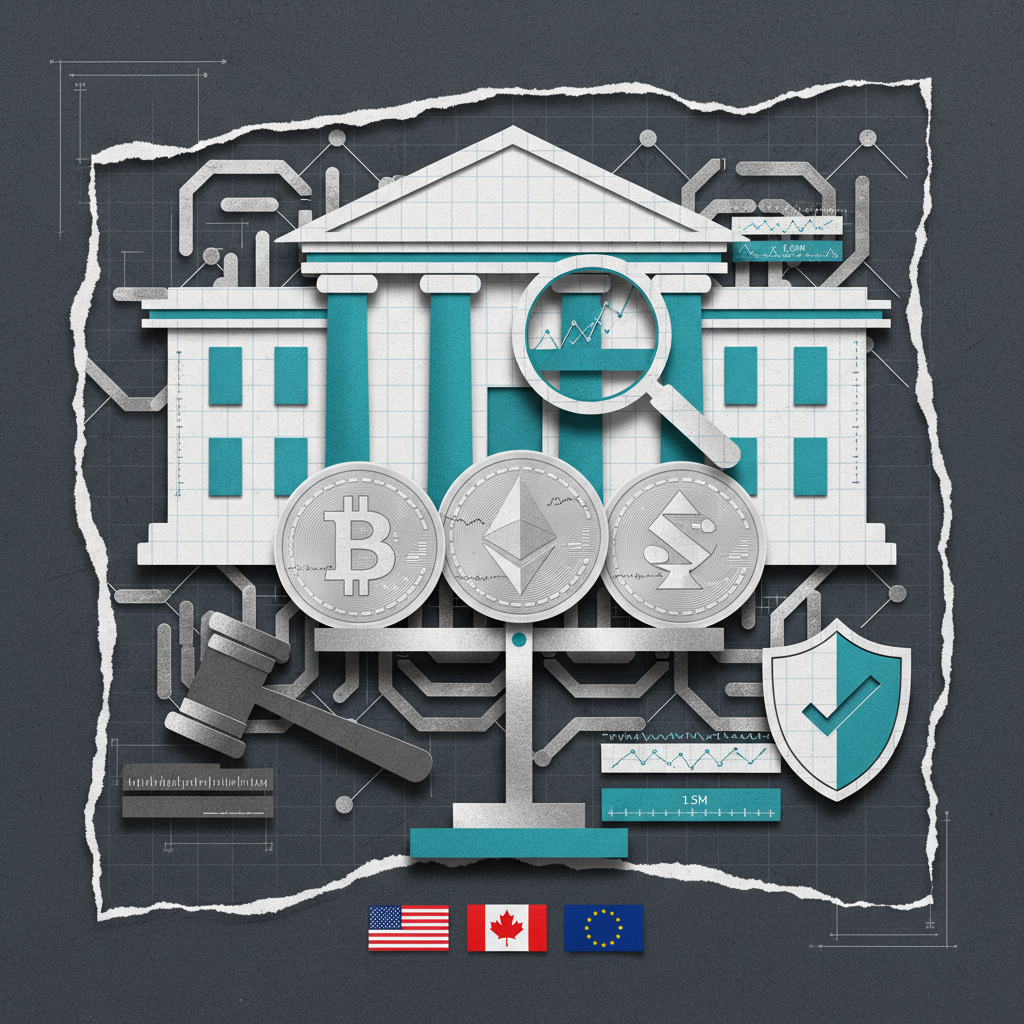
On March 17, 2026, the U.S. Securities and Exchange Commission and the Commodity Futures Trading Commission issued their first-ever joint interpretive release on crypto asset classification—a watershed moment ending over a decade of regulatory ambiguity. This comprehensive guide breaks down the new five-category framework, the 18 tokens officially designated as digital commodities, and the Token Safe Harbor poised to reshape how blockchain startups raise capital.
What Is the SEC-CFTC Joint Interpretation? A Decade of Regulatory Uncertainty Resolved
Quick Answer: On March 17, 2026, the SEC and CFTC issued their first-ever joint interpretive release, classifying crypto assets into five categories. Eighteen major tokens—including BTC, ETH, SOL, and XRP—were officially designated "digital commodities," confirming they are not securities. This landmark decision ends a decade of enforcement-driven regulatory uncertainty.
The SEC-CFTC Joint Interpretation is a landmark regulatory release that establishes, for the first time, a unified federal classification framework for crypto assets across both agencies. Announced on March 17, 2026, the interpretive release categorizes all crypto assets into five distinct classes: digital commodities, digital collectibles, digital tools, stablecoins, and digital securities, according to the official SEC press release. The 18 tokens designated as digital commodities—including Bitcoin, Ethereum, Solana, and XRP—collectively represent over $1.7 trillion in market capitalization, roughly 72% of the total crypto market cap of $2.37 trillion as of March 29, 2026. This classification removes these assets from securities oversight entirely, placing them under the CFTC's commodity jurisdiction instead. The implications are profound: exchanges can list these tokens without fear of SEC enforcement actions, institutional custodians gain legal clarity, and derivatives markets can expand under a well-defined regulatory umbrella.
The Five-Category Crypto Asset Classification Framework
For over a decade, the SEC relied primarily on the Howey Test—a 1946 Supreme Court standard—to determine whether crypto tokens constituted investment contracts. This enforcement-first approach led to years of costly litigation, most notably the SEC's multi-year battle with Ripple Labs over XRP's classification. The new joint interpretation replaces this ad hoc model with five clearly defined categories:
- Digital Commodities: Fully decentralized tokens with no central issuer promising profits. Subject to CFTC oversight. Eighteen tokens designated in this initial release.
- Digital Collectibles: NFTs and unique digital assets functioning as collectibles rather than investment vehicles. Exempt from both SEC and CFTC registration requirements.
- Digital Tools: Utility tokens providing access to specific blockchain services or platforms. Regulated based on actual function, not speculative potential.
- Stablecoins: Tokens pegged to fiat currencies or stable assets, subject to separate regulation under the GENIUS Act signed into law on July 18, 2025.
- Digital Securities: Tokens meeting Howey Test criteria that remain under full SEC jurisdiction, requiring registration or applicable exemption.
SEC Chairman Paul Atkins emphasized the significance of the framework: "After more than a decade of uncertainty, this interpretation will provide market participants with a clear understanding of how the Commission treats crypto assets under federal securities laws. This is what regulatory agencies are supposed to do: draw clear lines in clear terms," according to the SEC announcement.
The 18 Digital Commodities: Full List and Market Impact
The designation of 18 crypto assets as digital commodities marks the largest single reclassification event in U.S. crypto regulatory history. For projects like XRP, which fought a three-year SEC lawsuit, and SOL, which was named in multiple enforcement actions, the reclassification removes existential legal overhang. For a deeper look at how this regulatory shift is affecting prices, see our latest Bitcoin price analysis.
| Token | Sector | Market Cap Tier | Prior Regulatory Status | New Classification |
|---|---|---|---|---|
| BTC | Layer 1 | Mega (>$1T) | Commodity (CFTC precedent) | Digital Commodity ✅ |
| ETH | Layer 1 / Smart Contract | Large ($200B+) | Disputed (SEC vs. CFTC) | Digital Commodity ✅ |
| XRP | Payments | Large ($50B+) | SEC Lawsuit (Ripple) | Digital Commodity ✅ |
| SOL | Layer 1 | Large ($30B+) | Named in SEC enforcement actions | Digital Commodity ✅ |
| DOGE | Meme / Payments | Mid ($10B+) | Unclassified | Digital Commodity ✅ |
| ADA | Layer 1 | Mid ($10B+) | Named in SEC enforcement actions | Digital Commodity ✅ |
| LINK | Oracle Network | Mid ($8B+) | Unclassified | Digital Commodity ✅ |
| AVAX | Layer 1 | Mid ($6B+) | Named in SEC enforcement actions | Digital Commodity ✅ |
| DOT | Layer 0 | Mid ($5B+) | Unclassified | Digital Commodity ✅ |
| LTC | Layer 1 | Mid ($5B+) | Commodity (CFTC precedent) | Digital Commodity ✅ |
| BCH | Layer 1 | Mid ($4B+) | Commodity (CFTC precedent) | Digital Commodity ✅ |
| SHIB | Meme / DeFi | Mid ($4B+) | Unclassified | Digital Commodity ✅ |
| XLM | Payments | Small ($3B+) | Unclassified | Digital Commodity ✅ |
| HBAR | Enterprise DLT | Small ($3B+) | Unclassified | Digital Commodity ✅ |
| APT | Layer 1 | Small ($3B+) | Unclassified | Digital Commodity ✅ |
| XTZ | Layer 1 | Small ($1B+) | SEC Settlement (2024) | Digital Commodity ✅ |
| ALGO | Layer 1 | Small ($1B+) | Named in SEC enforcement actions | Digital Commodity ✅ |
| LBC | Content / Media | Micro | SEC Lawsuit (Lost at trial) | Digital Commodity ✅ |
Source: Bitcoin.com News. Market cap tiers based on CoinGecko data as of March 29, 2026.
CFTC Chairman Michael S. Selig reinforced the collaborative nature of the release: "For far too long, American builders, innovators, and entrepreneurs have awaited clear guidance on the status of crypto assets under the federal securities and commodity laws. With today's interpretation, the wait is over," as reported by the SEC.
Historical Precedent: 2013 FinCEN Guidance vs. 2026 Joint Interpretation
The closest historical parallel is the March 2013 FinCEN guidance that first classified virtual currencies under existing money transmission laws. That single regulatory clarification helped legitimize Bitcoin in the eyes of traditional finance, catalyzing a market rally from $45 to over $1,100 within nine months. The 2026 SEC-CFTC joint interpretation carries far greater weight: it involves two major federal regulators acting in concert, covers 18 specific assets by name, and establishes a permanent classification framework rather than a narrow enforcement interpretation. With BTC currently trading at $66,505 and funding rates at a neutral -0.0000% on Coinglass, the market appears to be pricing in regulatory clarity as a structural positive rather than a short-term catalyst. Market participants now face the clearest U.S. regulatory environment since Bitcoin's inception—a development poised to accelerate institutional capital flows into digital commodities and reshape the global crypto regulatory landscape.
What Is the Token Safe Harbor and How Does It Impact Blockchain Startups?
The Token Safe Harbor is a proposed regulatory framework introduced by SEC Chairman Paul Atkins under the broader "Regulation Crypto Assets" initiative, designed to give early-stage blockchain projects a defined path to launch tokens without immediate securities registration. Under the proposal, qualifying startups would receive a four-year exemption period during which they can raise up to $5 million through token sales while building toward sufficient decentralization, according to Ledger Insights. The framework also introduces parallel Regulation D and Regulation S fundraising exemptions, allowing projects to simultaneously raise capital from accredited U.S. investors and international participants. With the total crypto market currently valued at $2.37 trillion and BTC trading at $66,505 per Coinglass data, the Safe Harbor arrives at a critical moment when startups need regulatory certainty to attract institutional seed funding in an environment marked by extreme fear (Fear & Greed Index: 9/100).
How the Regulation Crypto Assets Framework Works
Chairman Atkins' framework addresses three distinct scenarios that have historically trapped blockchain projects in regulatory limbo. The first component—the Startup Exemption—allows new token projects to raise up to $5 million over a four-year period without registering their tokens as securities. During this window, projects must demonstrate measurable progress toward network decentralization, publish quarterly transparency reports, and maintain audited financial disclosures.
The second component enables parallel fundraising through existing SEC exemptions. Projects can simultaneously use Regulation D (for accredited investors in the U.S.) and Regulation S (for international investors) to raise capital alongside their token sales. This dual-track approach eliminates the either-or choice that previously forced projects to choose between domestic and international fundraising, as detailed by Ledger Insights.
The third component—the Investment Contract Safe Harbor—provides legal certainty for tokens that may initially resemble securities but are on a credible path to decentralization. If a project achieves "sufficient decentralization" within the four-year window, its tokens permanently exit securities classification. If it fails to meet the threshold, existing securities laws apply retroactively, but with reduced penalties for projects that maintained good-faith compliance throughout the exemption period.
SEC Chairman Atkins acknowledged the framework's limitations while expressing confidence in its trajectory: "The interpretative release is not a panacea. It's really just setting out the boundary here, and then we will work on a broader framework... A more solid foundation will be in place by the end of 2026," as reported by CryptoNews.
Reg A+ Mini-IPO Boom: A Historical Blueprint for the Token Safe Harbor
The Token Safe Harbor draws striking parallels to the SEC's 2015 implementation of Regulation A+, which expanded the original Regulation A exemption to allow companies to raise up to $50 million through simplified public offerings—often called "Mini-IPOs." Between 2016 and 2019, Reg A+ filings surged by over 300%, enabling companies like Myomo and Arcimoto to access public markets without the prohibitive costs of a traditional IPO process.
The Token Safe Harbor could catalyze a similar wave of blockchain project launches. The $5 million fundraising cap, while modest compared to Reg A+'s $50 million ceiling, targets the critical seed-to-Series A funding gap where most blockchain projects stall. Combined with parallel Reg D/S exemptions, total accessible capital for compliant projects could significantly exceed the nominal $5 million threshold. For startups navigating these new pathways, understanding the evolving U.S. crypto regulatory landscape is essential to maximizing fundraising opportunities while maintaining compliance.
However, key structural differences exist. Reg A+ required SEC qualification of offering circulars—a process that typically took six to twelve months. The Token Safe Harbor, by contrast, operates on a notice-filing basis, potentially reducing launch timelines from months to weeks. This streamlined approach, combined with the EU's MiCA framework already providing regulatory clarity across 27 European nations since June 2024, positions compliant blockchain startups to access both U.S. and European capital markets with unprecedented efficiency—a dual-market advantage that the 2015 Reg A+ era never offered.
GENIUS Act and CLARITY Act: How Far Has U.S. Stablecoin Regulation Come?
The GENIUS Act and the CLARITY Act represent the two most consequential pieces of stablecoin legislation ever advanced in the United States, collectively redefining how digital dollar-pegged assets are issued, reserved, and distributed to consumers. The stablecoin market has grown to approximately $275 billion in total capitalization as of March 2026, with Tether's USDT commanding $187 billion and Circle's USDC at $75.7 billion, according to CoinGecko. On March 2, 2026, the Office of the Comptroller of the Currency (OCC) published its Notice of Proposed Rulemaking (NPRM) to implement the GENIUS Act — signed into law on July 18, 2025 — mandating 1:1 cash or short-term Treasury reserve backing and monthly public reserve disclosures for all stablecoin issuers operating under U.S. jurisdiction, as detailed in OCC Bulletin 2026-3. The public comment period closes May 1, 2026, making the next five weeks a decisive window for the entire industry.
OCC Rulemaking: The GENIUS Act's Reserve and Disclosure Framework
The GENIUS Act's core mandate is straightforward but transformative: every stablecoin issuer must hold reserves equal to 100% of circulating supply in cash or short-term U.S. Treasuries, and must publish independently audited reserve reports on a monthly basis. The OCC's NPRM lays out a detailed compliance timeline, requiring issuers to register with either the OCC or a state-level regulator within 18 months of the rule's finalization. This framework directly targets the opacity that has long plagued the stablecoin sector — particularly Tether, which faced years of scrutiny over the composition of its reserves before gradually shifting toward Treasury-heavy backing, as documented by The Block. For firms already maintaining transparent reserves, such as Circle, the compliance burden is expected to be minimal. A Senate Banking Committee hearing is scheduled for late April 2026 to review the rulemaking's progress before finalization.
The CLARITY Act Yield Compromise: Where Passive Returns Meet Regulation
Perhaps the most contentious element of the current legislative cycle is the stablecoin yield question. On March 20, 2026, Senators Thom Tillis (R-NC) and Angela Alsobrooks (D-MD) announced a bipartisan compromise under the CLARITY Act that draws a sharp line: passive yield on stablecoin holdings is explicitly prohibited, while activity-based rewards — earned through payments, transfers, or other transactional use — remain permissible, as reported by CoinDesk. This distinction is designed to prevent stablecoins from functioning as unregistered securities or shadow banking products while still allowing competitive incentive structures. The compromise could reshape how DeFi protocols structure stablecoin rewards, forcing a shift from passive lending yields toward transaction-based models. For context on how this impacts the broader regulatory landscape, see our U.S. crypto regulation tracker.
Stablecoin Market Share and Regulatory Impact Assessment
| Stablecoin | Issuer | Market Cap (Mar 2026) | Market Share | Reserve Composition | GENIUS Act Compliance Outlook |
|---|---|---|---|---|---|
| USDT | Tether | $187.0B | 68.0% | T-bills, cash, secured loans | Major restructuring required; monthly audit mandate |
| USDC | Circle | $75.7B | 27.5% | Cash, short-term T-bills | Largely compliant; minor disclosure adjustments |
| DAI | MakerDAO | $5.3B | 1.9% | Crypto-collateral, RWA | Decentralized structure may require exemption |
| FDUSD | First Digital | $2.1B | 0.8% | Cash, T-bills | Must register with OCC or state regulator |
| PYUSD | PayPal | $0.7B | 0.3% | Cash, T-bills | Existing banking charter provides advantage |
Source: CoinGecko, OCC Bulletin 2026-3. Market share calculated against total stablecoin supply of ~$275B.
EU MiCA Comparison: The U.S. Is Two Years Behind
The trajectory of U.S. stablecoin regulation closely mirrors Europe's Markets in Crypto-Assets (MiCA) framework, which took effect in June 2024. MiCA imposed similar 1:1 reserve requirements and regular disclosure obligations on European stablecoin issuers, prompting firms like Tether to restructure their European operations and Circle to obtain an Electronic Money Institution (EMI) license in France, according to Cointelegraph. The GENIUS Act's provisions are nearly identical in substance, confirming a clear global regulatory convergence trend — with the U.S. trailing the EU by approximately two years. The key divergence lies in yield treatment: MiCA explicitly prohibits interest-bearing stablecoins across the board, while the CLARITY Act's activity-based rewards carve-out attempts a more nuanced middle ground. As global frameworks align, issuers operating across jurisdictions will face increasingly uniform compliance standards — a development that could ultimately accelerate institutional adoption of regulated stablecoins. Follow the latest updates in our stablecoin regulation guide.
Why Kraken's Federal Reserve Account Approval Is a Historic Milestone
On March 4, 2026, the Kansas City Federal Reserve approved a limited-purpose master account for Kraken Financial, making it the first cryptocurrency company in U.S. history to gain direct access to the Federal Reserve's core payment infrastructure. This landmark decision reverses years of institutional resistance — most notably the Federal Reserve Board's January 2023 denial of Custodia Bank's application for a master account, which was rejected after a two-year review citing safety and soundness concerns, according to CoinDesk. The approval grants Kraken direct access to Fedwire and other critical settlement systems, eliminating the need for intermediary banking relationships that have historically constrained crypto-native firms. However, this milestone has already drawn sharp political scrutiny: Representative Maxine Waters, ranking member of the House Financial Services Committee, has demanded a complete accounting of the approval process, with a response deadline of April 10, 2026.
From Custodia's Denial to Kraken's Approval: A Three-Year Policy Reversal
The contrast between the Federal Reserve's treatment of Custodia Bank in 2023 and Kraken Financial in 2026 illustrates one of the most dramatic regulatory pivots in modern U.S. financial history. Custodia, a Wyoming-chartered special purpose depository institution, applied for a Fed master account in 2020 and was definitively rejected in January 2023, with the Fed citing concerns about the bank's crypto-focused business model and the systemic risks it allegedly posed. Just three years later, the Kansas City Fed's approval of Kraken's limited-purpose account signals a fundamental reassessment of how regulators view crypto firms' integration into traditional financial infrastructure. This shift reflects a broader policy realignment under the current administration, which has actively promoted regulatory clarity for digital assets through the SEC-CFTC joint interpretation and the GENIUS Act framework discussed above.
Structural Implications and Political Pushback
Direct access to Federal Reserve payment rails carries profound structural implications for the entire crypto industry. Without a Fed account, crypto firms must rely on correspondent banking relationships — arrangements that are expensive, slow, and vulnerable to sudden termination, as the industry painfully experienced during the 2023 banking crisis that saw Silvergate, Signature, and Silicon Valley Bank collapse in rapid succession. With Fedwire access, Kraken can settle dollar-denominated transactions in real time, reducing counterparty risk and operational costs significantly.
Yet the approval has not gone unchallenged. As Rep. Maxine Waters, ranking member of the House Financial Services Committee, stated: "We need rigorous oversight when dealing with institutions that have faced compliance issues... Access to the nation's critical financial infrastructure should not be granted without complete transparency." Her concerns underscore the political tension surrounding this precedent. Nevertheless, if Kraken's account operates without incident, other crypto firms — including Coinbase, which holds a New York BitLicense and state trust charter — are widely expected to pursue similar applications, potentially opening Federal Reserve access to the broader digital asset industry. For a deeper analysis, see our crypto banking access report.
Bitcoin ETF Fund Flows Signal Regulatory Impact: From $6.3 Billion in Outflows to a $2.5 Billion Inflow Reversal
Bitcoin ETF fund flows have become the most reliable barometer for measuring how regulatory shifts translate into institutional capital movement. After four consecutive months of hemorrhaging — with spot Bitcoin ETFs recording a staggering $6.386 billion in cumulative net outflows from November 2025 through February 2026, according to Blockchain News — March 2026 marked a dramatic reversal with approximately $2.5 billion in net inflows. This roughly $8.9 billion swing in capital direction coincides directly with the SEC-CFTC joint interpretive release on March 17, which classified 18 crypto assets as digital commodities rather than securities. The timing is not coincidental: institutional allocators who had been sidelining capital amid regulatory ambiguity are now re-entering the market with renewed conviction. Yet the reversal is far from linear — single-day outflows exceeding $170 million reveal that uncertainty still lingers beneath the surface of this structural shift.
Q1 2026 Spot Bitcoin ETF Net Inflows: The Institutional Scoreboard
| ETF Ticker | Issuer | Q1 2026 Net Inflow | Est. Market Share |
|---|---|---|---|
| IBIT | BlackRock | $8.4B | ~48% |
| FBTC | Fidelity | $4.1B | ~23% |
| ARKB | ARK / 21Shares | $1.2B | ~7% |
| BITB | Bitwise | $0.9B | ~5% |
| Others | Various | $3.0B | ~17% |
BlackRock's IBIT continues to dominate the Bitcoin ETF landscape, commanding nearly half of all Q1 inflows at $8.4 billion. Fidelity's FBTC trails at $4.1 billion but maintains robust institutional demand. The concentration of flows in these two products — representing over 70% of total inflows — underscores a decisive "flight to quality" pattern among institutional allocators navigating the new regulatory framework. Smaller issuers like ARK/21Shares and Bitwise continue to carve out niche positions, but the gap is widening rather than narrowing.
March 26 Snapshot: A $171.3 Million Reality Check
Despite the broader monthly inflow trend, March 26 delivered a sharp reminder that sentiment remains fragile. Spot Bitcoin ETFs recorded a combined net outflow of $171.3 million on that single day, per Blockchain News. The breakdown reveals broad-based selling pressure rather than any single fund's capitulation: IBIT shed $41.9 million, BITB lost $33.1 million, FBTC saw $32.8 million in redemptions, and ARKB recorded $30.5 million in outflows. This synchronized withdrawal across all major issuers suggests macro-driven profit-taking rather than product-specific concerns — a pattern consistent with quarter-end portfolio rebalancing by institutional investors adjusting risk exposure ahead of Q2.
The Fear-Greed Paradox: Extreme Fear Meets Institutional Conviction
Perhaps the most striking data point is the stark disconnect between retail sentiment and institutional behavior. The Crypto Fear & Greed Index sits at just 9 out of 100 — deep in "Extreme Fear" territory and down 3 points from the prior session, according to CoinGlass. Meanwhile, Binance perpetual funding rates for BTC hover at -0.0000%, reflecting a neutral-to-slightly-bearish positioning in derivatives markets with no aggressive leveraged longs in sight. Yet institutions continued to pour $2.5 billion into spot Bitcoin ETFs throughout March. This divergence carries a clear message: while retail traders capitulate in fear, institutional capital interprets regulatory clarity as a structural buying opportunity. With BTC trading at $66,505 as of March 29, the current price level may represent a compression zone where regulatory tailwinds are only beginning to be priced into long-term portfolio allocations. The historical pattern following major regulatory milestones — from the 2013 FinCEN guidance to the 2024 spot ETF approvals — suggests that the bulk of institutional inflows typically arrive three to six months after the initial policy catalyst, meaning the true impact of the March 17 joint interpretation may not manifest until the second half of 2026.
After David Sacks: Who Controls the U.S. Crypto Policy Agenda?
The departure of David Sacks from his role as the White House AI and Crypto Czar on March 26, 2026 — after precisely 130 days in office — has opened a leadership vacuum at the apex of U.S. digital asset policymaking. Sacks transitioned to co-chair of the President's Council of Advisors on Science and Technology (PCAST), a role with broader but less operationally focused influence over crypto-specific legislation. According to CNBC, no successor has been named, leaving critical legislative initiatives — including the CLARITY Act and a proposed Bitcoin strategic reserve — without a dedicated White House champion. The question now confronting the $2.37 trillion crypto market is whether the SEC and CFTC, freshly empowered by their joint interpretive framework, can independently sustain the regulatory momentum that Sacks helped initiate, or whether the absence of centralized policy coordination will stall reform at a pivotal moment.
The Sacks Legacy: Achievements vs. Unfinished Business
| Date | Milestone | Status |
|---|---|---|
| Nov 2025 | Appointed White House AI & Crypto Czar | ✅ Completed |
| Jan 2026 | Bitcoin Strategic Reserve executive order drafted | ⏳ Incomplete |
| Feb 2026 | Coordinated SEC-CFTC joint framework discussions | ✅ Completed |
| Mar 17, 2026 | SEC-CFTC Joint Interpretive Release (18 assets classified) | ✅ Completed |
| Mar 20, 2026 | CLARITY Act stablecoin yield compromise reached | ⏳ In Progress |
| Mar 26, 2026 | 130-day tenure expires; transitions to PCAST co-chair | ✅ Completed |
| Q2–Q3 2026 | CLARITY Act full congressional passage | 🔲 Pending |
| TBD | Bitcoin Reserve legislation enacted | 🔲 Pending |
Sacks' 130-day tenure produced one landmark achievement — the SEC-CFTC joint interpretation that classified 18 crypto assets as non-securities — while leaving two flagship legislative initiatives incomplete. The CLARITY Act, which aims to establish a comprehensive U.S. crypto regulatory framework, advanced to a bipartisan stablecoin yield compromise on March 20 but has yet to clear committee. The Bitcoin strategic reserve proposal remains stalled at the executive order draft stage. In his own words, Sacks framed the transition with characteristic optimism: "I think moving forward as co-chair of PCAST, I can now make recommendations on not just AI but an expanded range of technology topics," he told CNBC. Whether that broader mandate dilutes his crypto-specific influence or amplifies it remains an open question.
Policy Vacuum or Institutional Autopilot?
The absence of a named successor creates two competing scenarios for U.S. crypto policy through the remainder of 2026. The bear case: without a centralized policy czar, the CLARITY Act loses its White House advocate and stalls in congressional committee, while the Bitcoin reserve proposal quietly dies — a pattern reminiscent of how the 2022 Executive Order on Digital Assets produced recommendations that were never legislatively enacted. The bull case: SEC Chairman Paul Atkins and CFTC Chairman Michael Selig have already demonstrated autonomous regulatory momentum through their joint interpretive release, and may not require a White House intermediary to drive further progress. Historical precedent supports the latter view — landmark securities regulations like Regulation A+ (2015) and the JOBS Act provisions advanced primarily through agency initiative rather than executive-branch direction. With Atkins publicly committing to having "a more solid foundation in place by the end of 2026," according to CryptoNews, the regulatory apparatus appears to have sufficient built-in momentum to continue — at least through the current legislative session. The critical test arrives in April, when the CLARITY Act faces Senate Banking Committee hearings and the OCC's GENIUS Act rule-making comment period closes on May 1.
Global Regulatory Risks: Where Crypto Faces Headwinds in 2026
While the United States moves toward regulatory clarity with the SEC-CFTC joint interpretation, several major jurisdictions are simultaneously tightening restrictions on digital assets, creating a fragmented global landscape that threatens cross-border capital flows. Canada introduced Bill C-25 on March 26, 2026, proposing a complete ban on cryptocurrency political donations with penalties of double the donation amount plus $100,000, according to CoinDesk. Washington state filed suit against prediction market platform Kalshi, alleging illegal gambling operations, adding to over 20 civil lawsuits and criminal charges in Arizona, as reported by CoinDesk. The United Kingdom has implemented an immediate moratorium on crypto political contributions, triggering a cascading regulatory response across Commonwealth nations. For investors navigating this divergent environment, the contrast between innovation-friendly frameworks and restrictive measures will determine where capital, talent, and blockchain enterprises concentrate over the next 12 to 18 months.
Canada's Bill C-25: A Full Ban on Crypto Political Donations
Canada's Strong and Free Elections Act (Bill C-25), introduced at first reading on March 26, marks one of the most aggressive legislative moves against cryptocurrency's intersection with democratic processes. The bill prohibits all digital asset contributions to political campaigns, parties, and candidates. Violators face penalties of double the donated amount plus a CAD $100,000 fine — a punitive structure designed to deter even minor infractions. The legislation follows the United Kingdom's immediate moratorium on crypto political donations, suggesting a coordinated Commonwealth approach to election integrity. For global crypto investors tracking political risk, this trend signals that even jurisdictions traditionally friendly to financial innovation are drawing hard regulatory lines when democratic institutions are perceived to be at stake.
Washington State vs. Kalshi: The Prediction Market Crackdown
Washington Attorney General Nick Brown filed suit against Kalshi in King County Superior Court on March 28, 2026, alleging the prediction market platform operates as an illegal gambling operation under state law. This action compounds a mounting legal offensive: Kalshi now faces over 20 civil lawsuits across multiple jurisdictions, criminal prosecution in Arizona, and a 14-day operational ban in Nevada issued on March 20. The state-level assault on prediction markets illustrates how sub-national regulators can create severe operational headwinds even when federal agencies signal openness — a dynamic that applies broadly to crypto exchanges and DeFi platforms operating across U.S. state lines, and one that investors should factor into platform-specific risk assessments.
Comparative Regulatory Landscape: Global Divergence at a Glance
| Jurisdiction | Key Regulation (2026) | Status | Regulatory Stance |
|---|---|---|---|
| United States | SEC-CFTC Joint Interpretation; GENIUS Act; CLARITY Act | Active Rulemaking | Pro-Innovation |
| European Union | MiCA (Markets in Crypto-Assets) | Fully Enforced (since June 2024) | Structured Compliance |
| Canada | Bill C-25 (crypto political donation ban) | First Reading (March 2026) | Restrictive |
| United Kingdom | Crypto political donation moratorium | Immediate Effect | Restrictive |
| Japan | FSA comprehensive crypto framework review | Ongoing Consultation | Cautiously Open |
The divergence is unmistakable: the U.S. and Japan are moving toward innovation-friendly clarity, while Canada and the UK are imposing targeted restrictions on crypto's political and financial applications. The EU occupies a structured middle ground with its comprehensive MiCA framework. This regulatory bifurcation is already influencing enterprise relocation decisions — blockchain firms evaluating jurisdictional risk will increasingly favor markets where rules are clear, predictable, and supportive of token-based business models. Capital follows regulatory certainty, and jurisdictions providing it first will capture disproportionate crypto market share in the next cycle.
Key Regulatory Milestones and Variables Investors Must Watch in H2 2026
The second half of 2026 represents a pivotal window for cryptocurrency regulation, with multiple overlapping deadlines that could either accelerate institutional adoption or deepen market uncertainty. The OCC's comment period for GENIUS Act stablecoin rules closes on May 1, 2026, while the Senate Banking Committee has scheduled hearings for late April on the CLARITY Act's stablecoin yield compromise, according to CoinDesk. Representative Maxine Waters has demanded answers from the Kansas City Federal Reserve by April 10 regarding Kraken's unprecedented Fed account approval, as reported by Benzinga. SEC Chairman Paul Atkins stated that "a more solid foundation will be in place by the end of 2026," signaling further rulemaking ahead, per CryptoNews. With the Fear and Greed Index at an extreme fear reading of 9 out of 100 as of March 29, the convergence of regulatory clarity with deeply pessimistic sentiment creates a textbook asymmetric opportunity for forward-looking investors.
Critical Dates on the Regulatory Calendar
Three imminent deadlines demand attention. First, the April 10 deadline for the Kansas City Fed to respond to Maxine Waters' inquiry on Kraken's Federal Reserve account could either validate or undermine crypto firms' access to core banking infrastructure. Second, the late April Senate Banking Committee hearings on the CLARITY Act will determine whether the bipartisan Tillis-Alsobrooks compromise — which bans passive stablecoin yield but permits activity-based rewards — advances to a full floor vote. Third, the May 1 OCC comment deadline for GENIUS Act implementation rules will shape compliance requirements for every stablecoin issuer operating in U.S. markets, including mandatory 1:1 reserves in cash or short-term Treasuries and monthly public disclosure.
Asymmetric Opportunity Amid Extreme Fear
The current Fear and Greed Index reading of 9 — deep in extreme fear territory, down 3 points from the prior session — stands in stark contrast to the most constructive regulatory environment the crypto industry has ever experienced. BTC trades at $66,505 with flat funding rates (-0.0000%) on Binance, while ETH funding sits at -0.0037% and SOL at -0.0232%, signaling heavily bearish derivatives positioning. Historically, extreme pessimistic sentiment combined with positive fundamental catalysts has preceded significant rallies. The 18 digital commodities confirmed as non-securities, stablecoin frameworks under active rulemaking, and Bitcoin ETFs attracting approximately $2.5 billion in March inflows — reversing four months of $6.39 billion in outflows — all point toward a potential inflection for crypto market positioning and outlook.
Risk Factors: Policy Gaps, Gridlock, and State-Level Friction
Despite the bullish regulatory trajectory, three risk vectors warrant caution. David Sacks' departure as White House Crypto Czar on March 26 — with no successor announced — creates a policy coordination vacuum at the executive level during a critical legislative window. Congressional gridlock remains a persistent threat: neither the CLARITY Act nor the broader digital asset market structure bill has secured enough bipartisan support for guaranteed passage. Finally, as the Kalshi lawsuits and multi-state crackdowns demonstrate, federal deregulation cannot immunize crypto platforms from aggressive state attorneys general wielding local gambling, consumer protection, and securities statutes. Investors should treat regulatory tailwinds as directionally positive but structurally incomplete until legislation is signed into law.
Frequently Asked Questions
Which Cryptocurrencies Has the SEC Confirmed Are Not Securities?
On March 17, 2026, the SEC and CFTC issued a landmark joint Interpretive Release classifying 18 major cryptocurrencies as "digital commodities" — explicitly confirming they are not securities. The full list includes BTC, ETH, SOL, XRP, ADA, AVAX, DOT, LINK, LTC, BCH, XLM, HBAR, XTZ, APT, DOGE, SHIB, ALGO, and LBC, according to Bitcoin.com. The "digital commodity" designation places these assets under CFTC oversight for spot markets rather than SEC enforcement, effectively ending years of regulatory ambiguity that had chilled institutional participation. This classification is part of a broader five-category framework — digital commodities, digital collectibles, digital tools, stablecoins, and digital securities — that aims to provide the regulatory clarity the industry has demanded since 2017. For investors, this means these 18 tokens now carry significantly reduced regulatory risk, which has already begun attracting renewed institutional capital into major crypto assets tracked by Spoted Crypto.
When Does the GENIUS Act Stablecoin Regulation Take Effect?
The GENIUS Act was signed into law on July 18, 2025, but full enforcement depends on the rulemaking process now underway. The Office of the Comptroller of the Currency (OCC) published its Notice of Proposed Rulemaking (NPRM) on March 2, 2026, requiring stablecoin issuers to maintain 1:1 reserves in cash or short-term Treasury bills and publish monthly reserve disclosures, with the public comment period closing on May 1, 2026, per the OCC bulletin. Running in parallel, the CLARITY Act yield compromise — brokered by Senators Tillis and Alsobrooks — would ban passive holding yield on stablecoins while permitting activity-based rewards, with a Senate Banking Committee hearing scheduled for late April, according to CoinDesk. Industry analysts project substantive enforcement to begin in late 2026 to early 2027, once the OCC finalizes rules and issuers complete compliance transitions. For a deeper look at how these regulations reshape the stablecoin landscape, see our stablecoin regulation tracker on Spoted Crypto.
How Does the Token Safe Harbor Affect Global Crypto Investors?
SEC Chairman Paul Atkins' "Regulation Crypto Assets" framework introduces a startup exemption allowing early-stage projects to raise up to $5 million over four years without full securities registration, alongside expanded Reg D/S pathways and an investment-contract safe harbor, as detailed by Ledger Insights. For global investors, this means a larger pipeline of legitimately funded U.S.-based projects entering the market, raising the overall quality of tokens available on major exchanges. However, a critical gap exists: the U.S. safe harbor does not automatically translate to compliant status in other jurisdictions — the EU's MiCA regime, for example, imposes its own whitepaper and reserve requirements, and Asian markets such as Japan, South Korea, and Singapore maintain separate listing criteria. Investors outside the United States should verify whether tokens launched under the U.S. safe harbor also meet local regulatory standards before allocating capital, particularly when trading on offshore exchanges. As regulatory frameworks diverge globally, staying informed through resources like our global crypto regulation guide on Spoted Crypto becomes essential for risk management.
Why Is Capital Flowing Back Into Bitcoin ETFs?
After enduring a punishing $6.386 billion in net outflows between November 2025 and February 2026, U.S. spot Bitcoin ETFs reversed course in March with approximately $2.5 billion in net inflows — a dramatic sentiment shift driven by multiple converging catalysts. The SEC-CFTC joint classification framework removed the existential regulatory threat that had kept institutional allocators on the sidelines, providing the legal certainty asset managers require for fiduciary-grade positioning. Simultaneously, the Fear & Greed Index plunged into "extreme fear" territory during February's sell-off, triggering systematic buy signals for quantitative funds and value-oriented institutions executing dip-buying strategies at historically attractive price levels. Institutional portfolio rebalancing at the end of Q1 also contributed, as pension funds and endowments that had reduced crypto exposure during the drawdown began restoring target allocations. This confluence of regulatory clarity, contrarian positioning, and mechanical rebalancing suggests the ETF inflow trend may accelerate into Q2 2026 — a dynamic we continue monitoring in our Bitcoin ETF flow analysis on Spoted Crypto.
Data Sources
- SEC Press Release — Joint Interpretive Release on Crypto Asset Classification (March 17, 2026)
- Bitcoin.com — SEC Identifies 18 Crypto Tokens as Digital Commodities
- Ledger Insights — SEC Chair Atkins Outlines Token Safe Harbor Framework
- OCC Bulletin 2026-3 — GENIUS Act NPRM for Stablecoin Regulation
- CoinDesk — CLARITY Act Stablecoin Yield Compromise
- CNBC — David Sacks Crypto Czar Tenure Concludes
This article is for informational purposes only and does not constitute investment advice. All investment decisions should be made based on your own judgment and responsibility.
Related Articles
- Ethereum vs Solana 2026: Down 55% From ATH but On-Chain Metrics Hit Records — Time to Buy?
- Meme Coin Market Cap Down 75% — Are DOGE, SHIB & PEPE at the Bottom?
- 5 On-Chain Signals Flashing a Bitcoin Bottom: Realized Profit Down 96% and Miner Capitulation Explained
- Bitcoin Weekly RSI Hits 27.48, Lowest Since 2018 — What Whale Accumulation of 270K BTC Signals
- Bittensor (TAO) Surges 113% in 30 Days: How Nvidia's Backing, Halving, and Subnet Growth Fueled the AI Coin Rally