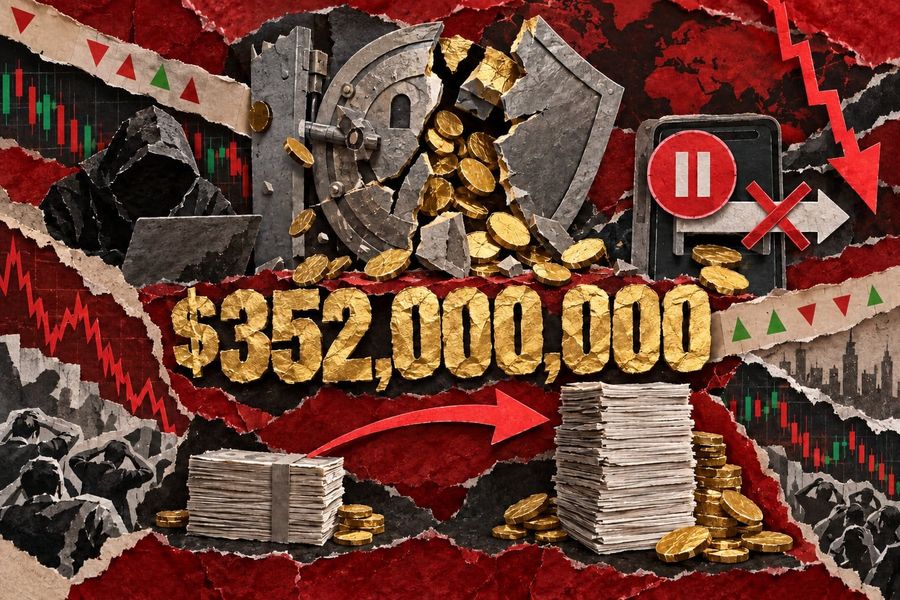
Index providers rarely move crypto markets on purpose. On August 14, 2026, MSCI managed it anyway — with a rulebook change that never says the word "bitcoin" and that flags a uranium warehouse alongside the two largest listed bitcoin treasuries.
What MSCI Actually Proposed on August 14, 2026
MSCI's August 14, 2026 consultation proposes making "non-operating companies" ineligible for the MSCI Global Investable Market Indexes (GIMI), using balance-sheet and cash-flow ratios rather than an asset-class label . The document never references digital assets by name. Its simulation, however, run on May 2026 data, would have deleted three constituents from the MSCI ACWI IMI: Strategy (MSTR), Tokyo-listed Metaplanet (3350.T), and Yellow Cake PLC .
Quick Answer: MSCI's August 14, 2026 consultation would delete "non-operating companies" from its Global Investable Market Indexes using five balance-sheet ratios, not a crypto label. A May 2026 simulation removed three names — Strategy ($23.931B float-adjusted market cap), Metaplanet ($654M), and uranium holder Yellow Cake PLC. Feedback closes September 30, 2026.
The scale of the three simulated deletions is uneven. MSCI lists Strategy as a U.S. Large Cap constituent with $23.931 billion of float-inclusion-factor (FIF) market cap and Metaplanet as a Japan Small Cap constituent with $654 million FIF market cap . Yellow Cake, a UK-listed vehicle that holds physical uranium and has no crypto exposure at all, is the third — and the clearest signal that the screen is keyed to operating substance rather than to any particular reserve asset . Three more names — Ethereum treasury firm SharpLink, Center Laboratories, and Lydia Holding — would land on a public watchlist rather than face immediate deletion .
The calendar is tight and specific:
- September 30, 2026 — consultation feedback window closes .
- On or before October 16, 2026 — MSCI expects to announce results .
- November 11, 2026 — the Index Review at which any deletion decisions would be taken .
This is the successor to a narrower attempt. On October 10, 2025, MSCI floated a crypto-specific rule that would have excluded Digital Asset Treasury Companies holding digital assets at 50% or more of total assets . MSCI shelved that version on January 6, 2026, freezing affected constituents in place while promising a broader review of non-operating companies generally . MSCI stresses that the consultation "may or may not" result in implementation, and index composition is unchanged for now .
The Five-Ratio Test: How MSCI Decides 'Non-Operating' Status
MSCI's proposed screen is a two-stage filter that measures operating substance, not asset type. Stage one is a Core Screen: if a company's operating assets exceed 50% of total assets, it is exempt and faces no further review . Companies that fail move to stage two, where five non-industry-specific ratios are assessed. Trip four of the five and the issuer is deemed ineligible for the MSCI Global Investable Market Indexes .
The five ratios cover operating asset intensity, expense intensity, operating cash flow, non-operating fair-value intensity, and capital dependence. Reporting on the consultation puts the individual thresholds as follows [6][7]:
| Ratio | Threshold that trips the flag | What it measures |
|---|---|---|
| Operating asset intensity | Operating assets below 20% of total assets | How much of the balance sheet does actual business work |
| Expense intensity | Operating expenses below 5% of total assets | Whether the company spends like a going concern |
| Operating cash flow | Negative | Whether operations generate cash at all |
| Non-operating fair-value intensity | Fair-value changes above 5% of total assets | How far mark-to-market swings drive reported earnings |
| Capital dependence | Above 20% | Reliance on equity and debt issuance to fund the balance sheet |
Two turnover buffers slow the mechanism down. An existing GIMI constituent must fail the screen in two consecutive annual filing reviews before deletion, while a company not already in the index can be blocked on its latest single filing . That asymmetry matters for anyone modelling timelines: one clean annual filing resets the clock for an incumbent, while a newly listed treasury vehicle can be kept out immediately.
The buffer is already visible in MSCI's own simulation. Applying the screen to the MSCI ACWI IMI on May 2026 data produced three outright deletions and three companies placed on a public watchlist — Ethereum treasury firm SharpLink, Center Laboratories, and Lydia Holding. Each failed only the latest filing check, so removal would require a second consecutive failure the following year [6][7]. Watchlist status is a disclosure event, not a deletion, but it publishes a forward-looking sell signal to index-aware investors roughly twelve months before any mechanical flow occurs.
The design choice worth noting is what the five ratios do not reference: no asset class, no sector, no digital-asset percentage. The 2025 version keyed on a 50% digital-asset threshold; this one keys on whether a balance sheet behaves like an operating business . That reframing is harder to contest on discrimination grounds, and it widens the population of companies that could eventually be caught.
Why a Uranium Miner Is the Tell, Not the Footnote
Yellow Cake PLC is the third company MSCI's simulation would delete from the MSCI ACWI IMI, and it holds no bitcoin at all — its balance sheet is stacked with physical uranium . The UK-listed vehicle buys and warehouses uranium oxide, generates negligible operating revenue against those holdings, and funds purchases through equity issuance. On MSCI's five ratios, that profile trips the same flags as Strategy and Metaplanet . The screen did not go looking for crypto; it went looking for companies whose assets sit still.
That single name does more analytical work than the two better-known ones. Strategy's objection to the October 2025 draft was that a 50%-digital-asset threshold singled out one asset class arbitrarily . Yellow Cake's presence answers that directly: a commodity holder with zero digital-asset exposure fails the identical test. MSCI can now point to a screen keyed to operating substance rather than to what is being held — a position that is considerably harder to litigate or lobby against than a crypto-specific carve-out.
The sequencing matters too. When MSCI declined to implement the DATCO exclusion at the February 2026 Index Review, it froze existing constituents in place — no increases to Number of Shares, Foreign Inclusion Factor or Domestic Inclusion Factor, with additions and size-segment migrations deferred — while flagging a broader consultation on non-operating companies . Reuters-sourced reporting at the time read the reprieve as removing a near-term technical risk without settling the underlying eligibility question . The August 14 document is that unresolved question returning in generalized form.
For traders, the practical read is narrower than the headlines suggest. This is not an index ban on crypto exposure; it is a balance-sheet-composition rule that happens to catch two bitcoin treasury companies alongside a uranium holder. Positions should be sized against the specific ratios each issuer trips, not against a sector-wide thesis about index providers turning hostile to digital assets.
Base Case: The Numbers Behind Strategy and Metaplanet's Flags
The base case is that both issuers trip four of the five ratios at their next annual filing review, because their own disclosures already describe balance sheets built almost entirely from a single fair-valued asset funded by external capital. Strategy reported 843,775 BTC at an aggregate purchase price of $63.69 billion, an average cost of $75,476 per coin, and a $2.55 billion USD Reserve as of July 5, 2026 . That is the operating-asset-intensity and non-operating-fair-value-intensity flags in a single line item.
Strategy's funding structure supplies the third and fourth flags. The company raised $25.3 billion in 2025 to advance the treasury strategy and reported 713,502 BTC at a $54.26 billion total cost as of February 1, 2026 . Its SEC filings state that bitcoin is the primary treasury reserve asset, that assets are concentrated in bitcoin, and that the strategy depends substantially on equity and debt financing . The BTC Monetization Program, under which the company may sell bitcoin including to generate up to $1.25 billion for the USD Reserve, is a further signal that operating cash flow is not the funding source .
Metaplanet's numbers map onto the same grid from a smaller base. Bitcoin holdings rose from 13,350 BTC at June 30, 2025 to 43,000 BTC at June 30, 2026, cumulative capital raised passed ¥580.2 billion, and shareholders reached 243.7k . Revenue and operating profit excluding bitcoin valuation effects grew 133.7% and 136.3% year over year — evidence of a real operating segment — yet ordinary profit swung to a ¥182.874 billion loss and profit attributable to owners of parent to a ¥182.774 billion loss on bitcoin valuation losses . A fair-value swing of that scale relative to total assets is exactly what the non-operating fair-value-intensity threshold, set at 5% of total assets, is designed to catch .
| Metric | Strategy (MSTR) | Metaplanet (3350.T) |
|---|---|---|
| Bitcoin held (latest disclosure) | 843,775 BTC (Jul 5, 2026) | 43,000 BTC (Jun 30, 2026) |
| Aggregate purchase cost | $63.69B (avg $75,476) | Cumulative capital raised >¥580.2B |
| Cash / reserve buffer | $2.55B USD Reserve | Not separately disclosed |
| Headline earnings effect | Fair-value P&L on bitcoin | ¥182.874B ordinary loss |
| MSCI GIMI status (May 2026 simulation) | U.S. Large Cap, $23.931B FIF mkt cap — simulated deletion | Japan Small Cap, $654M FIF mkt cap — simulated deletion |
Under the two-consecutive-failure buffer for existing constituents, neither company can be removed on this consultation alone; both would need to fail the screen at a second annual filing review . That makes the November 11, 2026 Index Review the earliest realistic decision point rather than a settled deletion date . The base case, then, is a slow clock: unchanged methodology, unchanged ratio profiles, and a deletion path that runs through filings rather than headlines.
Bull Case: Why Deletion May Not Happen — or Matter as Much
The bull case rests on three facts that are already on the record: MSCI has not decided anything, the affected companies are contesting the operating-substance question directly, and even a completed deletion touches only a fraction of each shareholder base. MSCI's own August 14, 2026 language is explicit that the consultation "may or may not" result in implementation of any or all of the proposed changes, and index composition is unchanged today . Feedback does not close until September 30, 2026, and the January 6, 2026 precedent shows MSCI is willing to consult, publish, and then decline to implement .
Strategy is arguing the principle rather than the arithmetic. In its response to the proposal, the company framed the screen as a category error:
"Digital assets are assets. Index providers should measure markets, not decide which assets companies are allowed to own... Bitcoin doesn't need MSCI. Neither does Strategy." — Strategy, public statement on the MSCI consultation, August 14, 2026 (source: The Block)
Strategy added that the proposal puts MSCI "out of step with regulators, markets, and its own customers," building on its December 2025 argument that it is an operating business by virtue of its software segment, treasury operations, and bitcoin-backed credit instruments .
Metaplanet has made the same case with a different evidence set. Its April 2026 open letter to the JPX/TOPIX consultation cited over 40,000 BTC, more than 250,000 shareholders, a hotel business, Bitcoin Magazine Japan, bitcoin income generation, Project Nova and Metaplanet Ventures, and urged principles-based treatment keyed to disclosure, governance, liquidity, operating substance and shareholder protection rather than a single balance-sheet ratio . Its August 13, 2026 Q2 deck reinforces the point: revenue and operating profit excluding bitcoin valuation effects grew 133.7% and 136.3% year over year, with shareholders at 243.7k . MSCI's five ratios do not formally weigh any of that, and the consultation is the venue where that objection gets tested.
The mechanical ceiling matters too. Deletion compels selling by passive tracker funds only — active managers face no obligation to mirror a benchmark change — and it does not force either company to sell bitcoin. JPMorgan's own framing put roughly $9 billion of Strategy's then-$50 billion market value in passive index funds, meaning the large majority of the holder base is discretionary . The January reprieve showed how quickly that discretionary bid returns: Strategy rose roughly 5–6% in extended trade and Metaplanet gained 4% in Tokyo the next session .
Bear Case: Quantifying the Passive-Outflow Risk
The bear case is a sizing exercise, and the largest published estimate is JPMorgan's. Analysts led by Nikolaos Panigirtzoglou calculated in November 2025 that MSCI exclusion alone could force roughly $2.8 billion of passive outflows from Strategy, rising to about $8.8 billion if FTSE Russell, S&P Dow Jones and comparable providers adopted similar screens . That gap between $2.8 billion and $8.8 billion is the whole bear thesis: MSCI on its own is an absorbable event, while a provider cascade is a different order of magnitude.
Independent estimates cluster lower on the MSCI-specific piece. TD Cowen put $2.5 billion of Strategy's market value as derived from MSCI inclusion and $5.5 billion from other indexes . Adjusted for the lower share price prevailing in August 2026 — MSTR fell 4.3% on the announcement session with bitcoin near $62,600 — more recent framing puts the MSCI-only figure closer to $1.8–2.0 billion . The dollar estimate has fallen while the structural probability of deletion has risen.
- MSCI-only scenario: ~$1.8–2.0 billion of compelled passive selling at current prices, versus JPMorgan's $2.8 billion at November 2025 levels .
- Cascade scenario: ~$8.8 billion if FTSE Russell, S&P Dow Jones, CRSP or TOPIX adopt comparable operating-substance logic .
- Metaplanet exposure: smaller in absolute terms at $654 million of float-inclusion-factor market cap as a Japan Small Cap constituent, but proportionally more concentrated .
The more consequential damage is second-order. Deletion does not compel either company to sell bitcoin; it compresses the share price, and a lower share price compresses the multiple-to-net-asset-value premium both firms depend on to issue equity accretively. Strategy raised $25.3 billion in 2025 to fund accumulation , and Metaplanet has raised more than ¥580.2 billion cumulatively . A sub-1.0 mNAV turns that machine off — accumulation slows rather than reverses.
The 2025 episode supplies the calibration. During the original DATCO scare Metaplanet's shares bottomed near ¥340 on November 18, 2025, then recovered to close at ¥531 (about $3.40) after the January reprieve, lifting mNAV to roughly 1.25 with bitcoin near $91,792 . That ~56% peak-to-trough round trip on index headlines alone is the realistic template for a confirmed October 16 deletion path (video: Crypto World Daily).
Portfolio Implication: Positioning Into September 30 and November 11
The tradable window between now and year-end is defined by three fixed dates, and positioning should be anchored to them rather than to bitcoin's spot path. Feedback on the MSCI consultation closes September 30, 2026; results are due on or before October 16, 2026; and any adopted deletion would be executed at the November 2026 Index Review, scheduled for November 11, 2026 . MSCI has stated the consultation "may or may not" result in implementation, and index composition is unchanged until then .
The leading indicator is the multiple-to-net-asset-value, not the bitcoin price. mNAV is the ratio of a treasury company's market capitalization to the market value of its digital-asset holdings, and it is the mechanism through which index risk becomes operating risk: a compressed premium makes accretive equity issuance harder, which slows accumulation regardless of what bitcoin does. Metaplanet's mNAV re-rated to roughly 1.25 on the January 6, 2026 reprieve ; sustained compression below that level into late September would signal the market pricing deletion as the base case.
Separate the exposures. This is an equity-index technical risk, not a bitcoin fundamentals risk. Deletion compels selling only by tracker funds — active managers are under no obligation to mirror benchmark changes — and it does not require either company to sell a single coin . Traders holding MSTR or 3350.T as a proxy for spot exposure are carrying an index-eligibility risk they are not being paid for; those two decisions should be sized independently.
The watchlist is the second-order tell. SharpLink, Center Laboratories and Lydia Holding failed only the latest filing check and would need a second consecutive failure before removal . If the October 16 announcement widens the deletion list or tightens the four-of-five threshold, the rule is being applied broadly; if MSCI softens the capital-dependence ratio, it is being applied narrowly.
The takeaway: track mNAV compression into September 30, treat the October 16 result as the decision point, and keep MSTR/3350.T sizing distinct from spot bitcoin. The screen that caught Yellow Cake PLC is asset-agnostic — arguing about crypto's merits will not change the ratios.
Frequently asked questions
Will Strategy and Metaplanet actually be removed from MSCI indexes?
Not decided. The August 14, 2026 document is a consultation, not a rule, and MSCI states it "may or may not" result in implementation of any or all of the proposed changes; index composition is unchanged for now . Feedback closes September 30, 2026, results are expected on or before October 16, 2026, and the earliest execution would be the November 11, 2026 Index Review . Existing GIMI constituents must also fail the screen in two consecutive annual filing reviews before deletion, so a single clean filing resets the clock .
Why is a uranium company (Yellow Cake) part of a bitcoin story?
Because Yellow Cake PLC proves the screen is not about crypto. The UK-listed company holds physical uranium and has no digital-asset exposure, yet MSCI's simulation on May 2026 data lists it alongside Strategy and Metaplanet as one of three companies that would be deleted from the MSCI ACWI IMI . The common factor is balance-sheet composition — a portfolio of non-operating assets with thin operating expenses and cash flow — not the identity of the asset held. That distinction directly answers Strategy's earlier objection that a 50% digital-asset threshold was arbitrary .
How is this different from MSCI's October 2025 DATCO proposal?
The October 10, 2025 proposal was crypto-specific: it would have excluded Digital Asset Treasury Companies whose primary business involved bitcoin or other digital-asset treasury activity, using a threshold of digital assets at 50% or more of total assets as of September 30, 2025, and it named 39 companies . MSCI confirmed on January 6, 2026 that it would not implement that exclusion at the February 2026 Index Review, while freezing DATCOs in place — no increases to Number of Shares, Foreign Inclusion Factor or Domestic Inclusion Factor, and additions and size-segment migrations deferred . The August 2026 replacement is asset-agnostic, testing five operating and financial ratios that any company can trip.
What would MSCI deletion actually do to MSTR and Metaplanet's share price?
Deletion compels selling only by passive index-tracking funds; active managers are not obliged to mirror benchmark changes, and neither company would be forced to sell bitcoin. JPMorgan analysts led by Nikolaos Panigirtzoglou estimated in November 2025 that MSCI exclusion alone could force roughly $2.8 billion of passive outflows from MSTR, rising to about $8.8 billion if FTSE Russell, S&P Dow Jones and peers adopted comparable rules . The more durable risk is second-order: a lower share price compresses the multiple-to-net-asset-value premium both firms rely on to issue equity accretively, raising the cost of further accumulation. Metaplanet's mNAV re-rated to about 1.25 on the January 2026 reprieve, making it the cleanest real-time gauge (video: Crypto World Daily) .
What are the specific financial ratios MSCI is using to screen companies?
The test runs in two stages. The Core Screen asks whether operating assets exceed 50% of total assets; issuers that clear it face no further scrutiny . Companies that fail are assessed on five non-industry-specific ratios, and are deemed ineligible if four of the five flags are tripped :
- Operating asset intensity — operating assets below 20% of total assets.
- Operating expense intensity — operating expenses below 5% of total assets.
- Operating cash flow — negative.
- Non-operating fair-value intensity — fair-value changes above 5% of total assets.
- Capital dependence — above 20%.
Turnover buffers differ by status: existing GIMI constituents need two consecutive annual filing failures before deletion, while non-constituents can be blocked on their latest single filing .
Enjoyed this article? Subscribe to get new stories by email whenever they're published.