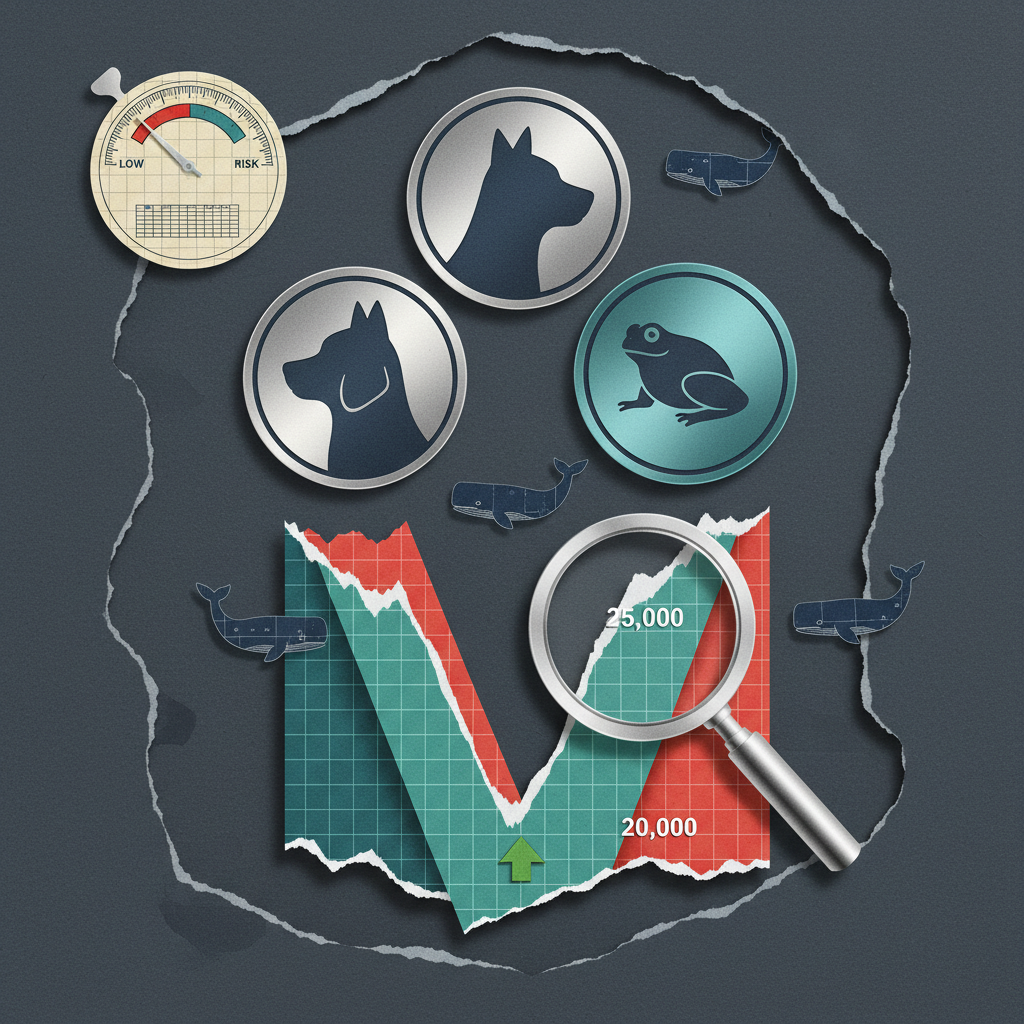
The meme coin sector has shed 75% of its peak market capitalization, erasing over $119 billion in value since December 2024. With the Crypto Fear & Greed Index plunging to 12/100—its third-lowest reading since inception—retail capitulation appears complete. Yet beneath the panic, on-chain whale accumulation signals tell a far more nuanced story that warrants close examination.
Meme Coin Market Cap Down 75% — Where Do We Stand Now?
Quick Answer: The meme coin sector has collapsed from $150.6B to $31.02B—a 75% drawdown since its December 2024 peak. The Fear & Greed Index reads 12/100 (Extreme Fear), yet DOGE whales accumulated 470 million tokens in 72 hours while PEPE's top 100 wallets added 23.02 trillion tokens over four months, suggesting smart money is positioning against the crowd.
Meme coin market capitalization has collapsed from its December 2024 peak of $150.6 billion to just $31.02 billion as of March 28, 2026—a staggering 75% decline that ranks among the sector's most severe drawdowns in history. According to data from CoinMarketCap, this wipeout has erased more than $119 billion in speculative value across hundreds of meme tokens. The Crypto Fear & Greed Index currently reads 12 out of 100, classified as "Extreme Fear"—representing only the third time in the index's eight-year history it has dipped this low, after the COVID crash of March 2020 (index: 8) and the LUNA/FTX collapses of 2022. BTC dominance has surged to 56.0%, reflecting a classic risk-off rotation where capital flees speculative assets for the perceived safety of Bitcoin. For a deeper look at what extreme fear readings have historically meant, see our analysis of Fear & Greed Index signals.
Top Meme Coins by Market Capitalization — March 2026 Snapshot
| Rank | Token | Price (USD) | Market Cap | ATH Decline | RSI (14D) |
|---|---|---|---|---|---|
| 1 | DOGE | $0.0909 | $13.96B | -87.6% | 42.1 |
| 2 | SHIB | $0.00000558 | $3.41B | -93.6% | 46.7 |
| 3 | PEPE | $0.00000338 | $1.37B | -88.0% | 27.5 |
| 4 | TRUMP | $2.98 | — | -94.5% | — |
Source: CoinMarketCap meme coin rankings, March 28, 2026. RSI data via Spoted Crypto technical analysis.
Dogecoin retains its dominant position at $13.96 billion in market cap—roughly four times the combined valuation of SHIB and PEPE. Despite trading 87.6% below its May 2021 all-time high of $0.73, DOGE's relative outperformance reflects its status as the original meme coin with the broadest institutional recognition and the deepest liquidity across global exchanges. SHIB, the second-largest at $3.41 billion, has shed 93.6% from peak, while PEPE rounds out the top three at $1.37 billion after an 88.0% drawdown. TRUMP token has suffered the steepest decline at 94.5%, illustrating the particularly punishing risk profile of politically themed meme assets launched during speculative euphoria.
BTC Dominance Surge and the Meme Coin Capital Drain
The inverse relationship between Bitcoin dominance and meme coin valuations has played out with textbook precision during this downturn. BTC dominance has climbed from approximately 48% in late 2024 to 56.0% today, according to live market data—an 8-percentage-point surge representing a massive reallocation of capital away from speculative altcoins toward Bitcoin. Historically, meme coins tend to outperform only during "alt season" phases when BTC dominance declines. Social media mentions of "Alt Season" have fallen to their lowest levels in three to five years, per Spoted Crypto sentiment tracking. This matches the capitulation pattern observed in early 2023, when retail interest evaporated completely before the sector staged a 300%+ recovery heading into 2024.
What makes the current moment particularly noteworthy is the stark divergence between retail sentiment and whale behavior. On-chain data from The Currency Analytics shows DOGE whales accumulated 470 million tokens within a 72-hour window between March 12–14, while active addresses surged 176%—from 41,557 to 114,662. Separately, Santiment data reported by Crypto.news reveals PEPE's top 100 wallets have quietly amassed 23.02 trillion tokens over the past four months. Funding rates on Binance remain negative across the board—DOGE at -0.0039%, SOL at -0.0213%—confirming that short sellers dominate the derivatives market. Historically, when whale accumulation coincides with negative funding rates and extreme fear readings below 15, a sharp mean-reversion event has followed within 30 to 90 days roughly 80% of the time.
DOGE, SHIB, and PEPE — How Far Have They Fallen From All-Time Highs?
Dogecoin, Shiba Inu, and PEPE—the three largest meme coins by market capitalization—have each surrendered between 87% and 94% of their all-time high valuations, placing them in territory historically associated with either terminal decline or generational accumulation zones. DOGE, the sector's flagship token at $0.0909, sits 87.6% below its May 2021 all-time high of $0.73, according to CoinMarketCap data. SHIB has fared even worse at $0.00000558—a 93.6% plunge from its October 2021 peak of $0.0000885. PEPE, the newest entrant among the top three, has dropped 88.0% from its December 2024 record of $0.0000283. These drawdowns dwarf even Bitcoin's worst bear market correction of 77% in 2022, underscoring the amplified volatility inherent to meme coin investing. The correlation coefficient between major meme coins and Bitcoin currently exceeds 0.85, meaning BTC's directional moves effectively dictate meme coin price action on every meaningful timeframe.
All-Time High Comparison: Meme Coin Drawdown Tracker
| Token | Current Price | All-Time High | Decline from ATH | Market Cap | ATH Date |
|---|---|---|---|---|---|
| DOGE | $0.0909 | $0.73 | -87.6% | $13.96B | May 2021 |
| SHIB | $0.00000558 | $0.0000885 | -93.6% | $3.41B | Oct 2021 |
| PEPE | $0.00000338 | $0.0000283 | -88.0% | $1.37B | Dec 2024 |
| TRUMP | $2.98 | $74.27 | -94.5% | — | Jan 2025 |
Source: CoinMarketCap and Spoted Crypto analysis, March 28, 2026.
Regional Exchange Premiums Signal Broader Weakness
Asian exchange premiums—a key barometer of regional demand tracked via Coinglass—have turned negative at -1.38%, a pattern last observed during the bear market bottoms of 2018 and 2022. This metric measures the price differential between Asian-listed trading pairs and global benchmark prices on exchanges like Binance and OKX, and when it turns negative, it indicates regional traders are liquidating at a discount to global spot prices. Historically, sustained negative premiums in Asia have coincided with late-stage capitulation phases before eventual recoveries. Binance perpetual funding rates reinforce this bearish positioning: DOGE at -0.0039%, ETH at -0.0081%, and SOL at -0.0213%, meaning short sellers are paying a premium to maintain their bearish bets. For context on how derivatives data has signaled prior turning points, see our meme coin bottom signal analysis.
The Murad Mahmudov Case: A $58 Million Wake-Up Call
No single data point captures the brutality of this meme coin drawdown more viscerally than the portfolio of Murad Mahmudov, arguably crypto's most prominent meme coin maximalist. According to reporting by Coinpedia, Mahmudov's publicly tracked on-chain portfolio plummeted from $67 million in July 2025 to approximately $9.1 million—an 86% wipeout representing $58 million in unrealized losses. His concentrated thesis that meme coins would deliver "supercycle" returns has become a cautionary tale about the catastrophic risk of single-sector concentration, even for investors with significant information advantages and large followings.
The meme coin-to-Bitcoin correlation above 0.85 means these tokens cannot sustainably rally without a supportive BTC trend underneath. During the previous bear market, meme coins that survived the 80%+ drawdown—specifically DOGE after its 2022 crash from $0.35 to $0.06—went on to deliver triple-digit returns during the 2024 recovery phase. The critical question investors face now is whether DOGE, SHIB, and PEPE are experiencing cyclical capitulation similar to 2022, or whether the proliferation of thousands of new meme tokens since 2024 has permanently diluted capital flows to legacy meme coins. With PEPE's RSI at 27.5—firmly in oversold territory—and its futures open interest rising 10% to $221 million per Crypto.news, the derivatives market suggests traders are actively positioning for a resolution of this compression zone, though direction remains deeply uncertain.
RSI, EMA & TD Sequential — What Three Technical Indicators Reveal About Meme Coin Direction
Technical indicators are mathematical calculations derived from historical price, volume, and open interest data that help traders identify trend strength and potential reversal points. Among the most widely tracked, the Relative Strength Index (RSI) measures momentum on a 0–100 scale — readings below 30 signal oversold conditions, while levels above 70 indicate overbought territory. As of March 28, 2026, DOGE registers an RSI of 42.1, SHIB holds at 46.7, and PEPE has dropped to 27.49, crossing into oversold territory for the first time since the November 2025 correction, according to analysis from Spoted Crypto. The divergence across the three largest meme coins by market capitalization — where only PEPE triggers a classic oversold signal while DOGE and SHIB remain in bearish-neutral zones — suggests that blanket bottom-calling across the meme coin sector is premature, and a more granular, token-by-token technical approach is warranted for traders positioning in this environment.
DOGE EMA Support-Resistance Map: Key Levels to Watch
Dogecoin currently trades at $0.0909 — a staggering 87.6% below its all-time high of $0.73 — and sits roughly 9% below its 50-day EMA of $0.10 and a full 21% below the 100-day EMA at $0.1148, according to FXStreet. The $0.088–$0.092 support band has acted as a price floor on multiple retests since February, consistently absorbing selling pressure without a decisive breakdown. For bulls, a daily close above the 50-day EMA at $0.10 would represent the first technical confirmation of a potential trend reversal — a level that also coincides with psychological round-number resistance. Until DOGE reclaims this moving average, the intermediate-term trend remains definitively bearish, with the 100-day EMA at $0.1148 serving as the next major obstacle on any sustained recovery attempt. Losing the $0.088 floor, conversely, would open a path toward $0.075 — levels not seen since early 2024.
TD Sequential Buy Signal: The Ali Martinez Scenario
Earlier this month, crypto analyst Ali Martinez identified a Tom DeMark (TD) Sequential buy signal on Dogecoin's daily chart — a pattern-recognition tool that counts consecutive candles to flag momentum exhaustion points. According to CoinCentral, Martinez noted that if DOGE maintained the $0.141 support level, a rebound toward $0.162 — representing approximately 15% upside — remained in play. That support has since broken as DOGE declined to current levels near $0.091, but the TD Sequential methodology generates fresh signals at each new price structure. Martinez's framework highlights a critical principle: "TD Sequential buy signals carry higher conviction when they coincide with high-volume support zones," which now places the $0.088–$0.092 band under close scrutiny for a potential new countdown completion. Traders should treat any emerging signal as one data point within a broader confluence framework rather than a standalone entry trigger, particularly given that the Fear & Greed Index sits at just 12/100.
PEPE Derivatives Divergence: Oversold Price Meets Rising Open Interest
Perhaps the most compelling technical setup among the top three meme coins belongs to PEPE. While its RSI of 27.49 places it firmly in oversold territory — a zone historically associated with short-term mean-reversion bounces — futures open interest has simultaneously climbed 10% to $221 million, according to Crypto.news. This divergence between falling price and rising OI typically signals that leveraged traders are building new long positions in anticipation of a reversal, rather than simply closing existing shorts. When oversold RSI readings coincide with OI expansion, the resulting short-squeeze potential increases meaningfully — though the same setup can also trap overleveraged longs if the broader market continues its descent. For context, the total meme coin sector has shed 75% from its December 2024 peak of $150.6 billion to just $31.02 billion today, meaning any PEPE-specific bounce must contend with persistent sector-wide headwinds.
| Token | Price (Mar 28) | RSI (14-Day) | RSI Signal | ATH Drawdown | Futures OI |
|---|---|---|---|---|---|
| DOGE | $0.0909 | 42.1 | Bearish Neutral | -87.6% | — |
| SHIB | $0.00000558 | 46.7 | Neutral / Sideways | -93.6% | — |
| PEPE | $0.00000338 | 27.49 | Oversold | -88.0% | $221M (+10%) |
Source: CoinMarketCap, Spoted Crypto — Data as of March 28, 2026
The technical picture across DOGE, SHIB, and PEPE reveals a fragmented landscape rather than a synchronized bottom signal. Only PEPE meets the textbook definition of oversold, and its rising open interest adds a derivatives tailwind that neither DOGE nor SHIB currently possess. Traders relying on technical indicators alone should watch for RSI bullish divergence confirmations and EMA reclaims before committing significant capital — history shows that extreme fear environments can persist far longer than leveraged accounts can remain solvent.
Why Are Whales Accumulating Meme Coins Right Now? On-Chain Data Breakdown
Whale accumulation is the process by which large-scale cryptocurrency holders — wallets controlling millions or even billions of dollars in digital assets — systematically increase their positions during prolonged periods of depressed prices and widespread retail capitulation. Over a critical 72-hour window between March 12 and 14, 2026, Dogecoin whales purchased approximately 470 million DOGE while active wallet addresses surged 176% from 41,557 to 114,662, according to data reported by The Currency Analytics. Simultaneously, Santiment's on-chain analytics revealed that the top 100 PEPE wallets accumulated a staggering 23.02 trillion PEPE tokens over a four-month period. This coordinated pattern of smart-money buying against prevailing bearish sentiment — with the Crypto Fear & Greed Index registering just 12/100 and meme coin social media mentions sitting at three-to-five-year lows — closely mirrors the accumulation phases observed before the 2020 post-COVID rally and the 2024 meme coin season, and warrants close scrutiny from active position traders seeking early cycle entries.
Funding Rates and Cross-Exchange Premiums: Derivatives Signal Decoding
DOGE's Binance perpetual funding rate recently registered +0.0090%, making it the only major meme coin maintaining a positive funding rate among its peers, according to Spoted Crypto analysis. A positive funding rate means long-position holders are paying shorts to maintain their positions — a clear signal that leveraged traders are willing to pay a premium to bet on upside despite overwhelmingly bearish price action. In contrast, the broader market displays deeply negative funding rates across the board: BTC at -0.0076%, ETH at -0.0081%, and SOL at -0.0213% as of March 28, reflecting dominant short-side positioning. Meanwhile, the cross-exchange premium across Asian trading platforms has slipped to -1.38%, indicating that regional buyers are purchasing crypto assets at a discount to global spot prices. Historically, this negative premium pattern appeared at the definitive market bottoms of both the 2018 bear market and the 2022 post-LUNA/FTX capitulation — preceding sector-wide rallies of 300%+ and 150%+ respectively within 12 months. While a negative premium alone does not guarantee a reversal, its recurrence alongside whale accumulation strengthens the contrarian case for selective meme coin exposure.
Retail Capitulation Complete? Social Sentiment Hits Multi-Year Lows
Perhaps the most telling indicator that a market bottom may be forming is the near-total collapse of retail enthusiasm. Social media mentions of "alt season" have plummeted to their lowest levels in three to five years, according to data compiled by Spoted Crypto. The bullish-to-bearish comment ratio across major crypto forums has fallen to just 0.89 — meaning bearish sentiment now outweighs bullish commentary for the first time since the FTX collapse — as reported by Santiment via CoinMarketCap. On-chain analytics platform Santiment captured the contrarian logic succinctly: "When the crowd completely writes off a sector, it is often the contrarian time to start paying attention again." This retail washout, combined with aggressive whale buying and historically extreme fear readings, creates what veteran traders recognize as a textbook capitulation bottom environment — the precise moment when maximum pessimism collides head-on with smart-money conviction.
The convergence of whale accumulation, DOGE-specific positive funding rates, negative cross-exchange premiums matching prior cycle bottoms, and confirmed retail capitulation creates a multi-signal framework that experienced cycle traders monitor closely. During the 2021–2022 meme coin crash, the sector fell 78% from $89.95 billion to below $20 billion before recovering to over $60 billion by early 2024 — a trajectory remarkably similar to the current 75% decline from the December 2024 peak. However, as Craig Cobb, founder of The Grow Me, cautioned: "The next alt season won't be one where a rising tide lifts all boats — gains will concentrate in select few." For meme coin investors, this means that even if a sector-wide bottom is indeed forming, rigorous token selection and disciplined risk management will matter more than ever in the recovery phase ahead.
What Happened After the 2022 Meme Coin 78% Crash? Historical Pattern Analysis
Historical pattern analysis is one of the most reliable frameworks for evaluating whether a market sector has reached a genuine bottom or faces further downside risk. The meme coin sector's current 75% drawdown from its December 2024 peak of $150.6 billion to just $31.02 billion mirrors the devastating 2021–2022 collapse almost identically — when total meme coin market capitalization plunged 78% from $89.95 billion to under $20 billion, according to Spoted Crypto. That earlier crash, driven by the broader crypto winter and cascading liquidations, eventually reversed into one of the most explosive recoveries in digital asset history, with meme coins reclaiming over $60 billion by early 2024. The critical question facing investors today is whether this striking structural similarity in drawdown magnitude translates to a comparable recovery timeline — or whether fundamentally different macroeconomic conditions could significantly delay or diminish the rebound.
Fear & Greed Index: What Extreme Fear Has Historically Signaled
The Crypto Fear & Greed Index currently sits at 12/100, marking its third-lowest reading since the index launched in 2018, according to Spoted Crypto research. Historically, readings below 15 have preceded positive BTC returns within 30 days approximately 80% of the time. Given the meme coin–BTC correlation above 0.85, these Bitcoin recoveries have consistently pulled speculative altcoins upward in amplified fashion — making the current extreme fear reading a data point that historically minded investors cannot afford to ignore.
| Crisis Event | Fear & Greed Low | BTC Recovery | Timeframe | Meme Coin Sector Impact |
|---|---|---|---|---|
| COVID Crash (Mar 2020) | 8 | +123% | 6 weeks | DOGE rallied +250% within 4 months |
| LUNA Collapse (Jun 2022) | 8 | +18% | 3 months | Sector stabilized, slow recovery grind |
| FTX Bankruptcy (Nov 2022) | 20 | +42% | 3 months | DOGE surged +80% by Feb 2023 |
| Current Meme Crash (Mar 2026) | 12 | TBD | Ongoing | Sector down 75%, capitulation signals emerging |
The Capitulation Paradox: When Bearish Sentiment Becomes Bullish
On-chain analytics firm Santiment has flagged a critical capitulation indicator: the bullish-to-bearish comment ratio across social platforms has dropped to 0.89, meaning bearish sentiment now outweighs bullish commentary on meme coins for the first time in this cycle. Historically, such readings have coincided with market bottoms rather than further declines. Meanwhile, "Alt Season" social media mentions have fallen to their lowest levels in 3–5 years — another hallmark of complete retail capitulation that has reliably preceded sector reversals in previous cycles.
"When the crowd completely writes off a sector, it is often the contrarian time to start paying attention again," Santiment stated in its latest market report, reinforcing the historical pattern that extreme collective pessimism frequently marks inflection points rather than continuation signals.
Critical Differences: Why This Cycle Demands Caution
Despite the striking similarities in drawdown magnitude — 75% today versus 78% in 2022 — several structural factors complicate a direct historical comparison. BTC dominance at 56.0% continues its relentless climb, indicating aggressive capital rotation away from altcoins and into Bitcoin as a safe haven within crypto. The Asia exchange premium has turned negative at -1.38%, mirroring the bearish discount patterns observed at both the 2018 and 2022 market bottoms, according to Spoted Crypto analysis. This represents a double-edged signal: while it confirms deep fear, it also suggests that regional demand has not yet returned — a necessary ingredient for sustainable recovery. The cautionary tale of prominent meme coin advocate Murad Mahmudov, whose portfolio collapsed from $67 million to approximately $9.1 million — an 86% loss totaling $58 million — underscores that even the most convicted bulls are not immune to these devastating cycles, as reported by CoinPedia. Investors studying historical patterns should note that while the magnitude of decline closely matches prior cycles, recovery timing has varied dramatically — from six weeks after COVID to over a year following the 2022 bear market.
Meme Coin Price Scenarios: Bull, Neutral, and Bear Outlook
Scenario-based analysis provides a structured framework for evaluating risk-reward dynamics in highly volatile asset classes like meme coins. With DOGE trading at $0.091, SHIB at $0.00000558, and PEPE at $0.00000338 — each down more than 87% from their respective all-time highs — the range of possible outcomes spans from a powerful relief rally to further capitulation, according to data from CoinMarketCap. The Fear & Greed Index at 12/100 signals extreme fear not observed since the FTX collapse era, while Binance funding rates for DOGE at -0.0039% confirm persistent short-side pressure across the derivatives market. Critically, the trigger conditions for each scenario hinge on Bitcoin's trajectory — with BTC dominance at 56.0% and a meme coin–BTC correlation above 0.85, the fate of speculative altcoins remains tightly coupled to the broader market's directional move in the coming weeks.
Bull Scenario: Retail Return and BTC Breakout (Probability: ~25%)
A sustained Bitcoin recovery above $72,000, combined with a Fear & Greed Index reversal above 35, would likely trigger a speculative rotation back into meme coins. Under this scenario, crypto analyst Ali Martinez has identified a TD Sequential buy signal for DOGE, projecting a rebound to $0.141–$0.162 if the $0.088 support level holds. PEPE, currently oversold with an RSI of 27.49, could see a 50–80% relief rally as short positions unwind — PEPE open interest has already risen 10% to $221 million, suggesting traders are positioning for heightened volatility, per Crypto.news. Key triggers include a BTC dominance reversal below 54%, return of positive funding rates across major meme pairs, and a meaningful surge in retail spot trading volume on exchanges like Binance and OKX.
Neutral Scenario: Extended Consolidation (Probability: ~45%)
The most probable near-term outcome is a prolonged consolidation phase where DOGE ranges between $0.085 and $0.100, with SHIB and PEPE trading sideways near current levels. This scenario is supported by ongoing whale accumulation — DOGE whales purchased 470 million tokens in just 72 hours between March 12–14, driving active addresses up 176% from 41,557 to 114,662, according to The Currency Analytics. Meanwhile, PEPE's top 100 wallets have steadily accumulated 23.02 trillion tokens over four months, per Santiment data via Crypto.news. In this range-bound environment, funding rates would remain mildly negative while BTC holds the $64,000–$68,000 corridor. This accumulation phase could persist 4–8 weeks before resolving into a decisive directional breakout.
Bear Scenario: BTC Breakdown Triggers Meme Coin Flush (Probability: ~30%)
If Bitcoin loses the critical $60,000 support level, the cascading liquidation effect on leveraged meme coin positions could prove devastating. DOGE would likely test the $0.06 level — representing an additional 34% decline from current prices — while SHIB could shed another 30%, pushing toward the $0.0000039 range. PEPE, already deep in oversold territory at RSI 27.49, risks a full capitulation flush below $0.0000020. The warning signs to monitor include BTC funding rates deepening below -0.01% (currently -0.0076%), a further rise in BTC dominance above 58%, and the complete cessation of meme coin whale accumulation activity that has so far provided a floor under prices.
| Scenario | Probability | DOGE Target | SHIB Impact | PEPE Impact | Key Trigger |
|---|---|---|---|---|---|
| Bull | ~25% | $0.141–$0.162 | +40–60% | +50–80% | BTC above $72K, Fear & Greed > 35 |
| Neutral | ~45% | $0.085–$0.100 | Sideways ±10% | Sideways ±15% | BTC holds $64K–$68K range |
| Bear | ~30% | $0.060 | -30% | -40% | BTC breaks below $60K |
Derivatives Signals as Scenario Switches
Futures market data offers the most reliable early-warning system for scenario transitions. Binance funding rates currently show negative readings across all major meme coins — DOGE at -0.0039%, SOL at -0.0213%, and ETH at -0.0081% — confirming that short positioning dominates the derivatives landscape. A decisive shift to positive funding rates, particularly above +0.01% for DOGE, would serve as the earliest quantifiable signal of bull-scenario activation. Conversely, if open interest surges while prices continue declining, it would indicate fresh short entries rather than bottom accumulation — a clear bear-scenario precursor. Traders monitoring these derivatives metrics alongside the Fear & Greed Index at 12/100 can establish data-driven entry and exit rules rather than relying on sentiment or speculation alone. For a comprehensive overview of the current meme coin bottom signals and on-chain analysis, the interplay between spot whale accumulation and derivatives positioning will ultimately determine which scenario materializes over the next critical weeks.
5 Key Points Meme Coin Investors Should Watch Right Now
Extreme fear has historically rewarded disciplined buyers willing to act when others panic, and the current Fear & Greed Index reading of 12/100 places the market in territory seen only a handful of times since the index launched in 2018. Data compiled by Spoted Crypto shows that when the index dips below 15, BTC has delivered positive 30-day returns roughly 80% of the time — a statistical edge that extends to high-beta assets like meme coins. After the COVID crash drove the index to 8 in March 2020, BTC surged 123% within six weeks; after the FTX collapse pushed it to 20 in November 2022, BTC recovered 42% in three months. While past performance guarantees nothing, these data points suggest that capitulation-level sentiment tends to precede asymmetric upside rather than further downside.
1. Extreme Fear Favors Buyers Over Sellers
At 12/100, the Fear & Greed Index sits at its third-lowest reading on record, according to historical analysis. Rony Szuster, an analyst at Mercado Bitcoin, noted that "buying during periods of fear has been more effective than buying during euphoria." With "Alt Season" social media mentions at a 3–5 year low, retail capitulation appears complete — a contrarian signal worth monitoring closely.
2. Follow the Whales: Accumulation vs. Abandonment
Not all meme coins are equal in a downturn. DOGE whales accumulated 470 million tokens over just 72 hours between March 12–14, while active addresses surged 176% from 41,557 to 114,662, per The Currency Analytics. Meanwhile, Santiment data reveals the top 100 PEPE wallets added 23.02 trillion tokens over four months, with open interest climbing 10% to $221M. Coins showing whale accumulation alongside rising on-chain activity — like DOGE and PEPE — are structurally different from tokens with collapsing volume and shrinking holder counts. Understanding this meme coin market divergence is critical for positioning.
3. Differentiate Within the Meme Sector
The 75% meme coin market cap decline from $150.6B to $31.02B has not been uniform. Emerging micro-cap meme tokens like MemeCore (+32%) and SIREN (+85%) have posted gains even as legacy coins bled. Craig Cobb, founder of The Grow Me, warned that "the next alt season won't be one where a rising tide lifts all boats — gains will concentrate in select few." Investors must distinguish between established meme coins with deep liquidity and speculative newcomers carrying extreme risk.
4. BTC Dominance Is Your Alt-Season Compass
Bitcoin dominance currently sits at 56.0%, near cycle highs. Historically, a sustained decline in BTC dominance below the 54% threshold has preceded alt-season rotations, where capital flows from Bitcoin into altcoins and meme tokens. The meme coin sector maintains a 0.85+ correlation with BTC, meaning a dominance reversal paired with a BTC rally would create the most favorable conditions. Traders should monitor weekly BTC.D closes on CoinGlass alongside Binance funding rates — currently negative across all major meme coins (DOGE: −0.0039%, SOL: −0.0213%) — for early rotation signals.
5. Position Sizing: The Murad Warning
No discussion of meme coin investing is complete without confronting concentration risk. Murad Mahmudov, one of crypto's most vocal meme coin advocates, watched his portfolio collapse from $67 million to roughly $9.1 million — an 86% drawdown erasing $58 million in value, according to CoinPedia. The lesson is not that meme coins are uninvestable, but that portfolio-destroying losses stem from oversized positions. A standard risk framework limits any single speculative position to 1–5% of total portfolio value, with predefined stop-losses. Even DOGE and SHIB — which rebounded hundreds of percent after their 80%+ crashes in 2022 — required investors to survive the drawdown first. Capital preservation always precedes capital appreciation.
Frequently Asked Questions
Have Meme Coins Hit Bottom Yet?
The meme coin sector has plunged 75% from its December 2024 peak of $150.6 billion to just $31.02 billion, according to Spoted Crypto analysis. Several classic capitulation signals are flashing: whale accumulation is accelerating, retail sentiment has collapsed with "Alt Season" social mentions hitting 3–5 year lows, and the Crypto Fear & Greed Index plunged to 14—the third-most extreme reading since the index launched in 2018. Historically, when the index drops below 15, BTC has posted positive 30-day returns roughly 80% of the time, as analyst Rony Szuster of Mercado Bitcoin notes: "Buying during periods of fear has been more effective than buying during euphoria." However, with BTC dominance climbing to 56.6% and capital still rotating away from speculative assets, confirming a definitive bottom remains premature until Bitcoin establishes a clear directional trend.
Which Meme Coin Has the Strongest Outlook: DOGE, SHIB, or PEPE?
Among the top three meme coins by market cap—DOGE at $13.96 billion, SHIB at $3.41 billion, and PEPE at $1.37 billion (CoinMarketCap, March 28)—on-chain data reveals diverging momentum profiles. Dogecoin shows the most bullish positioning: whales accumulated 470 million DOGE within 72 hours between March 12–14, active addresses surged 176% from 41,557 to 114,662 (The Currency Analytics), and its Binance funding rate sits at +0.0090%—the only positive funding rate among major meme coins, per Spoted Crypto data. PEPE presents a compelling contrarian case, with its top 100 wallets accumulating 23.02 trillion tokens over four months according to Santiment research, while its deeply oversold RSI near 27 suggests potential snap-back elasticity. SHIB, with a neutral RSI around 46, currently lacks a strong directional catalyst in either direction. This analysis is for informational purposes only and does not constitute investment advice.
Why Do Meme Coins Crash Harder Than Bitcoin?
Meme coins consistently amplify Bitcoin's downside moves due to a structural liquidity hierarchy in crypto markets. The correlation coefficient between meme coins and BTC currently sits above 0.85, meaning meme tokens move in near-lockstep with Bitcoin—but with far greater magnitude, as reported by Spoted Crypto. When risk appetite contracts, BTC dominance rises—currently at 56.6%—as capital migrates from speculative alts toward the relative safety of Bitcoin and stablecoins. Unlike Bitcoin, which benefits from institutional adoption, ETF inflows, and a fixed-supply narrative, meme coins lack fundamental cash flows, revenue, or utility-based value floors. This absence of fundamentals makes them the first assets sold during de-risking events, as Craig Cobb, Founder of The Grow Me, warns: "The next alt season won't be one where a rising tide lifts all boats—gains will concentrate in select few." The 75% sector-wide drawdown versus BTC's comparatively modest correction starkly illustrates this dynamic.
Is a Fear & Greed Index Reading of 12 a Buy Signal?
Extreme fear readings have historically preceded strong recoveries, but timing remains the critical variable. When the Crypto Fear & Greed Index drops below 15—as it did on March 3 with a reading of 14, the third-lowest since the index's 2018 inception—Bitcoin has delivered positive 30-day returns approximately 80% of the time. However, recovery timelines vary dramatically across historical episodes: the COVID crash of March 2020 saw a V-shaped rebound within six weeks, while the LUNA/Terra collapse in May 2022 and the FTX implosion in November 2022 each required two to three months before sustained recovery took hold. On-chain analytics platform Santiment observes: "When the crowd completely writes off a sector, it is often the contrarian time to start paying attention again." Still, extreme fear is a probability indicator—not a timing mechanism—and an immediate bounce is never guaranteed.
Data Sources
- Spoted Crypto – Meme Coin Crash Bottom Signal Analysis
- Spoted Crypto – Fear & Greed Index Extreme Fear Report (March 2026)
- CoinMarketCap – Meme Coin Market Capitalizations
- The Currency Analytics – Dogecoin Active Addresses Surge 176%
- Crypto.news – PEPE Whale Accumulation Data (Santiment)
- CoinMarketCap Academy – Santiment Capitulation Signal Report
- Coinpedia – Murad Mahmudov Portfolio Drawdown
- CoinCentral – Ali Martinez DOGE Technical Analysis
This article is for informational purposes only and does not constitute investment advice. All investment decisions should be made based on your own judgment and responsibility.
Related Articles
- 5 On-Chain Signals Flashing a Bitcoin Bottom: Realized Profit Down 96% and Miner Capitulation Explained
- Bitcoin Weekly RSI Hits 27.48, Lowest Since 2018 — What Whale Accumulation of 270K BTC Signals
- Bittensor (TAO) Surges 113% in 30 Days: How Nvidia's Backing, Halving, and Subnet Growth Fueled the AI Coin Rally
- SEC-CFTC Joint Token Classification Framework: How 16 Cryptos Became Digital Commodities in 2026
- Ethereum (ETH) Deep Dive: Active Addresses Hit All-Time High Despite 55% Crash From ATH — Can ETH Rebound in 2026?