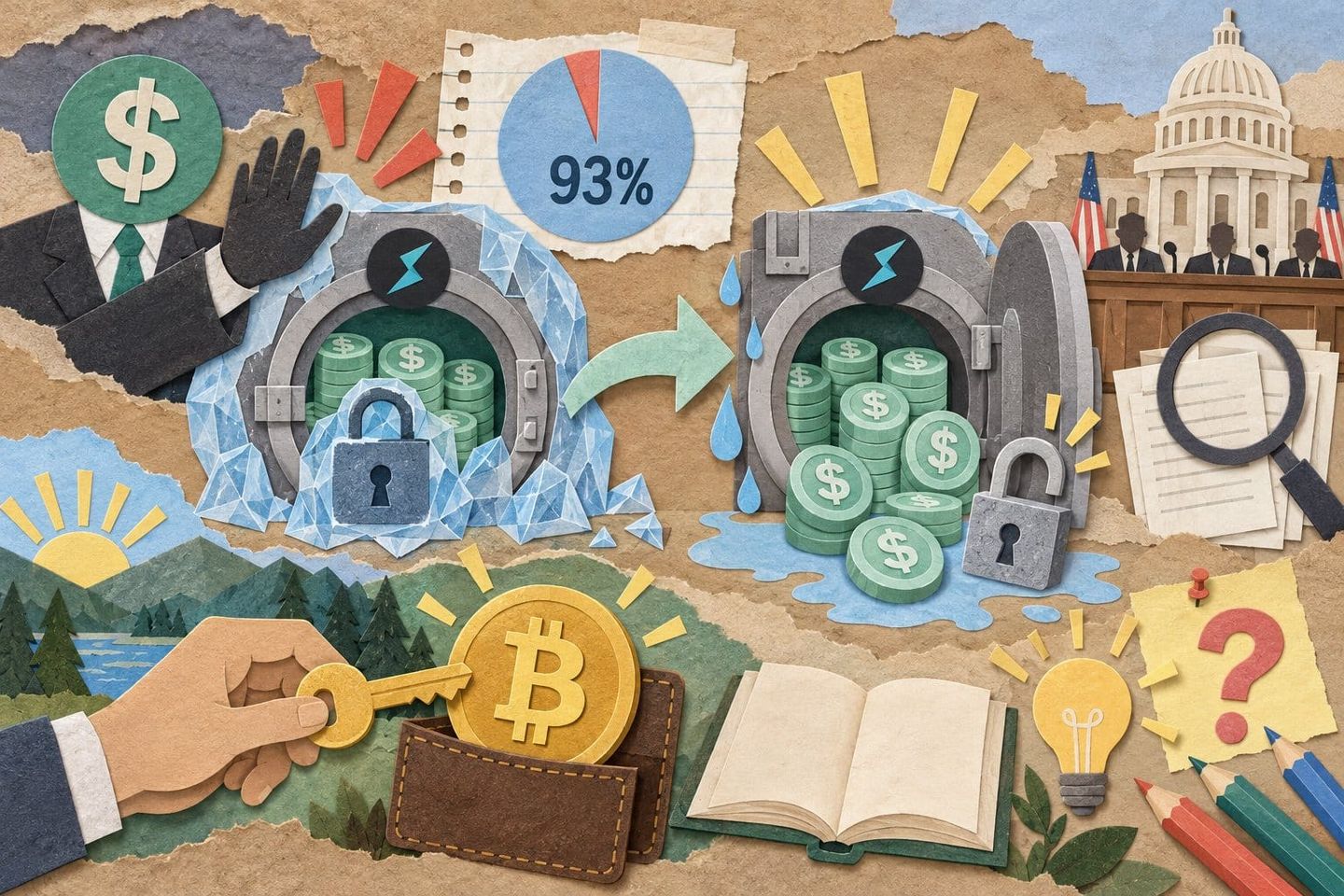
For about two to three hours on 9 October 2026, most of THORChain's USDT on Tron could not move. The cause was not a hack. Tether, the company that issues USDT, used its own contract controls to freeze the vaults, then reversed the freeze the same afternoon without saying why.
What happened when Tether froze THORChain's Tron USDT vaults?
On 9 October 2026, Tether blacklisted four of THORChain's six USDT vault addresses on Tron. That froze about 1.45 million USDT, roughly 93% of THORChain's assets on that chain . Tether lifted the blacklist around 15:30 UTC the same day, and the balances came back intact . During the freeze, THORChain halted Tron-based cross-chain swaps and paused liquidity-provider (LP) operations on that chain. Its other chains kept running normally (source: Crypto Briefing, 2026-10).
Quick Answer: On 9 October 2026, Tether blacklisted four of THORChain's six Tron USDT vaults. About 1.45M USDT was frozen, roughly 93% of THORChain's Tron assets. Tron swaps stopped until Tether lifted the freeze around 15:30 UTC that day. Nothing was lost and no wrongdoing was alleged, but the episode showed that a single issuer can freeze USDT without warning.
THORChain is a decentralized exchange (DEX) for swapping native assets across different blockchains. Users and liquidity providers deposit funds into on-chain vaults, and those vaults make the swaps possible. If the vaults on one chain stop working, every swap that goes through that chain stops too. To put the frozen amount in context, Crypto Briefing estimated THORChain's total liquidity at about $47.9 million across all assets . The frozen USDT was a small share of the whole protocol, but it was almost all of THORChain's capacity on Tron.
Reports disagree on how long the freeze lasted. Crypto Briefing puts it at about three hours . Cointelegraph, citing THORChain's technical co-founder, says about two hours . Both outlets report that no hack or theft took place. Tether has not publicly explained why it acted.
| Metric | Figure | Source |
|---|---|---|
| Date of freeze | 9 October 2026 | Cointelegraph, Crypto Briefing |
| Vault addresses blacklisted | 4 of 6 Tron USDT vaults | Cointelegraph, Crypto Briefing |
| USDT frozen | ~1.45 million USDT | Cointelegraph, Crypto Briefing |
| Share of THORChain's Tron assets | ~93% | Crypto Briefing |
| THORChain total liquidity (all assets) | ~$47.9 million | Crypto Briefing |
| Blacklist lifted | ~15:30 UTC, same day | Crypto Briefing |
| Reported duration | ~2 hours (Cointelegraph) vs ~3 hours (Crypto Briefing) | Both |
| Chains affected | Tron only; swaps and LP operations paused | Crypto Briefing, Cryptonomist |
THORChain says it had no warning. Chad Barraford, the technical co-founder, said the team had not been in contact with Tether before the action :
"We don't know why this choice was made and have had no comms with USDT before this action," — Chad Barraford, Technical Co-founder at THORChain (source: Cointelegraph)
Barraford added that he hoped the freeze "was made in error / misunderstanding." Before the reversal, THORChain had no way to unfreeze the funds itself. As Cryptonomist pointed out, THORChain promotes itself as a censorship-resistant DEX, yet its Tron vaults held an asset that one company can freeze (source: Cryptonomist, 2026-10).
What this means for traders:
- Anyone swapping through THORChain's Tron route during the freeze could not complete the trade until the blacklist was lifted.
- Liquidity providers on Tron could not add or withdraw liquidity while LP operations were paused.
- No funds were lost. The real lesson is that, for a few hours, someone other than THORChain or its users decided whether the money could move.
How can Tether freeze USDT, and why did THORChain have no warning?
Tether can freeze USDT because the token's smart contract includes an addBlackList function that only Tether controls. When Tether adds an address to the list, that address can no longer send USDT . THORChain got no warning because the function needs no notice, court order or consent from the holder. Tether can use it on any address at any time, and it takes effect as soon as the transaction confirms (source: Cryptonomist, 2026-10). On 9 October 2026, that meant four THORChain vault addresses on Tron stopped working almost immediately .
Holders cannot prevent this at the protocol level. A blacklist is the right term because the tokens are not taken. They stay at the address but cannot move. The same switch is used whether the target is a sanctioned wallet, a hacker's address or, as in this case, the treasury of a working cross-chain exchange. The contract does not tell these cases apart. Tether's judgement does.
THORChain's response: no contact before the freeze
THORChain's team says it heard nothing from Tether before the freeze. Its technical co-founder said so publicly on X while the vaults were still frozen:
"We don't know why this choice was made and have had no comms with USDT before this action," — Chad Barraford, technical co-founder at THORChain (source: Cointelegraph)
Barraford added that he hoped the freeze "was made in error / misunderstanding" . Tether has not publicly explained why it acted or why it reversed the action. That leaves traders without an official reason for either decision.
The reversal also did not clear everything. According to Crypto Briefing, 19 other wallets were still blacklisted after THORChain's vaults were released . The THORChain addresses came off the list, but the freeze power was still in use.
Context: a routine tool and an unconfirmed motive
Blacklisting is not unusual for Tether. Crypto Briefing reports that the company has carried out more than 11,000 blacklist actions over its history . What made this case stand out was the target. Most freezes hit addresses tied to sanctions, scams or theft. This one hit the main liquidity of a decentralized exchange that has not been accused of wrongdoing.
Some readers have linked the freeze to an earlier THORChain decision. The protocol had recently declined to block addresses tied to the $387.5 million Bitget hack . No one has shown a link between that decision and the freeze. Without a statement from Tether, treat the two events as separate unless more evidence appears.
The structural tension
The episode shows a gap between THORChain's design and what it holds:
- THORChain markets itself as censorship-resistant. Its validators and vaults are built so no single party can stop a swap.
- Its Tron vaults held an asset one company can freeze. USDT carries the issuer's control with it, wherever it sits (source: Cryptonomist, 2026-10).
- The result: a protocol built to resist censorship can be partly shut down by an off-chain decision about one of its assets.
For traders, a DEX's censorship resistance only covers its own design. It does not cover the assets in its pools. A route that settles in USDT can be paused by Tether, whatever the protocol's governance or code says.
How often does Tether freeze USDT in 2026, and who is challenging it?
Tether freezes USDT often, and the THORChain case was not unusual. In the 30 days to early May 2026, Tether blacklisted 371 addresses holding about $515 million in USDT on Ethereum and Tron. Tron accounted for about 98% of that value (source: Bitcoin.com News, 2026-05). Most large freezes follow sanctions or law-enforcement actions. A growing number are now being challenged in court.
That one-month figure shows how routine the blacklist has become. Crypto Briefing counts more than 11,000 blacklist actions over Tether's history (source: Crypto Briefing, 2026-10). Because so much of the frozen value sits on Tron, Tron-based USDT carries most of the exposure. That is the network where THORChain's vaults were hit.
Iran-linked freezes: about $550 million in 2026
The largest single group of 2026 freezes is tied to Iran. In a statement on 28 September, Tether said it had helped freeze about $550 million in Iran-linked USDT during the year (source: CryptoPotato, 2026-09). Two actions make up most of that total:
- April 2026: more than $344 million across two Tron addresses, frozen after input from OFAC and US law enforcement. OFAC added both addresses to its listing for Iran's central bank on 24 April .
- July 2026: more than $130 million across four Tron addresses that OFAC designated on 14 July .
In both cases a public sanctions designation sat behind the freeze, so the holders and the wider market could see the reason. The THORChain freeze was different. Tether has given no public explanation for it, and no wrongdoing was alleged.
Legal pushback: two lawsuits over frozen funds
Freezes that are not tied to a published sanctions listing are now being tested in court. Cointelegraph reports two cases (source: Cointelegraph, 2026-10):
- Conduit Technology: filed suit earlier in the same week as the THORChain freeze. It alleges Tether froze $2.76 million in USDT linked to a 2024 Brazilian investigation.
- Thai nationals: in an August suit, the plaintiffs allege Tether froze $42.4 million after an "informal request" from US Homeland Security Investigations (HSI).
Both cases raise the same question: on what basis can a private issuer lock funds, and for how long, when there is no court order or formal designation? Neither case had been resolved when the sources were published.
| Date (2026) | Amount (USDT) | Chain | Addresses | Trigger |
|---|---|---|---|---|
| April (OFAC listing 24 Apr) | $344M+ | Tron | 2 | Sanctions (OFAC, Iran central bank) |
| 30 days to early May | ~$515M | Ethereum + Tron (~98% Tron) | 371 | Mixed blacklist actions |
| July (OFAC designation 14 Jul) | $130M+ | Tron | 4 | Sanctions (OFAC) |
| August (lawsuit filed) | $42.4M | Not specified | Not specified | Law enforcement ("informal request" from HSI, alleged) |
| October (lawsuit filed) | $2.76M | Not specified | Not specified | Law enforcement (2024 Brazilian investigation, alleged) |
| 9 October | ~1.45M | Tron | 4 THORChain vaults | Unexplained; reversed the same day |
Sources for the table: CryptoPotato, Bitcoin.com News, Cointelegraph and Crypto Briefing . Note that some rows overlap. The April sanctions freeze, for example, may fall inside the 30-day May window.
For traders, the pattern is clear. Most frozen value is tied to sanctions and sits on Tron. A smaller group of freezes rests on informal or foreign law-enforcement requests, and the THORChain case had no stated reason at all. If you hold USDT on Tron, these events are part of the asset's normal operating risk, not rare exceptions.
What is the Senate probe into Cantor Fitzgerald and Tether's reserves?
The Senate probe is a formal letter sent on 8 October 2026 by Senator Richard Blumenthal (D-CT), the top Democrat on the Senate Permanent Subcommittee on Investigations. He sent it to Cantor Fitzgerald CEO Brandon Lutnick. Cantor holds and manages Tether's US reserves . The letter makes 13 requests and sets a deadline of 23 October 2026 . The freezes covered above concern who controls USDT on-chain. This inquiry concerns the other side of the stablecoin: where the dollars behind it are held and who looks after them. Brandon Lutnick is the son of Commerce Secretary Howard Lutnick, which gives the letter political weight beyond a routine custody question (source: CoinDesk, 2026-10).
Blumenthal's main point is about location. Tether presents itself as an offshore company, but its reserves are in the US.
"While Tether claims to operate out of El Salvador, the vast majority of its assets reside in the United States under your custodianship," — Senator Richard Blumenthal, Ranking Member of the Senate Permanent Subcommittee on Investigations (source: CoinDesk)
In another passage reported by Decrypt, he wrote that "Cantor Fitzgerald's lucrative business arrangements with Tether come at the expense of America's national security."
The 13 requests fall into several groups, according to Decrypt and Cryptonomist:
- Structure and controls: records on ownership, custody arrangements, audits, sanctions and AML screening, KYC procedures, and communications with regulators .
- Cantor's equity stake: details of Cantor's reported 5% stake in Tether, which Decrypt reports grew from about $600 million to about $10 billion .
- Lutnick family transfers: the terms of any loans that helped move Howard Lutnick's assets into his children's trust, plus his communications with the White House and regulators about Tether .
- Illicit-finance checks: every step Cantor has taken to investigate claims that USDT was used in Iran's shadow banking network and to evade Russia sanctions .
Decrypt also reports that Howard Lutnick has received more than $250 million since Trump took office, including a $192 million distribution from Cantor .
The letter builds on an earlier report by the subcommittee's Democrats titled "Tethered to Terrorism." That report found that 84% of 846 sanctioned Iran-linked wallets used USDT exclusively or almost exclusively . This ties the inquiry to the same sanctions activity behind most of Tether's large Tron freezes this year. Lawmakers are asking whether a US custodian earning fees and equity gains from Tether has done enough checking on how the token is used.
The inquiry has clear limits. It is a minority request for information, not a subpoena, and it is not a finding that Cantor or Tether broke any law . Because it comes from the minority party, Cantor is not legally required to reply by 23 October. Neither company responded to requests for comment .
Cryptonomist points out that holding the reserves and freezing tokens are separate jobs. Cantor holds the Treasuries, but only Tether controls the blacklist. For a USDT holder, that means two separate points of control. One is a custodian now under congressional scrutiny. The other is an issuer that can freeze an address without warning, as it did to THORChain's vaults.
What do Tether's 2026 attestations say about its reserves and bitcoin holdings?
Tether's 2026 attestations show a company holding more assets than it owes USDT holders, with a cushion that shrank during the year. The Q1 2026 report showed a record $8.23 billion of excess reserves . Coverage of the Q2 report says that buffer fell to roughly $4.1 billion . Excess reserves are the gap between what Tether reports it holds and the USDT it has issued. Traders should watch that gap, but it does nothing to protect a frozen address.
The Q1 attestation covers the position as of 31 March 2026. Tether published it on 1 May, and the accounting firm BDO prepared it. According to Tether's Q1 2026 release, the report showed these figures :
- Net profit: $1.04 billion for the quarter.
- Total assets vs liabilities: $191.77 billion against $183.54 billion.
- US Treasury exposure: about $141 billion in direct and indirect T-bill exposure. Tether says this makes it the 17th largest holder of US Treasuries.
- Bitcoin: about $7 billion.
- Physical gold: about $20 billion.
Bitcoin and gold together came to roughly $27 billion. That is more than three times the $8.23 billion buffer. Because of this, the buffer moves with the price of two volatile assets as well as with Treasury yields. Forbes and other coverage of the Q2 report, which reflects 30 June, say the buffer was roughly halved to about $4.1 billion as gold and bitcoin prices fell .
| Metric | Q1 2026 (as of 31 March) | Q2 2026 (as of 30 June) |
|---|---|---|
| Excess reserves (buffer) | $8.23B (record high) | ~$4.1B (reported, roughly halved) |
| Total assets | $191.77B | Not given in cited coverage |
| Total liabilities | $183.54B | Not given in cited coverage |
| US T-bill exposure (direct + indirect) | ~$141B | Not given in cited coverage |
| Bitcoin holdings | ~$7B | Lower prices cited as a cause of the drop |
| Physical gold | ~$20B | Lower prices cited as a cause of the drop |
| Net profit | $1.04B | Not given in cited coverage |
| Report type | Attestation (BDO) | Attestation |
These numbers come with two caveats. The first is that both reports are attestations, not full audits . An attestation confirms balances at one point in time. It does not test internal controls or show what happened between reporting dates. The second is that Cantor Fitzgerald, which custodies the Treasury portion of these reserves, is now the subject of the Senate minority inquiry. That means the largest line in the table sits with an institution under scrutiny.
The bigger point for traders is that reserve solvency and freeze risk are separate questions. A buffer of $8.23 billion or $4.1 billion tells you whether USDT as a whole is backed. It does not tell you whether your own address can move funds tomorrow. THORChain's Tron vaults were part of a fully backed system and were still frozen within hours. Even with the bitcoin on Tether's own balance sheet, USDT stays an issuer-controlled token. Holding bitcoin directly in your own wallet is a different kind of exposure.
USDT vs self-custodied bitcoin: where does control actually sit?
With USDT, control sits mostly with Tether, the issuer. With self-custodied bitcoin, control sits with whoever holds the private keys. Tether can blacklist any USDT address on its own, and the THORChain vault freeze took effect within hours on 9 October 2026 . Bitcoin has no issuer and no blacklist function. Your risk moves from "can someone freeze this?" to "can I protect my keys, and who else have I trusted?"
USDT stacks three separate layers of control on top of every balance:
- Issuer blacklist. Tether controls the
addBlackListfunction in the USDT contract. Once an address is on the list, it cannot send USDT (source: Cryptonomist, 2026-10). THORChain got no notice before four of its six Tron vaults were frozen . - Reserve custodian. Tether's US reserves are held and managed by Cantor Fitzgerald. On 8 October 2026, Senator Richard Blumenthal sent Cantor a request for information (source: CoinDesk, 2026-10) .
- Government pressure. Many freezes follow OFAC designations or requests from law enforcement. Tether's April and July 2026 Iran-linked actions both followed OFAC listings (source: CryptoPotato, 2026-09) .
These layers are separate, and traders often mix them up. Cryptonomist notes that Cantor holds the Treasuries, but only Tether controls the blacklist (source: Cryptonomist, 2026-10). So the Senate inquiry is about the backing behind USDT, not about who can freeze it. Whatever Cantor sends back by the 23 October deadline, Tether's power to freeze an address stays the same . A reserve problem would put USDT's peg at risk. A blacklist entry puts one specific address at risk. They are different risks and you hedge them differently.
Self-custodied bitcoin has neither layer. No company can call a function that stops a valid transaction signed with your key. The risks don't go away, they move:
- Key management. If you lose your seed phrase, the coins are gone, and nobody can restore them.
- Theft. If someone takes your keys, they can move the coins, and there is no issuer that can freeze the stolen funds.
- Exchange and custodian choice. Bitcoin held on an exchange or with a custodian is only as freeze-resistant as that company's compliance policy. It can be frozen at the account level, even though the protocol has no blacklist.
There are two fair points on the other side. First, bitcoin is volatile. Tether's own Q2 2026 reserve buffer fell to about $4.1 billion partly because the bitcoin price dropped . Swapping a dollar stablecoin for BTC swaps freeze risk for price risk. That is a poor trade for anyone who needs to settle in dollars next week. Second, the freeze function has real uses. Tether has carried out more than 11,000 blacklist actions over its history , and some of them stop stolen or sanctioned funds from moving. If a hack ever drains your wallet, an issuer that can freeze the funds may be what lets you get them back.
The useful question is not which asset is "safer." It is which kind of control you are willing to accept for the funds you are holding, and for how long.
Which stablecoin and custody setup fits which trader? A decision framework
Pick your stablecoin and custody setup by matching it to how you trade. Then limit how much of your capital depends on one issuer, one chain or one protocol vault. The THORChain episode shows why. A single blacklist action froze about 93% of the protocol's Tron assets, about 1.45 million USDT, for roughly two to three hours . No wrongdoing was alleged. Your setup should limit how much of your capital a single event like that can lock.
Five criteria do most of the work:
- Freeze exposure. Can one company stop your funds from moving? USDT can be frozen through the addBlackList function in its contract, which Tether controls . Self-custodied bitcoin has no issuer-level freeze.
- Reserve transparency. Tether publishes quarterly attestations, not full audits. Its excess-reserve buffer was reported to have fallen from $8.23 billion at the end of Q1 to about $4.1 billion at the end of Q2 2026 .
- Chain concentration. Tron accounted for about 98% of the roughly $515 million in USDT that Tether blacklisted in the 30 days to early May 2026 . Large Tron USDT balances are the most exposed to freezes.
- Counterparty and legal risk. The reserves sit with a custodian, Cantor Fitzgerald, that faces a 13-item Senate information request due 23 October 2026 . Lawsuits over earlier freezes are still open.
- Liquidity needs. USDT is still the main settlement asset on many venues. Leaving it entirely can cost you spreads, trading pairs and speed.
| Trader profile | Suggested approach | Main risk to manage |
|---|---|---|
| Active DEX user / liquidity provider | Check each pool's vault composition and issuer exposure before depositing. Spread liquidity across chains and assets. | A protocol halt caused by a freeze on vault addresses, as THORChain saw on Tron |
| Short-term trader | Use USDT where it gives the best liquidity, but keep idle balances small. Hold part of your cash in a second stablecoin. | Withdrawals or swaps on one chain getting stuck during a volatile move |
| Long-term holder | Keep core holdings, such as bitcoin, in self-custody. Use stablecoins only for planned rebalancing. | Losing keys or backups, rather than an issuer freeze |
| Treasury or large balance | Spread holdings across several stablecoin issuers and chains. Keep written records of where funds came from. Review custodian and attestation updates every quarter. | A single-issuer freeze or a reserve-quality shock hitting a large share of working capital |
Practical steps for any of these profiles:
- Avoid relying on a single chain or a single issuer. If most of your stablecoin balance is Tron USDT, one blacklist action or chain halt can lock most of it.
- Check protocol vault exposure before you provide liquidity. A DEX that calls itself censorship-resistant can still hold assets a single company can freeze. Read the protocol's vault or treasury breakdown and note which assets can be frozen.
- Keep long-term holdings in self-custody. Coins you don't plan to trade this month don't need to sit in a freezable token or on an exchange.
- Hold some of your cash in a stablecoin other than USDT. Other fiat-backed stablecoins can also be frozen by their issuers, so this spreads your issuer and reserve risk rather than removing freeze risk.
- Keep records of where your funds came from. Many freezes follow law-enforcement input, so clean records can help if you ever need to contest one.
None of this is financial advice, and no setup removes risk entirely. Self-custody swaps issuer risk for the risk of losing your keys. Diversifying stablecoins adds operational work. The goal is simpler: make sure no single freeze, halt or reserve shock can lock more of your capital than you could afford to have stuck for a few hours or longer.
What to watch next: checklist and key dates
The next useful signals are Cantor Fitzgerald's reply to the Senate inquiry, which is due on 23 October 2026 , and whether Tether explains why it froze THORChain's vaults. Watch three more things: changes to THORChain's Tron setup, the outcome of pending freeze lawsuits, and Tether's next quarterly attestation. Each one can change how much risk a USDT balance carries.
- 23 October: Cantor's deadline. Senator Blumenthal's letter asks for answers to 13 items by this date . It is a minority request, not a subpoena. A reply, a refusal or no response at all would each tell you something about how much scrutiny the reserve custodian is prepared to accept.
- An explanation from Tether, or a change to its process. Tether lifted the blacklist at about 15:30 UTC on 9 October and has given no public reason for it . If it published a notice policy or an appeal path, the risk of a sudden freeze would be easier to measure. If it stays silent, assume a freeze can happen again with no warning.
- THORChain's Tron vault design. Watch whether THORChain spreads USDT across more vaults, reduces its USDT exposure on Tron, or changes how it handles assets that an issuer can freeze. Treat any reopening of Tron swaps without design changes as the same risk as before.
- The 19 wallets that are still blacklisted. Crypto Briefing reported that 19 other wallets were still frozen after THORChain's balances were released . Whether any of them are released will show whether the THORChain reversal was an exception.
- Lawsuits over freezes. Conduit Technology's claim over $2.76 million and the Thai nationals' claim over $42.4 million both challenge how Tether decides on freezes . Court rulings could set limits on blacklist actions that are not based on a sanctions designation.
- The next Tether attestation. The Q1 report covered balances as of 31 March and was published on 1 May . Coverage of the Q2 report said the excess-reserve buffer had fallen to about $4.1 billion . Our sources do not give a date for the Q3 report, which will cover balances as of 30 September. When it comes out, check whether the buffer grew or shrank again.
The takeaway is simple. A freeze lasting two to three hours, with no reason given, shut down about 93% of THORChain's Tron assets. Size your USDT balances so a freeze like that is an inconvenience you can absorb, not a crisis. Check your exposure again after 23 October and after the next attestation.
Last updated: 2026-10-10. Reviewed against reports published 8–9 October 2026 on the THORChain freeze and the Senate letter to Cantor Fitzgerald.
Frequently Asked Questions
Why did Tether freeze THORChain's USDT?
Tether has not publicly explained why it froze THORChain's USDT. On 9 October 2026 it blacklisted four of THORChain's six USDT vault addresses on Tron. Together those vaults held about 1.45 million USDT, roughly 93% of THORChain's assets on that chain . THORChain technical co-founder Chad Barraford said the team had "no comms with USDT before this action" and hoped the freeze "was made in error / misunderstanding" . No hack or theft was reported. THORChain had recently declined to block addresses linked to a $387.5 million Bitget hack, but no connection between that decision and the freeze has been shown (source: Crypto Briefing, 2026-10) .
Did THORChain users lose money?
No reported losses resulted from the THORChain freeze. Tether lifted the blacklist at about 15:30 UTC on 9 October 2026, and the frozen vault balances came back intact . Users did lose access for a while. Tron-based cross-chain swaps and liquidity-provider operations were paused, and reports put the outage at about two hours (Cointelegraph, citing Barraford) or about three hours (Crypto Briefing) . THORChain's other chains kept running normally (source: Cryptonomist, 2026-10).
Can Tether freeze any USDT address?
Yes. The USDT contract includes an addBlackList function that only Tether controls, and a listed address can no longer send USDT . Tether uses this power often. It has carried out more than 11,000 blacklist actions over its history . In the 30 days to early May 2026 it blacklisted 371 addresses holding about $515 million on Ethereum and Tron, with Tron accounting for about 98% of the value (source: Bitcoin.com News, 2026-05) . Many freezes follow OFAC or law-enforcement input, such as the roughly $550 million in Iran-linked USDT that Tether says it helped freeze during 2026 .
Is the Senate investigation a finding against Tether or Cantor?
No. Senator Richard Blumenthal's 8 October 2026 letter to Cantor Fitzgerald is a minority request for information. It is not a subpoena, and it does not find that Cantor or Tether broke any law (source: Cryptonomist, 2026-10). The letter lists 13 items and sets a 23 October deadline . It asks for records on custody, audits, sanctions and AML screening, and Cantor's reported 5% stake in Tether. Neither company responded to requests for comment (source: CoinDesk, 2026-10) .
Can anyone freeze self-custodied bitcoin?
No issuer can freeze bitcoin held in self-custody, because bitcoin has no central party with a blacklist function. Whoever holds the private keys controls the coins. Self-custody carries different risks: you can lose or leak your keys, and any exchange or custodian you choose to use can still freeze your account on its own platform. Bitcoin also swings in price in a way a dollar-pegged stablecoin like USDT does not. Weigh issuer-freeze risk against volatility and key-management risk before deciding how to split your holdings.
Enjoyed this article? Subscribe to get new stories by email whenever they're published.