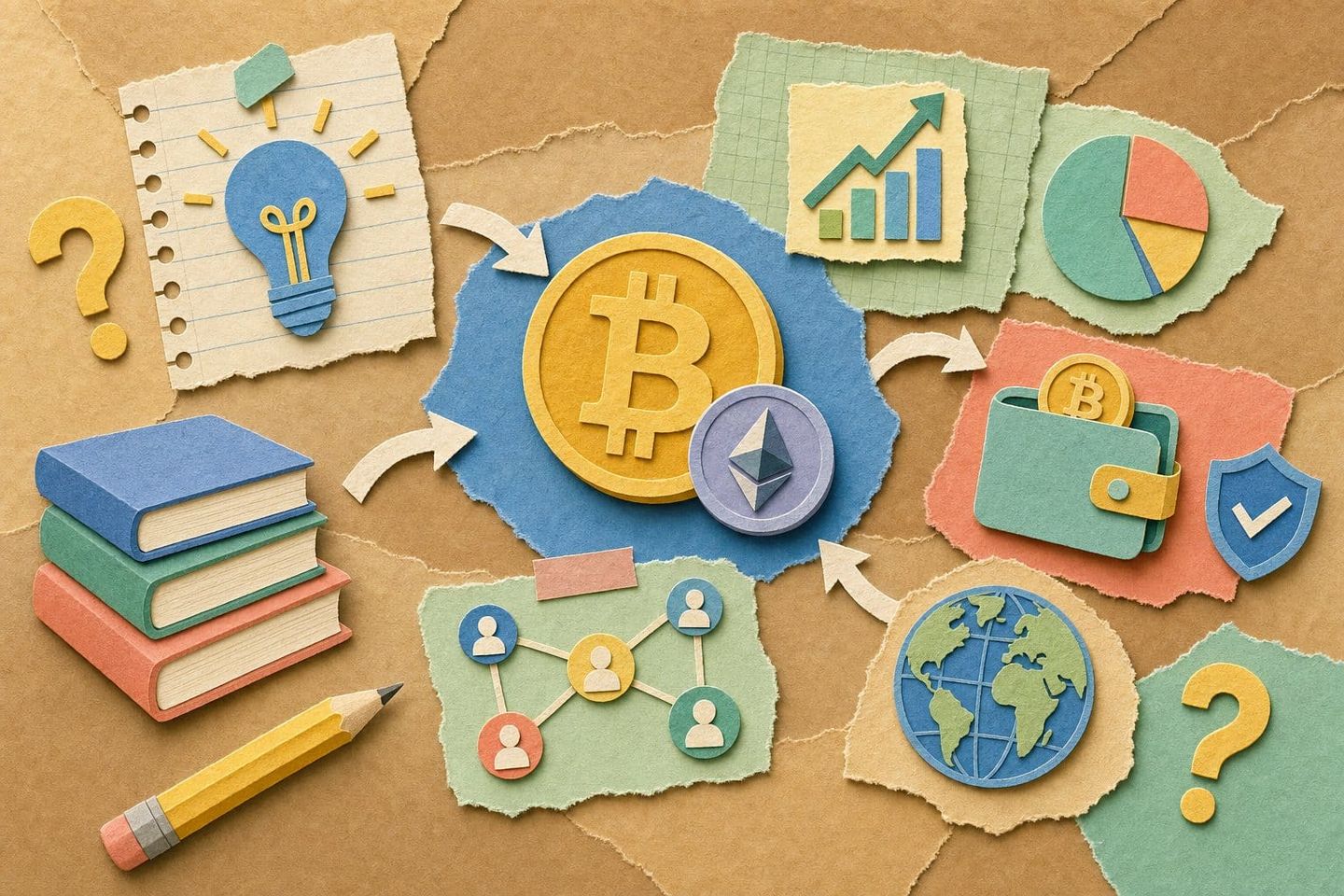
What Is Cryptocurrency? The Core Essentials
Cryptocurrency is digital money secured by cryptography and operating on decentralized blockchain networks — no government, central bank, or single company controls its issuance, transaction records, or supply. First introduced with Bitcoin in 2009, the asset class has grown into a global market spanning thousands of distinct tokens and protocols across multiple competing blockchains. According to TradingCosts, the total crypto market capitalization fluctuates between $2.5 trillion and $3.5 trillion as of May 2026, with Bitcoin (BTC) representing 40–50% and Ethereum (ETH) holding 15–20% of total market value. Unlike traditional fiat currencies, no central authority can unilaterally expand the supply, reverse a settled transaction, or freeze an account without control of the underlying private key. This architecture — borderless by default, transparent in its public ledger, and governed by protocol code rather than institutions — marks the foundational distinction between cryptocurrency and every conventional form of money that has preceded it.
Quick Answer: Cryptocurrency is decentralized digital money secured by cryptography — no government or bank controls it. As of May 2026, the total crypto market cap sits between $2.5–3.5 trillion, with Bitcoin commanding 40–50% of that value, making it the most established entry point for new investors.
Three core properties distinguish cryptocurrency from traditional money and shape everything a new investor needs to understand before committing capital. First, there is no central issuer: Bitcoin's supply is capped at 21 million coins by protocol, and that limit cannot be changed by any government decree or corporate board decision. Second, crypto transactions are borderless by design — sending value from New York to Singapore requires no bank, no correspondent network, and no multi-day settlement window. Third, the transaction history recorded on a public blockchain is transparent and immutable: every confirmed transaction is visible to anyone and computationally prohibitive to alter or erase retroactively.
These properties create both the opportunity and the risk profile that retail investors must internalize before entering the market. The absence of a central authority means there is no Federal Deposit Insurance Corporation (FDIC) equivalent protecting your holdings. Exchange hacks, smart contract bugs, and fraudulent tokens represent real, recurring hazards in this space. According to Yahoo Finance's crypto investing guide, crypto markets can shed 50% or more of total value during correction cycles — a characteristic that requires investors to calibrate position sizes accordingly, not as pessimism, but as structural reality.
The regulatory environment has matured considerably since the 2022 bear market. The European Union's Markets in Crypto-Assets (MiCA) regulation came into full force across all 27 member states in 2025, establishing the world's first comprehensive licensing framework for exchanges and stablecoin issuers operating in a major economic bloc. In the United States, spot Bitcoin and Ethereum exchange-traded funds now trade on regulated exchanges, offering retail investors institutional-grade access vehicles through standard brokerage accounts. These structural developments have lowered the barrier to entry but have not eliminated the fundamental volatility that defines this asset class.
How Blockchain Technology Works
A blockchain is a distributed digital ledger that records every transaction across thousands of computers simultaneously — there is no single server, no central headquarters, and no single point of control or failure. When a user initiates a cryptocurrency transfer, that transaction is broadcast to a global peer-to-peer network of computers called nodes, each of which independently verifies the transaction against its own copy of the existing ledger. Verified transactions are bundled into a "block" and cryptographically linked to the preceding block using a hash function, forming an unbroken chain of records dating back to the network's first transaction. According to E*TRADE's Blockchain Technology Guide, altering any historical block would require recalculating the cryptographic proof for that block and every subsequent block simultaneously — a computational task designed to be prohibitively expensive for any attacker operating against a well-distributed network with significant security budget.
"The blockchain is an incorruptible digital ledger of economic transactions that can be programmed to record not just financial transactions but virtually everything of value." — Don Tapscott, Co-author, Blockchain Revolution (source: E*TRADE Blockchain Technology Guide)
The mechanism by which new blocks are added to the chain is called a consensus mechanism, and the two dominant models differ significantly in speed and energy consumption. Bitcoin uses Proof-of-Work (PoW): specialized computers called miners race to solve a complex mathematical puzzle; the winner adds the next block and earns a BTC reward. This process takes approximately 10 minutes per block and consumes substantial electricity — an intentional design choice that makes attacks economically prohibitive because any attacker must outpace the entire combined computational power of the honest network. Ethereum switched to Proof-of-Stake (PoS) in September 2022, reducing energy consumption by approximately 99% and cutting block finality to roughly 12 seconds. Under PoS, validators stake ETH as collateral to earn the right to propose blocks; dishonest behavior results in "slashing," or forfeiture of that collateral.
The practical consequence of these architecture choices matters for investors evaluating specific assets. Bitcoin's slower, energy-intensive PoW is viewed by many participants as contributing to its security and decentralization — the network has never suffered a successful 51% attack since its launch in 2009. Ethereum's faster PoS enables the throughput needed for decentralized applications, decentralized finance protocols, and other on-chain activity to operate at meaningful scale. According to CryptoLinkNet's blockchain explainer, Ethereum processes blocks approximately every 12 seconds under PoS, compared to Bitcoin's roughly 10-minute interval — a 50× difference in transaction finality speed that directly shapes what each network can be used for.
Understanding blockchain architecture also clarifies why cryptocurrency valuations are not purely speculative. Each blockchain's security budget — the total computational power or staked value that would need to be overcome to falsify the transaction history — represents a real, ongoing economic commitment. When that security budget is large and decentralized across thousands of independent participants, the ledger becomes a genuinely trustworthy record-keeping system without requiring a trusted intermediary. This is the foundational value proposition underlying the entire asset class: reliable, permissionless transaction settlement.
Types of Cryptocurrency: A Beginner's Map
Not all cryptocurrencies serve the same function, and treating the entire asset class as a homogeneous category is one of the most common and costly beginner errors. The landscape divides into several distinct categories with meaningfully different risk profiles, use cases, and market dynamics. Bitcoin, with a hard supply cap of 21 million coins embedded in its protocol, functions as a scarce digital store of value — often described as "digital gold" due to its predictable supply schedule and 15-year track record as the most liquid and widely held crypto asset. Smart contract platforms such as Ethereum, Solana, Cardano, and Avalanche power decentralized applications and self-executing contracts, deriving value from network usage and developer activity. Stablecoins including USDT and USDC maintain 1:1 pegs to the US dollar, providing a low-volatility medium of exchange and a bridge between crypto markets and the traditional financial system. According to TradingCosts, understanding these categories before allocating capital is the prerequisite to building a coherent, risk-adjusted strategy.
| Category | Key Examples | Primary Use Case | Volatility Profile | Beginner Suitability |
|---|---|---|---|---|
| Store of Value | Bitcoin (BTC) | Digital gold, long-term value storage | High — but most established | Core holding; most appropriate starting point |
| Smart Contract Platform | Ethereum (ETH), Solana (SOL), Avalanche (AVAX), Cardano (ADA) | Decentralized apps, DeFi, NFTs | Very high | ETH suitable for beginners; others carry higher risk |
| Stablecoin | USDT (Tether), USDC (Circle) | Dollar equivalent, exchange on/off ramp, holding position | Minimal — pegged to USD | Useful operational tool; not an investment asset |
| DeFi Token | Aave (AAVE), Uniswap (UNI) | Decentralized lending, trading, and liquidity protocols | Extreme | Advanced users only; significant smart contract risk |
| Meme Coin | Dogecoin (DOGE), Shiba Inu (SHIB) | Community-driven, social sentiment speculation | Extreme | Highly speculative; minimal fundamental utility |
Bitcoin's fixed supply architecture makes it unique among all major asset classes. Unlike fiat currencies — which central banks can expand in response to economic conditions — Bitcoin's supply schedule is determined entirely by its code. Approximately 19.8 million of the 21 million coins had already been mined by early 2026, leaving fewer than 1.2 million remaining to be issued over the coming decades via block rewards that halve roughly every four years. This built-in, protocol-enforced scarcity is the basis for the store-of-value investment thesis, independent of any short-term price movement.
Smart contract platforms present a different value proposition: the more developers build on a network, and the more users interact with those applications, the greater the demand for the native token to pay transaction fees. Ethereum dominates this category by developer count and total value locked (TVL) in its DeFi ecosystem, while Solana has captured meaningful market share with its higher throughput and lower per-transaction costs. Both face ongoing competition from newer Layer-1 blockchains, and each carries material risks including smart contract vulnerabilities, network congestion, and competitive displacement.
Stablecoins deserve particular attention as operational tools rather than investment assets. USDT (Tether) and USDC (Circle) each maintain reserves backing their dollar pegs, though the composition and audit practices of those reserves differ between issuers. For new market participants, stablecoins serve as holding positions between trades and as on/off ramps between the crypto and fiat systems — not as assets expected to appreciate. DeFi tokens and meme coins represent the highest-risk market segment: according to Bitget Academy, deploying a new token on Ethereum or Solana costs almost nothing, which means the market is continuously flooded with projects carrying no fundamental utility and, in many cases, deliberate fraud risk. Verification through on-chain data tools and established community sources is essential before committing capital to any asset outside the established top tier.
How to Buy Cryptocurrency: Three Entry Points Compared
Beginners have three distinct entry points into the crypto market, each involving different trade-offs between accessibility, custody control, and cost transparency. Centralized exchanges (CEXs) such as Coinbase, Kraken, and Gemini offer the broadest coin selection, direct wallet transfer capability, and regulated custody in licensed jurisdictions — Coinbase is NASDAQ-listed and subject to SEC oversight as a public company; Kraken holds a New York BitLicense; Gemini is regulated by the New York Department of Financial Services. Minimum purchases on major CEXs typically start at $10–$50, and all three support fractional Bitcoin purchases. Financial apps including Robinhood, PayPal, and Cash App offer lower-friction onboarding — a new buyer can be transacting within minutes — but usually provide fewer coin options, less transparent pricing, and in some cases no ability to withdraw crypto to an external wallet. The third route, purchasing spot crypto ETFs through a standard brokerage account, is the most hands-off approach with no wallets or private keys required. According to KuCoin's 2026 buying guide, understanding these distinctions before committing capital is essential for managing fees and custody risk from day one.
| Entry Point | Key Platforms | Coin Selection | Minimum Purchase | Self-Custody Possible? | Best For |
|---|---|---|---|---|---|
| Centralized Exchange (CEX) | Coinbase, Kraken, Gemini | Hundreds of tokens | $10–$50 | Yes — full wallet withdrawals supported | Active traders, diversified portfolios |
| Financial App | Robinhood, PayPal, Cash App | Limited (5–20 coins) | $1–$5 | Limited — varies by platform | Absolute beginners, BTC/ETH exposure only |
| Spot ETF via Brokerage | iShares, Fidelity, Bitwise ETFs (via any licensed broker) | BTC, ETH, SOL (as of October 2025) | 1 share (~$20–$60) | No — brokerage holds fund shares | Hands-off investors, IRA/retirement accounts |
The spot ETF route expanded significantly in late 2025. Following the landmark approvals of spot Bitcoin and Ethereum ETFs in the US in 2024, Solana ETFs launched in October 2025, extending ETF-accessible crypto exposure to a third major asset. This development means investors can now hold BTC, ETH, and SOL exposure within tax-advantaged accounts such as IRAs, through the same brokerage interface used for equities and bonds. The primary trade-off is the absence of direct asset ownership: ETF holders own shares in a fund, not the underlying cryptocurrency, and cannot withdraw crypto to a personal wallet or participate in on-chain activities such as staking or DeFi.
For beginners prioritizing simplicity alongside regulatory protection, CEXs registered with US regulators represent a strong starting point. Coinbase, Kraken, and Gemini all maintain state-level money transmitter licenses in major US states and, in Kraken's and Gemini's cases, BitLicenses in New York — the most stringent state-level crypto licensing regime in the country. These regulatory frameworks provide meaningful consumer protections compared to offshore exchanges, though they do not eliminate custody risk. The FTX collapse in November 2022 — in which a major, apparently regulated exchange became insolvent, locking customer funds — is the defining cautionary example: regulatory status is a necessary but not sufficient basis for trust in a custodian.
Fee structures vary meaningfully across all three routes and compound significantly over time. CEXs typically charge 0.5–1.5% per trade, with lower rates for higher-volume accounts. Financial apps often embed wider bid-ask spreads rather than explicit commissions, making the true cost less visible but not necessarily lower. Spot crypto ETF expense ratios range from approximately 0.19% to 0.95% annually — predictable and low for passive holders, but more expensive than direct exchange trading for investors who plan to trade actively. Mapping the fee structure to your anticipated trading frequency before selecting a platform is one of the most straightforward ways to improve net returns.
Building Your First Portfolio: DCA and Allocation
Dollar-cost averaging (DCA) is the practice of investing a fixed dollar amount at regular intervals — weekly, biweekly, or monthly — regardless of the current market price. Rather than attempting to identify optimal entry points in a market characterized by unpredictable short-term swings, DCA distributes purchases across time, automatically acquiring more units when prices are lower and fewer when prices are higher. For a market as volatile as cryptocurrency, this mechanical discipline removes emotional decision-making from the equation entirely. A beginner investing $50 per week builds a diversified cost basis over time, reducing the risk of deploying a large position immediately before a sharp correction. According to TradingCosts' 2026 investing guide, DCA is consistently identified as the most appropriate entry strategy for retail investors without professional trading experience or the capacity to conduct active technical analysis.
"Dollar-cost averaging is especially effective in high-volatility markets — investing fixed amounts on a regular schedule removes timing pressure and produces a lower average cost basis than most discretionary entry attempts over comparable periods," notes the investment guidance team at Yahoo Finance in its 2026 crypto investing guide, citing DCA as the primary recommended strategy for retail participants entering the crypto market.
Portfolio allocation requires equal discipline. Financial planning consensus reflected across multiple industry sources suggests limiting total crypto exposure to 5–10% of an overall investment portfolio for most retail investors. Conservative investors — particularly those within 10–15 years of retirement — are advised to cap crypto allocation at 1–3%. The core rationale: cryptocurrency's structural capacity for large, rapid drawdowns means no investor should hold more than they can absorb losing entirely without material impact on their financial goals. This is not a pessimistic framing; it is a structural acknowledgment that even the most established assets in this class have experienced drawdowns exceeding 50% within a single calendar year on multiple occasions.
Within the crypto allocation, a core-satellite framework provides a practical structure. Allocate 60–80% of the crypto position to Bitcoin and Ethereum as core holdings: both carry the longest track records, the deepest liquidity, the broadest institutional recognition, and the clearest regulatory status as of 2026. The remaining 20–40% can be directed toward vetted altcoins as satellite exposure for higher-upside potential with correspondingly higher risk. A sample beginner portfolio consistent with this framework: 50% BTC, 30% ETH, and 20% divided equally across four altcoins at 5% each. This construction provides exposure to higher-growth potential assets without concentrating meaningful risk in any single speculative position.
Rebalancing should be planned before the first purchase, not after prices move. If an altcoin satellite position appreciates significantly and grows to represent 15–20% of the total crypto allocation, trimming it back to the target weight locks in gains and resets the risk profile toward the intended structure. Conversely, if a core position declines below its target weight, the scheduled DCA purchases naturally rebalance toward it over time without requiring a discretionary judgment call. This systematic approach is particularly well-suited to retail investors who hold crypto as a portion of a broader portfolio that also includes equities, bonds, or real estate holdings.
Crypto Wallet Security: Hot Storage vs. Cold Storage
A crypto wallet is not a container that holds coins — it is a device or application that stores the private keys that prove ownership of assets recorded on the blockchain. Your cryptocurrency exists on the blockchain itself; what the wallet holds is the cryptographic credential that authorizes transactions. Hot wallets are software-based applications — MetaMask, Trust Wallet, and Phantom are among the most widely used — that maintain an internet connection and offer convenient access for active trading or interacting with decentralized applications. Cold wallets are hardware devices such as Ledger and Trezor, costing between $60 and $200, that store private keys on a physically isolated chip that never connects to the internet directly, preventing remote access by attackers. According to TradingCosts, cold storage is strongly recommended for any holdings exceeding $1,000–$2,000 in combined value.
"Not your keys, not your coins — storing cryptocurrency on an exchange means you hold a claim against that platform, not the underlying asset itself." — Andreas Antonopoulos, Author, Mastering Bitcoin (source: BlockLR Beginners Guide)
The security risk profile of hot wallets concentrates around two primary attack vectors: phishing and exchange insolvency. Phishing attacks attempt to deceive users into entering their 12–24 word recovery seed phrase on a fraudulent website or application, after which an attacker can immediately drain the entire wallet balance. Exchange hacks have resulted in losses exceeding $1 billion in several historical incidents. The non-negotiable security rule that applies regardless of wallet type or platform: never share your private key or recovery seed phrase with any person, platform, application, or "support agent" under any circumstances whatsoever. Any party requesting this information is attempting to steal your holdings — legitimate platforms never ask for seed phrases.
Cold wallets add a physical security layer by requiring the hardware device to be physically present and manually activated to sign any transaction. Even if the connected computer is fully compromised by malware, the private key never leaves the hardware device's isolated chip. Ledger and Trezor both manufacture industry-standard devices with independently audited firmware; the $60–$200 cost represents modest insurance relative to holdings of any meaningful size. For beginners who keep their crypto on a centralized exchange while first learning the market, transitioning to a hardware wallet after the $1,000–$2,000 threshold is a widely accepted practical guideline — not because licensed exchanges are inherently unsafe, but because exchange custody means a third party controls the private keys to your assets, and that counterparty risk should be explicitly managed rather than ignored.
Crypto Taxes: Key Rules Every Beginner Must Understand
In the United States, the Internal Revenue Service classifies cryptocurrency as property — not as currency. This classification has significant practical implications: every time you sell, trade, or spend cryptocurrency, you trigger a taxable capital gains event, regardless of whether the transaction occurs on a centralized exchange, a decentralized protocol, or a peer-to-peer transfer. Simply holding cryptocurrency without transacting does not generate a taxable event — long-term holders who do not sell or trade incur no current-year tax obligation on their positions. According to Yahoo Finance, meticulous record-keeping of every transaction — including date, amount, asset price at the time, and cost basis — is mandatory for accurate tax compliance from the very first trade.
The holding period determines the applicable tax rate on any realized gain. Assets held for fewer than 12 months are subject to short-term capital gains rates, which equal ordinary income tax rates — potentially 22–37% for many retail investors in the United States depending on total taxable income. Assets held for 12 months or longer qualify for preferential long-term capital gains rates of 0%, 15%, or 20%, tiered by income level. This distinction creates a meaningful structural incentive for longer holding periods: the tax efficiency differential between short-term and long-term treatment can materially affect net returns on identical underlying price appreciation. A position held 366 days versus 364 days can face a dramatically different effective tax rate.
Staking rewards and airdrops are treated differently from capital gains events. The IRS has clarified that staking rewards are recognized as ordinary income at the fair market value of the tokens on the date they are received — not when they are eventually sold. This means a staker who earns $500 in ETH staking rewards during 2026 owes ordinary income tax on that $500 in the 2026 tax year, even if none of the ETH is sold. Similarly, tokens received via airdrops are treated as ordinary income at time of receipt. Active DeFi participants — stakers, liquidity providers, yield farmers — therefore accumulate tax obligations with each reward event, not only when they exit positions.
Tax reporting software specifically designed for cryptocurrency — including Koinly, CoinTracker, and TaxBit — can aggregate transaction histories across multiple exchanges and wallets and generate IRS-compliant Form 8949 schedules. For investors just entering the market, the most important habit to establish immediately is maintaining a complete transaction log: every buy, sell, transfer, swap, and reward event, with corresponding dates and USD values at time of transaction. Reconstructing cost basis retroactively across multiple platforms after years of trading is a laborious and error-prone process; beginning with clean records eliminates that problem entirely.
Current Market Context: What Beginners Should Know
Bitcoin's price trajectory since late 2024 provides a useful and concrete reference frame for understanding the structural volatility that characterizes this market. According to Yahoo Finance, Bitcoin peaked at $126,198 in October 2025, fell to $60,074 by February 2026 — a decline of approximately 52% from peak — and subsequently rebounded above $71,000. This sequence is not exceptional by historical standards; drawdowns of 40–70% from prior cycle peaks have occurred multiple times across Bitcoin's 15-year operating history, interspersed with recoveries that eventually restored and surpassed previous highs. For investors entering the market in May 2026, the critical data point is not any specific price level but the demonstrated range of outcomes this market can deliver within compressed timeframes — information that must inform position sizing before any purchase is made.
Infrastructure maturity has improved substantially since the 2022 bear market cycle. The approval and launch of spot Bitcoin and Ethereum ETFs on regulated US exchanges marked a structural shift in institutional accessibility. Solana ETFs followed in October 2025, extending the ETF menu for retail investors and allowing SOL exposure within tax-advantaged retirement accounts for the first time. In Europe, the EU's MiCA framework came into full operational force in 2025, establishing licensing requirements for crypto exchanges and stablecoin issuers across all 27 member states — the world's first comprehensive regulatory regime of this kind. These parallel regulatory developments represent a meaningful reduction in systemic infrastructure risk compared to the environment that existed during the 2022 FTX collapse, though market-level volatility has not moderated proportionally.
The broader blockchain industry is projected to reach $23.3 billion in market size in 2026, according to CryptoLinkNet. This figure reflects enterprise adoption, infrastructure investment, and developer ecosystem expansion — it does not translate directly into individual asset price performance. Blockchain industry growth and the price of BTC, ETH, or any specific token are distinct variables: a thriving development ecosystem can coincide with flat or declining token prices when supply dynamics, market sentiment, or macroeconomic conditions — particularly changes in global liquidity and interest rate environment — work against the asset. New investors who conflate industry growth with individual asset appreciation expose themselves to a common analytical error.
Two risk categories deserve particular attention from anyone entering this market in 2026. First, leverage and margin trading: multiple major exchanges offer 5×, 10×, or higher leverage products to retail accounts. These instruments amplify both gains and losses proportionally — a 10% adverse price move eliminates a 10× leveraged position entirely via liquidation. Beginners should avoid leveraged products without exception until they have developed a consistent track record in spot trading and a thorough understanding of liquidation mechanics. Second, the proliferation of scam tokens: because deploying a new contract on Ethereum or Solana costs almost nothing, thousands of fraudulent projects launch annually, many mimicking legitimate project names or sustaining short-term social media promotion before collapsing. Verification through on-chain data aggregators, official project websites, and established community channels is non-optional before committing capital to any asset outside the established, deeply liquid tier.
Frequently Asked Questions
How much money do I need to start investing in cryptocurrency?
Most major centralized exchanges — including Coinbase, Kraken, and Gemini — allow minimum purchases of $10–$50 per transaction, and all three support fractional Bitcoin purchases, meaning a $25 buy acquires a proportional fraction of a BTC without requiring a full coin purchase. Financial apps like Cash App set minimums as low as $1. The more important constraint is not the platform minimum but the amount you can absorb losing entirely without impact on your financial situation. Crypto markets have historically experienced drawdowns of 40–70% from peak values in a single year. Start with a position size that would not materially affect your financial goals if it went to zero — for most beginners, this means treating crypto as a single-digit percentage of a diversified portfolio, not a primary savings vehicle or a replacement for an emergency fund.
Which cryptocurrency is best for beginners?
Bitcoin (BTC) and Ethereum (ETH) are the most appropriate starting points for investors new to this market. Bitcoin has operated continuously since January 2009, carries the longest track record among all crypto assets, a fixed 21-million-coin supply cap, and the broadest institutional and regulatory recognition — including spot ETF availability on US exchanges as of 2024. Ethereum has operated since 2015 and remains the dominant smart contract platform by developer activity and total value locked. Both now have spot ETFs available in the US, offering access through standard brokerage accounts. No crypto asset is risk-free — BTC and ETH have each experienced multiple 50%+ drawdowns historically — but they represent the more established, more liquid end of the risk spectrum compared to altcoins, DeFi tokens, or meme coins, which carry additional layers of project-specific, liquidity, and smart contract risk.
Do I need a crypto wallet to get started?
Not immediately. Centralized exchanges such as Coinbase, Kraken, and Gemini, as well as financial apps like Robinhood and PayPal, hold your crypto in custody on your behalf — you access your holdings via standard login credentials rather than managing private keys directly. This exchange-custody model is the simplest approach for beginners and is fully functional for initial positions. However, exchange custody means a third party controls your private keys, and your access to your holdings depends on that platform's continued operational status — the FTX insolvency in 2022 is the defining case study for custody counterparty risk. Once your combined crypto holdings approach $1,000–$2,000 or above, transferring assets to a hardware wallet (Ledger or Trezor, priced at $60–$200) significantly reduces custody risk by placing private key control directly in your hands. Spot ETF investors have no wallet requirement, but also have no ability to withdraw the underlying crypto to personal custody.
What is dollar-cost averaging and why is it recommended for crypto?
Dollar-cost averaging (DCA) is the strategy of investing a fixed dollar amount at regular intervals — for example, $50 every week or $200 every month — regardless of the current price. Because you invest a fixed dollar amount rather than a fixed number of coins, you automatically purchase more units when prices are lower and fewer when prices are higher. Over time, this produces an average cost basis that is typically lower than the simple average of all the prices you encountered during the investment period. In a market as volatile as cryptocurrency, DCA removes the psychological and practical pressure of timing entry points — a task that professional traders frequently fail at under controlled conditions, and that retail investors have no structural advantage in attempting. DCA also prevents the common mistake of deploying a large lump sum at or near a short-term peak, which behavioral research consistently identifies as one of the most damaging investor behaviors in volatile markets.
How is cryptocurrency taxed in the United States?
The IRS classifies cryptocurrency as property, meaning every sale, trade (including crypto-to-crypto swaps), or purchase made using cryptocurrency is a taxable capital gains event. Simply holding crypto without transacting does not create a tax obligation. The applicable tax rate depends on how long you held the asset before the taxable event: holdings sold in under 12 months are taxed at short-term capital gains rates equal to your ordinary income tax rate — which can reach 22–37% for many retail investors depending on total annual income. Holdings sold after 12 months or more qualify for preferential long-term capital gains rates of 0%, 15%, or 20% based on income level. Beyond trading gains, staking rewards, mining income, and airdropped tokens are generally treated as ordinary income at the fair market value on the date of receipt — a tax obligation that arises even if you never sell the received tokens. Maintain complete records of every transaction from your first day of trading, including dates, amounts, and USD values at time of each event.
What Every Beginner Should Take Away
Cryptocurrency represents a structurally distinct asset class — decentralized, borderless, operating outside the traditional financial system — with a genuine and documented track record of both significant appreciation and severe drawdowns across its 15-year history. The market has matured considerably since the 2022 bear cycle: regulated spot ETFs for BTC, ETH, and SOL are widely available, the EU's MiCA regulatory framework is operational, and the infrastructure supporting retail participation is deeper and more resilient than at any prior point. For beginners, the primary discipline is not selecting the right token — it is position sizing. Limiting crypto to 5–10% of a total portfolio, anchoring in the most established assets, and deploying capital gradually through dollar-cost averaging are the three behaviors that most reliably separate disciplined investors from those who take on more risk than they can structurally absorb.
Security and tax compliance are foundational requirements to address before the first purchase, not after positions have grown. Understanding the difference between exchange custody and self-custody, knowing the threshold at which a hardware wallet becomes advisable, and maintaining transaction records from day one are habits that protect capital against preventable operational losses. The market's volatility is a feature of its structure — a function of global 24/7 trading, leverage use by other market participants, and still-developing institutional infrastructure — not a temporary condition that will resolve as the market matures. Every participant in this asset class will experience periods of significant unrealized loss; the ones who navigate it successfully are those who anticipated that possibility and sized their positions accordingly.
The blockchain industry's projected $23.3 billion market size in 2026 reflects genuine infrastructure growth with long-term implications for finance, contracts, and data ownership. But individual token performance depends on variables — market liquidity cycles, regulatory decisions, competitive protocol dynamics, and global macro conditions — that are largely independent of ecosystem fundamentals in the short term. Approach every position with clear entry criteria, a defined and pre-committed allocation limit, and an honest assessment of the full downside scenario before evaluating any upside potential. That framework, applied consistently across an extended time horizon and paired with disciplined DCA, is the most reliable foundation available to any retail investor entering this market.
Last updated: 2026-05-08. This article reflects market data, regulatory frameworks, ETF product availability, and exchange offerings current as of May 2026. Key figures including market capitalization ranges, ETF listings, and tax treatment summaries are reviewed periodically as conditions evolve.