What Changed: $11.3B Record Volume, a 6.6% QQQ Drop
Tokenized equities just posted their biggest month on record — while the flagship asset behind that record lost value. The gap between those two facts is the whole story.
Tokenized stock and ETF trading volume rose 288% month-over-month to a record $11.3 billion in July 2026, according to CoinDesk Data's monthly "Stablecoins & Tokenized Assets" report published August 1, 2026 . A tokenized stock is a blockchain-issued token that tracks a listed equity or ETF 1:1, usually backed by custodied shares of the underlying. The record, however, was not spread across the market — it came from one instrument.
QQQB, a 1:1 tokenized tracker of the Invesco QQQ Trust listed on Binance, generated $9.27 billion on its own — roughly 82% of all tokenized-equity volume in July . Binance's wider bStocks suite accounted for $9.41 billion, or 83.3% of market-wide volume .
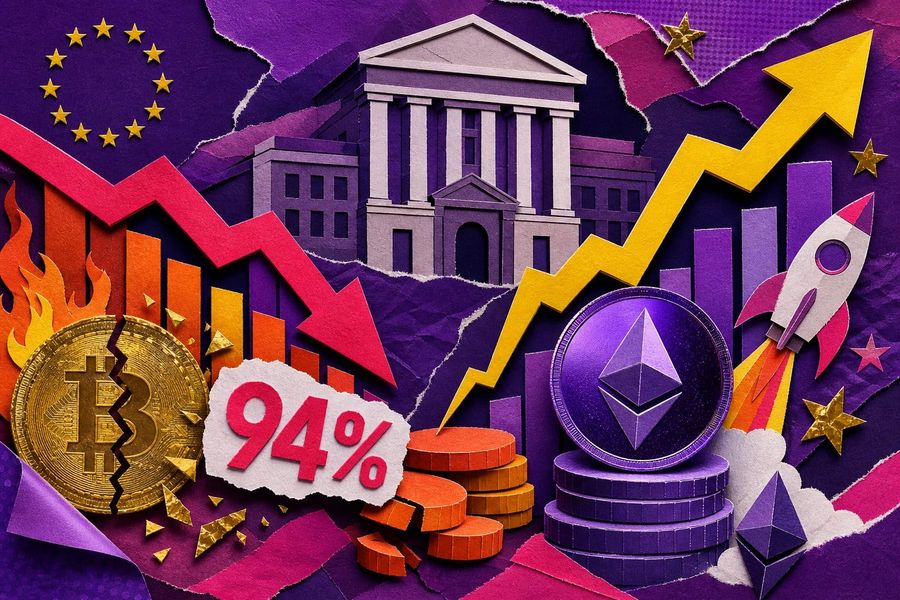
The unusual part is what the underlying asset did over the same stretch. QQQ fell 6.6% in July, a steeper drop than the broad indices, and traded as much as 10.2% below its June 30 close before recovering in the final two sessions . Record token volume tracked a falling asset, not a rally.
- Invesco QQQ Trust: −6.6% in July 2026
- Nasdaq Composite: −3.2%
- S&P 500: −0.1%
- Intramonth low vs. June 30 close: −10.2%
One framing error is already circulating and worth flagging early: 288% is the month-over-month growth rate of total tokenized-equity volume, not QQQB's contribution. QQQB's share was about 82% . Headlines conflating the growth rate with the share — including at crypto.news — describe a statistic that does not exist. The two numbers measure different things, and the distinction matters for anyone sizing this market.
Why It Happened: A Fee Waiver, Not a Price Signal
July's volume spike traces to two Binance incentives with fixed end dates, not to fresh investor demand. QQQB began trading on Binance on June 30, 2026, with zero maker fees scheduled to run through August 31, 2026. A zero-cost venue for round-trip trading changes behavior on its own, regardless of what the underlying index is doing.
The second lever arrived mid-month. On July 23, Binance began counting stock and bStocks volume at 3x its traded value for users working toward higher VIP tier status. That multiplier lifts credited volume without any matching increase in economic activity, and it landed in the same window that produced the record print.
The two incentives together explain the shape of the data better than any demand story:
- Zero maker fees (Jun 30 – Aug 31): removes the cost of high-frequency round trips in a single instrument.
- 3x VIP volume multiplier (from Jul 23): rewards traders for routing size through bStocks specifically.
- Concentration: QQQB alone printed $9.27 billion, the pattern you would expect from an incentive funnel rather than broad adoption.
Binance's own research arm reports a materially larger number. Binance Research put July tokenized-equities volume at $18.2 billion, a 4.4x increase over June, with year-to-date volume through July 31 at $34.3 billion — more than half the year's total in one month. That gap against CoinDesk Data's $11.3 billion is a methodology difference, and Binance is reporting on its own product.
Binance co-CEO Richard Teng spotlighted a related figure from that same Binance Research data: tokenized equities rose from 0.4% of SPY's trading volume in June 2026 to 2.3% in July (source: Crypto Briefing, 2026-08). The ratio is real, but it was measured while one venue was giving the product away.
Why It Matters: Strip Out One Token and the Market Shrank
Remove QQQB from the July tally and the tokenized-equity market did roughly $2.03 billion, about 30% below June's estimated $2.91 billion. That is the qualification the 288% headline hides: the sector set an all-time volume record in the same month its non-QQQB activity contracted by nearly a third (source: CoinDesk, 2026-08).
The issuer league table reshuffled just as violently. xStocks led June with a 53.1% share, then dropped to fourth place in July on $335 million, roughly 3% of the market.
| Issuer | July 2026 volume | Share of market | June position |
|---|---|---|---|
| Binance bStocks (incl. QQQB) | $9.41B | 83.3% | Launched June 30 |
| Ondo | $792M | ~7% | Top-three issuer |
| Backpack | $479M | ~4% | Top-three issuer |
| xStocks | $335M | ~3% | 1st ($1.55B, 53.1%) |
Table data: CoinDesk Data, July 2026.
The stickier metrics tell a different and more credible story. These compounded without a fee waiver behind them:
- Market cap: tokenized public equities reached a record $2.26 billion, up 50.3% in July — a fourth straight monthly gain (source: KuCoin, 2026-08).
- Holders: 758,950 holders and 248,774 active addresses after roughly 92% growth in 30 days, approaching one million (source: Bitcoin.com News, 2026-08).
- Issuer concentration eased: Ondo stayed the largest issuer at $612 million, though its share fell from 44% to 27%.
Robinhood Chain is the other structural shift. Over the seven days to July 28, it averaged $29.7 million in daily tokenized-equity DEX volume, beating Solana's xStocks ($11.1M) and Backpack's Sunrise ($13.4M) combined (source: The Defiant, 2026-07).
That figure carries its own asterisk. Launch platforms including Bankr and long.xyz built memecoins backed by tokenized stocks in liquidity pools, so memecoin trading throws off stock-token volume as a byproduct. The leading pair, Artificial Inu (AI/NVDA), traded $2.6 million daily against tokenized Nvidia's $13.9 million.
What to Watch Next: Three Incentive Cliffs
Three subsidy expirations land in sequence between August and October 2026, and each one strips away part of the scaffolding that produced July's record. Binance's zero maker fee on QQQB runs through August 31, 2026 . Robinhood's gas subsidy for tokenized-equity traders lapses around the end of September 2026 . The DTCC's tokenized-securities infrastructure launch is set for October 2026 .
- August 31 — Binance QQQB fee waiver ends. The September print is the first clean read on whether QQQB volume survives without free maker execution. Binance's separate 3x volume multiplier for VIP-tier credit, live since July 23, is the other variable to track (source: CoinDesk, 2026-08).
- End of September — Robinhood Chain gas subsidy lapses. Robinhood Chain averaged $29.7 million in daily DEX volume as of July 28, much of it memecoin-adjacent. Paid gas changes the economics of that byproduct flow first (source: The Defiant, 2026-07).
- October — DTCC tokenized-securities launch. This is a catalyst rather than a cliff, and it could redirect where institutional volume settles (source: crypto.news, 2026-08).
The metric that answers the question is not the headline total. It is non-QQQB volume in the August and September CoinDesk Data monthly reports. That line came in near $2.03 billion in July, down roughly 30% from June's estimated $2.91 billion .
Pair it with the slower series: market capitalization at a record $2.26 billion and 758,950 holders . Those compounded without a fee waiver. If holders and market cap keep climbing while non-QQQB volume recovers, the adoption case holds. If only the incentivized number falls, July was a promotion, priced accordingly.
Frequently asked questions
What caused the 288% jump in tokenized stock trading volume in July 2026?
Mostly one token. QQQB, Binance's 1:1 tokenized tracker of the Invesco QQQ Trust, produced roughly $9.27 billion of the $11.3 billion market-wide total — about 82% of all tokenized-equity volume . Two Binance incentives explain the concentration: zero maker fees on QQQB running through August 31, 2026, and a change on July 23 that credited stock and bStocks volume at 3x its traded value toward VIP tier status . A volume multiplier inflates reported activity without changing the underlying economics, so the headline growth rate reflects promotion mechanics more than new demand. Read more at CoinDesk Data.
Does the record volume mean real growth in tokenized stock adoption?
It is a mixed signal, and the two halves point in opposite directions. Strip out QQQB and the rest of the market traded about $2.03 billion in July, roughly 30% below June's estimated $2.91 billion . The slower-moving metrics tell a better story: tokenized public equity market capitalization rose 50.3% to a record $2.26 billion, a fourth straight monthly gain and nearly double the $1.17 billion level at the start of 2026 . Holder counts reached 758,950 with 248,774 active addresses, after roughly 92% growth in 30 days . Those compounded without a fee waiver attached, which is why they carry more weight than the volume print.
Why did QQQB volume spike while the underlying QQQ price fell 6.6%?
Because the flow followed a fee schedule, not a price move. The Invesco QQQ Trust fell 6.6% in July, against a 3.2% decline in the Nasdaq Composite and a 0.1% slip in the S&P 500, and traded as much as 10.2% below its June 30 close before recovering in the final two sessions . QQQB began trading on Binance on June 30, 2026 with maker fees waived, so activity ramped independently of the ETF's performance . When volume rises while the tracked asset declines, the driver is usually structural — cost, credit, or rebate — rather than a directional view on the underlying.
Why do different reports show $11.3B vs $18.2B for July tokenized-equity volume?
Different methodologies and different scopes, from sources with different incentives. CoinDesk Data's monthly report, published August 1, 2026, put July tokenized stock and ETF volume at $11.3 billion . Binance Research reported $18.2 billion — a 4.4x increase over June — with year-to-date volume through July 31 at $34.3 billion . Binance Research is reporting on bStocks, its own product line, which warrants added scrutiny. Similar gaps appear in platform assets: DWF Labs data from late July put Ondo at $857 million versus CoinDesk Data's $612 million. Treat the figures as separate series, not interchangeable numbers.
What happens when Binance's QQQB fee waiver and Robinhood's gas subsidy expire?
Those two dates are the cleanest test of how much July was real. Binance's zero maker fee on QQQB ends August 31, 2026, and Robinhood's full subsidy of network gas fees for tokenized-equity traders on its Arbitrum-based rollup lapses around the end of September 2026 . A third date follows: the DTCC's full tokenized-securities infrastructure launch is set for October 2026 . If reported volume reverts toward the roughly $2 billion non-QQQB baseline once fees return, the record was a promotion. If activity holds while market cap and holders keep climbing, the adoption case strengthens. Watch the September and October prints rather than the headline.
Enjoyed this article? Subscribe to get new stories by email whenever they're published.