The total crypto market cap stands at $2.76 trillion. Bitcoin dominance sits at 58.8%. The Fear & Greed Index reads exactly 50 — the textbook definition of neutral. May 2026 is a market in search of a direction, and that's precisely when portfolio structure, not market timing, determines long-term results.
This guide applies institutional research from Fidelity Digital Assets, VanEck, and CoinShares to the problem of building a crypto portfolio that survives full market cycles — with live Binance and OKX data as of May 5, 2026 grounding every claim.
Why a Portfolio Strategy Outperforms Pure Speculation
Quick Answer: A structured crypto portfolio manages volatility while improving risk-adjusted returns. Fidelity Digital Assets found that allocating just 2% of a traditional portfolio to Bitcoin improves annual retirement spending capacity by 1–4%, while increasing loss risk by only 0.5–1.0 percentage points — a highly favorable trade-off for long-term investors.
Cryptocurrency's low historical correlation with equities and bonds makes it a genuine diversifier, not merely a speculative side bet. According to Fidelity Digital Assets' institutional white paper, long-term investors should target 0–5% crypto exposure, with younger, more aggressive investors permitted up to 7.5%. The efficiency gains are front-loaded: the first 0.5–1% allocation delivers the sharpest Sharpe Ratio improvement per dollar deployed.
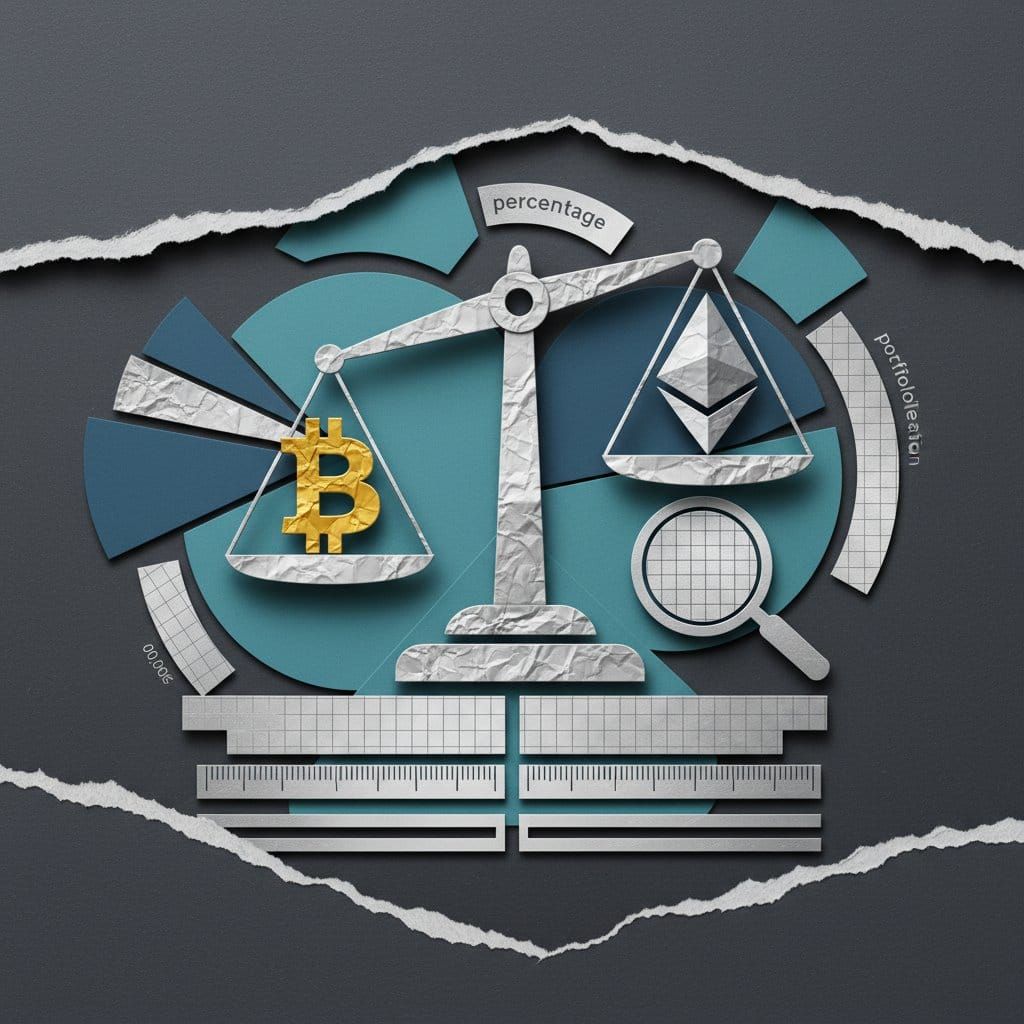
Matthew Sigel, Head of Digital Assets Research at VanEck, has noted in published research that optimizing for Sharpe Ratio in a crypto-only portfolio consistently points to a BTC 71.4% / ETH 28.6% split — a finding that holds across multiple backtested periods. A Yale Endowment simulation cited by CoinShares reinforces the case: a 7% Bitcoin allocation lifted modeled annual returns from 6.8% to 18.8% with disciplined position sizing containing the downside.
Institutional Allocation Benchmarks for 2026
How much crypto belongs in a portfolio, and how should that crypto be structured? Here is the institutional consensus as of 2026:
| Investor Type | Crypto % of Total Portfolio | BTC Share Within Crypto | Source |
|---|---|---|---|
| Conservative long-term investor | 1–3% | 80–90% | Fidelity (minimum) |
| General long-term investor | 3–5% | 70–80% | Fidelity (baseline) |
| Young aggressive investor | 5–7.5% | 60–70% | Fidelity (maximum) |
| Crypto-only portfolio | 100% | 71.4% | VanEck (Sharpe-optimal) |
| University endowment | 3–10% | 70–80% | Yale Endowment model |
| Corporate treasury | 5–15% | 80–90% | MicroStrategy model |
Geographic regulatory context matters here: European institutional investors tend toward 75–80% BTC due to regulatory conservatism, while Asian institutions typically carry higher altcoin exposure. For a deeper look at why BTC dominance shapes these ratios, see our Bitcoin dominance explainer.
Live Market Data: May 5, 2026 (14:59 KST)
BTC trades at $80,990 (+1.20%) on Binance; OKX shows $80,991 (+1.41%). ETH sits at $2,380 (+0.15%) on Binance and $2,379.88 (+1.39%) on OKX — the two exchanges pricing in near-perfect alignment. The day's standout movers tell a different story: TON surged +25.16% and TST gained +18.18%, both textbook high-risk satellite behavior — sharp upside moves that carry equivalent downside risk. Here are the top 10 assets by Binance 24-hour volume:
| # | Coin | Price | 24h Change | Volume(24h) | High | Low |
|---|---|---|---|---|---|---|
| 1 | USDC | $1.00 | +0.00% | $2.2B | $1.00 | $1.00 |
| 2 | BTC | $80,990 | +1.20% | $1.8B | $81,323.52 | $78,202.00 |
| 3 | ETH | $2,380 | +0.15% | $862.4M | $2,390.74 | $2,314.25 |
| 4 | SOL | $85 | -0.52% | $229.2M | $85.41 | $83.23 |
| 5 | ZEC | $421 | +1.65% | $139.5M | $436.99 | $397.34 |
| 6 | DOGE | $0.11 | -0.81% | $112.1M | $0.11 | $0.11 |
| 7 | BNB | $628 | -0.79% | $95.7M | $634.13 | $620.00 |
| 8 | XRP | $1.40 | -0.68% | $95.2M | $1.42 | $1.39 |
| 9 | TON | $1.74 | +25.16% | $88.5M | $1.86 | $1.36 |
| 10 | TST | $0.02 | +18.18% | $86.6M | $0.03 | $0.02 |
The derivatives market adds critical context for portfolio builders. BTC's futures funding rate is -0.0004% with open interest at $9.0B and a striking long/short ratio of 33.3% long vs. 66.7% short — professionals are heavily net short near current levels, likely hedging spot exposure rather than expressing pure bearishness. ETH funding is similarly negative at -0.0020% with $5.1B in OI and a more balanced 56.4%/43.6% long/short split. SOL tells a different story: positive funding at +0.0065% with 71.5% long positioning signals retail-driven speculative enthusiasm. For ongoing derivatives tracking, bookmark our daily crypto market overview.
| Coin | Funding Rate | Open Interest | Long/Short |
|---|---|---|---|
| ADA | 0.0012% | $87.7M | N/A |
| AVAX | -0.0013% | $79.7M | N/A |
| BNB | 0.0054% | $357.4M | N/A |
| BTC | -0.0004% | $9.0B | 33.3% / 66.7% |
| DOGE | 0.0018% | $393.6M | 66.6% / 33.4% |
| DOT | 0.0100% | $43.4M | N/A |
| ETH | -0.0020% | $5.1B | 56.4% / 43.6% |
| LINK | 0.0084% | $91.4M | N/A |
| SOL | 0.0065% | $834.6M | 71.5% / 28.5% |
| XRP | -0.0014% | $371.0M | 69.3% / 30.7% |
The Core-Satellite Model: 60/30/10
Morningstar empirical analysis — cited in Ainvest's 2025 core-satellite review — found the 60/30/10 structure delivers +1.5% annual excess returns versus either a pure-core or pure-satellite approach. Applied to a crypto portfolio, the breakdown works as follows:
- Core (60%): BTC and ETH — stability, institutional liquidity, and the strongest network effects in the asset class
- Growth Satellite (30%): SOL ($85), BNB ($628), AVAX — established use cases, higher beta, meaningful upside capture in bull markets
- High-Risk Satellite (10%): New alts, DeFi tokens, memecoins — small, bounded positions with asymmetric upside potential
Current BTC dominance at 58.8% strongly favors a core-heavy structure. When dominance is elevated, altcoins historically underperform BTC on a risk-adjusted basis — this is not the environment to overweight satellites. For guidance on evaluating which altcoins merit satellite positions, see our altcoin risk assessment guide.
One non-negotiable discipline: cap any single high-risk satellite at 1–2% of total crypto holdings. A single position going to zero should be a manageable setback, not a defining portfolio event.
Rebalancing: Three Approaches, One Clear Winner
Unmanaged Bitcoin carries annualized volatility of 65.2%. Apply a systematic trend-following framework and that figure drops to 21.5%, according to Amberdata's institutional risk management research. Regular rebalancing is the mechanism that captures this reduction in practice.
Calendar rebalancing — Fixed monthly or quarterly reset. Simple to execute and audit; completely ignores market conditions.
Threshold rebalancing — Trigger when any asset drifts ±5–10% from its target weight. Fewer trades, more responsive to actual price moves.
Hybrid rebalancing (recommended) — Quarterly reviews combined with immediate action when thresholds are breached. CoinShares data confirms this approach outperforms buy-and-hold across multi-year periods and reflects how institutional crypto managers actually operate. Weekly rebalancing, by contrast, generates disproportionate transaction costs and tax events that erode the gains the strategy is designed to protect.
Three Risk Management Rules That Don't Bend
1. Maintain core concentration. Keep BTC + ETH combined above 60% of crypto holdings. At 58.8% BTC dominance, chasing unproven altcoins introduces asymmetric downside with no compensating edge.
2. Hard position sizing caps. No single altcoin exceeds 5% of your crypto allocation. High-risk satellite positions: 1–2% each, maximum. Any single loss should sting — not break the portfolio.
3. Dynamic stablecoin buffer. At the current Fear & Greed reading of 50 (neutral), maintain 10–15% in stablecoins as dry powder for opportunistic buys. If the index crosses 70 (extreme greed), take partial profits and raise stablecoin reserves to 20%. See our stablecoin allocation guide for implementation specifics.
FAQ
What is the optimal Bitcoin-to-Ethereum ratio in a crypto portfolio?
VanEck's Sharpe Ratio optimization research identifies BTC 71.4% / ETH 28.6% as the risk-adjusted optimum for crypto-only portfolios. In practice, a range of BTC 60–80% and ETH 20–40% accommodates different risk tolerances and market regimes. Both assets warrant permanent core positions in any serious long-term crypto strategy — neither should be eliminated without strong, data-backed justification.
How often should I rebalance my crypto portfolio?
Conduct a full portfolio review at minimum once per quarter. Supplement this with ±10% threshold triggers: if any asset drifts more than 10 percentage points from its target weight, rebalance immediately regardless of calendar timing. Avoid weekly rebalancing — the transaction costs and tax events compound faster than the marginal benefit justifies, particularly in jurisdictions that treat each rebalance as a taxable event.
This article is for informational purposes only and does not constitute financial or investment advice. Cryptocurrency investments carry significant risk, including the possible loss of principal. All investment decisions should be made based on your own research, financial situation, and risk tolerance.
Related Articles
- How to Read Crypto Charts in 2026: Candlestick, RSI, MACD & Bollinger Bands
- Crypto DCA Strategy Complete Guide 2026 — Backtesting Returns, Interval Comparison & Auto-Buy Setup
- Ethereum Staking Yields: Solo, Lido, Restaking Compared
- Trezor Wallet Complete Guide 2026: Models, Setup & Security
- Exodus Wallet: Data-Driven Complete Guide for 2026