Solana's validators are weighing a change that would multiply the network's daily SOL burn by up to 14 times. The headline number is dramatic — but the supply math underneath tells a more sober story.
What SGP-0003 Actually Does: The 14x Burn in Plain Numbers
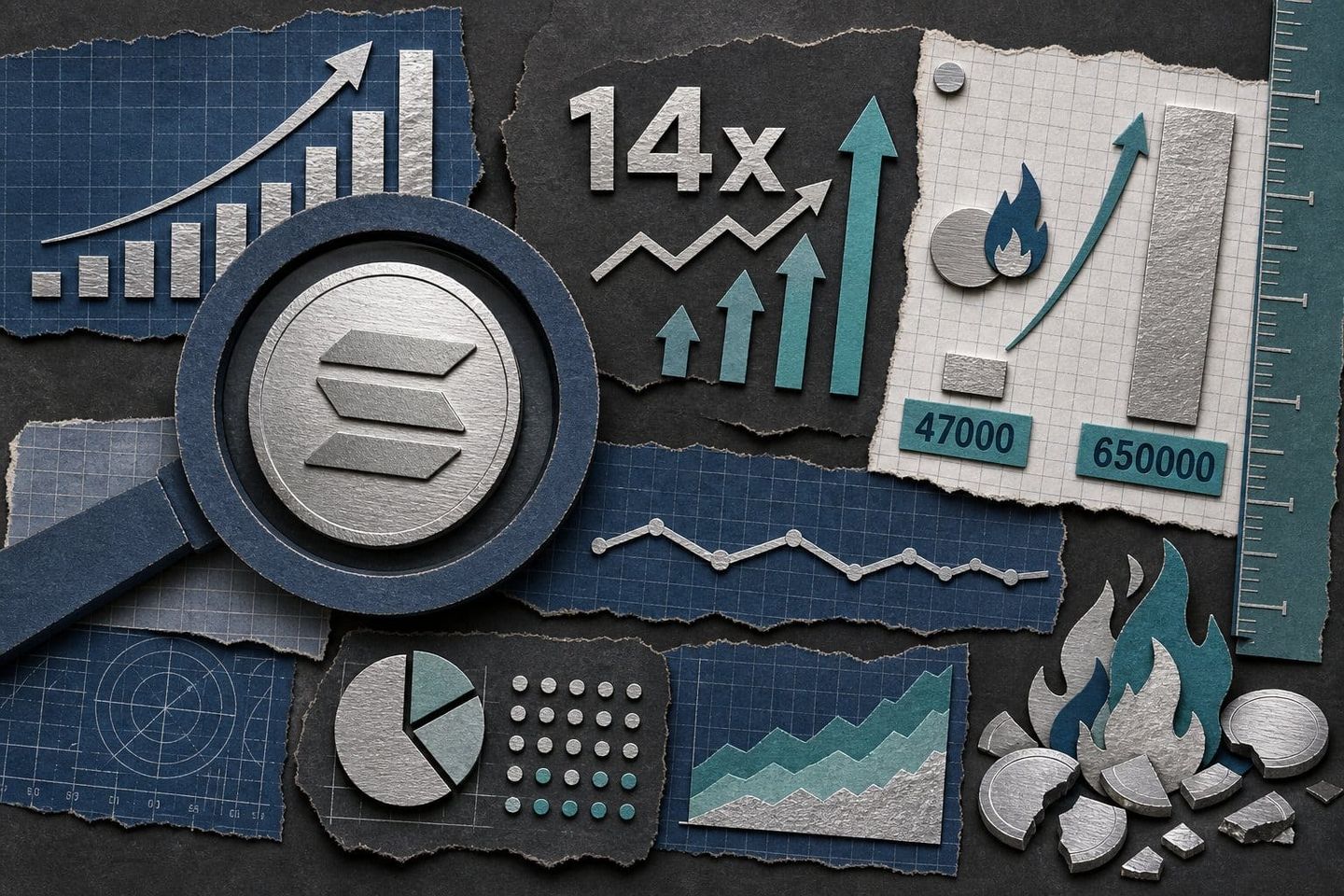
SGP-0003 is a Solana Governance Proposal that bundles two linked changes — SIMD-0553 and SIMD-0550 — and they must be read together to understand the real supply thesis. SIMD-0553 is the burn engine; SIMD-0550 is the disinflation lever. Together they would lift daily SOL burns from roughly 650 SOL (about $47,000 at the ~$74 SOL price) to a terminal range of 7,500–9,000 SOL per day, or roughly $650,000 daily — an increase reported as "about 14-fold" by Bankless and Crypto Times and "more than 10-fold" by Decrypt.
Quick Answer: SGP-0003 bundles two Solana proposals: SIMD-0553 introduces resource-based transaction fees that are fully burned, and SIMD-0550 doubles the annual disinflation rate. Combined, they would raise daily SOL burns from ~650 SOL (~$47,000) to 7,500–9,000 SOL (~$650,000) — a reported 14x jump.
SIMD-0553 replaces the existing model, under which Solana burns 50% of base transaction fees (priority-fee burns ended with SIMD-96 in February 2025). In its place, each transaction is charged according to the network resources it consumes, and those new resource fees are burned in full. The mechanism ramps through three feature gates toward a terminal rate of 0.5 lamports per cost unit, rather than switching on all at once.
Using May 2026 on-chain activity as a baseline, one analysis projected the following phased burn schedule:
| Phase | Projected burn (SOL/day) | Approx. annualized |
|---|---|---|
| Current baseline | ~650–700 | ~240,000 SOL |
| Phase 1 | 1,500–1,800 | ~0.6M SOL |
| Phase 2 | 3,750–4,500 | ~1.5M SOL |
| Terminal | 7,500–9,000 | ~2.7M–3.3M SOL |
Those terminal figures — roughly 2.7 million to 3.3 million SOL burned annually — are the source of the eye-catching multiple. What they don't answer, and what the next section addresses, is how that burn stacks up against Solana's daily issuance.
The Inflation Math That Kills the Deflation Narrative
Here is the number that reframes everything: Solana issues roughly 60,000 SOL per day in staking rewards. Set that against even the most aggressive terminal burn of 7,500–9,000 SOL per day, and net daily issuance still runs near 51,000 SOL. The network stays strongly net inflationary. The 14x headline changes the burn side of the ledger dramatically; it barely dents the balance.
Put in annual terms, current inflation sits near 3.8%. Both proposals passing does not flip that sign in the near term. This is the operative phrase behind the title — SOL still won't go deflationary — and it is stated repeatedly across the coverage, not buried as a footnote. As Decrypt and Crypto Times both emphasize, the burn increase alone is largely symbolic relative to daily issuance.
The reflexive comparison — "this is Solana's EIP-1559 moment" — is where retail traders get the math wrong. Ethereum became net deflationary because its fee burns under EIP-1559 routinely exceeded a modest proof-of-stake issuance rate. That equation only worked because ETH issuance is structurally low relative to fee volume. Solana's issuance is the opposite: it is structurally far higher relative to the fees the network currently generates. Even a resource-fee engine ramping toward 0.5 lamports per cost unit cannot out-burn 60,000 SOL of daily emissions. The two chains are not solving the same equation, and treating the burn multiple as a supply shock imports a conclusion that Ethereum's numbers earned and Solana's do not.
"Limiting the inflation rate limits supply growth and in theory could lead to an increase in the price," notes the analysis from Bankless — with the qualifier "in theory" doing deliberate work.
That framing matters. The thesis is disinflationary, not deflationary — a claim about the trajectory of supply growth, not an outright supply squeeze. The burn engine is the visible, marketable half of the package, but it is not the lever that materially tightens supply. That role belongs to the companion disinflation proposal, which changes how fast emissions decay rather than how much SOL is destroyed each day.
SIMD-0550: The Disinflation Lever That Actually Moves the Needle
SIMD-0550 doubles Solana's annual disinflation rate from 15% to 30%, and it — not the burn engine — is the part of SGP-0003 with a measurable long-run supply impact. Developed by an engineer at validator and infrastructure firm Helius, the proposal accelerates how quickly emissions decay: it pulls Solana's terminal 1.5% inflation floor forward by three years, to 2029 from 2032, and removes roughly 18.9 million SOL from the six-year emissions schedule — worth about $1.36 billion at the ~$74 SOL price during the reporting window.
The mechanical distinction matters for how you weigh the two proposals. SIMD-0553's burn increase is the narrative hook — the headline "14x" figure that travels across coverage. SIMD-0550 is the actual supply lever, because it changes the trajectory of emissions rather than shaving a symbolic amount off daily issuance. According to CoinDesk and Decrypt, this is where the durable tightening comes from — a slower-growing float compounding over years, not a one-off destruction of tokens.
What makes the pairing more than symbolic is that both levers land at similar magnitudes through entirely different mechanisms. At its terminal rate, SIMD-0553's burns remove roughly 3.3 million SOL per year; SIMD-0550's steeper disinflation curve is equivalent to withholding about 3.15 million SOL per year of would-be emissions.
| Mechanism | Proposal | Annual SOL impact (terminal) | How it works |
|---|---|---|---|
| Burn engine | SIMD-0553 | ~3.3M SOL destroyed | Resource-based fees fully burned |
| Disinflation | SIMD-0550 | ~3.15M SOL never issued | 15% → 30% annual disinflation rate |
The reason SIMD-0550 carries the thesis is that its effect is structural and cumulative: it lowers the emission curve permanently, so the gap widens every year until the 1.5% floor arrives in 2029. The burn is capped by transaction demand; the disinflation compounds regardless of network activity. For traders modeling SOL's forward float, SIMD-0550 is the input that changes the supply schedule — SIMD-0553 mostly changes the story told about it.
Governance Countdown: 14.4% Stake Signaled, August 18 Deadline
Before either proposal reaches a formal vote, SGP-0003 must clear a 15% stake-signaling threshold — roughly 65.16 million SOL of the approximately 432.65 million SOL currently staked — with signaling closing on August 18, 2026. As of the latest snapshot, roughly 63 million SOL — about 14.4% of staked supply — had signaled support, leaving the effort near 3 million SOL short of the bar, according to Decrypt.
That figure moved quickly. An earlier tally reported by CoinDesk put backing at just 24.94 million SOL — about 5.8% of staked supply, or 38% of the threshold, across 16 supporting validators. The spread between the two counts underscores how fluid the signaling window is: traders reading a single number risk anchoring to a stale point on a fast-moving curve.
The concentration behind that stake matters more than the headline percentage. Named backers include Helius, Jupiter, Staking Facilities, Drift, OtterSec and Solana Compass — but Helius alone accounted for roughly two-thirds of committed stake in the earlier snapshot, per Crypto Times. Helius also authored SIMD-0550, so a single validator is both the intellectual and the numerical center of gravity. That is a fragility: a shift from one large operator could swing the tally by several percentage points, and thin, top-heavy support is easier to unwind than broad-based backing.
The proposal does not arrive without precedent. It builds on SIMD-547, introduced in May 2026, when co-founder Anatoly Yakovenko publicly signaled support for increasing SOL burns via resource-based fees, according to Crypto Times. Founder endorsement lends the mechanism legitimacy, but it does not substitute for stake: the 15% gate is decided by validators' committed SOL, not by public statements. With the deadline fixed and the count within a few million SOL of passing, the next fortnight is a countable, on-chain event rather than a matter of sentiment.
Bull Case: Both Pass and Markets Re-Price the Supply Compression Story
The bull case does not require SOL to ever burn more than it issues. It requires only that SGP-0003 clears the August 18 signaling gate, advances to a formal vote, and hands the market a clean, marketable supply-tightening story: a 14x jump in daily burns paired with roughly 18.9 million SOL of emissions removed over six years . Whether the network is technically deflationary is, for pricing purposes, secondary — narratives about shrinking supply have historically priced in long before the underlying maths turned negative.
Ethereum is the reference case. EIP-1559 introduced fee burning in August 2021, and the Merge cut new issuance in September 2022, yet both events drove sustained repricing in the months around them — well before ETH ever recorded a genuinely deflationary stretch. Supply-compression stories are bought on the roadmap, not on the realized burn. SGP-0003 gives SOL a comparable, datable roadmap: a doubled 30% disinflation rate that pulls the 1.5% terminal inflation floor forward to 2029 from 2032 , plus a burn engine ramping toward 7,500–9,000 SOL per day .
Valuation leaves room to re-rate. SOL traded near $74 for a market cap around $43 billion during the reporting window . If institutional desks link SGP-0003 to a credible supply-reduction path through 2029 — and Bankless notes the thesis that capping inflation caps supply growth and, in theory, supports price — a re-rating does not need deflation to justify itself.
The upside signpost is on-chain and countable. Validator signaling accelerating past the 15% stake threshold before August 18, with ecosystem validators joining beyond the current cohort of 16 supporters , would be the first hard confirmation that the story has institutional conviction behind it — not just founder endorsement.
Bear Case: Pass the Vote, Still Fail the Narrative
The bear case does not need the vote to fail. Even if SGP-0003 clears signaling and passes, SOL can still disappoint because the supply story does not survive contact with the issuance math. At the terminal burn range of 7,500–9,000 SOL per day against roughly 60,000 SOL issued daily, the network sheds net issuance of about 51,000 SOL every day . That gap is the trap: a market that bought the "14x burn" line as a deflation trade has every reason to unwind once it re-reads the fine print, making a "sell the news" reaction the base risk into and just past August 18.
Three specific failure modes compound that risk:
- Helius concentration. Roughly two-thirds of committed signaling stake traces to a single validator, Helius . If Helius withdraws or abstains, the threshold math breaks quickly, and the remaining 15 of 16 supporters would need to backfill billions in stake before the deadline.
- Projection risk on the burn ramp. SIMD-0553's resource-fee schedule is modeled on May 2026 activity. If Solana on-chain volume softens in H2 2026, Phase 1 lands nearer 1,500 SOL per day rather than the headline figure , delaying the terminal 2.7–3.3 million SOL annual burn indefinitely.
- Governance timeout. Miss the August 18 signaling close and the proposals require re-submission , a near-term negative narrative catalyst independent of price fundamentals.
None of these require SOL's underlying network health to deteriorate. They only require the market to correct a misread, or one large validator to change its mind — either of which can happen before the countdown ends.
Portfolio Implication: Positioning SOL Into the August 18 Binary
Treat August 18 as a binary event and size accordingly. The base case is that SGP-0003 clears the 15% signaling threshold and the formal vote advances . That outcome supports SOL's current $74 range as a narrative positive, but it is not a standalone breakout catalyst. With inflation near 3.8% and the 1.5% terminal floor not reached until 2029 , supply does not compress meaningfully until 2028–2029. The fundamental payoff is delayed by years, not weeks.
That timing gap defines the trade structure. Signaling failure is an unambiguous short-term negative — a governance timeout forces re-submission and hands the market a clean bearish narrative catalyst . Signaling success, by contrast, is a narrative win whose economic impact arrives on a 2026–2029 horizon. When the downside is immediate and the upside is deferred, outright spot sizing into the deadline carries poor risk symmetry. Defined-risk structures — where maximum loss is capped ahead of the event — fit the asymmetry better than adding to a naked long position two weeks before a coin-flip vote.
Frame the thesis honestly on horizon. SIMD-0550's disinflation effect — doubling the annual rate to 30% and removing roughly 18.9 million SOL over six years, about $1.36 billion at current prices — is a medium-term supply story, not a 2026 swing trade. Position sizing should reflect that multi-year clock rather than a two-week catalyst.
The single leading indicator worth watching is validator stake weight in the final days before August 18. Support sat near 14.4% of staked supply, just about 3 million SOL short of the roughly 65.16 million needed . At that margin, one large validator joining or withdrawing moves the math decisively. The takeaway: hold defined-risk exposure into the deadline, track the stake tally daily, and separate the vote outcome from a supply thesis that will not actually bite until 2028.
Frequently asked questions
What is SIMD-0553 and how does it change Solana's existing fee burn?
SIMD-0553 is the burn engine inside SGP-0003. It introduces resource-based transaction fees — each transaction is charged according to the network resources it consumes, and those new fees are fully burned. This replaces the modest existing model, under which Solana burns only 50% of base transaction fees; priority fees stopped being burned after SIMD-96 shipped in February 2025 . The resource fee ramps up gradually through three feature gates toward a terminal rate of 0.5 lamports per cost unit, lifting daily burns from roughly 650 SOL toward an eventual 7,500–9,000 SOL per day .
Will SGP-0003 make SOL deflationary like ETH?
No. Solana still issues roughly 60,000 SOL per day in staking rewards, so even at the terminal burn rate of 9,000 SOL per day, net daily issuance stays near 51,000 SOL and the network remains net inflationary . Inflation sat near 3.8% during the reporting window . SIMD-0550 accelerates the path toward lower inflation, but neither proposal flips SOL deflationary in the near term — the burn increase alone is largely symbolic relative to daily issuance .
What happens if the August 18 signaling deadline is missed?
If the proposals fail to clear the 15% stake signaling threshold by August 18, 2026, they do not advance to a formal on-chain vote . Developers could re-submit modified versions in a future SIMD cycle, much as this effort itself built on the earlier SIMD-547 introduced in May 2026 . A missed deadline is a short-term negative narrative catalyst for SOL, but it triggers no immediate on-chain change to issuance or burns.
Why does SIMD-0550 matter more than the 14x burn increase?
SIMD-0550 doubles Solana's annual disinflation rate from 15% to 30%, pulling the 1.5% terminal inflation floor forward to 2029 from 2032 and removing roughly 18.9 million SOL of emissions over six years — worth about $1.36 billion at then-current prices . Because that compounding cut to issuance dwarfs the burn increase measured against ~60,000 SOL minted daily, the disinflation lever is what materially tightens net supply, while the 14x burn is smaller than daily issuance and mostly optical .
How much SOL must signal support before August 18 for the proposals to advance?
The proposals need signaling from 15% of staked supply — approximately 65.16 million SOL of the roughly 432.65 million SOL currently staked . As of the latest reports, about 63 million SOL, or 14.4% of staked supply, had signaled support, leaving roughly 3 million SOL short ahead of the August 18, 2026 deadline . At that margin, a single large validator joining or withdrawing can move the outcome decisively, so the running tally is worth tracking daily.
Enjoyed this article? Subscribe to get new stories by email whenever they're published.