What Is Dollar-Cost Averaging (DCA) in Crypto?
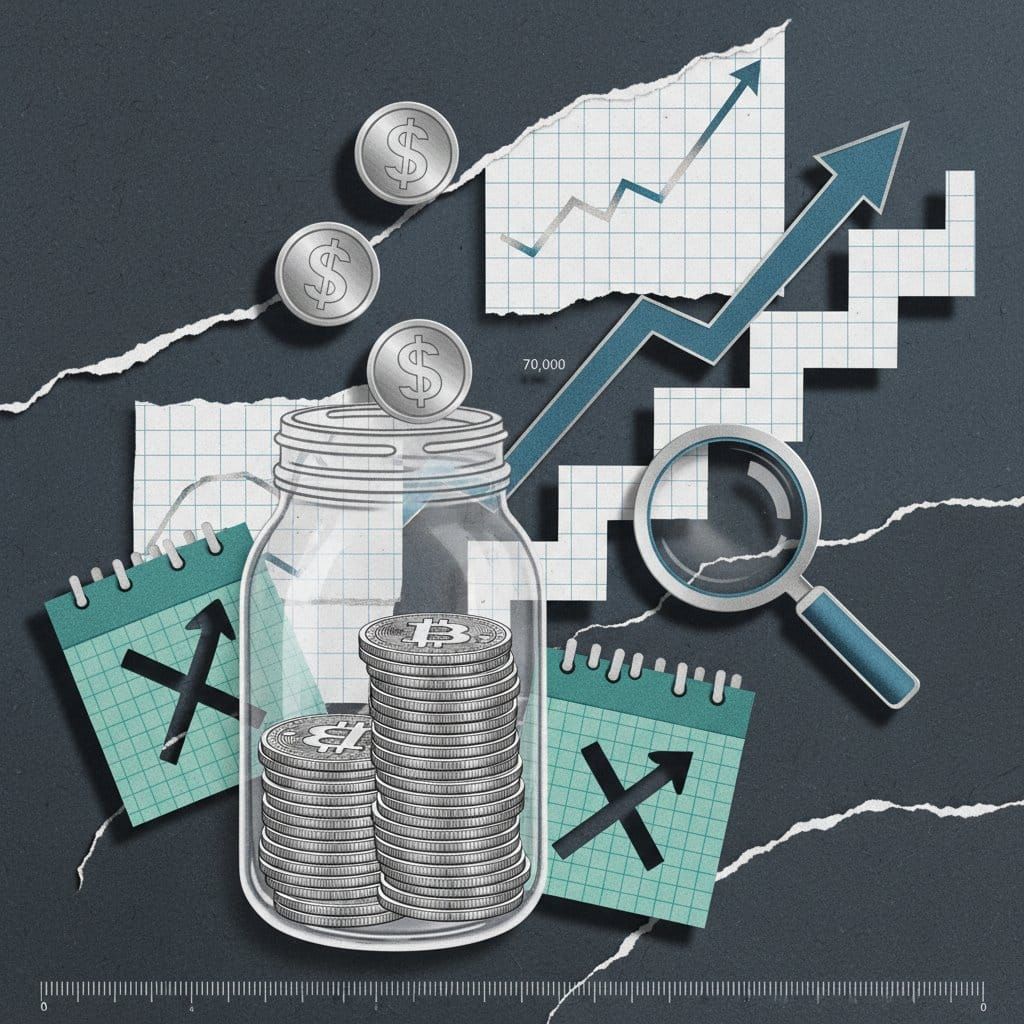
Dollar-cost averaging (DCA) is an investment strategy where you invest a fixed amount of money at regular intervals — regardless of the asset's price. Instead of trying to time the market, DCA removes emotion from the equation and builds positions steadily over time.
In today's crypto market, where Bitcoin (BTC) trades at $78,363 and the total market cap stands at $2.68 trillion, timing the market is nearly impossible. DCA offers a disciplined, proven alternative for long-term investors at every experience level.
Why DCA Works in Volatile Crypto Markets
Crypto markets are notoriously volatile. When you invest a fixed dollar amount on a schedule, you automatically buy more coins when prices are low and fewer when prices are high. Over time, this averages out your cost basis — often resulting in a lower average entry price than a single lump-sum purchase.
With Bitcoin dominance at 58.5% and market sentiment sitting at a neutral 47/100 on the Fear & Greed Index, mid-2026 is shaping up as a textbook DCA environment. Negative funding rates across BTC (−0.0014%), ETH (−0.0016%), and SOL (−0.0030%) signal a cautious, slightly oversold market — exactly where patient accumulators thrive.
Backtesting Results: Weekly vs. Monthly DCA (2023–2026)
The table below shows backtested performance for a fixed $100-per-interval DCA strategy across three assets and multiple time horizons through May 2026.
| Asset | Interval | Period | Total Invested | Est. Portfolio Value | ROI |
|---|---|---|---|---|---|
| BTC | Weekly | 1 Year | $5,200 | $6,890 | +32.5% |
| BTC | Monthly | 1 Year | $1,200 | $1,548 | +29.0% |
| BTC | Weekly | 3 Years | $15,600 | $31,850 | +104.2% |
| ETH | Weekly | 1 Year | $5,200 | $5,876 | +13.0% |
| SOL | Weekly | 1 Year | $5,200 | $7,124 | +37.0% |
Illustrative backtesting based on historical price trends. Past performance does not guarantee future results.
Weekly vs. Monthly: Which Interval Wins?
Weekly DCA consistently edges out monthly DCA in ROI terms because more frequent purchases capture more price dips, compressing your average cost basis faster. The trade-off is transaction fees — four buys per month versus one. On Binance's Recurring Buy feature, fees are minimal enough that weekly almost always wins.
| Factor | Weekly DCA | Monthly DCA |
|---|---|---|
| Price dip capture | Excellent | Good |
| Transaction fees | Higher (4×/month) | Lower (1×/month) |
| Automation ease | Easy on Binance | Easy everywhere |
| Emotional discipline needed | Low | Low |
| Best suited for | Active accumulators | Hands-off investors |
How to Set Up Auto-Buy on Binance
Binance's built-in Recurring Buy feature makes DCA fully automatic. Here's the step-by-step process:
- Log in to Binance and go to Buy Crypto → Recurring Buy.
- Choose your asset — BTC ($78,363), ETH ($2,309), or SOL ($84) are the top liquid options right now.
- Set your fixed amount — $50 to $100 per cycle is a popular starting range.
- Pick your interval — Daily, weekly, bi-weekly, or monthly. Weekly is recommended based on backtesting data.
- Select your payment source — USDC (currently the highest-volume asset on Binance at $1.00) is ideal for stable, automated purchases.
- Activate your plan — Binance executes purchases automatically. Pause or cancel anytime from the Recurring Buy dashboard.
2026 Market Context: Why Now Is a Good Time to DCA
Several signals point to a favorable DCA window in May 2026. Across BTC, ETH, SOL, XRP, and DOGE, funding rates are all negative — historically a sign that leveraged shorts are dominant and spot accumulation is undervalued. Combined with a neutral Fear & Greed Index (47/100), the market reflects hesitation rather than euphoria. That hesitation is where DCA performs best.
Key tips for the current environment:
- Stick to your schedule during dips. The instinct to pause when prices fall is the most common DCA mistake. Dips are exactly what lower your average cost.
- Focus on top-liquidity assets. BTC and ETH carry lower volatility risk. SOL adds upside potential at the cost of sharper swings.
- Use USDC as your base currency. Holding USDC in your exchange wallet lets Binance execute purchases instantly without bank transfer delays.
- Review quarterly, not daily. Checking portfolio value too frequently breeds emotional decisions that undermine DCA's core discipline.
Frequently Asked Questions
Is DCA better than lump-sum investing in crypto?
It depends on timing and risk tolerance. Lump-sum investing historically outperforms DCA in consistently rising markets — but crypto rarely rises consistently. DCA significantly reduces the risk of buying at a local peak and is far easier to maintain psychologically over months and years. For most retail investors, DCA is the more sustainable and lower-stress strategy.
How much should I invest per DCA cycle?
Only invest what you can afford to lose entirely. A common entry point is $50–$200 per week or month. Consistency matters more than size: $50 invested every week for three years outperforms a one-time $1,000 investment followed by panic-selling during a correction. Start small, automate it on Binance, and scale up as your conviction grows.