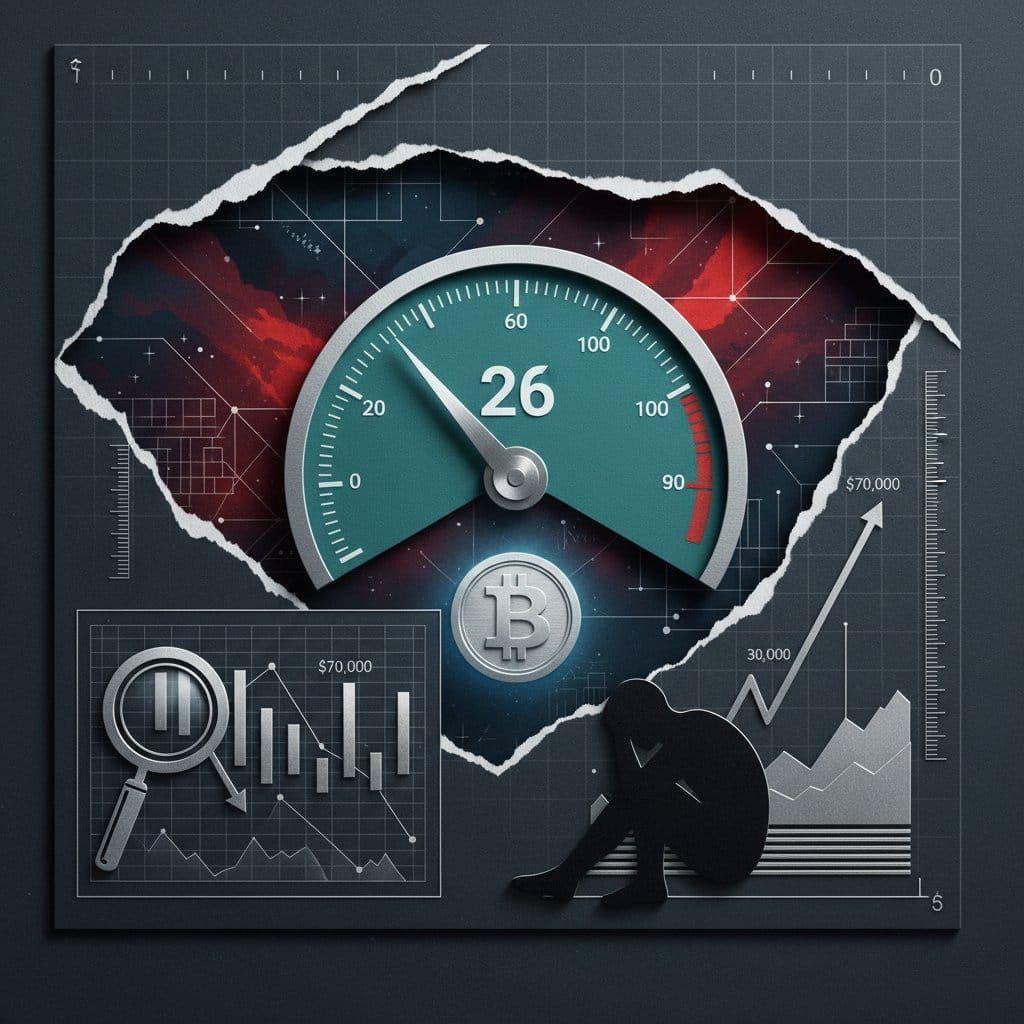
The Crypto Fear & Greed Index dropped to 26 on April 29, 2026 — a sharp 7-point single-day decline that pushed market sentiment firmly into the Fear zone. With Bitcoin trading at $76,967 on Binance and total crypto market cap at $2.65 trillion, understanding this reading — and what history says to do with it — is critical for every active investor.
What Is the Crypto Fear & Greed Index?
Quick Answer: The Crypto Fear & Greed Index scores market sentiment from 0 (extreme panic) to 100 (extreme greed) using six weighted signals including volatility, momentum, and Bitcoin dominance. At 26, the index sits in Fear territory — historically a zone that has preceded strong long-term recoveries, though not a guaranteed bottom signal on its own.
Published daily by Alternative.me, the index combines six weighted inputs into a single score:
- Volatility (25%) — current price swings versus 30- and 90-day averages
- Market Momentum & Volume (25%) — buying pressure relative to historical norms
- Social Media (15%) — engagement volume and tone across crypto-related posts
- Surveys (15%) — periodic polls of retail investor sentiment
- Bitcoin Dominance (10%) — rising dominance signals risk-off rotation into Bitcoin
- Google Trends (10%) — search interest in Bitcoin and related queries
A score near 0 reflects full panic. Near 100 signals irrational euphoria. The index is designed as a contrarian tool: when fear is high, disciplined buyers may find opportunity; when greed peaks, caution becomes essential.
The Five Sentiment Zones
| Zone | Score Range | Market Interpretation |
|---|---|---|
| Extreme Fear | 0–24 | Panic selling; potential long-term accumulation window |
| Fear ← Current (26) | 25–44 | Sentiment contraction; staged, cautious approach recommended |
| Neutral | 45–55 | Sideways sentiment; market seeking a directional catalyst |
| Greed | 56–74 | Optimism spreading; watch for overextension |
| Extreme Greed | 75–100 | Bubble risk; elevated probability of sharp correction |
At 26, the index sits just three points above the Extreme Fear threshold. A single adverse macro event — an unexpected rate decision, a major exchange failure, or a geopolitical shock — could push sentiment below 25.
Live Market Snapshot: April 29, 2026 (13:21 KST)
Bitcoin trades at $76,967 on Binance (+0.19%, 24h range: $75,666–$77,154). Ethereum is at $2,313 (+1.06%). Total crypto market cap stands at $2.65 trillion. Bitcoin dominance is at 58.1% — capital is consolidating into Bitcoin as a relative safe haven within the asset class. With Ethereum at 10.5% dominance, these two assets account for 68.6% of total market cap combined.
| # | Coin | Price | 24h Change | Volume(24h) | High | Low |
|---|---|---|---|---|---|---|
| 1 | USDC | $1.00 | +0.01% | $2.1B | $1.00 | $1.00 |
| 2 | BTC | $76,967 | +0.19% | $1.0B | $77,154.00 | $75,666.60 |
| 3 | ETH | $2,313 | +1.06% | $474.1M | $2,316.36 | $2,258.24 |
| 4 | CHIP | $0.07 | -6.49% | $208.5M | $0.07 | $0.07 |
| 5 | SOL | $85 | +0.81% | $125.3M | $84.74 | $82.98 |
| 6 | DOGE | $0.10 | +1.22% | $106.8M | $0.10 | $0.10 |
| 7 | USD1 | $1.00 | +0.02% | $98.8M | $1.00 | $1.00 |
| 8 | TON | $1.31 | +0.15% | $80.0M | $1.32 | $1.29 |
| 9 | XRP | $1.39 | -0.29% | $74.8M | $1.40 | $1.37 |
| 10 | PENGU | $0.01 | +3.66% | $48.3M | $0.01 | $0.01 |
OKX data confirms the same picture: BTC at $76,960, ETH at $2,313, SOL at $84.60, DOGE at $0.101 (+2.0%). The sharpest mover on OKX was ZKJ, down -26.1% in 24 hours — in fear markets, lower-liquidity tokens absorb the heaviest losses as traders consolidate into larger-cap assets.
Derivatives Signals: Funding Rates, Open Interest, and Long/Short Ratios
Spot prices tell only part of the story. Binance futures data as of April 29 reveals how leveraged traders are positioned:
| Coin | Funding Rate | Open Interest | Long/Short |
|---|---|---|---|
| ADA | 0.0023% | $82.8M | N/A |
| AVAX | 0.0003% | $87.5M | N/A |
| BNB | 0.0046% | $340.4M | N/A |
| BTC | 0.0013% | $7.6B | 47.9% / 52.1% |
| DOGE | 0.0043% | $356.7M | 66.4% / 33.6% |
| DOT | 0.0096% | $42.9M | N/A |
| ETH | 0.0028% | $4.6B | 67.1% / 32.9% |
| LINK | 0.0092% | $85.7M | N/A |
| SOL | -0.0016% | $804.9M | 74.2% / 25.8% |
| XRP | -0.0043% | $366.4M | 70.5% / 29.5% |
Bitcoin's long/short ratio of 47.9% long vs. 52.1% short is nearly balanced — a slight bear majority consistent with the fear reading. Altcoins paint a different picture: ETH at 67.1% long, SOL at 74.2% long, XRP at 70.5% long. Retail traders are maintaining bullish altcoin positioning even as overall sentiment turns negative, suggesting elevated vulnerability if prices decline further.
Negative funding rates on SOL (-0.0016%) and XRP (-0.0043%) mean shorts are paying longs — a mechanical dynamic that can slow downward price pressure. However, large open interest across the board — BTC OI at $7.6 billion, ETH OI at $4.6 billion, SOL OI at $805 million — means significant leverage is still active. In fear conditions, this raises the risk of a liquidation cascade if prices move sharply lower.
What History Shows About Buying in the Fear Zone
Fear zones have historically provided favorable entry windows for patient investors — but fear alone has never been a reliable short-term timing signal. Three key episodes illustrate the range of outcomes:
- 2018 Crypto Winter: The index spent months below 20 as Bitcoin fell from ~$20,000 to a low of ~$3,200. Investors who accumulated systematically in the 15–25 range over late 2018 captured strong returns through the 2020–2021 bull cycle.
- March 2020 — COVID Crash: The index briefly hit 8. Bitcoin dropped below $4,000 and recovered to pre-crash levels within roughly six months — though the path required holding through continued uncertainty.
- May–June 2022 — LUNA/Terra Collapse: Contagion from the Terra ecosystem kept the index below 20 for weeks. Systematic buyers during this period recovered cost basis within the next cycle.
The throughline is consistent: fear zones have preceded recoveries across every major cycle. But they are not short-term buy signals. As investors from Canonical Crypto and Spartan Group stated in early 2026, "I think we're in the trough right now" — yet troughs can extend for months, and calling exact turning points consistently has proven impossible even for professional market participants.
How to Build a Strategy for the Fear Zone
Dollar-Cost Averaging Over a Single Entry
The most defensible approach in fear territory is staged accumulation rather than deploying all capital at once. A practical DCA framework at the current index level:
- Tranche 1 (index 25–30, now): Deploy 20–30% of intended capital
- Tranche 2 (if index drops to 20–24): Add another 30–40%
- Tranche 3 (below 15, Extreme Fear): Deploy remaining capital at peak pessimism
Federico Variola, CEO of Phemex, captured the 2026 market environment clearly: "2026 is the year bills come due — only profitable protocols survive and value accrues to projects showing real revenue, real growth, and sustainable economics." In a fear market, this argues for concentrating accumulation in assets with demonstrated fundamentals — primarily Bitcoin and Ethereum — rather than speculative altcoins chasing narratives. BTC dominance at 58.1% reinforces this: historically, dominance peaks near cycle bottoms, then declines as risk appetite returns and capital rotates into altcoins.
Securing What You Accumulate
During fear-driven accumulation phases, storage security matters as much as entry timing. Investors building significant BTC positions should match their wallet choice to position size. Hardware wallets like Trezor provide cold storage with zero internet exposure — the gold standard for long-term holdings. Software wallets such as Exodus offer a reasonable balance of security and accessibility for actively managed funds. Choosing the best crypto wallet for your use case is a foundational part of risk management that too many investors overlook when focused purely on price levels. SpotedCrypto's crypto wallet comparison guide reviews the leading options for 2026.
For related strategy reading, see SpotedCrypto's guides on what Bitcoin dominance signals, how to interpret crypto funding rates, and building a DCA plan for crypto investors.
Frequently Asked Questions
Q: Should I automatically buy whenever the Fear & Greed Index is in the Fear zone?
A: Not automatically. Fear zones have historically overlapped with favorable medium-to-long-term entry points, but they are not reliable short-term timing signals on their own. Cross-reference with on-chain data, macro conditions such as interest rates and dollar strength, and your personal risk tolerance. Deploy capital in stages rather than all at once, and never invest more than you can afford to lose.
Q: What is the practical difference between Fear (25–44) and Extreme Fear (0–24)?
A: Fear reflects broad sentiment contraction — investors cautiously reducing risk exposure. Extreme Fear signals capitulation, where even long-term holders liquidate under panic conditions. Extreme Fear has historically produced the strongest forward returns for buyers willing to hold through continued volatility, but it can persist for weeks or months before prices recover. At 26, today's reading sits at the boundary of these two zones, and the potential for deeper capitulation remains.
Disclaimer: This article is for informational purposes only and does not constitute investment advice or financial guidance. Cryptocurrency investments carry significant risk, including the potential loss of principal. All investment decisions should be made based on your own independent research and personal risk tolerance.
Related Articles
- RWA Tokenization Guide 2026: How to Invest in Real Estate, Bonds & Art on the Blockchain
- Best Bitcoin Wallet 2026: Trezor, Ledger & Exodus Compared
- RWA Tokenization Guide 2026: How to Invest in Real Estate, Bonds & Art on the Blockchain
- Solana vs Ethereum 2026: Speed, Fees, TVL, and Developer Ecosystem Compared
- Bitcoin vs Ethereum 2026: A Data-Driven Comparison Guide