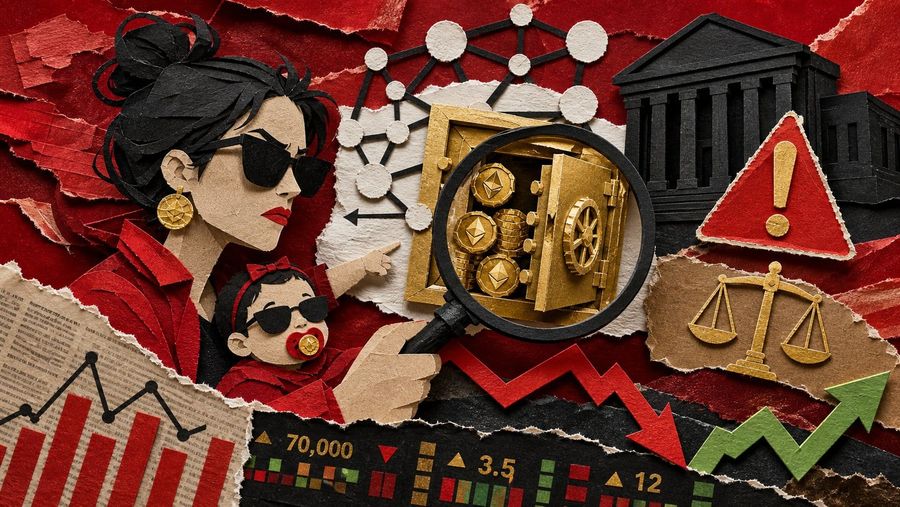
Over 120 crypto companies—including Coinbase, Ripple, Kraken, Circle, and a16z—have given the U.S. Senate a clear ultimatum: pass the CLARITY Act by end of May, or the industry waits until 2030 for regulatory clarity. Polymarket prices in just 46% odds of passage. Meanwhile, Tether has frozen $344M in USDT linked to Iran sanctions, EU MiCA has levied €540M in fines, and Japan just slashed crypto taxes from 55% to 20%. The global regulatory battle of 2026 is at full intensity.
As of April 26, 20:00 KST, BTC trades at $78,020 on Binance (+0.31%) with ETH at $2,333 (+0.56%). The Fear & Greed Index sits at 33 (Fear)—BTC dominance holds at 58.2%, reflecting cautious rotation away from altcoins. In the futures market, only 42.9% of BTC positions are long vs. 57.1% short, while XRP longs dominate at 70.3%, likely positioning for a CLARITY Act catalyst.
The CLARITY Act's May Ultimatum
Quick Answer: The CLARITY Act would settle SEC vs. CFTC jurisdiction over digital assets in the U.S. The bill faces a make-or-break Senate vote by end of May 2026—failure means a regulatory vacuum until 2030. Polymarket odds stand at 46% as of April 25, 2026.
Senator Cynthia Lummis stated plainly at an April 10 Banking Subcommittee hearing: "This is our last chance to pass the Clarity Act until at least 2030." Senator Bernie Moreno (R-Ohio) set the clock: pass by end of May, or the legislative window closes ahead of midterm election season.
The Crypto Council for Innovation and the Blockchain Association coordinated a joint letter signed by 120+ companies—Coinbase, Ripple, Kraken, Circle, and a16z among them—demanding an immediate Senate vote. The coalition represents the backbone of U.S. crypto infrastructure: exchanges, custodians, venture funds, and protocol developers unified on a single demand.
Galaxy Digital CEO Mike Novogratz is upbeat: "The CLARITY Act will get done in May—it goes to committee in the first week of May, then Trump will be signing it in June." His own firm's research head, Alex Thorn, disagrees: "In our view, the odds of CLARITY being signed into law in 2026 are roughly 50-50, and possibly lower."
The stakes are clearest in XRP's price chart. The token trades at $1.34—down 63% from its July 2025 peak of $3.65—a drawdown driven largely by unresolved legal uncertainty that CLARITY would settle. When the SEC closed its Ripple lawsuit in 2023, XRP surged over 300%. A structurally comparable catalyst is in play if the bill passes.
How Global Crypto Regulation Stacks Up in 2026
The CLARITY Act is one front in a worldwide regulatory shift. According to SpotedCrypto's 2026 global regulation analysis, 68 countries have now enacted or proposed crypto-specific legislation—a 62% jump in two years—with over 92% of jurisdictions tightening rules in some form.
| Region | Key Legislation | Status | Core Requirement | Market Impact |
|---|---|---|---|---|
| U.S. | CLARITY Act | ⏳ May vote pending | Resolves SEC vs. CFTC digital asset jurisdiction | Passage = altcoin rally; failure = void until 2030 |
| U.S. | GENIUS Act | ✅ Signed July 2025 | 1:1 reserve + monthly disclosure for stablecoins | USDT/USDC entering regulated framework |
| EU | MiCA | ✅ Active enforcement | CASP licensing; fines up to 12.5% of annual revenue | €540M+ fined; 40+ CASPs licensed |
| Japan | FIEA Reclassification | ✅ Approved April 2026 | Tax rate 55%→20%; unlicensed = up to 10 years prison | Investor inflows expected |
| South Korea | VAUPA | ✅ Since July 2024 | Exchange obligations; investor protection rules | Smaller altcoin listings declining |
Japan's dual-track approach deserves attention. The April 10 cabinet approval of FIEA reclassification dramatically stiffens penalties for unlicensed operators—up to 10 years prison vs. the previous 3—while simultaneously cutting the tax rate from 55% to 20%. The signal is deliberate: drive out bad actors, attract legitimate capital. For the full regional breakdown, see SpotedCrypto's global regulation comparison.
Tether's $344M Freeze: The Stablecoin Governance Reality
On April 24, Tether froze two TRON blockchain wallets—$212.9M and $131.3M in USDT, totaling $344 million—in cooperation with U.S. Treasury's OFAC under "Operation Economic Fury," targeting Iran sanctions violations. Treasury Secretary Scott Bessent stated: "We will follow the money that Tehran is desperately attempting to move outside of the country and target all financial lifelines tied to the regime."
This is the largest single stablecoin freeze on record. It confirms a hard governance reality: USDT is a centralized instrument subject to issuer-controlled freezes at government request. The GENIUS Act—signed by Trump in July 2025—requires 1:1 reserves and monthly disclosures, providing an even stronger regulatory foundation for enforcement actions like this going forward. For investors, the practical takeaway is direct: stablecoin issuer compliance is now a material portfolio risk factor, not a theoretical concern.
Bitcoin ETF Flows Reflect Institutional Conviction
Despite the Fear & Greed reading of 33, Bitcoin spot ETFs continue absorbing institutional capital at scale. Total net assets across U.S. spot BTC ETFs stand at $96.5 billion, with cumulative net inflows exceeding $53 billion. BlackRock's IBIT pulled in $505.7 million across April 14–15 and logged $269.3 million in a single day on April 10 alone.
SEC Chair Paul Atkins has reshaped the regulatory tone: "The Commission's objective should be to increase the cost of fraud and manipulation, not the cost of compliance itself." The data backs it up—SEC crypto enforcement actions dropped 60%, from 33 new cases in 2024 to just 13 in 2025 (Cornerstone Research, January 2026). Historically, regulatory clarity functions as a structural price catalyst: the January 2024 spot ETF approval preceded a 150% BTC rally over six months.
| # | Coin | Price | 24h Change | Volume(24h) | High | Low |
|---|---|---|---|---|---|---|
| 1 | USDC | $1.00 | +0.01% | $504.1M | $1.00 | $1.00 |
| 2 | BTC | $78,020 | +0.31% | $461.7M | $78,210.00 | $77,140.23 |
| 3 | ETH | $2,333 | +0.56% | $210.7M | $2,337.68 | $2,300.55 |
| 4 | SOL | $86 | -0.14% | $102.0M | $86.76 | $85.53 |
| 5 | CHIP | $0.07 | -13.18% | $80.3M | $0.08 | $0.07 |
| 6 | TRUMP | $2.67 | -9.33% | $79.4M | $2.95 | $2.46 |
| 7 | ORCA | $1.80 | +89.80% | $66.7M | $2.12 | $0.95 |
| 8 | AXS | $1.41 | -17.83% | $48.1M | $1.78 | $1.38 |
| 9 | ZBT | $0.17 | +17.38% | $46.9M | $0.21 | $0.13 |
| 10 | DOGE | $0.10 | +0.19% | $45.4M | $0.10 | $0.10 |
The Binance futures desk reinforces the cautious macro picture. BTC's funding rate is nearly neutral at 0.0002% (OI: $7.49B), with 57.1% of traders short—a wait-and-see posture rather than directional conviction. ETH funding is slightly negative at -0.0019% (OI: $4.84B, 64.6% long). SOL leads majors with the highest funding rate at 0.0094% and 69.6% longs, suggesting speculative positioning ahead of a potential regulatory catalyst. On OKX, BTC trades at $78,010—consistent with Binance pricing, confirming cross-venue market stability.
| Coin | Funding Rate | Open Interest | Long/Short |
|---|---|---|---|
| ADA | 0.0075% | $87.0M | N/A |
| AVAX | 0.0071% | $85.5M | N/A |
| BNB | 0.0033% | $343.4M | N/A |
| BTC | 0.0002% | $7.5B | 42.9% / 57.1% |
| DOGE | 0.0053% | $315.0M | 69.5% / 30.5% |
| DOT | -0.0016% | $42.4M | N/A |
| ETH | -0.0019% | $4.8B | 64.6% / 35.4% |
| LINK | 0.0010% | $86.6M | N/A |
| SOL | 0.0094% | $801.3M | 69.6% / 30.4% |
| XRP | -0.0001% | $369.1M | 70.3% / 29.7% |
What Investors Should Watch Now
With Fear & Greed at 33 and BTC dominance at 58.2%, capital is defensive and concentrated. The CLARITY Act verdict is the single most important near-term trigger for altcoin positioning:
- CLARITY Act passes (bull case): XRP, SOL, and other legally ambiguous altcoins could see sharp re-ratings. Historical reference: XRP surged 300%+ after the Ripple/SEC settlement in 2023.
- CLARITY Act fails (bear case): Regulatory vacuum persists, BTC dominance likely climbs further, altcoin recovery pushed toward 2027 or later.
- EU MiCA July 1 deadline: Non-compliant CASPs face EU market exclusion. Verify compliance status for any exchange or project with meaningful European exposure now.
- Japan's 20% tax rate: The new rate takes effect in 2026. Watch for increased capital inflows into Japanese crypto markets and Japan-listed tokens.
- Stablecoin concentration risk: Tether's $344M freeze sets a clear precedent. Consider spreading stablecoin exposure across multiple issuers to reduce single-issuer governance risk.
Track ongoing regulatory developments at SpotedCrypto as the May deadline approaches.
Frequently Asked Questions
What happens to the crypto market if the CLARITY Act fails in May 2026?
Senator Lummis has explicitly warned this is "the last chance until at least 2030." Failure leaves SEC vs. CFTC digital asset jurisdiction unresolved, continuing to suppress institutional participation in U.S. altcoin markets. Tokens like XRP and SOL—whose legal status remains ambiguous—would likely continue underperforming Bitcoin as investors systematically avoid regulatory risk exposure.
How does EU MiCA enforcement affect global crypto investors and exchanges?
Any crypto asset service provider (CASP) wanting to operate in the EU must hold a MiCA license by July 1, 2026—or face complete market exclusion. Enforcement is already substantial: over €540M in fines since MiCA took effect, with the maximum penalty capped at 12.5% of annual revenue. Global investors should confirm that their exchanges currently hold valid EU compliance status.
This article is for informational purposes only and does not constitute financial or investment advice. All investment decisions should be made based on your own research and risk tolerance.
Related Articles
- Solana vs Avalanche April 2026: Are L1 Altcoins Finally Bottoming?
- Meme Coin Rebound: PEPE ETF Filing and DOGE Whale Accumulation Signal Possible Bottom
- Bitcoin Exchange Reserves at 7-Year Low: MVRV, SOPR, and Hash Price Signal the 2026 Cycle Bottom
- Bitcoin Price Analysis: Whales Accumulate 270K BTC, ETF AUM Tops $96.5B — What Does It Take to Break $80K?
- Ethereum (ETH) Price Analysis: $2,331 Support Test — Is a Short-Term Bounce Coming?