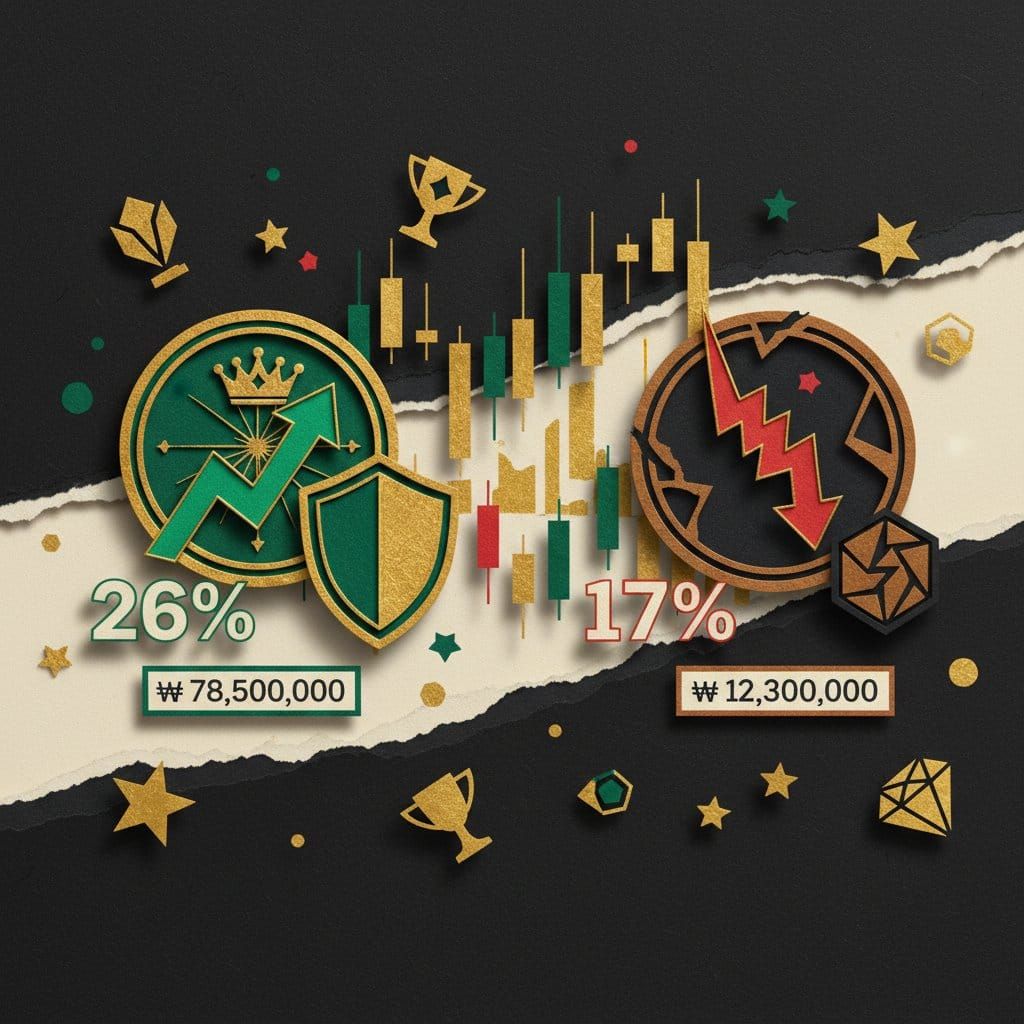
The crypto market is sending contradictory signals on April 30. Fear grips the broader landscape — the Fear & Greed Index at 29/100, Bitcoin dominance at 58.0%, and most major assets in retreat — yet pockets of the altcoin universe are posting extreme intraday swings. Nowhere is that contrast sharper than between BIO Protocol (+26%) and BLEND (-17%), two low-cap tokens that captured everything right and wrong about trading in a fearful market.
Market Snapshot: Fear Persists as BTC Holds $76K
Quick Answer: As of April 30 at 20:00 KST, the crypto Fear & Greed Index sits at 29/100 ("Fear"), up just 3 points from the prior day. Global market cap is $2.62 trillion with BTC dominance at 58.0%. BIO Protocol surged 26% on DeSci narrative momentum while BLEND crashed 17% on profit-taking — a textbook small-cap divergence in a low-liquidity fear environment.
As of April 30 at 20:00 KST, total crypto market capitalization stands at $2.62 trillion with 17,489 active cryptocurrencies tracked globally. Bitcoin dominance at 58.0% signals continued capital concentration in the largest asset — a pattern that has historically preceded altcoin rotation, though current fear conditions do not yet support a breakout thesis.
On Binance, BTC trades at $76,050 (-2.02% over 24 hours), with an intraday range of $74,937 to $77,694. ETH sits at $2,263 (-3.00%) with $736.5M in 24-hour Binance volume, the top-traded non-stablecoin on the exchange. SOL is at $83.01 (-2.48%) and DOGE at $0.107 (-2.95%). PLUME leads the Binance top-10 losers at -7.26%. On OKX, BTC registers $76,054 with a slightly positive reading in the OKX measurement window, and CHIP appears in the top 5 on both exchanges with roughly 4% gains — a rare bright spot in an otherwise red session.
| # | Coin | Price | 24h Change | Volume(24h) | High | Low |
|---|---|---|---|---|---|---|
| 1 | USDC | $1.00 | +0.03% | $2.0B | $1.00 | $1.00 |
| 2 | BTC | $76,050 | -2.02% | $1.2B | $77,694.61 | $74,937.52 |
| 3 | ETH | $2,263 | -3.00% | $736.5M | $2,336.00 | $2,220.36 |
| 4 | CHIP | $0.07 | +3.91% | $256.3M | $0.07 | $0.06 |
| 5 | DOGE | $0.11 | -2.95% | $236.6M | $0.11 | $0.10 |
| 6 | SOL | $83 | -2.48% | $194.6M | $85.16 | $81.40 |
| 7 | PLUME | $0.01 | -7.26% | $119.4M | $0.01 | $0.01 |
| 8 | TON | $1.31 | -1.51% | $118.6M | $1.36 | $1.29 |
| 9 | USD1 | $1.00 | +0.02% | $115.4M | $1.00 | $1.00 |
| 10 | XRP | $1.37 | -1.91% | $101.0M | $1.40 | $1.35 |
BIO Protocol: DeSci Momentum Meets Low-Liquidity Spike
BIO Protocol's 26.09% intraday surge on April 30 is not tied to a single protocol event — it reflects a convergence of DeSci (Decentralized Science) narrative momentum against a backdrop of thin liquidity. BIO recently launched Bio V2 and BioAgents, positioning itself as infrastructure for AI-coordinated scientific research. Earlier in April, the protocol completed a $6.9M funding round led by Maelstrom, Arthur Hayes's family office — institutional backing that put BIO on watchlists across the DeSci community and created a credibility floor for speculative flows.
On South Korea's Upbit exchange, BIO reached 64 KRW as the session closed. The kimchi premium for major assets remains negligible — BTC at just +0.29% and ETH at +0.24% above global prices — confirming that the BIO move was not driven by broad Korean retail enthusiasm, but by concentrated speculative buying in a specific narrative pocket.
"Small-cap tokens in emerging narratives like DeSci can see 20–30% moves in a single session when volume concentrates in a low-liquidity window," said Michael Terpin, founder of Transform Ventures. "The same illiquidity that creates the upside is what makes the reversal brutal." Investors entering BIO at current levels are accepting elevated tail risk. Without a sustained protocol catalyst, the move is vulnerable to a sharp mean-reversion.
BLEND Loses 17%: Profit-Taking Cascade
BLEND fell 17.13% to 208 KRW on Upbit, erasing most of the prior session's gains in a single move. There is no identifiable negative catalyst — this is mechanics, not fundamentals. After an extended rally, profit-taking triggered stop-loss orders, which cascaded into additional selling. The pattern is familiar for low-liquidity altcoins operating in fear-dominated environments.
"When the market is fearful, the spread between winners and losers in small caps widens dramatically," noted Mati Greenspan, founder of Quantum Economics. "You can be right on the narrative and still get stopped out by the volatility." Both BIO and BLEND illustrate the same structural reality: position sizing and staggered entries are non-negotiable for small-cap altcoin exposure in sub-30 fear conditions.
Derivatives Data: Institutional Positioning Reveals Genuine Uncertainty
Binance perpetual futures provide a sharper view of leveraged positioning than spot prices alone. The data as of April 30 at 20:00 KST reveals a market in genuine uncertainty rather than full capitulation.
| Coin | Funding Rate | Open Interest | Long/Short |
|---|---|---|---|
| ADA | 0.0049% | $78.8M | N/A |
| AVAX | -0.0004% | $81.0M | N/A |
| BNB | 0.0000% | $338.1M | N/A |
| BTC | -0.0018% | $7.3B | 49.6% / 50.4% |
| DOGE | 0.0083% | $376.4M | 66.8% / 33.2% |
| DOT | -0.0143% | $41.7M | N/A |
| ETH | -0.0046% | $4.5B | 67.9% / 32.1% |
| LINK | -0.0045% | $85.8M | N/A |
| SOL | 0.0074% | $786.3M | 74.9% / 25.1% |
| XRP | -0.0001% | $357.1M | 70.5% / 29.5% |
BTC's funding rate is -0.0018% — slightly negative, meaning short positions are marginally paying longs. That is a mild bearish lean from the derivatives market, not an extreme. ETH's funding rate is more negative at -0.0046%, reflecting heavier short positioning in ETH futures. Notably, SOL carries a positive funding rate of +0.0074% despite a -2.48% spot decline — leveraged traders are betting on a SOL recovery even as spot price retreats.
Open interest remains large and sticky: BTC OI stands at $7.3 billion and ETH at $4.5 billion. The scale of these positions alongside negative funding rates indicates institutional players are hedging, not exiting. The long/short ratios deepen the picture: BTC is split nearly evenly at 49.6% long vs. 50.4% short — genuine market indecision. ETH leans bullish at 67.9% long, SOL is the most crowded long at 74.9%, and DOGE carries positive funding (+0.0083%) with 66.8% long positioning, reflecting persistent retail meme momentum even under fear conditions.
Historical Context: Sub-30 Fear Has a Track Record
For investors with a longer time horizon: historically, when the Fear & Greed Index drops below 30, the median 90-day forward return for BTC has been approximately +38.4% based on prior cycle data. The current structural setup — sub-30 fear, 58% BTC dominance, and negative BTC and ETH funding rates suggesting light net long positioning — shares characteristics with prior cycle accumulation phases.
Matt Hougan, Chief Investment Officer at Bitwise Asset Management, has observed: "We've seen this pattern before. When BTC dominance plateaus in the 58–62% range and Fear & Greed stays suppressed, it often marks the accumulation phase before the next leg higher." Key upcoming catalysts include the SUI CME futures launch on May 4, potential CLARITY Act passage (tracking at approximately 72% odds), and the Ethereum Glamsterdam upgrade expected in June — all capable of shifting institutional flows materially if they land favorably.
Risk Factors: DeFi Sector Overhang Persists
Not every signal points upward. The Kelp DAO exploit on April 18–20 wiped $8.45 billion from Aave's TVL and triggered a sector-wide -7% contraction across DeFi protocols. That structural overhang has not fully cleared from market pricing or sentiment. Any additional security incidents in DeFi could reignite fear-driven selling across the altcoin complex, particularly affecting tokens with significant DeFi protocol exposure. Risk managers should treat this as an active tail risk, not a resolved event.
For ongoing coverage, explore SpotedCrypto's Top Picks, follow our altcoin analysis, check the latest daily market reports, and read our DeFi sector updates.
Frequently Asked Questions
What drove BIO Protocol's 26% gain on April 30, 2026?
BIO Protocol's surge combined multiple factors: growing momentum in the DeSci (Decentralized Science) narrative, the recent launch of Bio V2 and BioAgents, and a $6.9M Maelstrom-led funding round that drew institutional attention earlier in April. No single on-chain event triggered the April 30 move — low liquidity and concentrated speculative buying amplified the price action. The absence of a real-time catalyst means the move carries significant reversal risk.
Is a Fear & Greed Index reading of 29 a buying opportunity?
Historically, sub-30 Fear & Greed readings have preceded strong 90-day recoveries — the median is approximately +38.4% for BTC in prior cycles. However, this is a statistical tendency, not a guarantee. Current conditions add complexity: BTC at $76,050, negative ETH and BTC funding rates, and residual DeFi sector weakness from the Kelp DAO exploit. Contrarian investors may treat sub-30 readings as accumulation signals, but waiting for a confirmed trend reversal before sizing up is the more conservative approach.
Disclaimer: This article is for informational purposes only and does not constitute financial or investment advice. Cryptocurrency markets are highly volatile and investments may result in partial or total loss of principal. All investment decisions should be made based on independent research and in consultation with a qualified financial advisor.
Related Articles
- Fear & Greed at 26: Top 3 Altcoins Worth Watching Right Now
- 5 Altcoins to Watch in April 2026 as Bitcoin Pulls Back
- 5 Crypto Picks for April 2026: Contrarian Buys at Fear Index 31
- Top 5 Altcoins to Buy Right Now: April 2026 Upbit Volume Leaders
- Top 5 Altcoins to Buy This Week: BIO, AXL, DOGE, IP & VIRTUAL — April 2026