2026 Altcoin Market Structure: Bitcoin Dominance and Selective Rotation
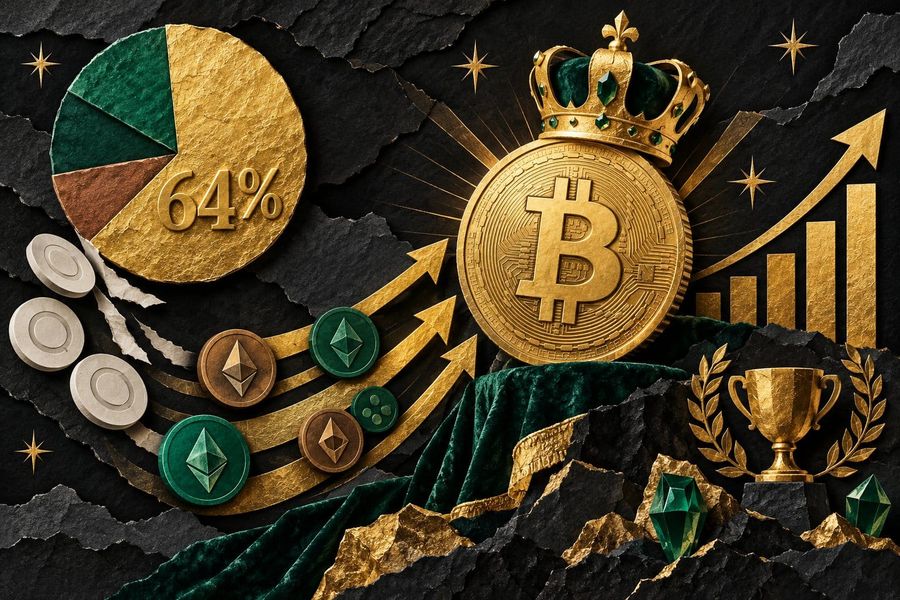
The 2026 altcoin market operates in a structurally distinct environment from prior crypto cycles. Bitcoin dominance — the share of total crypto market capitalization held in BTC — has remained elevated at 58–60% throughout the first five months of 2026, while the Altcoin Season Index sits in the 27–35 range, firmly within 'Bitcoin Season' territory. The Index uses a 90-day lookback window: a reading above 75 qualifies as Altcoin Season, below 25 indicates extreme Bitcoin dominance, and the current 27–35 band confirms that broad-based altcoin rotation has not yet materialized. Cumulative inflows into spot Bitcoin ETFs have surpassed $87 billion, anchoring institutional capital in the flagship asset and compressing the capital flow available to alternatives. In this environment, token selection — identifying the narrow set of altcoins with verifiable on-chain revenue, institutional adoption, or structural catalysts — matters significantly more than broad-basket altcoin exposure. The headline 2026 performance data reflects this reality directly: top-tier names delivered triple-digit gains while long-tail assets largely stagnated or declined against Bitcoin.
Quick Answer: As of May 2026, it is Bitcoin Season — not altcoin season. The Altcoin Season Index reads 27–35, well below the 75 threshold required for altcoin season classification. Bitcoin dominance holds at 58–60%, ETF inflows have exceeded $87 billion, and altcoin gains remain concentrated in a selective tier of top-performing assets rather than the broad market.
Understanding the Bitcoin Season dynamic is essential for timing altcoin entry decisions. Historically, Bitcoin Season periods are characterized by compressed altcoin beta — altcoins tend to underperform BTC on a risk-adjusted basis and exhibit higher volatility with lower upside capture. Capital rotation into altcoins typically begins when Bitcoin dominance breaks below 52–54% and sustains that level for two to three consecutive weeks. With dominance currently at 58–60%, that threshold remains a meaningful distance away, according to market data tracked by KuCoin Research. Three conditions must materialize simultaneously for a confirmed altseason pivot: Bitcoin dominance breaking below 52%, sustained rotation from the combined $265 billion stablecoin pool (USDT at $187B, USDC at $78B) into altcoins, and volume spikes on altcoin-focused exchanges. Until all three activate concurrently, altcoin strength remains selective rotation rather than a broad cycle.
The $87 billion in cumulative Bitcoin ETF inflows introduces a structural variable absent from prior altcoin cycles. Institutional investors accessing crypto through regulated ETF vehicles are overwhelmingly exposed to Bitcoin alone — these flows do not convert into altcoin buying. This creates a structural floor for BTC and a ceiling on altcoin dominance until either altcoin ETFs gain comparable scale or institutional mandates broaden to multi-asset crypto exposure. Both developments are underway — Ethereum ETFs are live, and multiple altcoin ETF filings are pending for Solana, XRP, and Hyperliquid — but the capital displacement effect remains net-positive for Bitcoin dominance through mid-2026.
The selective rotation dynamic has bifurcated the altcoin landscape into two distinct tiers: assets with institutional-grade narratives (Ethereum, Solana, XRP, Hyperliquid) that attract genuine capital despite Bitcoin Season conditions, and long-tail tokens where the proliferation of over 10 million tradeable assets has fragmented speculative capital to the point where most individual tokens receive negligible sustained buying pressure. The practical implication for portfolio construction is that a concentrated approach — owning fewer, higher-conviction positions with defined catalysts — is structurally better suited to the current market regime than a diversified altcoin basket.
| Metric | Current Reading (May 2026) | Interpretation | Altseason Trigger Level |
|---|---|---|---|
| Bitcoin Dominance | 58–60% | Bitcoin Season — capital anchored in BTC | Below 52% sustained 2–3 weeks |
| Altcoin Season Index | 27–35 | Selective rotation; broad altseason not confirmed | Above 75 for confirmed altcoin season |
| Spot BTC ETF Cumulative Inflows | $87B+ | Institutional capital anchored in BTC, not altcoins | — |
| USDT Total Supply | ~$187B | Large stablecoin pool — potential rotation fuel if conditions shift | Sustained rotation into altcoins |
| USDC Total Supply | ~$78B | Institutional stablecoin — slower to deploy into risk assets | Sustained rotation into altcoins |
YTD Performance Leaderboard: Top Altcoin Returns Through April 2026
Year-to-date performance through late April 2026 reveals a sharply tiered altcoin landscape where a handful of assets with concrete institutional or regulatory catalysts delivered exceptional returns while the median token declined against Bitcoin. Among all tracked large-cap altcoins, DeXe (DEXE) leads at +363.67% YTD, trading at $15.03 — gains driven by its decentralized governance and social trading infrastructure gaining meaningful traction within DeFi communities. In the mega-cap category — assets with market capitalizations exceeding $50 billion — XRP delivered returns surpassing +400% YTD, powered by the August 2025 resolution of its SEC enforcement case and subsequent launch of spot XRP ETFs, according to analysis from CoinCub. Solana (SOL) gained approximately +180% YTD, trading in the $85–94 range with a market capitalization near $50–54 billion. Ethereum gained +21.87% YTD to approximately $2,318 — a price underperformer but the foundational liquidity anchor for global DeFi with a $279 billion market cap.
Hyperliquid (HYPE) delivered +68.62% YTD at approximately $40–43, a result that stands out given broadly risk-off conditions characterizing early 2026. Unlike speculative narrative tokens that require market euphoria to appreciate, Hyperliquid's gain reflects institutional conviction buying triggered by simultaneous spot ETF filings from Grayscale, Bitwise, and 21Shares. At a ~$10.4 billion market cap and ranked #13 globally, HYPE has rapidly transitioned from a DeFi niche product to an institutional-grade contender — a trajectory with few precedents among decentralized protocol tokens. MemeCore (M) at +118.53% ($3.44) demonstrates that selective speculative pockets remain active in the 2026 cycle, though this category carries materially higher execution and liquidity risk than the blue-chip tier, as noted in Motley Fool's January 2026 altcoin analysis.
The dispersion between top and median performers is the defining characteristic of 2026's YTD return environment. Assets with concrete regulatory catalysts (XRP), verifiable ecosystem revenue (Solana's $2.85 billion in 12-month revenue), or active institutional ETF demand (HYPE) outperformed dramatically. Assets without these structural anchors largely failed to maintain gains against Bitcoin's YTD performance. This pattern validates the selective approach: broad-basket altcoin exposure underperforms a concentrated portfolio of high-conviction positions under Bitcoin Season conditions, where beta-to-the-market is insufficient to generate alpha.
| Token | YTD Return (through Apr 2026) | Current Price | Market Cap | Primary Catalyst |
|---|---|---|---|---|
| XRP | +400%+ | ~$1.42–$1.43 | ~$87.7B | SEC case resolution; spot ETF launches |
| DeXe (DEXE) | +363.67% | $15.03 | Large-cap | DeFi governance growth; social trading adoption |
| Solana (SOL) | ~+180% | $85–$94 | ~$50–54B | Ecosystem revenue; Firedancer upgrade; DePIN/meme hub |
| MemeCore (M) | +118.53% | $3.44 | Mid-cap | Speculative narrative momentum |
| Hyperliquid (HYPE) | +68.62% | ~$40–$43 | ~$10.4B | Institutional ETF filings; perpetuals DEX growth |
| Ethereum (ETH) | +21.87% | ~$2,318 | ~$279B | Glamsterdam upgrade; DeFi TVL anchor; ETH ETF flows |
Tier-1 Blue-Chip Altcoins: ETH, SOL, XRP, and LINK
Tier-1 blue-chip altcoins share three defining characteristics that differentiate them from the broader altcoin universe: verifiable on-chain revenue or ecosystem economic activity that provides fundamental valuation support; institutional recognition through active ETF filings, regulatory resolution, or both; and market capitalizations large enough to absorb institutional position sizes without excessive slippage. Ethereum leads this tier with a $279 billion market cap and an estimated 75% share of total global DeFi value locked — a structural position no Layer-1 challenger has meaningfully eroded through 2026, according to analysis from CoinDCX. The 2026 'Glamsterdam' upgrade materially reduced Layer-2 gas fees on Arbitrum and Base, strengthening Ethereum's cost competitiveness against high-throughput alternative chains. Analyst price targets for ETH range from $3,000 to $8,000 for the cycle — a wide range that reflects genuine multi-scenario uncertainty rather than analytical consensus, with the lower end implying approximately 1.3x from current levels near $2,318 and the upper end approximately 3.4x, per forecasts compiled by CoinCub.
"Ethereum's long-term positioning is defined not just by price performance but by protocol revenue and ecosystem capture. With 75% of DeFi TVL and the Glamsterdam upgrade reducing Layer-2 costs, ETH retains structural advantages that make it a core holding rather than a speculative trade." — CoinCub Research, 2026
Solana has cemented its position as the preferred high-throughput platform for DeFi, DePIN, and meme coin ecosystems simultaneously — a multi-sector dominance that distinguishes it from specialized Layer-1 competitors. Processing 4,000+ real transactions per second under live network load, Solana's ecosystem generated $2.85 billion in verifiable revenue in the 12 months ending September 2025, providing fundamental support beyond price speculation. The Firedancer validator client, developed by Jump Crypto, targets over 1 million TPS for enterprise-grade applications — a capacity upgrade that would position Solana as a credible infrastructure layer for institutional deployments at scale. SOL price targets range $200–$500 for the 2026 cycle, according to aggregated analyst forecasts compiled by CoinCub and CryptoDaily.
XRP's +400% YTD performance is directly traceable to three concrete institutional events: the August 2025 resolution of Ripple's SEC enforcement case, which eliminated the primary regulatory overhang on institutional adoption; Ripple's $2.5 billion acquisition program, deepening its institutional partner network; and $500 million in financing raised at a $40 billion private valuation, signaling sustained confidence from major investors. At approximately $87.7 billion market cap, XRP has re-entered the top-five assets by market capitalization and attracted spot ETF listings. Price targets range from $2.50 to $13 — the wide spread reflecting both upside scenarios involving further institutional adoption and base-case scenarios where current gains are consolidated rather than extended. Chainlink (LINK) trades at approximately $10.46 — a 77% discount from its 2021 all-time high of $52 — yet its oracle infrastructure simultaneously underpins two of the fastest-growing sectors in 2026: real-world asset tokenization and AI integration on-chain. This dual-sector positioning creates asymmetric upside if either or both narratives accelerate through the second half of 2026.
Breakout Altcoin of 2026: Hyperliquid (HYPE)
Hyperliquid is the standout institutional story of 2026, and its emergence illustrates how product-market fit in a specific underserved segment can rapidly elevate a protocol from DeFi niche to institutional-grade contender. Hyperliquid operates as a decentralized perpetuals exchange — combining the capital efficiency of centralized derivatives venues with non-custodial on-chain settlement, a combination that addresses a genuine gap in the crypto infrastructure landscape. Its defining breakout signal came when Grayscale, Bitwise, and 21Shares simultaneously filed for spot HYPE ETFs — an event with no direct precedent among decentralized protocol tokens outside of Bitcoin and Ethereum. This multi-issuer filing represents asset managers with institutional distribution networks independently concluding that HYPE meets their listing criteria, a qualitatively distinct signal from retail-driven momentum buying. As of May 2026, Hyperliquid holds a ~$10.4 billion market cap and ranks #13 globally — a position reached in under two years from launch, according to market tracking by KuCoin Research.
"Hyperliquid's simultaneous ETF filings from three major issuers represent a structural shift in how institutional investors are approaching DeFi infrastructure — this signals conviction-led institutional demand for on-chain derivatives exposure, not retail-driven speculation." — KuCoin Research Blog, 2026
The +68.62% YTD return in broadly risk-off conditions is particularly significant in the context of the Bitcoin Season environment. Most DeFi and mid-cap altcoins lost ground against Bitcoin under the same market conditions, making HYPE's positive absolute and relative performance a signal of conviction-driven institutional buying rather than passive market beta capture. This pattern — outperforming in adverse macro conditions — is a characteristic historically associated with assets transitioning from speculative to institutional-grade classifications. Institutional buyers are tolerating near-term drawdown risk because they are positioning ahead of ETF approval rather than reacting to price momentum.
The primary risk for Hyperliquid is regulatory treatment of its core product category. Perpetuals DEXs — platforms enabling leveraged derivatives trading on crypto assets without a centralized intermediary — remain legally unresolved in the European Union under the MiCA framework and in South Korea under the Virtual Asset User Protection Act. In jurisdictions where centralized derivatives platforms face stringent licensing requirements, regulators may extend equivalent or more restrictive frameworks to decentralized equivalents. A definitive adverse regulatory ruling in either the EU or South Korea — two of the largest crypto trading markets by volume — would represent a material headwind to HYPE's ETF approval prospects and institutional adoption trajectory. Investors in HYPE should explicitly factor this binary regulatory risk into position sizing decisions.
Sector Themes Attracting Institutional Capital: AI, DePIN, and RWA
Three sector narratives are capturing disproportionate institutional capital relative to their combined market capitalization in 2026: artificial intelligence tokens providing blockchain-native machine learning infrastructure, Decentralized Physical Infrastructure Networks (DePIN) offering credible alternatives to cloud monopolies, and Real World Asset (RWA) tokenization bridging traditional financial instruments onto public blockchains. These three themes share a structural characteristic that distinguishes them from prior cycle sector plays: they address large existing markets — cloud computing, asset management, and infrastructure finance — with addressable market sizes measured in trillions of dollars. This framing gives institutional investment committees a methodology for sizing potential future token value using traditional technology or finance benchmarks, making these narratives legible to institutional allocators who would not engage with purely crypto-native speculation. The concentration of institutional flows into these three themes relative to their combined market cap constitutes a structural tailwind, according to analysis from CoinCub's 2026 market analysis.
"AI tokens, DePIN, and RWA tokenization are not just crypto narratives — they are blockchain-native responses to multi-trillion-dollar traditional markets. That framing is what converts institutional investment committees from skeptics to allocators." — CryptoDaily, May 2026
AI Tokens: Bittensor (TAO) and Fetch.ai (FET) represent the two primary institutional AI token positions in 2026. Bittensor operates as a decentralized marketplace for machine learning model training — validators earn TAO by contributing useful ML computations, creating economic incentives for AI development outside centralized cloud providers. This positions TAO as infrastructure for the open-source AI ecosystem rather than a speculative vehicle. Fetch.ai provides the autonomous agent coordination layer, enabling AI systems to transact and coordinate on-chain without human intermediary steps — a use case gaining traction as enterprise automation deployments accelerate through 2026. Both protocols address genuine infrastructure needs extending beyond crypto-native use cases, lending them credibility with technology-focused institutional investors who assess token value through a software infrastructure lens.
DePIN: Render (RNDR) and Filecoin (FIL) are the two highest-liquidity DePIN assets in 2026. Render aggregates idle GPU compute capacity from distributed node operators and sells it to media, AI, and gaming production workflows — competing directly with AWS GPU instances and Google Cloud TPUs at potentially lower unit costs for burst workloads. Filecoin provides decentralized storage with cryptographic proofs of data integrity, positioning itself as an alternative to S3-compatible cloud storage with verifiable censorship resistance. Both assets benefit from enterprise awareness of cloud concentration risk following high-profile centralized infrastructure outages in 2024–2025.
RWA Tokenization: Ondo Finance (ONDO) and Hedera (HBAR) are primary on-ramps for institutional financial instruments onto public blockchains. Ondo tokenizes US Treasury bills and investment-grade bond products, enabling 24/7 on-chain settlement of instruments previously constrained to T+2 settlement cycles. Hedera's enterprise-grade consensus mechanism and low per-transaction fees make it a preferred execution layer for financial institution pilots. Chainlink (LINK) provides the oracle infrastructure — real-time price feeds and cross-chain data bridges — that makes RWA tokenization technically feasible at institutional scale. The interconnection between these three protocols creates a compounding institutional adoption dynamic as each new RWA on-chain deployment requires all three layers.
Emerging Layer-1 Challengers: SUI, AVAX, APT, and INJ
Beyond Solana's established high-throughput position, four emerging Layer-1 protocols are pursuing differentiated market strategies targeting specific verticals where Ethereum's fee structure or EVM architecture creates friction. Sui (SUI) has emerged as the leading gaming and NFT-focused blockchain, deploying an object-centric data model that enables 120,000 theoretical TPS and parallel transaction processing — a technical architecture that delivers low-latency, low-fee performance for the frequent microtransaction patterns characteristic of on-chain gaming ecosystems. Avalanche (AVAX) targets enterprise and institutional deployments through its subnet customization architecture: institutions can deploy application-specific Avalanche subnets with configurable validator sets, compliance-ready KYC/AML logic, and 4,500+ TPS throughput — making it the preferred Layer-1 for regulated enterprise pilots that require permissioned execution environments. Aptos (APT) differentiates through its Move programming language, which incorporates formal verification capabilities providing mathematical safety guarantees — a compelling pitch to institutional developers who require auditability and reduced smart contract exploit risk, as noted in CryptoDaily's May 2026 analysis. Injective (INJ) occupies a narrow but deeply defensible position: a purpose-built derivatives and order-book DEX chain optimized for on-chain derivatives trading that Ethereum cannot efficiently serve due to block-time latency and gas cost constraints.
The competitive positioning of each emerging Layer-1 should be evaluated against Solana rather than Ethereum, because Solana has effectively occupied the high-performance general-purpose Layer-1 niche in the 2026 cycle. SUI, AVAX, APT, and INJ are not attempting to replicate Solana's positioning — each is targeting a specific vertical where Solana's general-purpose design produces sub-optimal outcomes. SUI targets gaming where Ethereum fees create friction; AVAX targets enterprise compliance environments where public blockchains cannot operate; APT targets institutional developers who require formal safety verification; INJ targets derivatives liquidity that benefits from an order-book architecture. This differentiation strategy means each chain's success is more correlated with the growth of its specific vertical than with the overall crypto market cycle.
For investors evaluating emerging Layer-1 positions, the key risk is execution timeline. SUI's gaming ecosystem adoption depends on game developers committing to on-chain mechanics — a slow enterprise sales cycle. AVAX subnets require institutional clients to complete procurement and compliance reviews before deployment. APT's Move ecosystem requires developer retraining from Solidity. INJ's derivatives volume is sensitive to regulatory developments in the perpetuals DEX space. Each of these Layer-1 challenges carries a distinct risk profile that differs meaningfully from the revenue-anchored risks of blue-chip tier assets like Solana and Ethereum.
Altcoin Portfolio Allocation Framework for 2026
The consensus portfolio allocation framework among structured crypto investors in 2026 reflects the Bitcoin Season reality: a defensive core augmented by selective altcoin exposure rather than broad-basket altcoin diversification across hundreds of assets. The standard three-tier framework begins with a 50% core position in BTC and ETH combined — assets with spot ETF liquidity, institutional infrastructure, and the deepest on-chain security histories. The second tier allocates 30% to major alternative Layer-1s with demonstrated institutional adoption: Solana (SOL), XRP, and BNB are the consensus inclusions based on market cap, regulatory status, and ecosystem revenue metrics. The remaining 20% is allocated to sector-specific narratives including AI tokens, DePIN assets, RWA tokenization plays, and gaming infrastructure — the highest-upside but highest-volatility allocation sleeve. This three-tier structure explicitly acknowledges the tiered capital flow dynamics of the current Bitcoin Season, per structured analysis from KuCoin Research and CoinCub.
Within the 20% narrative sleeve, individual positions should be capped at 3–5% of total crypto portfolio value to limit single-asset execution risk. This cap means no individual speculative token can cause a portfolio-level impairment event even in a severe adverse scenario — a structural protection against the categorical collapses that characterized 2022's sector token unwinds. A 3–5% cap implies four to six distinct sector positions within the sleeve, providing enough diversification across AI, DePIN, and RWA themes to capture sector-level upside without requiring single-token precision calls.
Rebalancing triggers should be defined in advance rather than reactively. The consensus framework identifies three specific signals that justify increasing altcoin sleeve exposure: the Altcoin Season Index crossing and sustaining above 50 — indicating rotation is broadening beyond the top-tier; Bitcoin dominance dipping below 55% on a sustained basis; or a confirmed macro risk-on pivot from major central banks. When any two of these three triggers activate simultaneously, the structural case exists for increasing the narrative sleeve from 20% to 25–30% and reducing the BTC/ETH core proportionally. The critical distinction between conviction holds — blue-chip protocols with verifiable revenue — and tactical narrative bets — sector tokens with event-driven catalysts — should determine which positions are held through volatility versus sized for specific outcomes and reassessed post-event.
| Portfolio Tier | Allocation % | Example Assets | Investment Rationale | Max Single Position |
|---|---|---|---|---|
| Core — BTC/ETH | 50% | Bitcoin, Ethereum | ETF liquidity; institutional infrastructure; deepest on-chain security | 25–35% BTC; 15–25% ETH |
| Major Alternatives | 30% | SOL, XRP, BNB | Proven ecosystem revenue; regulatory clarity; institutional adoption pipeline | 10–15% per asset |
| Sector Narratives | 20% | TAO, FET, RNDR, ONDO, HYPE, LINK, SUI | High-upside thematic plays with defined event catalysts; sized for outcomes | 3–5% per asset |
2026 Altcoin Outlook: Catalysts, Risks, and Price Targets
The 2026 altcoin outlook operates across three distinct probability-weighted scenarios — base case selective rotation continuing through year-end, upside broad altcoin season triggered by BTC dominance breaking below 52%, and downside extended Bitcoin-only dominance through H2 2026 — with the base case currently carrying the highest conditional probability given the structural market signals. The primary bullish catalysts are well-defined: the Altcoin Season Index crossing and sustaining above 50, signaling rotation is broadening from the top tier into a wider altcoin set; approved spot ETFs for Solana, XRP, and Hyperliquid, each creating a new institutional demand channel with regulated distribution infrastructure comparable to Bitcoin's ETF catalyst in early 2024; and accelerating real-world asset adoption on-chain, driving sustained demand for oracle infrastructure (LINK), tokenization platforms (ONDO, HBAR), and high-throughput execution layers (SOL, AVAX). Consolidated analyst price targets reflect genuine cycle uncertainty: ETH $3,000–$8,000, SOL $200–$500, XRP $2.50–$13, per forecasts compiled by CoinCub and CryptoDaily.
"The three-scenario framework for altcoins in 2026 — selective rotation, broad altseason, or extended BTC dominance — is not analyst hedging. It reflects genuine structural uncertainty about whether ETF-driven institutionalization of Bitcoin ultimately pulls capital away from altcoins or creates a rising-tide effect for the entire asset class over a multi-quarter horizon." — KuCoin Research, 2026
The key risk factors are both macro and crypto-specific. On the macro side, a sustained high-rate environment reduces risk appetite across all speculative asset classes — altcoins typically experience more severe corrections than Bitcoin due to lower institutional liquidity buffers and higher retail ownership percentages. On the crypto-specific side, four risks stand out: sustained Bitcoin dominance above 58% delays broad rotation and extends the Bitcoin Season dynamic well into H2 2026; regulatory classification ambiguity for AI tokens — whether protocols like Bittensor and Fetch.ai constitute securities, commodities, or utility tokens — creates binary regulatory risk for the sector's institutional adoption timeline; aggressive token unlock schedules for emerging Layer-1 projects (SUI, APT, INJ) generate sustained selling pressure that can offset ecosystem growth narratives for extended periods; and the proliferation of 10 million+ tokens across all chains creates liquidity traps for mid-cap holders unable to exit positions without significant market impact.
In the base case — selective rotation continuing through 2026 — the highest-probability outperformers are assets meeting all three institutional criteria: verifiable revenue, regulatory clarity, and active ETF filing status. Solana, XRP, Ethereum, and Hyperliquid meet all three. In the upside scenario — broad altcoin season triggered by BTC dominance breaking below 52% — sector tokens and emerging Layer-1s would likely outperform blue-chips on a percentage basis as capital rotates down the risk curve. In the downside scenario — extended BTC-only dominance through H2 2026 — the 50% BTC/ETH core allocation provides capital preservation with meaningful participation in Bitcoin's continued performance, preserving capital for altcoin deployment at more favorable entry points when conditions eventually shift.
Frequently Asked Questions
Is 2026 an altcoin season?
No — as of May 2026, it is firmly Bitcoin Season, not altcoin season. The Altcoin Season Index reads 27–35, well below the 75 threshold required for altcoin season classification. The Index measures what percentage of the top 100 altcoins have outperformed Bitcoin over the past 90 days: above 75 signals altcoin season, below 25 signals extreme Bitcoin dominance, and the current 27–35 range confirms selective rotation without broad altcoin participation. For a genuine altcoin season to begin, analysts identify three required simultaneous conditions: Bitcoin dominance breaking and sustaining below 52%, meaningful rotation from the combined $265 billion USDT and USDC stablecoin pool into altcoins, and volume spikes on altcoin-focused trading venues. As of the date of this article, none of these three conditions are fully met — the market remains in a selective tier-rotation phase rather than a broad altcoin cycle.
Which altcoin has performed best in 2026 so far?
The answer depends on the market-cap category. In the mega-cap tier — assets with market capitalizations above $50 billion — XRP leads with returns exceeding +400% YTD through late April 2026, driven by the August 2025 resolution of Ripple's SEC enforcement case and the subsequent launch of spot XRP ETFs. In the large-cap tier, DeXe (DEXE) leads all tracked assets at +363.67% YTD at a price of $15.03. Among established blue-chip altcoins, Solana (SOL) is the strongest performer at approximately +180% YTD, trading in the $85–94 range. Hyperliquid (HYPE) at +68.62% YTD is notable specifically because it outperformed in broadly risk-off conditions — a signal of institutional conviction buying rather than speculative retail momentum. Ethereum gained +21.87% YTD — a price underperformer but the dominant DeFi liquidity anchor globally with a $279 billion market capitalization. Each of these leaders has a distinct, traceable catalyst rather than a generic market-beta explanation.
How should I split my portfolio between Bitcoin and altcoins in 2026?
The consensus structured framework among active crypto investors in 2026 is a three-tier allocation: 50% in a BTC/ETH core position providing institutional-grade liquidity and ETF-accessible exposure; 30% in major established altcoins with proven ecosystem revenue and regulatory clarity (SOL, XRP, BNB); and 20% in sector-specific narrative tokens spanning AI infrastructure, DePIN, RWA tokenization, and gaming (TAO, FET, RNDR, ONDO, HYPE, SUI). Within the 20% narrative sleeve, individual positions are recommended at 3–5% of total portfolio value to limit single-asset drawdown impact. This framework is a general structural guideline — not financial advice — and should be calibrated to individual risk tolerance, investment horizon, liquidity needs, and tax situation. The framework should be recalibrated when the Altcoin Season Index crosses 50+ or Bitcoin dominance drops below 55%, as those signals indicate structurally more favorable conditions for increasing altcoin exposure proportionally.
What sectors are driving altcoin gains in 2026?
Three thematic sectors are attracting disproportionate institutional capital relative to their combined market capitalization in 2026. First, AI tokens — specifically Bittensor (TAO) and Fetch.ai (FET) — provide blockchain-native infrastructure for machine learning model training and autonomous agent coordination, addressing real infrastructure needs that extend beyond the crypto-native market and giving institutional analysts a technology framework for valuation. Second, DePIN (Decentralized Physical Infrastructure Networks) — led by Render (RNDR) for GPU compute and Filecoin (FIL) for decentralized storage — position themselves as verifiable alternatives to AWS, Google Cloud, and other centralized cloud providers with enterprise-credible use cases and existing revenue. Third, RWA (Real World Asset) tokenization — through Ondo Finance (ONDO), Hedera (HBAR), and Chainlink (LINK) — bridges traditional financial instruments onto public blockchains, a sector attracting regulated asset managers and financial institutions who would not otherwise engage with crypto assets. The common structural thread across all three is addressable market size measured in trillions of dollars, which makes them legible to institutional investment processes that require fundamental valuation anchors.
What are the main risks of investing in altcoins in 2026?
Five primary risks characterize altcoin investing in 2026. First, prolonged Bitcoin dominance above 58% delays broad rotation and keeps most altcoins underperforming Bitcoin — a dynamic that can persist for multiple quarters without a specific catalyst to change it. Second, the macro rate environment: if major central banks maintain restrictive monetary policy longer than markets expect, risk appetite contracts and altcoins experience disproportionate drawdowns relative to Bitcoin due to lower institutional liquidity buffers. Third, regulatory ambiguity: AI token classification (securities vs. commodity vs. utility token) and the treatment of perpetuals DEXs under MiCA and Asian regulatory frameworks remain unresolved, creating binary regulatory risk for entire sectors. Fourth, aggressive token unlock schedules for emerging Layer-1 projects — SUI, APT, and INJ all have substantial token supply unlocks scheduled through 2026 — which create structural selling pressure that ecosystem growth must outpace to deliver positive returns. Fifth, the proliferation of over 10 million tradeable tokens has fragmented speculative liquidity to the point where mid-cap and long-tail assets face structural exit liquidity constraints, making drawdown recoveries slower and more difficult than in prior cycles with fewer competing assets.
What to Watch for the Rest of 2026
The defining structural question for the remainder of 2026 is whether Bitcoin's ETF-driven institutionalization creates a rising-tide effect for the broader crypto asset class — as occurred in the 2020–2021 cycle when institutional Bitcoin adoption preceded broad altcoin appreciation — or entrenches a two-tier market where only the top 5–10 altcoins by market cap capture meaningful institutional flows. The current data suggests neither pure scenario but rather a progressive tier-expansion model: institutional flows begin with BTC, then gradually incorporate ETH through existing ETF infrastructure, then major alternatives (SOL, XRP, HYPE) as ETF approvals are processed, and finally the sector narrative tier as thematic ETFs develop. This is a slower rotation cycle than prior altcoin seasons but arguably a more structurally durable one — institutional capital, once deployed into altcoins through regulated vehicles, does not exit as rapidly as retail speculation.
Three specific data points merit active monitoring through H2 2026. First, the Altcoin Season Index trend: a sustained move above 40, then 50, would represent meaningful broadening of the rotation and justify reassessing the 20% sector narrative allocation upward. Second, the ETF approval pipeline: SOL, XRP, and HYPE ETF decisions will each serve as discrete capital formation catalysts with predictable institutional demand implications. Third, the macro rate trajectory: any central bank communications indicating a pivot toward rate reductions — even a gradual one — historically precedes crypto risk-on periods with a 60–90 day lag as capital reallocation processes move through institutional review cycles. All three signals are visible in public data and should be tracked systematically rather than reactively.
The most robust altcoin portfolio for 2026 is not one optimized solely for the upside broad altcoin season scenario. It is one structured to survive the extended Bitcoin dominance scenario while capturing meaningful participation if broad rotation materializes. The three-tier allocation framework — 50% core, 30% major alternatives, 20% sector narratives with 3–5% individual position caps — achieves this balance by ensuring the downside scenario preserves capital while the upside scenario, if it arrives, delivers meaningful gains from positions already established at lower entry points. Positioning discipline, not market-timing precision, is the primary driver of cycle-over-cycle performance for active retail crypto traders in the current environment.
Last updated: 2026-05-09. Data reflects publicly available market prices, ETF filing records, on-chain revenue metrics, and aggregated analyst forecasts as of early May 2026. Price targets represent compiled analyst ranges from multiple sources and do not constitute investment advice or a solicitation to buy or sell any asset. All investments in crypto assets carry substantial risk of loss including the potential loss of the entire principal amount invested.
Related Articles
- Crypto Market Analysis: Bitcoin Outlook, Altcoins & Regulation
- Top Trending Altcoins by Sector: Performance & Market Analysis
- Best Altcoins to Buy: Analyst Price Predictions & Portfolio Guide
- Best Altcoins to Watch: Top Performers by On-Chain Activity
- Top Altcoins to Buy Now: Analyst-Backed Price Predictions