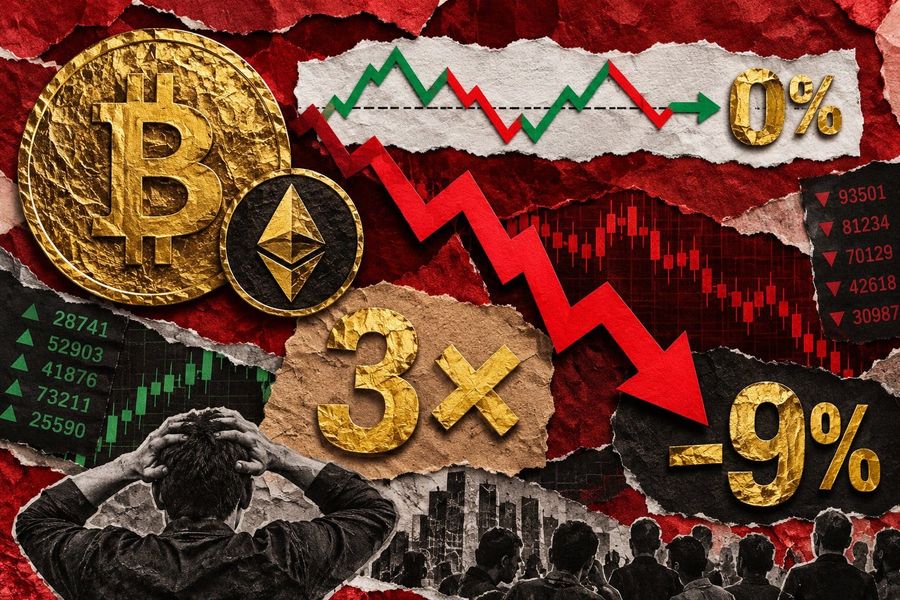
The crypto market is experiencing a capitulation event that dwarfs the FTX collapse in both scale and duration. With $209 billion erased from altcoin valuations over 13 relentless months and the Fear & Greed Index pinned at 9 out of 100, investors face the longest period of extreme fear ever documented in digital asset markets.
Altcoin Market Loses $209 Billion — How Deep Is the Damage?
Quick Answer: The total altcoin market cap has collapsed from $1.19 trillion to $719 billion over 13 months — a 39.5% decline exceeding the FTX crash. The Fear & Greed Index reads 9/100 with 46 consecutive days of Extreme Fear, the longest streak in crypto history. Some 38% of altcoins now trade near all-time lows.
Altcoin capitulation is a market phase in which broad-based selling exhausts remaining holders, driving prices to levels that reflect maximum pessimism rather than underlying value. According to data compiled by Spoted Crypto, the total altcoin market capitalization has cratered from $1.19 trillion in October 2025 to $719 billion as of March 29, 2026 — a loss of $209 billion across 13 consecutive months of net outflows. The drawdown has pushed 38% of all altcoins to trade near all-time low prices, exceeding the roughly 30% observed during the FTX collapse in November 2022. Meanwhile, Bitcoin dominance has climbed to 56.1% while Ethereum dominance has contracted to just 10.2%, revealing a stark capital rotation from risk assets into the perceived safety of BTC. The Crypto Fear & Greed Index sits at 9 out of 100, with 46 consecutive days locked in Extreme Fear — the longest such streak ever recorded.
Current Altcoin Downturn vs. Historic Crypto Crashes
| Metric | Current (Mar 2026) | FTX Collapse (Nov 2022) | Terra/Luna (Jun 2022) |
|---|---|---|---|
| Altcoins Near All-Time Lows | 38% | ~30% | Est. ~25% |
| Fear & Greed Lowest Reading | 5 | 10 | 6 |
| Consecutive Extreme Fear Days | 46 (record) | ~40 | Est. ~30 |
| Drawdown Duration | 13 months (structural) | ~2 weeks (acute) | ~4 weeks (acute) |
| BTC Dominance at Peak Stress | 56.1% | ~40% | ~47% |
The numbers above expose structural damage without parallel in recent crypto history. During the FTX collapse, roughly 30% of altcoins hit all-time low territory — a figure considered catastrophic at the time. Today, that proportion has swollen to 38%, an 8-percentage-point increase reflecting not a single-event shock but a methodical draining of liquidity from the long tail of crypto assets. The meme coin sector alone has shed 75% of its market cap, plummeting from $150.6 billion in December 2024 to just $31 billion, according to Spoted Crypto's meme coin crash analysis.
The capital concentration into Bitcoin is equally telling. At 56.1% BTC dominance and just 10.2% ETH dominance, the market exhibits a risk-off posture not seen since the early stages of the 2022 bear cycle. Binance funding rates reinforce this bearish positioning: BTC perpetual swaps carry a negative rate of -0.0037%, ETH sits at -0.0011%, and SOL at a deeply negative -0.0302%, per live CoinGlass data — a clear signal that short sellers dominate current positioning.
Ethereum's decline has been particularly brutal. With a weekly RSI below 25 — an event that has occurred fewer than five times in ETH's entire trading history — the second-largest cryptocurrency has entered what analysts call a "triple oversold" signal. Exchange-held ETH supply has dropped to 16 million coins, a record low representing a 30.4% decline from 23 million in 2023, suggesting long-term holders are moving assets to cold storage rather than liquidating.
"Shorter narrative windows, more violent rotations, and fewer room for weak projects to survive on hype alone. The long tail of tokens will still exist, but will largely function as high-risk venture or casino-style plays," said Andrei Grachev, Managing Partner at DWF Labs.
Why This Capitulation Is Being Called Worse Than the FTX Collapse
Market capitulation typically follows a recognizable arc: a sudden catalyst triggers a sharp sell-off, forced liquidations accelerate the decline, and recovery begins once weak hands are flushed out. The 2026 altcoin downturn defies this template entirely. Unlike the FTX collapse — a single corporate fraud event that concentrated its worst damage within a two-week window in November 2022 — the current crisis has unfolded as a grinding 13-month structural liquidity drain with no single identifiable shock. Data from CoinGlass confirms that the Crypto Fear & Greed Index has now spent 46 consecutive days in Extreme Fear territory, surpassing the approximately 40-day streak that followed FTX's implosion to set an all-time record. On February 6, 2026, the index plunged to 5 — the lowest reading in its entire history, below the Terra/Luna crash trough of 6, the COVID Black Thursday reading of 8, and the FTX nadir of 10.
Fear & Greed Index Across Crypto's Worst Crises
| Crisis Event | Fear & Greed Low | Extreme Fear Streak | Trigger Type |
|---|---|---|---|
| Current Downturn (Mar 2026) | 5 (all-time low) | 46 days (record) | 13-month structural drain |
| FTX Collapse (Nov 2022) | 10 | ~40 days | Single fraud event |
| Terra/Luna (Jun 2022) | 6 | ~30 days | Algorithmic stablecoin failure |
| COVID Black Thursday (Mar 2020) | 8 | ~21 days | Global macro shock |
The structural nature of this downturn is what separates it from every prior crash in crypto history. The FTX collapse was violent but contained: Sam Bankman-Fried's fraud was exposed, contagion spread through Alameda Research and BlockFi, and the market found a floor within weeks. The current environment offers no such clarity. "This metric shows how much altcoins are still under pressure. In fact, this represents the largest regression of altcoins observed during this cycle," said Darkfost, analyst at CryptoQuant. Capital has been slowly bleeding out of altcoins since late 2025, driven by macroeconomic headwinds, regulatory uncertainty across the U.S. SEC and EU MiCA frameworks, and a steady institutional rotation into Bitcoin-only strategies.
The divergence between Bitcoin and altcoins sharpens the picture further. While altcoins hemorrhage value, Bitcoin ETFs recorded a single-day net outflow of $340 million — the largest since January 2026 — yet cumulative March inflows still total $2.5 billion, according to Spoted Crypto. Institutional investors are tactically de-risking on volatile sessions while maintaining strategic Bitcoin allocations — a luxury unavailable to the broader altcoin market. The result is a two-tier ecosystem: Bitcoin absorbing institutional bid flow at 56.1% dominance, while altcoins drift deeper into capitulation without a visible floor.
Adding fuel to the downward pressure, the largest options expiry of 2026 landed on March 28. A combined $15.58 billion in contracts expired in a single session — $13.46 billion in Bitcoin (195,398 contracts) and $2.12 billion in Ethereum (1,026,462 contracts), according to Crypto Economy. The expiry erased roughly $30 billion from total market capitalization within hours, with 24-hour liquidations reaching $450 million — 89% of which ($402 million) were long positions, per Spoted Crypto.
"Extreme fear readings below 15 have historically been a gift for patient capital, but the first 48–72 hours after such readings often produce the most violent shakeouts," warned Markus Thielen, Head of Research at 10x Research. Historical precedent supports guarded optimism: sub-15 readings have preceded average 60-day returns of 38%, according to James Butterfill, Head of Research at CoinShares. After the FTX collapse, BTC rallied 96% within six months; following the Terra/Luna crisis, ETH recovered 127% from its trough. Yet derivatives data suggests the market has not found its footing — Binance perpetual funding rates remain negative across every major pair, with SOL at -0.0302% and BTC at -0.0037%. For those tracking this historic 46-day Extreme Fear streak, the question is no longer whether capitulation has arrived — but whether the market has finished capitulating.
Are Meme Coins Dead? The Reality Behind a $119 Billion Wipeout
The meme coin market has lost $119 billion in value since its December 2024 peak, collapsing from a total market capitalization of $150.6 billion to just $31.02 billion by late March 2026 — a staggering 79.4% drawdown that has obliterated speculative portfolios globally. According to data tracked by Spoted Crypto, this crash rivals the 2022 bear market that saw meme tokens shed 78% of their collective value, dropping from $89.95 billion to below $20 billion. The critical question facing traders is whether this represents a terminal decline for hype-driven tokens or a cyclical reset that will eventually produce another speculative wave. With the Crypto Fear & Greed Index sitting at 9 — deep in Extreme Fear territory — and funding rates turning negative on most major exchanges, the meme coin sector is experiencing capitulation-level selling pressure not witnessed since the FTX collapse.
The Numbers Behind the Meme Coin Meltdown
To understand the full scale of destruction, consider the side-by-side comparison between the two worst meme coin crashes in crypto history:
| Metric | 2022 Bear Market | 2026 Current Cycle |
|---|---|---|
| Sector Peak Market Cap | $89.95B | $150.6B |
| Sector Trough Market Cap | <$20B | $31.02B |
| Peak-to-Trough Decline | ~78% | ~79.4% |
| Dollar Value Destroyed | ~$70B | ~$119.6B |
| Post-Trough Recovery | $60B+ by early 2024 | Ongoing |
| Fear & Greed at Trough | 10 (FTX, Nov 2022) | 9 (Mar 2026) |
Sources: Spoted Crypto, CoinGlass
While the percentage declines are nearly identical — 78% versus 79.4% — the absolute dollar destruction in 2026 dwarfs the prior cycle by a factor of 1.7, reflecting the massive influx of speculative capital that flooded into meme tokens during the 2024 boom. The marquee names have not been spared. Dogecoin (DOGE), once the poster child of retail mania, has been trapped in a prolonged sideways range on Binance with its perpetual funding rate at a tepid 0.0077% — signaling near-total exhaustion of directional conviction among leveraged traders. Shiba Inu (SHIB) and PEPE have fared even worse, with both tokens down over 80% from their cycle highs and daily volumes on centralized exchanges contracting to levels last seen in mid-2023. Open interest across meme coin perpetual futures has declined steadily throughout Q1 2026, confirming a mass exodus of speculative capital from the sector.
What History Suggests — And Why This Time May Differ
The 2022 precedent offers a glimmer of hope for meme coin bulls. After the 78% wipeout that bottomed near $20 billion, the sector staged a remarkable comeback — climbing back above $60 billion by early 2024 as a fresh wave of retail capital rotated into new narratives like PEPE and BONK. But market veterans warn that a repeat recovery is far from guaranteed.
Craig Cobb, founder of The Grow Me, argues that the next cycle will look fundamentally different: "Next alt season won't lift all boats — gains concentrate in select few," he told Spoted Crypto. This view is echoed by Andrei Grachev, Managing Partner at DWF Labs, who offered a blunter assessment: "Shorter narrative windows, more violent rotations, and fewer room for weak projects to survive on hype alone. The long tail of tokens will still exist, but will largely function as high-risk venture or casino-style plays."
The implication is sobering: even if meme coins as a category eventually rebound, the era of indiscriminate rallies where every dog-themed token surges 1,000% may be over. For investors still holding positions in lower-tier meme tokens, the broader altcoin capitulation suggests that capital will concentrate in projects with demonstrable community resilience and sustained exchange liquidity — leaving the majority of the 2024 meme coin vintage permanently underwater.
$450 Million Liquidated in 24 Hours: Inside the Leverage Massacre
What does a $450 million liquidation cascade look like in real time? Over a single 24-hour window in late March 2026, leveraged traders across major exchanges were wiped out at an alarming pace — with long positions accounting for $402 million (89%) of total liquidations and shorts absorbing just $48 million (11%), according to Spoted Crypto. The asymmetry reveals a market that had become dangerously one-sided, with over-leveraged bulls caught off guard by a swift downward move that triggered cascading margin calls across Binance, OKX, and Bybit perpetual markets. Most critically, $258 million of the total liquidations — more than 57% — occurred within a concentrated four-hour window, illustrating how modern crypto market structure transforms orderly selling into violent, self-reinforcing liquidation spirals. The episode underscores a brutal truth: in a market governed by extreme fear, leverage is not a tool — it is a loaded weapon pointed at the holder.
Anatomy of a Cascade: How $258 Million Vanished in Four Hours
The mechanics are brutally efficient. When Bitcoin dropped from its 24-hour high of $67,289 toward the $66,124 low — a relatively modest 1.7% swing — it crossed critical liquidation thresholds that triggered automatic position closures across perpetual futures platforms. Each forced sell order pushed prices lower, which in turn breached the next tier of margin requirements, creating a self-reinforcing feedback loop. On Binance, BTC perpetual funding rates plunged to -0.0037%, while SOL funding rates cratered to -0.0302% — among the most negative readings of 2026 — confirming that the market had flipped decisively bearish once the cascade concluded. This domino effect explains why over half the day's total damage was compressed into just 240 minutes of concentrated violence.
The ETF Paradox: $340 Million Outflow vs. $2.5 Billion Monthly Inflow
The liquidation event coincided with a $340 million single-day outflow from Bitcoin spot ETFs — the largest since January 2026, per Spoted Crypto. Yet this headline figure masks a more nuanced reality: cumulative net inflows into BTC ETFs for March 2026 still stood at a robust $2.5 billion, suggesting that institutional demand remained structurally intact even as short-term momentum traders rotated out. This divergence between daily flow volatility and monthly accumulation trends is characteristic of a maturing asset class where institutional allocators operate on quarterly rebalancing cycles — not 24-hour sentiment swings. A single day of dramatic outflows, however alarming in isolation, does not necessarily signal a reversal of the broader institutional thesis that has underpinned ETF adoption since 2024.
Regional Market Dynamics: Asia Signals Relative Calm
While Western exchanges absorbed the brunt of the liquidation cascade, Asian markets displayed notable resilience. Regional price premiums on major Asian platforms held steady, with BTC trading at approximately +0.60% above global spot prices and ETH at +0.55% — a marked contrast to the negative premiums that typically accompany panic selling. Historically, stable or positive premiums across Asian exchanges during broad liquidation events have indicated that local participants view the selloff as a tactical entry point rather than a catalyst for further capitulation. This divergence between leveraged derivatives destruction on one hand and spot-driven regional stability on the other adds a crucial layer of nuance to the current market picture — and may prove to be an early signal of broader stabilization in the weeks ahead.
What Are Whales Doing Amid the Fear? On-Chain Accumulation Signals
While retail investors capitulate in droves, on-chain data reveals a starkly different narrative among the crypto market's largest holders. Bitcoin whale wallets holding 1,000+ BTC have surged to a record 2,140 addresses, according to Spoted Crypto, with these entities accumulating approximately 270,000 BTC — worth between $18.7 billion and $23 billion — over just the past 30 days. This represents the single largest monthly whale buying spree in 13 years, dwarfing accumulation patterns seen during both the FTX collapse and the Terra/Luna implosion. Simultaneously, Ethereum exchange reserves have plunged to a historic low of 16 million ETH, down 30.4% from 23 million ETH in 2023, signaling that large holders are moving assets into cold storage at an unprecedented pace. The stark divergence between retail panic and institutional accumulation has rarely been this extreme across crypto market history.
BTC Whale Accumulation: A 13-Year Record
The 270,000 BTC absorbed by whale addresses in March 2026 alone is a staggering figure by any historical measure. At current prices near $66,732, that haul equates to roughly $18.0 billion at the monthly low and $23.0 billion at the monthly high — a volume that eclipses the aggressive whale buying seen during Bitcoin's sub-$16,000 trough in late 2022. The climb to 2,140 whale wallets, an all-time high, indicates that these are not short-term speculators buying a dip; they are long-horizon conviction holders expanding positions during maximum pain.
| On-Chain Metric | Current Value | Previous Benchmark | Change |
|---|---|---|---|
| BTC Whale Wallets (1,000+ BTC) | 2,140 (ATH) | ~1,900 (Nov 2022) | +12.6% |
| 30-Day Whale Accumulation | 270,000 BTC ($18.7–23B) | ~180,000 BTC (Nov 2022) | +50% |
| ETH Exchange Reserves | 16M ETH (ATL) | 23M ETH (2023) | −30.4% |
| ETH Withdrawn from Exchanges | ~7M ETH (~$13.7B) | — | Since 2023 |
| BTC Funding Rate (Binance) | −0.0037% | +0.01% (neutral) | Bearish bias |
ETH Exchange Exodus: Supply Squeeze in the Making?
The Ethereum supply picture tells an equally compelling story. Exchange-held ETH has collapsed to 16 million — approximately $32 billion at current prices — representing the lowest balance in the asset's trading history. Compared to the 23 million ETH sitting on exchanges in 2023, roughly 7 million ETH worth an estimated $13.7 billion has been withdrawn into private wallets, according to Spoted Crypto. This 30.4% decline in exchange supply creates the preconditions for a supply shock should demand return — fewer coins available for immediate sale mean that even modest buying pressure could produce outsized price moves.
"On-chain fingerprints are consistent with structured accumulation, not distribution," said Will Clemente, Co-founder of Reflexivity Research. Clemente's analysis points to the growing disconnect between price action and underlying holder behavior — while BTC has declined 42% from its all-time high, the strongest hands in the market are buying at the fastest rate in over a decade.
Retail Capitulation as the Smart Money Entry Signal
Clara Medici, Senior Market Analyst at Kaiko Research, frames the dynamic in behavioral terms: "Negative regional premiums are essentially a sentiment X-ray. They tell you that the most emotionally reactive cohort — retail traders — has already thrown in the towel. That's often when the smart money begins accumulating." With the Fear & Greed Index pinned at 9 and BTC funding rates at −0.0037% on Binance, the derivatives market confirms that short-side crowding has reached extreme levels. Historically, such configurations have preceded violent short squeezes — though timing remains the perennial challenge. For a deeper look at the capitulation dynamics driving this divergence, see our full altcoin capitulation analysis.
How Has the Market Rebounded After Extreme Fear? A Historical Playbook
History suggests that periods of extreme fear in crypto markets have consistently preceded significant recoveries — with one notable exception. The Fear & Greed Index has now spent 46 consecutive days in Extreme Fear territory, surpassing the approximately 40-day streak following the FTX collapse in November 2022, according to Spoted Crypto. After the COVID crash of March 2020, when the index hit 8, Bitcoin surged 133% within six months. Following the FTX implosion, which bottomed at a reading of 10, BTC rallied 96% over the subsequent half-year. The lone outlier remains the Terra/Luna collapse of May 2022, which produced a further 4.5% decline before eventual stabilization. With the current cycle recording an all-time-low Fear & Greed reading of 5 on February 6, 2026 — the lowest ever in crypto history — the critical question facing investors is whether this capitulation marks the final washout or a structural break from historical recovery patterns.
Crisis-by-Crisis: The Recovery Scoreboard
| Crisis Event | Fear & Greed Low | BTC Drawdown from ATH | 6-Month Return | ETH Weekly RSI at Low |
|---|---|---|---|---|
| COVID Crash (Mar 2020) | 8 | −53% | +133% | ~28 |
| Terra/Luna (May 2022) | 6 | −58% | −4.5% | <25 |
| FTX Collapse (Nov 2022) | 10 | −77% | +96% | <25 |
| Current Cycle (Mar 2026) | 5 (Feb 6 ATL) | −42% | ? | <25 |
The pattern is striking but not absolute. Three out of four extreme fear episodes delivered powerful double-digit recoveries, while the Terra/Luna aftermath — which was followed just five months later by the FTX collapse — stands as the cautionary tale. Notably, the current BTC drawdown of 42% from its all-time high is significantly shallower than the 77% peak-to-trough decline during the 2022 bear market, suggesting that structural supports such as spot ETF flows, corporate treasury adoption, and maturing derivatives markets may be establishing a higher price floor than previous cycles.
ETH's Triple Oversold Signal: What Happened Next?
Ethereum's weekly RSI has dropped below 25 — an event that has occurred fewer than five times in the asset's entire trading history, according to Spoted Crypto. The previous two instances paint an encouraging picture for patient holders. In June 2022, when ETH traded near $880 with a sub-25 weekly RSI, the asset rallied 127% over the following months. In November 2022, at approximately $1,100, ETH bounced 91%. While past performance guarantees nothing, the statistical rarity of this signal commands serious attention — each prior occurrence marked a generational buying opportunity in hindsight.
"Extreme fear readings below 15 have historically been a gift for patient capital, but the first 48–72 hours after such readings often produce the most violent shakeouts," warned Markus Thielen, Head of Research at 10x Research. Thielen's caveat is critical: even if the macro setup favors a recovery, the path to it is rarely linear, and leveraged positions can be liquidated during the final capitulation flush before any sustained reversal takes hold.
The Case for Measured Optimism
James Butterfill, Head of Research at CoinShares, provides the most concise statistical argument: "Sub-15 readings have preceded average 60-day returns of 38%." If history rhymes, the current Fear & Greed reading of 9 would place crypto squarely in the zone where forward returns have been overwhelmingly positive. However, as the Terra/Luna episode demonstrated, structural breaks — cascading protocol failures, regulatory shocks, or systemic contagion events — can override historical patterns entirely.
The derivatives market adds an important layer of nuance. BTC perpetual funding rates on Binance remain negative at −0.0037%, and SOL funding sits at a deeply negative −0.0302%, indicating that short positioning is severely crowded. When combined with the 89% long-side liquidation dominance — $4.02 billion of $4.5 billion in the most recent 24-hour flush — the market appears to have already purged much of its leveraged long exposure. For those tracking the technical signals in real time, our Ethereum triple oversold analysis provides additional context on what sub-25 RSI readings have historically meant for forward returns. The setup increasingly resembles late 2022 — but only time will reveal whether the resolution follows the same recovery playbook.
Altcoin Capitulation Phase: 3 Scenarios Every Investor Must Watch Now
Quick Answer: With $209 billion erased from altcoin markets over 13 months and the Fear & Greed Index at an extreme-fear reading of 9, three distinct scenarios are emerging — a supply-compression rebound within 3–6 months, a further 20–30% drawdown, or a prolonged sideways grind as BTC dominance pushes past 60%.
Altcoin capitulation describes the phase in which weak hands exhaust their selling pressure and markets approach a structural inflection point. The total altcoin market cap has contracted from $1.19 trillion in October 2025 to $719 billion as of March 2026 — a $209 billion evaporation that surpasses the damage inflicted during the FTX collapse, when roughly 30% of tokens traded near all-time lows compared with 38% today. According to Spoted Crypto, the Fear & Greed Index has spent 46 consecutive days in Extreme Fear territory — six days longer than the post-FTX record — while today's reading sits at a harrowing 9 out of 100. The question is no longer whether capitulation has arrived; it is which exit ramp the market chooses next.
Scenario 1 — Bullish: Supply Compression Triggers a 3-to-6-Month Rebound
The strongest bull case rests on whale behavior and exchange outflows that mirror every major bottom in crypto history. BTC wallets holding 1,000+ coins have surged to a record 2,140, with whales accumulating roughly 270,000 BTC ($18.7–23 billion) over the past 30 days — the largest monthly buying spree in 13 years. Meanwhile, ETH exchange reserves have plummeted to 16 million ETH — a 30.4% decline from 23 million in 2023, representing approximately $13.7 billion in net withdrawals. Will Clemente, co-founder of Reflexivity Research, noted that "on-chain fingerprints are consistent with structured accumulation, not distribution." If this supply compression intensifies while BTC dominance (currently 56.1%) begins to roll over, capital rotation into altcoins could ignite a 3-to-6-month recovery. Historically, Fear & Greed readings below 15 have preceded average 60-day returns of 38%, according to James Butterfill, Head of Research at CoinShares.
Scenario 2 — Bearish: Structural Liquidity Drain Extends the Bleed
The bear case cannot be dismissed. Negative funding rates across major altcoins — SOL at −0.0302%, BTC at −0.0037%, and ETH at −0.0011% on Binance — signal that short sellers remain firmly in control. A single-day BTC ETF outflow of $340 million, the largest since January, underscores institutional hesitation despite $2.5 billion in cumulative March inflows. The meme coin sector, often a leading indicator of speculative appetite, has already collapsed 75% from $150.6 billion to $31 billion. Andrei Grachev, Managing Partner at DWF Labs, warned of "shorter narrative windows, more violent rotations, and fewer room for weak projects to survive on hype alone." Under this scenario, altcoins face an additional 20–30% drawdown as structural liquidity continues to exit lower-conviction tokens, compressing the investable universe to a handful of survivors.
Scenario 3 — Sideways: BTC Dominance Surges Past 60%, Delaying Alt Season
The most psychologically grueling outcome may be a prolonged sideways grind. BTC dominance at 56.1% is already its highest level this cycle; a decisive break above 60% would signal that capital is consolidating almost exclusively into Bitcoin, starving altcoins of the rotational flows needed to sustain a rally. Craig Cobb, founder of The Grow Me, cautioned that the "next alt season won't lift all boats — gains concentrate in select few." In this scenario, altcoin markets flatline for six months or longer while BTC absorbs institutional demand through spot ETFs, leaving most tokens range-bound near capitulation lows.
Key Indicators to Monitor Right Now
Alex Thorn, Head of Research at Galaxy Digital, summarized the uncertainty plainly: "2026 is too chaotic to predict… risk remains to the downside in the near term." For investors navigating this fog, three metrics deserve daily attention. First, watch for the Fear & Greed Index to reclaim the 30 level — every sustained recovery since 2020 has begun with this threshold. Second, track BTC dominance for a reversal below 54%; a rollover historically precedes altcoin outperformance cycles. Third, monitor exchange reserve trends: continued BTC and ETH outflows confirm accumulation, while sudden inflows warn of renewed distribution. The 46-day Extreme Fear streak will end eventually — but until these three signals align, capital preservation remains the rational priority over bottom-fishing.
Frequently Asked Questions
What Is Altcoin Capitulation, and Is the Market in One Right Now?
Capitulation is the phase of a market cycle where investors collectively abandon positions in panic-driven selling, effectively surrendering to losses rather than enduring further drawdowns. It is typically marked by extreme fear sentiment, surging liquidation volumes, and a disproportionate number of assets trading near historic lows. Capitulation events historically precede major cycle bottoms — but the pain can persist for weeks before a reversal materializes.
The current data strongly suggests the crypto market is deep in a capitulation phase that rivals — and in several metrics exceeds — the FTX collapse of November 2022. The total altcoin market cap has shed $209 billion over 13 months, plunging from $1.19 trillion in October 2025 to $719 billion by late March 2026. Approximately 38% of all altcoins are now trading near their all-time lows, surpassing the ~30% figure recorded during the FTX meltdown. Perhaps the most telling indicator: the Crypto Fear & Greed Index has remained in "Extreme Fear" territory for 46 consecutive days — shattering the previous record of roughly 40 days set after FTX — and touched a historic low of 5 on February 6, 2026. Combined with $450 million in 24-hour liquidations (89% long positions), the market exhibits textbook capitulation behavior across every major metric.
When Could the Altcoin Market Bottom in 2026?
Historically, periods of extreme fear lasting longer than 30 days have preceded meaningful rebounds within approximately 60 days, with average recoveries of around 38% from the trough. While no indicator can pinpoint the exact bottom, several on-chain signals suggest the market is approaching an inflection point. Bitcoin whale wallets holding 1,000+ BTC have surged to 2,140 — an all-time high — with these large holders accumulating 270,000 BTC (valued at $18.7–$23 billion) over the past 30 days, the largest monthly accumulation in 13 years. Meanwhile, ETH exchange reserves have dropped to 16 million — a record low — reflecting roughly $13.7 billion worth of Ethereum withdrawn from exchanges since 2023, a classic supply-squeeze signal.
However, investors should remain cautious. The Terra/Luna collapse of 2022 demonstrated that capitulation can have multiple legs, with apparent bottoms giving way to further declines lasting months. The record $15.58 billion options expiry on March 28 — the largest single event of 2026 — erased $30 billion in market capitalization in a single session, underscoring how macro catalysts can extend drawdowns beyond what historical averages suggest. Bottom formation is a process, not a single event.
Can Meme Coins Stage a Recovery?
The meme coin sector has collapsed 75%, falling from a peak of $150.6 billion in December 2024 to just $31.02 billion by March 2026 — a staggering $119 billion in destroyed value. Precedent does exist for recovery: after the 2022 bear market wiped roughly 78% off meme coin valuations, the sector rebounded to over $60 billion by mid-2024, proving the category can regenerate market interest.
Yet a full-scale replay is unlikely. The current cycle reflects structural shifts in how meme coins function — narrative lifespans have compressed dramatically, community attention fragments faster, and capital rotates away from weaker projects with no utility or social staying power. The more probable outcome is a selective recovery where a handful of established tokens with deep liquidity and persistent community engagement recapture significant market share, while hundreds of smaller projects fade permanently. Investors eyeing this sector should expect a Darwinian shakeout, not a blanket resurrection.
What Investment Strategies Work During Extreme Fear Periods?
Extreme fear environments demand disciplined risk management above all else. The single most cited strategy among institutional analysts is dollar-cost averaging (DCA) — deploying capital in fixed, scheduled increments rather than attempting to time the exact bottom. With the Fear & Greed Index pinned below 15 for weeks and 89% of liquidations hitting long positions, the market is punishing leveraged directional bets with extreme prejudice.
Following whale behavior offers a useful compass. The record accumulation by Bitcoin whales — 270,000 BTC in 30 days — and the ETH exchange outflow trend (reserves at an all-time low of 16 million ETH) signal that the largest, most sophisticated holders are positioning in BTC and ETH, not speculative altcoins. Markus Thielen, Head of Research at 10x Research, has warned that the 48–72 hours following major options expiry events (such as the $15.58 billion event on March 28) carry elevated volatility risk, making it critical to avoid entering new leveraged positions during these windows. The core principles: prioritize large-cap assets, eliminate leverage entirely, spread entries across weeks via DCA, and maintain sufficient cash reserves to absorb further downside without forced selling.
Data Sources
- Spoted Crypto — Altcoin Capitulation Analysis
- Spoted Crypto — Fear & Greed 46-Day Extreme Fear Report
- Spoted Crypto — March 2026 Market Liquidation & Whale Data
- Spoted Crypto — Ethereum Triple Oversold Signal
- Spoted Crypto — Meme Coin Crash Analysis
- CryptoEconomy — $15.58B Options Expiry Coverage
This article is for informational purposes only and does not constitute investment advice. All investment decisions should be made based on your own judgment and responsibility.
Related Articles
- Altcoin Bloodbath: $209B Wiped Out, 38% Near All-Time Lows — Capitulation Worse Than FTX Collapse
- Kimchi Premium Turns Negative: What the Reverse Premium Signals for Crypto Markets
- Backpack BP Token TGE Breakdown: 0% Insider Allocation and 25% Airdrop Experiment
- SEC & CFTC Classify 16 Digital Commodities: What It Means for Altcoins
- JTO Surges 5% Amid Extreme Fear — Hits Upbit Top 5 Volume