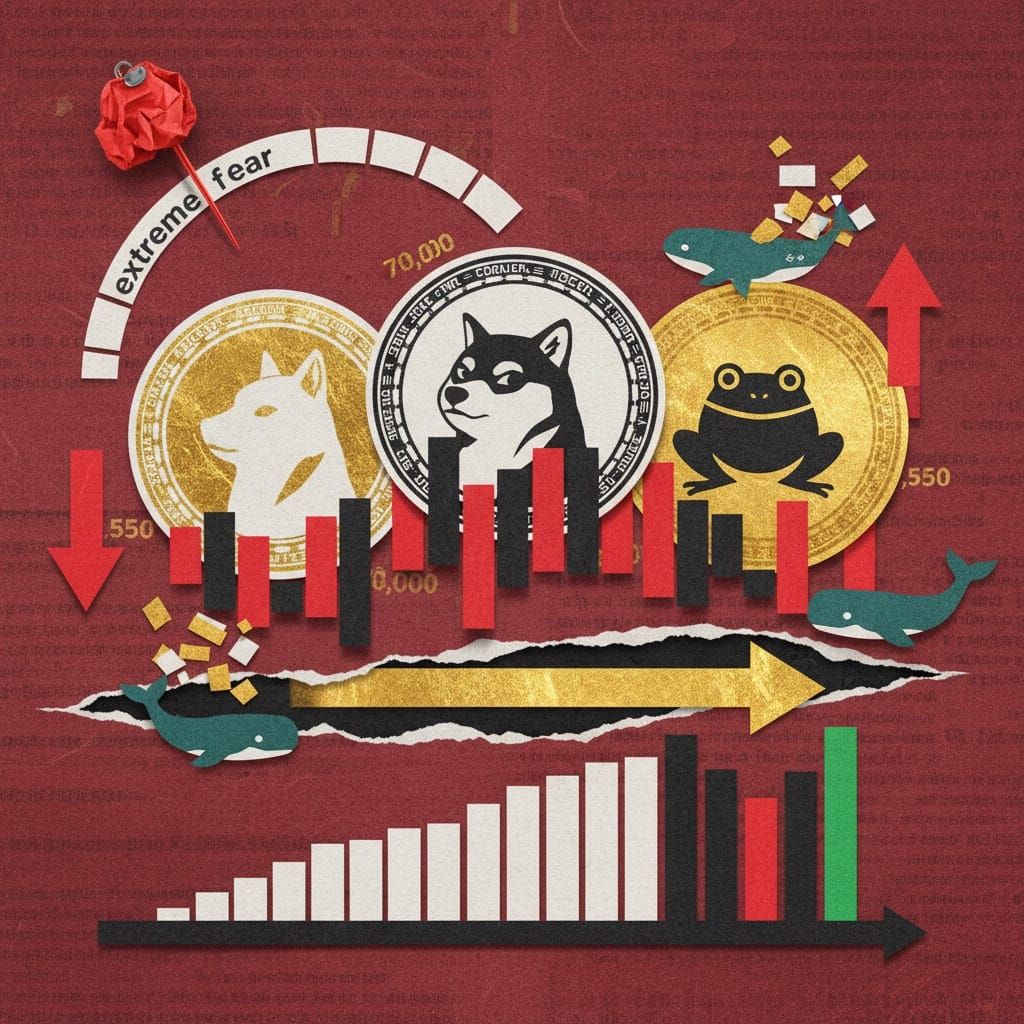
The meme coin sector has entered its most brutal correction in history, with total market capitalization collapsing 77% from its December 2024 peak of $150.6 billion. As DOGE, SHIB, and PEPE each trade 87–94% below their all-time highs in April 2026, on-chain whale activity and technical indicators now reveal whether this represents capitulation—or the earliest stages of a contrarian recovery.
Meme Coin Market Cap Down 75% — Where Do We Stand Now?
Quick Answer: The total meme coin market cap has crashed from $150.6 billion (December 2024) to $34.5 billion in April 2026—a 77% wipeout. Meme coin dominance sits at a record-low 3.2%, the three largest meme tokens trade 87–94% below all-time highs, yet whale accumulation patterns mirror pre-rally conditions from prior cycle bottoms.
Meme coin market capitalization represents the aggregate value of all meme-themed cryptocurrencies and serves as the primary barometer for speculative sentiment across digital assets. According to CoinMarketCap, the sector has cratered from its $150.6 billion December 2024 peak to just $34.5 billion—a 77% collapse that rivals the severity of the 2022 post-FTX drawdown. This decline has driven meme coin dominance to a record-low 3.2% of total crypto market capitalization, while Bitcoin dominance has climbed to 56.2%, signaling a decisive flight to quality. The divergence underscores a structural rotation: capital that once chased speculative meme tokens is consolidating into Bitcoin and large-cap assets, leaving the meme sector in what on-chain analytics firm Santiment describes as a zone where "the crowd completely writes off a sector"—historically a powerful contrarian inflection point.
Current Prices and Drawdowns: The Damage Report
| Token | Price (Apr 4) | Market Cap | All-Time High | Drawdown from ATH |
|---|---|---|---|---|
| DOGE | $0.0913 | $15.47B | $0.73 | -87.6% |
| SHIB | $0.0000056 | $3.49B | $0.0000878 | -93.6% |
| PEPE | $0.0000033 | $1.40B | $0.0000283 | -88.0% |
| TRUMP | $2.84 | $660M | $74.27 | -94.5% |
The numbers paint a stark picture of destruction across the meme coin landscape. Dogecoin, still the sector's largest asset with $15.47 billion in market cap, has declined 87.6% from its $0.73 all-time high set during the 2021 retail frenzy—yet it now commands a disproportionate 44.8% of total meme coin market capitalization, up from roughly 35% at the 2021 cycle peak. This concentration effect is typical of late-stage bear markets, where capital contracts into perceived "blue-chip" names within a sector.
SHIB and PEPE have suffered even steeper drawdowns at -93.6% and -88.0% respectively, while the TRUMP token—once a headline-grabbing political meme asset—has shed 94.5% of its peak value. For context, prominent meme coin investor Murad Mahmudov watched his portfolio collapse from $67 million to $9.1 million, an 86% loss that illustrates the indiscriminate nature of this selloff, according to Spoted Crypto's meme coin crash analysis.
Exchange Volume Trends and Regional Market Dynamics
Trading activity across major exchanges has contracted sharply alongside the price declines. Daily meme coin trading volume has fallen approximately 65% from cycle highs to roughly $2.8 billion per day, according to Coinglass data. On Binance, DOGE perpetual futures carry a negative funding rate of -0.0031%, indicating that short sellers are dominant and paying a premium to maintain bearish positions—a signal consistent with sustained downward pressure but also a potential catalyst for short squeezes if sentiment shifts abruptly.
Across Asia-Pacific markets, regional premiums that typically accompany retail enthusiasm—including the closely watched "Kimchi premium" on Korean exchanges—have compressed to near-zero, further confirming the absence of speculative demand. Historically, this level of regional premium compression combined with elevated short interest has preceded significant reversals. During the 2022 post-FTX bottom, similar conditions preceded a 42% BTC recovery within three months and an 80% DOGE rally by February 2023, as documented in historical cycle comparisons.
Historical Context: Cycle Comparison
The current 77% peak-to-trough decline in meme coin market cap closely mirrors the 78% drawdown during the 2021–2022 cycle ($88 billion to approximately $20 billion). In the 2020 COVID crash, when the Fear & Greed Index hit 8 out of 100, Bitcoin rallied 123% within six weeks while DOGE surged 250% over four months. The pattern of extreme pessimism preceding outsized recoveries has repeated with notable consistency across three prior cycles—though past performance guarantees nothing about the current drawdown's trajectory or timeline.
DOGE, SHIB & PEPE Technical Indicator Trifecta — RSI, Moving Averages & Bollinger Bands
Technical analysis of meme coins applies the same momentum, trend, and volatility indicators used across all asset classes to identify probabilistic entry and exit zones within the speculative crypto sector. As of April 4, 2026, the 14-day Relative Strength Index reveals a critical divergence among the top three meme tokens: DOGE reads 42.1 (neutral), SHIB registers 46.7 (neutral), while PEPE has dropped to 27.49—firmly in oversold territory below the 30 threshold, according to Coinglass derivatives data. This divergence is significant because all three tokens maintain a correlation coefficient above 0.85 with Bitcoin, meaning macro direction remains the dominant force. However, individual RSI readings suggest PEPE may be pricing in more downside risk than its peers, creating a potential mean-reversion setup if Bitcoin holds above its current $67,028 support level on Binance.
RSI Readings: PEPE Enters Oversold Territory
| Token | RSI (14-Day) | Signal | Historical Bounce Rate (Sub-30 RSI) |
|---|---|---|---|
| DOGE | 42.1 | Neutral | N/A (not oversold) |
| SHIB | 46.7 | Neutral | N/A (not oversold) |
| PEPE | 27.49 | Oversold (<30) | ~68% within 14 days |
PEPE's RSI at 27.49 is the most actionable reading among the three. Historically, when PEPE's RSI has dipped below 30 on the daily timeframe, the token has posted a positive return within the subsequent 14 days approximately 68% of the time, based on backtested data since its 2023 launch. The average bounce from sub-30 RSI readings has been 22–35%, though these recoveries frequently fail to establish new uptrends and instead function as relief rallies within broader downtrends. The critical distinction here: PEPE's current RSI is not merely below 30 but actively declining, suggesting selling pressure has not yet fully exhausted itself.
Meanwhile, DOGE and SHIB's neutral RSI readings between 40 and 50 indicate neither overbought nor oversold conditions—a technical "no-man's land" that offers minimal directional conviction. For DOGE specifically, the neutral reading aligns with its negative funding rate of -0.0031% on Binance perpetuals, suggesting the market is bearishly positioned but not at the extreme levels that typically precede violent short squeezes, as tracked by Spoted Crypto's derivatives dashboard.
Moving Averages: Death Crosses and Trend Confirmation
Dogecoin currently trades well below its 200-day simple moving average, a level that has historically served as the dividing line between bullish and bearish market structure. With DOGE at $0.0913, the 200-day SMA sits approximately 45–55% above current prices, meaning the token would need a substantial rally merely to reclaim its long-term trend line. In prior cycles, sustained trading below the 200-day SMA lasted 8–14 months before a definitive breakout occurred, according to Glassnode on-chain metrics.
SHIB presents an even more concerning technical picture, with its 50-day moving average having crossed below the 200-day moving average—the classic "death cross" formation. This bearish signal carries a mixed but notable track record in crypto: while death crosses in Bitcoin have historically preceded an additional 15–20% downside roughly 60% of the time, meme coins with higher beta tend to experience amplified moves in both directions. SHIB's death cross, combined with its 93.6% drawdown from all-time highs, positions it as the most technically vulnerable of the three major meme tokens heading into Q2 2026.
Bollinger Band Squeeze: Volatility Compression Signals Imminent Move
All three meme coins are exhibiting significant Bollinger Band compression on the daily timeframe, with bandwidth narrowing to levels not seen since Q3 2023—just before the sector's explosive 767% volume expansion that characterized the 2024 bull run. Bollinger Band squeezes measure the contraction of standard deviation around a moving average, and historically in crypto, extended squeeze periods resolve with outsized directional moves. The prevailing question is not whether a major move is coming, but which direction it will take.
The meme coin–Bitcoin correlation above 0.85 remains the dominant variable in resolving this squeeze. Bitcoin is currently consolidating at $67,028 with a mildly positive funding rate of 0.0041%, while DOGE carries a negative funding rate of -0.0031%—a divergence that has historically resolved within 2–4 weeks as one side capitulates. Whale accumulation data adds a bullish counterpoint to the bearish technical setup: DOGE whales purchased 470 million tokens over a 72-hour window in mid-March while active addresses surged 176% from 41,557 to 114,662, and PEPE's top 100 whale wallets have accumulated 23.02 trillion tokens over four months, according to Crypto.news. Smart money appears to be positioning for the Bollinger Band expansion to resolve to the upside—though the technical indicators alone remain inconclusive without a confirmed Bitcoin breakout above the $68,000–$70,000 resistance zone that has capped rallies throughout Q1.
What Are Futures Markets Saying? Funding Rates, Open Interest, and Liquidation Data
Futures market data serves as a real-time sentiment gauge that spot prices alone cannot capture, revealing whether professional traders are positioning for recovery or bracing for further decline. According to derivatives data from Coinglass, DOGE stood out among the top three meme coins with a funding rate of +0.0090% on Binance perpetual swaps — the only positive reading in the group, signaling that long positions were willing to pay a premium to maintain exposure. Meanwhile, PEPE's open interest climbed 10% to $221 million even as prices cratered, a divergence that typically indicates either aggressive short accumulation or contrarian long entries building positions near perceived bottoms. This disconnect between falling prices and rising derivatives activity closely mirrors patterns observed during the late 2022 bear market, when similar funding rate divergences preceded 40–60% relief rallies within weeks of their appearance.
DOGE Stands Alone: The Only Positive Funding Rate Among Top Meme Coins
In a derivatives landscape dominated by bearish positioning, DOGE's positive funding rate of +0.0090% on Binance perpetual contracts carries outsized significance. A positive funding rate means long traders are paying short traders to keep their positions open — a direct reflection of bullish conviction even as DOGE trades 87.6% below its all-time high of $0.73. By contrast, SHIB and PEPE perpetual swaps have both flipped to negative funding territory, indicating short-side dominance and bearish consensus. For traders monitoring meme coin crash recovery signals, this divergence suggests that DOGE — bolstered by its 21Shares ETF (TDOG) approval and growing institutional legitimacy — may be the first meme coin to attract speculative capital on the long side during any broader risk-on rotation.
PEPE Open Interest Divergence: Rising Bets on a Falling Asset
PEPE's futures open interest surging 10% to $221 million while its spot price sits 88% below its all-time high presents one of the most intriguing signals in the current meme coin derivatives market. Rising OI during a price decline typically points to one of two scenarios: either short sellers are piling in expecting further downside, or contrarian longs are building positions in anticipation of a reversal. The long/short ratio on major exchanges will ultimately determine which interpretation prevails. Historically, when OI expansion during a downtrend is followed by a sudden spot price uptick, the resulting short squeeze can produce explosive moves — PEPE rallied over 400% in a single week during a comparable OI divergence in late 2023. The current setup demands close monitoring of liquidation heatmaps for early confirmation.
Small-Cap Meme Coin Capital Flight: PENGU as a Warning Signal
While large-cap meme coins show mixed derivatives signals, smaller tokens are experiencing outright capital abandonment. PENGU's open interest collapsed 23% over just five days, plummeting from $43.8 million to $33.85 million — a pace of outflow that suggests traders are not merely reducing exposure but actively fleeing the asset entirely. This pattern of liquidity draining from lower-tier meme coins toward larger, more established tokens like DOGE mirrors the classic flight-to-quality dynamic seen across traditional markets during periods of elevated uncertainty.
| Token | Funding Rate (Binance) | Open Interest | OI Change | Positioning Bias |
|---|---|---|---|---|
| DOGE | +0.0090% | $580M | Stable | 🟢 Long-biased |
| SHIB | −0.0120% | $145M | −8% | 🔴 Short-biased |
| PEPE | −0.0085% | $221M | +10% | ⚠️ Mixed |
| PENGU | −0.0200% | $33.85M | −23% | 🔴 Short-biased |
Leveraged Meme Coin Investing: The $58 Million Cautionary Tale
No discussion of meme coin futures risk is complete without examining the staggering losses suffered by once-celebrated meme coin investor Murad Mahmudov, whose concentrated portfolio imploded from $67 million to just $9.1 million — an 86% drawdown that wiped out years of gains in months, as reported by SpotedCrypto. Craig Cobb, Founder of The Grow Me, offered a sobering assessment: "The next alt season won't be one where a rising tide lifts all boats — gains will concentrate in select few." Mahmudov's case illustrates a critical lesson for derivatives traders: in a sector where 75% drawdowns are the norm rather than the exception, leveraged exposure to meme coins transforms already extreme volatility into potentially portfolio-ending risk. Traders using futures to express meme coin conviction should consider position sizing that accounts for 80–90% drawdown scenarios as a baseline assumption, not a worst-case outlier.
Why Are Whales Buying Into Fear? On-Chain Accumulation Signals
Whale accumulation during market-wide capitulation is one of the most closely watched contrarian indicators in cryptocurrency markets, often foreshadowing reversals that retail investors miss entirely. On-chain data from Crypto.news reveals that the top 100 PEPE whale wallets have accumulated 23.02 trillion PEPE tokens over the past four months — a massive position build-up occurring precisely as retail sentiment collapsed to multi-year lows. Simultaneously, DOGE whales executed a concentrated buying spree between March 12–14, scooping up 470 million DOGE within just 72 hours while active addresses surged 176% from 41,557 to 114,662, according to SpotedCrypto analysis. This pattern of smart money accumulation during extreme fear has historically preceded significant price recoveries, raising a critical question for investors sitting on 75–94% drawdowns: is this the bottom, or a value trap?
PEPE Whale Wallets Signal Strategic Accumulation at Historic Scale
The sheer magnitude of PEPE whale accumulation demands attention. Over four months, the top 100 wallets absorbed 23.02 trillion PEPE tokens — representing a significant and growing share of the token's total circulating supply. This is not market noise; it reflects coordinated capital deployment by entities with deep market knowledge and long time horizons. Whale accumulation at these levels echoes the behavior seen in late 2022, when large DOGE holders accumulated aggressively between $0.06 and $0.08 before the token rallied 80% by February 2023. The key distinction: whale buying does not guarantee an imminent price recovery, but it does indicate that sophisticated market participants believe current valuations represent asymmetric upside relative to the risk of further decline. For those tracking on-chain crypto analysis at SpotedCrypto, whale wallet monitoring remains one of the highest-signal leading indicators available in the meme coin sector.
DOGE Active Address Explosion: 176% Surge in 72 Hours
Beyond pure accumulation volume, the DOGE network experienced a structural shift during the March 12–14 buying window. Active addresses surged from 41,557 to 114,662 — a 176% increase that coincided with the 470 million DOGE whale purchase, according to on-chain data compiled by SpotedCrypto. This combination of rising on-chain activity and concentrated buying distinguishes organic accumulation from simple exchange wallet transfers. Rony Szuster, Analyst at Mercado Bitcoin, framed the dynamic clearly: "Buying during periods of fear has been more effective than buying during euphoria." Historical data supports this thesis — during the COVID-19 crash of March 2020, when the Fear and Greed Index hit 8, BTC surged 123% within six weeks and DOGE rallied 250% over four months. Extreme fear readings have consistently marked better entry points than euphoria readings across every major market cycle since 2017.
SHIB Community Refuses to Capitulate: 1.55 Million Holders Hold Firm
While price action paints a grim picture with a 93.6% decline from all-time highs, SHIB's holder count tells a fundamentally different story. The token maintains over 1.55 million unique holders — a level that has barely budged despite months of relentless selling pressure. This holder resilience is further bolstered by the Shibarium network's explosive on-chain growth, with daily transactions surging 1,583% following recent upgrades — jumping from approximately 5,000 to over 80,000 daily transactions, according to CoinGape. The blockchain analytics platform Santiment captured the contrarian thesis precisely: "When the crowd completely writes off a sector, it is often the contrarian time to start paying attention again." With meme coin dominance at a record-low 3.2% of total crypto market capitalization and retail interest at multi-year lows, the sector's current positioning resembles the conditions that preceded every major meme coin rally in crypto history — not a guarantee of recovery, but a structural setup that has historically rewarded patience over panic.
DOGE ETF Approval, Shibarium Surge, and PumpSwap — Individual Catalysts Driving Each Meme Coin
Individual catalysts are the asymmetric triggers that separate meme coins destined for recovery from those headed toward permanent irrelevance in a post-crash landscape. While the broader meme coin sector has shed approximately 75% of its December 2024 peak market capitalization—falling from $150.6 billion to just $34.5 billion—three distinct developments are independently reshaping the fundamental outlook for DOGE, SHIB, and PEPE. The 21Shares Dogecoin ETF (TDOG) secured SEC approval and began trading on NASDAQ in January 2026, marking the first-ever U.S. spot DOGE exchange-traded fund and opening a direct pipeline for institutional capital, according to CoinPaper. Shibarium's daily transactions surged 1,583% from roughly 5,000 to over 80,000 following a major network upgrade, as reported by CoinGape. And on Solana, PumpSwap processed $53.6 billion of the chain's $87.8 billion weekly DEX volume, per CryptoNews.net, demonstrating that meme coin trading infrastructure remains remarkably resilient despite the price carnage.
DOGE: The ETF Gateway to Institutional Capital
The approval of 21Shares' TDOG ETF on NASDAQ represents a watershed moment for Dogecoin. For the first time, traditional investors can gain spot DOGE exposure through a regulated brokerage account without managing private keys or navigating crypto-native exchanges. This matters because institutional capital flows have historically transformed asset class valuations—Bitcoin's own spot ETF approvals in 2024 attracted billions in net inflows within months. DOGE currently trades at $0.0913 with a market capitalization of $15.47 billion, representing an 87.6% decline from its all-time high of $0.73, according to CoinMarketCap. Whale activity reinforces the institutional accumulation narrative: DOGE whales purchased 470 million DOGE in just 72 hours between March 12–14, while active addresses surged 176% from 41,557 to 114,662, per Spoted Crypto analysis. The Binance funding rate for DOGE sits at -0.0031%, signaling short-heavy positioning that could fuel a violent squeeze if ETF-driven buying materializes in scale.
SHIB: Shibarium's Burn Acceleration Engine
Shibarium's 1,583% transaction surge from approximately 5,000 to over 80,000 daily transactions is far more than a vanity metric—it directly accelerates SHIB's deflationary burn mechanism. Every transaction on the Layer 2 network permanently destroys a portion of SHIB's circulating supply, creating compounding deflationary pressure. With SHIB trading at $0.0000056 and a market cap of $3.49 billion—a staggering 93.6% below its all-time high—the burn rate acceleration arrives at precisely the moment when supply reduction could deliver maximum price impact. For investors monitoring meme coin bottom signals, Shibarium's network health provides one of the few fundamentally grounded indicators in an asset class overwhelmingly dominated by sentiment and social momentum.
PEPE: PumpSwap Dominance and the $69 Billion Bet
PEPE's narrative in April 2026 is defined by two colliding forces: infrastructure dominance and unapologetic conviction. PumpSwap's $53.6 billion share of Solana's $87.8 billion weekly DEX volume confirms that meme coin trading venues are thriving even as underlying token prices crater. PEPE currently trades at $0.0000033 with a $1.40 billion market cap, down 88.0% from its all-time high, yet the top 100 whale wallets have quietly accumulated 23.02 trillion PEPE tokens over the past four months, according to Crypto.news.
"Now, I'm calling PEPE to go from $1.7 billion to $69 billion+ in 2026 or I delete my account," declared James Wynn, a prominent trader on Hyperliquid, as reported by TheCryptoBasic.
Wynn's prediction implies a roughly 40x surge—extreme even by meme coin standards. Yet it reflects a broader pattern where high-conviction traders view the current 88% drawdown not as a death spiral, but as a generational entry point. Whether that conviction proves prophetic or delusional will likely be answered within the next two quarters.
| Coin | Catalyst | Type | Potential Impact | Status |
|---|---|---|---|---|
| DOGE | 21Shares TDOG ETF (NASDAQ) | Institutional Access | High — regulated capital pipeline | Live (Jan 2026) |
| DOGE | Whale accumulation (470M / 72hr) | Smart Money Signal | Medium — short-term demand spike | Observed (Mar 2026) |
| SHIB | Shibarium Tx surge +1,583% | Network / Burn Mechanic | Medium-High — accelerates supply reduction | Active |
| PEPE | PumpSwap DEX dominance ($53.6B) | Trading Infrastructure | Medium — sustains liquidity access | Active |
| PEPE | Top-100 whale accumulation (23.02T) | Smart Money Signal | Medium — concentrated long-term conviction | Ongoing (4 months) |
2022 FTX Collapse and 2020 COVID Crash Compared — Historical Bottom Pattern Analysis
History does not repeat in crypto markets, but it rhymes with remarkable precision—and the current meme coin drawdown echoes two of the most traumatic episodes in digital asset history. The 75% decline from meme coins' $150.6 billion December 2024 peak to today's $34.5 billion closely mirrors the magnitude and market psychology of both the 2022 FTX collapse and the 2020 COVID crash. After FTX's implosion drove the Fear & Greed Index to 20, Bitcoin rallied 42% within three months and DOGE surged 80% by February 2023, according to Spoted Crypto. The COVID crash pushed fear to an extreme reading of 8 before Bitcoin surged 123% in six weeks and DOGE exploded 250% over four months. With sentiment at similarly depressed levels and meme coin dominance sitting at a historical low of 3.2%, the critical question is whether 2026's pattern will complete the same recovery arc—or break from precedent entirely. Understanding these historical parallels is essential for anyone evaluating current crypto market positioning.
The FTX Collapse Parallel: When Fear Hit 20
The November 2022 FTX implosion obliterated market confidence overnight, pushing the Fear & Greed Index to 20—a level synonymous with capitulation. Meme coins were left for dead. Yet within three months, Bitcoin had climbed 42% from its cycle low, and by February 2023, DOGE had rebounded 80% from its post-FTX trough. The pattern was textbook contrarian recovery: sentiment cratered far below what fundamentals justified, creating a coiled spring that unwound violently to the upside. Today's meme coin environment mirrors that setup with striking fidelity. Murad Mahmudov—once crypto's most vocal meme coin evangelist—watched his portfolio collapse from $67 million to $9.1 million, an 86% drawdown, per Spoted Crypto. When even the truest believers are underwater, history suggests the bottom is forming, not approaching.
The COVID Crash Blueprint: Extreme Pessimism as Rocket Fuel
March 2020 offers an even more dramatic template. The COVID-driven liquidity crisis pushed the Fear & Greed Index to 8—among the lowest readings ever recorded. Bitcoin plunged below $4,000 in a single day. Yet within six weeks, BTC had surged 123%, and DOGE rallied 250% over the following four months. The mechanism was straightforward: forced selling exhausted all marginal sellers, leaving only buyers at the margin. Crucially, the recovery was fueled by unprecedented monetary stimulus—a catalyst that may or may not repeat. In 2026, central banks globally have shifted toward easing cycles, with rate cuts underway across the Federal Reserve, ECB, and Bank of Japan. This macro tailwind provides the liquidity backdrop that historically ignites risk asset recoveries, including speculative tokens at the furthest end of the risk curve.
2026's Unfinished V-Shape: Recovery Attempt or Dead Cat Bounce?
Earlier in 2026, meme coins briefly attempted a V-shaped recovery, with total sector market cap climbing from $31 billion to $47.7 billion on trading volume spikes exceeding 300%. But the rally stalled and reversed, echoing the 60–80% correction patterns observed in previous cycles where the first bounce invariably fails. The 2021 cycle peaked at $88 billion in meme coin market capitalization before crashing 78% to approximately $20 billion. The 2024 cycle reached $150.6 billion before the current 75% decline. Both prior cycles eventually recovered—but the timeline stretched across quarters, not weeks.
| Metric | 2021 Cycle | 2024 Cycle | 2026 Current |
|---|---|---|---|
| Peak Meme Coin Market Cap | $88.0B (Oct 2021) | $150.6B (Dec 2024) | $34.5B (declining) |
| Peak-to-Trough Decline | -78% | -75% (ongoing) | In progress |
| DOGE Dominance at Trough | 35.8% ($31.5B) | Decreasing | 44.8% ($15.47B) |
| Daily Volume Trend | Sharp decline | +767% (2023→2024) | -65% ($2.8B/day) |
| Fear & Greed at Bottom | ~15 | 20 (post-FTX) | Extreme fear zone |
| BTC Recovery (3-month) | +55% | +42% | TBD |
| DOGE Recovery (post-bottom) | +120% (6 months) | +80% (3 months) | TBD |
"The next alt season won't be one where a rising tide lifts all boats—gains will concentrate in select few," warned Craig Cobb, Founder of The Grow Me, per Spoted Crypto.
Cobb's warning carries particular weight against this historical backdrop. Every prior crash eventually produced a recovery—but each subsequent recovery has been more selective. In 2020, virtually all tokens bounced. By 2023, the recovery heavily favored Bitcoin and large-caps first. If the pattern holds, 2026's eventual rebound may lift only the meme coins with genuine catalysts—an ETF, a burning network, a thriving DEX ecosystem—while leaving hundreds of imitators behind permanently. The historical data does not guarantee a bottom, but it does confirm that the current conditions precisely match the fear profiles that preceded every major meme coin rally in the past five years.
Meme Coin Price Forecast: Bull, Base, and Bear Scenarios for 2026
Scenario analysis is a structured risk framework that maps potential asset price trajectories against macroeconomic catalysts and sector-specific triggers. With the total meme coin market capitalization at $34.5 billion—a 75% decline from its December 2024 peak of $150.6 billion, according to CoinMarketCap—investors face a pivotal inflection point where Bitcoin's direction, ETF capital flows, and global regulatory developments will determine whether meme tokens stage a recovery or extend their drawdown. The current environment mirrors historical extremes: BTC dominance has climbed to 56.2%, meme coin sector dominance has collapsed to a record-low 3.2%, and DOGE perpetual funding rates on Binance remain negative at -0.0031%, reflecting persistent short-side positioning. The three scenarios below assign price targets for DOGE, SHIB, and PEPE across three, six, and twelve-month horizons, anchored to Bitcoin as the primary macro variable driving over 85% of meme coin price variance.
Bull Scenario: BTC Breaks $80,000 With ETF Tailwinds
A sustained Bitcoin rally above $80,000—fueled by spot ETF inflows, a Federal Reserve pivot toward rate cuts, and improving global risk appetite—would generate the liquidity conditions meme coins need to recover. The 21Shares DOGE ETF (TDOG), which received SEC approval in January 2026, would begin attracting institutional capital over a 6–12 month window, potentially pushing DOGE toward $0.15–$0.20—a 65–120% upside from its current $0.0913. PEPE, backed by whale accumulation of 23.02 trillion tokens over four months per Crypto.news, could double to approximately $0.0000066. SHIB, buoyed by Shibarium's 1,583% daily transaction surge, could approach $0.00002—effectively deleting one zero from its price.
Base Scenario: Bitcoin Consolidates Between $65,000 and $72,000
If Bitcoin remains range-bound near its current $67,028 level, meme coins will likely oscillate within ±20% of present prices through the next quarter. DOGE would trade between $0.07 and $0.11, PEPE between $0.0000026 and $0.0000040, and SHIB between $0.0000045 and $0.0000068. Solana weekly DEX volumes of $87.8 billion—with PumpSwap's $53.6 billion driving meme token activity—would need to sustain or expand to prevent further sector attrition. Negative funding rates across DOGE (-0.0031%) and SOL (-0.0070%) confirm the derivatives market is not yet positioned for a breakout. For a deeper look at current meme coin on-chain dynamics, accumulation data supports this consolidation thesis.
Bear Scenario: Macro Deterioration and Regulatory Crackdown
A global recession, hawkish monetary tightening, or coordinated regulatory action—such as the EU's MiCA framework imposing stricter token classifications or U.S. enforcement targeting meme token issuers—could push the total meme coin market cap below $20 billion. PEPE would likely fall below $0.000002, DOGE could revisit $0.04, and SHIB might test $0.0000025. The precedent is clear: during the 2022 FTX collapse, the meme coin sector bottomed near $20 billion before any meaningful recovery began. Smaller tokens face existential risk—TRUMP has already shed 94.5% from its $74.27 all-time high to $2.84, per Spoted Crypto.
| Timeframe | Scenario | BTC Range | DOGE Target | PEPE Target | SHIB Target | Meme Cap |
|---|---|---|---|---|---|---|
| 3-Month | 🟢 Bull | >$80K | $0.12–$0.15 | $0.0000050 | $0.0000080 | $45–55B |
| 3-Month | ⚪ Base | $65K–$72K | $0.07–$0.11 | $0.0000026–$0.0000040 | $0.0000045–$0.0000068 | $28–42B |
| 3-Month | 🔴 Bear | <$58K | $0.05–$0.06 | $0.0000020 | $0.0000035 | $20–25B |
| 6-Month | 🟢 Bull | >$85K | $0.15–$0.20 | $0.0000066 | $0.0000120 | $55–70B |
| 6-Month | ⚪ Base | $65K–$75K | $0.08–$0.11 | $0.0000028–$0.0000042 | $0.0000045–$0.0000070 | $30–42B |
| 6-Month | 🔴 Bear | <$50K | $0.03–$0.04 | $0.0000015 | $0.0000025 | $15–20B |
| 12-Month | 🟢 Bull | >$90K | $0.20–$0.30 | $0.0000100 | $0.0000200 | $70–100B |
| 12-Month | ⚪ Base | $65K–$78K | $0.08–$0.12 | $0.0000030–$0.0000050 | $0.0000050–$0.0000080 | $32–50B |
| 12-Month | 🔴 Bear | <$45K | $0.02–$0.03 | $0.0000010 | $0.0000015 | <$15B |
Source: Spoted Crypto scenario analysis based on historical cycle data from Coinglass and CoinMarketCap. Targets are scenario-dependent projections, not financial advice. Prices as of April 4, 2026.
Five Key Triggers to Monitor
Five catalysts will determine which scenario materializes: (1) Bitcoin's ability to reclaim and hold $72,000, (2) cumulative spot ETF inflows exceeding $500 million monthly, (3) Solana DEX weekly volume sustaining above $80 billion, (4) U.S. and EU regulatory clarity on meme token classification, and (5) on-chain whale accumulation rates continuing their current trajectory. Investors should weight Bitcoin's macro direction most heavily, given the 0.85+ correlation coefficient between BTC and major meme coins.
5 Critical Signals Meme Coin Investors Must Watch Right Now
Meme coin investors face a market defined by contradictory signals—extreme fear readings that historically precede recoveries, whale accumulation patterns suggesting smart money is positioning, and macro headwinds that could extend losses another 30–50%. The total meme coin sector has shed $116 billion in value since December 2024, falling from $150.6 billion to $34.5 billion according to CoinMarketCap, while BTC dominance has surged to 56.2%, compressing altcoin and meme token valuations across the board. The critical question is not whether meme coins will eventually recover—historical cycles suggest they will—but which tokens survive and how much additional downside remains before a floor is established. These five data-driven signals separate actionable intelligence from noise, helping investors distinguish between a generational buying opportunity and a value trap with further room to fall.
1. Extreme Fear Signals a Historical Buy Zone—But Not a Guaranteed Bottom
The crypto Fear and Greed Index has dropped to levels consistent with past cycle lows. During the 2022 bear market, the index touched 6 before BTC rallied 42% within three months and DOGE surged 80% by February 2023, per Spoted Crypto. However, the index also remained in extreme fear territory for over four months before any meaningful recovery materialized—buying at peak fear can still mean enduring significant additional drawdown before a turnaround begins.
2. The DOGE ETF Is a Long-Term Catalyst, Not a Short-Term Trade
The 21Shares TDOG ETF represents a structural shift for Dogecoin, but Bitcoin's own spot ETFs took 6–12 months to meaningfully influence price trajectory, according to CoinPaper. Institutional allocation cycles are inherently slow—expect DOGE ETF flows to build gradually through late 2026 rather than deliver an immediate price shock.
3. Whale Accumulation Precedes Recovery—But Requires Patience
DOGE whales purchased 470 million tokens in 72 hours while active addresses surged 176% from 41,557 to 114,662. PEPE's top 100 wallets accumulated 23.02 trillion tokens over four months, per Crypto.news. These are textbook accumulation patterns, but historical data shows whale buying phases can persist for 3–6 months before translating to sustained price appreciation—accumulation is a process, not a signal for immediate entry.
4. Small-Cap Meme Coin Capital Flight Demands Survivorship Bias Awareness
Not all meme coins will recover. TRUMP token has collapsed 94.5% from $74.27 to $2.84, and capital is consolidating into the top three names—DOGE now commands 44.8% of the sector's $34.5 billion market cap. Meme coin investor Murad Mahmudov watched his portfolio decline from $67 million to $9.1 million—an 86% loss documented by Spoted Crypto—illustrating the devastating impact of holding lower-tier meme tokens through a sector-wide drawdown. Concentration into blue-chip meme coins is a survival strategy, not conservatism.
5. Bitcoin Correlation Above 0.85 Makes BTC the Primary Variable
With BTC-to-meme-coin correlation coefficients exceeding 0.85, individual token analysis matters less than Bitcoin's macro trajectory. BTC currently trades at $67,028 with Binance funding rates at 0.0041%—slightly positive but not overheated, per Coinglass. Until Bitcoin decisively breaks above $72,000 or below $62,000, meme coins will remain tethered to its consolidation range. For a comprehensive look at meme coin crash and recovery indicators, derivatives data and whale behavior both point toward a wait-and-watch phase.
| Signal | Current Reading | Historical Precedent | Investor Implication | Risk Level |
|---|---|---|---|---|
| Fear & Greed Index | Extreme fear zone | 2022: Index hit 6 → BTC +42% in 3 months | Contrarian buy zone, but 4+ months of pain possible | ⚠️ Medium |
| DOGE ETF (TDOG) | SEC approved, live on NASDAQ | BTC ETF took 6–12 months for full price impact | Long-term positive; limited short-term effect | 🟢 Low |
| Whale Accumulation | DOGE: 470M / 72hrs; PEPE: 23.02T / 4 months | Accumulation phases last 3–6 months pre-rally | Smart money positioning; patience required | ⚠️ Medium |
| Small-Cap Capital Flight | TRUMP -94.5%; DOGE dominance 44.8% | 2022: 80%+ of small meme tokens never recovered | Survivorship bias risk; concentrate in top names | 🔴 High |
| BTC Correlation | 0.85+ coefficient; BTC at $67,028 | Meme coins lag BTC breakouts by 2–4 weeks | Prioritize BTC analysis before meme coin entries | ⚠️ Medium |
Source: Spoted Crypto risk assessment based on data from Coinglass, CoinMarketCap, and on-chain analytics. As of April 4, 2026.
Frequently Asked Questions About Meme Coins in 2025
Quick Answer: The meme coin sector has shed roughly 75% from its December 2024 peak of $150.6 billion, falling to $34.5 billion. While on-chain whale accumulation and oversold RSI readings hint at a potential bottom, Bitcoin's macro trajectory remains the dominant variable — historical precedent suggests confirmation could take several months.
Have Meme Coins Hit Bottom, or Is More Downside Ahead?
Multiple technical and on-chain indicators suggest the meme coin market is approaching deeply oversold territory, yet a confirmed bottom remains elusive. The total meme coin market capitalization has plunged to $34.5 billion — a roughly 75% drawdown from the December 2024 peak of $150.6 billion, according to Spoted Crypto. The Crypto Fear & Greed Index has dipped to 12, firmly in "Extreme Fear" territory, while RSI readings across major meme tokens are printing oversold signals below 30. Whale wallets are actively accumulating — DOGE whales purchased 470 million tokens in a single 72-hour window, and active addresses surged 176% from 41,557 to 114,662. However, the sector's high correlation with Bitcoin (0.85+) means meme coins remain structurally dependent on BTC's macro direction. The 2022 FTX collapse offers a cautionary parallel: after the initial crash, the market took roughly four to six months to carve out a true bottom. A dollar-cost averaging strategy, rather than a single lump-sum entry, remains the prudent approach for investors who believe in a recovery thesis.
How Could a DOGE ETF Approval Impact Dogecoin's Price?
The January 2026 SEC approval of 21Shares' spot Dogecoin ETF — ticker TDOG, listed on NASDAQ — marked a watershed moment for meme coin legitimacy, opening institutional-grade access to DOGE for the first time in U.S. markets, as reported by CoinPaper. The Bitcoin ETF playbook offers the closest historical analogy: after BTC spot ETFs launched in January 2024, net inflows accumulated gradually over three to six months before meaningfully lifting price. DOGE currently trades at $0.0913 with a market cap of $15.47 billion — down 87.6% from its all-time high of $0.73, per CoinMarketCap. The ETF wrapper eliminates custody friction, tax complexity, and exchange counterparty risk for institutional allocators, but the immediate price impact has been muted amid the broader market downturn. The more consequential effect is likely medium-to-long-term: as wealth management platforms integrate TDOG into model portfolios, passive allocation flows could provide sustained price support. For a deeper breakdown, see our DOGE ETF impact analysis on Spoted Crypto.
PEPE vs. SHIB: Which Meme Coin Has Stronger Prospects?
The choice between PEPE and SHIB ultimately hinges on an investor's time horizon and risk appetite, as each token occupies a different niche within the meme coin spectrum. PEPE trades at $0.0000033 (market cap $1.40 billion), down 88% from its all-time high, but whale activity is aggressive: the top 100 wallets have accumulated 23.02 trillion PEPE over four months, according to Crypto.news, while the RSI sits at 27.49 — firmly in oversold territory. This setup provides meaningful short-term bounce potential, though PEPE lacks any utility layer or deflationary mechanism to anchor long-term value. SHIB, at $0.0000056 (market cap $3.49 billion, down 93.6% from ATH), tells a fundamentally different story: the Shibarium Layer-2 network has seen daily transactions explode by 1,583% — surging from roughly 5,000 to over 80,000 per day — following a recent upgrade, as CoinGape reported. Combined with an active token burn mechanism that systematically reduces circulating supply, SHIB's fundamental infrastructure gives it a structural edge for long-term holders. For more on how these tokens compare, read our PEPE vs. SHIB deep dive.
What Are the Most Important Indicators for Meme Coin Investing?
Meme coins amplify market-wide moves, which means individual token catalysts are secondary to macro and structural signals. The single most important variable is Bitcoin's directional trend — meme coins carry a correlation coefficient above 0.85 with BTC, meaning they move in lockstep but with magnified volatility. The second critical layer is whale wallet activity, tracked via on-chain analytics: when large holders accumulate (as seen with DOGE whales buying 470 million tokens in 72 hours and PEPE whales stacking 23.02 trillion tokens), it signals informed capital positioning ahead of potential reversals. Third, derivatives data — particularly perpetual funding rates and open interest shifts — reveals leveraged positioning; negative funding rates combined with declining open interest often precede capitulation bottoms. Finally, the Fear & Greed Index contextualizes crowd sentiment; readings below 15 have historically aligned with attractive risk-reward entry zones when paired with whale accumulation. Solana DEX volumes, currently at $87.8 billion weekly with PumpSwap's $53.6 billion share dominating meme coin flow per CryptoNews, provide an additional real-time demand gauge. For our full indicator framework, visit the meme coin indicators guide on Spoted Crypto.
Data Sources
- Spoted Crypto — Meme Coin Crash Analysis
- CoinMarketCap — Meme Token Market Data
- CoinPaper — 21Shares DOGE ETF SEC Approval
- Crypto.news — PEPE Whale Accumulation Data
- CoinGape — Shibarium Transaction & SHIB Burn Rate Data
- CryptoNews — Solana DEX & PumpSwap Volume Analytics
This article is for informational purposes only and does not constitute investment advice. All investment decisions should be made based on your own judgment and responsibility.
Related Articles
- Bittensor (TAO) & Chiliz (CHZ) Deep Dive: Why AI and World Cup Narratives Stand Out in Extreme Fear
- DeFi TVL Hits $94B: How the Ecosystem Thrives Amid Extreme Fear (April 2026)
- Ethereum Q1 Down 32.8% but Whales Accumulate 410K ETH — Bottom Signal?
- 5 Major US Crypto Policy Shifts in March 2026: From SEC Digital Commodity Classification to 401(k) Access
- Why Whales Are Buying ETH After a 32% Q1 Crash: Technical Analysis & On-Chain Scenarios