Does This Tax Proposal Really Out-Earn Four Years of Dev Funding?
Ethereum's core developers are funded by donations, grants and goodwill. A June 2026 forum post asked whether the protocol itself should start writing the checks — and the arithmetic behind it is larger than most people expect.
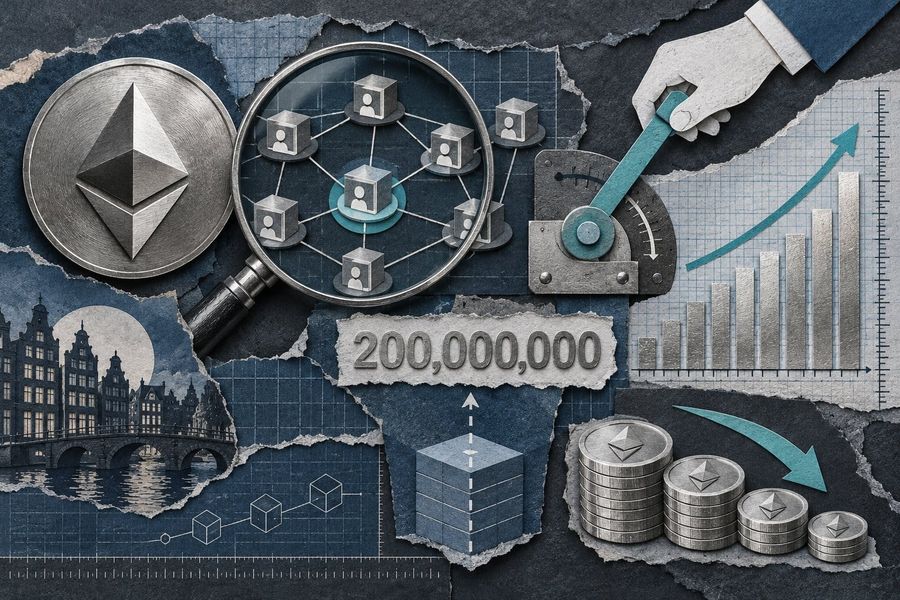
On paper, yes. Validator Redirected Revenue (VRR) is a proposal to route a validator-approved share of newly issued ETH — capped at 10% — into ecosystem funding, and its author estimates that a 5–10% redirect would raise roughly 50,000–70,000 ETH per year from the approximately 700,000 ETH paid annually to validators at a 1.91% reward rate on 35–40 million ETH staked . At the prices prevailing when the proposal circulated, that is about $82.5 million to $120 million a year . Protocol Guild, the main independent funding vehicle for Ethereum core contributors, reports $39 million distributed since 2022 across 190 contributors and 47 core repositories . One year at the top of the VRR range would exceed four years of Protocol Guild distributions several times over.
Quick Answer: Ethereum's proposed 10% validator reward redirect (VRR) could raise roughly 50,000–70,000 ETH — about $82.5M–$120M — per year, versus the $39 million Protocol Guild has distributed to core contributors since 2022. But VRR is a forum post, not a filed EIP, and no client team has begun implementation.
The scale is the only part that is settled. VRR was posted to the Ethereum Research forum on 21 June 2026 by Clément Lesaege, founder of the decentralized arbitration platform Kleros . No formal EIP has been filed, no client implementation work has started, and Lesaege described his own post as a deliberate "wrong answer" written to force debate rather than a roadmap commitment . For ETH holders, the relevant question is not whether the money exists, but whether a mechanism that touches validator yield can survive the cartel, governance and taxation objections that arrived within days of publication.
The Numbers: VRR's Projected Revenue vs. Protocol Guild's Four-Year Total
The arithmetic behind Validator Redirected Revenue is simple enough to check on a napkin. Lesaege's proposal assumes roughly 35–40 million ETH staked at an approximate 1.91% reward rate, which implies around 700,000 ETH paid to validators each year in new issuance . Apply a 5–10% redirect to that base and the ecosystem fund collects roughly 50,000–70,000 ETH annually — reported in media coverage as approximately $82.5 million to $120 million at prices prevailing at the time of publication .
The comparison that gives the proposal its rhetorical force is Protocol Guild, the leading independent funding vehicle for Ethereum core developers. Protocol Guild reports having distributed $39 million directly to core contributors since 2022, tracking 190 contributors across 47 core repositories . A single year of VRR at the top of its projected range would exceed that cumulative four-year total by roughly three times.
Set against stated need, the gap looks even wider. Trent Van Epps, a former Ethereum Foundation core-development coordinator, estimated in June 2026 that roughly $30 million per year is required across more than ten client teams, research groups and coordination teams, and warned of a possible core-development funding crisis within three to nine months . Both figures are Van Epps's own warning as reported, not official Foundation guidance. VRR's upper range would cover that estimate twice over in a single year.
| Figure | Amount | Period / basis | Source |
|---|---|---|---|
| Total validator issuance (est.) | ~700,000 ETH | Per year, 35–40M ETH staked at ~1.91% | Lesaege, VRR post (2026-06) |
| VRR redirect at 5–10% | ~50,000–70,000 ETH | Per year | Lesaege, VRR post (2026-06) |
| VRR redirect in USD terms | ~$82.5M–$120M | Per year, at prevailing prices | The Block (2026-06) |
| Protocol Guild distributions | $39M | Cumulative since 2022 | Protocol Guild (2026) |
| Estimated annual funding need | ~$30M | Per year, 10+ teams | Van Epps estimate (2026-06) |
Two caveats belong next to those numbers. First, every USD figure floats with ETH's price — the same 70,000 ETH redirect swings by tens of millions of dollars across a normal drawdown, so a fund sized in ETH does not deliver a stable payroll. Second, the revenue is gross, not net: the proposal does not specify allocation costs, governance overhead, or what share reaches contributors versus intermediaries. The headline that one year out-earns four years of Protocol Guild is arithmetically correct and operationally unproven.
How Validator Redirected Revenue Would Actually Work
Validator Redirected Revenue (VRR) is a protocol-level mechanism that would force every Ethereum validator to divert a fixed share of newly issued rewards to addresses chosen by a stake-weighted vote. Clément Lesaege, founder of the decentralized arbitration platform Kleros, published the design to the Ethereum Research forum on 21 June 2026 . It has two moving parts, and both are coercive by design rather than opt-in.
The first part sets the rate. Validators signal a preferred redirect rate anywhere from 0% up to a hard cap of 10%; if a stake-weighted 51% majority backs a non-zero rate, that rate becomes mandatory for every validator on the network — including the 49% who voted against it . There is no opt-out and no reduced-participation tier. The second part decides where the money goes: validators nominate recipient addresses and percentage splits, and execution clients aggregate those preferences into a single "splitter" contract through a king-of-the-hill / Condorcet-style process, with protocol-level votes simplified down to increase/decrease the rate and keep/change the splitter . One forum commenter called that aggregation step too complicated for the problem it is trying to solve.
The justification is a coordination failure. Shared infrastructure — clients, research, tooling — benefits every validator, but no single operator will fund it while others free-ride, so the argument runs that the protocol should force the commitment. Lesaege was explicit that he posted VRR as a deliberately "wrong answer" meant to provoke debate rather than as an agreed roadmap item, and as of the reporting window no formal EIP had been filed and no client implementation work had begun .
The structural weak point is who actually votes. The VRR post itself notes that roughly 90% of ETH is staked through operators rather than solo stakers . Ethereum.org distinguishes home staking, staking-as-a-service, pooled staking and exchange staking; the pooled and delegated routes let users stake under 32 ETH but introduce third-party risk and are not native protocol pooling . Under VRR, the operator sets the redirect preference while the delegator absorbs the yield cut — a textbook principal-agent gap.
Lesaege's answer is market competition: stakers dissatisfied with an operator's rate or recipient list can move their ETH to one whose choices match their own, and some operators might pass preference-setting through to end users .
"With voting power weighted by sticky stake shares, top stakers would decide who gets funded at everyone else's expense," — Lefteris Karapetsas (LefterisJP), describing the design as a textbook cartel risk in the proposal thread (source: Ethereum Research, 2026-06).
Critics dispute that exit is realistic for liquid staking protocols, spot ETH ETFs, exchange staking desks and passive delegators, where switching costs, mandates or plain inattention keep capital parked regardless of the redirect rate . Retail stakers who reach the network through a custodian would, in practice, be taxed by a vote they never saw (video: InvestAnswers).
The Funding Cliff Behind the Proposal
The funding cliff behind the proposal is the simultaneous expiry of the Ethereum Foundation's Client Incentive Program in April 2026 with no replacement announced , alongside a restructuring that cut 54 colleagues — roughly 20% of staff — on 23 June 2026 . VRR did not arrive in a vacuum; it arrived four weeks after the primary institutional subsidy for client teams stopped paying out.
The expired program, announced on 13 December 2021, granted each participating client team 144 validators — 4,608 ETH per full team — with withdrawal credentials vesting over time to align teams with Ethereum's long-term health. Erigon, Geth, Hyperledger Besu, Lighthouse, Lodestar, Nethermind, Nimbus, Prysm and Teku were listed as eligible, with Lodestar at a 50% stake . That structure did two things at once: it paid teams a staking yield stream rather than a grant, and it gave them skin in the game. Its lapse removes both.
The Foundation's own budget is tightening by design, not by accident. Its Treasury Policy of 4 June 2025 sets annual operating expenditure at 15% of treasury with a 2.5-year operating buffer, then glide-paths opex down roughly linearly over five years toward a 5% endowment-style baseline . In February 2026 the EF began staking approximately 70,000 ETH from its own treasury — using Dirk and Vouch, minority clients, Type 2 withdrawal credentials and a mix of hosted and self-managed infrastructure — with rewards returning to the treasury . Read together, the three moves describe an organization converting itself from a spending body into an endowment, and shrinking the discretionary pool that client teams previously drew from.
Trent Van Epps, a former EF core-development coordinator, warned in June 2026 of a possible core-development funding crisis within three to nine months, estimating roughly $30 million per year of support needed across more than ten client teams, research groups and coordination teams . Both the figure and the window are his warning as reported by The Block, not official EF guidance — a distinction worth holding onto, because the $30 million estimate is the number VRR's projected $82.5–120 million range is implicitly sized against.
Not everyone accepts the premise. Bitmine chairman Tom Lee put the odds of a funding crisis at "zero chance," a position used by some to argue the staking tax is moot before it is debated . His confidence has a concrete basis: Ethlabs, launched in June 2026 by five EF alumni under Executive Director Ansgar Dietrichs, opened with two to three years of runway from Bitmine Immersion Technologies, Sharplink, Joe Lubin, Anchorage, Octant and SNZ, with funders holding observer seats but no roadmap control . Whether that counts as a solution or as the corporate-capture outcome VRR was meant to prevent is precisely the disagreement.
Base Case: The Debate Stalls, No Protocol Change in 2026
The most probable near-term outcome is that Validator Redirected Revenue never leaves the forum. As of the reporting window, no formal EIP had been filed for VRR and no client implementation work had begun . Clément Lesaege framed his 21 June 2026 post as a deliberately "wrong answer" meant to force debate, not as a roadmap item . In the base case, client teams keep operating on shrinking Ethereum Foundation grants and Protocol Guild donations, and the funding question stays unsolved rather than being answered badly.
Reform energy is also splitting two ways. EIP-8363, "Tapered Issuance Burn," was created on 14 July 2026 and merged into the ethereum/EIPs repository as a Draft Core EIP on 11 August 2026 . Its rationale explicitly rejects the redirect premise: routing rewards to a treasury leaves total issuance unchanged and creates a new claimant whose share can be lobbied over . Messari assessed the EIP as unlikely to pass, and it did not make the Hegotá upgrade, whose final EIP selection deadline is 8 November with mainnet expected in Q2 2027 . Two competing answers, neither shipping, is the definition of a stalled debate.
What actually moves in this scenario is the cliff, not the mechanism. Trent Van Epps, a former EF core-development coordinator, warned in June 2026 of a possible core-development funding crisis within three to nine months and put the annual need at roughly $30 million across more than ten client teams, research groups and coordination teams . Both figures are his warning as reported by The Block, not official EF guidance. That window — roughly September 2026 through March 2027 — is the near-term catalyst worth tracking, whether or not VRR advances a single step.
For price, the base case is close to a non-event. Nothing in a stalled forum thread changes ETH supply, staking yield, or validator economics. This remains a governance and funding story, not a supply-shock story, until a mechanism actually ships to mainnet. Traders positioning around VRR headlines in 2026 are trading narrative, not mechanics.
Bull Case vs. Bear Case: Funding Breakthrough or Validator Cartel
The bull case for Validator Redirected Revenue is that a protocol-enforced 5–10% redirect turns Ethereum's core-development budget from a donation problem into a line item. Lesaege's own estimate puts the take at roughly 50,000–70,000 ETH per year , or about $82.5 million to $120 million at then-prevailing prices . That comfortably clears the roughly $30 million per year Trent Van Epps estimated is needed across more than ten client teams, research groups and coordination teams . In that world, client diversity stops depending on whether a single foundation renews a grant cycle — the Client Incentive Program, which expired in April 2026 without replacement , had granted teams 144 validators each, or 4,608 ETH per full team — and the maintenance overhang on ETH's long-term credibility narrows.
The bear case is not a funding shortfall. It is capture. Lesaege's post names validator cartelization the "most significant risk": 51% of stake could set the rate to the 10% cap and point the splitter at addresses they control, extracting yield from the other 49% . His defences are the hard cap, reputational damage to ETH's price, and an appendix arguing such cartels are unstable under a simplified Nash equilibrium — stable for many small validators only under narrower assumptions . Critics were unconvinced. Lefteris Karapetsas called it a textbook cartel risk, noting that with voting power weighted by sticky stake shares, top stakers would decide who gets funded at everyone else's expense.
"A pile of money up for grabs," — Micah Zoltu, forum respondent on the Validator Redirected Revenue thread, who argued recipients are either centrally chosen, unrestricted in a way that reintroduces free riding, or picked through an exploitable allocation game, and that socially punishing validators for funding an illegitimate recipient is far harder than socially responding to censorship (source: Ethereum Research, 2026-06).
Two further objections cut deeper than mechanism design. Yearn contributor banteg warned the scheme brings politics into the consensus layer, and attorney Gabriel Shapiro argued any L1 "devmine" or tax would require robust on-chain governance that Ethereum does not have . Ellie Rennie framed the likely outcome as a "limited-access order" in which elites control discretionary rent without impersonal structural constraints, and a commenter raised ratchet risk directly — "if 10% is allocated, do we set it to 12%?" . Decred shows the design can work when governance is built for it: since its February 2016 launch it has split block rewards 60/30/10 to miners, stakers and a development fund, with proposals requiring 60% yes votes and 20% turnout via Politeia (video: Coin Bureau) . Ethereum has no equivalent on-chain voting layer to lean on.
| Dimension | Bull case | Bear case |
|---|---|---|
| Annual revenue | 50,000–70,000 ETH (~$82.5M–$120M) funds core dev outright | Same pool becomes a contested rent for the largest stakers |
| Funding gap | Clears Van Epps's ~$30M/year estimate with margin | Gap already addressed by Ethlabs, Protocol Guild and EF treasury yield |
| Governance | Splitter competition disciplines recipient choice | No on-chain governance exists to legitimize allocation (Shapiro) |
| Stake concentration | 10% cap bounds worst-case extraction | ~90% of ETH staked via operators; 51% threshold is reachable |
| Delegator effect | Users migrate to operators matching their preferences | ETF, exchange and passive delegators absorb the cut silently |
The asymmetry matters for how ETH holders should weight the two branches. The bull case delivers a diffuse, slow-moving benefit — a healthier maintenance base that shows up in fewer client-diversity scares, not in a repricing. The bear case delivers a concentrated, fast-moving harm: a visible cartel event would hit ETH's governance credibility immediately, and roughly 90% of staked ETH sits with operators rather than solo stakers , meaning most holders would learn about a redirect from a yield statement rather than a vote.
Portfolio Implication: What ETH Holders and Stakers Should Watch
For ETH holders, the correct position today is monitoring, not repositioning. Validator Redirected Revenue has no EIP number, no client implementation work, and no activation date; Clément Lesaege published it to the Ethereum Research forum on 21 June 2026 and explicitly framed it as a deliberately "wrong answer" meant to force debate rather than a roadmap item . Nothing about spot exposure, staking allocation, or validator setup needs to change on the strength of a forum thread.
Exposure is unevenly distributed, though, and it is worth knowing which side of the line you sit on. Roughly 90% of staked ETH runs through operators rather than solo stakers , and under VRR the operator sets the redirect rate and recipient split while the delegator absorbs the yield reduction. Pooled staking, liquid staking tokens, exchange staking and ETF wrappers all sit in that category — routes that The Block notes critics single out precisely because passive delegators have no realistic mechanism to express a preference. Home stakers running their own 32 ETH validators keep the vote; everyone else inherits someone else's.
Two signals matter more than price, and they point in opposite directions:
- Escalation: a formal EIP filing for VRR, or a client team publicly committing to prototype the splitter contract. That would move this from forum debate to protocol risk.
- Substitution: continued momentum behind EIP-8363, merged as a Draft Core EIP on 11 August 2026 . Its rationale rejects redirection outright — burning issuance creates no new claimant to lobby. The two proposals are mutually exclusive framings of the same reward pool.
- Funding stress: a second Ethereum Foundation restructuring after the 23 June 2026 cut of 54 roles , or a visible shortfall at Protocol Guild, which has distributed $39 million since 2022 .
The concrete takeaway: track the Hegotá EIP selection deadline of 8 November as the next hard date . If neither proposal clears it, the base case holds and your staking yield is unchanged through 2027. If VRR gets an EIP number in the interim, delegated stakers should reread their operator's governance policy before assuming their preferences are represented.
Frequently asked questions
What is Ethereum's proposed 10% validator tax?
The proposal is Validator Redirected Revenue (VRR), posted to the Ethereum Research forum on 21 June 2026 by Clément Lesaege, founder of the decentralized arbitration platform Kleros . It would let validators signal a redirect rate between 0% and a hard cap of 10% of their staking rewards; if a stake-weighted 51% majority backs a non-zero rate, that rate becomes mandatory for every validator, including those who voted against it . Recipients are chosen through a separate "splitter" contract aggregated by execution clients. It is a research proposal, not a scheduled protocol change (source: CoinDesk, 2026-06).
How much money could the Ethereum validator tax raise?
Lesaege's post estimates roughly 35–40 million ETH staked at about a 1.91% reward rate, implying roughly 700,000 ETH paid to validators per year; a 5–10% redirect would raise approximately 50,000–70,000 ETH annually . Media coverage valued that at roughly $82.5 million to $120 million at then-prevailing prices . For comparison, Protocol Guild says it has distributed $39 million directly to core contributors since 2022 and tracks 190 contributors across 47 core repositories . One year at the top of the VRR range would exceed that cumulative four-year total.
Is the Ethereum validator tax proposal official or approved?
No. VRR exists only as a post on the Ethereum Research forum. As of the reporting window, no formal EIP had been filed and no client implementation work had begun . Lesaege explicitly framed the post as a "wrong answer" intended to force debate before any technical implementation, not as an agreed roadmap item . Prominent objections came quickly: Lefteris Karapetsas called it a textbook cartel risk, Micah Zoltu described it as creating "a pile of money up for grabs," and attorney Gabriel Shapiro argued any L1 levy would require on-chain governance Ethereum does not have (source: The Block, 2026-06).
What is EIP-8363 and how does it differ from the validator tax?
EIP-8363, "Tapered Issuance Burn," was created on 14 July 2026 and merged into the ethereum/EIPs repository as a Draft Core EIP on 11 August 2026, authored by pintail, Jérôme de Tychey, dapplion, pa7x1, Ladislaus von Daniels and Justin Drake . It deducts a share of each validator duty's idealised reward at every epoch boundary and burns that ETH rather than redirecting it, with the burn fraction scaling as b = (D / 60,250,000)^(3/2) and reaching 100% at 60.25 million ETH staked . Its rationale explicitly rejects the redirect approach, arguing a treasury leaves total issuance unchanged and creates a new claimant to lobby over (source: Ethereum Magicians, 2026-08).
Why is Ethereum core-developer funding suddenly at risk?
Three changes converged in 2026. The Ethereum Foundation's Client Incentive Program — announced 13 December 2021, granting participating client teams 144 validators each, or 4,608 ETH per full team — expired in April 2026 with no replacement . On 23 June 2026 the EF announced a restructuring with 54 fewer colleagues, roughly 20% of staff, alongside a new five-cluster structure . And Trent Van Epps, a former EF core-development coordinator, warned in June 2026 of a possible funding crisis within three to nine months, estimating roughly $30 million per year needed across more than ten client teams, research groups and coordination teams . Both figures are Van Epps's warning as reported by The Block, not official EF guidance. Not everyone agrees: Bitmine chairman Tom Lee put the odds of a funding crisis at "zero chance," citing the arrival of independently funded labs such as Ethlabs (source: The Defiant, 2026-06).
Enjoyed this article? Subscribe to get new stories by email whenever they're published.