Why Bear Markets Create Prime DeFi Airdrop Conditions
Quick Answer: With the Fear & Greed Index at 26/100 and BTC dominance at 58%, retail participation has collapsed — lowering gas costs and reducing competition for DeFi airdrop eligibility on Ethereum L2s. Bear markets historically reward on-chain participants who farm while others panic-sell.
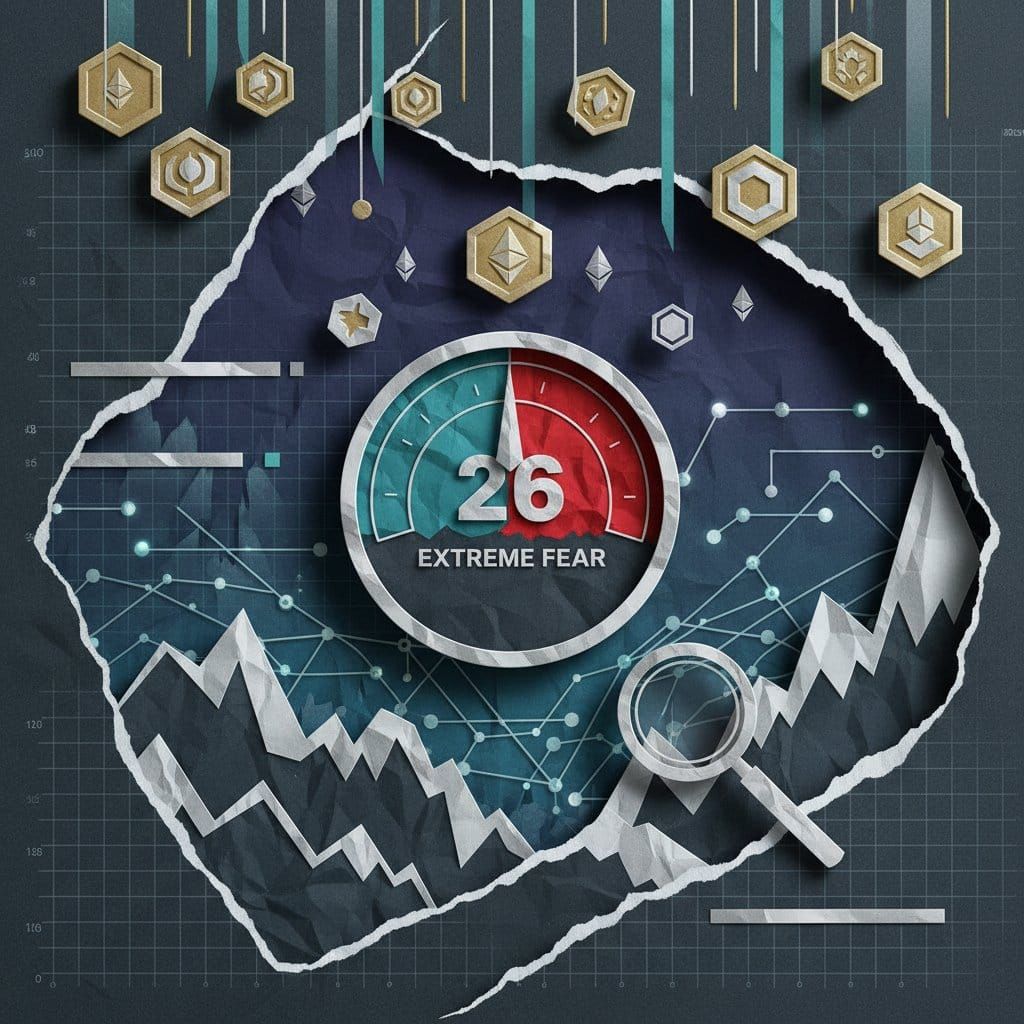
As of April 29, 2026 at 18:12 KST, Bitcoin trades at $77,009 on Binance — up a modest 0.25% on 24-hour volume of $1.01 billion. The total crypto market cap sits at $2.66 trillion, and the Fear & Greed Index has fallen to 26, down 7 points from yesterday, placing sentiment firmly in "Fear" territory. BTC dominance at 58% signals continued capital flight from altcoins.
For most investors, this is a time to wait. For DeFi airdrop farmers, it is a structural window. Ethereum L2 protocols continue distributing points and liquidity rewards to active participants — quietly accumulating eligibility for future token distributions. When markets recover, these positions pay out. The question is whether you are building them now or watching from the sidelines.
Live Market Data: What the Numbers Show
Binance spot volume tells a mixed story. ETH gained 1.70% to $2,325 on $512.9 million in 24-hour volume, one of the clearest outperformers in an otherwise flat session. DOGE rallied 6.0% on $149.3 million in volume. CHIP fell 7.40% despite $197.6 million in trading activity — a reminder that high volume does not imply directional strength in fear markets.
| # | Coin | Price | 24h Change | Volume(24h) | High | Low |
|---|---|---|---|---|---|---|
| 1 | USDC | $1.00 | +0.00% | $2.2B | $1.00 | $1.00 |
| 2 | BTC | $77,009 | +0.25% | $1.0B | $77,455.71 | $75,666.60 |
| 3 | ETH | $2,325 | +1.70% | $512.9M | $2,342.50 | $2,258.24 |
| 4 | CHIP | $0.07 | -7.40% | $197.6M | $0.07 | $0.07 |
| 5 | DOGE | $0.11 | +6.00% | $149.3M | $0.11 | $0.10 |
| 6 | TON | $1.32 | +0.99% | $138.2M | $1.33 | $1.29 |
| 7 | SOL | $85 | +0.73% | $123.5M | $85.06 | $82.98 |
| 8 | USD1 | $1.00 | -0.02% | $117.3M | $1.00 | $1.00 |
| 9 | XRP | $1.39 | +0.05% | $78.8M | $1.40 | $1.37 |
| 10 | FDUSD | $1.00 | +0.08% | $46.0M | $1.00 | $1.00 |
Derivatives data adds a critical layer of context. BTC carries a negative funding rate of -0.0028% on Binance perpetuals, indicating short-side dominance from professional traders. Open interest on BTC stands at $7.5 billion with only 44.8% of accounts positioned long versus 55.2% short. ETH tells a different story: a positive funding rate of +0.0047%, $4.6 billion in OI, and 63.2% of traders long. SOL is even more aggressively long at 73.2% with $793.5 million in OI. On OKX, ZKJ collapsed -37.4% on $25.6 million in volume — a textbook post-airdrop dump illustrating the downside of chasing distributions without evaluating fundamentals.
| Coin | Funding Rate | Open Interest | Long/Short |
|---|---|---|---|
| BTC | -0.0028% | $7.5B | 44.8% / 55.2% |
| ETH | 0.0047% | $4.6B | 63.2% / 36.8% |
| SOL | 0.0079% | $793.5M | 73.2% / 26.8% |
| XRP | -0.0010% | $368.0M | 70.3% / 29.7% |
| DOGE | 0.0100% | $414.0M | 65.6% / 34.4% |
| BNB | 0.0000% | $337.3M | N/A |
| LINK | 0.0082% | $85.1M | N/A |
| AVAX | 0.0100% | $85.4M | N/A |
| ADA | 0.0100% | $83.0M | N/A |
| DOT | 0.0059% | $42.1M | N/A |
The Bear Market Airdrop Advantage: Three Structural Edges
DeFi airdrops distribute protocol tokens to users meeting defined on-chain criteria: liquidity provision, swap volume, bridging activity, governance participation, or sustained protocol usage. The mechanics are unchanged in a bear market. What changes sharply is the competitive environment — and it moves in favor of active participants.
"Bear markets are the best time to accumulate airdrop eligibility," noted Ryan Watkins, co-founder of Syncracy Capital, in a recent research note. "Gas is cheap, liquidity rewards are higher in relative terms, and the number of active participants farming drops by 60–80% from bull market peaks. Expected value per transaction increases significantly."
Three structural edges define the current environment:
- Lower gas costs: Network congestion falls alongside market activity. On-chain transactions on Ethereum mainnet and L2s now cost a fraction of bull market rates — reducing capital needed to qualify across multiple campaigns simultaneously.
- Reduced competition: Fewer wallets are actively farming. When a fixed token allocation pool is divided among a smaller eligible base, per-wallet reward sizes can increase substantially.
- Enhanced liquidity incentives: Protocols competing for TVL in a down market frequently increase point multipliers and extend reward windows to attract capital they would otherwise lose to higher-yielding alternatives.
Where the Action Is: Ethereum L2 Ecosystem
With ETH dominance at 10.6% — near multi-year lows — it might appear counterintuitive to focus on Ethereum-native protocols. But on-chain data shows L2 transaction volumes have remained consistently elevated throughout the current bear cycle, driven by structured point-accumulation campaigns that generate participation independent of price direction.
Active campaign categories worth monitoring include:
- OP Stack ecosystem: Multiple applications building on the Optimism Superchain have confirmed future token distributions tied to measurable on-chain activity, with bear-period usage weighted favorably.
- ZK-rollup networks: ZK-based rollups continue rewarding early and consistent users, with some campaigns explicitly weighting activity during low-traffic periods — like the current window.
- Restaking infrastructure: EigenLayer AVS operators and adjacent protocols carry unresolved points systems representing potentially significant future distributions.
"The L2 wars are far from settled," said Ryan Berckmans, Ethereum investor and community researcher. "Airdrops remain the most cost-effective user acquisition tool in crypto, and bear markets are when protocols do their most serious bootstrapping. The users who show up now get the best allocations."
Competition has intensified significantly compared to the 2022–2023 cycle. Holding a wallet address or executing minimal transactions no longer qualifies for most major distributions. Protocols have hardened eligibility screening to reward genuine usage: swap volume thresholds, minimum liquidity duration, diversity of asset interactions, and governance vote participation are increasingly standard gates. For ongoing Layer 2 analysis, see SpotedCrypto's Layer 2 coverage and Ethereum tracker.
Airdrop Due Diligence: What to Check Before Committing Capital
Not every campaign converts to real value. The post-TGE dump cycle is well-documented: early recipients sell immediately into initial liquidity, creating sharp price declines in the hours and days following a token generation event. ZKJ's -37.4% collapse on OKX today is a live example. Evaluating protocol fundamentals before participating is non-negotiable.
| Evaluation Factor | What to Check | Priority |
|---|---|---|
| TVL Size & Trend | Total value locked and 30/90-day growth on DeFiLlama | High |
| Smart Contract Audits | Audited by Trail of Bits, Certik, OpenZeppelin, or equivalent | High |
| Token Unlock Schedule | Vesting timeline for team, investors, and airdrop recipients post-TGE | High |
| Team Transparency | Known founders, public backgrounds, verifiable track record | Medium |
| Community Activity | Discord and X engagement quality — organic versus bot-inflated | Medium |
The unlock schedule deserves particular attention. Even fundamentally sound protocols can see immediate post-airdrop price collapses when 30–40% of supply unlocks simultaneously for early investors. Map cliff dates before committing capital. For tracking live campaigns and historical airdrop performance, SpotedCrypto's airdrop section maintains updated analysis.
Risk Management for the Current Environment
DeFi participation carries inherent smart contract risk at all times. Bear markets amplify consequences — underfunded protocol teams may defer security audits, and exploit frequency historically correlates with prolonged TVL decline. With total market cap at $2.66 trillion and most tokens down 40–70% from recent highs, position sizing discipline matters more than strategy selection.
Core principles for airdrop farming in the current environment:
- Use a dedicated farming wallet: Interact with unaudited or newer protocols from a separate hot wallet. Keep primary holdings on a hardware device, never connected to airdrop-eligible protocol interfaces.
- Diversify across 3–5 campaigns: Concentration in a single protocol eliminates the portfolio benefit of the airdrop model. Spread activity across different L2 ecosystems and protocol categories.
- Size as venture exposure: Each farming position should be sized as if it could go to zero. Capital deployed in early-stage DeFi protocols carries early-stage equity risk — not fixed-income risk.
- Track unlock calendars: Set reminders for major investor vesting cliffs. Secondary market liquidity often thins in advance of large unlock dates, amplifying sell pressure when the event hits.
For protocol-level risk analysis and exploit postmortems, SpotedCrypto's DeFi coverage tracks audit findings and security events. Current Bitcoin derivatives analysis — including context behind today's -0.0028% BTC funding rate — is available in our Bitcoin market section.
Frequently Asked Questions
Q: Why is a bear market better for DeFi airdrop farming than a bull market?A: Three factors converge in fear markets: gas fees fall with reduced network congestion, lowering transaction costs for qualifying activity; the active farming population drops sharply — often 60–80% from bull market peaks — meaning fixed token pools are divided among fewer eligible addresses; and protocols competing for TVL in down markets frequently offer more generous multipliers and longer reward windows. The combination improves expected return per unit of effort significantly compared to crowded bull-market conditions.Q: How do I verify a DeFi protocol is legitimate before farming its airdrop?A: Start with the audit trail — confirm the smart contract has been reviewed by a reputable security firm (Trail of Bits, Certik, and OpenZeppelin are benchmarks). Check TVL trends on DeFiLlama for organic growth patterns versus artificial spikes. Verify team identity through public profiles and prior project history. Review the tokenomics document carefully for investor vesting cliffs. Avoid any campaign requiring unlimited token approvals or wallet connections through unofficial links. SpotedCrypto's airdrop tracker flags red-flag patterns as they emerge in active campaigns.
Disclaimer: This article is for informational purposes only and does not constitute financial or investment advice. Cryptocurrency investments carry significant risk, including potential total loss of principal. DeFi protocol interactions carry additional smart contract and liquidity risk. All investment decisions should be made based on your own independent research and risk tolerance. SpotedCrypto does not endorse any specific protocol, token, or airdrop campaign referenced in this article.
Related Articles
- KelpDAO Hack Wipes $13B from DeFi TVL — 2026 Airdrop Opportunities Analyzed
- Is Ethereum Hitting a Cycle Bottom? Weekly RSI 30 and the 2026 Price Outlook
- Is Ethereum Hitting a Cycle Bottom? Weekly RSI 30 and the 2026 Price Outlook
- CLARITY Act Faces 50/50 Senate Odds as GOP Fractures Over Ethics Clause
- PRL (Perle) Upbit Listing Deep Dive — 24-Hour Price Analysis & 2026 Outlook