Citrini Research's new tokenization report says the biggest gains may go to the protocols and companies that collect fees, not to bitcoin or ether. The 15-token basket it built around that idea is spread across many smaller names rather than concentrated in a few large ones.
What did Citrini's tokenization basket actually say?
Citrini Research published "Breaking The Wall" on October 8, 2026. The 79-page report argues that the biggest winners from tokenization may be the companies and protocols that collect fees from trading, lending, payments and derivatives on onchain assets, rather than BTC or ETH . The report brings together two trends: traditional assets moving onchain and agentic AI.
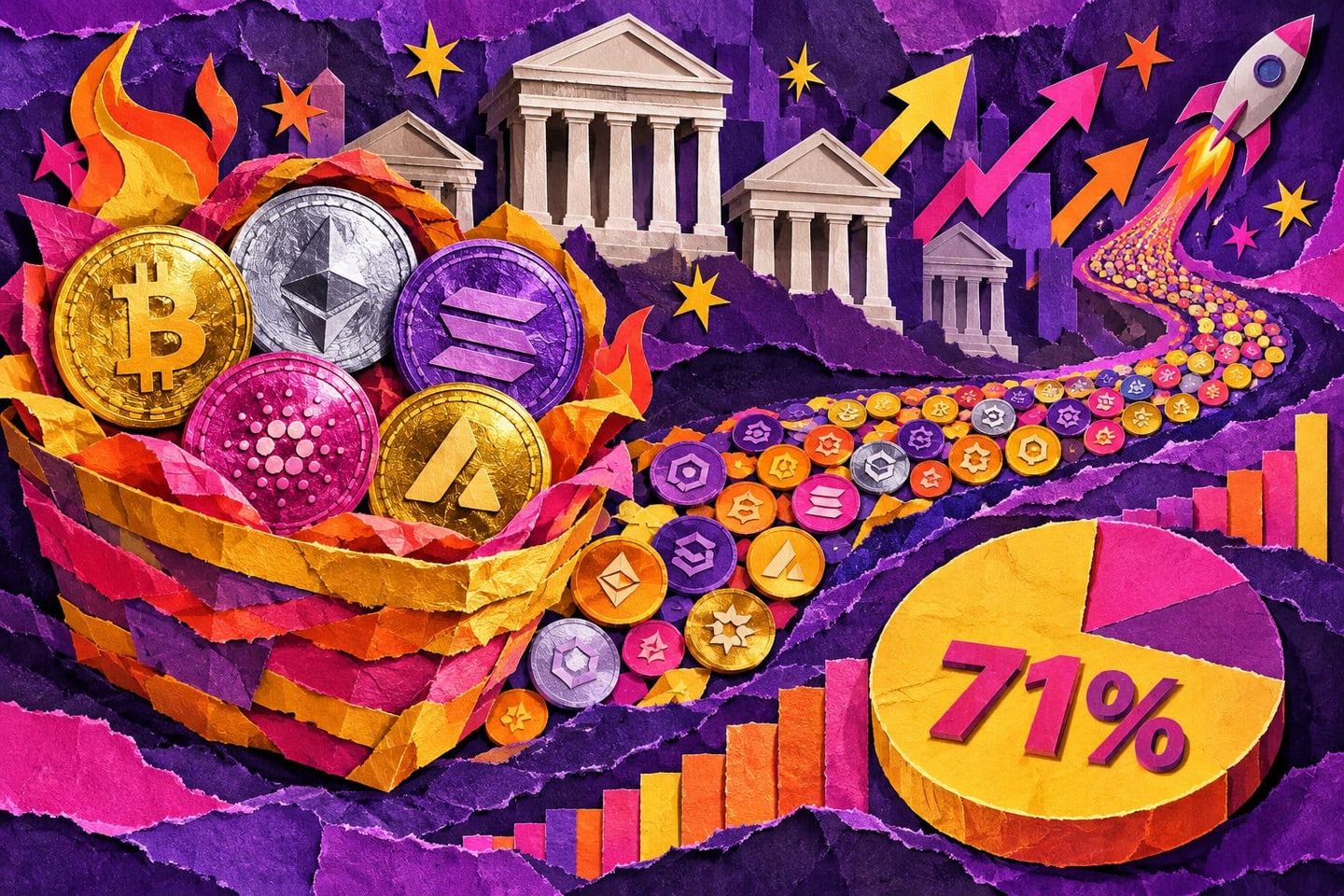
Quick Answer: Citrini Research's October 8, 2026 report argues that tokenization's biggest winners may be fee-collecting protocols, not bitcoin or ether. In its reported 15-token basket, the five largest positions (ETHFI, AAVE, UNI, PENDLE and ONDO) add up to only 29%. The other 71% is split across ten smaller tokens, according to Crypto Briefing.
"We can't assume that majors, primarily BTC and ETH, will make new ATHs on this," — Citrini Research, "Breaking The Wall" (source: CoinDesk, 2026-10)
Citrini says it is "actually more excited" about the token basket than the stock basket because the tokens offer broader exposure than the small group of listed companies . The weights below come from Crypto Briefing's coverage. Citrini has not confirmed them publicly.
| Token | Reported weight | Role in the thesis |
|---|---|---|
| ether.fi (ETHFI) | 10% | Crypto-based financial services |
| Aave (AAVE) | 9% | Lending infrastructure |
| Uniswap (UNI) | 4% | Decentralized trading of tokenized assets |
| Pendle (PENDLE) | 3% | Trading future yield on interest-bearing assets |
| Ondo (ONDO) | 3% | Tokenized Treasuries and stocks, plus perpetual futures |
| Other 10 tokens | 71% | Long-tail positions |
Source for weights:
CoinDesk names nine of the long-tail tokens . The public coverage we reviewed does not identify the tenth.
- Aerodrome (AERO): could collect trading fees on tokenized stocks
- Maple (SYRUP), Ethena (ENA), Chainlink (LINK) and LayerZero (ZRO)
- Derive (DRV): onchain options
- Lighter (LIT), Variational (VAR) and Hyperliquid (HYPE)
The stock basket is more concentrated. Securitize (SECZ) has a reported weight of about 20%, while Circle (CRCL) and Coinbase (COIN) are about 18% each. Together these three make up roughly 56% of the stock basket . The other holdings are Robinhood (HOOD), Figure (FIGR), SoFi (SOFI), Bullish (BLSH) and the Bitwise Hyperliquid ETF (BHYP) .
On the day the report came out, CoinDesk quoted COIN at $173.21, HOOD at $98.90 and CRCL at $82.25 . SOFI was at $14.55 and BLSH at $29.48 in the same report .
Why does fee capture matter more than activity for these tokens?
Citrini's answer is that a token is only worth holding if the protocol earns fees and passes some of them to holders. The report says the lasting value comes after assets move onchain, when people trade them, borrow against them or post them as collateral . It also warns that "fees matter more than activity."
Each name in the basket covers a different part of that later trading, lending and collateral activity. According to AltcoinBuzz and KuCoin's summary of the report, the roles break down like this :
- Trading: Aerodrome (AERO) could collect fees on tokenized stock trades. Uniswap (UNI) offers decentralized trading of tokenized assets.
- Lending: Aave (AAVE) is lending infrastructure.
- Tokenized assets: Ondo (ONDO) covers tokenized Treasuries and stocks, plus perpetual futures.
- Yield: Pendle (PENDLE) lets users trade the future yield of interest-bearing assets.
- Payments: Ethena (ENA) is a stablecoin issuer moving into savings, cards and payments.
- Data and connections between chains: Chainlink (LINK) provides market data. LayerZero (ZRO) links blockchains to each other.
- Options: Derive (DRV) runs onchain options. It could gain if tokenized assets bring more derivatives trading onchain.
Before buying any of these tokens, the report suggests three checks. First, how does the protocol actually earn money? Second, who collects those fees? Third, do token holders get any share of them? A protocol can process a lot of volume and still leave its token with little of the value, which is why more network activity does not automatically lift token prices .
The report also flags several risks that could weaken the thesis, as summarized by Crypto Briefing:
- Split liquidity: competing chains can divide trading volume, so no single venue builds deep markets.
- Security exploits: smart-contract hacks remain a direct threat to lending and trading protocols.
- Synthetic stock tokens: some tokens track a share price but give no voting rights or direct ownership. That creates legal uncertainty.
These caveats matter for the 71% of the basket outside the top five names. Smaller tokens often have thinner fee histories, so the three checks above are harder to answer for them .
Are banks and regulators backing the same trend?
Yes. Banks and regulators are moving the same way, but neither is responding to Citrini. On third-quarter earnings calls reported October 17, 2026, executives at Goldman Sachs, Wells Fargo and Morgan Stanley described tokenization as a way to grow their businesses, not a threat to them . CoinDesk's coverage does not connect those comments to the report. Treat them as a separate signal pointing the same way.
Goldman Sachs CEO David Solomon was asked whether tokenization, DeFi and prediction markets could eat into trading revenue. He said they may do the opposite, though he added that "the activity so far is small and at the margin" .
"The developments are obviously creating more products, greater activity, potentially new clients, broader distribution channels," — David Solomon, CEO at Goldman Sachs (source: CoinDesk)
Goldman has worked on this for years. It built GS DAP, its tokenized-asset platform, as early as 2022 . In July, it took part in a half-day tokenization run with DTCC .
The three banks each pointed to a different opportunity:
- Goldman Sachs (trading): more products and more trading activity, though still small so far.
- Wells Fargo (moving money): CFO Michael Santomassimo said cross-border payments using tokenized deposits are "in production" at small volume. Payments reach the beneficiary account "in two minutes or less" . Wells Fargo has a relatively small international branch network, so this lets it grow cross-border business without adding branches.
- Morgan Stanley (advice): CFO Sharon Yeshaya said: "The tokenized world means it is faster and easier to move assets around, and you will need advice."
None of the three banks gave a revenue figure for tokenization. The bank signal is real but has no numbers attached yet.
The regulatory signal is more concrete. On September 17, 2026, the SEC issued a temporary, conditional "Innovation Exemption" (Release No. 34-106402). It permits permissioned onchain secondary trading of tokenized NMS stocks through automated market makers (AMMs) and liquidity pools . An NMS stock is a share listed on a U.S. national securities exchange. SEC Chairman Paul Atkins called the exemption "a significant step forward" (source: SEC, 2026-09).
Both exemptions run through September 17, 2031. Tokenized Securities Venues are exempt from the definition of an "exchange," and certain AMM liquidity providers are exempt from the definition of a "dealer" . The limits are strict:
- No initial offerings on these venues.
- A tokenized share must carry the same rights as the underlying share.
- Issuers get 30 days to object when a third party tokenizes their stock .
- Antifraud and AML rules still apply.
This helps explain why AMM-based venues such as Uniswap and Aerodrome are in Citrini's basket. The "same rights" rule also speaks to the synthetic-stock concern raised above: under this exemption, tokens with no voting rights or direct ownership would not qualify (source: Morgan Lewis, 2026-09).
What should traders watch next?
The next useful signals are confirmations, not price moves. Traders should check three things: whether the reported weights match Citrini's primary report, whether the top tokens' protocols start sharing fees with token holders, and whether banks and SEC-exempt venues begin publishing real volume. Until those arrive, the basket describes a thesis about who collects fees. It is not a price forecast.
Start with the weights. The 79-page "Breaking The Wall" report is a subscriber product. The allocations in circulation come from secondary coverage . Those reported numbers do not fully add up. If Pendle and Ondo sit at 3% each, ten long-tail tokens holding 71% would average about 7.1% apiece, which is more than either of them. Public coverage also names only 14 of the 15 tokens . Treat every weight as reported, not confirmed.
Concentration still matters for sizing. Five named tokens make up 29% of the basket. The other 71% is spread across smaller, often thinner-traded names. Copying the basket means taking on very different liquidity risk from one position to the next, especially in tokens like DRV, LIT or VAR.
Concrete catalysts to track:
- Fee-sharing moves: any buyback, fee switch or revenue-distribution vote at Aave, Uniswap or ether.fi. This tests the report's "fees matter more than activity" point directly.
- Bank disclosures: the first time Goldman Sachs, Wells Fargo or Morgan Stanley puts a revenue number on tokenization. None of them did on Q3 calls .
- AMM volume: early trading data from Tokenized Securities Venues operating under the SEC's September 17, 2026 Innovation Exemption .
The takeaway: read Citrini's basket as a map of where fees might build up, and check each name's revenue model before taking a position. This is not investment advice.
Frequently Asked Questions
What is in Citrini's tokenization token basket?
Citrini Research's crypto basket from its October 8, 2026 report "Breaking The Wall" holds 15 tokens . According to Crypto Briefing, the largest reported weights are ether.fi (ETHFI) at 10% and Aave (AAVE) at 9%. Uniswap (UNI) has 4%, and Pendle (PENDLE) and Ondo (ONDO) have 3% each .
Together, those five tokens make up 29% of the basket. The other 10 tokens account for the remaining 71% . They include Aerodrome (AERO), Maple (SYRUP), Ethena (ENA), Chainlink (LINK), LayerZero (ZRO), Derive (DRV), Lighter (LIT), Variational (VAR) and Hyperliquid (HYPE). These weights come from secondary coverage, not from Citrini directly. The full report is only available to Citrini subscribers.
Does Citrini expect Bitcoin and Ether to benefit?
Not much from this theme. Citrini wrote, "We can't assume that majors, primarily BTC and ETH, will make new ATHs on this" . The report expects most of the lasting value to go to companies and protocols that collect fees from trading, lending, payments and derivatives on tokenized assets. Crypto Briefing summed it up this way: the money may flow "to the plumbing, not the headline assets."
Did Goldman, Wells Fargo and Morgan Stanley respond to Citrini?
No. CoinDesk's coverage does not connect the banks to Citrini's report. On their Q3 2026 earnings calls, reported October 17, 2026, Goldman Sachs, Wells Fargo and Morgan Stanley each described tokenization as a growth opportunity on their own . Each bank pointed to a different area: trading for Goldman, cross-border payments for Wells Fargo and wealth advice for Morgan Stanley. According to CoinDesk, none of them gave a revenue figure.
Will higher tokenization activity push token prices up?
Not necessarily. Citrini warns that more volume and network activity do not automatically lift token prices, because "fees matter more than activity" . Before buying, check three things: how the protocol earns fees, who collects them, and whether token holders get a share. The report also flags other risks: liquidity split across competing chains, security exploits, and legal problems with synthetic tokenized stocks that carry no voting rights (source: Altcoin Buzz).
Enjoyed this article? Subscribe to get new stories by email whenever they're published.