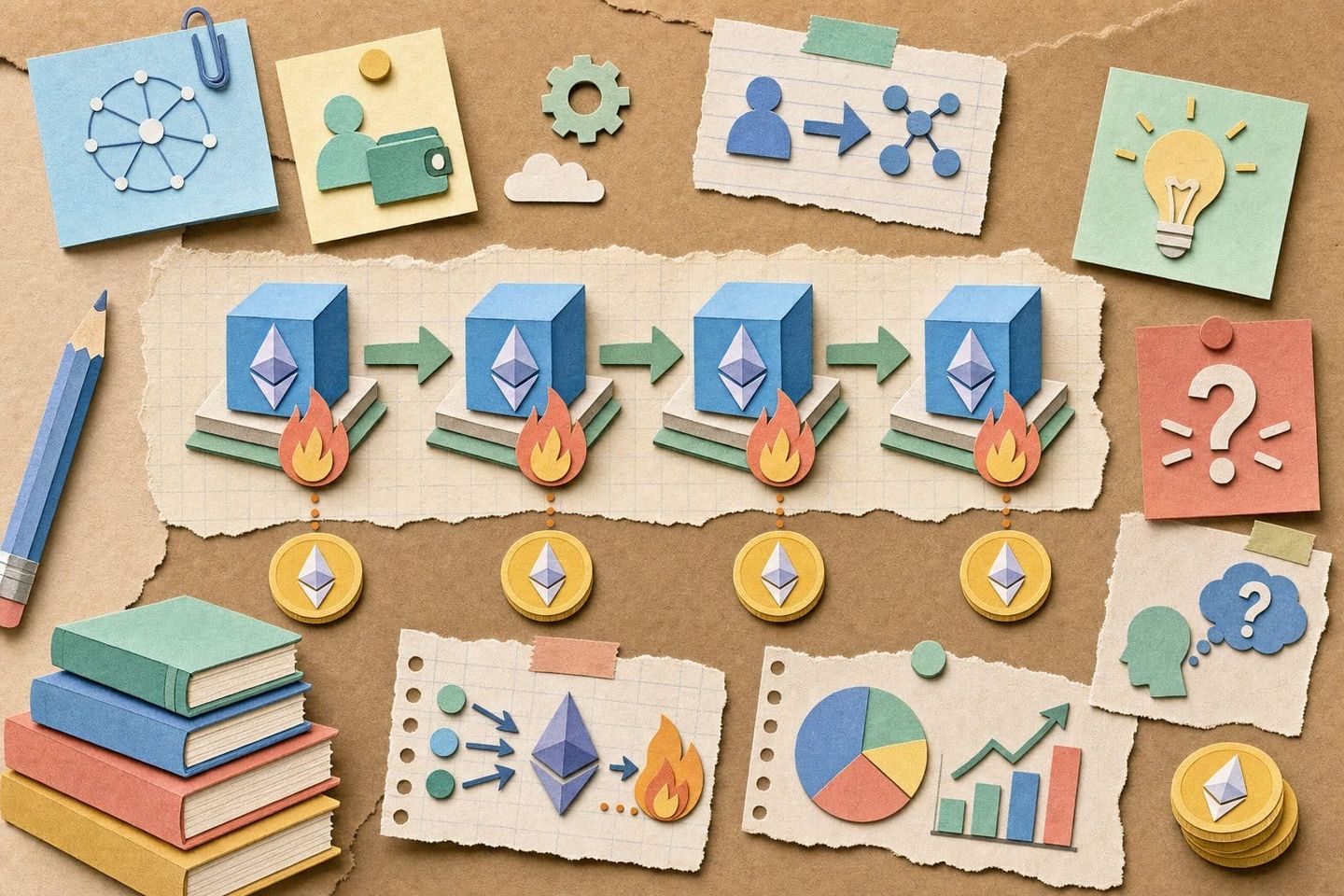
Most people still file Ethereum next to Bitcoin as "another cryptocurrency you can buy and hold." That framing misses what the network was built to do — and why every block it produces quietly burns ETH.
What Ethereum Actually Is — Programmable Blockchain, Not Digital Cash
Ethereum is a public, open-source, decentralized blockchain that functions as shared, programmable computing infrastructure — its own documentation describes it as "a blockchain with an embedded computer" rather than a payment network . In practice that means it is a globally distributed state machine: a single shared computer, replicated across thousands of independent nodes, that executes whatever code developers deploy to it. Bitcoin moves value; Ethereum runs programs. That one design choice is the root of nearly everything else covered in this guide.
Quick Answer: Ethereum is a decentralized blockchain that acts as a global, programmable computer, not a payment rail. Launched in July 2015, it adds a built-in execution environment (the EVM) on top of blockchain consensus, letting developers deploy arbitrary smart contracts — the layer that powers DeFi, NFTs, and DAOs.
The contrast with Bitcoin is structural, not cosmetic. Bitcoin was designed primarily as peer-to-peer digital cash and a store of value, with a deliberately limited scripting capability. Ethereum keeps the same core consensus idea — nodes agreeing on a shared, tamper-resistant ledger — but bolts on a Turing-complete execution layer where developers publish and run their own software . The official docs frame Ethereum as "the foundation for building apps and organizations in a decentralized, permissionless, censorship-resistant way" . Same trust model, radically different capability layer.
Timing matters here. Ethereum launched in July 2015, and its 2014 whitepaper proposed a blockchain with a built-in Turing-complete programming language for smart contracts and decentralized applications . But ethereum.org now flags that the whitepaper is historically important and no longer fully describes today's system — proof of stake, layer-2 scaling, ERC token standards, DeFi, NFTs, and DAOs all arrived after launch and are absent from the original document . So when traders treat Ethereum as a static asset, they are misreading a network that has been re-engineered repeatedly since 2015.
The mechanics underneath are simple to state, even if they are deep to implement. The network maintains a public database updated across thousands of independent nodes; each block cryptographically references earlier blocks, nodes agree on new blocks through consensus, and every transaction updates a shared state that any honest node can verify . The table below maps the two networks side by side so the difference in purpose is unambiguous.
| Dimension | Bitcoin | Ethereum |
|---|---|---|
| Primary purpose | Peer-to-peer digital cash and store of value | Programmable, globally shared execution environment |
| Programmability | Limited, fixed scripting | Turing-complete smart contracts run on the EVM |
| Consensus mechanism | Proof of work | Proof of stake (since The Merge, Sept 15, 2022) |
| Fee model | Miner fees, no protocol burn | Gas in ETH; EIP-1559 base fee is burned |
| Supply policy | Fixed maximum issuance schedule | No hard cap; issuance offset by fee burn under load |
Read the table as a thesis, not trivia: Ethereum and Bitcoin share a lineage but solve different problems. Bitcoin optimizes for sound, predictable money. Ethereum optimizes for arbitrary, verifiable computation — and that is exactly why the rest of this guide spends its time on the EVM, smart contracts, gas, and consensus rather than on price charts.
The EVM: Ethereum's Global State Machine Explained
The Ethereum Virtual Machine (EVM) is the deterministic execution environment that turns "verifiable computation" from a promise into a mechanism: every node runs the identical function, so the same inputs always produce the same output everywhere. Formally, the EVM is a distributed state machine expressed as Y(S,T)=S′ — given an old valid state S and a set of valid transactions T, it produces exactly one new valid state S′, committed through block production . There is no ambiguity and no local discretion; thousands of independent nodes store that state and must agree on it .
That determinism is engineered, not incidental. The EVM uses a stack architecture limited to 1,024 items, each slot holding a 256-bit word . The depth ceiling and uniform word size are deliberate constraints: they bound how complex any single execution can become and keep every operation reproducible, which is what makes the chain fully auditable across machines run by strangers who never coordinate. Predictability here is the security model — if execution could diverge between nodes, consensus on a single shared record would be impossible.
State on Ethereum lives in accounts, and there are exactly two kinds:
- Externally owned accounts (EOAs) — controlled by a private key, with a 42-character address (a 20-byte value shown as 40 hexadecimal characters plus the
0xprefix). These are the wallets people hold and sign from . - Contract accounts — controlled by deployed bytecode, not a private key. They hold ETH and tokens and run their code only when something calls them .
Nothing changes state until a transaction does. A transaction is a cryptographically signed instruction, usually initiated by an EOA, that mutates Ethereum's shared state . Its fields carry everything the EVM needs to act deterministically: from, to, signature, nonce, value, input data, gasLimit, maxPriorityFeePerGas, and maxFeePerGas . If the recipient is a contract account, the transaction triggers that contract's bytecode; the input field specifies which function runs and with what arguments. The nonce enforces strict ordering per account and blocks replay, while the gas fields cap and price the computation.
Put together, the picture is mechanical rather than mystical: signed transactions enter, the EVM applies its one fixed function, and a single new state emerges that every honest node can independently reconstruct and verify. That shared computer is what the next section's smart contracts actually run on.
Smart Contracts: Code That Self-Executes — and What It Can't Do
A smart contract is a reusable program a developer publishes directly into EVM state: code written in a high-level language such as Solidity or Vyper, compiled down to low-level bytecode, and stored permanently on-chain . Once an externally owned account or another contract calls it, the code runs automatically and deterministically — every node executes the same instructions and arrives at the same result, so no counterparty can alter the outcome mid-execution . The official documentation compares the mechanism to a vending machine: feed it the right input and it dispenses a fixed outcome by preset rules, with no operator able to intervene.
"Smart contracts are like a vending machine — they automatically execute by rules written in code, dispensing an outcome when called." — Ethereum developer documentation (source: ethereum.org)
This determinism is what makes composability possible. Contracts can call other contracts, and protocols assemble out of those calls: DeFi lending and borrowing markets, decentralized exchanges, NFT ownership records, DAO governance votes, and cross-chain bridges all run as interlocking contract code . A single user action — say, swapping a token on an exchange and depositing the proceeds into a lending pool — can route through several contracts in one transaction, each executing under the same shared rules.
The critical limitation traders overlook is that contracts cannot fetch real-world data on their own. The EVM is a closed, deterministic system, so a contract has no native way to read a stock price, a sports score, or even ETH's market price. Oracles bridge that gap — Chainlink price feeds and similar services push off-chain inputs on-chain so contracts can act on them . That bridge is also the weak point: oracle failure or price manipulation is among the most common DeFi exploit vectors, because a contract executes its rules faithfully even when the data feeding it is wrong.
The second trap is immutability. By default, once a contract is deployed its code cannot be changed — a feature for trust-minimization, but a problem when a bug surfaces. Teams work around this with upgradeable proxy patterns, where a proxy contract forwards calls to a swappable logic contract . The tradeoff is direct: upgradeability hands control to whoever holds the admin key. A DeFi protocol that markets itself as decentralized may still let an admin rewrite the logic behind your funds — a centralization compromise worth checking before you deposit. When you evaluate any contract-based product, two questions matter most: where does its data come from, and who, if anyone, can change the code after launch.
Gas, Gwei, and the EIP-1559 Burn: Why ETH Gets Scarcer Under Load
Gas is the unit that meters how much computation, storage, and bandwidth a transaction consumes on Ethereum, and your fee is simply gas used multiplied by the price you pay per unit . A plain ETH transfer costs 21,000 gas; a token swap or a layered DeFi call costs far more because each opcode the EVM runs adds to the tally. Gas is deliberately measured separately from ETH so the work a transaction does stays constant even as the market price of ETH moves . This is the answer to the two questions that closed the last section: data and code may vary by contract, but every contract pays the same metered price for the resources it touches.
Quick Answer: Ethereum gas fees are priced in gwei, where 1 gwei = 0.000000001 ETH. Since EIP-1559 (August 2021), every transaction's base fee is burned — permanently destroyed — while only the tip reaches the validator. When burns exceed new validator rewards, ETH issuance turns net negative .
Prices are quoted in gwei because raw ETH units are unwieldy: 1 gwei equals 0.000000001 ETH, and balances themselves are denominated in wei, with 1 ETH equal to 1×10¹⁸ wei . EIP-1559, which went live in August 2021, restructured the fee into two parts. The base fee is set by the protocol itself based on network demand and is burned — permanently removed from circulating supply. The priority fee is a tip you choose that goes directly to the validator who includes your transaction, incentivizing faster inclusion .
The base fee is not a fixed number — it auto-adjusts by up to 12.5% per block depending on whether the previous block ran above or below its target capacity . When blocks are full, the base fee climbs block by block until demand cools; when they are light, it drifts down. That feedback loop prevents runaway fee spirals and spam while turning heavy usage into a built-in supply sink: the busier the network, the more ETH it burns.
The deflationary effect is real but conditional. New ETH still enters circulation as validator rewards under proof of stake; net issuance only turns negative when burned base fees exceed those rewards . Periods of intense DeFi and NFT activity have produced deflationary stretches where supply shrank week over week, while quiet periods leave issuance mildly positive. You can monitor the live burn-versus-issuance rate on community trackers such as ultrasound.money rather than guessing from price action.
The table below breaks down where your money actually goes and what different transaction types typically cost. Gas amounts are protocol-determined; the gwei price floats with demand, so real ETH cost rises and falls with network congestion.
| Fee component | Who sets it | Where it goes |
|---|---|---|
| Base fee | Protocol (per-block, ±12.5%) | Burned — removed from supply |
| Max priority fee (tip) | User | Block validator |
| Max fee cap | User | Ceiling on base + tip; unused portion refunded |
| Transaction type | Approx. gas used | Relative cost |
|---|---|---|
| Simple ETH transfer | ~21,000 | Lowest |
| ERC-20 token swap | ~100,000–200,000 | Moderate |
| Complex DeFi interaction | ~300,000+ | Highest |
The practical takeaway: you control the tip and the fee cap, but never the base fee or the gas an operation requires. Timing transactions for low-congestion windows is the main lever a holder has over cost.
Proof of Stake: How Ethereum Reaches Consensus Without Mining
Ethereum reaches consensus through proof of stake (PoS), a system in which validators put up ETH as collateral instead of burning electricity to mine blocks. The switch happened at The Merge on September 15, 2022, which replaced proof of work and cut the network's energy consumption by roughly 99.95% . The official documentation describes the post-Merge network as more secure, far less energy-intensive, and better suited to future scaling . For ETH holders, the change also removed the structural sell-pressure overhang created by miners liquidating block rewards to cover hardware and power bills.
"Proof of stake is more secure, less energy-intensive, and better for implementing new scaling solutions compared to the previous proof-of-work architecture," — Ethereum Foundation official documentation (source: ethereum.org).
To run a solo validator, a participant deposits ETH into the official deposit contract and operates three pieces of software: an execution client, a consensus client, and a validator client . The traditional minimum stake is 32 ETH per validator. Pectra's EIP-7251, activated May 7, 2025, raised the maximum effective balance from 32 ETH to 2,048 ETH per validator, letting large operators consolidate many validators into one and compound rewards automatically .
Time on the network is divided into 12-second slots, grouped into 32-slot epochs . In each slot, one validator is randomly selected to propose a block, while committees of other validators issue attestations — signed votes that collectively confirm the block is valid. This division of labor spreads the work across the validator set rather than concentrating it, the way a single mining pool once could.
Two mechanisms make attacks economically irrational. Finality is achieved through checkpoint voting at epoch boundaries that requires a two-thirds supermajority of all staked ETH; reversing a finalized block would force an attacker to burn an economically prohibitive share of total stake . And misbehavior is punished by slashing, which scales with severity:
- Minor penalties for going offline or missing attestations — small, recoverable losses for honest downtime.
- Slashing for provable faults such as double-proposing or contradictory attestations — a portion of stake destroyed plus forced ejection.
- Correlated slashing in coordinated attacks, which can escalate toward destruction of the entire stake .
Slashing penalties grow sharper when many validators commit the same fault simultaneously — which is exactly why client diversity matters. If a single execution or consensus client commands a supermajority and ships a bug, validators running it could be slashed together as a correlated group. Running minority-client software is therefore not just an idealistic gesture; it is a direct hedge against systemic slashing risk for anyone staking real ETH.
Dencun, Pectra, Fusaka: What Each Upgrade Actually Changed
Ethereum's last three network upgrades — Dencun, Pectra, and Fusaka — each targeted a different bottleneck: data costs for layer-2s, validator and account flexibility, and blob capacity at scale. Dencun activated at epoch 269568 on March 13, 2024 ; Pectra at epoch 364032 on May 7, 2025 ; and Fusaka, the most recent mainnet upgrade as of June 2026, at epoch 411392 on December 3, 2025 . None changed how you hold ETH — but all three reshaped what running on Ethereum costs.
Dencun shipped EIP-4844, "proto-danksharding," which introduced ephemeral data blobs . Rollups had been posting compressed transaction data as permanent calldata; blobs gave them a cheaper, short-lived channel for the same data. The practical result was an 80–99% drop in fees on major L2s, the single largest cost reduction users felt directly.
Pectra bundled 11 EIPs . Three matter most to ordinary participants:
- EIP-7702 lets externally owned accounts temporarily take on smart-contract abilities — batching multiple actions into one transaction, gas sponsorship, alternative authentication, spending controls, and social recovery — though it requires careful delegation to use safely .
- EIP-6110 cut new-validator deposit processing from roughly 9 hours to about 13 minutes .
- EIP-7251 raised the maximum effective validator balance from 32 ETH to 2,048 ETH, and EIP-7691 lifted blob throughput from a target/max of 3/6 to 6/9 per block .
Fusaka centered on EIP-7594, "PeerDAS," which lets validators sample blob data rather than download every blob, enabling an official 8× theoretical blob-capacity increase . It also set the default gas limit to 60M and added a per-transaction gas cap of 2²⁴ (about 16.78M gas) . Two follow-up "Blob Parameter Only" forks tuned capacity further: BPO1 raised blob target/max to 10/15 on December 9, 2025, and BPO2 to 14/21 on January 7, 2026 .
Looking ahead, the 2026 protocol tracks are Scale, Improve UX, and Harden the L1 — including raising the gas limit toward and beyond 100M, the Glamsterdam upgrade (with enshrined proposer-builder separation and gas repricings), and longer-term zkEVM and statelessness research . May 2026 interop notes discuss a credible post-Glamsterdam 200M gas-limit floor while flagging unresolved questions around ePBS request signatures and builder liveness . Crucially, Ethereum follows no fixed upgrade calendar: every change requires a public EIP, multi-client implementation, testing, and voluntary node-operator adoption before it goes live . For holders, that means upgrades rarely demand action; for stakers and rollup teams, each one is a date to plan around.
Your Ethereum Decision Matrix: L1, L2, Staking, or Just Holding
Your correct response to Ethereum's design depends entirely on which role you occupy: holder, staker, DeFi user, or developer. Most readers are simply ETH holders, and for them the practical answer is reassuring — hard forks rarely require any action unless a wallet or exchange explicitly prompts you. The mechanics covered above (the burn, validator rewards, layer-2 settlement) matter for understanding value, not for daily operation. The four profiles below map each role to a concrete decision.
Quick Answer: Match the layer to the job: settle high-value, finality-critical transactions on Ethereum L1; route frequent low-value swaps and gaming to an L2 like Arbitrum, Base, or Optimism, where post-Fusaka blob pricing makes fees a fraction of mainnet . Want yield with minimal overhead? Use a liquid staking protocol rather than running 32 ETH solo.
- ETH holder: No action during upgrades unless your wallet or exchange asks. Track net issuance — base-fee burn versus validator rewards — to gauge long-run supply, since EIP-1559 burns the base fee permanently while priority fees reward validators . Dashboards such as ultrasound.money visualize whether the network is net-inflationary or net-deflationary.
- Staker / node operator: Upgrade your execution and consensus clients before every hard-fork deadline, or risk following an incompatible minority chain . Run a minority client by design: no single client should exceed roughly one-third of validators, because finality requires a two-thirds supermajority and concentration above 33% turns a single client bug into correlated slashing exposure .
- DeFi / dApp user: Use L1 when settlement finality is critical and value is high — above roughly $5,000 is a reasonable threshold. Use an L2 for frequent, lower-value interactions; Fusaka's PeerDAS data sampling lifted effective blob capacity and kept rollup fees a small fraction of mainnet .
- Developer: Review the EIPs before each upgrade — opcode costs, gas limits, account behavior, and blob parameters all change. EIP-7702 from Pectra is especially high-impact, letting EOAs temporarily gain smart-contract abilities for batching, gas sponsorship, session keys, and recovery .
As a single heuristic: transaction value above $5k plus finality required points to L1; frequent swaps, gaming, or micro-interactions under $500 point to an L2; yield exposure with minimal overhead points to a liquid staking protocol; and running infrastructure points to a solo validator on a minority client.
"Ethereum is the foundation for building apps and organizations in a decentralized, permissionless, censorship-resistant way." — Ethereum Foundation documentation (source: ethereum.org)
The takeaway: you don't need to track every EIP to use Ethereum well — you need to know your role. Holders watch net issuance and otherwise sit still; stakers diversify clients and patch on schedule; users pick the layer that fits the transaction; and developers read the spec before each fork. Get that match right, and the burn, the EVM, and proof of stake become infrastructure you rely on rather than mechanics you have to fight.
Last updated: 2026-06-20. Reviewed against Ethereum's mainnet upgrade history through Fusaka (December 3, 2025) and the 2026 protocol-priorities roadmap.
Frequently asked questions
What is the difference between ETH and Ethereum?
Ethereum is the network and protocol — a public, decentralized blockchain that runs as a global, shared state machine. ETH (Ether) is its native currency. The two are not interchangeable: Ethereum is the computer, ETH is the fuel that pays for computation. Per the official documentation, ETH pays transaction fees metered in gas, serves as validator collateral securing the network, and weights consensus votes . You hold ETH; you use Ethereum.
Why do Ethereum gas fees spike so unpredictably?
Gas fees spike because EIP-1559's protocol-set base fee can rise by up to 12.5% per block whenever blocks exceed their target capacity . A viral NFT mint or a large DeFi liquidation cascade can produce 10–20 consecutive over-capacity blocks, compounding that 12.5% increase rapidly. The effect is exponential, not linear, which is why fees can multiply within minutes. Since Dencun activated proto-danksharding on March 13, 2024, layer-2 rollups absorb most routine traffic, so mainnet spikes matter less for everyday users .
Is ETH deflationary or inflationary?
ETH is both, depending on network demand. Validator rewards issue new ETH each epoch, while the EIP-1559 base fee is burned — permanently removed from supply — with every transaction . Under heavy load, burns exceed issuance and net supply contracts (deflationary); under low activity, issuance exceeds burns and supply grows slightly (inflationary). There is no fixed answer — the balance shifts block by block with usage, since the base fee adjusts up to 12.5% per block against the target size .
Do I need 32 ETH to stake on Ethereum?
To run a solo validator, yes — the official deposit contract requires a 32 ETH minimum, alongside running an execution client, a consensus client, and a validator client . Since the Pectra upgrade on May 7, 2025, EIP-7251 lets a single validator compound rewards up to a 2,048 ETH effective balance, though the 32 ETH entry minimum is unchanged . Liquid staking protocols such as Lido and Rocket Pool accept any amount, but they add smart-contract risk and, with Lido in particular, centralization risk.
What did The Merge change for ordinary ETH holders?
The Merge, completed on September 15, 2022, switched Ethereum's consensus from proof of work to proof of stake, which the official docs describe as more secure and far less energy-intensive . For holders, the practical effects were indirect: energy consumption dropped by roughly 99.95%, miner sell pressure disappeared because block rewards to miners ended, and new ETH issuance fell sharply. Critically, no action was required from ordinary ETH holders at switchover — wallets and balances carried over automatically, since validators rather than holders bear the upgrade burden .