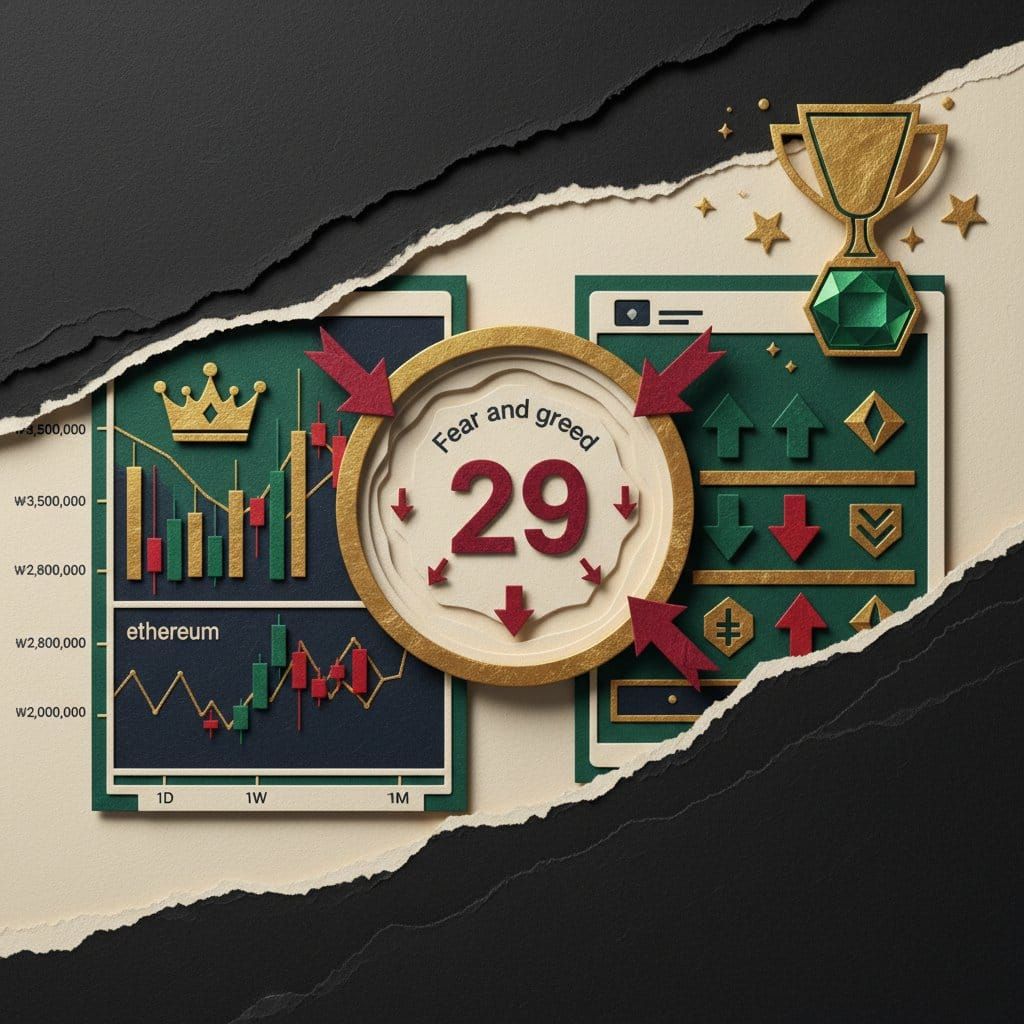
As of April 20, 2026 at 14:00 KST, the Crypto Fear & Greed Index sits at 29/100 — "Fear", up just 2 points from the prior day. Total market capitalization stands at $2.60 trillion, with Bitcoin dominance at 57.4% and Ethereum dominance at 10.6%. Prices are broadly lower: BTC trades at $74,525 on Binance (-1.52%), ETH at $2,282 (-2.18%), and SOL at $84.58 (-1.18%). Yet beneath the surface, elevated trading volume in select assets suggests informed capital is quietly positioning.
Historically, Fear & Greed readings below 30 have marked medium-term accumulation windows. The late-2022 extreme fear period preceded a substantial market recovery in 2023. Whether April 2026 represents a similar inflection point depends on macro factors — U.S. rate policy and regulatory uncertainty remain headwinds — but volume data tells a more nuanced story than the headline sentiment number.
Why Fear Markets Signal Selective Opportunity
Quick Answer: With the Fear & Greed Index at 29/100 and total crypto market cap at $2.60T, ETH holds $4.9B in open interest with 68.4% of futures traders positioned long. BLUR is drawing heavy volume despite a 5.70% price drop — a classic accumulation signal. Selective DCA into high-liquidity assets is the preferred approach at these levels.
Sub-30 fear readings concentrate risk-adjusted opportunity — but only where volume confirms conviction. When price falls while volume rises, larger participants are absorbing supply rather than panicking. Derivatives data — funding rates, open interest, long/short ratios — helps distinguish between panic-driven and accumulation-driven volume. Today's data leans toward the latter in several key assets.
For context on how extreme fear dynamics played out earlier this month, see our April 2026 extreme fear crypto analysis.
Global Volume Leaders — Binance & OKX, April 20, 2026
On Binance, the world's largest crypto exchange by volume, stablecoin dominance tells the fear story directly: USDC leads all pairs at $1.8B, reflecting capital-preservation behavior. BTC follows at $967.6M, ETH at $601.6M, and SOL at $225.7M. DOGE ranks seventh at $101M in volume — meaningful outperformance for a meme coin during a broad risk-off session. Cross-referencing with OKX confirms the trend: BTC led at $367M, ETH at $323M, and DOGE appeared in the top five with $57.7M in volume. ORDI was a notable outlier on OKX, surging +19.92% — one of the session's few material green candles.
| # | Coin | Price | 24h Change | Volume(24h) | High | Low |
|---|---|---|---|---|---|---|
| 1 | USDC | $1.00 | +0.00% | $1.8B | $1.00 | $1.00 |
| 2 | BTC | $74,525 | -1.52% | $967.6M | $76,240.66 | $73,724.31 |
| 3 | ETH | $2,282 | -2.18% | $601.6M | $2,350.24 | $2,252.72 |
| 4 | SOL | $85 | -1.18% | $225.7M | $87.12 | $82.94 |
| 5 | XRP | $1.41 | -1.56% | $142.2M | $1.45 | $1.39 |
| 6 | USD1 | $1.00 | +0.02% | $113.7M | $1.00 | $1.00 |
| 7 | DOGE | $0.09 | -0.05% | $101.0M | $0.10 | $0.09 |
| 8 | ZEC | $309 | -4.22% | $86.9M | $337.89 | $299.58 |
| 9 | TREE | $0.07 | +0.15% | $78.6M | $0.07 | $0.06 |
Source: Binance spot market, April 20, 2026 14:00 KST
Ethereum (ETH) — Structural Bull Case Intact
ETH trades at $2,282 on Binance, down 2.18% over 24 hours with an intraday range of $2,252.72–$2,350.24. Despite the session decline, Ethereum's medium-term outlook is supported by two converging catalysts that distinguish it from the broader market dip.
ETF inflows: Ethereum spot ETFs have accumulated $11.6 billion in cumulative inflows, including a standout $120M single-session inflow on April 7. Total Bitcoin ETF net assets now stand at $86.22 billion, with institutional crypto inflows exceeding $18 billion year-to-date in 2026. According to SpotedCrypto's market tracking, this institutional demand floor did not exist during previous bear cycles and represents a structural shift in how crypto drawdowns resolve. For the full breakdown, see our top altcoins to buy in April 2026.
Glamsterdam upgrade (June 2026): Ethereum's upcoming hard fork will expand the gas limit from 60M to 200M per block and push theoretical throughput toward 10,000 TPS — a transformative improvement for Layer 2 economics and DeFi usability that strengthens the medium-term investment thesis.
Derivatives snapshot: ETH's Binance funding rate is -0.0009% — near-neutral, indicating no extreme leverage overhang. Open interest stands at $4.9 billion with a 68.4% long / 31.6% short ratio, reflecting strong bullish conviction among derivatives traders even as spot prices dip. On Korea's Upbit exchange, ETH posted a marginal +0.50% gain on the session, suggesting regional demand is providing a slight support cushion relative to global spot markets.
BLUR — Contrarian Volume Surge in NFTs' Top Protocol
BLUR dropped 5.70% on the session on Upbit (Korea's largest crypto exchange), yet ranked second by trading volume — a textbook divergence experienced traders recognize as a potential accumulation signal. When price falls while volume rises, sellers are being absorbed by larger participants rather than causing a cascade of exits.
Earlier this month, BLUR spiked +22.53% in a single session, with Upbit Korea recording ₩49.6 billion (~$33M) in daily volume and an intraday swing of +35.7%. The subsequent pullback has drawn a different buyer profile: lower-urgency, longer-horizon capital positioning for the next leg. Analysts tracking Korean exchange flows note that BLUR's volume concentration on Upbit — even during down sessions — suggests the asset retains a dedicated speculator base.
BLUR's fundamental case ties directly to NFT marketplace market share. The protocol captures a dominant portion of NFT trading fees, making it a direct beneficiary of any recovery in NFT market activity. Key risk: NFT market recovery timelines remain uncertain, and BLUR is a high-beta asset in both directions. Position sizing discipline is essential for managing drawdown exposure.
DOGE — Community Resilience as a Volatility Cushion
Dogecoin trades at $0.09461 on Binance, essentially flat at -0.05% for the 24-hour period. In a session where most majors are down 1–2%, DOGE's near-zero change is notable. The asset's large, active retail community has historically acted as a price floor during fear cycles — holders tend to average down rather than exit, creating natural demand absorption.
Futures data confirms the bullish bias: DOGE carries the highest long positioning of any major tracked asset at 73.5% long / 26.5% short, with $221.8M in open interest. The funding rate of -0.0021% indicates a mild short-side payment, which is constructive for long spot holders. On Upbit, DOGE posted +0.72% on the same session, consistent with Korean retail demand providing a marginal premium over global spot pricing.
Derivatives Snapshot: Funding Rates, OI & Long/Short Ratios
Funding rates across all major assets are negative or near-zero — a healthy market reset that removes the forced-liquidation risk that accompanies over-leveraged upside. SOL carries the sharpest negative funding at -0.0086%, while XRP is the only asset with positive funding (+0.0034%), creating mild short-squeeze potential on any positive catalyst. BTC's near-balanced long/short split (50.3% / 49.7%) suggests near-term price action will be driven by spot flows rather than derivatives positioning.
| Coin | Funding Rate | Open Interest | Long/Short |
|---|---|---|---|
| ADA | -0.0106% | $81.6M | N/A |
| AVAX | -0.0125% | $82.3M | N/A |
| BNB | 0.0000% | $334.5M | N/A |
| BTC | -0.0046% | $7.1B | 50.3% / 49.7% |
| DOGE | -0.0021% | $221.8M | 73.5% / 26.5% |
| DOT | -0.0087% | $44.8M | N/A |
| ETH | -0.0009% | $4.9B | 68.4% / 31.6% |
| LINK | -0.0004% | $82.8M | N/A |
| SOL | -0.0086% | $777.3M | 72.7% / 27.3% |
| XRP | 0.0034% | $396.5M | 71.4% / 28.6% |
Source: Binance Futures, April 20, 2026 14:00 KST
SOL and XRP show 70%+ long positioning — which could amplify recoveries but also deepens drawdown risk if key support levels fail. For our full positioning and altcoin analysis, read our latest altcoin picks breakdown.
Fear Market Strategy: A Practical Playbook
Sub-30 Fear & Greed readings have historically rewarded disciplined, systematic capital deployment. Crypto portfolio managers consistently point to five principles for navigating these environments:
- Dollar-cost average (DCA): Spread entries across multiple sessions. Even 3–5 tranches over two weeks materially reduces single-point timing risk without sacrificing recovery participation.
- Prioritize liquidity: BTC ($7.1B OI) and ETH ($4.9B OI) offer the deepest order books and the strongest institutional support floors. Altcoin upside is higher, but drawdowns are steeper.
- Volume as primary signal: High volume during a price drop — as seen with BLUR today — is the market's most honest signal. It warrants closer analysis, not panic-selling.
- Check funding rates before entry: Uniformly negative funding today means shorts are paying longs. This is structurally constructive for spot buyers and reduces forced-flush risk.
- Maintain cash reserves: Fear environments can deepen before resolving. Keeping 20–40% in stablecoins preserves the ability to average down on further weakness.
Frequently Asked Questions
Q: Does a Fear & Greed Index of 29 mean it's time to buy crypto?
A: Historically, sub-30 readings have marked medium-term entry opportunities — the late-2022 extreme fear zone that preceded the 2023 rally is the clearest recent precedent. But no single indicator should drive a buy decision. Cross-reference with technical support levels (BTC's $73,724 intraday low today is a key short-term reference), macro conditions including U.S. rate policy, and volume trends. Small, staggered DCA entries reduce timing risk significantly compared to single large positions.
Q: Why does high volume during a price decline sometimes indicate accumulation rather than panic?
A: High volume with falling prices can mean either panic selling or strategic absorption of that selling by larger participants. The key differentiator is derivatives data and price behavior at support. When open interest is stable or rising while funding rates remain neutral or negative — as is the case today across ETH ($4.9B OI, -0.0009% funding) and BTC ($7.1B OI, -0.0046% funding) — it indicates positioning is building, not unwinding. Panic selling typically coincides with sharp, sudden drops in open interest as leveraged longs get liquidated.
Disclaimer: This article is for informational purposes only and does not constitute investment advice or financial guidance. Cryptocurrency investments carry substantial risk of loss, including total loss of principal. All investment decisions should be made based on your own independent research and risk tolerance.
Related Articles
- Top 5 Altcoins Institutions Are Buying in the Fear Zone — April 2026
- Top 5 Cryptos to Buy in April 2026: Why Extreme Fear Is the Institutional Signal
- Top 5 Altcoins to Watch in April 2026 — Extreme Fear, Real Opportunity
- Top 5 Altcoins to Watch in Extreme Fear — April 2026 Expert Picks
- Top 5 Altcoins to Buy in April 2026 — Extreme Fear, Institutional Signals