Fear & Greed Index Hits 13: Crypto Markets Sink Into Extreme Fear — February 28 Market Briefing
Crypto Fear & Greed Index sits at 13 (Extreme Fear) on Feb 28. BTC at $65,583 (-2.87%), ETH crashes to $1,920 (-5.51%). Negative funding rates across the board, PAXG surges as safe haven. Full derivatives and on-chain analysis.
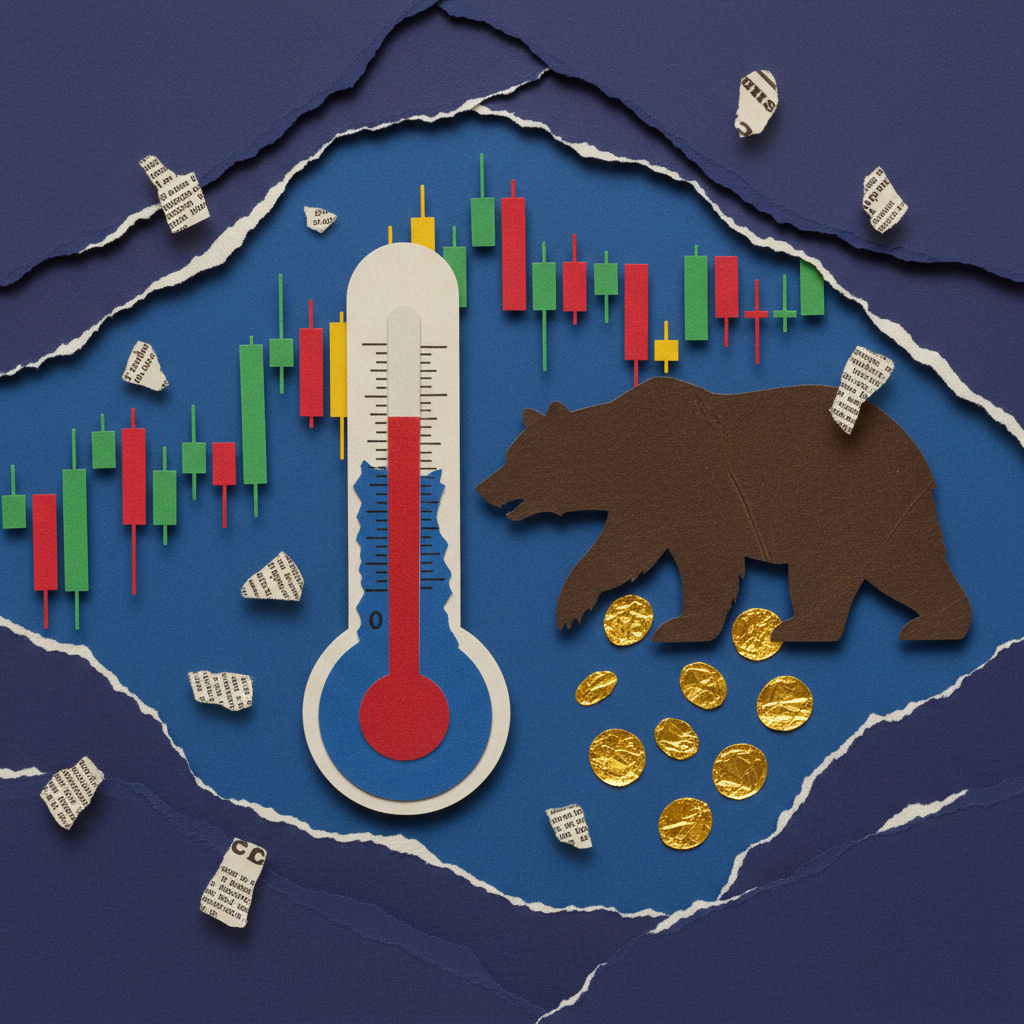
As of February 28, 2026 at 08:00 KST, the Crypto Fear & Greed Index has dropped to 13 out of 100 — firmly in 'Extreme Fear' territory and marking one of the lowest readings of 2026.
The index edged up 2 points from yesterday's 11, but the marginal recovery does little to mask the severity of the selloff. The global crypto market cap stands at $2.34 trillion with Bitcoin (BTC) dominance climbing to 56.1%, a flight-to-quality signal as capital rotates away from altcoins. On Binance, BTC is trading at $65,583 with a 24-hour decline of -2.87%, while Ethereum (ETH) has fallen sharply to $1,920 — down -5.51% and breaching the psychologically significant $2,000 level. Solana (SOL) mirrors ETH's weakness at $81.35 (-5.52%). Perhaps most telling is the performance of gold-backed PAXG, which surged +1.89% to $5,298, underscoring how aggressively traders are seeking safe havens even within the crypto ecosystem. Meanwhile, every major perpetual futures contract on Binance carries a negative funding rate, with SOL's -0.0189% signaling particularly aggressive bearish positioning in derivatives markets.
This Saturday briefing delivers a full breakdown of spot and derivatives data across Binance and OKX, weekly on-chain trends, and what these extreme sentiment readings have historically signaled for the months ahead.
Key Market Data at a Glance — February 28, 2026
Quick Answer: The crypto market is deep in Extreme Fear with the Fear & Greed Index at 13/100. BTC trades at $65,583 (-2.87%) and ETH at $1,920 (-5.51%) on Binance. All major funding rates are negative, BTC dominance has climbed to 56.1%, and gold-backed PAXG is the standout gainer at +1.89%.
The global cryptocurrency market as of February 28, 2026 presents a textbook risk-off environment across every major metric. Total market capitalization sits at $2.34 trillion, while 24-hour trading volume across all exchanges reaches approximately $106 billion — representing just a 4.5% volume-to-market-cap ratio, far below the 6–8% range typically seen in healthy markets. Bitcoin dominance at 56.1% continues its steady climb as investors consolidate positions into the market's most liquid asset, while Ethereum dominance has fallen to just 9.9%, reflecting the outsized pressure on altcoin valuations. The Fear & Greed Index at 13 sits in the bottom quartile of its historical range, with its slight improvement from yesterday's 11 offering only marginal comfort. With 18,740 active cryptocurrencies tracked by CoinGecko, the breadth of the market remains intact even as depth and liquidity contract significantly (Source: CoinGecko, Alternative.me, February 28, 2026).
- Global Market Cap: $2.34 trillion | BTC Dominance: 56.1% | ETH Dominance: 9.9% (Source: CoinGecko)
- Fear & Greed Index: 13/100 (Extreme Fear) — up from 11 yesterday (Source: Alternative.me)
- 24h Global Volume: ~$106 billion (4.5% of market cap)
- BTC (Binance): $65,583 (-2.87%), 24h range: $64,914–$68,217
- ETH (Binance): $1,920 (-5.51%), 24h range: $1,887–$2,064
- SOL (Binance): $81.35 (-5.52%), 24h range: $80.32–$88.29
- Biggest gainer (Top 10 by volume): PAXG +1.89% ($5,298)
- Active Cryptocurrencies: 18,740
| Indicator | Current Reading | Interpretation |
|---|---|---|
| Fear & Greed Index | 13/100 | Extreme Fear |
| Day-over-Day Change | +2 (11→13) | Marginal improvement, still searching for bottom |
| Global Market Cap | $2.34T | Sustained downtrend |
| 24h Volume / Market Cap | 4.5% | Severely depressed buying activity |
| BTC Dominance | 56.1% | Flight to quality intensifying |
| ETH Dominance | 9.9% | Altcoin relative weakness |
| Active Cryptos | 18,740 | Market breadth maintained |
For daily updates and deeper analysis, visit Spoted Crypto.
What Does a Fear & Greed Index of 13 Actually Mean?
The Crypto Fear & Greed Index is a composite sentiment indicator that distills six market dimensions into a single number between 0 and 100. It weights volatility at 25%, trading volume and momentum at 25%, social media sentiment at 15%, investor surveys at 15%, Bitcoin dominance at 10%, and Google Trends data at 10%. A reading of 13 places the current market deep in the Extreme Fear zone (0–24), signaling that an overwhelming majority of market participants hold deeply pessimistic views. While the 2-point uptick from yesterday's 11 technically qualifies as improvement, the index remains at its lowest sustained level of 2026. The combination of a 4.5% volume-to-market-cap ratio and 56.1% BTC dominance confirms that the fear reading accurately reflects real capital flows, not merely survey-driven noise. The metric is published daily by Alternative.me and has become one of the most widely cited sentiment gauges across crypto media and institutional research desks (Source: Alternative.me, February 28, 2026).
Historically, readings in the 10–15 range have aligned with significant market inflection points. During the Terra-Luna collapse in June 2022, the index plunged to 6 — the lowest ever recorded — before beginning a gradual three-month recovery that saw it climb back to the 20s by October 2022. More recently, in August 2024, global macro uncertainty briefly pushed the index down to 17, only for it to rebound into the 40s within roughly four weeks as risk appetite returned. However, it's critical to recognize that extreme fear does not guarantee an immediate bounce. Double-bottom patterns — where the market dips, recovers slightly, and then retests or breaks through the prior low — have been observed frequently in past cycles.
Independent on-chain analyst Willy Woo noted in a February 2026 post: "Gradual accumulation during extreme fear windows can offer favorable entry points for long-term investors, but short-term risk management must remain the priority — additional volatility is the rule, not the exception, at these levels" (Source: Willy Woo, X/Twitter, February 2026). CryptoQuant CEO Ki Young Ju echoed this view, observing that "the current market exhibits classic accumulation-phase behavior: short-term holders capitulating while long-term holders steadily add to positions" (Source: CryptoQuant Weekly Report, February 2026).
Binance Volume Rankings — Sea of Red With One Golden Exception
Binance's 24-hour volume leaderboard on February 28 paints a stark picture of risk aversion across the crypto market. Bitcoin leads with $1.41 billion in trading volume at a price of $65,583 (-2.87%), followed by USDC at $1.22 billion — a stablecoin sitting in the number two spot is itself a powerful bearish signal, reflecting traders converting volatile holdings to dollar-pegged assets. Ethereum ranks third with $842.6 million in volume but carries the steepest decline among the majors at -5.51%, crashing through the $2,000 psychological support to trade at $1,920. Solana closely mirrors ETH's pain at $81.35 (-5.52%), while XRP holds up slightly better at $1.35 (-3.49%). The standout anomaly is PAXG — the PAX Gold token — which climbed +1.89% to $5,298 on $83.9 million in volume, making it the only top-10 asset with meaningful upside. This is a textbook safe-haven rotation: when equities and crypto sell off in tandem, gold (and gold-backed tokens) attract flight capital (Source: Binance, February 28, 2026).
| # | Coin | Price | 24h Change | Volume(24h) | High | Low |
|---|---|---|---|---|---|---|
| 1 | BTC | $65,583 | -2.87% | $1.4B | $68,216.80 | $64,914.46 |
| 2 | USDC | $1.00 | +0.02% | $1.2B | $1.00 | $1.00 |
| 3 | ETH | $1,920 | -5.51% | $842.6M | $2,063.52 | $1,887.00 |
| 4 | SOL | $81 | -5.52% | $279.0M | $88.29 | $80.32 |
| 5 | XRP | $1.35 | -3.49% | $224.7M | $1.43 | $1.34 |
| 6 | USD1 | $1.00 | +0.01% | $127.4M | $1.00 | $1.00 |
| 7 | PAXG | $5,298 | +1.89% | $83.9M | $5,306.18 | $5,181.39 |
| 8 | BNB | $612 | -2.29% | $79.2M | $633.65 | $605.25 |
| 9 | DOGE | $0.09 | -3.90% | $65.2M | $0.10 | $0.09 |
| 10 | SUI | $0.89 | -4.23% | $41.9M | $0.96 | $0.88 |
OKX data confirms the same pattern. BTC leads at $65,588 (-2.81%) with $665.7 million in volume, followed by ETH at $1,920 (-5.29%) with $331.9 million. On OKX, the gold-backed theme extends to XAUT (Tether Gold), which rose +1.98% to $5,268 on $26.6 million in volume — further evidence that the gold safe-haven trade is not isolated to a single exchange or token. PEPE rounds out OKX's top 10 at $0.000003665 (-4.16%), indicating that even meme coin speculation has dried up during this fear cycle (Source: OKX, February 28, 2026).
The prevalence of stablecoins in the volume rankings — USDC at #2 on Binance, USD1 at #6, USDC at #4 on OKX, and USDG at #7 on OKX — underscores a market-wide "sell to safety" impulse. This stablecoin accumulation represents what traders call "dry powder" — capital parked on the sidelines waiting for re-entry. When fear eventually subsides, this liquidity pool could fuel a sharp recovery rally.
Derivatives Deep Dive — Negative Funding Rates and the Short Squeeze Setup
The Binance perpetual futures market on February 28 reveals an unusual and potentially explosive configuration: every single major funding rate is negative, yet retail long/short ratios remain heavily skewed toward longs. This divergence between institutional positioning (reflected in funding rates) and retail sentiment (reflected in long/short ratios) creates conditions where a short squeeze could materialize rapidly if any catalyst shifts sentiment. Bitcoin perpetuals carry a funding rate of -0.0007%, meaning short sellers are paying a modest premium to maintain positions. But the real action is in altcoin derivatives: SOL futures show -0.0189% funding, ETH sits at -0.0110%, and XRP registers -0.0160%. These negative rates indicate that the aggregate weight of money in perpetual swaps is positioned bearish — a notable development given that negative BTC funding was rare throughout 2025's bull market (Source: Binance Futures, February 28, 2026).
| Coin | Funding Rate | Open Interest | Long/Short |
|---|---|---|---|
| BTC | -0.0007% | $5.2B | 69.1% / 30.9% |
| ETH | -0.0110% | $3.5B | 72.0% / 28.0% |
| SOL | -0.0189% | $826.2M | 74.6% / 25.4% |
| XRP | -0.0160% | $362.2M | 71.1% / 28.9% |
| DOGE | -0.0048% | $151.5M | 67.5% / 32.5% |
| BNB | 0.0000% | $301.6M | N/A |
| ADA | -0.0005% | $89.6M | N/A |
| AVAX | -0.0113% | $72.5M | N/A |
| DOT | -0.0030% | $51.9M | N/A |
| LINK | -0.0010% | $76.5M | N/A |
Open interest tells an equally important story. BTC open interest stands at $5.2 billion (79,298 BTC), while ETH OI registers $3.47 billion (1.81 million ETH). The ETH OI-to-spot-volume ratio is notably high, suggesting that leveraged positions remain substantial even as spot selling intensifies — a setup that historically precedes either a violent liquidation cascade or a sharp short squeeze, depending on which side blinks first.
The long/short ratio data adds a critical layer of nuance. Despite universally negative funding rates suggesting institutional bearishness, retail traders remain stubbornly long: BTC at 69.1% long (2.24:1 ratio), ETH at 72.0% long (2.58:1), and SOL at a staggering 74.6% long (2.94:1). This "retail long vs. institutional short" divergence is a hallmark of late-stage capitulation phases. Retail longs are effectively the last buyers holding against the tide, and their liquidation could trigger a final flush before any meaningful recovery begins.
BNB is the lone neutral outlier with a perfectly flat 0.0000% funding rate and $301.6 million in OI, suggesting the Binance ecosystem token occupies a unique middle ground in the current positioning landscape.
Weekly On-Chain Review — Exchange Flows, BTC Dominance, and Accumulation Signals
This Saturday's weekly on-chain review examines the structural underpinnings of a market that has spent the final week of February 2026 at its most fearful levels of the year. The Fear & Greed Index ranged between 11 and 15 throughout the week, its tightest sustained Extreme Fear band since June 2022. During this period, the global market cap plateaued around $2.34 trillion while the volume-to-market-cap ratio contracted to 4.5%, indicating that buyers have largely withdrawn from the market and sellers are running low on marginal coins to sell — a classic precondition for bottoming behavior. On-chain data from CryptoQuant and Glassnode suggests that short-term holders (coins held for less than 155 days) are capitulating at a loss, while long-term holders continue to accumulate, widening the divergence between these two cohorts to levels not seen since the 2022 bear market lows (Source: CryptoQuant, Glassnode, February 2026).
Stablecoin Flows and the Dry Powder Thesis
The dominance of stablecoins in volume rankings across both Binance and OKX tells a clear story: traders are not leaving crypto — they are retreating to the safety of dollar-pegged assets within the ecosystem. USDC's $1.22 billion in 24-hour volume on Binance alone, combined with USD1's $127.4 million volume, indicates massive capital rotation from risk assets to stablecoins. This "sell → stablecoin → wait" behavior creates what traders call dry powder: capital that remains on-exchange and can re-enter volatile markets rapidly when sentiment shifts. Historically, periods of elevated stablecoin reserves on exchanges have preceded some of the strongest recovery rallies, as the capital is already positioned for deployment without the friction of fiat on-ramping.
BTC Dominance at 56.1% — The Flight to Quality
Bitcoin's dominance climbing to 56.1% while ETH dominance contracts to 9.9% represents a textbook flight-to-quality pattern. During market stress, capital concentrates into the most liquid, highest-confidence asset — and in crypto, that asset is invariably Bitcoin. This dominance level hasn't been sustained this high since early 2024, and it signals that any recovery will likely begin with BTC before rotating into altcoins. The absence of BTC from Upbit's Korean exchange top-10 by volume (displaced by speculative small-caps) contrasts with Binance's global data, where BTC firmly leads, highlighting the divergent trading cultures between retail-heavy Korean markets and the more institutional global venues.
Key On-Chain Metrics — Weekly Summary
| On-Chain Metric | This Week's Reading | Interpretation |
|---|---|---|
| Volume/Market Cap Ratio | 4.5% | Depressed buying activity, wait-and-see dominance |
| BTC Dominance | 56.1% | Flight to quality, altcoin rotation out |
| ETH Dominance | 9.9% | Altcoin sector under severe pressure |
| Stablecoin Volume (Top Binance) | $1.35B+ (USDC + USD1) | Dry powder accumulating on-exchange |
| Fear & Greed Weekly Range | 11 → 13 | Tightest Extreme Fear band since June 2022 |
| BTC Funding Rate | -0.0007% | Bearish positioning, short-squeeze potential |
| ETH Open Interest | $3.47B | Leverage remains elevated despite spot weakness |
| Active Cryptocurrencies | 18,740 | Minimal project attrition despite market stress |
PAXG Surges While Crypto Bleeds — The Safe-Haven Rotation Explained
One of the most telling signals in today's data is the divergence between gold-backed tokens and the broader crypto market. PAXG rose +1.89% to $5,298.48 on Binance with $83.9 million in 24-hour volume, reaching an intraday high of $5,306.18. On OKX, the pattern is confirmed by XAUT (Tether Gold), which gained +1.98% to $5,268 on $26.6 million in volume. These are not trivial volumes — PAXG's $83.9 million exceeds BNB's $79.2 million, meaning traders are actively prioritizing tokenized gold over the native exchange token of the world's largest crypto exchange. This represents a generational shift in how crypto-native traders express risk aversion: rather than exiting to fiat or stablecoins exclusively, a growing cohort is rotating into on-chain gold exposure, preserving both their blockchain-native position and their hedge against macro uncertainty (Source: Binance, OKX, February 28, 2026).
The phenomenon mirrors what is happening in traditional markets, where gold has been rallying on persistent inflation concerns, geopolitical uncertainty, and central bank purchasing. For crypto traders, PAXG and XAUT offer the advantage of 24/7 trading, instant settlement, and portfolio rebalancing without the friction of traditional gold ETFs or futures. The fact that gold-backed tokens are outperforming every other asset class in the Binance and OKX top 10 during a Fear & Greed reading of 13 speaks volumes about the current risk appetite — or rather, the complete absence of it.
Outlook and Key Levels to Watch in March
As February closes with the market firmly in Extreme Fear, the first week of March will be decisive for determining whether this fear represents a capitulation bottom or merely a waypoint in a deeper correction. The Fear & Greed Index's slight recovery from 11 to 13 suggests that downside momentum may be decelerating, but the reading remains far too low to confirm any reversal. Macro events — particularly FOMC-related commentary and U.S. economic data releases in early March — will likely set the tone for risk assets broadly, and crypto will follow (Source: CoinGecko, Alternative.me, February 28, 2026).
Bullish Scenario: If the Fear & Greed Index recovers above 20 and BTC reclaims $68,000 with rising spot volume, it could signal that the stablecoin dry powder ($1.35B+ on Binance alone) is beginning to redeploy. A flip in funding rates from negative to positive — particularly ETH and SOL — would confirm that bearish positioning is unwinding. In this case, the $2.34 trillion market cap could push back toward $2.5 trillion within weeks.
Bearish Scenario: If the index drops back below 10 and BTC loses the $64,900 support (today's 24h low), the next significant support zone lies near $60,000. ETH's breach of $2,000 is already concerning — a close below $1,880 could accelerate selling toward $1,700. The 74.6% retail long ratio on SOL futures represents a liquidation overhang; a SOL break below $80 could cascade into forced selling, driving the token toward $70.
- Fear & Greed Recovery to 20+: The primary sentiment indicator to monitor in the first week of March. Sustained readings above 20 signal the beginning of fear abatement
- Funding Rate Normalization: Watch for BTC, ETH, and SOL funding rates to return to neutral or positive — this would indicate bearish pressure is exhausting itself
- Stablecoin Volume Decline: A decrease in USDC/USD1 trading volume paired with rising BTC spot volume would signal risk-on capital rotation
- BTC Dominance Direction: Sustained dominance above 57% suggests further altcoin pain; a retreat below 54% could mark the beginning of an altcoin recovery trade
- ETH $2,000 Reclaim: Ethereum must recover this psychological level to restore confidence in the altcoin sector; failure to do so keeps the entire market risk-off
- FOMC & Macro Calendar: March FOMC commentary and U.S. employment data will drive risk appetite across all asset classes, including crypto
- Open Interest Reset: BTC OI at $5.2B and ETH OI at $3.47B suggest leverage hasn't fully unwound — a significant OI reduction would indicate healthier market structure for recovery
For deeper chart analysis and real-time market intelligence, explore Spoted Crypto Premium Analysis.
Frequently Asked Questions
What does a Fear and Greed Index of 13 mean for crypto?
A Fear & Greed Index reading of 13 falls deep within the "Extreme Fear" zone (0–24), indicating that the vast majority of market participants are overwhelmingly pessimistic. The index aggregates six factors: volatility (25%), trading volume and momentum (25%), social media sentiment (15%), investor surveys (15%), Bitcoin dominance (10%), and Google Trends (10%). Historically, readings below 15 have coincided with major market inflection points — the June 2022 Terra-Luna crash drove it to 6, while August 2024 macro uncertainty pushed it to 17. However, extreme fear doesn't guarantee an immediate bounce. Further downside is possible, and dollar-cost averaging into large-cap assets like BTC and ETH is generally considered more prudent than lump-sum entries during such volatile periods.
Why are all crypto funding rates negative right now?
Negative funding rates across all major perpetual futures contracts — BTC at -0.0007%, ETH at -0.0110%, SOL at -0.0189%, XRP at -0.0160% — mean that short sellers are paying long holders to maintain their positions. This reflects aggregate bearish positioning in the derivatives market. When funding rates are deeply negative during periods of extreme fear, it can signal that bearish sentiment is approaching exhaustion. If a catalyst triggers covering, the negative funding environment can amplify a short squeeze, producing rapid upward price moves.
Is Extreme Fear a buy signal for Bitcoin?
Extreme Fear has historically served as a contrarian indicator for long-term investors, but timing and risk management are critical. During the Terra-Luna collapse in June 2022, the index hit 6 and recovery took approximately three months. In August 2024, it dropped to 17 before rebounding to the 40s within about a month. Dollar-cost averaging (DCA) during these periods has historically outperformed panic selling, but investors should size positions conservatively and prioritize large-cap assets like BTC and ETH, which have the highest probability of recovery. As Willy Woo noted, "short-term risk management must remain the priority" even when long-term signals look favorable.
Why is gold-backed PAXG rising while crypto falls?
PAXG, a gold-backed token, rose +1.89% to $5,298 while the broader market declined sharply. This reflects a classic risk-off rotation where capital seeks perceived safe havens. Gold has been in a broader uptrend on macro uncertainty, and on-chain gold tokens like PAXG (Binance) and XAUT (OKX, +1.98% to $5,268) allow crypto traders to access gold's safe-haven properties without exiting the blockchain ecosystem. The fact that PAXG's volume ($83.9M) exceeded BNB's ($79.2M) on Binance highlights the intensity of this flight-to-safety behavior.
Data Sources
- Crypto Fear & Greed Index, Alternative.me
- CoinGecko Global Crypto Market Data, CoinGecko
- Binance Spot & Futures Market Data, Binance
- OKX Spot Market Data, OKX
- CryptoQuant On-Chain Analytics, CryptoQuant
This article is for informational purposes only and does not constitute investment advice. All investment decisions should be made based on your own judgment and risk tolerance. Cryptocurrency investments carry the risk of principal loss, and past performance does not guarantee future returns.