Total crypto market cap sits at $2.67 trillion, BTC dominance is 58.1%, and the Fear & Greed Index has fallen to 31 (Fear) as of April 25, 2026. In this environment, how you structure your portfolio matters far more than any single trade.
Cryptocurrency markets punish reactive investors and reward systematic ones. Disciplined asset allocation, scheduled rebalancing, and hard risk rules have separated consistent performers from the crowd through every cycle. This guide uses live Binance and OKX data to give you a numbers-driven framework you can act on today.
Market Snapshot: April 25, 2026
Quick Answer: A sound 2026 crypto portfolio allocates 60–70% to BTC and ETH as core holdings, 20–30% to large-cap altcoins, and maintains 10–20% in stablecoins as a dry-powder buffer. With BTC dominance at 58.1% and Fear & Greed at 31, conservative positioning and DCA entries are strongly recommended over aggressive altcoin bets.
As of 11:00 KST on April 25, Bitcoin trades at $77,542 on Binance — down 1.13% over 24 hours — with volume of $958.6 million, the second-highest on the exchange behind USDC. OKX confirms BTC at $77,536, showing tight price alignment across venues. Ethereum sits at $2,318 on both Binance ($407.7M volume) and OKX ($197.5M volume), off 0.63% on the day. Total market capitalization stands at $2.67 trillion with BTC dominance at 58.1% — well above the 50% threshold that historically separates Bitcoin-led markets from altcoin seasons.
The Fear & Greed Index reading of 31, down 8 points from yesterday, marks a classic accumulation zone — but not the moment for aggressive altcoin exposure. For real-time sentiment context, follow our market analysis coverage.
| # | Coin | Price | 24h Change | Volume(24h) | High | Low |
|---|---|---|---|---|---|---|
| 1 | USDC | $1.00 | +0.00% | $2.0B | $1.00 | $1.00 |
| 2 | BTC | $77,542 | -1.13% | $958.6M | $78,581.93 | $77,264.08 |
| 3 | ETH | $2,318 | -0.63% | $407.7M | $2,335.39 | $2,300.22 |
| 4 | USD1 | $1.00 | -0.01% | $153.1M | $1.00 | $1.00 |
| 5 | SOL | $86 | +0.00% | $152.1M | $86.94 | $84.92 |
| 6 | KAT | $0.02 | +54.42% | $122.2M | $0.03 | $0.01 |
| 7 | APE | $0.21 | +103.33% | $109.2M | $0.28 | $0.10 |
| 8 | DOGE | $0.10 | +0.47% | $94.7M | $0.10 | $0.10 |
| 9 | XRP | $1.44 | -0.59% | $89.4M | $1.45 | $1.42 |
| 10 | CHIP | $0.08 | -19.93% | $73.9M | $0.10 | $0.08 |
Today's Binance session illustrates altcoin concentration risk in vivid terms: APE more than doubled (+103.3%), KAT surged 54.4%, and CHIP collapsed nearly 20% — all in a single day. These are not statistical outliers; they are the expected distribution of an unmanaged altcoin book.
Recommended Allocation by Investor Profile
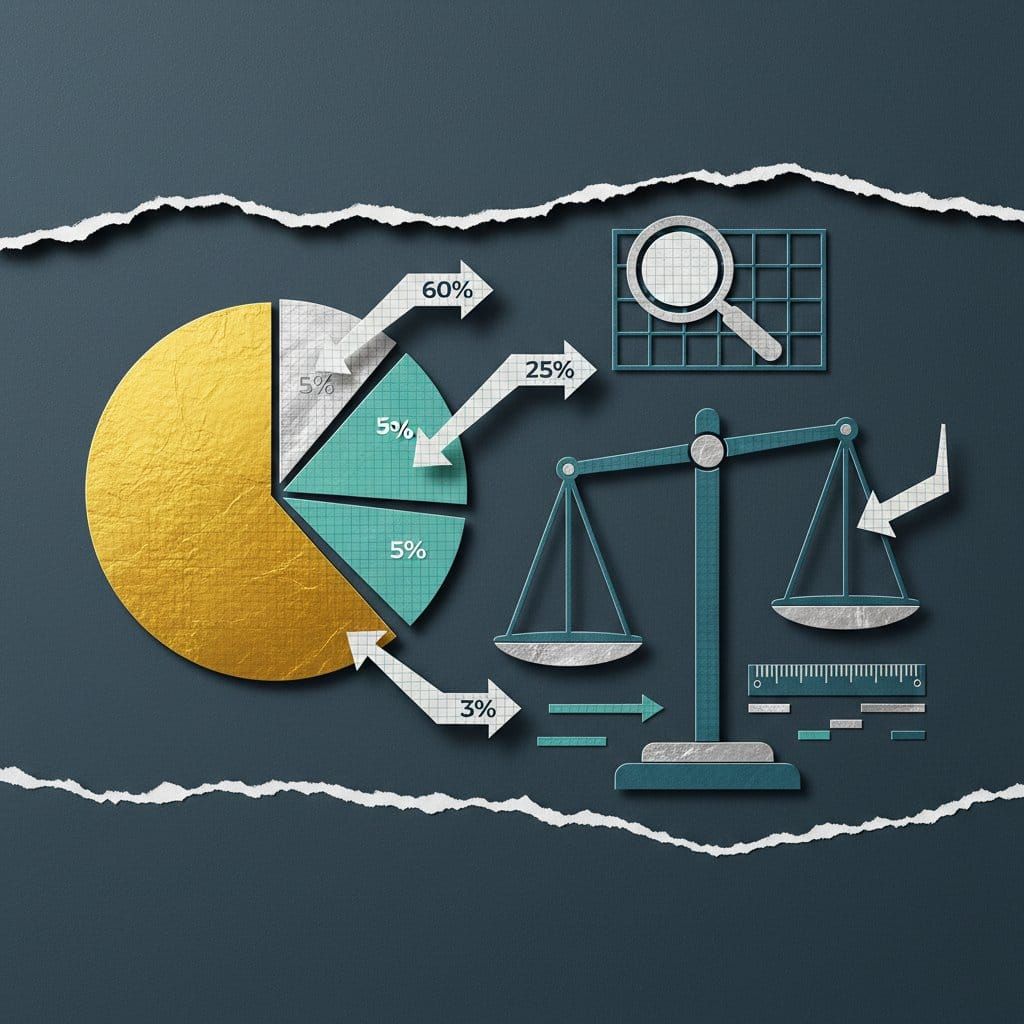
Portfolio weights should match your risk tolerance and time horizon. During Fear-index periods (F&G ≤ 35), every profile should carry 5–10 percentage points more in stablecoins than the baseline. The table below draws on Messari Crypto Theses 2026 and CoinGecko Annual Report 2026 data.
| Investor Type | BTC | ETH | Large-Cap Alts | Mid/Small Alts | Stablecoins |
|---|---|---|---|---|---|
| Conservative | 55% | 20% | 10% | 0% | 15% |
| Balanced | 40% | 25% | 20% | 5% | 10% |
| Aggressive | 30% | 20% | 25% | 15% | 10% |
| Trader | 20% | 15% | 30% | 20% | 15% |
Large-cap alts here refer to assets in the top 10 by market cap: SOL (flat at $86 on Binance), BNB, and XRP ($1.44, -0.59%). Mid/small caps ranked outside the top 50 carry substantially higher liquidity risk. For a beginner-friendly primer, see our crypto investing fundamentals guide.
Derivatives Signals: What Futures Data Is Telling You
Binance perpetual futures data as of April 25, 11:00 KST reveals a clear structural picture. BTC funding is -0.0011% — mildly negative, signaling short-side bias and reducing long-squeeze risk for holders. ETH funding is even more negative at -0.0044%, the most bearish reading in the peer group. In contrast, DOGE, ADA, AVAX, and LINK all show maximum positive funding at +0.01%, pointing to crowded retail longs in speculative names.
| Coin | Funding Rate | Open Interest | Long / Short |
|---|---|---|---|
| BTC | -0.0011% | $7.5B | 43.6% / 56.4% |
| ETH | -0.0044% | $4.7B | 67.0% / 33.0% |
| SOL | +0.0052% | $788.7M | 69.0% / 31.0% |
| XRP | +0.0039% | $368.1M | 69.7% / 30.3% |
| DOGE | +0.0100% | $316.2M | 69.0% / 31.0% |
| BNB | +0.0032% | $346.0M | N/A |
| LINK | +0.0100% | $86.1M | N/A |
| ADA | +0.0100% | $84.3M | N/A |
BTC is the only major asset with more shorts than longs (56.4% short). Combined with negative funding, this configuration can fuel a violent short-squeeze rally on any positive macro catalyst. BTC open interest at $7.5 billion dwarfs ETH at $4.7 billion, confirming BTC as the primary institutional battleground. As Tom Dunleavy, Senior Analyst at Delphi Digital, wrote in the firm's March 2026 weekly report: "Crypto portfolio max drawdown tolerance should be set at 30–40%. Beyond that threshold, position reduction is non-negotiable."
Rebalancing: When and How to Execute
Rebalancing means returning your portfolio to target weights after market drift. If BTC was targeted at 40% but rallied to 60%, you trim the excess and reinvest in underweight assets. According to CoinTracker's 2025 Annual Report, portfolios that rebalanced regularly outperformed passive holders by 8–12 percentage points per year on average.
Three approaches work in practice:
- Calendar rebalancing: Monthly or quarterly, regardless of conditions. Eliminates emotional decision-making. Best for long-term holders with limited monitoring time.
- Threshold (drift) rebalancing: Trigger when any asset drifts ±15–20% from its target weight. More market-responsive but generates more taxable events.
- Hybrid: Monthly review plus immediate action on extreme moves. Recommended for active investors managing five or more positions. Balances discipline with adaptability.
Avoid rebalancing more than twice per month. Transaction fees (Binance spot: 0.1%, reduced to 0.075% with BNB) plus capital gains obligations compound into a meaningful performance drag. For a deeper breakdown, see our portfolio rebalancing strategy guide.
5 Core Risk Management Rules
With multiple altcoins posting ±50% single-session swings and the Fear & Greed Index at 31, these rules function as circuit breakers:
- Position sizing: No single non-BTC asset exceeds 20% of portfolio value. Concentration risk is the silent portfolio killer, and today's markets prove it daily.
- Stop-loss discipline: Set a hard exit at -25% to -30% from entry on individual positions. Do not average down without re-validating the investment thesis from scratch.
- Leverage limits: Beginners — zero leverage, no exceptions. Intermediate traders — maximum 2–3x, only on assets with open interest above $300M. BTC ($7.5B OI), ETH ($4.7B), and SOL ($788.7M) qualify today. Everything else carries liquidation risk that outweighs the upside.
- Liquidity filter: Any coin with 24-hour volume below 1% of its market cap is capped at 5% of your portfolio. CHIP's near-20% single-day crash is the textbook example of thin-market liquidations cascading.
- Cold wallet separation: Assets you plan to hold over 12 months belong on a hardware wallet, not an exchange. Only active trading capital stays on-platform. See our crypto security guide for setup recommendations.
5-Stage Portfolio Construction Checklist
- Define your time horizon: Short (<1 year), medium (1–3 years), or long (>3 years). Shorter horizons require lower altcoin exposure and higher stablecoin reserves. The math is unforgiving for short-term holders caught in drawdowns.
- Assess risk tolerance honestly: Can you hold through a -30% portfolio drawdown without panic-selling? If the answer is no, choose the Conservative profile. The market will test you within months.
- Build the BTC/ETH core via DCA: Allocate 60–70% to BTC and ETH, spread purchases over 2–4 weeks. In a Fear environment, DCA eliminates timing risk entirely. Our DCA strategy guide covers execution mechanics in detail.
- Add sector-diversified altcoins: Use the remaining 20–30% across DeFi, AI, RWA, and L2 sectors. No single sector exceeds 10% of total portfolio value. With BTC dominance at 58.1%, wait for a sustained break below 55% before meaningfully increasing altcoin weight.
- Set stablecoin buffer and schedule rebalancing: Keep 10–15% in USDC or USDT at all times as dry powder. Put your first rebalancing date on your calendar today — treat it like a recurring obligation, not an optional review.
Frequently Asked Questions
How much of my portfolio should be in Bitcoin in 2026?
Given BTC dominance at 58.1%, a 40–55% BTC allocation is appropriate for most investors today. Conservative profiles should target 55%; aggressive traders can go as low as 30–35%. Monitor the 50% dominance level as the primary trigger to rotate into large-cap altcoins — below that threshold, altcoin season signals strengthen significantly. For ongoing dominance tracking, check our Bitcoin coverage section.
How often should I rebalance my crypto portfolio?
Monthly rebalancing is the sweet spot for most long-term investors. Supplement it with threshold triggers: act immediately if any asset drifts more than ±15–20% from its target weight. Avoid rebalancing more than twice per month — transaction fees and capital gains events will compound into a material drag on annual returns that offsets the benefit of tighter allocation control.
This article is for informational purposes only and does not constitute financial or investment advice. All investment decisions should be made based on your own research and risk assessment.
Related Articles
- How to Read Crypto Charts in 2026: RSI, MACD & Bollinger Bands Explained
- Bitcoin DCA Strategy 2026: How $100/Month Turned Into Nearly $1 Million
- Crypto Staking Guide 2026: APY by Coin, Risks, and Best Platforms
- Upbit vs Bithumb vs Coinone vs Binance: Korean Crypto Exchanges Compared (2026)
- Cold Wallet vs Hot Wallet: Best Crypto Wallets for 2026