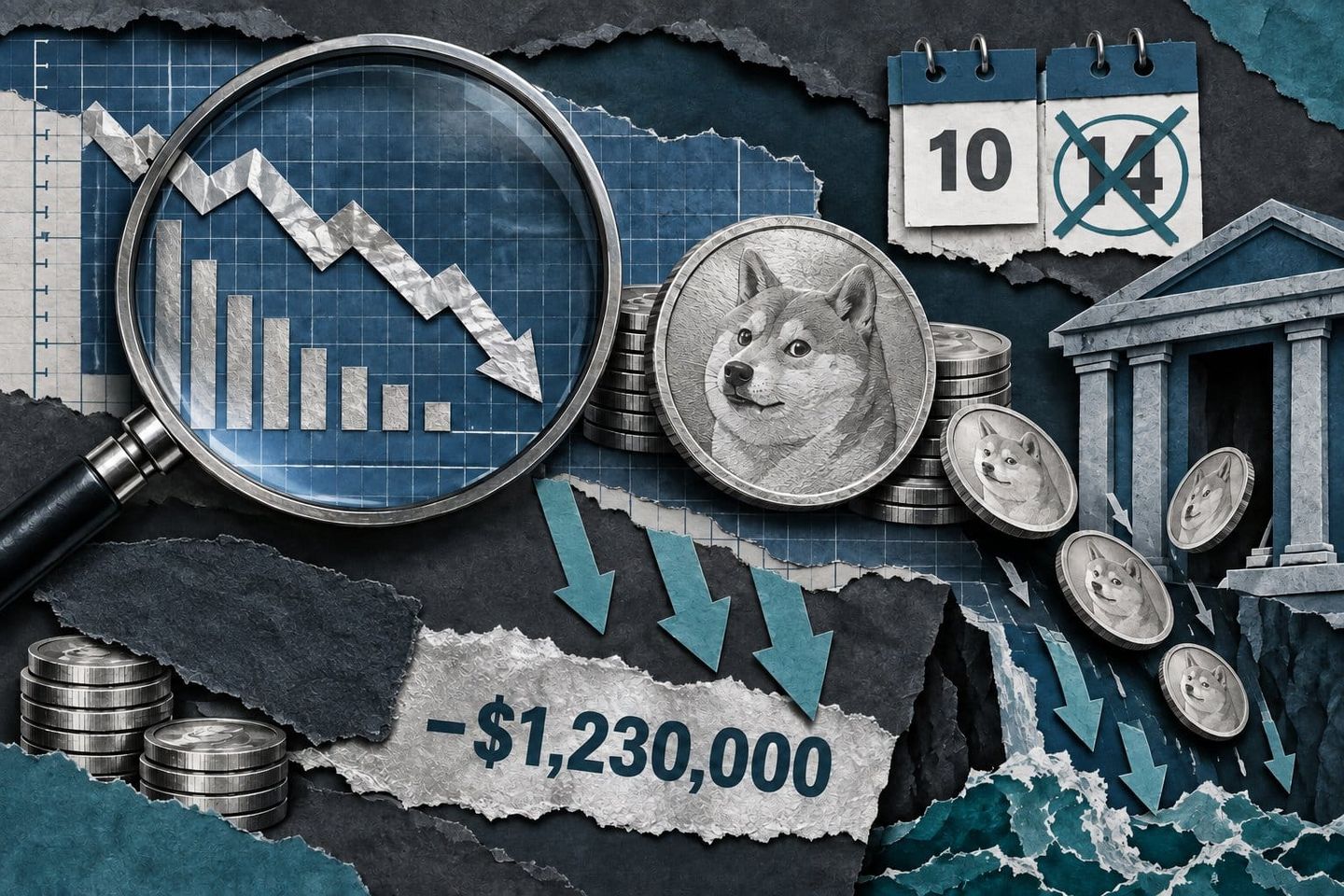
The cheapest Dogecoin ETF in the United States is shutting down — and cost had nothing to do with it. Bitwise's decision to wind down BWOW is a clean case study in the gap between product availability and actual investor demand.
Why Is Bitwise Liquidating BWOW Despite the Lowest Fee in the Category?
Bitwise is liquidating the Bitwise Dogecoin ETF (NYSE Arca: BWOW) because the fund attracted roughly $1.23 million in net outflows while rivals took in capital — Grayscale's GDOG drew about $11.7 million and 21Shares' TDOG about $1.63 million in net inflows. Fee was not the deciding variable: BWOW charged a 0.34% expense ratio against GDOG's 0.35% sponsor fee and TDOG's 0.50% management fee. The sponsor announced the closure on September 10, 2026, less than eleven months after launch.
Quick Answer: Bitwise is closing BWOW, the lowest-fee U.S. Dogecoin ETF at 0.34%, because it drew about $1.23 million in net outflows while Grayscale's GDOG pulled in roughly $11.7 million. Distribution and first-mover positioning, not cost, determined where capital went.
The balance sheet leaves little ambiguity. As of September 9, 2026, BWOW held 8,195,053.02 DOGE worth approximately $687,713 across just 50,000 shares outstanding — a net asset value down 45.37% since the fund's November 2025 inception, as of August 30, 2026 . Decrypt put net assets near $722,000 as of September 8, 2026.
The official explanation offers nothing beyond boilerplate. The Form 8-K exhibit states only that "Bitwise has determined to liquidate the Fund as it continues to optimize its product range to meet evolving investor needs," with no executive quote and no further detail. The market read it quickly: BWOW shares fell 4.54% on the announcement date.
The BWOW Liquidation Timeline: October 14, 15, and 22
The BWOW wind-down runs on a fixed three-date schedule: October 14, 2026 is the expected last day of trading on NYSE Arca and the date the fund's dogecoin holdings are converted to cash; creation of new shares stops before the market open on October 15, 2026; and on October 22, 2026 remaining shareholders receive the net asset value of their shares as of October 21, 2026, paid in cash . Bitwise states that it coordinated with the NYSE to ensure an orderly delisting and liquidation, and that "shareholders do not need to take any action during this process" .
| Date | Event | What it means for holders |
|---|---|---|
| October 14, 2026 | Expected last day of trading on NYSE Arca; DOGE holdings converted to cash | Final window to sell in the secondary market, until the close of trading |
| October 15, 2026 (pre-open) | Creation of new BWOW shares ceases | Authorized participants can no longer add shares; the arbitrage mechanism closes |
| October 21, 2026 | NAV struck for the final distribution | This NAV, not the last traded price, determines the payout |
| October 22, 2026 | Cash distributed to remaining shareholders | No action required; proceeds arrive in the brokerage account |
The structural detail worth noting is the one-week gap between the cash conversion on October 14 and the NAV date on October 21 . Because the fund's DOGE is sold on October 14, holders who stay through liquidation are no longer exposed to dogecoin price movement during that week — they hold a claim on a cash balance, less remaining expenses. Anyone who wants continued DOGE exposure must exit on or before October 14 and redeploy themselves; the liquidation does not roll positions into another product.
The halt on share creation before the October 15 open also matters for anyone still trading BWOW in its final days. Once creations stop, the mechanism that normally keeps an ETF's market price aligned with its underlying value is impaired, which can widen the spread between price and NAV in thinly traded names . With only 50,000 shares outstanding and roughly $687,713 of DOGE held as of September 9, 2026, BWOW is already among the thinnest listed crypto products, so that risk is concentrated in a small float .
Fee Leader, Capital Loser: BWOW vs. GDOG vs. TDOG by the Numbers
BWOW charged the lowest expense ratio of any U.S. spot Dogecoin ETF — 0.34%, against Grayscale's 0.35% sponsor fee on GDOG and 21Shares' 0.50% management fee on TDOG — and still finished last on capital raised . Cumulative flows put GDOG at roughly $11.7 million in net inflows and TDOG at about $1.63 million, while BWOW recorded approximately $1.23 million in net outflows . The one basis point of fee advantage moved no money.
| Fund | Ticker | Fee | U.S. listing date | Cumulative net flows |
|---|---|---|---|---|
| Grayscale Dogecoin Trust ETF | GDOG | 0.35% sponsor fee | November 24, 2025 | ≈ +$11.7M |
| 21Shares Dogecoin ETF | TDOG | 0.50% management fee | January 22, 2026 | ≈ +$1.63M |
| Bitwise Dogecoin ETF | BWOW | 0.34% expense ratio | Late November 2025 | ≈ −$1.23M |
Sources: CryptoSlate, Grayscale, 21Shares.
The flow distribution is the more revealing number. BWOW posted a non-zero daily net flow on only three trading days across its entire history . That is not a fund losing a share war; it is a fund that was almost never traded in primary-market size. Its 50,000 shares outstanding and roughly $687,713 of DOGE as of September 9, 2026 compare to the 100,000 Seed Basket shares that an affiliate of the sponsor, Bitwise Investment Manager, LLC, purchased for $2.5 million at the fund's November 25, 2025 launch — the float had already been cut in half before the closure was ever announced.
The inactivity was not unique to Bitwise. Across the Dogecoin ETF group's 199 trading days, 166 — 83% — registered zero net flow industry-wide. Even GDOG's $11.7 million and TDOG's $1.63 million were accumulated in a small number of discrete creation events rather than steady daily demand . For context on scale: the entire category's cumulative inflows are smaller than a single mid-sized allocation to a spot bitcoin product.
TDOG is the cleanest control in the experiment. It listed on January 22, 2026 — roughly two months after BWOW — and charges a fee nearly 50% higher, yet it still outraised Bitwise by a wide margin . Later start, worse price, more capital. In a category this small, fee competition is not the binding constraint — distribution and pre-existing asset bases are, which is exactly what Decrypt noted when it reported BWOW's net assets at roughly $722,000 on September 8, 2026 .
Why Grayscale's Head Start Beat Bitwise's Lower Fee
Grayscale won the Dogecoin ETF category because GDOG arrived with assets and shareholders already attached. GDOG operated as a private trust from January 2025 and held roughly $2.09 million in assets by October 31, 2025, before it ever listed on NYSE Arca on November 24, 2025 . Bitwise opened BWOW with a seed of about $2.5 million and an empty shareholder register, and the gap never closed .
The conversion mechanic matters more than the one-day listing gap. When a private trust uplists, its existing holders become ETF shareholders without having to make a new allocation decision. Grayscale's day-one base was therefore inherited, not solicited. Bitwise had to persuade advisors and retail traders to initiate a fresh position in a meme-coin product — and by the sponsor's own flow record, almost none did: BWOW registered a non-zero daily net flow on only three trading days across its entire life .
The precise launch date is worth stating carefully. Sources give BWOW's debut as November 25 or November 26, 2025; the SEC Form CERT is dated November 25, 2025, so late November 2025 is the accurate framing . Either way, the calendar edge Grayscale held was roughly 24 hours. A single day of listing priority does not explain an $11.7 million versus negative $1.23 million flow divergence — ten months of pre-built trust ownership does .
21Shares' TDOG closes the argument from the opposite direction. It listed on January 22, 2026, charges a 0.50% management fee, and still attracted about $1.63 million in net inflows while the cheaper fund bled capital . If price were the deciding variable, the ordering would be inverted. What separated the three products was shelf access and brand recall inside a category where the addressable audience was small and largely indifferent to a 16-basis-point saving.
Bitwise's own liquidation language concedes the point without naming it:
"Bitwise has determined to liquidate the Fund as it continues to optimize its product range to meet evolving investor needs" — Bitwise Investment Advisers, LLC, liquidation announcement, September 10, 2026 (source: SEC Form 8-K, Exhibit 99.1)
The operative phrase is "evolving investor needs." In a nascent, low-conviction wrapper category, those needs were never expressed as fee sensitivity. They were expressed as inertia — capital stayed where it already sat. Fee competition is a lever for mature categories with contested flows; it does not manufacture demand that has not formed yet .
Dogecoin ETF Thesis: Base, Bull, and Bear Cases After BWOW
The base case after BWOW is a product-line prune, not a category verdict. Grayscale's GDOG and 21Shares' TDOG remain listed on U.S. exchanges and both hold materially more in assets than the roughly $722,000 Bitwise wound down . Bitwise itself manages approximately $9 billion across more than 70 investment products, serving about 5,500 wealth advisors and institutional clients plus 21 banking partners, so closing one sub-$1 million fund is a rounding decision inside a large shelf . Read narrowly, this is one issuer reallocating shelf space — regulated DOGE access continues uninterrupted.
The bull case rests on consolidation. Capital that was nominally split three ways now has two destinations, and GDOG's roughly $11.7 million in cumulative net inflows against TDOG's $1.63 million suggests the category's modest demand was already concentrating before Bitwise exited . That matters because the regulated channel persists through a weak tape: DOGE traded near $0.099 on September 22, 2026, with a market capitalization around $17.1 billion on roughly 171.7 billion circulating tokens . Price sits far below the $0.48 cycle high and spent much of August 2026 below both the 50-day (~$0.075) and 200-day (~$0.10) moving averages. An advisor-accessible wrapper that survives the drawdown is positioned for whatever flows arrive if sentiment turns.
The bear case is the one the flow data supports most directly. BWOW registered approximately $1.23 million in net outflows and posted a non-zero daily net flow on only three trading days across its entire history . Across the Dogecoin ETF group's 199 trading days, 166 — 83% — registered zero net flow. That is not a distribution problem or a pricing problem; it is an absence of institutional bid for meme-coin wrappers. If flows do not accelerate, GDOG's $11.7 million and TDOG's $1.63 million are thin enough that either could face the same arithmetic Bitwise faced.
Underneath all three cases sits an asset-level risk the issuer documented itself. The BWOW prospectus states that "the unlimited supply of DOGE may negatively impact the long-term value of DOGE, and potentially the integrity of the Dogecoin Network" . DOGE has no supply cap, which means the wrapper cannot engineer scarcity into an asset that lacks it.
Weighing the three, the base case carries the most evidence today and the bear case carries the most risk. The category's survival depends on demand that has not yet appeared on any trading day in meaningful size .
Portfolio Implication: What BWOW Holders and DOGE ETF Investors Should Do
BWOW holders face a binary choice with a hard deadline: sell in the secondary market on or before the close of trading on October 14, 2026, or do nothing and receive the fund's net asset value in cash on October 22, 2026, based on the NAV struck October 21, 2026 . Bitwise states plainly that "shareholders do not need to take any action during this process" . Both routes end in cash; neither converts into DOGE or into another fund automatically.
The practical differences are execution quality and tax treatment. Selling before the October 14 close means accepting the bid in a fund that averaged near-zero turnover after launch week — BWOW traded roughly $3 million on day one and never revisited that level , which argues for limit orders rather than market orders across 50,000 shares outstanding . Holding to liquidation removes spread risk but hands you the NAV as of a single date, after the fund's DOGE is converted to cash on October 14 .
On tax: a cash liquidation is a disposition, not an in-kind transfer. In a taxable account, both selling and receiving the liquidating distribution realize gain or loss against your cost basis, with no rollover into a successor fund. Holders in tax-deferred accounts are unaffected on that dimension. This is general information, not tax advice — the specific character and timing of the distribution should be confirmed with a tax professional.
Anyone who wants uninterrupted regulated DOGE exposure has to bridge the gap themselves. Creation of new BWOW shares stops before the market open on October 15, 2026 , so rotating into Grayscale's GDOG or 21Shares' TDOG ahead of that date is the only way to avoid a cash-out window with no DOGE beta.
The broader sizing lesson is uncomfortable for fee-first investors. BWOW was the cheapest product in the group at a 0.34% expense ratio, below GDOG's 0.35% sponsor fee and TDOG's 0.50% management fee, and still finished with roughly $1.23 million in net outflows against GDOG's $11.7 million in net inflows . In thin-liquidity spot-crypto ETFs, a one-basis-point fee edge is worth less than incumbency, since the closure risk it fails to offset can cost an investor far more than the fee saved.
- Selling by Oct 14: secondary-market execution, wide spreads likely, use limits.
- Holding: cash at Oct 21 NAV, paid Oct 22, no action required.
- Staying long DOGE: rotate into GDOG or TDOG before the Oct 15 creation cutoff.
- Future selection: weight assets under management and flow consistency above a sub-20bp fee gap.
What Doesn't Change: DOGE's Market and the Remaining ETFs
The BWOW wind-down changes almost nothing outside the fund itself. Converting the trust's 8,195,053.02 DOGE — roughly $687,713 as of September 9, 2026 — into cash is a rounding error against DOGE's approximately $1.68 billion in daily trading volume . That single liquidation represents about 0.04% of one day's turnover, which is why no mechanical spot-price effect should be expected around October 14.
The underlying asset's profile is unchanged as well. DOGE traded near $0.099 on September 22, 2026, with a market capitalization of roughly $17.1 billion on a circulating supply of about 171.7 billion tokens, ranking approximately #11 by market cap . Regulated U.S. exposure also survives: Grayscale's GDOG (0.35% sponsor fee) and 21Shares' TDOG (0.50% management fee) remain listed and continue operating, both holding materially more than BWOW did .
Nor is this a retreat from crypto products by the sponsor. The closure is limited to one fund; Bitwise manages roughly $9 billion in client assets across more than 70 investment products, serving about 5,500 wealth advisors and institutional clients plus 21 banking partners .
The concrete takeaway: treat BWOW as a distribution verdict, not a DOGE verdict. Price the fund you buy on assets and flow persistence — GDOG's roughly $11.7 million in cumulative net inflows versus BWOW's approximately $1.23 million in net outflows — and read the fee line last.
Frequently asked questions
When does the Bitwise Dogecoin ETF (BWOW) stop trading?
The expected last day of trading for BWOW on NYSE Arca is October 14, 2026, and the fund's dogecoin holdings are converted to cash on that same date . Creation of new BWOW shares ceases prior to the market open on October 15, 2026 . Holders who want to exit in the secondary market rather than wait for the cash distribution must sell before the close on October 14. Bitwise said it coordinated with the NYSE to ensure an orderly delisting and liquidation, per the announcement filed as Exhibit 99.1 to a Form 8-K with the SEC.
When do BWOW shareholders get paid, and how much?
Remaining BWOW shareholders receive a cash distribution on October 22, 2026, equal to the net asset value of their shares as of October 21, 2026 . The release states plainly that "shareholders do not need to take any action during this process" — the payout is automatic through the broker holding the position. Because NAV is struck on October 21, the final amount tracks DOGE's price on that date rather than the price on the announcement day; for reference, the fund held 8,195,053.02 DOGE worth roughly $687,713 across 50,000 shares outstanding as of September 9, 2026 . See the full mechanics at StockTitan.
Why did BWOW fail despite having the lowest fee among Dogecoin ETFs?
BWOW charged a 0.34% expense ratio — below Grayscale's 0.35% sponsor fee on GDOG and 21Shares' 0.50% management fee on TDOG — and still lost capital . Cumulative flows show GDOG at roughly $11.7 million in net inflows and TDOG at about $1.63 million, while BWOW registered approximately $1.23 million in net outflows . The deciding variables were distribution and timing, not price: GDOG had run as a private trust since January 2025 with about $2.09 million in assets by October 31, 2025, then listed on NYSE Arca one day before BWOW . A 1–16 basis point fee gap is not enough to move allocators who already hold a converted position.
Are other Dogecoin ETFs closing too?
No. This is a single-fund closure. Grayscale's GDOG and 21Shares' TDOG remain listed, and both hold materially more in assets than BWOW's roughly $722,000 in net assets as of September 8, 2026 . Regulated U.S. exposure to DOGE therefore continues after October 22. The decision also does not extend to Bitwise's other funds; the firm manages roughly $9 billion in client assets across more than 70 investment products . Its stated rationale was that it "continues to optimize its product range to meet evolving investor needs," with no further explanation in the filing.
Does the BWOW liquidation affect Dogecoin's price?
There is no meaningful direct mechanical effect. Converting BWOW's 8.2 million DOGE — about $688,000 at the September 9, 2026 mark — into cash is a rounding error against DOGE's roughly $1.68 billion in daily trading volume . DOGE traded near $0.099 on September 22, 2026, with a market capitalization around $17.1 billion on a circulating supply of about 171.7 billion tokens . The signal value is about demand for the wrapper, not about spot supply: BWOW recorded a non-zero daily net flow on only three trading days in its entire history . Read the closure as a verdict on distribution, and see the demand framing at Cryptopolitan.
Enjoyed this article? Subscribe to get new stories by email whenever they're published.