What Binance Actually Bought: The $100M Circle Deal in Numbers
Binance did not simply buy a slice of Circle — it bought a seat at the table of the company that pays its distribution partners more than it earns in operating income. The numbers behind the September 2026 agreement explain why.
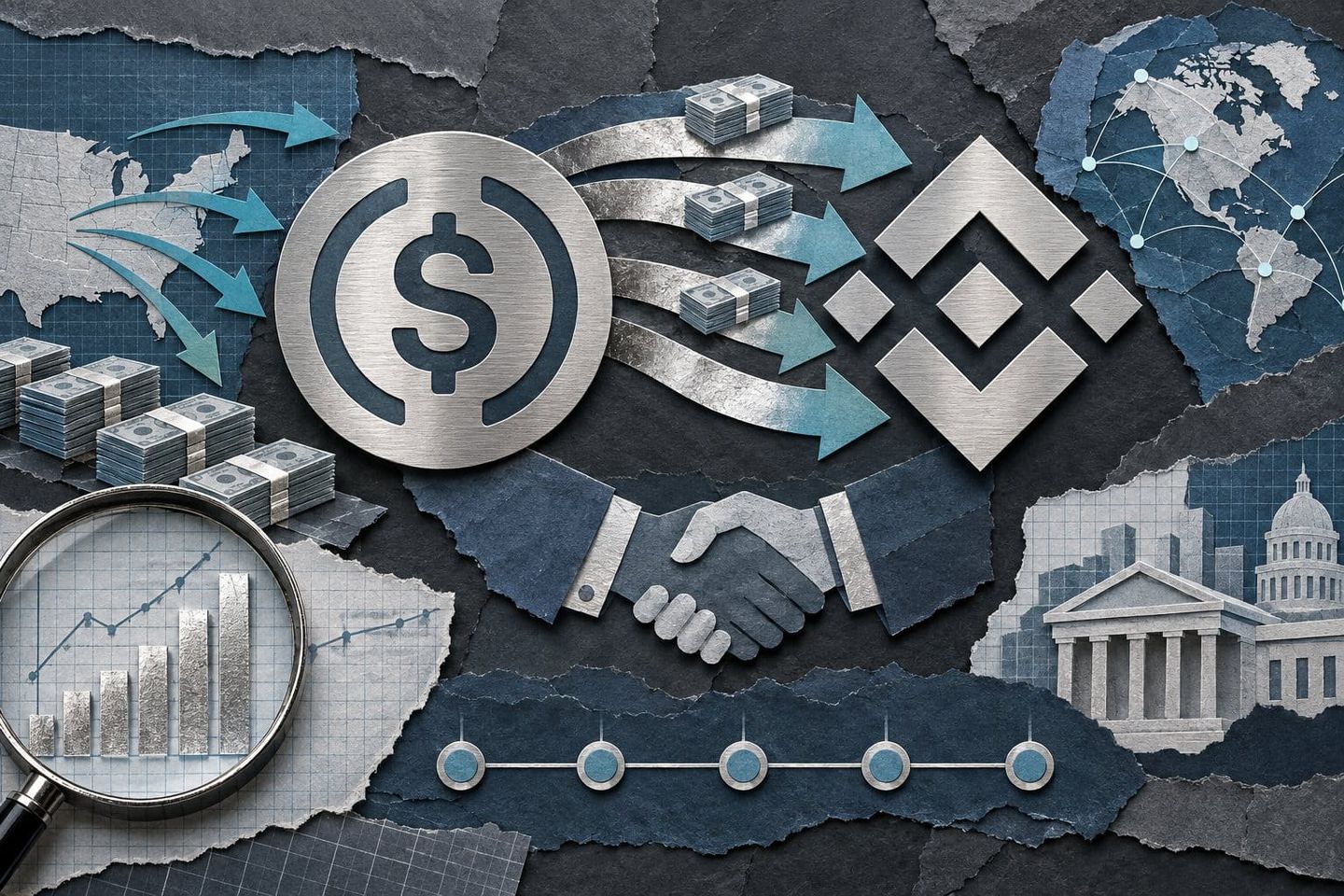
Binance acquired 1,237,011 shares of Circle Class A common stock at $80.84 per share on September 17, 2026, for aggregate proceeds of $100 million — roughly a 5% discount to that day's CRCL close . The shares were issued in a private placement exempt from registration under the Securities Act of 1933, and the equity closing occurred substantially concurrently with execution of the commercial arrangements .
At CRCL's September 21 close of $94.49, that stake marked at roughly $116.9 million on paper — but the gain is unrealizable . Binance cannot sell, transfer, pledge or hedge the position until the earlier of the second anniversary of closing or termination of the commercial arrangements, though it keeps voting rights throughout .
The commercial side is the larger change. The new agreement runs five years and supersedes the pacts the two signed in November 2024 and August 2025 . The prior arrangement, struck in late 2024, carried a $60.25 million upfront payment plus monthly fees tied to USDC balances over a two-year term . Announced from Abu Dhabi, the expanded partnership is framed around widening USDC access in emerging markets .
Why Circle Is Paying Binance to Hold USDC
Circle is paying Binance because stablecoin issuers earn on balances, not on transactions — so the issuer's core economic problem is getting coins to sit still on a large platform. Under the new arrangement, certain Circle subsidiaries agreed to pay Binance a monthly incentive fee representing a percentage of the amount of USDC held through Circle's Modular Smart Contract Wallet infrastructure service, while Binance commits to promoting and more widely integrating USDC on its platform . Circle supplies the infrastructure supporting the holding and use of USDC; Binance supplies the distribution. Either party may terminate unilaterally upon certain specified events .
The distribution being bought is the largest in the industry by user count. Binance describes itself as the world's largest crypto exchange by trading volume and registered users, serving more than 300 million users in over 100 countries . Against USDC circulation of $73.3 billion at the end of Q2 2026, up about 19% year over year , versus Tether's roughly $183 billion , the gap Circle needs to close is a distribution gap more than a product gap.
The stated target is geographic. Both companies framed the five-year agreement around expanding USDC access across emerging markets, where dollar demand is structural rather than speculative . Circle co-founder, chairman and CEO Jeremy Allaire pointed to the opportunity to leverage USDC to expand dollar access for people and businesses across global emerging markets . That is a different growth vector from trading-pair volume, and it is the one a 300-million-user retail platform is positioned to serve.
"Circle has earned its place as one of the most credible issuers in the world, spanning USDC, Arc, and the infrastructure reshaping how value moves across borders. Our $100 million investment and five-year commitment represent long-duration conviction." — Richard Teng, co-CEO, Binance (source: Circle Pressroom, 2026-09)
Read the two commitments together and the logic is symmetrical. The equity stake is locked for the earlier of two years from closing or termination of the commercial arrangements, which ties Binance's balance-sheet outcome to the same agreement generating its fee income . Circle, meanwhile, converts a variable marketing problem into a contractual cost line it can model for five years . Whether that cost line is worth paying is a question the Coinbase arrangement already answers in numbers.
The Coinbase Precedent: Why $908M/Year Matters More Than $100M
Circle's distribution economics are already dominated by one exchange partner: of roughly $1.01 billion in total distribution costs in 2024, $908 million went to Coinbase . Under that arrangement Coinbase receives 100% of reserve income on USDC held on its own platform, plus a share of income generated elsewhere . Against that baseline, Binance's $100 million equity cheque is a rounding item — the recurring monthly incentive fee is the number that matters .
The Q2 2026 income statement shows how little room that leaves. Circle reported $701.3 million of revenue and reserve income against $410.4 million in distribution and transaction costs, leaving roughly $34.4 million of operating income . In other words, about 59 cents of every revenue dollar leaves the business before Circle pays engineers, compliance staff or marketing. A single percentage-point shift in the blended distribution rate moves operating income by tens of millions — which is why the fee percentage Circle agreed to with Binance, undisclosed in the Form 8-K, is the most consequential unpublished term in the deal .
| Metric | Figure | Read-through |
|---|---|---|
| 2024 payments to Coinbase | $908M | ~90% of all distribution costs concentrated in one partner |
| 2024 total distribution costs | ~$1.01B | Structural, not discretionary, spend |
| Q2 2026 revenue + reserve income | $701.3M | Rate-sensitive top line |
| Q2 2026 distribution + transaction costs | $410.4M | ~58.5% of revenue paid out |
| Q2 2026 operating income | ~$34.4M | ~4.9% operating margin |
| Coinbase revenue-share expiry | 2029 (renewed, existing terms) | No near-term renegotiation lever |
| Prior Binance pact (late 2024) | $60.25M upfront + monthly fees, 2-year term | New deal: 5-year term, monthly fee only |
Two details make the Coinbase comparison more than an analogy. First, Circle renewed the Coinbase revenue-share through 2029 on existing terms, so the largest payout line is locked in rather than up for renegotiation . Second, the Binance agreement supersedes the November 2024 and August 2025 arrangements and runs five years instead of two, converting what was a shorter-dated experiment into a second standing recurring payout stacked on top of the Coinbase structure . The prior pact carried a $60.25 million upfront component; the new one is fee-driven, which scales with balances rather than being expensed once .
The practical read for anyone sizing CRCL exposure: distribution cost is the operating variable, not USDC circulation. USDC supply reached $73.3 billion at the end of Q2 2026, up about 19% year over year, yet operating income stayed under $35 million . Growth flows through a cost structure that captures much of it at the exchange layer. Binance brings distribution reach across more than 300 million users in over 100 countries, and Circle is paying for access to that funnel on a percentage-of-balances basis for the next five years . Whether that trade improves margins or simply widens the payout base is the question the next two quarters of filings will settle.
Base Case: What This Deal Does for USDC's Market Position
The base case is incremental share gain, not a reversal of the stablecoin hierarchy. USDC circulation stood at $73.3 billion at the end of Q2 2026, up roughly 19% year over year , against Tether's USDT at approximately $183 billion — roughly 63% of a stablecoin market near $292 billion . Even a well-executed five-year Binance distribution push does not close a $110 billion gap. What it plausibly does is move USDC's growth rate above the market's, in specific corridors, at a defined cost per dollar of balance.
The geography is the part worth underwriting. Circle and Binance both framed the agreement around expanding dollar access in emerging markets, and Binance reports serving more than 300 million users across over 100 countries . USDT's dominance is concentrated precisely in those markets — Latin America, Southeast Asia, Turkey, parts of Africa — where dollar demand is retail, high-velocity, and largely indifferent to attestation quality. Winning share there means competing on the one axis Circle can control through a partner: where the balance sits by default.
Timing reinforces the rail story rather than the retail one. The equity closing landed a day after Circle opened Arc, its EVM-compatible Layer 1 using USDC as the gas token, with a permissioned validator set that includes BlackRock, Visa, Mastercard and DTCC . Binance was already among the exchanges providing Arc on-ramps before the subscription agreement was signed on September 17 . The $100 million and the five-year term therefore deepen an existing technical relationship rather than open a new one — closer to converting a counterparty into a stakeholder than to buying distribution from scratch.
Read that way, the base case is modest and specific: USDC compounds from a $73 billion base at a mid-to-high-teens rate with improved emerging-market penetration, institutional settlement volume migrates toward Arc where USDC is structurally required, and the market-share ratio against USDT narrows slowly rather than flipping. The prior Binance arrangement — a $60.25 million upfront payment plus balance-linked monthly fees over two years, struck in late 2024 — gives a partial benchmark for what the spend bought last time . Balance growth on Binance over the next two reporting periods is the cleanest test of whether the renewal was priced correctly.
Bull Case vs. Bear Case for CRCL Holders
For CRCL shareholders, the Binance deal is best read as a trade of near-term margin for multi-year distribution certainty. The bull case rests on a five-year term that removes the renewal cliff attached to the two-year 2024 pact, plus access to a user base Binance describes as more than 300 million people across over 100 countries . The bear case is arithmetic: Circle's distribution line already absorbs most of its reserve income, and this adds another claim on it.
Bull case. The new arrangement supersedes the November 2024 and August 2025 agreements and runs five years, which pushes the next renegotiation out to 2031 rather than leaving a renewal decision hanging over the 2026 filing cycle . Structurally, the lockup matters as much as the term. Binance bought 1,237,011 Class A shares at $80.84 and cannot sell, transfer, pledge or hedge them until the earlier of the second anniversary of closing or termination of the commercial arrangements, while retaining voting rights throughout . With CRCL closing at $94.49 on September 21, that stake was worth roughly $116.9 million on paper and unrealizable . An exchange that profits from USDC float and cannot exit its equity for two years has a different incentive profile than a fee-only counterparty.
Bear case. The margin math leaves little slack. In Q2 2026 Circle reported $701.3 million of revenue and reserve income against $410.4 million in distribution and transaction costs, producing about $34.4 million of operating income . The Coinbase arrangement alone consumed $908 million of roughly $1.01 billion in 2024 distribution costs and has been renewed through 2029 on existing terms . A new monthly incentive fee tied to Binance-held balances is therefore additive to an expense base that already tracks float growth one-for-one. If balances migrate between partner platforms rather than expanding the total, Circle pays twice for the same dollar.
The second bear-case input is counterparty concentration. In March 2023, USDC broke its $1 peg after Circle disclosed that $3.3 billion of reserves — about 12.2% of roughly $40 billion — was stranded at the failed Silicon Valley Bank, a break visible across the 14-, 30-, 90-, 180-day and one-year price history before the peg was restored (video: Digital Asset News) . Each additional distribution partner concentrates more float on fewer platforms, and either party may terminate unilaterally on specified events . That optionality cuts both ways.
Portfolio Implication: How to Read This for CRCL and USDC Exposure
For portfolio purposes, this is a distribution-economics event for CRCL equity and a liquidity-routing event for USDC — not a repricing event for the token itself. USDC remains a 1:1 dollar-reserve instrument, so no commercial agreement moves its price; what the Binance deal moves is where USDC float sits and what percentage of Circle's reserve income leaves the company before it reaches operating profit. Circle reported $701.3 million of revenue and reserve income against $410.4 million of distribution and transaction costs in Q2 2026, leaving roughly $34.4 million of operating income . That ratio is the number that matters.
CRCL equity holders should weight the near-term structural terms above the five-year headline. Binance subscribed at $80.84 per share, roughly a 5% discount to the September 17 close , versus a CRCL close of $94.49 on September 21 . The two-year restriction on selling, transferring, pledging or hedging — with voting rights retained — means the 1,237,011 shares are not a float event until 2028 at the earliest, or earlier if the commercial arrangements terminate .
For stablecoin allocators, the practical read is concentration, not credit. USDC circulation stood at $73.3 billion at the end of Q2 2026, up about 19% year over year , against USDT's roughly $183 billion in a stablecoin market near $292 billion . More of that float now routes through two venues rather than one.
- Track quarterly: distribution-and-transaction costs as a percentage of revenue and reserve income — the Q2 2026 baseline is 58.5% .
- Track monthly: USDC circulation growth rate. Incremental supply is what the Binance incentive fee is buying; flat circulation with rising costs is the bear signal.
- Track in filings: disclosure of the Binance monthly fee percentage, which Circle's 8-K describes only as a percentage of USDC held through its Modular Smart Contract Wallet service .
- Do not track: USDC price as a deal outcome. It is pegged, and the 2023 depeg was a reserve-custody failure, not a distribution one.
Framed as a moat question: Circle is buying distribution it does not own, on renewable terms, from counterparties that can terminate. Whether that is accretive depends entirely on whether incremental circulation outruns incremental fees .
What Comes Next: Terms to Watch Before 2028
The next verifiable checkpoints for this deal are Binance's lockup expiry, Circle's distribution-cost line, and Arc's on-ramp activity. Binance cannot sell, transfer, pledge or hedge its 1,237,011 CRCL shares until the earlier of the second anniversary of the September 17, 2026 closing — roughly September 2028 — or termination of the commercial arrangements . That "earlier of" clause is the detail worth tracking: any commercial unwind before 2028 releases the stake early, so an unexpected Form 4 or 13D amendment would be a signal about the partnership, not just about Binance's treasury.
Three further items belong on a watchlist:
- Termination triggers. Either party may unilaterally terminate the five-year agreement upon specified events, and Circle has not published the full trigger list — only that the pact supersedes the November 2024 and August 2025 arrangements . Future 10-Q risk-factor language is where that detail would surface.
- The distribution-cost line. Q2 2026 showed $410.4 million of distribution and transaction costs against $701.3 million of revenue, leaving roughly $34.4 million of operating income . The first full quarter under the Binance fee will show whether a second balance-linked partner compresses that spread the way the $908 million Coinbase arrangement does.
- Arc and on-ramps. Arc launched with a permissioned validator set including BlackRock, Visa, Mastercard and DTCC, and Binance among the on-ramp providers . Balance growth on the Modular Smart Contract Wallet service is the practical test.
The concrete takeaway: judge this deal by USDC circulation against the ~$73.3 billion Q2 2026 base and by Circle's disclosed fee burden — not by the $100 million headline, which is already priced and locked up.
Last updated: 2026-09-23.
Frequently asked questions
How much did Binance invest in Circle?
Binance invested $100 million in Circle Internet Group (NYSE: CRCL) through a private placement. Circle issued and sold 1,237,011 shares of Class A common stock, par value $0.0001 per share, at $80.84 per share on September 17, 2026 — roughly a 5% discount to that day's closing price . The shares were sold in a transaction exempt from registration under the Securities Act of 1933, so they were not offered to public investors .
How long is Binance locked up from selling its Circle stake?
Binance cannot sell, transfer, assign, pledge or hedge the shares until the earlier of the second anniversary of the closing date or a termination of the commercial arrangements, subject to customary exceptions . Binance keeps voting rights on the stock throughout the lockup period . Practically, that means the paper gain on the position — CRCL closed at $94.49 on September 21, valuing the stake near $116.9 million — is unrealizable on that timeline .
What does Circle pay Binance for under the USDC deal?
Circle subsidiaries agreed to pay Binance a monthly incentive fee calculated as a percentage of USDC balances held through Circle's Modular Smart Contract Wallet infrastructure service. In return, Binance undertakes activities promoting and more widely integrating USDC across its platform, while Circle supplies the infrastructure supporting the holding and use of the token . The arrangement runs five years and supersedes the agreements the two parties signed in November 2024 and August 2025; either side may terminate unilaterally on specified events . The earlier 2024 pact carried a $60.25 million upfront payment plus monthly balance-linked fees over two years .
How does the Binance deal compare to Circle's Coinbase arrangement?
The Coinbase arrangement remains far larger. In 2024, $908 million of Circle's roughly $1.01 billion in total distribution costs went to Coinbase, which receives 100% of reserve income on USDC held on its platform plus a share of income generated elsewhere; Circle renewed that revenue-share through 2029 on existing terms . The Binance deal is structurally similar — pay a distribution partner for balances held — but newer and disclosed only as a percentage-based monthly fee rather than a full pass-through of reserve income . For scale, Circle reported $701.3 million of revenue and reserve income against $410.4 million in distribution and transaction costs in Q2 2026, leaving about $34.4 million of operating income .
Is this deal positive for USDC's price?
No — USDC is a dollar-pegged stablecoin, so distribution deals do not drive price appreciation. What changes is reach and cost structure: wider integration on an exchange that reports more than 300 million users in over 100 countries can lift circulation, while the monthly incentive fee adds to Circle's distribution expense line . USDC circulation stood at $73.3 billion at the end of Q2 2026, up roughly 19% year over year , against Tether's USDT at about $183 billion . Peg integrity depends on reserve quality and banking counterparties, as the March 2023 Silicon Valley Bank episode showed, when $3.3 billion of reserves — about 12.2% of roughly $40 billion — was briefly stranded and USDC traded below $1 before the peg was restored (video: Digital Asset News) .
Watch / Sources
- Digital Asset News — THE CIRCLE USDC NATIONAL CRYPTO BANK IS COMING. WATCH OUT!
- Digital Asset News — USDC STABLECOIN IN TROUBLE. HERE'S WHY & WHAT YOU NEED TO KNOW NOW.
- Digital Asset News — USDC CIRCLE CEO CALLS FOR CBDC's? ARE THEY INEVITABLE?
Enjoyed this article? Subscribe to get new stories by email whenever they're published.