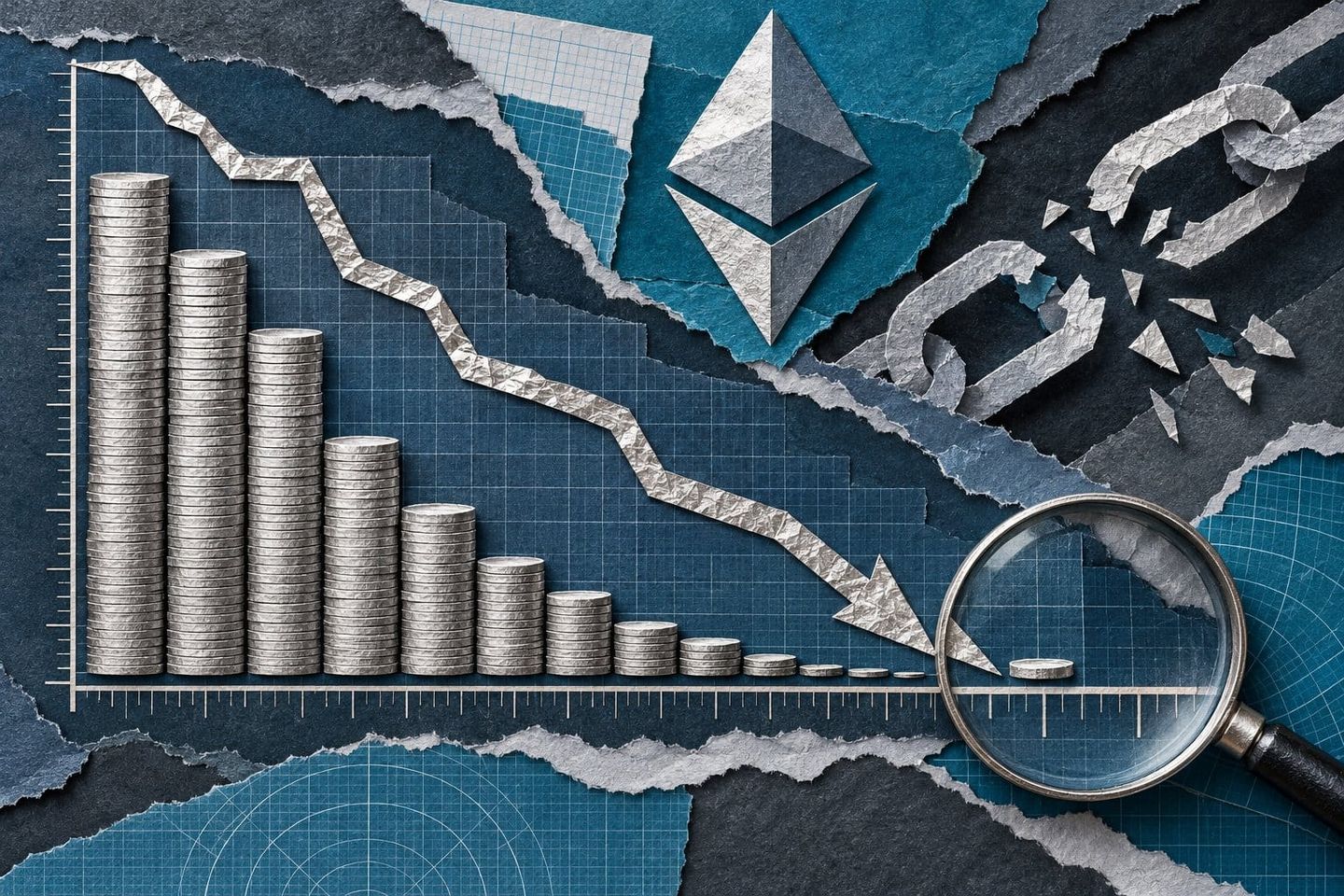
Blast was an Ethereum layer-2 that pulled in more than $2 billion in deposits within months of launch. It is now closing because running the chain costs more than it earns. Anyone with funds still on the network has until October 26, 2026 to withdraw them the easy way.
Why Is Blast Shutting Down, and What Is the Deadline?
Blast is shutting down because the cost of operating the chain now exceeds the revenue it brings in. The team announced the wind-down on its official X account on October 2, 2026. It set October 26, 2026 as the last day to withdraw through the normal Blast interface . According to CoinDesk, citing DefiLlama data, Blast's DeFi total value locked (TVL) peaked at about $2.2 billion in June 2024 . By the time of the announcement it had fallen to roughly $32 million, a drop of about 98% . As of today, October 23, the regular exit route has three days left.
Quick Answer: Blast is closing because operating costs exceed the chain's revenue. Its DeFi TVL fell from about $2.2 billion in June 2024 to roughly $32 million in October 2026. Users have until October 26, 2026 to withdraw through the normal interface. After that, funds stay claimable, but only by interacting directly with the bridge contracts on Ethereum.
The team's own statement makes clear this is a business decision, not a technical failure:
"We launched Blast with the goal of building a self-sustaining chain for users and developers. Unfortunately, the economics of operating the chain no longer make sense. The ongoing costs of maintaining Blast exceed the revenue generated by the L2, and we do not see a credible path to making the chain economically sustainable," — the Blast team, in its official shutdown announcement on X (source: Forklog)
The team called the decision difficult and apologized to the users and developers who built on Blast. It also warned the community about accounts impersonating the project, per KuCoin News . Blast was built by "Pacman" (Tieshun Roquerre), the founder of the NFT marketplace Blur. It had raised $20 million from Paradigm and Standard Crypto in November 2023 .
Traders should keep four facts in mind:
- It is a voluntary wind-down, not an exploit. No hack or loss of user funds has been reported. The closure is about economics.
- No compensation fund or buyback has been disclosed. According to Smithii, users are responsible for moving their own assets out .
- October 26 is a convenience deadline, not a loss deadline. Funds left on Blast after that date can still be claimed, but only by interacting directly with the Blast Bridge contracts on Ethereum L1, per CryptoSlate . That route carries more risk of user error and fake clone contracts.
- Revenue had already all but disappeared. In the 24 hours before the announcement, the chain earned about $110 in revenue against $124 in fees, per DefiLlama data reported by FXStreet . That compares with about $3.5 million for the month of June 2024.
In short, Blast drew billions in deposits, but almost none of that activity stayed. Once revenue fell below the cost of running the network, shutting down was the only option the team described as realistic.
How Did Blast Reach $2 Billion So Fast?
Blast reached about $2 billion by paying people to deposit and stay locked in, not by attracting users to its apps. It offered "native yield" on idle ETH and stablecoins, and it gave out points toward an expected token airdrop. Deposits could not leave until mainnet. Startup Fortune, citing CoinDesk, puts deposits at about $2.27 billion when mainnet launched on February 29, 2024 . Most of that money arrived before there was a working chain to use.
Blast opened early access in November 2023. The project was led by the Blur founder known as "Pacman" (Tieshun Roquerre), who brought a large NFT trading audience with him from Blur . On November 20, 2023, the team disclosed $20 million in funding from Paradigm and Standard Crypto . Those backers made the project look credible at a time when most new layer-2s were struggling to get noticed.
The native yield pitch
Native yield means deposits earn a return automatically, without the user taking any action. On most layer-2 networks, bridged ETH earns nothing. Blast said its version would work like this, according to CryptoSlate:
- ETH: deposits were staked through Lido, so balances earned Ethereum staking yield.
- Stablecoins: deposits earned yield through MakerDAO.
- Points: depositors collected points that were widely expected to turn into a token airdrop .
The combination worked for depositors. They kept their ETH exposure, earned staking yield, and got a claim on a future token. The cost was liquidity: funds stayed locked until mainnet.
The deposit timeline
| Date | Milestone | Approx. deposits |
|---|---|---|
| Nov 2023 (first 48 hours) | Early access opens | ~$230 million |
| Nov 20, 2023 | $20M funding from Paradigm and Standard Crypto disclosed | n/a |
| Early Dec 2023 | Deposits locked, points accruing | ~$720 million |
| Just before mainnet | Deposits still locked | ~$2 billion |
| Feb 29, 2024 | Mainnet launch | ~$2.27 billion |
The figures in this table come from Startup Fortune, which cites CoinDesk reporting . CoinDesk separately reported that users had sent more than $1.1 billion before launch, partly because they expected an airdrop .
What the early TVL actually measured
Total value locked (TVL) is the dollar value of assets deposited in a network's protocols. People usually read it as a sign of demand. Blast's pre-launch number is hard to read that way. Before February 29, 2024 there were no live applications, no trading and no way to withdraw. The money was sitting in a yield-bearing waiting room. Technically, Blast was an Ethereum-compatible optimistic rollup . In practice, its first $2 billion reflected how much people expected from the airdrop more than how much they used the chain. When those expectations were met, or let down, much of the capital had no reason to stay.
What Do the Numbers Show: TVL, Bridge Assets, Revenue and Users?
Blast's numbers show a chain that lost almost all of its capital and income. DeFi total value locked (TVL) fell from a peak of about $2.2 billion in June 2024 to about $32 million when the shutdown was announced, a drop of roughly 98% . Monthly revenue went from millions of dollars to a few thousand. By the end, the chain was taking in less in a day than it paid in fees.
The size of the decline is not in dispute, but the exact peak depends on the source. According to CoinDesk, which cites DefiLlama, TVL peaked at about $2.2 billion. FXStreet gives $2.26 billion , and Startup Fortune gives about $2.27 billion at the February 29, 2024 mainnet launch . A fair way to state it is a peak of $2.2 billion to $2.3 billion. The low end also kept moving. A day after the announcement, FXStreet reported TVL of $24.7 million .
TVL vs. TVS: two ways to count what's left
TVL counts capital deployed in DeFi apps on the chain. Total value secured (TVS) counts all assets held in the rollup's bridge, whether or not they are used in DeFi. For anyone with funds still on Blast, TVS is the more useful figure, because it shows what is waiting to be withdrawn. L2Beat currently shows $47.22 million secured, down 13% over seven days . It breaks down as follows:
- ETH and derivatives: $33.58 million (71.1%)
- Stablecoins: $9.24 million (19.5%)
- BLAST token: $3.79 million (8.04%)
Startup Fortune put the bridged balance at about $51 million at announcement time, including about $46.6 million of ETH staked through Lido . That Lido position explains why the team has to unstake before withdrawals can be processed. The gap between about $32 million in TVL and $47 million to $51 million in the bridge means a meaningful share of user funds was sitting idle rather than in active DeFi positions.
Revenue: from $3.5 million a month to $110 a day
The revenue figures show why the team said the chain no longer covered its costs. Blast earned about $3.5 million in June 2024 . Last month, CoinDesk put revenue at $1,793 , while Forklog reported $6,532 . Either way, that is a decline of more than 99%. In the 24 hours before the announcement, DefiLlama data cited by FXStreet showed $110 in revenue against $124 in fees . At that point the chain was losing money on its own transaction flow, before counting staff, infrastructure or the cost of posting data to Ethereum.
User activity: treat with caution
Some coverage reports that daily active addresses fell from about 37,000 to 2,648, a 92.8% drop. None of the sources reviewed for this article link that figure to primary on-chain data, so we treat it as unverified and leave it out of the table below. The direction fits every other metric, but the exact size has not been confirmed.
| Metric | Peak or launch value | Value at shutdown | Source |
|---|---|---|---|
| DeFi TVL | ~$2.2B–$2.3B (June 2024 peak) | ~$32M (Oct 2, 2026); $24.7M a day later | CoinDesk / DefiLlama, FXStreet |
| Bridge assets (TVS) | ~$2.27B at Feb 2024 mainnet | $47.22M (L2Beat); ~$51M (Startup Fortune) | L2Beat, Startup Fortune |
| Lido-staked ETH in bridge | Not disclosed | ~$46.6M | Startup Fortune |
| Monthly revenue | ~$3.5M (June 2024) | $1,793 (CoinDesk) or $6,532 (Forklog) | CoinDesk, Forklog |
| 24-hour revenue vs. fees | Not applicable | $110 revenue / $124 fees | DefiLlama via FXStreet |
Why Did the Economics Fail? Mercenary Capital and Airdrop Farming
Blast's economics failed because most of its deposits were there to farm an airdrop, not to use the chain. When the BLAST token was distributed in June 2024 , the capital that had been waiting for it started to leave. TVL peaked at about $2.2 billion that same month . It then declined for more than two years until the October 2026 shutdown. Without users who stayed after the incentives ended, fee revenue could not cover the cost of running the network.
Coverage of the closure describes Blast as a textbook case of "mercenary capital." That term means liquidity that goes wherever the next reward is and leaves as soon as the reward is paid out (source: Forklog, 2026-10). Blast's design encouraged this. Deposits earned native yield and collected points toward an expected token, so the most profitable move was to deposit, wait and exit. Once the airdrop was claimed, many depositors had no reason to keep assets on the network.
"TVL inflated by farming incentives is not demand, it's a loan against future attention," — Startup Fortune analysis of the Blast shutdown (source: Startup Fortune)
That framing explains why the headline figure misled people. In early 2024, a multibillion-dollar TVL looked like proof of demand. In practice it was borrowed against the airdrop. Once the token was paid out, the deposits did not stay, and the chain had to compete on its own merits.
On those merits, Blast was up against much larger rivals. CoinDesk cites rising operating costs and competition from bigger networks, including Coinbase's Base and Robinhood's own chain-building effort . Those competitors have built-in user bases from their parent exchanges and brokerages. Blast had a points program, and that program had already ended.
The revenue figures show how big the gap became. In the 24 hours before the announcement, Blast earned about $110 in revenue against $124 in fees, per DefiLlama data cited by FXStreet . Every rollup has ongoing costs, including:
- Sequencer operations: the infrastructure that orders and processes L2 transactions around the clock.
- Data posting to Ethereum: publishing transaction data to L1, which a rollup must do to inherit Ethereum's security.
- Engineering, monitoring and security: keeping bridge contracts, nodes and tooling maintained.
Blast has not published its cost breakdown, so no exact operating figure is available. Still, about $110 a day works out to roughly $40,000 a year, which cannot plausibly fund all three. The team said as much in its announcement: "The ongoing costs of maintaining Blast exceed the revenue generated by the L2, and we do not see a credible path to making the chain economically sustainable" (source: CryptoSlate, 2026-10).
For traders, the takeaway is to judge any incentive-heavy chain by what is left after the rewards end. Look at sustained fee revenue, active addresses and TVL after the token launch, not the peak deposit figure. Startup Fortune places Blast in a wider L2 and DeFi shakeout that also took down Kinto and Starknet lender zkLend in 2025 , which suggests the pattern is not limited to Blast.
How Do You Withdraw From Blast Before October 26?
To withdraw from Blast, move every on-chain asset to Ethereum mainnet through the official Blast interface by October 26, 2026. That includes balances inside the Blast PWA web app . As of today, October 23, that leaves about three days to use the normal route. After the deadline, your funds can still be claimed, but the process is harder and easier to get wrong (source: KuCoin News, 2026-10).
The exit happens in a fixed order. If you skip a step, the transfer may fail or your funds may stay stuck on the L2.
- Step 1: Get funds out of Blast DeFi apps first. Assets inside lending pools, DEX liquidity positions or vaults on Blast may need to be withdrawn from each app before they can be bridged (source: Smithii, 2026-10). Once they are back in your wallet on Blast, bridge everything to Ethereum mainnet, including any Blast PWA balance .
- Step 2: Wait for the Lido unwind. Blast's native yield came from staking user ETH with Lido, so the team has to unwind those positions first. That was expected to take about one week, and all user withdrawals were paused during that time . Startup Fortune estimated that about $46.6 million of ETH was staked with Lido when the shutdown was announced .
- Step 3: Use the shorter 24-hour exit window. Once the unwind is finished, the withdrawal delay drops from 7 days to 24 hours . L2Beat now lists a 1-day challenge period, "recently reduced from 7 days" . In practice, a withdrawal you start through the interface should be claimable on L1 about a day later. Plan for that delay, plus Ethereum gas, when you decide how close to the deadline you can leave it.
What happens after October 26? Funds left on Blast are not forfeited. They stay claimable, but only by interacting directly with the Blast Bridge contracts on Ethereum L1. The team said it would publish detailed instructions before the deadline . Calling contracts directly carries more risk of user error. It also gives scammers an opening, since fake "claim" pages and clone contracts tend to appear around deadlines like this (source: Smithii, 2026-10). This is a voluntary wind-down for economic reasons, and no compensation fund or buyback has been disclosed. Any message offering "compensation" should be treated as a red flag.
Before you sign any withdrawal, run through this safety checklist:
- Use only official Blast channels. Follow the official Blast X account and the official bridge interface for updates and instructions.
- Ignore impersonators. Blast itself warned users about accounts posing as the project . Replies, DMs and "support" accounts are common phishing routes.
- Verify contract addresses. If you go the direct L1 route, check the Blast Bridge address against the team's published instructions and an independent tracker such as L2Beat before approving anything.
- Never sign unsolicited links. Don't connect your wallet to sites you reached from a DM, airdrop banner or search ad, and reject any unexpected approval or permit signature.
- Don't wait until the last hour. With a 24-hour challenge period, gas spikes and possible interface congestion, starting early leaves room to fix mistakes.
What Are the Security and Governance Risks for Funds Left Behind?
Funds left on Blast after October 26 sit on a chain with weak security guarantees, and those guarantees will not improve during the wind-down. L2Beat, the independent tracker, does not rate Blast even as Stage 0, its lowest rollup maturity level . A small group of keyholders controls the bridge contracts that hold the remaining assets. Every extra day you leave funds there, you are trusting that group and its operational security.
The main technical gap is the proof system. L2Beat says "the proof system is still under development," so users depend on the honesty of the proposer, the party that posts the chain's state to Ethereum . An optimistic rollup is supposed to let anyone challenge an invalid state root during the challenge period. Without a working proof system, that challenge mechanism does not actually protect anyone. The challenge window, which L2Beat says was "recently reduced from 7 days" to 1 day, now mostly sets how long withdrawals take .
Governance is the second risk. According to L2Beat, a 3-of-5 multisig called "BlastMultisig 1" controls the critical contracts and can upgrade them with no delay. L2Beat says this leaves "no window for users to exit in case of an unwanted upgrade" . Startup Fortune makes the same point: five keyholders control the bridge, and any three of them can pause withdrawals . L2Beat also warns that funds can be frozen if the bridge runs short of liquidity. That matters because user ETH has to be unwound from Lido before it can be paid out.
| Risk | What it means | Who is exposed | Mitigation |
|---|---|---|---|
| No functioning proof system | State roots depend on the proposer's honesty, not on fraud proofs | All bridged assets | Withdraw before October 26 through the official interface |
| 3-of-5 instant-upgrade multisig | Contracts can be changed with no exit window | Anyone holding funds after a key compromise or bad upgrade | Shorten your exposure; check contract addresses on L2Beat |
| Withdrawal pause / liquidity freeze | Three keyholders can halt exits; a liquidity shortfall can freeze funds | Late withdrawers | Start early instead of waiting for the final window |
| Direct-contract claims after the deadline | Manual L1 calls increase the chance of mistakes and scam clone contracts | Users who miss October 26 | Use only the instructions Blast publishes; verify every address |
The last risk is the user's own error. After the deadline, funds stay claimable, but only by interacting directly with the Blast Bridge contracts on Ethereum L1. Smithii notes this route raises the risk of user error and of scam clone contracts posing as the real bridge . The same source says no compensation fund or buyback has been disclosed, so lost funds are unlikely to be recovered . Your exposure is set by two things: how long your funds stay on the bridge, and how carefully you handle the exit.
- Before October 26: leave DeFi positions on Blast first, then bridge everything to Ethereum mainnet through the official interface.
- After October 26: follow only Blast's published direct-contract instructions, and cross-check contract addresses against L2Beat.
- Always: treat any third-party "recovery" or "claim" service as a likely scam.
What Happened to the BLAST Token?
BLAST has lost roughly 98–99% of its value from its peak. The token's market cap was about $16.9 million after the shutdown announcement, compared with a peak of $468.2 million, according to Forklog . Most of that loss happened well before October 2026. The shutdown news pushed the price lower, but the decline had started more than a year earlier. Traders should see the shutdown as confirming a long slide rather than as one sudden crash.
The token went live in June 2024, a few months after the February 2024 mainnet launch (source: Startup Fortune, 2026-10) . Forklog's timeline of the price:
- January 2024: an all-time high of about $0.029. Forklog dates this to pre-launch trading, which came before the official June 2024 token launch.
- August 2024: below $0.01, about two months after the token launched.
- Early April 2025: about $0.003, around 90% below the high.
Outlets reported very different sizes for the drop after the announcement. CoinDesk reported a fall of about 19% . Forklog reported about 41%, to around $0.00024 . FXStreet reported 47% . The outlets likely measured over different time windows and used different price feeds. FXStreet also quoted a price of $0.0324. That figure is above Forklog's all-time high and roughly 100 times Forklog's post-announcement level, so it looks like an error. Treat it as unreliable, and use an exchange's live order book for any trade.
Exact prices vary by source, but the overall picture does not. CoinDesk and FXStreet both put BLAST about 98–99% below its launch or peak level . No buyback, compensation fund or token-holder program has been announced as part of the wind-down (source: Smithii, 2026-10) . The chain is closing, so the token no longer has a network to give it a use.
Most people with funds still on the bridge are exposed to ETH, not to BLAST. L2Beat shows that only $3.79 million (8.04%) of the $47.22 million secured by Blast is held in BLAST. ETH and its derivatives make up $33.58 million (71.1%), and stablecoins make up $9.24 million (19.5%) . If you bridged ETH or stablecoins, your main risk is how you exit, not the token's price. If you hold BLAST, a further move in the token matters less than finding an exit while there is still liquidity, and reported prices may not match what you can actually sell at.
What Does Blast's Closure Signal for Other Layer-2s?
Blast's closure shows that an Ethereum layer-2 can fail even after it has gathered billions in deposits. Running a chain is a business, and Blast's ongoing costs grew larger than its fee revenue. Its monthly revenue fell from about $3.5 million in June 2024 to $1,793 in the month before the announcement, according to CoinDesk . Any chain whose costs stay fixed while its fees shrink faces the same problem.
Blast is not the only casualty. Startup Fortune places it in a wider L2 and DeFi shakeout that also ended Kinto and the Starknet lender zkLend in 2025 . In each case, deposits drawn in by incentives did not turn into lasting usage. The same outlet summed it up this way: TVL inflated by farming incentives "is not demand, it's a loan against future attention."
Demand is moving toward chains that already have users. CoinDesk names competition from larger ecosystems as a factor, including Coinbase's Base and Robinhood's chain-building effort . These chains have a built-in way to reach users through an exchange or brokerage customer base. That is something a points program cannot buy for long. An L2 that lacks real fee revenue and has no distribution edge of this kind is on the same cost-versus-revenue path Blast followed. The real question is how long its runway lasts.
What to watch next
- Unclaimed funds after October 26. After October 26, 2026, withdrawals through the regular Blast interface end . The amount of value still left in the bridge will show how many users missed the window. L2Beat currently lists total value secured at $47.22 million .
- Post-deadline bridge instructions. The team has said it will publish instructions for claiming funds directly through the Blast Bridge contracts on Ethereum L1, per KuCoin News . Whether those instructions are clear will decide how many late users get their funds back safely.
- TVL mix at other points-driven chains. Watch how much of a chain's TVL sits in incentive programs, and how fast it leaves after a token distribution. That is the same pattern that came before Blast's 98% decline.
Trader takeaways
- Check fees and revenue as well as TVL. Blast still showed tens of millions in TVL while daily revenue was $110 against $124 in fees, according to DefiLlama data cited by FXStreet . You can track fee trends on DefiLlama.
- Estimate how much TVL is incentive-driven. Deposits that arrive ahead of points or an airdrop are likely to leave once the rewards end.
- Read the exit and governance terms before you deposit. Check the L2Beat stage rating, who holds the upgrade keys, how long the withdrawal delay is, and whether withdrawals can be paused.
The practical lesson: treat TVL as a snapshot of how much capital a chain has attracted, not as proof that the chain is viable. Before you bridge funds anywhere, check whether its fees cover its costs, and make sure you know how to get out if they don't. This article is for information only and is not investment advice.
Frequently Asked Questions
When is the Blast L2 shutdown deadline?
The deadline is October 26, 2026. That is the last day you can withdraw through the normal Blast interface. The team announced the shutdown on its official X account on October 2, 2026 . Users were told to move every on-chain asset to Ethereum mainnet before then, including balances in the Blast PWA web app. After October 26, funds can only be claimed by interacting directly with the Blast Bridge contracts on Ethereum L1 (source: CryptoSlate).
Will I lose my funds if I miss the Oct 26 deadline?
No. Funds left on Blast after October 26, 2026 can still be claimed through the Blast Bridge contracts on Ethereum, but you will have to call those contracts yourself instead of using a simple interface . The team said it will publish detailed instructions before the deadline. Doing it by hand makes mistakes more likely, and scammers may set up fake clone contracts. Blast has also warned about accounts impersonating it on social media (source: KuCoin News). If you have assets inside DeFi apps on Blast, you may need to withdraw them from those apps first (source: Smithii).
Why is Blast shutting down?
Blast is shutting down because it costs more to run than it earns. The team says there is no "credible path to making the chain economically sustainable." According to DefiLlama data cited by CoinDesk, Blast's TVL fell from a peak of about $2.2 billion in June 2024 to about $32 million at the time of the announcement, a drop of roughly 98% . Monthly revenue fell from about $3.5 million in June 2024 to about $1,793 in the month before the announcement .
How long do Blast withdrawals take now?
Withdrawals now take about 24 hours, down from the previous 7 days. Before that change takes effect, the team has to unwind the user ETH staked with Lido. That was expected to take about one week, and all user withdrawals were paused in the meantime . L2Beat now lists a 1-day challenge period, "recently reduced from 7 days" .
What happens to the BLAST token?
The BLAST token is still trading, but it is roughly 98–99% below its peak . Reports of how far it fell after the announcement vary by outlet: 19% per CoinDesk, 41% per Forklog and 47% per FXStreet. Forklog put the market cap at about $16.9 million, against a peak of $468.2 million . No buyback, compensation fund or token redemption has been disclosed. This is a voluntary economic wind-down. This answer is for information only and is not investment advice.
Enjoyed this article? Subscribe to get new stories by email whenever they're published.