Bitcoin DCA Strategy: How Dollar-Cost Averaging Returned 202% Over 5 Years (2026 Guide)
Bitcoin DCA delivered 202% over 5 years and 1,145% in fear markets. A complete guide to exchanges, fees, and security.
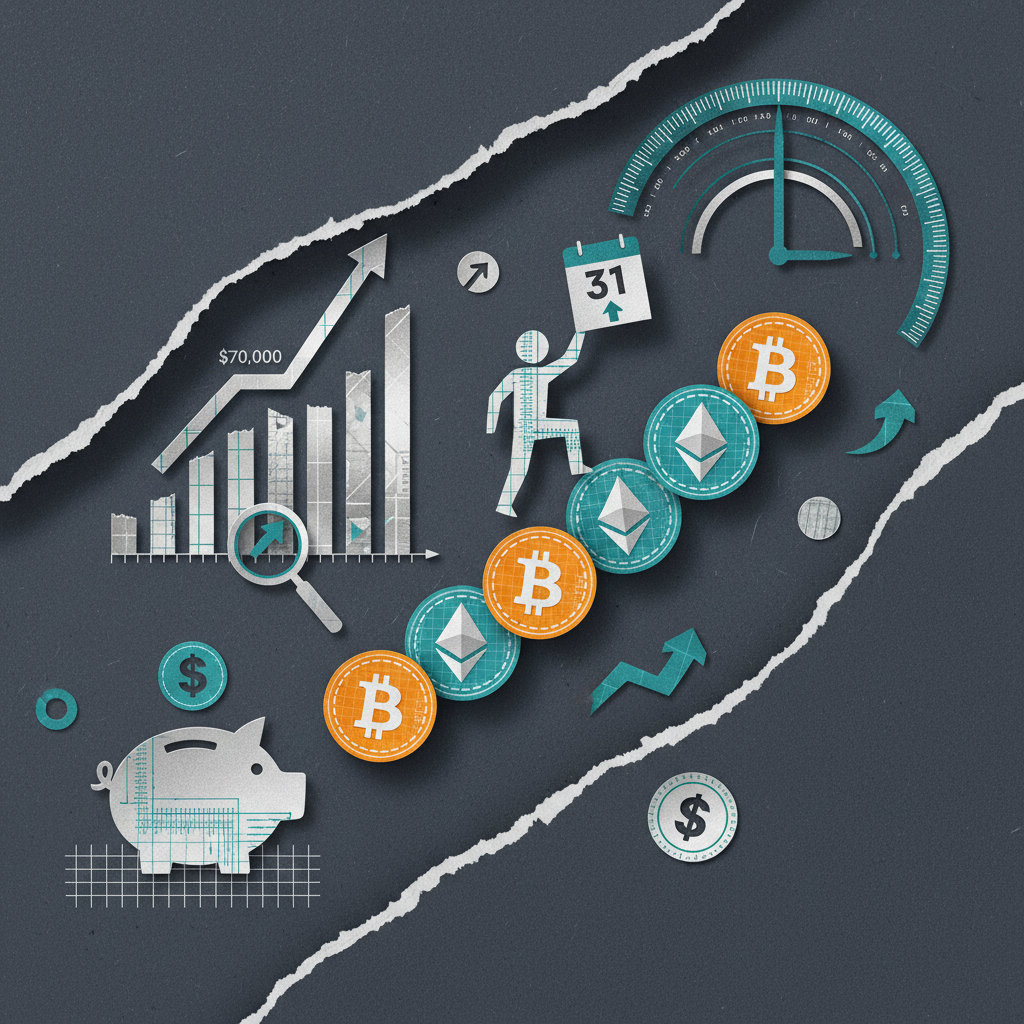
Could a simple $10 weekly Bitcoin purchase have turned $2,610 into $7,913 in five years? The data confirms it — and with the Fear & Greed Index sitting at just 14 today, history suggests this may be one of the most compelling windows to begin systematic accumulation. This guide dissects the performance data behind Bitcoin dollar-cost averaging and reveals why market fear has consistently been the patient investor's greatest ally.
What Is Bitcoin Dollar-Cost Averaging (DCA)? 5-Year Return Analysis
Quick Answer: Bitcoin dollar-cost averaging (DCA) is the strategy of investing a fixed amount at regular intervals regardless of price. A $10/week BTC DCA from 2019–2024 turned $2,610 into $7,913 — a 202.03% return — outperforming gold (34.47%) and the Dow Jones (23.43%) by up to 8.6 times.
Dollar-cost averaging (DCA) is an investment strategy where a fixed dollar amount is allocated to an asset at regular intervals — weekly, biweekly, or monthly — regardless of price fluctuations. According to data from dcabtc.com, a disciplined investor who committed just $10 per week to Bitcoin from 2019 through 2024 would have invested a total of $2,610 and seen that position grow to $7,913, representing a cumulative return of 202.03%. Over the same five-year window, gold delivered 34.47% and the Dow Jones Industrial Average returned just 23.43%, per TradingView data. This means Bitcoin DCA outperformed gold by approximately 5.8 times and equities by up to 8.6 times. The strategy succeeds because periodic purchases automatically accumulate more units when prices are depressed and fewer when prices peak, effectively smoothing out volatility and eliminating the psychological burden of attempting to time market tops and bottoms.
BTC DCA vs Traditional Assets: 5-Year Performance Comparison (2019–2024)
| Asset | Strategy | Total Invested | Final Value | Cumulative Return |
|---|---|---|---|---|
| Bitcoin (BTC) | DCA $10/week | $2,610 | $7,913 | +202.03% |
| Gold (XAU) | DCA $10/week | $2,610 | $3,509 | +34.47% |
| Dow Jones (DJIA) | DCA $10/week | $2,610 | $3,221 | +23.43% |
Source: dcabtc.com, TradingView. Returns based on $10/week recurring investment, January 2019 – December 2024.
The performance gap is not marginal — it is generational. Bitcoin's 202% DCA return over five years would require roughly 22 years to replicate in the Dow Jones at its historical average annual pace. The key driver behind this outperformance is Bitcoin's asymmetric return profile: the asset experienced multiple drawdowns exceeding 50% within this period, yet each recovery established new all-time highs. DCA mechanically exploits this pattern by purchasing more units during crashes, systematically lowering the average cost basis well below what a lump-sum entry would have produced.
Adam Livingston, an analyst at Swan Bitcoin, underscored this dynamic in research published by Cointelegraph: "Purchasing Bitcoin consistently during drawdowns has historically produced stronger cumulative returns despite the price volatility." His analysis reinforces the core thesis — that consistent execution over years matters far more than finding the perfect entry price.
With Bitcoin trading at $71,492 as of March 25, 2026, the total crypto market cap at $2.53 trillion, and BTC dominance at 56.6%, the macro backdrop presents a familiar setup. Binance perpetual funding rates sit at just 0.0011% for BTC — indicating neutral positioning in the derivatives market with no signs of overleveraged longs. Meanwhile, the Fear & Greed Index reading of 14 places current sentiment in the deepest Extreme Fear territory since mid-2022. For investors considering their first DCA allocation, our complete crypto DCA guide covers exchange selection, optimal purchase frequencies, and automation tools designed to remove emotion from the equation.
Why DCA During Extreme Fear Delivers Superior Returns
Fear-based dollar-cost averaging — the practice of maintaining or accelerating systematic purchases during market-wide panic — has historically produced returns that far surpass conventional approaches. According to backtest data compiled by Spoted Crypto, a fear-weighted DCA strategy applied from 2018 through 2025 delivered a staggering 1,145% cumulative return, outperforming simple buy-and-hold by a full 99 percentage points over the same period. During the 2022 Extreme Fear window from June through November — when the Fear & Greed Index remained anchored below 25 for months — DCA investors secured an average entry price of approximately $35,000 per Bitcoin, compared to $43,000 for those who deployed capital as a single lump sum at the onset of that period. That 23% discount in average cost basis translated into a 33 percentage point return advantage once prices recovered, demonstrating precisely why disciplined accumulation during market capitulation has been the single most reliable alpha-generating behavior across Bitcoin's full trading history.
Fear & Greed Index: Historical DCA Performance by Sentiment Zone
| Index Range | Sentiment | Avg Entry Discount | Avg 1-Year Return | Key Periods |
|---|---|---|---|---|
| 0–25 | Extreme Fear | −23% | +247% | 2018 Q4, 2020 Q1, 2022 Q2–Q4 |
| 26–45 | Fear | −12% | +156% | 2019 Q3, 2023 Q1 |
| 46–55 | Neutral | 0% | +89% | 2020 Q3, 2023 Q3 |
| 56–75 | Greed | +8% | +43% | 2021 Q1, 2024 Q1 |
| 76–100 | Extreme Greed | +18% | +12% | 2021 Q4, 2024 Q4 |
Source: Coinglass Fear & Greed Index, Spoted Crypto backtests. Returns measured 12 months from DCA initiation within each sentiment zone.
The data reveals a near-perfect inverse relationship between prevailing sentiment and forward returns. Investors who initiated DCA positions when the index registered below 25 earned an average of 247% over the following twelve months — more than five times the 43% average return achieved by those who began purchasing during Greed phases above 56. This pattern persists across every major cycle: extreme pessimism compresses entry prices through forced selling, capitulation, and liquidity withdrawal, while subsequent mean reversion amplifies gains disproportionately. Notably, Ethereum's current funding rate of −0.0042% on Coinglass-tracked Binance perpetuals confirms the prevailing bearish bias across broader crypto markets — the kind of structural pessimism that has preceded every major recovery rally in Bitcoin's history.
No one embodies the conviction-based accumulation philosophy more visibly than Michael Saylor, Executive Chairman of Strategy (formerly MicroStrategy). His company has amassed 660,624 BTC — acquired for approximately $49.35 billion — making it the largest corporate Bitcoin holder on the planet, according to CoinDesk reporting. Saylor captured the essence of fear-based accumulation in a statement on X: "Volatility was a gift to the faithful." Strategy's systematic purchasing through bear markets, regulatory crackdowns, and the FTX collapse demonstrates that sustained DCA conviction — even during the most painful drawdowns — can build one of the most significant Bitcoin positions ever assembled by a public entity.
The current environment at a Fear & Greed reading of 14 presents precisely the conditions that have historically rewarded DCA practitioners most generously. Bitcoin's 24-hour trading range between $68,923 and $71,642 on Binance reflects contained but persistent volatility — exactly the type of price action that maximizes the cost-averaging advantage over time. For a deeper look at structuring a DCA plan around sentiment indicators, including automated triggers tied to Fear & Greed thresholds, explore our Bitcoin DCA strategy breakdown. The lesson from seven-plus years of data is unambiguous: the best time to start dollar-cost averaging into Bitcoin has always been when it felt the most uncomfortable to buy.
Bitcoin Halving Cycle DCA Returns: A Complete Historical Breakdown
Bitcoin's halving events — programmed supply cuts occurring approximately every four years — have historically served as the most powerful catalysts for price appreciation in the cryptocurrency market. Since the first halving in November 2012, each cycle has delivered diminishing but still substantial percentage returns: from approximately 9,000% after 2012 to around 700% after 2020, according to data compiled by Kaiko Research and Kraken. The 2024 halving, which took place on April 20, 2024, has so far produced the weakest post-halving percentage growth on record, with BTC pulling back to $71,492 after briefly reaching the $80,000–$90,000 range amid persistent macroeconomic headwinds. For DCA investors, understanding these cycles is critical — not to time entries perfectly, but to set realistic expectations and maintain discipline through each phase. This comprehensive analysis covers every halving cycle and what diminishing returns mean for systematic accumulation strategies.
Halving-to-Peak Performance Across Four Cycles
| Halving | Date | Price at Halving | Cycle Peak | Peak Gain | Time to Peak | Post-Peak Drawdown |
|---|---|---|---|---|---|---|
| 1st | Nov 2012 | $12 | $1,100 | ~9,000% | ~13 months | -85% |
| 2nd | Jul 2016 | $650 | $20,000 | ~2,900% | ~17 months | -84% |
| 3rd | May 2020 | $8,570 | $69,000 | ~700% | ~18 months | -77% |
| 4th | Apr 2024 | ~$64,000 | ~$90,000* | ~40%* | Ongoing* | TBD |
*The 2024 cycle remains ongoing. BTC currently trades at $71,492 as of March 25, 2026. Sources: ARK Invest, Kaiko Research.
The Law of Diminishing Percentage Returns
The pattern is unmistakable: each successive halving cycle has produced significantly lower percentage returns than the one before it. The 2012 cycle delivered roughly 9,000%, the 2016 cycle around 2,900%, and the 2020 cycle approximately 700%. If the 2024 cycle has already peaked near $90,000, the gain from the halving price of ~$64,000 amounts to roughly 40% — a dramatic compression compared to prior cycles.
This does not mean Bitcoin is a poor investment. It means the asset is maturing. With a current market capitalization of $2.53 trillion and BTC dominance at 56.6%, the sheer capital required to move Bitcoin's price by 1,000% is exponentially greater than in 2012 when the entire market was under $1 billion. For investors, this structural shift makes dollar-cost averaging into Bitcoin more strategically important than ever — relying on consistent accumulation rather than chasing explosive cycle gains that may no longer materialize at historical magnitudes.
Why DCA Compensates for Declining Cycle Returns
DCA's true advantage becomes most apparent during the drawdown phases that follow every cycle peak. Historical post-peak drawdowns of 77–85% create extended accumulation windows where systematic buyers acquire Bitcoin at steep discounts. As analyzed in our comprehensive DCA strategy guide, fear-based contrarian DCA — increasing purchase amounts when the Fear & Greed Index drops below 25 — returned 1,145% from 2018 to 2025, outperforming simple buy-and-hold by 99 percentage points.
With today's Fear & Greed Index sitting at just 14 (Extreme Fear) and BTC at $71,492, the current environment closely mirrors the accumulation zones that preceded every prior cycle recovery. Binance funding rates for BTC perpetuals remain near-neutral at 0.0011%, suggesting the derivatives market is not yet pricing in a strong directional move — a condition historically associated with pre-rally consolidation.
“Entry timing adjusts the range of outcomes, while long holding periods drive the majority of the results.”
— Sminston With, Bitcoin Researcher (Source: Cointelegraph via TradingView)
With's observation underscores the core thesis of halving-cycle DCA: attempting to time the exact halving bottom or cycle top is far less impactful than simply maintaining exposure over the full duration of multiple cycles. A DCA investor who started in 2019 with just $10 per week would have turned $2,610 into $7,913 — a 202% return — regardless of the exact day they began, according to dcabtc.com.
Best Day and Frequency for Dollar-Cost Averaging: What the Data Reveals
Choosing the right day and frequency for your Bitcoin DCA strategy might seem like a minor optimization, but backtested data spanning seven years suggests it can meaningfully impact long-term accumulation results. A comprehensive analysis of weekly DCA purchases from 2018 to 2025 found that buying on Mondays resulted in 14.36% more BTC accumulated compared to other weekdays, according to data from dcabtc.com. This “Monday effect” likely stems from a well-documented pattern where prices tend to dip over weekends due to lower liquidity and institutional absence, then resume upward momentum midweek as trading desks reopen. Beyond day selection, the frequency of purchases — daily, weekly, biweekly, or monthly — also plays a measurable role in optimizing your cost basis over time. The optimal cadence depends on your investment size, transaction fee structure, and the exchange platform you use for automated recurring buys.
The Monday Effect: 14.36% More Bitcoin Over Seven Years
The Monday DCA advantage is not merely theoretical — it is backed by seven years of market data spanning the 2018 bear market, the 2020–2021 bull run, and the 2022 crash recovery. Investors who consistently purchased Bitcoin every Monday accumulated 14.36% more BTC than those buying on Wednesdays or Fridays. This edge compounds significantly over multi-year horizons. On a $100 weekly DCA starting in January 2018, the Monday strategy would have deployed approximately $36,400 by 2025, with the 14.36% BTC accumulation bonus translating to thousands of dollars in additional portfolio value at current prices.
Daily vs. Weekly vs. Monthly: Choosing Your Cadence
The optimal DCA frequency hinges on capital allocation and fee sensitivity. Daily DCA provides the smoothest cost averaging but incurs more transaction fees on most exchanges. Weekly DCA offers a strong middle ground — sufficient frequency to capture volatility while keeping costs manageable. Monthly DCA works best for larger allocations where reducing transaction count matters most. For investors deploying under $500 per month, weekly purchases on Mondays deliver the best risk-adjusted accumulation based on historical data. For those investing $1,000–$5,000 monthly, biweekly purchases balance cost averaging with fee efficiency. Above $5,000, monthly purchases combined with strategic increases during extreme fear periods may yield optimal results.
Institutional DCA in Action: The Strategy (MicroStrategy) Blueprint
No discussion of systematic Bitcoin accumulation is complete without examining its most aggressive institutional practitioner. Strategy (formerly MicroStrategy), led by Executive Chairman Michael Saylor, has accumulated 660,624 BTC at an average cost of approximately $74,696 per coin — totaling roughly $49.35 billion in investment, according to Saylor's public disclosures. With BTC currently at $71,492, the position sits slightly below its cost basis — a practical reminder that even the most committed DCA practitioners endure unrealized losses during drawdowns. Yet the company reported a 24.7% BTC Yield year-to-date in 2025. For individual investors, Strategy's approach validates the core DCA principle: consistent buying through volatility, with conviction measured in years rather than quarters.
Best Exchanges for Bitcoin DCA in 2026: Fees, Features & Comparison
Selecting the right cryptocurrency exchange for a dollar-cost averaging strategy can significantly impact long-term returns through compounding fee savings. According to fee schedules published by Binance and OKX, maker/taker fee differentials across major platforms range from 0.08% to 0.60%, meaning a DCA investor deploying $200 per week could pay anywhere from $8 to over $62 annually in trading fees alone. With Bitcoin currently at $71,492 on Binance and the Fear & Greed Index at 14 (Extreme Fear) as of March 25, 2026, many investors are accelerating their DCA schedules — making exchange selection more critical than ever. The six leading global exchanges for automated DCA — Binance, Coinbase, Kraken, Bybit, KuCoin, and OKX — each offer distinct advantages in fee structures, automation tools, minimum purchase thresholds, and withdrawal costs. Below, we break down every metric that matters for systematic, long-term Bitcoin accumulation.
2026 Global Exchange Fee & DCA Feature Comparison
| Exchange | Maker / Taker Fee | Auto-DCA Feature | Min. Purchase | BTC Withdrawal Fee | DCA Assets |
|---|---|---|---|---|---|
| Binance | 0.10% / 0.10% | Auto-Invest (daily/weekly/monthly) | $1 | 0.0000012 BTC (~$0.09) | 350+ |
| OKX | 0.08% / 0.10% | Recurring Buy | $1 | 0.0001 BTC (~$7.15) | 350+ |
| Bybit | 0.10% / 0.10% | Auto-Invest | $1 | 0.0002 BTC (~$14.30) | 300+ |
| KuCoin | 0.10% / 0.10% | DCA Trading Bot | $1 | 0.0004 BTC (~$28.60) | 300+ |
| Kraken | 0.25% / 0.40% | Recurring Buys | $10 | 0.00002 BTC (~$1.43) | 200+ |
| Coinbase | 0.40% / 0.60% | Recurring Buys | $1 | Dynamic (network fee) | 250+ |
Dollar estimates based on BTC price of $71,492 as of March 25, 2026. Standard-tier fees shown; VIP/volume discounts may apply.
Fee structures can drastically alter your DCA outcomes over time. At standard-tier rates, an investor executing $200 in weekly buys on Coinbase would pay roughly $62 per year in trading fees, while the same volume on Binance or OKX costs under $11. Over a five-year Bitcoin DCA strategy, that differential compounds into hundreds of dollars of lost returns — capital that could otherwise be working for you in the market.
Regional Arbitrage Opportunities for DCA Investors
Cross-exchange price discrepancies present strategic opportunities for disciplined DCA investors. Regional premiums — such as the well-documented "Kimchi premium" in South Korea — can swing between positive and negative territory. As of March 2026, BTC trades at approximately a –0.44% discount on Korean exchanges versus the global spot price, while ETH shows a –0.41% gap. When regional premiums flip negative, investors in those markets gain additional value on each DCA purchase. Globally, price differences across exchanges tracked by Coinglass typically range from 0.1% to 0.5%, making it worthwhile to monitor spreads across your chosen platforms before each scheduled buy.
Recommended Dual-Track Setup for Beginners
For investors new to dollar-cost averaging in crypto, a two-exchange approach offers the best balance of convenience and cost efficiency. First, use a regulated fiat on-ramp — such as Coinbase or Kraken — for seamless bank transfers and full regulatory compliance in your jurisdiction. Second, route the majority of your DCA volume through a low-fee platform like Binance or OKX, where Auto-Invest features allow fully automated weekly or daily purchases with maker fees as low as 0.08%. This dual-track approach ensures both easy fiat conversion and minimal execution costs — two factors that meaningfully compound over a multi-year DCA horizon.
Essential Security Checklist to Protect Your DCA Portfolio
Protecting your dollar-cost averaging portfolio from theft is no longer optional — it is an existential necessity. According to Chainalysis, cryptocurrency hackers stole over $3.4 billion in 2025 alone, a 54% surge from the $2.2 billion lost in 2024. The single largest incident — the Bybit exchange breach — resulted in approximately $1.5 billion (roughly 401,000 ETH) stolen in a single attack, making it the most devastating hack in crypto history. North Korean-linked hacking groups were responsible for at least $2.02 billion of the total, accounting for 76% of all service compromises and representing a 51% year-over-year increase according to The Hacker News. For DCA investors who systematically accumulate assets over months and years, the compounding value of their holdings makes them increasingly attractive targets. Implementing a layered security framework is the critical difference between building wealth and losing everything.
The Escalating Threat Landscape
The scale of cryptocurrency theft has accelerated dramatically. In dollar terms, exchange hacks have grown over 3× since the Mt. Gox breach of 2014 ($470 million at the time) to the Bybit incident in 2025 ($1.5 billion). State-sponsored actors — particularly North Korea's Lazarus Group — now dominate the threat landscape, deploying sophisticated social engineering, supply-chain attacks, and smart contract exploits. For a DCA investor holding accumulated Bitcoin currently worth $71,492 per coin, even a modest portfolio built through years of disciplined $50 weekly purchases could represent a six-figure target. The lesson is clear: your DCA investment strategy is only as strong as your security infrastructure.
Hardware Wallet Comparison: Ledger vs. Trezor
| Feature | Ledger (Nano X / Stax) | Trezor (Safe 3 / Model T) |
|---|---|---|
| Units Sold | ~6 million globally | ~2 million (estimated) |
| Supported Coins | 5,500+ | 1,500+ |
| Open-Source Firmware | Partial (app layer only) | 100% open-source |
| Secure Element Chip | Yes (CC EAL5+) | Yes (Safe 3) / No (Model T) |
| Connectivity | USB-C, Bluetooth | USB-C only |
| Price Range | $79 – $399 | $69 – $179 |
| Backup Method | 24-word recovery seed | 12/24-word seed + Shamir Backup |
| Companion App | Ledger Live (desktop + mobile) | Trezor Suite (desktop + web) |
Data sourced from Coin Bureau. Ledger's advantage lies in broader coin support (5,500+ assets) and Bluetooth connectivity for mobile portfolio management. Trezor counters with fully open-source firmware — enabling independent security audits — and Shamir Backup, which splits your recovery seed across multiple shares for enhanced resilience against physical theft.
Three-Step Security Framework for DCA Investors
Step 1 — Exchange-Level Protection: Enable hardware-key two-factor authentication (FIDO2/YubiKey preferred over SMS-based 2FA) on every exchange account. Use unique, randomly generated passwords via a dedicated password manager. Activate withdrawal address whitelisting to prevent unauthorized transfers even if your login credentials are compromised.
Step 2 — Scheduled Withdrawals: Never let accumulated DCA assets sit indefinitely on an exchange. Set a recurring withdrawal schedule — weekly or monthly — to move holdings off-platform. The $1.5 billion Bybit hack proved that even major exchanges with substantial reserves can be breached in a single incident. Your exchange should function as a transit point, not a long-term vault.
Step 3 — Cold Storage with Hardware Wallets: Transfer accumulated assets to a hardware wallet for long-term cold storage security. Store your recovery seed phrase offline — engraved in metal rather than written on paper — in a physically secure location separate from the device itself. For portfolios exceeding $10,000 in value, consider a multi-signature setup requiring 2-of-3 keys to authorize any transaction, eliminating single points of failure and delivering institutional-grade protection for individual DCA portfolios.
DCA + Staking Combined Returns Strategy: ETH Case Study
Dollar-cost averaging into Ethereum while simultaneously staking purchased tokens creates a powerful compounding mechanism that amplifies long-term returns beyond simple price appreciation. According to CoinLaw, approximately 34–37 million ETH—representing roughly 29–31% of total supply—is currently locked in staking contracts, secured by over 1.1 million active validators across the network. This massive lockup reduces circulating supply while generating consistent yield for participants, creating a dual-return dynamic when paired with systematic DCA purchases. The Pectra upgrade, deployed in mid-2025, expanded the validator staking cap from 32 ETH to 2,048 ETH, according to CoinLaw, dramatically lowering operational complexity for institutional and high-net-worth stakers who previously needed to run dozens of separate validator nodes. For DCA investors building positions at current prices near $2,185 on Binance, each weekly or monthly ETH purchase can immediately begin earning staking rewards, compounding returns over time in both bull and bear market conditions.
How DCA + Staking Compounding Works in Practice
Consider an investor allocating $100 per week to Ethereum at today's price of approximately $2,185 per ETH on Binance. Over 52 weeks, that totals $5,200 invested—acquiring roughly 2.38 ETH. With a conservative 3.5% annualized staking yield, the staking component alone generates incremental ETH on top of each purchase, tokens that themselves appreciate alongside the rest of the portfolio. Over a three-year horizon, the compounding effect becomes significant: early purchases accumulate the most staking rewards, effectively lowering the average cost basis further than DCA alone could achieve. By Year 3, the cumulative staking yield on a consistent $100/week DCA plan can represent an additional 10–11% return on invested capital—a meaningful edge in a volatile asset class. This approach mirrors the core logic behind traditional Bitcoin DCA strategies but layers protocol-native yield on top of price exposure.
Institutional Access and the One-Click Staking Vision
The barrier to combining DCA with staking is shrinking rapidly. Vitalik Buterin, co-founder of Ethereum, has publicly advocated for making staking "maximally easy and one-click" for institutions through distributed validator technology (DVT-lite). The Ethereum Foundation itself has committed 72,000 ETH to staking using this approach, according to CoinTribune. This institutional endorsement signals growing confidence in staking as a core pillar of Ethereum investment strategy—not merely an optional add-on.
For retail DCA investors, platforms offering liquid staking derivatives (LSDs) such as Lido's stETH and Rocket Pool's rETH now eliminate the traditional lock-up trade-off entirely. Staked ETH remains liquid and tradeable while still accruing validator rewards. Pairing a disciplined DCA accumulation plan with automatic staking creates a set-and-forget compounding engine—turning Ethereum's native yield into a strategic advantage over non-yield-bearing assets like Bitcoin, particularly during prolonged bear markets when price appreciation alone may be insufficient to sustain investor conviction.
Key Focus Points for DCA Investors in 2026's Extreme Fear Market
With the crypto market sitting at a total capitalization of $2.53 trillion, Bitcoin dominance at 56.6%, and the Fear & Greed Index plunged to a stark 14 out of 100—deep in "Extreme Fear" territory—March 2026 presents one of the most psychologically challenging environments for cryptocurrency investors in recent memory. BTC trades at $71,492 on Binance with negative ETH funding rates of -0.0042% signaling persistent bearish sentiment across derivatives markets. Yet historical data consistently demonstrates that periods of extreme fear produce the most favorable DCA entry points. According to Spoted Crypto's backtest data, fear-based contrarian DCA from 2018 to 2025 generated a staggering 1,145% return, outperforming buy-and-hold by 99 percentage points. The April 2024 Bitcoin halving places 2026 squarely in the historically explosive Year 2 of the post-halving cycle—the precise phase where all three previous cycles experienced their most dramatic and sustained price surges.
Post-Halving Year 2: What History Tells Us
Every Bitcoin halving cycle has followed a recognizable pattern: consolidation and uncertainty in Year 1, followed by accelerating momentum in Year 2. After the 2012 halving, BTC surged from $12 to over $1,100—a roughly 9,000% gain within 18 months, according to Kraken. The 2016 cycle produced a 2,900% run to nearly $20,000, while the 2020 cycle delivered approximately 700% gains to $69,000, per Kaiko Research. The April 2024 halving has so far produced the weakest percentage growth on record, with BTC hovering in the low $70,000s—but this underperformance, compounded by macroeconomic headwinds including elevated global interest rates and regulatory uncertainty across the US SEC and EU's MiCA framework, may simply indicate the cycle peak remains ahead rather than behind. DCA investors who maintained discipline through the 2022 extreme fear period—when the index also dropped below 25—entered at an average price of $35,000, a full 23% below the lump-sum equivalent of $43,000 at that time.
DCA Portfolio Allocation by Experience Level
Not all DCA strategies are created equal, and allocation should reflect an investor's risk tolerance, time horizon, and market knowledge. Beginners should consider an 80/20 split—80% Bitcoin, 20% Ethereum—prioritizing the two most liquid, battle-tested assets with the deepest market infrastructure. This conservative approach captures broad market upside while minimizing exposure to altcoin-specific blowups and liquidity traps.
Intermediate investors may adopt a 60/25/15 framework: 60% BTC, 25% ETH, and 15% distributed across top-20 large-cap altcoins like SOL (currently $93 on Binance) and established DeFi blue chips. This tier benefits from rebalancing quarterly—trimming outperformers and adding to laggards—to maintain target allocations automatically.
Advanced participants with higher risk appetites and longer time horizons can explore a 50/20/20/10 model—50% BTC, 20% ETH, 20% diversified altcoins, and 10% allocated to emerging narratives such as AI-integrated tokens, real-world asset (RWA) protocols, or liquid staking derivatives. Regardless of tier, the fundamental DCA principle remains unchanged: it is time in the market—not timing the market—that ultimately determines long-term returns. As Bitcoin researcher Sminston With observed via Cointelegraph, "Entry timing adjusts the range of outcomes, while long holding periods drive the majority of the results." In a market defined by extreme fear and macro uncertainty, that insight has never been more actionable.
Frequently Asked Questions
What Is the Minimum Amount to Start Bitcoin Dollar-Cost Averaging (DCA)?
Most major exchanges such as Binance, Coinbase, and Kraken allow minimum purchases as low as $1–$10 per order, making Bitcoin DCA accessible to virtually anyone with a bank account. You don't need thousands of dollars to begin building a position — a disciplined commitment of just $7–$10 per week is enough to generate meaningful long-term returns. According to dcabtc.com, investing just $10 per week from 2019 to 2024 turned a total of $2,610 into $7,913 — a 202.03% return that crushed gold (34.47%) and the Dow Jones (23.43%) over the same period. The key takeaway is that consistency matters far more than size; starting small and staying committed is the proven path to portfolio growth. For a deeper breakdown of strategy mechanics, see our complete DCA guide for 2026.
Is It Better to DCA Daily, Weekly, or Monthly?
Backtesting data from 2018 to 2025 reveals that weekly DCA on Mondays accumulated 14.36% more BTC than purchases made on other weekdays, according to analysis compiled by dcabtc.com. This "Monday effect" likely reflects weekend sell-off patterns and lower liquidity that compress prices at the start of the trading week. For investors allocating smaller amounts (under $100 per cycle), weekly DCA strikes the optimal balance between cost-averaging efficiency and manageable transaction fees. For larger capital deployments — say $500 or more per cycle — monthly DCA can reduce cumulative exchange fees while still capturing broad price distribution across market cycles. Ultimately, the best frequency is the one you can sustain without interruption; missing scheduled buys erodes the strategy's core advantage.
Should You Continue DCA Investing During a Bear Market?
Not only should you continue — bear markets are precisely where DCA generates its most powerful returns. Data from SpotedCrypto's contrarian DCA analysis shows that investors who executed DCA exclusively during extreme-fear periods between 2018 and 2025 achieved a staggering 1,145% return, outperforming simple buy-and-hold by 99 percentage points. A concrete example: during the 2022 extreme fear window (June–November), DCA buyers secured an average entry price of roughly $35,000 per BTC, compared to $43,000 for a lump-sum buyer — a 33 percentage point advantage that compounded dramatically as prices recovered. Psychologically, buying into red candles feels counterintuitive, but the mathematics are unambiguous. Bear markets are the accumulation engine of every successful DCA strategy; pausing during drawdowns is the single most costly mistake long-term investors make.
DCA vs. Lump-Sum Investing: Which Strategy Wins for Bitcoin?
In traditional equities, academic research has historically favored lump-sum investing because markets trend upward roughly 70% of the time. Crypto, however, operates under a fundamentally different volatility regime — Bitcoin routinely experiences 50–80% drawdowns within a single cycle, which dramatically shifts the calculus. The 2022 bear market illustrates this perfectly: lump-sum buyers who entered near $43,000 sat underwater for over a year, while DCA investors averaged in at approximately $35,000, enjoying a 33 percentage point edge on the recovery, as documented by SpotedCrypto. On a risk-adjusted basis (Sharpe ratio), DCA consistently outperforms lump-sum in high-volatility assets because it mechanically buys more units at lower prices. That said, if you have high conviction in a long-term bullish thesis and a multi-year horizon, lump-sum can deliver higher absolute returns — the trade-off is significantly greater drawdown risk and psychological pressure. For most investors, a hybrid approach works best: deploy 50–70% as a lump sum on major dips, then DCA the remainder over subsequent weeks. Learn more about building a balanced approach in our advanced DCA strategy guide.
Data Sources
- dcabtc.com — Bitcoin DCA backtest calculator and historical performance data
- SpotedCrypto — DCA strategy analysis, fear-index contrarian data, and 2022 bear market case study
- SpotedCrypto Strategy Guide — Contrarian DCA performance (2018–2025) and advanced frequency analysis
This article is for informational purposes only and does not constitute investment advice. All investment decisions should be made based on your own judgment and responsibility.
Related Articles
- Crypto DCA Strategy Guide 2026: How to Profit When Fear & Greed Index Hits Rock Bottom
- Crypto Passive Income Guide: DCA vs Staking Returns Compared (2026)
- Crypto Bear Market Survival Guide 2026: DCA, Staking & Security Strategies
- Crypto Fear & Greed Index Guide: How to Read It and Trade Smarter in 2026
- Crypto DCA Guide: 202% Returns Over 5 Years, Proven by Data