Bitcoin Crashes to $63K on Iran Airstrikes, Rebounds to $68.5K — Fear & Greed at 14 | March 4, 2026 Market Briefing
Bitcoin plunged to $63,000 after U.S.-Israeli strikes on Iran, then rebounded to $68,500. Fear & Greed Index at 14 (Extreme Fear), whales accumulate 270,000 BTC in 30 days, ETFs record $458M single-day inflow. Full derivatives and on-chain analysis.
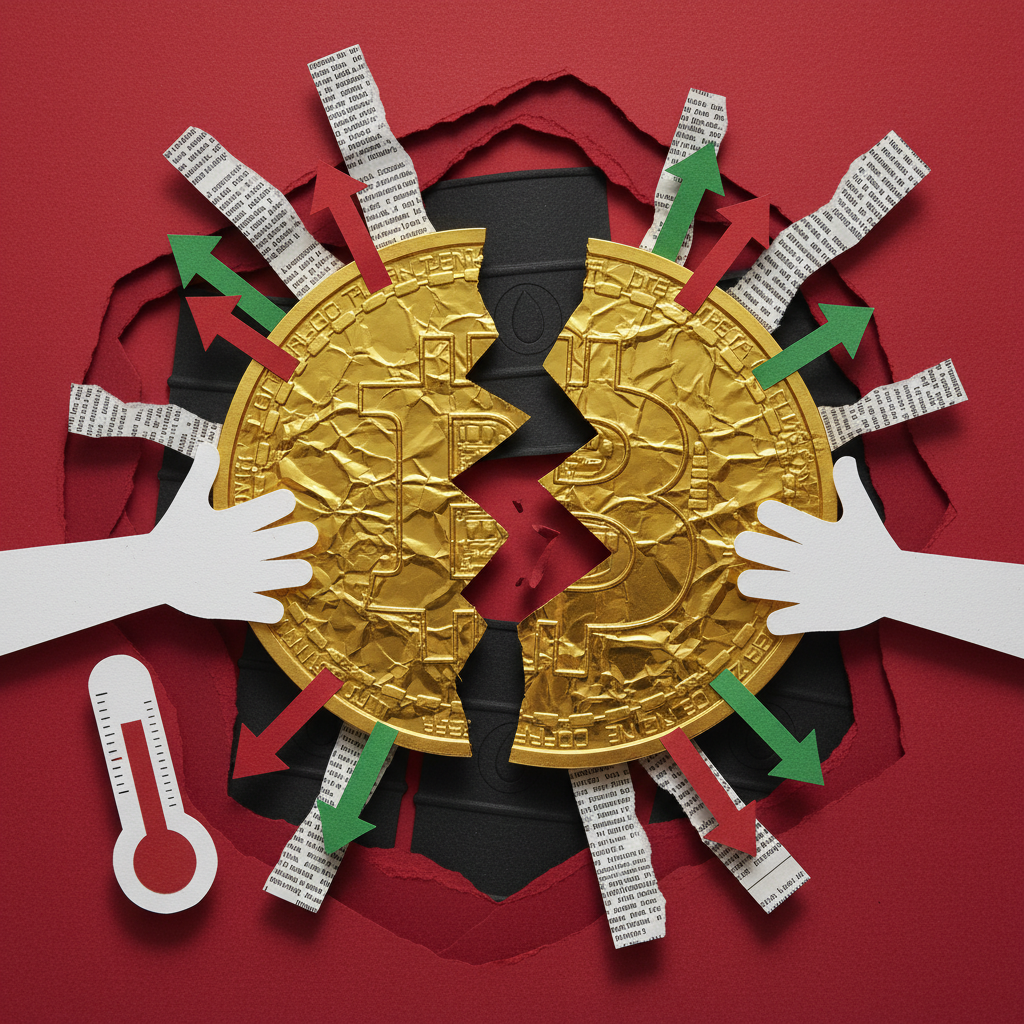
As of March 4, 2026, 08:24 KST, the Crypto Fear & Greed Index sits at 14 — deep in Extreme Fear territory — while Bitcoin trades at $68,527 on Binance after crashing to $63,000 in the aftermath of U.S.-Israeli military strikes on Iran over the weekend.
Between February 28 and March 1, the launch of U.S. and Israeli military operations against Iran sent shockwaves through global financial markets. Oil surged 13% to $82 per barrel — the highest since July 2024 — and Bitcoin absorbed approximately $300 million in long-position liquidations as it plunged to $63,000. Yet Bitcoin proved its role as the only major liquid asset trading on weekends, rebounding to $68,000–$69,000 before equity markets even opened. Beneath the extreme fear, powerful buy signals are emerging: whale wallets have accumulated 270,000 BTC over the past 30 days, spot Bitcoin ETFs recorded a $458.2 million single-day inflow on March 2, and the 14-day RSI has entered historically extreme oversold territory at 25.6. In today's SpotedCrypto market briefing, we deep-dive into the derivatives data to determine whether this extreme fear represents opportunity or a prelude to further pain.
Today's Key Market Indicators — Total Cap $2.42T, BTC Dominance 56.7%
Quick Answer: The crypto market cap stands at $2.42 trillion with Bitcoin dominance at 56.7%. Fear & Greed reads 14 (Extreme Fear), up 4 points from yesterday. Bitcoin's 14-day RSI at 25.6 marks only the third sub-30 reading in its entire history, while approximately $300 million in long positions were liquidated during the Iran-related selloff.
The total cryptocurrency market capitalization represents the combined market value of all crypto assets and serves as the primary gauge of overall market health and scale. As of March 4, 2026, 08:24 KST, the total crypto market cap stands at $2.42 trillion, reflecting a modest recovery from the lows hit immediately following the Iran airstrikes. Bitcoin dominance has climbed to 56.7%, demonstrating the flight-to-quality dynamic that typically emerges during market stress, while Ethereum dominance sits at 10.0%. The number of active cryptocurrencies tracked stands at 18,588, and 24-hour global trading volume reached approximately $125 billion. Notably, while the Fear & Greed Index remains at 14 in the Extreme Fear zone, it has improved by 4 points from the prior day and is gradually recovering from the all-time low of 5 recorded in February — the lowest reading across every major Bitcoin crash in history (Source: ETHNews).
| Indicator | Value | Notes |
|---|---|---|
| Total Market Cap | $2.42T | Recovering from post-airstrike low |
| BTC Dominance | 56.7% | Flight-to-quality in crisis |
| ETH Dominance | 10.0% | – |
| Fear & Greed Index | 14/100 | Extreme Fear (+4 vs yesterday) |
| 24h Global Volume | $125.0B | – |
| BTC 14-day RSI | 25.6 | 3rd sub-30 reading in history |
| BTC Hashrate (7d avg) | 977 EH/s | Network security intact |
| Active Cryptocurrencies | 18,588 | – |
Bitcoin's 14-day RSI at 25.6 deserves special attention. This marks only the third time in Bitcoin's entire history that the indicator has fallen below 30. The previous two instances — 2015 at roughly $200 and December 2018 at approximately $3,500 — both preceded multi-year bull runs with four-digit percentage gains. While history does not guarantee repetition, the convergence of extreme oversold RSI, record-low fear readings, and the largest whale accumulation in years creates a data profile that has historically coincided with generational buying opportunities.
Iran Airstrikes Shock Markets — Bitcoin's Flash Crash to $63K and Recovery
The Iran airstrike shock refers to the global risk-off event triggered when the United States and Israel launched military operations against Iran between February 28 and March 1, sending tremors through every major financial market. Bitcoin, as the only large-cap liquid asset that trades around the clock — including weekends — absorbed the initial wave of forced selling, plunging from roughly $69,000 to $63,000 in a matter of hours. Approximately $300 million in leveraged long positions were liquidated during the selloff, according to Blockspace Media. Crude oil surged 13% to $82 per barrel — the highest since July 2024 — while the Dollar Index (DXY) rose approximately 1% to 99.25 and the U.S. 10-year Treasury yield climbed 9 basis points to 4.05% (Source: CoinDesk Daybook).
Yet by the time equity markets opened on Monday and posted steep declines, Bitcoin had already rebounded to the $68,000–$69,000 range — a relative outperformance that caught many analysts' attention.
James Butterfill, Head of Research at CoinShares, noted: "Historically, bitcoin, as the only liquid asset that also trades on weekends, has absorbed shocks during periods of forced risk reduction. This time, the price development was constructive — bitcoin gained despite the increasing instability. The absence of significant liquidations despite rising yields and geopolitical tensions suggests that positioning is adjusted compared to previous episodes" (Source: CoinDesk).
The Strait of Hormuz — through which approximately one-fifth of the world's oil supply flows — remains the critical chokepoint. If the Iran conflict escalates and disrupts this corridor, oil prices could spike well above $100 per barrel, reigniting stagflation fears and clouding the Federal Reserve's already uncertain path toward rate cuts. QCP Capital analysts warned that "if stagflation takes hold, the Fed could lean toward hiking rates," a scenario that would put broad risk assets under significant selling pressure (Source: Blockspace Media).
Binance and OKX Exchange Data — Stablecoin Dominance Signals Risk-Off
Exchange volume rankings from the world's two largest crypto trading platforms — Binance and OKX — provide a real-time snapshot of where capital is flowing during periods of market stress. As of March 4, 08:24 KST, stablecoins dominate the top of Binance's volume leaderboard: USDC leads with $2.0 billion in 24-hour volume, while Bitcoin sits at second with $1.7 billion and Ethereum third at $1.1 billion. This stablecoin-first ordering is a classic risk-off signature, indicating that traders are rotating into dollar-pegged assets to preserve capital amid uncertainty. On OKX, a similar pattern holds: Bitcoin leads at $737 million in volume, but tokenized gold (XAUT) ranks third at $115 million — ahead of Solana — reflecting the flight to safe havens. Notably, PAXG (tokenized gold on Binance) saw $245.7 million in volume despite falling 3.73% as gold-backed tokens experienced selling pressure alongside the physical gold pullback.
| # | Coin | Price | 24h Change | Volume(24h) | High | Low |
|---|---|---|---|---|---|---|
| 1 | USDC | $1.00 | +0.01% | $2.0B | $1.00 | $1.00 |
| 2 | BTC | $68,527 | -0.78% | $1.7B | $69,258.08 | $66,158.00 |
| 3 | ETH | $1,992 | -2.44% | $1.1B | $2,041.50 | $1,929.56 |
| 4 | SOL | $87 | +0.07% | $352.2M | $87.46 | $82.50 |
| 5 | PAXG | $5,149 | -3.73% | $245.7M | $5,400.00 | $5,027.33 |
| 6 | USD1 | $1.00 | +0.00% | $224.8M | $1.00 | $1.00 |
| 7 | XRP | $1.36 | -2.13% | $186.9M | $1.40 | $1.34 |
| 8 | U | $1.00 | -0.02% | $115.1M | $1.00 | $1.00 |
| 9 | DOGE | $0.09 | -3.96% | $96.3M | $0.09 | $0.09 |
| 10 | BNB | $634 | -0.69% | $95.8M | $643.29 | $621.00 |
On OKX, tokenized gold (XAUT) posted $115 million in volume — ranking third behind Bitcoin ($737M) and Ethereum ($354M) — highlighting the safe-haven rotation playing out across platforms. Meanwhile, Solana ($87.28, +0.07%) was the only major altcoin in positive territory on Binance, showing relative resilience compared to XRP (-2.13%), DOGE (-3.96%), and BNB (-0.69%). The meme coin sector continued to bleed, with DOGE dropping nearly 4% on Binance and 3.5% on OKX, reflecting shrinking appetite for speculative assets during periods of acute geopolitical risk.
The three stablecoins in Binance's top 10 (USDC, USD1, U) collectively represent over $2.3 billion in 24-hour volume — a clear sign that capital preservation is the dominant strategy for now.
Derivatives Deep Dive — $300M Liquidations, Open Interest, and Funding Rates
Cryptocurrency derivatives data — including futures open interest, funding rates, liquidation volumes, and long/short ratios — provides critical insight into how leveraged traders are positioned and how much speculative excess remains in the market. As of March 4, CME Bitcoin futures open interest stands at 104,220 BTC, while total crypto futures open interest across all exchanges reached $93.78 billion, down 2% from the previous day (Source: CoinDesk Daybook). On Binance alone, Bitcoin perpetual futures carry $5.4 billion in open interest with a mildly positive funding rate of 0.0015%, while Ethereum's $3.8 billion in OI is paired with a negative funding rate of -0.0095%. The contrast between BTC's positive funding and the broadly negative funding across altcoins paints a split market: cautious optimism on Bitcoin, outright bearishness on everything else.
| Coin | Funding Rate | Open Interest | Long/Short |
|---|---|---|---|
| BTC | 0.0015% | $5.4B | 59.2% / 40.8% |
| ETH | -0.0095% | $3.8B | 69.1% / 30.9% |
| SOL | -0.0149% | $833.8M | 71.9% / 28.1% |
| XRP | -0.0176% | $359.9M | 69.4% / 30.6% |
| DOGE | -0.0175% | $170.4M | 69.9% / 30.1% |
| BNB | 0.0000% | $323.0M | N/A |
| LINK | -0.0052% | $74.3M | N/A |
| ADA | -0.0071% | $77.8M | N/A |
| AVAX | -0.0112% | $75.8M | N/A |
| DOT | -0.0106% | $46.7M | N/A |
Several key takeaways emerge from this data. First, every altcoin tracked carries a negative funding rate — meaning short sellers are paying longs to keep positions open — with XRP (-0.0176%) and DOGE (-0.0175%) showing the most bearish tilt. Second, the long/short ratios tell a contrarian story: SOL longs outnumber shorts 71.9% to 28.1%, and ETH shows 69.1% long. In a market where funding is negative yet retail traders are overwhelmingly long, the setup suggests potential for further squeeze if prices continue lower.
The broader liquidation picture provides crucial context. The approximately $300 million in long liquidations triggered by the Iran airstrikes — while significant — represents an 88% reduction compared to the $2.5 billion leveraged wipeout on February 5, which was a -6.05 standard deviation event and one of the fastest single-day crashes in crypto history. QCP Capital analysts characterized the recent liquidations as "contained," while cautioning that "the scale of this attack is far greater than last year's, [but] price action could be hinting at early signs of history repeating itself" (Source: Blockspace Media). The fact that the market absorbed a military escalation with only $300 million in liquidations — versus $2.5 billion just a month earlier — strongly suggests the market has already been substantially deleveraged.
| Derivatives Metric | Value | Notes |
|---|---|---|
| CME BTC Futures OI | 104,220 BTC | Institutional participation intact |
| Total Crypto Futures OI | $93.78B | -2% day-over-day |
| 24h Long Liquidations (Iran) | ~$300M | 88% less than Feb 5 event |
| Feb 5 Liquidation (comparison) | $2.5B | -6.05 standard deviations |
| DXY (Dollar Index) | 99.25 | +1% rise |
| U.S. 10-Year Yield | 4.05% | +9 bps |
| Oil (Crude) | $82/bbl | +13%, highest since Jul 2024 |
The 2% decline in total open interest to $93.78 billion confirms ongoing deleveraging, while CME's 104,220 BTC open interest suggests institutional participants have not exited. This divergence — retail leverage declining while institutional positioning holds — is typically a constructive signal for medium-term price stability.
Bitcoin ETF Flows Reverse — $458.2M Inflow After Four-Month Bleed
Bitcoin ETF fund flows track the movement of institutional capital into and out of SEC-approved spot Bitcoin exchange-traded funds, providing the most direct measure of institutional confidence in Bitcoin as an investment asset. On March 2, U.S. spot Bitcoin ETFs recorded a net inflow of $458.2 million — the first positive flow day after four consecutive weeks of outflows — with BlackRock's IBIT leading at $263.2 million, followed by Fidelity's FBTC at $94.8 million and Bitwise's BITB at $36.4 million (Source: KuCoin News). Remarkably, not a single ETF recorded an outflow on that day — a unanimity that underscores broad institutional conviction at current price levels (Source: Coinpedia). This reversal arrives after Bitcoin ETFs bled $6.39 billion in cumulative net outflows from November 2025 through February 2026.
| ETF | Manager | March 2 Net Flow |
|---|---|---|
| IBIT | BlackRock | +$263.2M |
| FBTC | Fidelity | +$94.8M |
| BITB | Bitwise | +$36.4M |
| Others | — | +$63.8M |
| Total | — | +$458.2M |
However, this reversal must be placed in context. The $6.39 billion in cumulative outflows over four months — from November 2025 through February 2026 — represented the longest sustained redemption streak since the spot ETFs launched in January 2024 (Source: Cryptonomist). A single $458.2 million inflow day, while encouraging, does not by itself confirm a trend reversal. The January 2024 launch week saw euphoric inflows followed by months of volatility and intermittent outflows. Whether March 2 marks a genuine inflection point will only become clear over the next 3–5 trading days. If consecutive daily inflows follow, the case for a structural shift strengthens considerably. If the inflow proves to be a one-day event, it may simply reflect opportunistic dip-buying by a small number of large allocators.
270,000 BTC Whale Accumulation and RSI 25.6 — Is History Repeating?
Whale accumulation refers to the process by which large-scale wallets — typically holding 1,000 BTC or more — systematically purchase Bitcoin on the open market, serving as one of the most closely watched on-chain indicators of institutional and high-net-worth investor sentiment. Over the past 30 days, whale wallets have accumulated approximately 270,000 BTC — roughly $18.7 billion at current prices — marking one of the largest accumulation sprees in Bitcoin's entire history (Source: SpotedCrypto). Simultaneously, Bitcoin's 14-day Relative Strength Index has dropped to 25.6, making this only the third time the RSI has fallen below the 30 threshold. The first was in 2015 at roughly $200, and the second in December 2018 at approximately $3,500 — both of which turned out to be the starting points of historic bull markets (Source: SpotedCrypto).
| Date | 14-Day RSI | BTC Price | Subsequent Max Rally | Bottom-to-ATH Duration |
|---|---|---|---|---|
| January 2015 | ~28 | ~$200 | +9,900% | ~36 months |
| December 2018 | ~24.5 | ~$3,500 | +1,700% | ~36 months |
| March 2026 | 25.6 | ~$68,527 | ? | ? |
The historical parallel is striking but demands nuance. Both prior sub-30 RSI events were followed by four-digit percentage rallies — but not immediately. In each case, Bitcoin endured 3–6 months of sideways consolidation before the sustained uptrend took hold. An expectation of an instant V-shaped recovery would be inconsistent with how previous bottoms actually formed. The more historically accurate interpretation is that Bitcoin is likely in the early stages of a bottoming process.
The Fear & Greed Index reinforces this reading. The February 2026 low of 5 surpassed every prior crash in Bitcoin's history: the 2012 first crash (10), the Mt. Gox collapse (9), the 2017–2018 bear market bottom (11), the March 2020 COVID crash (8), and the November 2022 FTX collapse (8). The current reading of 14 represents a gradual recovery from that historic extreme but remains firmly in the Extreme Fear zone (Source: ETHNews). When fear reaches these extremes while on-chain data shows smart money aggressively accumulating, the historical pattern strongly suggests the market is in the zone where long-term value is being created — even if short-term volatility remains elevated.
Outlook and Scenario Analysis
Arthur Hayes, co-founder of BitMEX, reiterated his $250,000 Bitcoin price target for 2026 and projected $500,000–$750,000 by the end of 2027, arguing that the Trump administration will "flood the system with money" and that a prolonged U.S.-Iran conflict could provide the Federal Reserve with political cover to shift toward accommodative monetary policy. Hayes emphasized that "during major wars, liquidity tends to expand, not contract" — a historically supported observation that draws from both the World War II era and modern geopolitical crises (Source: Benzinga). Meanwhile, Carol Alexander, Professor of Finance at the University of Sussex, forecasts Bitcoin will trade in a "high-volatility range between $75,000 and $150,000 with a centre of gravity around $110,000" (Source: CNBC).
Bullish scenario (1-month horizon): If the Iran conflict de-escalates quickly and ETF inflows sustain, Bitcoin could recover to $75,000–$80,000. The oversold RSI bounce combined with 270,000 BTC in whale accumulation would act as a strong floor, with reduced leverage in the system limiting the risk of cascading liquidations.
Bearish scenario (1-month horizon): If the Iran conflict escalates — particularly any disruption to the Strait of Hormuz — oil prices could spike above $100 per barrel, triggering stagflation fears and potentially pushing the Fed toward rate hikes rather than cuts. In this scenario, Bitcoin could retest $55,000–$60,000, with the broader risk-asset complex coming under intense selling pressure.
Medium-term outlook (3–6 months): Drawing from the historical RSI pattern, the base case is 3–6 months of consolidation before a sustained uptrend materializes. The whale accumulation of 270,000 BTC is a strong long-term bullish signal, and Bitcoin's hashrate holding at 977 EH/s confirms that network security and miner confidence remain intact despite the price decline. The combination of extreme oversold technicals, record fear, smart money buying, and completed deleveraging creates an environment that has historically rewarded patient capital.
What Investors Should Watch
- Fear & Greed Index trajectory: A recovery above 20 would signal a short-term bottom is forming. A drop back below 10 would indicate renewed selling pressure.
- ETF flow continuity: The $458.2M inflow needs confirmation — watch for 3–5 consecutive positive flow days to confirm a trend reversal versus a one-off dip-buy.
- Oil prices and DXY: Oil above $82 and DXY above 99.25 maintain downward pressure on Bitcoin. A retreat to oil below $75 and DXY below 98 would favor risk-asset recovery.
- Bitcoin RSI recovery: The 14-day RSI needs to reclaim 30. Extended time below 30 without recovery could signal further downside ahead.
- Iran conflict escalation: Any moves toward a Strait of Hormuz blockade would represent a systemic shock to global markets. Continuous monitoring of geopolitical developments is essential.
- Funding rate normalization: The broadly negative altcoin funding rates (SOL -0.0149%, XRP -0.0176%, DOGE -0.0175%) suggest heavy short positioning. Normalization toward zero would indicate bearish pressure is subsiding.
- FATF stablecoin regulation: The FATF has warned that stablecoins accounted for 84% of 2025's $154 billion in illicit crypto transaction volume. Regulatory tightening could impact stablecoin flows and overall market liquidity (Source: CoinDesk).
In an environment defined by geopolitical uncertainty and extreme market fear, the data supports a cautious but attentive posture. Excessive leverage should be avoided, diversification principles respected, and risk management treated as the top priority — especially when volatility remains elevated.
Frequently Asked Questions
What does a Fear & Greed Index reading of 14 mean?
A reading of 14 falls in the "Extreme Fear" zone of the Crypto Fear & Greed Index, which ranges from 0 (maximum fear) to 100 (maximum greed). The 0–24 range represents extreme fear, 25–49 is fear, 50 is neutral, 51–74 is greed, and 75–100 is extreme greed. Historically, extreme fear readings have coincided with market bottoms — the COVID crash in March 2020 registered 8, and the FTX collapse in November 2022 also hit 8. The February 2026 low of 5 was the lowest ever recorded. However, the fear index alone should not be used as a timing tool; it should be analyzed alongside RSI, whale activity, ETF flows, and derivatives data.
How long do geopolitical shocks typically affect Bitcoin's price?
Bitcoin price drops triggered by geopolitical events have historically been short-lived, typically resolving within 1–2 weeks. During the 2024 Iran-Israel tensions, Bitcoin crashed and recovered quickly. However, if this conflict escalates into a sustained disruption of oil supply through the Strait of Hormuz, the impact could extend into medium-term stagflation territory — putting pressure on all risk assets including Bitcoin for a more extended period.
Why are whales accumulating Bitcoin during extreme fear?
Whale wallets (1,000+ BTC) accumulated 270,000 BTC — approximately $18.7 billion — over the past 30 days, one of the largest accumulation events in Bitcoin's history. With the 14-day RSI at a historic extreme of 25.6, fear readings near all-time lows, and the market already substantially deleveraged after February's $2.5 billion liquidation event, these large investors appear to view current prices as a long-term entry point. This "buying when there's blood in the streets" approach has historically been the hallmark of smart money positioning.
Is Bitcoin's RSI of 25.6 a bottom signal?
Bitcoin's 14-day RSI falling below 30 has only occurred three times in its history. In 2015 at around $200, the subsequent rally reached +9,900%. In December 2018 at roughly $3,500, the rally hit +1,700%. Both represented generational bottoms. However, both also required 3–6 months of sideways trading before the sustained uptrend began. Rather than signaling an imminent reversal, the current RSI reading more likely indicates the early stage of a bottom formation process. Patience is historically rewarded in these scenarios, but so is position sizing and risk management.
Sources
- Bitcoin Outperforms Equities in Risk-Off Session, CoinDesk (2026-03-02)
- Bitcoin Attempting to Make a Stand as Global Markets Melt Down, CoinDesk (2026-03-03)
- Bitcoin Price Stabilizes, Iran Conflict Sparks $300M in Liquidations, Blockspace Media (2026-03-02)
- Bitcoin ETFs Record $458M Inflow, KuCoin News (2026-03-02)
- Bitcoin ETFs See $458M Inflows, No Outflows, Coinpedia (2026-03-02)
- Bitcoin ETFs Four-Month Outflow: $6.39B, Cryptonomist (2026-03-02)
- Whales Accumulate 270K BTC, SpotedCrypto (2026-03-03)
- Bitcoin RSI 25: Historic Oversold Pattern, SpotedCrypto (2026-03-03)
- 2026 Fear Index Reading of 5: Lowest in History, ETHNews (2026-03-02)
- Oil Shock and Inflation Fears Drag Down Bitcoin, CoinDesk Daybook (2026-03-03)
- Arthur Hayes: Bitcoin to $250,000 in 2026, Benzinga (2026-03-03)
- FATF Warns Stablecoins Used in Sanctions Evasion, CoinDesk (2026-03-03)
This article is for informational purposes only and does not constitute investment advice. All investment decisions should be made based on your own judgment and research. Cryptocurrency investments carry the risk of loss of principal — exercise caution and due diligence.