Bitcoin Breaks $68,000 After Iran Airstrikes — Fear Index at 14 in Extreme Fear, March 2026 Market Briefing
Bitcoin tops $68K after Iran airstrikes. Fear & Greed at 14, $327M liquidated in 24h, BTC ETF February outflows hit record $3.8B. Full market data breakdown.
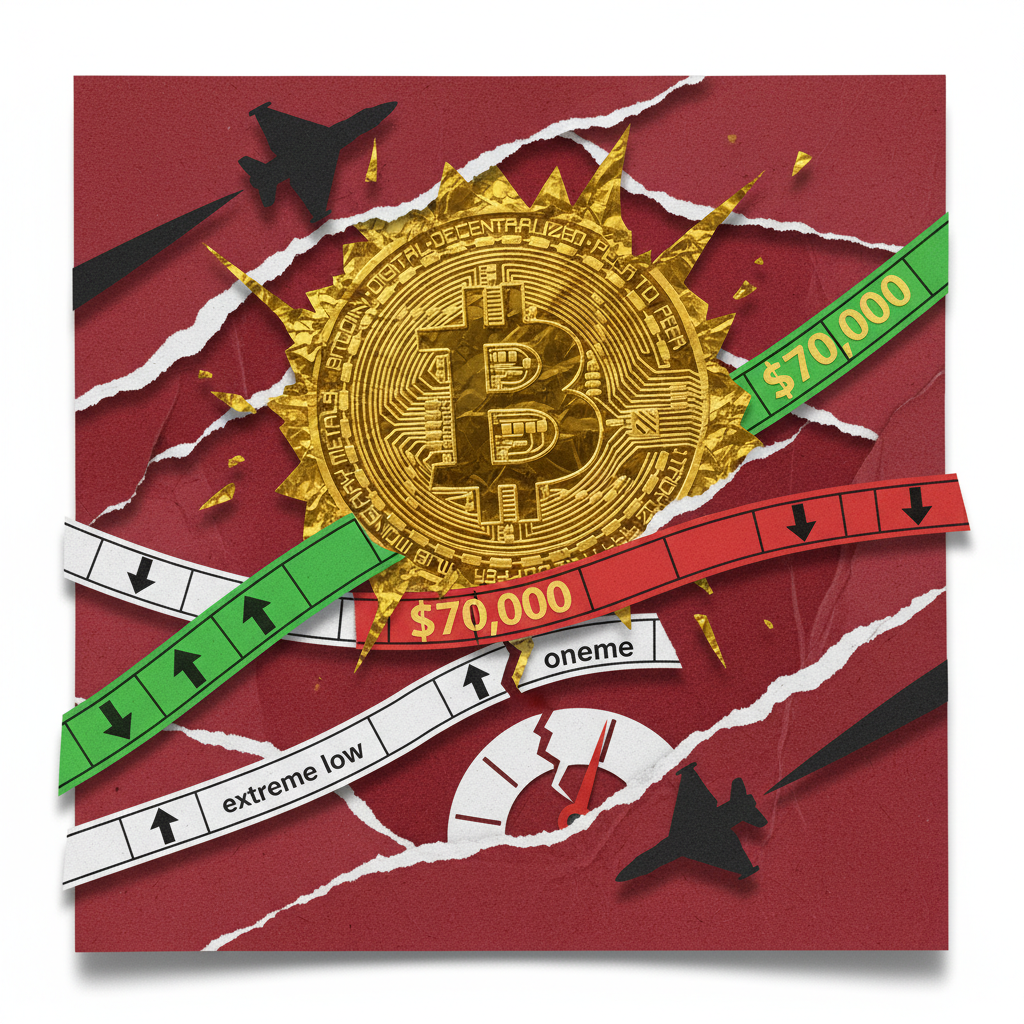
Minutes after Iran confirmed its supreme leader was killed in U.S.-Israel airstrikes, Bitcoin ripped through $68,000 — surging 2.62% in 24 hours to trade at $67,313 on Binance. Yet the Fear & Greed Index remains pinned at 14, deep in Extreme Fear territory.
As of March 1, 2026, 13:34 KST, total crypto market capitalization stands at $2.40 trillion with Bitcoin dominance at 56.1%. Over the past 24 hours, $327 million in leveraged positions were liquidated across exchanges, with longs accounting for 75.6% of the carnage. Bitcoin ETFs closed February with $3.8 billion in net outflows — the worst monthly hemorrhage since spot ETFs launched. Geopolitical shock, extreme fear, and institutional capitulation are colliding on the same day. Here is the complete data breakdown.
Today's Key Takeaways
Quick Answer: Bitcoin surged past $68,000 following Iran airstrikes, but the Fear & Greed Index remains at 14 (Extreme Fear). Key figures: $327M in 24h liquidations (75.6% longs), $3.8B in February ETF outflows (worst month ever), and a record-low 14-day RSI of 25.6. Negative funding rates across all major pairs suggest shorts are paying to stay positioned.
- Bitcoin rebounds post-airstrike: BTC hit $68,200 intraday before settling at $67,313 on Binance (+2.62% in 24h); ETH rallied 4.76% to $2,013
- Extreme Fear persists: Fear & Greed Index at 14/100 (+3 vs. prior day), recovering from a low of 5 on February 23
- Massive liquidations: $327M total in 24h — $245M longs (75.6%) vs. $78M shorts (24.4%); largest single liquidation: $6.63M on OKX (BTC)
- Record ETF exodus: Bitcoin ETF February net outflows of -$3.8B (worst month since inception); 2026 YTD: -$4.5B
- Whale 5-year high deposit: 11,318 BTC ($761M) moved to Binance on Feb 28 — highest single-day exchange deposit since January 2021
- RSI at historic low: Bitcoin's 14-day RSI hit 25.6, only the 3rd time in history it fell below 30 (prior two led to 18x and 100x rallies)
- Negative funding across the board: BTC funding at -0.0007%, ETH -0.0034%, SOL -0.0046%, XRP -0.0131% — shorts are dominant
- SOL leads recovery: Solana surged 7.56% to $88 on Binance, the biggest gainer among large-caps
Bitcoin Tops $68,000 After Iran Airstrikes — Why Crypto Rallied on Geopolitical Chaos
The Iran airstrikes and Bitcoin rally refer to the sharp price surge that followed confirmation on March 1, 2026, that the Iranian supreme leader was killed in a joint U.S.-Israel military operation. Bitcoin spiked to $68,200 before pulling back to $67,313 on Binance, marking a 2.62% gain in 24 hours (Source: CoinDesk, 2026-03-01). Ethereum climbed 4.76% to $2,013, while Solana led major altcoins with a 7.56% gain to $88. The move underscores Bitcoin's growing role as a geopolitical hedge — a digital store of value that traders reach for when traditional safe havens like treasuries and gold become uncertain. On the decentralized prediction market Polymarket, Iran war-related betting volume exceeded $600 million, with a single contract on the supreme leader's removal reaching $45 million (Source: CoinDesk, 2026-03-01). The scale of prediction market activity reflects real capital being deployed to price geopolitical outcomes in real time.
Iran is not merely an external shock factor for crypto markets. The country operates an estimated $7.8 billion crypto shadow economy, including a government-backed Bitcoin mining program (Source: CoinDesk, 2026-02-28). A regime change scenario could directly impact the fate of that mining network and the BTC supply it produces. Meanwhile, oil-linked HIP-3 futures on Hyperliquid surged 5% immediately after the airstrike reports, demonstrating how decentralized derivatives now mirror traditional commodity markets in real time (Source: CoinDesk, 2026-02-28). Eleven U.S. senators have also sent a letter to Binance demanding an investigation into $1.7 billion in digital asset flows to Iranian entities, adding regulatory pressure on top of geopolitical uncertainty (Source: CoinTelegraph, 2026-03-01). As sanctions enforcement tightens, cross-chain asset management tools like Nestree Bridge are gaining attention for their role in transparent, compliant asset transfers. For deeper geopolitical analysis and its crypto market implications, SpotedCrypto's market coverage provides ongoing updates.
Binance & OKX Volume Leaders — March 1 Global Exchange Snapshot
Binance volume data is the most-watched indicator of global crypto market activity, representing the largest centralized exchange by trading volume. As of March 1, 13:34 KST, Bitcoin led Binance spot volume at $1.73 billion with a 24h range of $63,030 to $68,200 (Source: Binance API, 2026-03-01). Ethereum followed closely at $1.12 billion in volume after a 4.76% rally. USDC trading volume reached $870 million, ranking third — a clear sign that traders are parking capital in stablecoins while awaiting clearer direction. On OKX, Bitcoin led with $852 million in spot volume, while gold-backed XAUT ($5,287, $168M volume) appeared in the top 3, highlighting the simultaneous demand for both digital and tokenized gold during geopolitical stress. PAXG on Binance told the same story, trading at $5,344 (+0.65%) with $310 million in volume — gold tokenization is emerging as a real-time safe-haven trade within crypto infrastructure.
| # | Coin | Price | 24h Change | Volume(24h) | High | Low |
|---|---|---|---|---|---|---|
| 1 | BTC | $67,313 | +2.62% | $1.7B | $68,199.99 | $63,030.00 |
| 2 | ETH | $2,013 | +4.76% | $1.1B | $2,054.80 | $1,835.36 |
| 3 | USDC | $1.00 | -0.01% | $870.0M | $1.00 | $1.00 |
| 4 | SOL | $88 | +7.56% | $485.3M | $88.90 | $77.12 |
| 5 | XRP | $1.41 | +4.15% | $367.3M | $1.43 | $1.27 |
| 6 | PAXG | $5,344 | +0.65% | $309.9M | $5,600.00 | $5,286.25 |
| 7 | USD1 | $1.00 | -0.08% | $195.5M | $1.00 | $1.00 |
| 8 | DOGE | $0.10 | +3.46% | $141.3M | $0.10 | $0.09 |
| 9 | BNB | $629 | +2.74% | $122.0M | $632.16 | $588.64 |
| 10 | SUI | $0.93 | +4.75% | $82.9M | $0.95 | $0.83 |
Solana's 7.56% surge to $88 on $485 million in volume made it the strongest large-cap performer of the day, followed by ETH (+4.76%), SUI (+4.75%), and XRP (+4.15%). DOGE added 3.46%, confirming continued meme-coin demand even during risk-off macro conditions. Notably, both stablecoin entries — USDC at $870M and USD1 at $196M — ranked in the Binance top 7, underscoring how much capital is sitting on the sidelines. Traders are accumulating dry powder for what many view as a potential capitulation bottom. Community sentiment on emerging market moves can be tracked and voted on through Vote.Token, where users weigh in on directional calls in real time.
$327 Million Liquidated in 24 Hours — Why 75% Were Longs
Liquidation in crypto futures refers to the forced closure of leveraged positions when collateral value falls below maintenance margin requirements. Over the 24 hours ending March 1, 2026, approximately $327 million in positions were liquidated across major exchanges, affecting an estimated 93,000 to 99,000 traders (Source: CoinGlass, 2026-03-01). Long positions accounted for $245 million (75.6%) of the total, while shorts were liquidated for $78 million (24.4%). The heavy long bias indicates that traders were over-leveraged on bullish bets during the pre-airstrike downturn, and the geopolitical shock triggered cascading stop-outs before Bitcoin reversed higher. The largest single liquidation event was a $6.63 million BTC position on OKX. Ethereum saw an even more extreme skew, with 83.6% of its $92.69 million in liquidations coming from longs — reflecting the pain of traders betting on a bounce while ETH remained 60% below its 2025 high of $5,033.
| Category | Liquidation Total | Longs | Shorts | Largest Single Event |
|---|---|---|---|---|
| All Crypto | $327M | $245M (75.6%) | $78M (24.4%) | $6.63M (OKX BTC) |
| BTC | $92.42M | $66.13M (71.5%) | $26.29M (28.5%) | — |
| ETH | $92.69M | $77.51M (83.6%) | $15.18M (16.4%) | — |
The 83.6% long liquidation ratio on ETH deserves particular attention. Even after a 60% drawdown from its 2025 peak, traders continued to enter leveraged long positions expecting a bounce — only to be stopped out en masse. This kind of forced deleveraging is painful in the short term but serves a structural purpose: it clears excess leverage and builds a healthier foundation for any sustained recovery. The fact that BTC long liquidations were slightly less skewed at 71.5% suggests that Bitcoin traders were marginally better positioned, possibly due to the asset's more established role as a geopolitical hedge. For a broader perspective on how liquidation cascades have historically preceded major trend reversals, SpotedCrypto's analysis archive offers detailed case studies from previous cycles.
Bitcoin ETF Outflows Hit Record $3.8 Billion in February — What It Signals
Bitcoin ETF outflows refer to the net withdrawal of capital from U.S. spot Bitcoin exchange-traded funds, which directly translates to selling pressure on the underlying asset. February 2026 saw approximately $3.8 billion in net outflows from Bitcoin ETFs — the worst single month since spot ETFs launched in January 2024 (Source: Outlook India, 2026-02-28). Year-to-date outflows have now reached $4.5 billion (Source: Yahoo Finance, 2026-02-28). The 90-day rolling average outflow has remained in an extreme risk zone for 25 consecutive days, breaking the prior record of 23 days set in 2023 (Source: CoinTelegraph, 2026-02-28). During the same three-month window, gold ETFs absorbed $16 billion in inflows, making the rotation from digital gold to physical gold one of the most visible macro trades of early 2026. Ethereum ETFs added to the institutional exodus, offloading approximately 563,600 ETH (roughly $1.13 billion) over a five-week period in February (Source: TronWeekly, 2026-02-28).
| Metric | Value | Context |
|---|---|---|
| BTC ETF Feb Net Outflow | -$3.8B | Worst month since ETF launch |
| 2026 YTD Net Outflow | -$4.5B | Jan–Feb cumulative |
| 90-Day Avg Extreme Risk | 25 consecutive days | Prior record: 23 days (2023) |
| ETH ETF 5-Week Selling | ~563,600 ETH (-$1.13B) | Concentrated in February |
| Gold ETF 3-Month Inflow | +$16B | BTC → Gold rotation |
The institutional exodus looks alarming on the surface, but there is a counterargument: seller exhaustion. When outflows reach this level of extremity — 25 straight days in a risk zone that has no historical precedent in the ETF era — the pool of willing sellers shrinks. The same pattern played out during the FTX collapse in November 2022, when extreme capital flight preceded the market bottom by just weeks. The question is not whether selling pressure is real — it clearly is — but whether it is nearing completion. Amid this institutional rotation, community-driven projects within the Nestree ecosystem have maintained independent traction, reflecting how community-backed tokens can decouple from institutional flow dynamics during periods of macro stress.
Whale Deposits and On-Chain Signals — Largest Exchange Inflows in 5 Years
Whale activity analysis tracks the transaction patterns of wallets holding 1,000 BTC or more, using on-chain data to gauge potential selling or accumulation behavior by large holders. On February 28, whales deposited approximately 11,318 BTC ($761 million) to Binance in a single day, with one whale alone moving 6,318 BTC ($425 million) (Source: The Coin Republic, 2026-02-28). This marked the highest single-day exchange deposit volume since January 2021 — a five-year record. On the surface, large exchange deposits signal potential selling intent: whales typically move coins to exchanges to liquidate. However, the January 2021 precedent is instructive. That month saw similarly large whale deposits, yet it marked the beginning — not the end — of a massive bull run that took Bitcoin from roughly $30,000 to $64,000 over the following four months. Context matters more than the raw number.
Bitcoin's 14-day RSI fell to 25.6, setting an all-time record low (Source: CoinDesk, 2026-02-19). The RSI (Relative Strength Index) dropping below 30 has occurred only three times in Bitcoin's history. The first instance (January 2015, RSI ~28, BTC ~$200) was followed by 8 months of consolidation and then a rally to $20,000 — roughly 100x from the RSI trough. The second instance (December 2018, RSI below 30, BTC ~$3,500) led to 3 months of sideways action before a rally to $64,000 — approximately 18x. Neither signal produced an immediate bounce; both required patience measured in months, not days.
Strategy (formerly MicroStrategy) continues to hold 717,722 BTC at an average cost basis of $66,384.56 per coin (Source: BingX, 2026-02-28). With Bitcoin trading at $67,313 — just 1.4% above Strategy's breakeven — this price level functions as an informal institutional floor. If Bitcoin were to dip significantly below $66,384, it would put Strategy's $33.1 billion position underwater, potentially forcing treasury management decisions that could cascade through markets. For now, the proximity to this cost basis acts as a psychological support level that both bulls and bears are watching closely.
Extreme Fear vs. Historical Returns — What Past Cycles Reveal
Historical returns during extreme fear refer to the performance of Bitcoin when purchased at moments when the Fear & Greed Index drops to 15 or below — periods of maximum pessimism where the majority of market participants are in panic mode. The current reading of 14 (up from a cycle low of 5 on February 23) places the market in the same sentiment territory as the March 2020 COVID crash (index: 8), the November 2022 FTX collapse (index: 12), and the December 2018 bear market bottom (index: 9). In each prior instance, buying during extreme fear and holding for 12 months produced returns ranging from 150% to 1,400% (Source: CoinDesk, CoinTelegraph composite data). However, there is a critical distinction: the current drawdown from ATH ($126,210 on October 6, 2025) is approximately 47% — far milder than the 77% to 87% drawdowns seen in previous capitulation events, suggesting that institutional infrastructure, including ETFs, may be limiting the downside range.
| Period | Fear Index | BTC Price | ATH Drawdown | 12-Month Return |
|---|---|---|---|---|
| March 2020 (COVID crash) | 8 | ~$3,800 | -84% | +1,400% |
| Nov 2022 (FTX collapse) | 12 | ~$15,500 | -77% | +150% |
| Dec 2018 (bear bottom) | 9 | ~$3,156 | -84% | +350% (2yr) |
| March 2026 (current) | 14 | ~$67,313 | -47% | ? |
Matthew Sigel, Head of Digital Asset Research at VanEck, assessed the situation directly: "The depth of the drawdown and the degree of leverage reset have made the current price washout increasingly attractive for building positions on a one- to two-year view" (Source: VanEck, 2026-02). On the bearish side, Steven McClurg, CEO of Canary Capital, warned: "2026 I expect to be a bear leg to the four-year cycle," predicting Bitcoin could fall to $50,000 by summer (Source: CCN, 2026-02). Tom Lee, CIO of Fundstrat Global Advisors, struck a middle ground: "Stop timing the bottom and start buying the dip," maintaining a 2026 BTC price target of $200,000 to $250,000 (Source: CoinDesk, 2026-02-11). The divergence among respected analysts underscores why position sizing and dollar-cost averaging are critical in the current environment. Kyle Chasse, crypto analyst, put it bluntly: "Every time, it marked a massive opportunity window. No, it doesn't guarantee the bottom. But historically, peak fear is where asymmetry lives" (Source: BeInCrypto, 2026-02).
Derivatives Deep Dive — Funding Rates, Open Interest, and Market Positioning
Derivatives data — encompassing funding rates, open interest, and long/short ratios — provides a real-time x-ray of how leveraged traders are positioned and where the next liquidation cascade might originate. As of March 1, 13:34 KST, Binance futures show negative funding rates across all major pairs: BTC at -0.0007%, ETH at -0.0034%, SOL at -0.0046%, and XRP at -0.0131% (Source: Binance API, 2026-03-01). Negative funding means short sellers are paying longs to hold their positions — an unusual condition that indicates bearish conviction among leveraged traders. BTC open interest stands at $5.3 billion on Binance alone, with ETH at $3.7 billion and SOL at $861 million. Despite the bearish funding, the long/short ratio tells a different story: 62.2% of BTC accounts are long versus 37.8% short (ratio: 1.65), suggesting that retail traders remain stubbornly bullish even as the smart money (funding rate) leans bearish. This divergence between retail positioning and institutional funding creates the conditions for sharp moves in either direction.
| Coin | Funding Rate | Open Interest | Long/Short |
|---|---|---|---|
| BTC | -0.0007% | $5.3B | 62.2% / 37.8% |
| ETH | -0.0034% | $3.7B | 63.9% / 36.1% |
| SOL | -0.0046% | $861.1M | 70.1% / 29.9% |
| XRP | -0.0131% | $376.9M | 67.4% / 32.6% |
| DOGE | -0.0038% | $163.9M | 66.8% / 33.2% |
| BNB | 0.0000% | $309.5M | N/A |
| ADA | 0.0100% | $90.4M | N/A |
| AVAX | 0.0100% | $74.4M | N/A |
| DOT | 0.0086% | $52.2M | N/A |
| LINK | 0.0095% | $76.5M | N/A |
SOL stands out with the most extreme long/short imbalance: 70.1% long vs 29.9% short (ratio: 2.35), paired with a negative funding rate of -0.0046%. This setup means retail is heavily long while sophisticated traders are paying to short — a classic precursor to either a short squeeze (if SOL breaks higher) or a long liquidation event (if it reverses). XRP's funding rate is the most negative at -0.0131%, indicating the strongest bearish conviction among derivatives traders, yet 67.4% of accounts remain long. ADA and AVAX are notable exceptions with positive funding rates (0.0100% each), suggesting that mid-cap altcoin derivatives are seeing less directional pressure. The aggregate picture: negative funding + high long/short ratios = a market that is fragile in both directions, where any sharp move could trigger cascading liquidations. Traders using leverage in this environment should consider SpotedCrypto's real-time alerts for liquidation risk monitoring.
Week Ahead: Key Events (March 2–7)
The first week of March 2026 is dominated by U.S. employment data releases that directly influence Federal Reserve rate expectations — and by extension, crypto market risk appetite. The most critical event is Friday's Non-Farm Payrolls (NFP) report for February, which has historically been the single highest-volatility macro event for Bitcoin. If payrolls come in significantly below expectations, rate cut expectations rise, making Bitcoin more attractive as a non-yielding asset. Conversely, a strong jobs number extends the higher-for-longer rate narrative and pressures risk assets. On top of the macro calendar, the Iran geopolitical situation remains a wild card: any escalation (retaliation, wider conflict) or de-escalation (diplomatic resolution) could trigger sharp, binary market moves. The FOMC meeting expected on March 17–18 and mid-March CPI data release are additional events traders should position for in advance.
| Date | Event | Impact | Key Watch |
|---|---|---|---|
| Mar 2 (Mon) | ISM Manufacturing PMI (Feb) | ★★★ | Sub-50 = contraction fears → risk-off selling |
| Mar 4 (Tue) | JOLTS Job Openings (Jan) | ★★ | Labor market health gauge |
| Mar 5 (Wed) | ADP Private Employment (Feb) / ISM Services PMI | ★★★ | NFP leading indicator + services sector check |
| Mar 7 (Fri) | Non-Farm Payrolls + Unemployment Rate (Feb) | ★★★★★ | Weak jobs = rate cut hopes = BTC bullish; Strong = hawkish |
| Mid-March | FOMC Meeting (3/17–18) + Feb CPI | ★★★★★ | Rate decision + inflation data dual catalyst |
| Ongoing | Iran geopolitical developments | ★★★★ | Escalation/retaliation risk → sharp binary moves |
What Traders Should Watch
- RSI 25.6 — historic low: The only two prior sub-30 entries (2015, 2018) each preceded rallies of 18x to 100x. Expect 3–8 months of consolidation before any confirmed bottom
- ETF outflow inflection point: The 25-day extreme risk streak must break before a sustainable trend reversal. Monitor daily ETF flow data for the first net positive week
- Strategy's cost basis at $66,385: With 717,722 BTC at an average cost of $66,384.56, this price acts as a psychological and structural support level. A sustained break below it would be a major bearish signal
- Negative funding = short squeeze risk: With BTC funding at -0.0007% and XRP at -0.0131%, any sudden rally could trigger cascading short liquidations and accelerate upside
- SOL long/short divergence: 70.1% long with negative funding — this tension must resolve in one direction. Watch for liquidation cascades on either side
- March 7 NFP: Weak payrolls → rate cut expectations → BTC bullish catalyst. Strong payrolls → extended tightening → bearish pressure
- Iran escalation risk: Further military action could trigger a short-term spike followed by a reversal; diplomatic resolution could spark a relief rally
- Leverage warning: With $327M liquidated in 24h, this is a spot-only or reduced-leverage environment. Over-leveraged positions are being systematically destroyed
NoOnes CEO Ray Youssef warned that "we are unlikely to see a V-shaped reversal before the summer of 2026" (Source: Investing.com, 2026-02). On the other hand, VanEck's Sigel sees the current washout as "increasingly attractive" for multi-year positioning. The market is at an inflection point where conviction matters less than risk management. Dollar-cost averaging, strict position sizing, and hedging through cross-chain diversification tools are prudent strategies during this period of elevated uncertainty.
For real-time chart analysis, derivatives alerts, and institutional flow tracking, explore SpotedCrypto's premium market intelligence.
Frequently Asked Questions
Why did Bitcoin surge after the Iran airstrikes?
Bitcoin functions as a "digital gold" during geopolitical crises, attracting capital seeking decentralized, censorship-resistant value storage. After Iran confirmed its supreme leader was killed in U.S.-Israel airstrikes, BTC surged 2.62% past $68,000 within hours. Iran's $7.8 billion crypto shadow economy and government-backed Bitcoin mining network added supply-side uncertainty, further amplifying demand. Historically, geopolitical shocks — from the 2020 Iran-U.S. tensions to the Russia-Ukraine conflict — have triggered short-term Bitcoin rallies, though the sustainability of these moves depends on broader macro conditions.
What does a Fear and Greed Index of 14 mean?
The Fear & Greed Index measures market sentiment on a scale of 0 (Extreme Fear) to 100 (Extreme Greed) using volatility, momentum, social media, dominance, and trend data. A reading of 14 falls squarely in the Extreme Fear zone. Historically, buying Bitcoin at index levels between 8 and 15 — such as during the COVID crash (index: 8) and FTX collapse (index: 12) — produced 12-month returns of 150% to 1,400%. The current reading of 14, recovering from a cycle low of 5 on February 23, suggests the market has begun a slow psychological recovery, though Extreme Fear conditions typically persist for weeks before sentiment fully normalizes.
How do Bitcoin ETF outflows affect the market?
ETF outflows represent institutional selling pressure that directly impacts the spot market, as ETF providers must sell underlying Bitcoin to meet redemptions. February's $3.8 billion outflow was the worst month since ETF inception, with the 90-day rolling average in an extreme risk zone for a record 25 consecutive days. While alarming, extreme outflow streaks have historically preceded market bottoms — the FTX-era sell-off followed a similar pattern before reversing. The gold ETF rotation ($16B in 3-month inflows) complicates the picture, as some capital may have permanently shifted from digital to physical gold.
Is Bitcoin at the bottom right now?
Multiple bottom indicators are flashing: the 14-day RSI at 25.6 (all-time record low), Fear & Greed at 14 (Extreme Fear), and a 47% drawdown from the $126,210 ATH. However, expert opinion is sharply divided. VanEck's Matthew Sigel sees it as "increasingly attractive for building positions," while Canary Capital's Steven McClurg expects BTC could drop to $50,000 by summer. Past RSI sub-30 entries required 3 to 8 months of consolidation before the bottom was confirmed, so even if this is the bottom, a sustained recovery will take time. Position sizing, dollar-cost averaging, and portfolio diversification remain the safest strategies in this uncertain environment.
Sources
- Bitcoin Tops $68,000 After Iran Confirms Leader Killed, CoinDesk
- Iran War Becomes $600M Betting Frenzy on Polymarket, CoinDesk
- Iran's $7.8 Billion Crypto Ecosystem in Spotlight, CoinDesk
- Oil-Linked Futures on Hyperliquid Surge 5%, CoinDesk
- The Great Flush: $3.8 Billion Bitcoin ETF Capitulation, Outlook India
- Bitcoin ETFs Bleed $4.5 Billion YTD, Yahoo Finance
- Bitcoin RSI Falls Below 30 for Third Time Ever, CoinDesk
- Whale Transfers Surge to 5-Year High, The Coin Republic
- Bitcoin Bottom Fractal Calls for 130% Rally, CoinTelegraph
- Ether 60% Down From 2025 High, CoinTelegraph
- 11 US Senators Request Binance Sanctions Probe, CoinTelegraph
- Crypto Liquidation Data, CoinGlass
- Ethereum Faces Sustained ETF Outflows, TronWeekly
Data Sources
- Live prices: Binance API & OKX API, March 1, 2026, 13:34 KST
- Fear & Greed Index: Alternative.me
- Liquidation data: CoinGlass (coinglass.com)
- ETF flows: Yahoo Finance, Outlook India
- On-chain data: The Coin Republic, CoinDesk
- Global market cap: CoinGecko API
- Derivatives data: Binance Futures API
This article is for informational purposes only and does not constitute investment advice. Cryptocurrency investments carry the risk of total loss of capital. All investment decisions should be made based on your own judgment and risk tolerance. Data is accurate as of publication time and may differ from real-time prices.