Most of the crypto crowd is already trading like altseason has arrived. The data says otherwise — and the gap between sentiment and structure is exactly where 2026 positioning gets decided.
What the Altcoin Season Index at 46 Actually Signals
An Altcoin Season Index reading of 46 means the broad altcoin rally has not structurally begun. The index, which measures how many of the top 50 altcoins outperformed Bitcoin over the trailing 90 days, only confirms altseason at a score of 75 or higher; in mid-2026 it sits near 46–49 of 100 . In plain terms: most traders are positioning for a move the index does not yet confirm.
The companion gauge is Bitcoin dominance (BTC.D), the share of total crypto market value held by Bitcoin. It is running roughly 56%–58.7%, and analyst consensus pegs a sustained break below ~55% as the structural trigger for broad rotation of capital out of Bitcoin and into altcoins . Until that level breaks and holds, altcoin strength tends to be narrative-specific rather than market-wide.
"Traders need Bitcoin dominance below 55% to trigger rotation," — market analysis, Bitcoin.com News.
The regulatory backdrop is arriving in sequence, and it matters because each step widens the on-ramp for institutional flows. The GENIUS Act federally regulated US stablecoins for the first time, with the Treasury expecting the stablecoin market to expand roughly 10x (video: Altcoin Daily) . The next structural unlock is the CLARITY market-structure bill, with a Senate markup dated January 15 and a target passage window of late January to February 2026 . Beyond legislation, SEC Chair Paul Atkins has publicly stated the agency intends to bring traditional-finance assets on-chain via tokenization, reinforcing the real-world-asset narrative .
The net implication is straightforward. At this index level, selective, narrative-driven positioning outperforms broad altcoin beta — owning everything and waiting for a tide that has not turned. Three things decide outcomes from here: the basket (which assets you hold and why), the sizing (how much risk each tier carries), and the timing signal (BTC.D holding below ~55% alongside CLARITY Act passage), which is not yet confirmed . The sections that follow build a tiered framework around exactly those three decisions.
2026 Altcoin Comparison: Performance, Risk Tier, and Investor Fit
The 2026 altcoin field separates cleanly into risk tiers once you score each asset on three axes: realized performance, the durability of the thesis behind that performance, and the failure mode most likely to break it. Ethereum, Solana, XRP, and Chainlink are not interchangeable bets on "altseason" — they are four distinct trades with opposite volatility profiles and opposite reasons to own them. Read year-to-date returns and you would rank them XRP, Solana, Ethereum. Read risk-adjusted durability and the order often inverts, because the biggest gains in this cohort carry the least settled fundamentals.
Ethereum is the institutional anchor and the laggard: roughly +22% YTD while trading in a $2,200–$3,000 window, the lowest-volatility non-Bitcoin base asset with a live US spot ETF and the deepest settlement liquidity. It underperformed peers in raw price but retains the broadest institutional access and the largest stablecoin and rollup footprint, which is precisely why conservative capital treats it as the core rather than the high-upside leg.
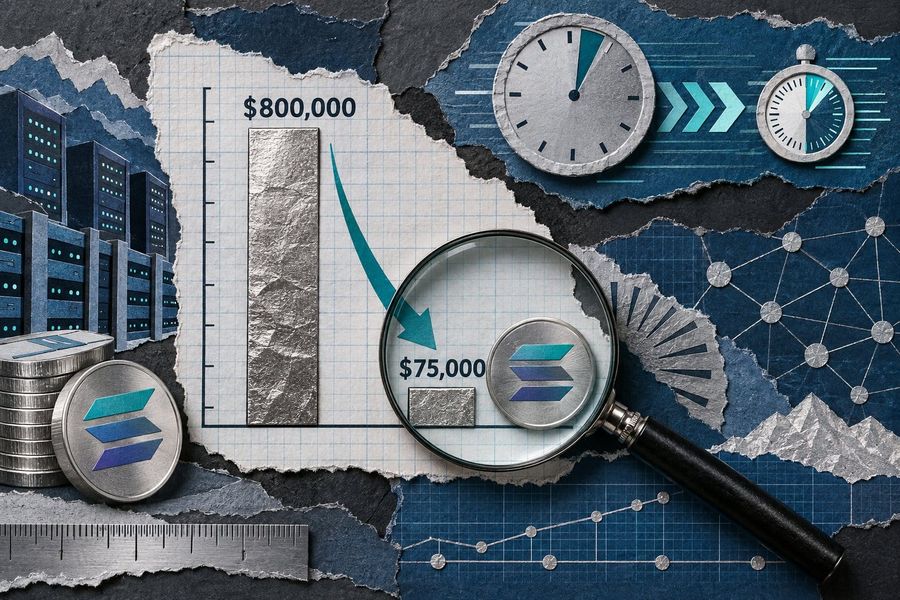
Solana is the fundamentals-backed growth tier: about +180% YTD at $85–$94, with the strongest on-chain economics in the group — trailing-12-month ecosystem revenue near $2.85 billion and a market cap roughly one-twenty-fifth of Ethereum's. The offsetting risk is ecosystem quality, not throughput: a 2026 study classified 76,469 of 100,063 Solana tokens issued in H1 2025 as rug-pulls, so the bull case depends on activity maturing past memecoin churn into durable fees.
XRP is the catalyst trade: over +400% YTD, the momentum leader, riding a materially resolved legal overhang. The July 13, 2023 summary judgment held that XRP as a token is not itself an investment contract, the case reached broader resolution in August 2025, and spot ETFs followed as a defined re-rating event. It is a payments-adoption and flow trade, not a smart-contract-demand bet. Chainlink (LINK) sits in the infrastructure tier — a picks-and-shovels position on cross-chain messaging and tokenized-asset rails that is largely uncorrelated to which L1 wins, carrying its own token-value-capture risk if protocol growth does not accrue to holders through fees and staking.
| Asset | YTD return | Price range | Risk tier | Primary thesis | Key risk | Ideal holder |
|---|---|---|---|---|---|---|
| ETH | ~+22% | $2,200–$3,000 | Core (low) | Deepest liquidity, live spot ETF, institutional settlement base | Underperforms in risk-on rotations; ETF staking restricted | Conservative, liquidity-first |
| SOL | ~+180% | $85–$94 | Growth (high) | Highest on-chain revenue (~$2.85B TTM), asymmetric vs ETH cap | 76% of new H1-2025 tokens flagged as rug-pulls; quality risk | Balanced-to-growth, volatility-tolerant |
| XRP | ~+400% | Catalyst-driven | Catalyst (high) | Legal overhang resolved, spot ETF live, payments flow | Speculation/flow-dependent; limited smart-contract demand | Catalyst/optionality seekers |
| LINK | Thesis-driven | Infra-driven | Infrastructure | Cross-chain and RWA rails, uncorrelated to L1 race | Adoption may not accrue to token value | Differentiated-hedge holders |
The pattern is consistent: the steepest YTD gains (XRP, SOL) pair with the least-settled fundamentals, while the laggard (ETH) carries the deepest liquidity. That tension — return versus durability — is what the tier-by-tier sections below resolve, starting with the core allocation (video: Altcoin Daily).
Tier 1 — Core: Why Ethereum Is Still the Institutional Foundation
Ethereum is the lower-volatility core of a 2026 altcoin basket because it pairs the deepest settlement and rollup ecosystem with regulated US ETF access — the most institutional counterpart exposure of any non-Bitcoin asset. The SEC approved spot ether ETF rule changes (Release No. 34-100224) on May 23, 2024 , and Coinbase and Grayscale both frame inflows as accelerating now that late-2025 restrictions were lifted, letting advisors and brokers proactively recommend the wrappers . ETH traded roughly $2,200–$3,000 in the comparison window after lagging peers at about +22% YTD as of May 2026 .
The protocol mechanics now back the thesis better than the old "cheap L1 fees" story. The Pectra upgrade raised the maximum effective validator balance from 32 ETH to 2,048 ETH and enabled compounding validators; a June 2026 paper estimates a roughly +5% relative consensus-layer APR uplift for small balances, falling below 1% for large providers — real, but not a standalone valuation catalyst . On fees, a mid-2026 empirical study (Jan 2024–Mar 2026) found mainnet median fees fell from over $2 to under $0.02, and L2 median fees fell more than 95% to $0.0015 after blob and block-capacity upgrades — meaningful headroom for adoption, even though the same study forecasts mainnet TPS staying below 100 until 2034 .
The clearest demand signal is stablecoin settlement. As Fundstrat's Tom Lee put it:
"ETH is grossly undervalued," — Tom Lee, Head of Research at Fundstrat, noting Ethereum's stablecoin-market share rose from roughly 47–48% to 53% and that about 30% of Ethereum fees now come from stablecoin transactions (source: Grayscale Research, 2026-01).
Those fundamentals feed a wide valuation fan. A common base case puts ETH near $8,000 if H1-2026 upgrade catalysts (Glamsterdam/Prague) land, while Lee's ETH/BTC-ratio frameworks reach $12,000 on the 8-year average ratio, $22,000 on the 2021-high ratio, and $62,000 at a 0.25 ratio with BTC near $250k . The caveats are honest ones: ETF staking restrictions still make the wrapper less efficient than holding ETH directly, and the APR uplift is incremental rather than transformative.
Who should Ethereum suit? In tier terms, it is the conservative allocation — the position for investors who prioritize deep liquidity, regulated ETF access, and durable institutional exposure over the steeper YTD prints further up the risk stack. It is the asset you size largest when you want non-Bitcoin participation without underwriting an unproven ecosystem.
Tier 2 — Growth: Solana's Fundamentals Case and Its Ecosystem Quality Problem
Solana (SOL) is the tier's high-beta execution-chain bet: the asset you size when you want fundamentals-backed upside and can underwrite ecosystem-quality risk. SOL trades roughly $85–$94, up about 180% year-to-date , and carries the strongest cited on-chain numbers in this basket. Trailing-12-month ecosystem revenue sits near $2.85 billion and real-world-asset (RWA) holders have surpassed 125,000 . These are genuine adoption signals, not throughput marketing — the case for SOL rests on whether that revenue base broadens, not on raw speed.
The asymmetric framing comes from scale. Solana's market capitalization is roughly one twenty-fifth of Ethereum's , so a maturing fee mix would compound from a far smaller base than ETH's. The decisive variable is the source of fees. Solana already wins on speed and cost, so the 2026 bull case does not depend on further throughput upgrades — it depends on the activity mix shifting away from memecoin churn toward durable revenue: DePIN, DeFi, stablecoin settlement, and payments. Throughput is solved; revenue durability is the open question.
That open question is where the central risk lives, and it is structural to the ecosystem rather than the protocol. A 2026 detector study examined 100,063 Solana tokens issued in the first half of 2025 and classified 76,469 of them — roughly 76% — as rug-pulls, using a model trained on 117 confirmed rug-pulls and 68 incident reports . The takeaway is not that Solana is broken; it is that a large share of on-chain activity historically came from low-quality, short-lived tokens. Fee volume inflated by churn of this kind is fragile. If most of the trailing revenue traces to disposable speculation rather than recurring economic use, the headline $2.85 billion figure overstates the durable fee base.
This is why monitoring fee composition matters more for SOL than for any other tier. The bullish path requires evidence that revenue is migrating into categories with repeat usage and real counterparties:
- Payments and stablecoins — recurring settlement flow that does not depend on token launches.
- DePIN — physical-infrastructure networks billing for real services rather than speculative trading.
- DeFi with sticky TVL — lending, perps, and liquidity that persist across market cycles.
- RWA expansion — the 125,000-plus holders growing into deeper tokenized-asset volume.
Brian Jung frames 2026 as the most consequential stretch of this cycle for separating chains that convert hype into lasting usage from those that do not (video: Brian Jung), and Solana is the clearest test of that thesis. If the revenue mix matures, the one-twenty-fifth market-cap gap to Ethereum is the asymmetric prize. If it does not, the same churn that produced the fees can evaporate just as quickly.
Who should Solana suit? In tier terms, it is the balanced-to-growth allocation — for investors comfortable with materially higher volatility than ETH, who will actively track on-chain fee composition and can distinguish durable revenue sources from memecoin throughput. It is a position you hold with conviction in the fundamentals but a hand on the size dial, because the ecosystem-quality risk is real and unresolved.
Tier 3 — Catalyst: XRP's Legal Resolution and Spot ETF Binary
XRP is the catalyst tier — a token whose 2026 thesis rests on legal certainty and discrete inflow events rather than smart-contract or DeFi demand. The defining moment came on July 13, 2023, when a federal summary judgment held that XRP as a digital token is not itself an investment contract, even though Ripple's institutional sales did violate securities law . That split ruling removed the existential overhang most large-cap altcoins never faced, and broader resolution of the case in August 2025 cleared the path for spot products .
The spot XRP ETF launches that followed function as a defined binary re-rating event. Either institutional access opens through a regulated wrapper or it does not — and once it does, the structure creates a repeatable inflow channel that advisors and brokers can recommend directly. This is a different mechanism from ETH's settlement-layer demand or SOL's on-chain revenue: it is a flow story, where the catalyst is access itself rather than usage growth. XRP's outsized move — over +400% year-to-date as of May 2026 — reflects exactly that, a re-rating driven by legal clarity and ETF-flow speculation rather than expanding application activity .
That distinction matters for how you size the position. XRP is fundamentally a payments-adoption and speculation-flow trade, not a smart-contract-demand bet, which means its upside is event-shaped and lumpy rather than compounding. The asset can sit dormant between catalysts, then re-rate sharply when a defined trigger — a new jurisdiction's approval, a fresh ETF listing, a settlement milestone — resolves to the upside. Held as optionality, that profile is an asset; held as a core compounding allocation, it exposes you to long flat stretches with no underlying usage tailwind to carry the position.
Three practical points anchor the tier-3 role:
- Catalyst-driven, not usage-driven: gains track legal and ETF events, so the entry and exit logic should be tied to those triggers, not to network metrics like fees or TVL.
- Lower legal risk, but a narrower thesis: the 2023 ruling and 2025 resolution materially de-risk XRP versus tokens still facing classification questions, yet they do not create new demand-side growth.
- Satellite sizing: position it as a defined-upside option around clear catalyst windows, not as a foundation.
Best fit: investors who want exposure to legal-resolution and ETF-listing upside with identifiable trigger points, and who are disciplined enough to keep that exposure satellite-scaled. XRP rewards traders who treat it as optionality — a small, catalyst-timed sleeve — rather than a compounding core, leaving the foundational weight to ETH and the fundamentals-backed growth allocation to SOL.
Tier 4 — Infrastructure: Chainlink, RWA Rails, and the Picks-and-Shovels Bet
Chainlink (LINK) is the clearest picks-and-shovels position in the basket — a bet on cross-chain messaging, oracle data, and tokenized-asset rails rather than on a single Layer 1 winning share. It earns the infrastructure tier because its adoption trail is enterprise-grade and chain-agnostic: on August 28, 2025, Chainlink announced work with the US Department of Commerce to bring Bureau of Economic Analysis macroeconomic data on-chain — including Real GDP, the PCE Price Index, and Real Final Sales to Private Domestic Purchasers — starting with six feeds across ten ecosystems . Those ten chains span Arbitrum, Avalanche, Base, Botanix, Ethereum, Linea, Mantle, Optimism, Sonic, and ZKsync, which is precisely the point: the value accrues to whichever chains and applications use the data, not to a single L1.
The institutional adoption signal extends into capital markets plumbing. DTCC has described using Chainlink's Cross-Chain Interoperability Protocol (CCIP) in Swift-related tokenized-asset interoperability work, minting test BondTokens compatible with CCIP . That positions LINK alongside the regulatory direction of travel. As SEC Chair Paul Atkins has framed it, the agency intends to bring traditional-finance assets on-chain through tokenization — a real-world-asset (RWA) tailwind that favors neutral interoperability layers over competing settlement chains.
The structural caveat is token-value capture, and it is the reason LINK sits in a satellite tier rather than the core. Protocol adoption can rise materially without proportional LINK appreciation unless fees, staking rewards, and security budgets accrue directly to token holders. A government data feed or a bank's bond pilot can succeed while the token lags, so the thesis depends on usage converting into holder-accruing economics — not on headline integrations alone.
The secondary infrastructure and thematic plays carry the same "prove it" condition:
- Avalanche (AVAX): a credible subnet/app-chain narrative, and it appears inside Chainlink's ten-chain rollout , but it must still demonstrate durable fee share against Ethereum L2s and Solana.
- Polygon (POL): a real AggLayer scaling thesis, weighed down by token-migration complexity and direct competition from Base, Arbitrum, Optimism, and zkSync.
- Cardano (ADA): governance depth and native USDC via Lace Wallet, but the weakest DeFi-liquidity case of the three absent accelerating usage and stablecoin flow.
Best fit: investors who want differentiated exposure to institutional tokenization and RWA rails without taking direct L1 competition risk against Ethereum or Solana. The discipline here is to treat each name as a small satellite that must earn an overweight — by showing rising users, fees, total value locked, or live enterprise deployments — before it graduates from a watch-list position to a sized allocation (video: Altcoin Daily).
The Structural Risk Every Altcoin Holder Must Size Around
The single largest structural risk in any altcoin basket is correlated downside under macro stress, and the clearest recent proof was the October 10, 2025 liquidation cascade that wiped out more than $19 billion — among the largest ever recorded. It was triggered when China's rare-earth export controls and an announced 100% additional US tariff (effective November 1) hit a market where open interest sat near all-time highs and positioning was heavily long . The macro headline lit the fuse; the leverage already in the system did the damage (video: Altcoin Daily).
The asymmetry of that day is the part most position-sizing frameworks underestimate. In the cascade, top-100 altcoins fell roughly 30% to 70%+, while Bitcoin fell materially less . Altcoins do not simply track macro shocks — they amplify them by a multiple, because thinner liquidity and longer-duration speculative positioning concentrate forced selling. A 50% Bitcoin-relative drawdown is not a tail outcome for a satellite altcoin during a deleveraging event; it is the base case.
The cascade's operative lesson is that leverage and crowded positioning are the multipliers, not the macro event itself. The same news flow produces very different outcomes depending on how a book is built:
- Leverage tier: the identical headline that prints a manageable mark-to-market loss at 2x can force full liquidation at 10x, because the maintenance buffer is gone before any thesis can play out.
- Crowding: when open interest clusters on one side, each liquidation triggers the next, so a position's risk depends on what everyone else is holding, not only on the asset's fundamentals.
- Liquidity depth: assets with shallow order books gap further on the same flow, which is why lower-tier names fell hardest in the October print.
The risk-management implication runs directly back to the tiered framework. Position sizing within each tier — and total altcoin exposure as a share of the overall portfolio — matters as much as which tier you pick. A correct call on Ethereum or Solana still produces a poor outcome if it is sized as though it carries Bitcoin's volatility profile. Practically, altcoins require wider stop ranges than Bitcoin to avoid being shaken out by ordinary noise, smaller individual position weights so no single satellite can dominate a drawdown, and a hard ceiling on leverage given that the broader rotation signal — BTC dominance breaking below ~55% alongside CLARITY Act progress — is a timing input, not a license to overextend . Sizing for the October-style event before it arrives is what separates a survivable basket from a liquidated one.
Decision Framework: Which Altcoin Tier Fits Your Risk Profile?
Match your tier to your risk tolerance, not to a forecast. The most defensible 2026 structure is a layered basket where each tier you add raises both expected upside and total drawdown risk, and where the broad-rotation trigger — Bitcoin dominance sustaining a break below ~55% alongside CLARITY Act passage — decides how aggressive the upper tiers should be . With the Altcoin Season Index near 46–49 of 100 and BTC.D around 56%–58.7%, selective tiered exposure is more defensible than a broad altseason bet until that compression is confirmed .
The tiers stack additively. Conservative investors hold ETH alone as the core: US spot-ETF access, the deepest non-BTC settlement liquidity, the longest institutional adoption trail, and the lowest intra-altcoin correlation to memecoin-quality risk . Balanced investors add a SOL growth leg — pairing institutional stability with fundamentals-backed upside, since both assets carry a real on-chain revenue thesis (Solana's trailing-12-month ecosystem revenue is near $2.85 billion), though total volatility rises .
Growth investors add XRP for legal-resolution and ETF optionality — its August 2025 case resolution and subsequent spot-ETF launches act as a defined re-rating event — but this materially raises basket risk and is only appropriate if BTC.D already shows early compression toward 55% . Speculative investors add LINK infrastructure plus AVAX/POL/ADA satellites, but no satellite should be overweighted before it proves rising users, fees, TVL, or enterprise deployments — Chainlink's Department of Commerce BEA macro-data feeds launched across ten ecosystems in August 2025 is the kind of concrete proof point to look for .
| Risk profile | Recommended tiers | Key trigger to watch | Position-sizing guideline | Exit signal |
|---|---|---|---|---|
| Conservative | ETH core only | Spot-ETF inflow trend; ETH/BTC ratio | Single core position; no leverage | Loss of ETF inflow momentum or thesis break |
| Balanced | ETH core + SOL growth | Solana on-chain revenue durability | Core overweight; SOL as minority growth sleeve | SOL activity reverting to memecoin churn |
| Growth | ETH + SOL + XRP catalyst | BTC.D early compression toward 55% | Smaller XRP weight; treat as event optionality | ETF catalyst exhausts or dominance re-expands |
| Speculative | Above + LINK + AVAX/POL/ADA satellites | Per-name proof: users, fees, TVL, deployments | Capped satellite weights; hard leverage ceiling | No adoption proof; crowded long open interest |
The single timing input that governs the whole stack is the same one analysts cite for broader altcoin beta: a sustained BTC dominance break below ~55%, ideally alongside CLARITY Act passage, whose Senate markup was targeted for January 15 with a late-January/February 2026 passage window . Until that confirms, keep the upper tiers light and the leverage ceiling hard — the October 10, 2025 cascade that erased over $19 billion and dropped top-100 altcoins 30%–70%+ is the reminder that crowded long positioning, not thesis quality, is what liquidates a basket .
The concrete takeaway: build from the core outward, add a tier only when your risk budget and the dominance signal both permit it, and let proof — inflows, on-chain revenue, ETF re-ratings, enterprise deployments — gate every step up the pyramid. A tiered basket you can hold through an October-style shock will outlast a broad altseason bet placed before the rotation signal arrives. This is informational synthesis, not financial advice.
Frequently asked questions
What is the altcoin season index and what does a reading of 46 mean?
The Altcoin Season Index is a 0–100 gauge that measures how many of the top 100 cryptocurrencies have outperformed Bitcoin over the trailing 90 days. A reading of 75 or above confirms an "altcoin season"; readings below it signal Bitcoin-led or selective markets. Mid-2026's print near 46–49 means fewer than half of large-cap altcoins are beating BTC, so broad rotation has not structurally begun. The practical takeaway is to favor narrative-driven, tier-based positioning over indiscriminate altcoin beta until the index sustains a move toward 75 .
What level of Bitcoin dominance triggers broad altcoin rotation?
Analysts cite a sustained break below roughly 55% Bitcoin dominance (BTC.D) as the structural trigger for broad capital rotation into altcoins. As of mid-2026, BTC.D runs around 56%–58.7%, still above that line, which is why relative altcoin performance has stayed selective rather than broad. A confirmed move under ~55% historically precedes periods when capital flows down the risk curve from BTC into ETH and then into smaller-cap names. The paired catalyst to watch is the CLARITY market-structure bill, with a January 15 Senate markup and a target passage window of late January to February 2026; the price signal and the legislative signal arriving together would strengthen the rotation case .
Is XRP a good investment in 2026 after its legal battle with the SEC?
XRP's legal overhang is materially lower than it was. The July 13, 2023 summary judgment held that XRP as a digital token is not itself an investment contract, although institutional Ripple sales did violate securities law; the case reached broader resolution in August 2025, followed by spot-ETF launches that act as a defined binary re-rating event . XRP was the momentum leader at over +400% YTD as of May 2026. Its thesis is payments adoption and ETF/speculation flows rather than smart-contract demand, which frames XRP as a catalyst-optionality satellite, not a core compounding position.
Why does Solana's rug-pull rate matter for long-term SOL investors?
The rug-pull rate matters because it reflects ecosystem-quality risk, which is Solana's decisive long-term variable rather than throughput. A 2026 study classified 76,469 of 100,063 Solana tokens issued in H1 2025 as rug-pulls — roughly 76%. That churn undermines the case for durable, fee-generating activity. Solana's bull thesis rests on trailing-12-month ecosystem revenue near $2.85 billion and a market cap about 1/25th of Ethereum's. Whether that asymmetry holds depends on activity maturing beyond memecoin speculation into DePIN, real DeFi, and stablecoin payments — sustained fees, not raw transaction counts, are what justify the valuation (video: Altcoin Daily).
What is the single biggest risk to an altcoin portfolio in 2026?
The single biggest risk is leverage and crowded positioning, not asset selection. On October 10, 2025, a liquidation cascade wiped out over $19 billion — among the largest ever — with top-100 altcoins falling 30%–70%+ while Bitcoin fell materially less. The shock was triggered by China's rare-earth export controls and announced 100% additional US tariffs (effective Nov 1) when open interest sat near all-time highs and was heavily long (video: Altcoin Daily). The lesson is structural: position sizing and total leverage exposure are the primary risk levers, because altcoins fall far harder than Bitcoin in stress and crowded longs amplify every drawdown.