on a losing trade generates useful data rather than regret about a process that was never defined.
Tier 1 — Blue-Chip Altcoins: ETH vs. XRP vs. SOL Compared
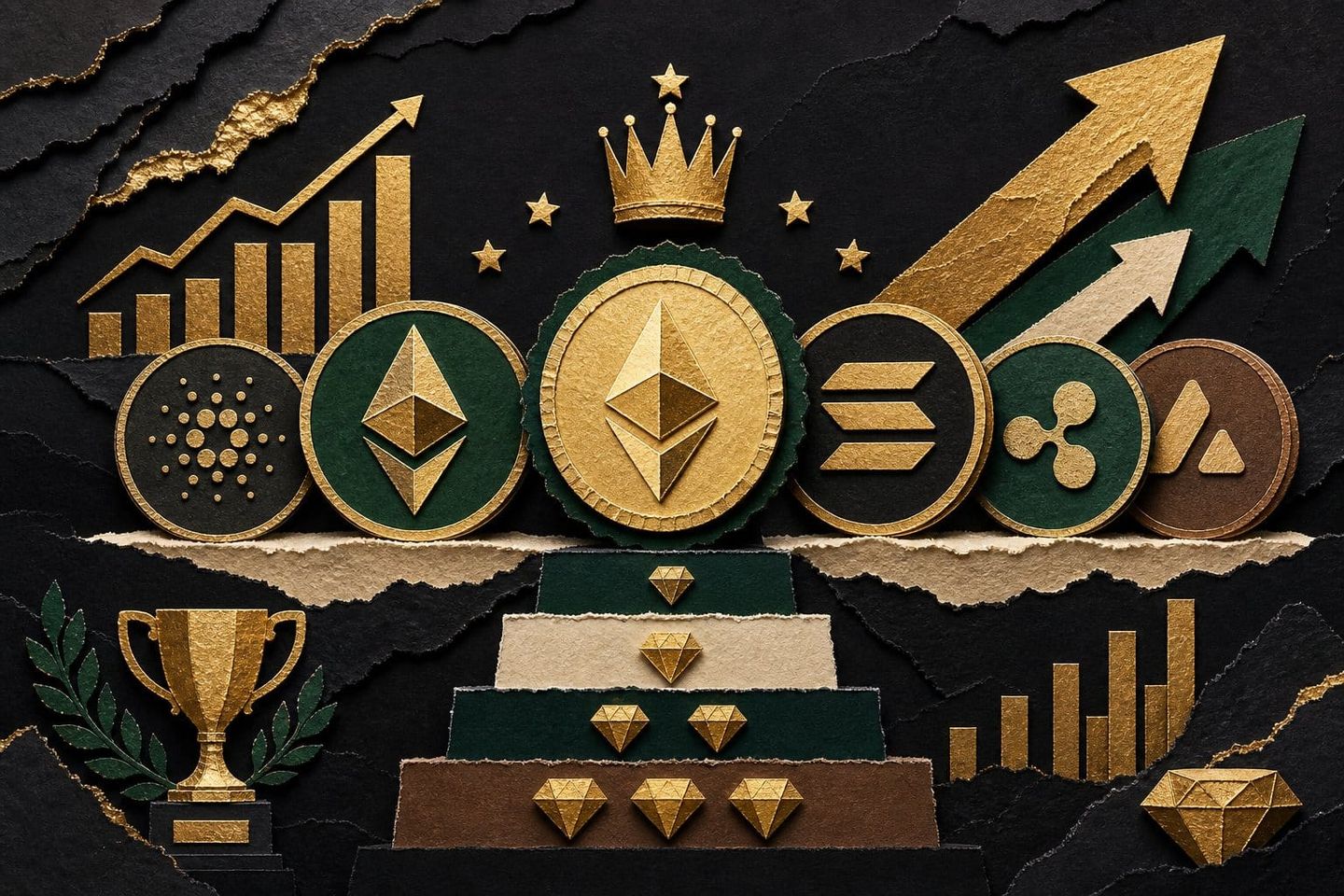
Blue-chip altcoins in 2026 share three defining characteristics: market capitalizations above $50 billion providing institutional-grade liquidity floors, documented on-chain activity or protocol revenue underpinning fundamental valuations, and specific near-term catalysts rather than purely macro-dependent price recovery. Ethereum, XRP, and Solana each meet these criteria—but with meaningfully different risk-return profiles suited to different investment objectives and time horizons.
Ethereum (ETH) trades near $2,318–$3,000 with approximately +21.87% year-to-date performance , anchoring a market capitalization of approximately $279 billion . ETH hosts approximately 75% of DeFi total value locked and maintains around $49 billion in USDC liquidity , creating structural demand from DeFi protocols, stablecoin issuers, and Layer-2 networks that depend on Ethereum for settlement finality. The Prague upgrade, targeted for H1 2026, expands blob throughput and increases L2 transaction capacity, directly addressing cost and speed limitations while preserving value accrual at the base layer. AI model consensus for ETH spans $3,000–$18,000 for end-2026, with a balanced base case near $8,000 representing approximately 170% upside from current levels .
XRP is the standout large-cap performer of the 2026 cycle, posting over +400% year-to-date with a current price range of $1.42–$1.95 . The defining catalyst was the August 2025 resolution of Ripple's multi-year SEC enforcement case —the largest regulatory overhang cleared on any major digital asset, unlocking institutional participation that had been legally constrained for years. On-Demand Liquidity banking partnerships have sustained institutional trading volume post-resolution. AI model consensus centers on a $3 base case (approximately 60% upside from current levels) with a $6 bull case contingent on ETF approvals proceeding through the SEC pipeline . Given the +400% YTD move already priced in, XRP's forward risk-return is more moderate than its headline performance implies—the cleaner incremental catalyst is ETF approval as a binary re-rating event.
Solana (SOL) ranks second among blue-chip performers at approximately +180% year-to-date, trading in the $85–$135 range . SOL's $2.85 billion in documented annual protocol revenue distinguishes it sharply from almost all other large-cap altcoins with fundamental fee-based backing. The Firedancer upgrade targets one million transactions per second , positioning SOL for high-frequency DeFi applications and consumer use cases that require throughput Ethereum currently cannot deliver. Analyst consensus runs $200–$300 for base-case end-2026 (approximately +120% upside) with higher-conviction targets spanning $350–$1,000 .
"Ethereum and Solana represent the most compelling risk-adjusted opportunities in large-cap altcoins for 2026—ETH on the basis of its dominant DeFi ecosystem and upcoming Prague upgrade, SOL on its documented fee revenue and the Firedancer throughput expansion targeting institutional and high-frequency use cases." — Bitwise Investments, 2026 Crypto Predictions Report
| Asset | Price Range (May 2026) | YTD Return | Market Cap | Protocol Revenue | Primary 2026 Catalyst | Base-Case Target |
|---|---|---|---|---|---|---|
| Ethereum (ETH) | $2,318–$3,000 | +21.87% | ~$279B | DeFi fees (75% TVL dominance) | Prague upgrade, blob throughput (H1 2026) | ~$8,000 |
| XRP | $1.42–$1.95 | >+400% | ~$90B+ | On-Demand Liquidity banking volume | ETF approval (multiple issuers under review) | $3 base / $6 bull |
| Solana (SOL) | $85–$135 | +180% | ~$60B+ | $2.85B annual protocol revenue | Firedancer upgrade (mid-2026) | $200–$300 |
All three assets qualify as core portfolio holdings across risk profiles, but optimal weighting depends on investor objective. ETH delivers the strongest risk-adjusted case for conservative portfolios prioritizing capital preservation. SOL offers the highest fundamental revenue backing of the three, reducing pure-narrative dependency in any macro downturn. XRP offers the highest forward catalyst specificity—ETF approval functions as a near-term binary event with defined re-rating potential.
Tier 2 — High-Conviction Mid-Caps: HYPE and TAO
Tier 2 assets occupy a distinct space in the 2026 altcoin risk spectrum: larger upside ceilings than blue-chips, meaningfully lower floors, and substantially thinner order books that demand more active position management. Hyperliquid (HYPE) and Bittensor (TAO) represent the strongest mid-cap cases in 2026—each with demonstrable market share or network adoption rather than pure narrative—but both require predefined exit triggers and active monitoring that Tier 1 holdings do not.
Hyperliquid (HYPE) trades at approximately $40–$46 and ranks #13 globally by market cap at roughly $10.4 billion , with +68.62% year-to-date performance despite a risk-off early-2026 macro environment. HYPE's competitive position is concrete and measurable: approximately 70% market share in decentralized perpetual futures trading . Unlike most DeFi governance tokens, HYPE's protocol actively buys back and burns tokens as trading volume revenue scales—a deflationary mechanism that creates structural supply pressure independent of sentiment cycles. Analysts cite a breakout target near $80 , representing 75–100% upside from the current range. The primary invalidation risk is market share erosion: centralized perpetual exchanges with deeper liquidity could recapture volume if Hyperliquid's product differentiation narrows.
Bittensor (TAO) trades near $305.80 and leads the decentralized AI compute category by developer adoption. TAO's model is structurally different from narrative-driven AI crypto tokens: miners earn TAO by performing verifiable AI inference tasks, creating a supply-demand relationship between compute utility and token issuance rather than a pure speculative premium. The long-term logarithmic channel upper boundary projects a breakout target at $482–$495 , approximately 58–62% upside from current levels. Key invalidation risk: decentralized AI compute networks have low switching costs, and TAO's premium depends on sustained developer preference over centralized cloud alternatives.
"HYPE is one of the few mid-cap DeFi tokens where protocol revenue and token mechanics are genuinely aligned—the buyback-and-burn model creates real supply-side pressure as trading volume scales, rather than relying on paper tokenomics or vague utility claims." — CoinPedia Research, Best Altcoins to Invest in 2026
Liquidity discipline is essential for both HYPE and TAO. Both assets have meaningfully tighter order books than ETH or SOL—traders should assume 2–3× more slippage on large exits compared to Tier 1 blue-chips . For positions above $25,000 in either asset, exit planning must explicitly account for this slippage differential. In risk-off episodes where order book depth contracts fastest, mid-cap positions can gap through intended exit levels—a risk that does not exist at the same magnitude for ETH or SOL. HYPE and TAO suit traders who can actively monitor positions and execute tactical exits on catalyst deterioration, not traders who prefer set-and-hold approaches.
Tier 3 — Sector Narrative Plays: RWA, AI Crypto, DePIN, and DeFi
Sector narrative plays carry the highest risk in the 2026 altcoin framework but include some of the most thematically defensible investments when filtered by revenue quality and catalyst specificity. Four sectors merit structured attention: Real-World Assets (RWA), AI Crypto, Decentralized Physical Infrastructure Networks (DePIN), and DeFi blue-chips. Each carries a distinct risk profile, realization timeline, and position-sizing constraint that separates disciplined allocation from undifferentiated speculation.
Real-World Assets (RWA) — Ondo (ONDO), Hedera (HBAR), Maker (MKR). Tokenized Treasuries and institutional issuance represent the fastest-growing DeFi sub-sector in 2026 . The investment thesis is regulation-contingent: as regulated on-ramps expand and TradFi institutions announce tokenization partnerships, assets embedded in that infrastructure capture disproportionate capital inflows. Favorable frameworks accelerate adoption; enforcement uncertainty compresses multiples rapidly. Maker (MKR) carries the most mature revenue model in this group. Ondo Finance (ONDO) has the clearest regulatory co-operation posture among newer RWA protocols .
AI Crypto — Fetch.ai (FET), SingularityNET (AGIX), Render (RNDR). The AI-blockchain convergence narrative captures speculative rotation effectively, but current valuations in this sector have execution risk priced in early . Sustaining premium multiples requires demonstrable proof of execution: measurable compute utilization growth, developer retention rates, and enterprise partnership conversions—not just narrative momentum. Traders allocating here should define specific utilization milestones as position reassessment triggers, not price targets alone, since narrative momentum in AI crypto can reverse abruptly when broader AI market sentiment rotates.
DePIN — Helium (HNT), Akash (AKT), Filecoin (FIL). Tokenized real-world infrastructure networks have longer realization timelines than DeFi protocols but potentially more defensible network effects once adoption milestones are crossed . DePIN assets are structurally better suited to 12–24 month holding horizons than tactical trading. Infrastructure deployment cycles are measured in quarters, not weeks; position sizing should reflect this duration with smaller initial allocations and defined add-on triggers tied to network growth metrics.
DeFi Blue-Chips — Chainlink (LINK), Uniswap (UNI), Aave (AAVE). Among all Tier 3 plays, DeFi blue-chips offer the strongest revenue and integration defensibility. Chainlink (LINK) at the $8.58 accumulation zone is particularly notable: LINK's oracle infrastructure underlies RWA market expansion, giving it cross-sector leverage across both DeFi growth and institutional tokenization adoption simultaneously. Uniswap and Aave hold the deepest liquidity and most established revenue models in decentralized exchange and lending markets respectively.
| Sector Theme | Representative Assets | Primary Catalyst | Risk Level | Position Size Guideline |
|---|---|---|---|---|
| Real-World Assets (RWA) | ONDO, HBAR, MKR | Tokenized Treasury expansion; TradFi partnership announcements | Medium-High | 3–5% of total portfolio per position |
| AI Crypto | FET, AGIX, RNDR | AI-blockchain convergence; compute utilization proof | High | 2–4% of total portfolio per position |
| DePIN | HNT, AKT, FIL | Infrastructure adoption milestones; supply-side revenue | High | 2–3% of total portfolio per position |
| DeFi Blue-Chips | LINK, UNI, AAVE | RWA oracle integration; protocol revenue growth | Medium | 4–7% of total portfolio per position |
A critical constraint applies across the entire Tier 3 category: with the Altcoin Season Index below 35, sector narrative assets are more exposed to Bitcoin dominance pullback than in prior cycles . A widely referenced 2026 allocation model distributes capital as follows: 50% BTC/ETH, 30% Tier 1 majors (SOL, XRP), 20% sector narratives . Within that 20% Tier 3 envelope, no single narrative play should exceed 10–15% of total portfolio to avoid uncompensated concentration risk in assets with no institutional liquidity floor.
Which Altcoin Fits Your Profile? The Risk-Match Decision Guide
Portfolio construction is where market analysis becomes actionable—and where the gap between knowing what to buy and knowing how much creates the most persistent errors in retail crypto investing. The three profiles below translate risk tolerance into specific allocation structures, with portfolio size thresholds that reflect real liquidity realities rather than theoretical optima. Each profile assumes the altcoin allocation represents a portion of total investable assets, not the entire portfolio.
Conservative — Capital Preservation with Measured Upside. ETH as the core position at 60–70% of the altcoin allocation, XRP or SOL as a satellite at 20–30%, with a 10% stablecoin reserve maintained as dry powder for drawdown opportunities. This structure deliberately accepts a lower total upside ceiling in exchange for the institutional liquidity floor ETH provides—meaningful protection against gap-down scenarios where illiquid assets can lose 40–60% before order books recover. Total altcoin exposure for this profile should remain at 20–30% of total investment portfolio.
Moderate — Growth-Oriented, Diversified Risk. Tier 1 assets (ETH, SOL, XRP) at 50% of the altcoin allocation, Tier 2 mid-caps (HYPE or TAO—not both at full weight simultaneously) at 30%, and Tier 3 sector plays at 20% with predefined stop-loss levels on every position. Stop-loss discipline is not optional at this allocation: Tier 2–3 assets without exit triggers become effectively illiquid in sharp drawdowns, converting manageable losses into portfolio-impairing ones. Total altcoin exposure: 40–50% of total investment portfolio.
Aggressive — Asymmetric Upside, Active Management Required. Tier 2–3 positions dominant at 50–60% of the altcoin allocation, with ETH as a hedge anchor at 20–30%. This structure maximizes exposure to mid-cap breakout scenarios and sector rotations, but demands active monitoring and genuine willingness to cut positions when catalysts fail—not to average down on narrative momentum after an invalidation event. The common failure mode here is holding Tier 2–3 assets through catalyst failures on the expectation of eventual recovery. Total altcoin exposure: up to 60% of total investment portfolio for traders with active monitoring capacity.
"Portfolio size thresholds are as binding as risk tolerance when allocating to altcoins: under $5,000 total altcoin capital, the correct universe is ETH and SOL only. Between $5,000 and $50,000, Tier 2 becomes viable without material slippage. Above $50,000, Tier 3 sector diversification begins to provide genuine risk-adjusted benefit rather than simply adding concentrated risk." — coincub.com, Best Crypto to Buy 2026
Portfolio size is a structural constraint, not a preference. Under $5,000 in total altcoin capital, the viable universe is ETH and SOL only—Tier 2 position sizing becomes impractical without incurring material slippage on meaningful allocations . Between $5,000 and $50,000, Tier 2 assets become viable without significant slippage on entry or exit. Above $50,000, Tier 3 sector diversification provides genuine incremental risk-adjusted return. Attempting Tier 3 narrative plays with sub-$5,000 altcoin capital is structurally equivalent to taking concentrated single-asset bets at the riskiest end of the spectrum—the inverse of the diversification benefit the allocation is intended to provide.
Key Risks That Could Invalidate the 2026 Altcoin Thesis
A rigorous investment approach requires explicit risk accounting—not as boilerplate, but as a structured identification of conditions under which the thesis fails and positions should be reduced or exited. Four primary risk categories apply systematically to the 2026 altcoin market, and each carries a specific monitoring signal that precedes price action.
Risk 1: Altcoin season does not materialize. The Altcoin Season Index remaining below 75 for the full 2026 calendar year is a plausible base case, not an extreme scenario. If Bitcoin dominance stays elevated and capital rotation remains narrow, only the highest-conviction Tier 1 assets—ETH and possibly SOL—generate meaningful outperformance relative to BTC on a risk-adjusted basis . Tier 2 and Tier 3 holdings in this environment face extended consolidation or outright drawdown. Practical action threshold: reduce Tier 2–3 exposure if the Altcoin Season Index remains below 40 through Q3 2026.
Risk 2: New regulatory enforcement actions. XRP's August 2025 SEC resolution materially reduced enforcement tail risk across the altcoin category , but it did not eliminate it. DeFi protocols and DePIN networks remain in regulatory gray zones across multiple jurisdictions. A targeted enforcement action against a leading DeFi protocol would compress multiples across the DeFi blue-chip category rapidly—sector contagion is the established pattern from prior enforcement cycles regardless of which specific asset is targeted. Tier 3 DeFi exposure should be sized to absorb a 60–70% sector drawdown from adverse enforcement news without forcing a total portfolio restructuring.
Risk 3: Macro shock and liquidity withdrawal. A higher-for-longer interest rate environment extending into H2 2026, or an equity market correction driven by credit or geopolitical stress, historically compresses altcoin multiples faster and more deeply than Bitcoin . Federal Reserve rate decisions are therefore the single most consequential external variable for altcoin portfolio management throughout 2026—monitor the Fed dot plot and CPI releases as leading macro signals before they translate into crypto market structure changes.
Risk 4: Asset-specific execution failures. Each Tier 1 asset carries upgrade execution risk: Firedancer delays on Solana, Prague upgrade scope reduction on Ethereum. Tier 2 assets carry market share risk: HYPE to centralized perpetual exchanges with deeper liquidity, TAO to competing decentralized compute networks. Security remains a persistent systemic concern—over $2 billion was lost to protocol hacks and exploits in the first half of 2026 alone . Position concentration in any single smart contract protocol, even a leading one, should be weighed against this background loss rate. Execution failures on named catalysts are the most asset-specific and least diversifiable risk category in this framework.
2026 Altcoin Catalyst Calendar: When and How to Position
The width of analyst price ranges for 2026 altcoins—ETH: $3,000–$18,000; SOL: $120–$800 —reflects genuine uncertainty about catalyst timing and execution, not analytical disagreement about directional thesis. For position-building, this has a direct implication: dollar-cost averaging across Q2–Q3 2026 materially reduces timing risk compared to lump-sum entry at current prices, particularly for assets with binary catalyst events still ahead.
Ethereum Prague Upgrade (Targeted H1 2026). The critical post-upgrade signals to track are blob fee data and L2 TVL migration rates. Sustained growth in both metrics validates the ~$8,000 base case; flat or declining metrics post-deployment compress the mid-range scenario toward the lower bound of analyst estimates. Recommended positioning: build ETH exposure ahead of the upgrade through systematic DCA, with a 30-day post-deployment review date to assess on-chain data before extending or reducing allocation.
Solana Firedancer Mainnet (Mid-2026 Updates). Institutional validator adoption and high-frequency DeFi volume are the leading indicators to monitor before price movements follow . SOL's documented revenue base means rising on-chain fees post-Firedancer provide the most direct confirmation signal for the $200–$300 base case thesis. Stagnant fee growth after deployment would be an early warning to reassess higher-conviction targets.
XRP ETF Pipeline (Multiple Issuers Under SEC Review). XRP ETF approval functions as a binary catalyst: approval compresses the spread between current price and the $3 base case within days, as institutional capital enters through regulated vehicles . Multiple concurrent issuer applications increase the probability of at least one approval in 2026. Positioning established ahead of approval announcements captures substantially more of the binary re-rating move than reactive entry after the fact.
The DCA rationale is consistent across all three Tier 1 assets. Given the analyst range width, a single-point lump-sum entry creates unnecessary timing concentration. Systematic biweekly purchases across Q2 and Q3 2026 captures a statistically representative entry range and eliminates the behavioral asymmetry of buying at a local high before a catalyst delay or macro correction.
Frequently Asked Questions
Which altcoin offers the best risk-adjusted return in 2026?
Ethereum (ETH) leads on risk-adjusted grounds among all altcoins in the 2026 market structure. Its approximately $279 billion market cap provides an institutional liquidity floor that mid- and small-cap altcoins cannot match. ETH commands approximately 75% of DeFi total value locked and hosts around $49 billion in USDC liquidity , creating structural demand that persists through sentiment cycles. The Prague upgrade provides a concrete near-term catalyst, and the AI model base case near $8,000 represents approximately 170% upside from current levels . No other altcoin combines ETH's institutional liquidity, ecosystem revenue, and identified near-term catalyst in the current environment.
Is 2026 actually an altcoin season?
Not broadly. The Altcoin Season Index currently sits at 27–35 —well below the 75 threshold that has historically defined a genuine altcoin season where capital rotates systematically out of Bitcoin dominance. A handful of assets with specific catalysts have outperformed sharply: XRP at over +400% year-to-date following its August 2025 SEC resolution , SOL at +180% on protocol revenue and Firedancer positioning. The majority of altcoins are trailing Bitcoin on a risk-adjusted basis. Selective, catalyst-driven exposure—not broad altcoin diversification—is the correct market posture. The Altcoin Season Index crossing 75 is the leading indicator to monitor for a genuine broad regime change.
Why is Hyperliquid (HYPE) considered a top mid-cap pick?
Hyperliquid commands approximately 70% market share in decentralized perpetual futures trading —a demonstrated competitive position backed by on-chain volume data, not narrative. Its deflationary buyback-and-burn model reduces circulating supply as protocol fee revenue scales, creating structural supply pressure independent of broader market sentiment. With a market cap of approximately $10.4 billion and an analyst breakout target near $80 , HYPE is one of the few Tier 2 assets where revenue mechanics and token design are structurally aligned. The primary invalidation risk to monitor is weekly decentralized perpetuals volume share—market share erosion to centralized exchanges is the clearest signal to reassess the position.
How should I size altcoin positions relative to my total portfolio?
Position sizing depends on both risk profile and total altcoin capital available. Conservative investors should limit total altcoin exposure to 20–30% of total investment portfolio, concentrated in ETH. Moderate investors can extend to 40–50% across all three tiers with predefined stop-loss levels on Tier 2–3 holdings. Aggressive investors with active monitoring capacity can allocate up to 60% in altcoins, but should cap any single Tier 3 narrative play at 10–15% of total portfolio to avoid uncompensated concentration risk. Portfolio size is a binding structural constraint: under $5,000 in total altcoin capital, the correct universe is ETH and SOL only; between $5,000 and $50,000, Tier 2 becomes viable; above $50,000, Tier 3 provides genuine diversification benefit .
What catalyst would trigger a broad altcoin rally in 2026?
A broad altcoin rally requires the Altcoin Season Index crossing 75—which demands capital rotation out of Bitcoin dominance at scale. Three triggers are most likely to produce this: (1) XRP or SOL spot ETF approvals by the SEC, introducing institutional demand flows into the broader altcoin market and signaling regulatory accommodation of major non-BTC/ETH assets; (2) Federal Reserve rate cuts driving risk-on inflows into growth assets broadly, compressing BTC dominance as risk appetite expands; (3) DeFi total value locked reaching new records as a sustained signal of on-chain demand recovery . Monitor the Altcoin Season Index weekly—it is the most reliable aggregate leading indicator of broad altcoin momentum and should be a standing item in every active trader's weekly market review.
2026 Altcoin Positioning: The Practical Action Plan
The 2026 altcoin market rewards precision over breadth. With the Altcoin Season Index at 27–35, the structural error to avoid is building a diversified altcoin portfolio as if broad capital rotation is already underway—it is not. The assets that have outperformed (XRP, SOL, HYPE) did so on specific, identifiable catalysts: legal resolution, protocol revenue, and measurable market share dominance. Assets without equivalent specificity have underperformed regardless of narrative appeal, and that dynamic is likely to persist until macro conditions or the ETF approval pipeline produce a material rotation event.
The tiered framework in this guide provides a decision architecture, not a buy list. Tier 1 blue-chips form the foundation for any portfolio size—institutional liquidity, documented fundamentals, and identified 2026 catalysts. Tier 2 mid-caps extend the upside for traders with active monitoring capacity and defined exit rules. Tier 3 sector plays offer asymmetric upside within a capped allocation envelope—not as primary exposure. For practical next steps: build ETH and SOL positions through systematic DCA across Q2–Q3 2026; watch the XRP ETF pipeline for binary catalyst timing; set weekly Altcoin Season Index reviews as a rebalancing trigger; define maximum drawdown thresholds for all Tier 2–3 positions before entry. That threshold must be set before the position is opened, not after a drawdown has already materialized.
Market data, analyst price ranges, and regulatory developments in the cryptocurrency sector can shift rapidly. Price targets cited in this article represent probabilistic scenarios drawn from analyst consensus and AI model outputs as of late May 2026, not investment advice. Past year-to-date performance of assets cited (XRP +400%, SOL +180%) does not reflect future results. Conduct independent research and assess your own risk tolerance before making any allocation decisions.
Last updated: 2026-05-30. Article reviewed against market data, analyst consensus, and regulatory developments current as of May 2026. Key metrics—Altcoin Season Index, price ranges, YTD returns, protocol revenue figures, analyst targets—reflect conditions reported across primary cited sources. Verify current data before making investment decisions.