Top 5 Coins to Buy in Extreme Fear — Institutions Are Accumulating Now (March 2026)
Fear & Greed at 23, yet institutions bought $2.7B in 3 weeks. 5 coins trading 41–63% off highs — full analysis inside.

When the market screams sell, smart money quietly accumulates. With the Crypto Fear & Greed Index plunging to 23/100—deep in "Extreme Fear" territory—institutional investors have poured $2.7 billion into crypto funds over just three weeks, signaling that the sharpest minds in finance see opportunity where retail sees catastrophe.
Why a Fear Index of 23 Signals the Perfect Buying Window
Quick Answer: The top 5 coins to buy during extreme fear (index 23/100) are BTC ($70,125, target $112K–$165K), ETH ($2,172, target $3,175–$4,488), SOL ($90, target $280), LINK ($9.17, CCIP growth catalyst), and TAO ($293, AI sector breakout). Institutions have deployed $2.7B in net inflows over three weeks while retail sentiment remains pinned at extreme fear levels.
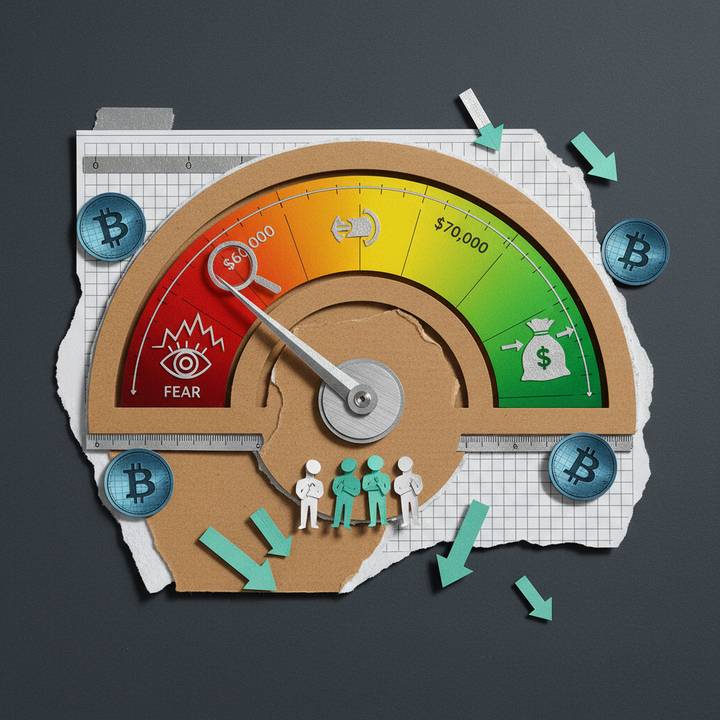
The Crypto Fear & Greed Index measures market sentiment on a 0–100 scale, where readings below 25 indicate "Extreme Fear"—historically the most profitable entry zone for long-term investors. As of March 19, 2026, the index sits at 23/100 according to Alternative.me, marking 46 consecutive days in extreme fear territory before a modest rebound from a low of 15 to 28 earlier this month, per BitcoinWorld. This prolonged fear phase mirrors two of the most lucrative buying windows in crypto history: the FTX collapse in November 2022, when the index bottomed at 10–15 before Bitcoin surged over 100% within 12 months, and the COVID crash of March 2020, when single-digit readings preceded Bitcoin's climb from $5,000 to an eventual $69,000 all-time high. The current drawdown of –41% from Bitcoin's 52-week high remains notably shallower than the –77% seen in 2022 or the –84% collapse in 2018.
Historical Pattern: Extreme Fear Precedes Exponential Gains
Every major crypto rally of the past decade was born in extreme fear. The data is unambiguous: investors who bought Bitcoin when the Fear & Greed Index dipped below 20 captured returns that dwarfed those who entered during euphoria. As our fear and greed index analysis details, the pattern has repeated with striking consistency across four distinct market cycles—making the current reading of 23 a signal seasoned investors recognize immediately.
| Event | Fear Index Low | BTC Price at Low | 12-Month Return | Eventual Peak |
|---|---|---|---|---|
| COVID Crash (Mar 2020) | 8 | $5,000 | +850% | $69,000 |
| FTX Collapse (Nov 2022) | 10–15 | $16,000 | +100%+ | $35,000 |
| 2018 Bear Bottom (Dec) | 10 | $3,200 | +130% | $14,000 |
| Current Cycle (Mar 2026) | 15–23 | $70,125 | TBD | Target: $112K–$165K |
The Institutional-Retail Divergence
Perhaps the most compelling signal is the stark disconnect between retail panic and institutional conviction. While the fear index reflects widespread capitulation among smaller holders, crypto investment products have recorded three consecutive weeks of net inflows totaling $2.7 billion, according to CryptoTimes. Bitcoin alone attracted $793 million in the most recent week, with Ethereum adding $315 million and Solana contributing $10.7 million. Simultaneously, on-chain analytics reveal that whale wallets holding over 1,000 BTC have accumulated an additional 56,227 BTC—worth approximately $4.1 billion—since December 2025, representing a 3.7% increase in their collective holdings.
This behavioral gap between institutions and retail is not unprecedented, but the magnitude is remarkable. In 2022, institutional outflows coincided with the FTX collapse, amplifying the downturn. Today, the opposite is unfolding: professional capital is flowing in aggressively despite declining prices, suggesting the current selloff is driven purely by sentiment rather than structural deterioration of the market.
Regional Market Dynamics Confirm Oversold Conditions
Cross-exchange pricing data reveals additional evidence of oversold conditions across global markets. The Asia premium indicator—which tracks price differentials between Asian exchanges and Western platforms like Coinglass-monitored venues—has turned negative at approximately –0.81%, per Spoted Crypto research. Historically, negative regional premiums signal excessive selling pressure in Asian markets, and prior instances have been followed by price recoveries within 30 to 45 days. Combined with negative funding rates across Binance perpetuals (BTC at –0.0030%, ETH at –0.0009%), the derivatives market is pricing in continued downside—a classic contrarian signal that has preceded sharp reversals in every previous cycle.
As Rony Szuster, Head of Research at Mercado Bitcoin, explains: "Historically, buying during periods of fear has been far more effective than buying during euphoria. The positions taken during extreme fear windows tend to define portfolio returns for years to come." (Source)
TOP 1. Bitcoin (BTC): 41% Discount From 52-Week High as Institutional Accumulation Accelerates
Bitcoin is trading at $70,125 as of March 19, 2026, representing a 41% decline from its 52-week high of $126,079—a discount that institutional investors are treating as a generational accumulation opportunity rather than a reason to exit. According to CoinDesk, BTC's market capitalization stands at $1.4 trillion with a 52-week range spanning $60,255 to $126,079, placing the current price firmly in the lower third of its annual trading band. Spot Bitcoin ETFs absorbed $793 million in net inflows over the past week alone, bringing total ETF holdings to 1,271,675 BTC valued at $83.29 billion, per AMBCrypto. Bitwise projects that ETFs will absorb approximately 166,000 BTC annually—exceeding 100% of newly mined supply—creating a structural supply squeeze that could fundamentally reshape Bitcoin's long-term price trajectory.
| Metric | Value |
|---|---|
| Current Price | $70,125 |
| Market Cap | $1.4T |
| 52-Week Range | $60,255 – $126,079 |
| Discount from 52W High | –41% |
| ETF Total Holdings | 1,271,675 BTC ($83.29B) |
| Weekly ETF Net Inflows | $793M |
| Binance Funding Rate | –0.0066% |
| Citi Base-Case Target | $112,000 |
| Citi Bull-Case Target | $165,000 |
ETF and Whale Accumulation at Scale
The scale of institutional buying is difficult to overstate. MicroStrategy disclosed the purchase of 17,994 BTC in a single week—its largest acquisition of 2026—underscoring the conviction of corporate treasuries that view current prices as a strategic entry point. Meanwhile, on-chain data shows that whale wallets holding more than 1,000 BTC have collectively added 56,227 BTC since December 2025, a 3.7% increase worth roughly $4.1 billion. This accumulation pattern, unfolding against a backdrop of falling prices, mirrors the behavior observed at prior cycle bottoms as explored in our Bitcoin ETF inflows analysis.
Derivatives Signal Excessive Bearish Positioning
Binance's perpetual futures funding rate for BTC stands at –0.0066%, indicating that short sellers are paying long holders to maintain their positions—an unusual condition that reflects extreme bearish consensus. According to Coinglass data, negative funding rates at this magnitude have historically preceded sharp short-squeeze-driven rallies, as crowded short positions create the fuel for rapid reversals. The current derivatives positioning suggests the market has already priced in substantial downside risk, effectively limiting further leveraged selling pressure.
Price Targets and Key Risks
Alex Saunders, Analyst at Citigroup, maintains a base-case target of $112,000 and a bull-case target of $165,000, noting: "Even under conservative assumptions of $10 billion in BTC ETF inflows, the demand-side pressure remains the single most important bullish catalyst for Bitcoin in 2026." (Source). Separately, MEXC's Shawn Young projects BTC reaching $135,000 within a sustained Federal Reserve rate-cutting cycle, per Finance Magnates.
However, risks remain material. A retest of the 52-week low at $60,255 cannot be ruled out if macroeconomic conditions deteriorate further—particularly if the Federal Reserve delays anticipated rate cuts or inflation data surprises to the upside. A broader equity market correction could also trigger correlated selling across risk assets, temporarily overriding the bullish structural dynamics created by persistent ETF demand. Investors should consider dollar-cost averaging into positions rather than deploying capital in a single tranche, and maintain strict position sizing to manage short-term volatility risk.
TOP 2. Ethereum (ETH): A -55% Discount on the $136B DeFi Ecosystem
Ethereum is trading at a staggering 55% discount from its 52-week high of $4,946, yet the network it underpins has never been more valuable. With a current price hovering between $2,172 and $2,327 and a market capitalization of $263 billion, ETH presents what many institutional analysts consider the most asymmetric risk-reward profile in crypto today. According to DefiLlama, Ethereum's total value locked (TVL) in decentralized finance protocols has surged past $136 billion — an all-time record that dwarfs every competing smart contract platform combined. For context, during the 2018 crash when ETH plummeted 94% from $1,400 to $85, DeFi TVL was virtually nonexistent. Today's drawdown is occurring atop an ecosystem with 31,869 active developers, institutional-grade ETF products, and a staking yield that BlackRock has deemed worthy of a dedicated Nasdaq-listed fund.
| Metric | Value | Source |
|---|---|---|
| Current Price | $2,172 – $2,327 | CoinDesk |
| Market Cap | $263B | Motley Fool |
| 52-Week High | $4,946 (−55%) | Motley Fool |
| DeFi TVL | $136B+ (ATH) | DefiLlama |
| Active Developers | 31,869 | Motley Fool |
| ETF Weekly Inflows | $315M | AMBCrypto |
| ETF Total Holdings | 5,697,268 ETH ($11B) | AMBCrypto |
| Binance Funding Rate | −0.0009% | Coinglass |
BlackRock's Staked Ethereum ETF: A Watershed Moment
The single most consequential development for Ethereum in March 2026 is the Nasdaq listing of BlackRock's iShares Staked Ethereum Trust ETF — the first regulated ETF product that passes through staking rewards to holders. This is not merely another wrapper for spot ETH exposure; it fundamentally alters the institutional calculus by offering a yield-bearing crypto asset within traditional brokerage accounts. According to Fintech Weekly, the product launched in early March and contributed to $315 million in weekly ETH ETF inflows, bringing total institutional ETH holdings across all ETF products to 5,697,268 ETH — roughly $11 billion at current prices. The implications are significant: institutional allocators who previously avoided ETH due to its complexity now have a single-ticker solution that captures both price appreciation and network yield.
The Largest Developer Ecosystem in Crypto
Price is a lagging indicator; developer activity is a leading one. Ethereum commands 31,869 active developers according to The Motley Fool — more than every other blockchain combined. This developer moat translates directly into protocol innovation, DeFi composability, and long-term network effects that are extraordinarily difficult for competitors to replicate. The $136 billion in TVL locked across Ethereum's DeFi protocols represents real capital deployed in lending, trading, and yield strategies — a stark contrast to the 2018 cycle when ETH's value proposition was almost entirely speculative. If you're looking to understand which cryptocurrencies institutions are buying during extreme fear, Ethereum's fundamentals make the case emphatically.
Analyst Price Targets and Downside Risks
Citigroup analyst Alex Saunders has set a base-case price target of $3,175 and a bull-case target of $4,488 for ETH, while MEXC's research team projects a potential move to $5,200 in a sustained rate-cutting environment. Even the conservative Citi target implies roughly 46% upside from the current $2,172 level. However, investors should weigh material risks. Competing Layer-1 networks — particularly Solana — are attracting developers and users at a faster rate, threatening Ethereum's dominance in throughput-sensitive applications. Gas fee volatility remains a structural limitation that Layer-2 solutions have only partially addressed. The Binance funding rate of −0.0009% signals mild bearish positioning in derivatives markets, though the magnitude is far less extreme than Bitcoin's −0.0030%, suggesting short sellers lack conviction. For those building a diversified crypto portfolio, ETH's combination of institutional adoption, developer depth, and a 55% drawdown from highs presents a compelling entry — but position sizing should account for the competitive threats eroding its once-unassailable smart contract monopoly.
TOP 3. Solana (SOL): 340% DeFi TVL Surge and the Fastest-Growing Ecosystem
Solana has suffered the sharpest drawdown among the top five coins on this list — a brutal 63% decline from its 52-week high of $252.78 to a current range of $89.78–$94.19. Yet beneath the price destruction, on-chain fundamentals tell a radically different story. According to The Motley Fool, Solana's DeFi TVL has exploded approximately 340% year-over-year to roughly $10 billion — the fastest growth rate among any Layer-1 blockchain. With a market capitalization between $51 billion and $54 billion and 17,708 active developers building on the network, SOL is no longer the speculative momentum play it was in 2021. It has matured into a high-throughput ecosystem that is aggressively siphoning market share from Ethereum, and early ETF inflows suggest institutions are beginning to take notice.
Quick Answer: Solana trades at $90 — down 63% from its $252.78 high — while its DeFi TVL surged 340% YoY to $10B. With 17,708 active developers and $43.6M in weekly ETF inflows, SOL offers the steepest discount paired with the fastest ecosystem growth among major Layer-1 blockchains.
Developer Growth Outpacing Ethereum
"Solana is attracting developers at a much faster rate than Ethereum," noted Leo Sun, Contributing Analyst at The Motley Fool, highlighting a trend that underpins Solana's long-term investment thesis. The network's 17,708 active developers represent a developer base that has grown faster in percentage terms than any competing smart contract platform. This matters because developer activity is among the strongest leading indicators of future protocol value — more developers mean more applications, more users, and ultimately more transaction fee revenue securing the network. Solana's sub-second finality, minimal transaction costs (fractions of a cent versus Ethereum's dollar-range fees), and Rust-based development environment have proven especially attractive for high-frequency use cases including decentralized exchanges, payment protocols, and increasingly, institutional DeFi products.
Institutional ETF Flows Signal Accumulation
While Solana's ETF ecosystem is still nascent compared to Bitcoin and Ethereum, the early numbers are encouraging. Weekly inflows hit $43.6 million for the week ending March 13, bringing total ETF holdings to 9,415,110 SOL — approximately $781.45 million at current prices, according to AMBCrypto. These inflows are occurring despite a 63% price decline, mirroring the same institutional conviction pattern observed in Bitcoin and Ethereum ETF products: smart money accumulates during fear, not euphoria. Exchange volume data from Coinglass shows Solana's Binance funding rate at −0.0002% — essentially neutral — suggesting the derivatives market has largely wrung out speculative excess and short-side positioning lacks meaningful momentum. For investors tracking institutional buying patterns during extreme fear conditions, SOL's combination of ETF adoption and on-chain growth metrics demands attention.
Price Targets and Critical Risk Factors
Analysts remain constructive on Solana's medium-term trajectory. A retest of its all-time high near $252 represents roughly 180% upside from current levels, while MEXC's bullish scenario projects $280 in a favorable macro environment with sustained Federal Reserve rate cuts, according to Finance Magnates. However, Solana carries risks that differentiate it sharply from more established assets. The network has experienced multiple outages throughout its history — full network halts that would be inconceivable on Ethereum or Bitcoin. These downtime incidents undermine confidence among institutional-grade DeFi protocols that require 100% uptime guarantees. Furthermore, SOL's 63% drawdown from its 52-week high is the steepest among all five coins featured in this analysis, reflecting both higher beta and the market's lingering concerns about network reliability. Investors should also consider the upcoming token unlock schedules that periodically create sell pressure. For portfolio construction purposes, Solana functions as a high-conviction, higher-volatility complement to a core Bitcoin and Ethereum allocation — offering outsized upside potential if its ecosystem trajectory continues, but demanding disciplined position sizing given the elevated risk profile.
TOP 4. Chainlink (LINK): CCIP Volume Surges 1,972% as RWA Infrastructure Play Dominates
Chainlink is the decentralized oracle network that connects smart contracts to real-world data, APIs, and cross-chain messaging — and its Cross-Chain Interoperability Protocol (CCIP) just posted staggering growth. According to CryptoAdventure, CCIP annual transaction volume reached $7.77 billion, a year-over-year increase of 1,972%. Despite this explosive adoption metric, LINK trades at just $9.00–$9.35 — representing one of the widest fundamental-value-to-price gaps in the top 30 by market cap. With the Fear and Greed Index sitting at 23 (Extreme Fear), Chainlink's beaten-down price offers a compelling asymmetric entry for investors who believe real-world asset tokenization is the next trillion-dollar narrative in crypto.
CCIP Adoption and the $100B Secured Asset Milestone
The numbers paint a clear picture of institutional trust. Chainlink now secures over $100 billion in on-chain asset value across its data feeds, Proof of Reserve, and CCIP services — a figure that dwarfs every competing oracle provider combined. This dominance didn't happen overnight. Chainlink's first-mover advantage in oracle infrastructure, combined with integrations across Ethereum, Arbitrum, Optimism, Avalanche, Polygon, and Base, has created deep network effects that are exceptionally difficult for competitors to replicate. When the SEC approved Nasdaq's tokenized securities trading framework in early 2026, it effectively validated the very infrastructure Chainlink has been building for years — secure, verifiable cross-chain data delivery for regulated financial products.
RWA Narrative Accelerates: Why LINK Is the Infrastructure Backbone
The real-world asset (RWA) tokenization trend is rapidly evolving from pilot programs to production deployments. BlackRock's BUIDL fund, Franklin Templeton's on-chain money market fund, and a growing roster of traditional finance institutions are choosing Chainlink's infrastructure stack as the bridge between legacy systems and blockchain rails. CCIP's 1,972% volume growth reflects this institutional migration — not speculative retail trading, but actual financial message transfer between chains. For investors monitoring the extreme fear environment and institutional buying patterns, LINK's positioning as the default RWA middleware layer makes it a fundamentally differentiated play versus pure speculative tokens.
Price Targets, Risks, and the Utility Disconnect Debate
Analyst consensus places LINK's neutral-scenario target at $18–$25, representing 100–170% upside from current levels around $9.15. The bull case hinges on continued CCIP adoption and RWA volume growth translating into increased LINK staking demand and node operator revenue. However, the persistent criticism remains valid: LINK's token price has chronically underperformed its adoption metrics. Despite securing $100B+ in assets and processing billions in cross-chain volume, the token trades at roughly 85% below its all-time high. Additionally, emerging competitors like Pyth Network on Solana and API3's first-party oracle model are chipping away at Chainlink's monopoly in specific verticals like DeFi price feeds. The key risk for LINK holders is that infrastructure dominance alone may not be sufficient to drive token price appreciation without stronger tokenomic catalysts tying network revenue directly to LINK demand.
TOP 5. Bittensor (TAO): AI Sector Leader — Breaking Down the 56% Weekly Surge
Bittensor is the decentralized machine learning network where AI models compete and collaborate to earn TAO tokens — and it just delivered the most explosive weekly performance among top-100 cryptocurrencies. According to CryptoTicker, TAO surged 56% in seven days from approximately $175 to a local high of $293.80, driven by two major catalysts: Grayscale's S-1 ETF conversion filing and the release of the Covenant-72B AI model on the Bittensor network. However, with the 7-day RSI now at 86.15 — deep in overbought territory — the rally demands careful analysis of whether this momentum can sustain or if a correction is imminent. Currently trading around $275 during a modest pullback, TAO represents both the promise and peril of the AI-crypto convergence narrative.
Catalyst 1: Grayscale's S-1 Filing Opens Institutional Access
Grayscale's decision to file an S-1 for TAO ETF conversion marks a watershed moment for the AI crypto sector. This is the same pathway that transformed Grayscale's Bitcoin Trust (GBTC) into a spot ETF, unlocking billions in institutional capital. If approved, a TAO ETF would give traditional investors — pension funds, RIAs, and hedge funds — regulated exposure to decentralized AI infrastructure without managing private keys or navigating crypto exchanges. The filing alone signals institutional validation of AI-native blockchain networks as a legitimate asset class. Given that crypto investment products have attracted $2.7 billion in net inflows over three consecutive weeks — even as spot prices decline — the appetite for new ETF vehicles is clearly robust.
Catalyst 2: Covenant-72B Proves Real-World AI Compute Utility
Beyond financial engineering, Bittensor's fundamental value proposition received a critical proof point with the launch of Covenant-72B — a 72-billion parameter AI model trained and served entirely on the decentralized Bittensor network. This isn't a whitepaper promise; it's a production-grade language model demonstrating that decentralized compute networks can produce outputs competitive with centralized alternatives. The broader AI crypto sector responded in sympathy: Render (RNDR) rallied 30–40% on the week while Fetch.ai (FET) gained 16%, collectively reinforcing the narrative that decentralized AI infrastructure is transitioning from theory to utility. For those building positions during this extreme fear market environment, the AI subsector's relative strength stands out.
Risk Assessment: Overbought Signals and ETF Uncertainty
The bearish case for near-term TAO exposure is straightforward: an RSI of 86.15 has historically preceded 20–35% corrections in mid-cap altcoins. The 56% weekly surge was fueled by speculative momentum that may not be sustainable without continued catalyst flow. ETF approval timelines remain uncertain — the SEC's review process for novel crypto assets typically spans 180–240 days, and there is no guarantee of a favorable outcome. Furthermore, TAO's fully diluted valuation relative to actual network revenue creates vulnerability if the AI narrative cools. Prudent positioning may involve scaling into TAO on pullbacks to the $200–$220 support zone rather than chasing the breakout at current levels. The convergence of institutional ETF interest, real AI compute deployment, and sector-wide momentum makes TAO a high-conviction but high-volatility pick — best suited for investors with defined risk parameters and a multi-month time horizon.
Top 5 Picks: Risk-Reward Comparison Table and Portfolio Allocation Strategy
Building a resilient crypto portfolio during extreme fear requires more than conviction — it demands a structured risk-reward framework that quantifies upside potential against downside exposure for each asset. With the Fear & Greed Index at 23 and BTC trading 41% below its 52-week high of $126,079, according to CoinDesk, institutional capital continues flowing into spot ETFs at a pace of $2.7 billion over three consecutive weeks, per AMBCrypto. The divergence between retail panic and institutional accumulation creates a rare window where disciplined investors can position across multiple risk tiers. Below, we synthesize key metrics for all five featured assets and outline two portfolio allocation models tailored to different risk appetites — anchored by dollar-cost averaging discipline that has historically outperformed lump-sum entries during volatile regimes. For deeper context, explore our fear-driven crypto buying analysis.
Five-Asset Risk-Reward Comparison (March 2026)
| Asset | Price (Mar 19) | 52W High / Drawdown | Analyst Target Range | Max Upside | Risk Grade | ETF / Institutional Status |
|---|---|---|---|---|---|---|
| BTC | $70,125 | $126,079 / −41% | $112,000–$165,000 (Citi) | +60% to +135% | Low–Medium | $83.3B AUM · 1.27M BTC held |
| ETH | $2,172 | $4,946 / −55% | $3,175–$4,488 (Citi) | +46% to +107% | Medium | $11B AUM · BlackRock staked ETF live |
| SOL | $90 | $252.78 / −63% | $280 (MEXC Research) | +211% | Medium–High | $781M AUM · DeFi TVL +340% YoY |
| LINK | $9.17 | Deep discount | CCIP-driven re-rating | High (CCIP vol +1,972% YoY) | Medium–High | $100B+ on-chain secured value |
| TAO | ~$275* | Recent +56% surge | AI sector momentum play | High (7d RSI 86.15) | Very High | Grayscale S-1 ETF conversion filed |
*TAO price approximate following 56% weekly rally to $293.8 high. Sources: Spoted Crypto, CoinDesk, CryptoTicker. BTC/ETH targets via Citigroup; SOL via MEXC Research. Binance funding rates: BTC −0.003%, ETH −0.0009% — bearish derivatives positioning that has historically preceded contrarian reversals.
Portfolio Allocation Models
Two model portfolios illustrate how different risk tolerances can be mapped to this asset universe during extreme fear conditions:
Conservative Model (Capital Preservation Focus): BTC 60% / ETH 30% / SOL 10%. This allocation concentrates 90% of capital in the two assets with the deepest institutional backing — BTC and ETH spot ETFs collectively hold $94.3 billion in assets under management. The modest SOL position captures higher-beta upside while keeping portfolio volatility anchored to large-cap dynamics.
Aggressive Model (Maximum Upside Capture): BTC 40% / ETH 20% / SOL 20% / LINK 10% / TAO 10%. This diversified approach allocates 40% to emerging catalysts — SOL's 340% DeFi TVL growth, LINK's CCIP infrastructure expansion processing $7.77 billion annually, and TAO's AI-sector momentum backed by Grayscale's ETF filing. Investors accept significantly higher volatility in exchange for potentially outsized returns if these narratives materialize during recovery.
Dollar-Cost Averaging: The Extreme Fear Playbook
Regardless of which model suits your risk profile, deploying capital through dollar-cost averaging (DCA) over 8 to 12 weeks remains the most disciplined approach during elevated volatility. With BTC's 24-hour range spanning $69,478 to $74,074 on March 19 — a $4,596 swing representing 6.6% intraday volatility — single-entry timing risk is substantial. DCA mechanically reduces average cost basis and removes emotional decision-making from the equation. As Rony Szuster, Head of Research at Mercado Bitcoin, noted: "Historically, buying during periods of fear has been more effective than buying during euphoria," per Spoted Crypto.
Alex Saunders, Analyst at Citigroup, reinforced the structural bullish case underpinning these allocations: "Even under conservative assumptions of $10 billion in BTC and $2.5 billion in ETH inflows, ETF demand remains the single most important positive catalyst," according to Spoted Crypto. Citi's base-case target of $112,000 for BTC implies 60% upside from current levels, while their bull scenario of $165,000 represents a potential 135% gain — a risk-reward profile rarely available outside extreme fear regimes.
Disclaimer: This article is for informational purposes only and does not constitute investment advice. Cryptocurrency markets are highly volatile, and past performance does not guarantee future results. Always conduct independent research and consult a licensed financial advisor before making investment decisions.
2026 Second-Half Crypto Market Outlook and Key Investor Watchpoints
The second half of 2026 is shaping up as a pivotal inflection point for digital assets, with a convergence of macro, structural, and narrative catalysts that could either validate the current accumulation thesis or expose portfolios to further drawdowns. The Federal Reserve's rate-cutting cycle — widely expected to accelerate through H2 — represents the single largest macro variable, with MEXC's Shawn Young projecting BTC at $135,000, ETH at $5,200, and SOL at $280 under sustained monetary easing. Meanwhile, Bitwise estimates that spot ETFs will absorb approximately 166,000 BTC annually — roughly $15.3 billion at current prices, exceeding total new mining supply — creating a structural supply squeeze that intensifies with each quarterly rebalance. Investors who position before these catalysts fully materialize stand to capture the most significant share of the repricing.
ETF Structural Buying Pressure: Supply Squeeze Accelerates
The ETF absorption rate is arguably the most underappreciated supply-side dynamic in crypto markets today. Spot Bitcoin ETFs already hold 1,271,675 BTC worth $83.29 billion, while Ethereum ETFs control 5,697,268 ETH ($11 billion) and Solana ETFs hold 9,415,110 SOL ($781 million), according to AMBCrypto. BlackRock's March launch of the iShares Staked Ethereum Trust ETF on Nasdaq — offering embedded staking yields — further extends institutional demand to ETH by attracting fixed-income allocators seeking yield in a declining-rate environment, per Fintech Weekly. With three consecutive weeks of net inflows totaling $2.7 billion despite falling prices, the institutional allocation trend is clearly decoupled from short-term sentiment.
AI-Crypto Convergence and RWA Tokenization: Dual Narrative Catalysts
Two sector-level narratives warrant close monitoring through H2 2026. The AI-crypto convergence — led by TAO, RNDR, and FET — has already delivered 30–56% weekly gains in March, fueled by Bittensor's Covenant-72B model release and Grayscale's ETF conversion filing. However, sustainability hinges on actual network utilization rather than speculative momentum; TAO's 7-day RSI of 86.15 signals near-term overextension, per CryptoTicker.
Real-world asset (RWA) tokenization is accelerating from pilot stage to production-grade infrastructure. The SEC's approval of tokenized securities trading on Nasdaq marks a regulatory inflection point, while Chainlink's CCIP protocol — processing $7.77 billion in cross-chain transaction volume, up 1,972% year-over-year — provides the critical interoperability layer that connects traditional finance rails to on-chain settlement, according to CryptoAdventure. For ongoing coverage of these developments, follow Spoted Crypto's market analysis.
Key Risks: What Could Derail the Recovery
Despite the bullish structural setup, three risk vectors demand investor vigilance. First, a global macroeconomic recession could trigger a correlated sell-off across all risk assets regardless of crypto-specific fundamentals — BTC's correlation to the Nasdaq remains elevated during stress events. Second, regulatory uncertainty persists: while the SEC has shown increased openness to tokenized securities, comprehensive stablecoin and DeFi regulation remains in flux across the US, the EU's MiCA framework, and Asia-Pacific jurisdictions. Third, a technical retest of BTC's 52-week low near $60,255 remains possible if macro conditions deteriorate sharply, which would likely drag altcoins into steeper drawdowns given their historically higher beta. Prudent position sizing, stop-loss discipline, and diversification across uncorrelated assets remain essential — even when the risk-reward math appears overwhelmingly favorable.
Frequently Asked Questions
Quick Answer: With the Fear & Greed Index lingering at 23–26 (Extreme Fear) for over 46 days and BTC trading 41% below its all-time high, historical data shows that buying during extreme fear periods has consistently outperformed buying during euphoria — delivering 100%+ returns within 12 months in past cycles.
Does Buying When the Fear & Greed Index Is Low Actually Generate Returns?
Historical evidence strongly supports contrarian buying during extreme fear — but with critical caveats. During the FTX collapse in late 2022, the Crypto Fear & Greed Index plunged to 10–15; investors who entered at those levels saw returns exceeding +100% within 12 months as BTC recovered from ~$16,000 to above $34,000. The COVID crash of March 2020 offers an even more dramatic case — the index hit single digits, and those who bought BTC near $5,000 captured gains of approximately +1,200% over the following 18 months as prices surged past $69,000. As Rony Szuster, Head of Research at Mercado Bitcoin, noted: "Historically, buying during periods of fear has been more effective than buying during euphoria," according to Spoted Crypto analysis. Today's index reading of 23–26 mirrors those prior capitulation zones, and whale wallets holding 1,000+ BTC have accumulated 56,227 BTC ($4.1B) since December 2025, signaling institutional conviction. However, past performance is never a guarantee — dollar-cost averaging (DCA) over 4–8 weeks rather than lump-sum entries, paired with strict position sizing (never more than 2–5% of a portfolio per entry), remains the prudent approach to manage downside risk during volatile bottoming processes.
Should I Invest in Bitcoin or Ethereum Right Now?
The answer depends entirely on your risk tolerance, investment horizon, and portfolio goals — and many analysts argue for holding both. Bitcoin currently trades at approximately $70,118–$74,174, representing a 41% discount from its 52-week high of $126,079, according to CoinDesk. BTC's investment thesis centers on institutional adoption: Bitwise projects that spot ETFs alone will absorb 166,000 BTC ($15.3B) in 2026 — more than 100% of newly mined supply — while MicroStrategy added 17,994 BTC in just the past week. Citigroup analyst Alex Saunders maintains a base-case target of $112,000 and a bull-case of $165,000 for BTC. Ethereum, meanwhile, trades at $2,172–$2,327 (a steeper 55% discount from its $4,946 high), commands over $136B in DeFi total value locked — the largest of any chain — and is supported by 31,869 active developers, per Motley Fool data. BlackRock's launch of the iShares Staked Ethereum Trust ETF on Nasdaq in March 2026 adds a new yield-bearing catalyst. Citi's base target for ETH sits at $3,175 (a ~45% upside), with $4,488 in the bull case. A common allocation framework: conservative investors might favor 70% BTC / 30% ETH for stability, while growth-oriented portfolios could shift to 50/50 or even 40% BTC / 60% ETH to capture Ethereum's higher beta and DeFi exposure.
Are AI Tokens TAO and RNDR Worth Buying Now?
Both Bittensor (TAO) and Render (RNDR) are among the strongest AI-sector narratives in crypto, but their near-term risk profiles differ significantly. TAO surged 56% in seven days — from $175 to a high of $293.8 — fueled by Grayscale's S-1 ETF conversion filing and the release of its Covenant-72B AI model, according to CryptoTicker. However, with RSI readings near 86 (deep overbought territory), a short-term pullback of 15–25% is historically probable before the next leg up. The Grayscale ETF filing is a meaningful medium-term catalyst, but chasing parabolic moves at these RSI levels carries elevated drawdown risk. RNDR presents a comparatively steadier entry: its 30–40% weekly gain pushed market cap past $1B, driven by surging demand for decentralized GPU rendering and a deflationary token-burn mechanism that removes RNDR from circulation as network usage grows. For both tokens, a phased approach is advisable — allocating only small positions (1–3% of portfolio) via 3–4 staggered entries over the coming weeks, prioritizing entries on pullbacks to key support levels rather than buying into momentum. Investors exploring the broader AI crypto sector should treat these as high-conviction, high-volatility satellite positions rather than core holdings.
What Does a Negative Kimchi Premium Mean for the Market?
The "Kimchi premium" — the price differential between crypto assets on South Korean exchanges versus global platforms — is a widely watched regional sentiment indicator, and when it turns negative, it carries significant contrarian implications. As of mid-March 2026, the Kimchi premium sits at approximately -0.81%, meaning Korean traders are selling crypto at a discount to global spot prices, according to Spoted Crypto market data. This negative premium reflects extreme pessimism among one of the world's most active retail trading populations — historically, South Korea accounts for 5–10% of global crypto volume. In past cycles, a negative Kimchi premium has preceded local bottoms: data from 2022 and 2023 shows that periods of negative premium typically resolved within 30–45 days, followed by meaningful price recoveries of 15–40%. The current reading aligns with the broader Fear & Greed Index at 23–26 (Extreme Fear) and mirrors a global pattern: institutional fund inflows totaling $2.7B over three consecutive weeks suggest that while retail is capitulating, smart money continues to accumulate. A negative Kimchi premium, in isolation, is not a buy signal — but when combined with rising whale accumulation, sustained ETF inflows, and deeply oversold RSI readings across major assets, it becomes one more data point in a historically reliable contrarian framework.
Data Sources
- CoinDesk Markets — BTC/ETH spot price data
- Spoted Crypto Fear Index Analysis — Fear & Greed Index, whale accumulation, ETF projections, Citi targets
- BitcoinWorld — Fear & Greed Index historical tracking
- The Motley Fool — ETH/SOL developer ecosystem data, expert commentary
- CryptoTicker — TAO and RNDR weekly performance data
- CryptoTimes — Weekly institutional fund flow data
- FintechWeekly — BlackRock Staked Ethereum ETF launch
- Finance Magnates — MEXC price target forecasts
This article is for informational purposes only and does not constitute investment advice. All investment decisions should be made based on your own judgment and responsibility.
Related Articles
- Fear Index at 26: Top 4 Cryptos to Buy the Dip in 2026, Backed by Data
- Top 7 Altcoins to Watch in Extreme Fear — Data-Driven Picks for March 2026
- Extreme Fear = Buying Opportunity? Top 6 Cryptos to Watch in March 2026 — BTC, DOT, UNI, XRP, SOL, ETH
- Top 5 Coins to Buy in Extreme Fear — Fear & Greed at 15, 80% Historical Rebound Rate
- 6 Coins to Buy When Fear & Greed Index Hits 18: Data-Backed Top Picks for March 2026