Nike's NFT Exit vs PIPPIN's 182% Surge — The Great Digital Asset Divide of 2026
While Nike sells RTFKT and exits NFTs entirely, PIPPIN meme coin rockets 182% in a $38B market with 5,100 tokens. Inside the polarization reshaping digital assets in 2026.
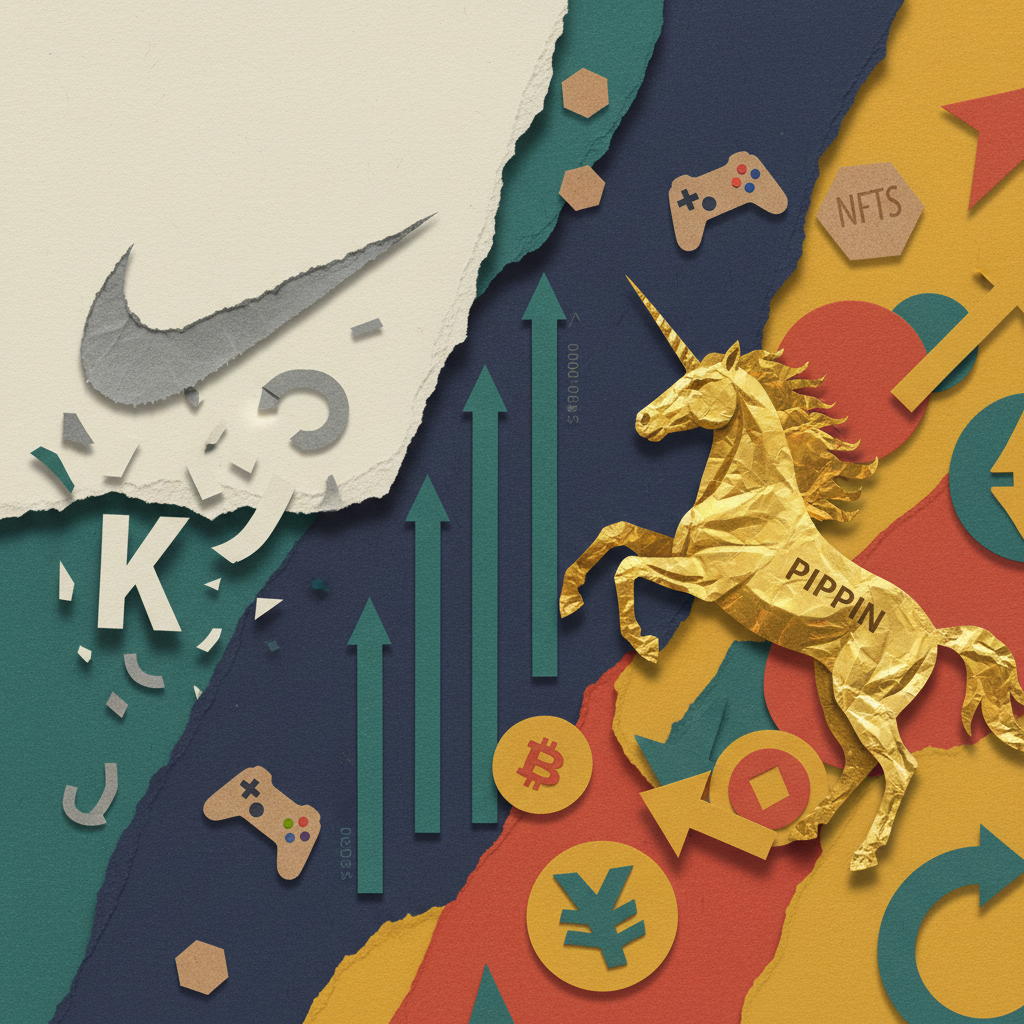
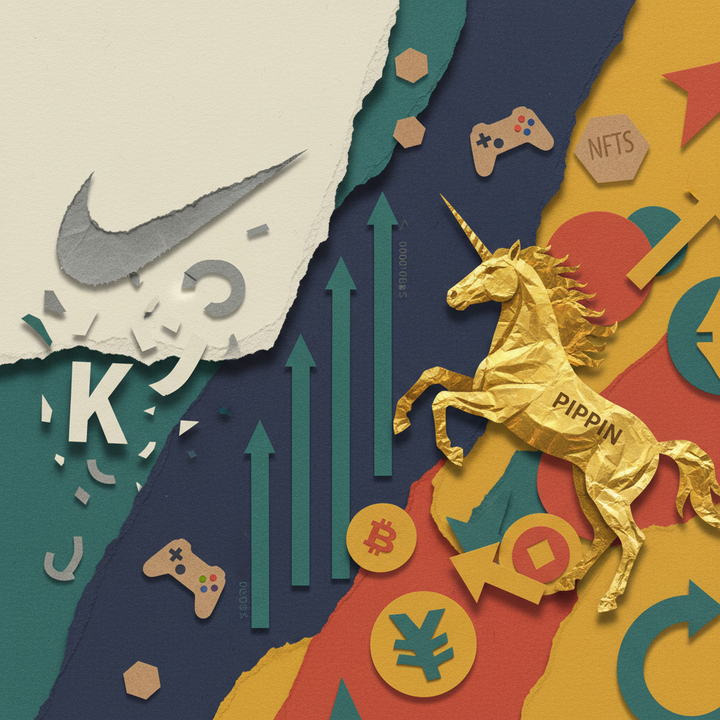
Nike officially sold its NFT subsidiary RTFKT in December 2025, marking a complete corporate retreat from digital collectibles. Meanwhile, Solana-based meme coin PIPPIN surged 182% over seven days with $90 million in 24-hour volume. As blue-chip brands abandon the metaverse and speculative tokens dominate a $38 billion market, 2026 reveals a digital asset landscape split between institutional withdrawal and retail gambling fever.
February 2026 presents crypto investors with a paradox. On one side, Nike, Adidas, and legacy brands are quietly liquidating NFT ventures that cost hundreds of millions. On the other, the meme coin sector has ballooned to $38 billion across 5,100+ tokens, with newcomers like PIPPIN delivering triple-digit gains in days. This isn't market noise—it's a fundamental shift in how investors perceive digital asset value, utility, and risk.
According to Bloomberg, Nike invested hundreds of millions acquiring RTFKT in 2021, only to reverse course under new CEO Elliott Hill in late 2024. Yet during the same period, Dogecoin rallied 30% in January 2026, Pepe jumped 17%, and speculative fervor reached levels unseen since 2021. What does this divergence signal for the future of NFTs, gaming tokens, and meme assets?
Key Takeaways
- Nike RTFKT Sale: Completed December 17, 2025, in undisclosed private transaction—full NFT exit after four years
- PIPPIN Explosion: 182% seven-day gain, $90M daily volume, $479.6M market cap—but 80% insider holdings raise red flags
- NFT Recovery Signals: Weekly trading volume up 30% to $85M in January 2026
- P2E Gaming Rebound: Axie Infinity market cap surged 247% to $748M after tokenomics overhaul cut inflation 30%
- Meme Coin Market: $38B total capitalization, 5,100+ tokens circulating
- GameFi Sector Growth: Weekly cap up 14.1%, recovering 2025 losses
- Institutional Crypto Sports: NBA contract trading volume exceeded NFL on prediction platforms
Why Did Nike Dump $49M in NFT Revenue?
Nike's RTFKT sale wasn't just business housekeeping—it symbolizes how global consumer brands have reassessed NFTs and the metaverse. RTFKT generated significant attention in 2021 with virtual sneakers and avatar wearables, accumulating over $49 million in lifetime token drops and royalty revenue, ranking ninth among all NFT projects. However, as the 2024 NFT bubble collapsed, resale values plummeted and speculative interest evaporated.
Elliott Hill, who became CEO in late 2024, implemented aggressive cost-cutting focused on non-core operations. He prioritized rebuilding relationships with major wholesale partners like Dick's Sporting Goods and Foot Locker while refocusing on high-performance footwear innovation. According to Nike insiders quoted by industry sources, "The metaverse was a speculative market, and conversion to actual physical product sales was under 1%."
The legal risks proved even more damaging. In April 2025, investors filed a class-action lawsuit in Brooklyn federal court alleging Nike committed a "rug pull" scam by shuttering RTFKT Web3 services and destroying digital asset value. The suit sought over $5 million in damages, claiming consumer protection violations. This case illustrates the emerging legal risks corporations face when exiting NFT ventures.
Hypebeast reported that Nike disclosed neither the buyer's identity nor transaction terms. Industry speculation suggests a Web3-focused fund or Asian collectibles firm acquired RTFKT, but Nike issued only a vague statement about "supporting RTFKT's next chapter." This reads as Nike quietly distancing itself from NFT failure without admitting defeat.
PIPPIN's 182% Rally — AI Unicorn or Insider Manipulation?
Precisely as Nike abandoned NFTs, Solana blockchain witnessed explosive growth in PIPPIN, a meme coin featuring an AI-generated unicorn character. CoinGecko data shows PIPPIN surged 180.30% over seven days in early February 2026, with a single-day spike of 50.4% on February 8 defending critical support levels. Daily trading volume jumped 175% to $90 million, with 110,010 on-chain transactions.
Three factors drove this explosive growth. First, amid broader crypto market weakness, the meme coin sector maintained a "risk-on" atmosphere attracting liquidity. Second, Glassnode on-chain data revealed continuous new address growth since November 2024, proving sustained retail demand. Third, Solana's low transaction fees and high speed created an optimal environment for meme coin trading.
Yet serious risks lurk beneath the surface. Blockchain analytics firm Bubblemaps reported that insiders control up to 80% of PIPPIN supply, valued at approximately $380 million. This extreme concentration signals price manipulation risk. Launched in late 2024, PIPPIN currently holds a $479.6 million market cap ranking 98th on CoinGecko—but large holder sell-offs could trigger catastrophic price collapse.
PIPPIN's case offers critical lessons for meme coin investors. Despite attractive short-term returns, on-chain data analysis is essential to verify supply distribution, trading patterns, and liquidity depth. Spoted Crypto Premium Analysis provides real-time on-chain metrics and whale wallet tracking tools to identify these risks proactively.
The $38 Billion Meme Coin Universe — From Dogecoin to 5,100 Tokens
As of February 2026, the meme coin market reached $38 billion total capitalization with over 5,100 tokens trading. According to CoinMarketCap data, top meme coins include:
- Dogecoin (DOGE): $15.75B market cap, $0.09337 price—up 30% from late January 2026 lows
- Shiba Inu (SHIB): $3.6B market cap, $0.056115 price—up 8% same period
- MemeCore (M): $1.81B market cap, $1.43 price
- Pepe (PEPE): $1.54B market cap, $0.053711 price—17% spike in early January
- Official Trump (TRUMP): $771.53M market cap, $3.31 price
Notably, meme coin market volatility remains extreme. DailyCoin reports that early 2026 saw large capital inflows driving double-digit gains for Dogecoin and Pepe. However, of total $5.9 billion daily volume, most concentrates in the top 10 coins—leaving the remaining 5,000+ tokens suffering liquidity crises.
Meme coin investing hinges on narrative warfare. Major 2026 narratives include:
- Political Themes: Politician-linked tokens like Official Trump correlate with election cycles
- AI-Generated Characters: AI art-based character tokens like PIPPIN
- Community Memes: Community-driven projects like Pudgy Penguins (PENGU), Bonk (BONK)
- Cross-Chain Expansion: Spreading across Solana, Base, Arbitrum
CoinMarketCap Academy's 2026 meme coin forecast warns that "regulatory uncertainty and macroeconomic volatility will polarize the meme coin market." The top 5-10 major meme coins survive on brand recognition and liquidity, but the vast majority face high probability of zeroing when speculation cycles end.
P2E Gaming Revival — Axie Infinity's 247% Surge and Tokenomics Reform
While NFT collectibles stagnated, the Play-to-Earn (P2E) gaming sector staged a powerful recovery in early 2026. GameFi sector market cap rose 14.1% weekly, beginning to recover 2025 losses, with weekly NFT trading volume up 30% to $85 million.
The most notable case is Axie Infinity's resurgence. According to AInvest reports, Axie Infinity implemented tokenomics reforms in early 2026 that reduced inflation pressure over 30%, driving AXS token market cap up 247% to $748 million. The redesigned model abandoned unlimited token issuance, instead building a sustainable economic system rewarding player skill, engagement, and creativity.
2026 P2E gaming trends shift from "Play-to-Earn" to "Play-and-Earn." DappRadar analysis reveals that past P2E games sacrificed gameplay for profit focus, but 2026's top games prioritize compelling gameplay while naturally integrating earning opportunities. Projects like Illuvium, Gods Unchained, and The Sandbox lead this new approach.
Market scale is impressive. Global Market Statistics forecasts the P2E NFT gaming market will grow from $1.35 billion in 2026 to $13.98 billion by 2035, achieving 21.3% compound annual growth rate (CAGR). This suggests P2E gaming follows a far healthier growth trajectory than NFT collectibles.
Particularly noteworthy is blockchain interchain compatibility. According to January 2026 CoinDesk coverage, while Ethereum maintains 62% of NFT contracts, Polygon emerged as a strong gaming application competitor. Low fees and fast transaction speeds optimize Polygon for P2E gaming.
Sports Prediction Markets and NBA Player Tokenization — Emerging GameFi Trends
One of 2026's most intriguing digital asset trends is sports prediction markets and player tokenization. CNBC reported that prediction market platforms recorded strong post-Super Bowl performance entering basketball season. Notably, NBA contract trading volume exceeded NFL on Robinhood's platform in January 2026—a remarkable shift.
Major platform status:
- Robinhood: 12 billion contracts traded in 2025, 4 billion contracts year-to-date 2026
- Kalshi: Covers major leagues including NFL, NBA, MLB, NHL
- Polymarket: Offers 12 major sports categories including basketball
- Crypto.com OG: Launched February 2026, targeting major events like March Madness
Tokenization technology is also booming. Crypto.news analysis shows the global tokenization market reached approximately $1.24 trillion in 2025, projected to grow to several trillion dollars by 2030. CFTC-regulated platforms use stablecoins and blockchain to offer event contracts across all 50 U.S. states, circumventing state-by-state betting restrictions.
On January 23, 2026, NBA veteran Tristan Thompson launched basketball.fun, entering the player tokenization market. The platform provides a sports prediction market converting top players into tradable assets. Though detailed mechanics remain undisclosed, industry observers speculate it's a derivatives trading model based on player performance data.
This sports-crypto fusion provides new Web3 use cases. Rather than pure speculation, it's a real-time data-driven trading system linked to actual sporting events. Spoted Crypto's analytics platform can integrate such cross-chain sports assets, enabling users to simultaneously access prediction markets across multiple blockchains.
2026 Digital Asset Investment Strategy — NFTs vs Meme Coins vs P2E Games
Nike's NFT exit, PIPPIN's 182% surge, and Axie Infinity's revival illustrate 2026's complex digital asset terrain. Investors must precisely understand each sector's risk-return profile.
NFT Collectibles Outlook:
Nike's case clearly demonstrates the limits of utility-free NFTs. Yet the market isn't completely dead. January 2026's 30% weekly NFT volume increase suggests selective recovery. Investment-worthy NFTs must meet these conditions:
- Provide real utility (game items, memberships, revenue rights)
- Strong community with continuous development roadmap
- Cross-platform compatibility and liquidity
- Use-driven demand rather than speculation
Meme Coin Sector Strategy:
A $38 billion market with 5,100 competing tokens demands extreme selectivity. Safe approaches include:
- Invest only in top 5-10 major meme coins (DOGE, SHIB, PEPE)
- Limit meme coin allocation to under 5% of portfolio
- Verify insider holding ratios (use tools like Bubblemaps)
- Short-term trading perspective, never long-term holding
- Monitor liquidity depth and trading volume
P2E Gaming Sector Opportunities:
Axie Infinity's 247% growth demonstrates fundamental value transformation can succeed. P2E gaming investment checklist:
- Tokenomics health—inflation control mechanisms exist?
- Actual gameplay quality—enjoyable without earnings?
- Active user count and retention rates
- Cross-chain compatibility and ecosystem partnerships
- Development team transparency and regular updates
TokenMetrics reports ranked 2026's top P2E games as Axie Infinity, Illuvium, Gods Unchained, The Sandbox, and Decentraland. All share combining sustainable economic models with high-quality gaming experiences.
For comprehensive on-chain meme coin analysis, P2E game tokenomics evaluation, and NFT project due diligence, Spoted Crypto Premium Analysis delivers real-time market insights and whale wallet tracking tools to navigate this polarized landscape.
Six-Month Scenario Analysis — Bull vs Bear Cases
Bullish Scenario (40% probability):
Post-Bitcoin ETF approval, institutional capital flows into crypto with portions reaching high-risk, high-reward sectors like meme coins and P2E gaming. GameFi market cap breaks $10 billion by June 2026, while top 10 meme coins reach $50 billion combined. NFT markets reorganize around utility-based projects, recovering $500 million quarterly volume. Key triggers:
- U.S. SEC crypto regulatory clarification (expected March 2026)
- Major game publishers launch blockchain games (Ubisoft, Square Enix)
- Sports leagues expand official NFT/token programs
Bearish Scenario (35% probability):
Macroeconomic uncertainty and regulatory pressure drain capital from speculative digital assets. Following Nike, more corporations exit NFT ventures, while 5,000 meme coins outside the top 100 effectively zero from liquidity collapse. P2E games face token price pressure from declining new user acquisition. Major risks:
- U.S. CFTC/SEC crackdown on prediction markets and gaming tokens
- Major exchanges increase meme coin delistings
- P2E sustainability failures (tokenomics collapse)
Neutral Scenario (25% probability):
Current polarization persists with major projects surviving but no explosive growth. Meme coin market ranges between $30-40 billion, P2E games continue gradual improvement, and NFTs shrink to niche markets without total extinction.
Critical Metrics and Dates for Investors
- Mid-March 2026: U.S. SEC crypto regulatory framework announcement expected—watch gaming token and NFT securities classification criteria
- Meme Coin Supply Distribution: When top 10 wallets exceed 70% holdings, manipulation risk warrants immediate sell consideration
- P2E Gaming MAU (Monthly Active Users): Month-over-month decline exceeding 20% signals token sell
- NFT Floor Price Trends: Major collection floor prices down 15%+ on 7-day average indicates market weakness
- GameFi TVL (Total Value Locked): Maintaining or increasing current levels confirms sector health
- Exchange Meme Coin Delistings: Over 10 monthly delistings signals strengthening regulatory pressure
- Sports Prediction Market Volume: Expect explosive March Madness (March) growth—pre-accumulation opportunity for related tokens
For risk management, structure digital asset portfolios as follows:
- Core assets (BTC, ETH): 70%
- P2E gaming tokens (top 5): 15%
- Major meme coins (DOGE, SHIB, PEPE): 10%
- NFTs / new projects: 5%
Crucially, never treat meme coins and NFTs as long-term holdings. Take profits immediately upon reaching target returns and strictly enforce stop-losses (typically -20%).
Historical Comparison — 2017 ICO Bubble vs 2026 Meme Coin Mania
The 2026 meme coin frenzy appears similar to 2017's ICO (Initial Coin Offering) bubble, but critical differences exist. In 2017, most projects had only whitepapers without actual products. Investors bet on future promises, and over 95% failed.
Conversely, 2026 meme coins are explicitly speculative assets from inception. PIPPIN investors don't expect the unicorn character to deliver actual utility. Instead, they trade liquidity, community, and narrative momentum. This transparency paradoxically creates healthier markets.
P2E gaming also differs from 2017 ICOs. Axie Infinity launched in 2018, subsequently acquiring millions of real users, with Filipinos earning livelihoods from Axie income in 2021. Though experiencing 2022-2023 collapse, 2026 tokenomics reforms enabled successful recovery. This demonstrates learning and evolution capacity.
NFTs similarly differ between 2021 bubble and 2026 conditions. In 2021, random JPEG images traded for millions, but surviving 2026 NFTs provide real utility like game items, event tickets, memberships, and property deeds. Nike RTFKT's failure actually evidences market maturation.
Frequently Asked Questions
Why did Nike sell RTFKT after investing hundreds of millions?
Nike adopted a core footwear business return strategy after new CEO Elliott Hill's late 2024 appointment. As the NFT market experienced 2024 bubble collapse with plummeting resale values, RTFKT's metaverse sales converted to actual product sales at under 1% rates. Additionally, April 2025 investor class-action lawsuits increased legal risks. Though RTFKT generated $49 million lifetime revenue, Nike decided physical innovation outweighed speculative digital assets.
Is PIPPIN meme coin a safe investment?
PIPPIN is an extremely high-risk speculative asset. Despite attracting attention with a 182% seven-day surge, blockchain analytics firm Bubblemaps reported insiders control 80% of total supply (approximately $380 million value). This extreme concentration signals price manipulation and sharp decline risks. Meme coin investors should limit allocation to under 5% of portfolios, set strict -20% stop-losses, absolutely prohibit long-term holding, and approach only from short-term trading perspectives.
Which P2E gaming tokens should I invest in?
2026 recommended P2E gaming tokens include Axie Infinity (AXS), Illuvium (ILV), Gods Unchained (GODS), The Sandbox (SAND), and Decentraland (MANA). Pre-investment checklist: (1) Tokenomics health—do inflation control mechanisms like Axie exist? (2) Are monthly active users (MAU) trending upward? (3) Is the game enjoyable without earnings? (4) Do cross-chain compatibility and partnerships exist? (5) Do development teams provide regular updates? According to TokenMetrics reports, these projects combine sustainable economic models with high-quality gaming experiences.
Are NFT markets completely finished?
No. While NFT collectibles markets stagnated, utility-based NFTs are growing. January 2026 saw weekly NFT trading volume increase 30% to $85 million, with Ethereum maintaining 62% of NFT contracts while Polygon emerged as a strong gaming NFT competitor. Surviving NFTs provide real value like game items, event tickets, memberships, and revenue rights. Nike RTFKT's failure marks the end of speculative JPEG NFTs, not utility NFTs. The 2026 NFT market projects growth to 267 million users.
How do sports prediction markets and player tokenization work?
Sports prediction markets are platforms for betting on event outcomes like game results and player performance. Platforms including Robinhood, Kalshi, Polymarket, and Crypto.com OG enable contract trading on NBA, NFL, and other league games. January 2026 saw NBA contract trading volume exceed NFL on Robinhood. Player tokenization, exemplified by Tristan Thompson's basketball.fun, converts players into tradable assets. CFTC-regulated platforms use stablecoins and blockchain to provide services across all 50 U.S. states while ensuring transparency and instant settlement.
What are the most important metrics for meme coin investing?
The three most critical meme coin metrics are: (1) Supply distribution—high manipulation risk when top 10 wallets hold over 70%, (2) 24-hour trading volume—must exceed 10% of market cap for liquidity, (3) New address growth rate—verifiable through Glassnode data, continuous increase signals healthy demand. Additionally monitor exchange listings (minimum 3+ mid-tier exchanges), community activity (Telegram/Discord engagement), and narrative momentum (Twitter/Reddit mention frequency). Always utilize on-chain analysis tools like Bubblemaps.
For deeper on-chain meme coin analysis, P2E gaming tokenomics evaluation, and NFT project due diligence reports, access real-time market insights and whale wallet tracking through Spoted Crypto Premium Analysis. Navigate 2026's polarized digital asset landscape with institutional-grade intelligence designed for the modern crypto investor.
Sources
- Nike Sells NFT Subsidiary RTFKT One Year After Shuttering Unit, Bloomberg
- Nike Quietly Sold RTFKT in December, Hypebeast
- pippin Price: PIPPIN Live Price Chart, Market Cap & News Today, CoinGecko
- Why Is the PIPPIN Meme Coin Price Skyrocketing Today?, CryptoGiggle
- PIPPIN Wallets and Tokens: Unveiling the Risks and Opportunities Behind the Meme Coin Surge, OKX
- GameFi's 2026 Narrative Play: FOMO Bounce or Sustainable Moonshot?, AInvest
- Top 10 Best Play-to-Earn Crypto Games: January & February 2026, DappRadar
- Play-to-Earn NFT Games Market Size, Share | Global Forecast [2035], Global Market Statistics
- Prediction markets head into basketball season on a high from Super Bowl, CNBC
- Tokenization and AI: Sport and prediction markets betting, Crypto.news
- Top Memes Tokens by Market Capitalization, CoinMarketCap
- Meme Coins Kick Off 2026 Strong As Big Capital Rolls In, DailyCoin
- The 10 Best NFT Games Worth Playing in 2026, NFT Plazas
- Best Play to Earn Crypto Games in 2026: Top Blockchain Games Rewarding Players with Real Value, Token Metrics
Risk Disclaimer: This article is for informational purposes only and does not constitute investment advice. Cryptocurrency, meme coin, NFT, and P2E gaming token investments carry significant principal loss risk, with meme coins exhibiting extreme volatility. Investment decisions are your sole responsibility and should only involve capital you can afford to lose. Conduct thorough research (DYOR) and consult financial professionals before investing in digital assets.