Nike's NFT Exit Isn't the End—It's the Beginning: How 2026 Marks the NFT-Gaming Revolution
Nike exiting NFTs signals not market death, but ruthless market maturation. As speculative NFTs collapse, real utility gaming, sports tokenization, and community-driven meme coins are exploding. Here's what's actually happening in 2026.
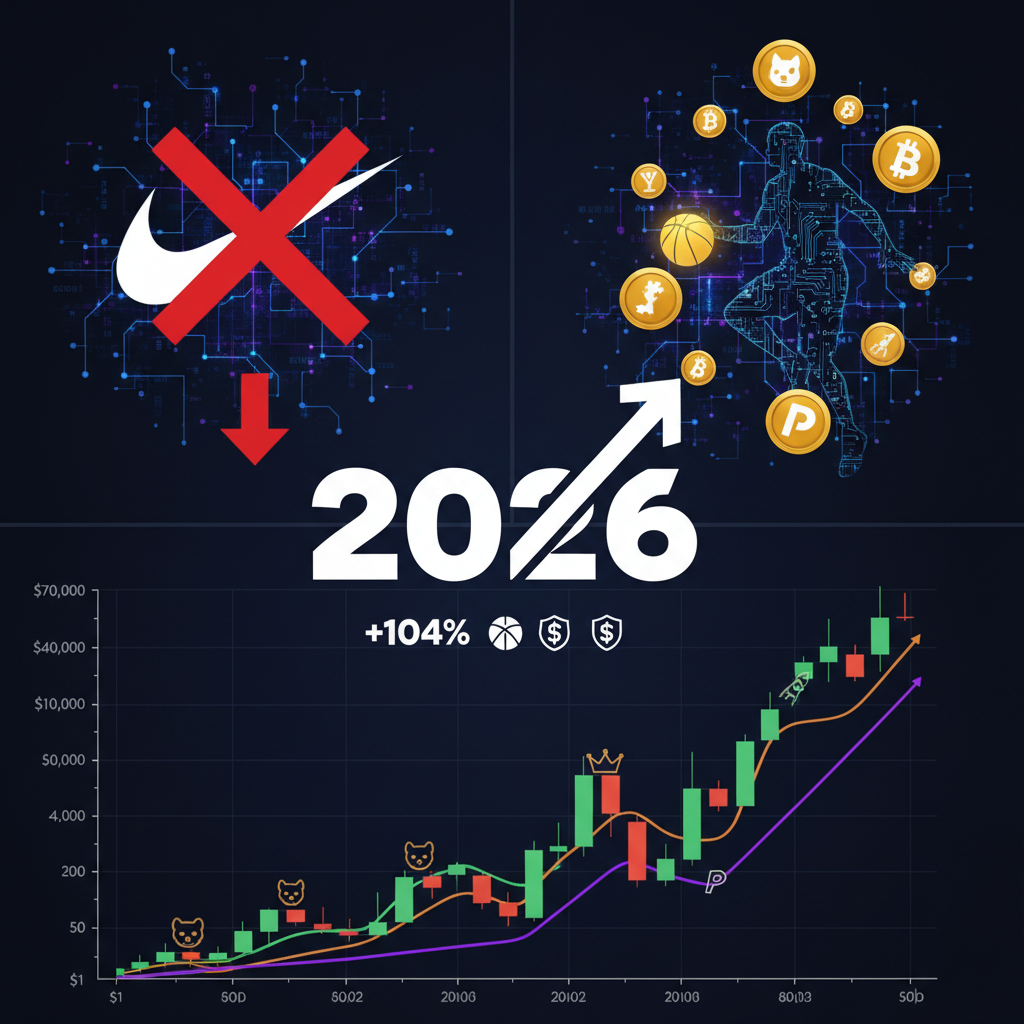
In February 2026, Nike announced its exit from NFTs and virtual sneakers. Most observers read this as a death knell for the entire NFT market. But this interpretation misses what's actually happening. On the same week Nike retreated, NBA veteran Tristan Thompson launched basketball.fun—a blockchain-based prediction market turning athletes into tradable assets. Simultaneously, a single meme coin rallied 104% in seven days. The crypto gaming and NFT landscape isn't dying. It's undergoing radical reconstruction. Speculative NFTs are collapsing, but utility-driven blockchain games, sports tokenization, and community tokens are experiencing explosive growth. The question isn't whether NFTs have a future. It's which NFTs survive—and which ones vanish forever.
Nike's Exit Is Not the End—It's Market Maturation
The conventional narrative around Nike's NFT shutdown is straightforward: "The hype died, consumers rejected digital sneakers, NFTs are finished." But this reading ignores historical precedent and misses the real lesson hidden in Nike's retreat.
Compare Nike's 2026 exit to the 2000-2001 dot-com crash. When the internet bubble burst, most observers declared the entire web a failed experiment. "The internet is just hype," critics proclaimed. Yet the crash didn't kill the internet—it killed bad internet companies. Amazon, Google, and eBay survived not because the bubble inflated them, but because they solved real problems. The crash was actually clarifying.
Nike's NFT exit works the same way.
Nike entered NFTs during the 2021-2022 hype peak. Digital collectibles showed massive speculative demand. Luxury brands competed to launch NFT collections. Trading volumes exploded. But volume is not the same as utility. Nike's virtual sneakers had no function beyond speculation—no in-game use, no real-world redemption, no community participation. They were speculative tokens masquerading as products.
By 2024, the speculative demand evaporated. Users realized that owning a digital JPEG of a sneaker had no value proposition. Nike wisely exited rather than burning capital on a dead product line.
But here's the critical point: Nike's failure doesn't invalidate NFTs themselves. It invalidates speculative NFTs with zero utility. Utility-driven NFTs—those backed by real game assets, real sports revenue, real gaming mechanics—are thriving simultaneously.
The Age of Real Utility: Sports Prediction Markets and Tokenization
The same week Nike announced its retreat, the sports-blockchain fusion accelerated dramatically.
Basketball.fun: Athletes as Tradable Assets
Tristan Thompson's basketball.fun represents a fundamental innovation: athletes become tradable prediction assets. Unlike traditional sports betting, basketball.fun is blockchain-native. Users can trade on real-time performance metrics—shooting percentages, rebounds, assists. Smart contracts automatically settle trades based on verifiable on-chain data. The difference from traditional sportsbooks? Transparency and peer-to-peer settlement eliminate middlemen fees.
This is not gambling dressed as blockchain. This is market infrastructure that blockchain actually improves.
Real-World Asset Tokenization (RWA) in Sports
More transformative: football clubs are tokenizing revenue streams. Imagine Liverpool FC converting monthly broadcast, ticket, and merchandise revenues into tradable tokens. Global fans can now own fractional claims on club revenue. Clubs gain access to capital markets they previously couldn't tap. Fans feel genuine ownership participation in their club's success.
This requires real cash flow backing—not speculation. When you own a tokenized revenue stream, you own a slice of actual revenue. This is securities, not collectibles. And it's just beginning to scale.
The Meme Coin Paradox: From Jokes to Community Assets
While speculative NFTs crashed, meme coins experienced explosive rallies:
• TRUMP token: +22.43% (7-day)
• pippin: +104.23% (7-day—doubled in one week)
• Bonk: +15.50%
• Pudgy Penguins NFT: +18.94%
The conventional interpretation: pure speculation. But the underlying story is more sophisticated.
2021 vs. 2026: Evolution of Meme Coins
In 2021, meme coins (Dogecoin, Shiba Inu) were jokes. Investors bought them to make quick profits. The community was speculative, transactional. "Buy the meme, cash out, repeat."
By 2026, meme coin ecosystems show genuine community depth. Holders run Discord communities. Governance discussions emerge. Utility mechanisms develop—staking pools, P2E game integration, merchant adoption. When pippin rallied 104%, it wasn't random volatility. Community activity, game mechanics, and token utility announcements drove accumulation.
Dogecoin's evolution proves this. It started as a joke in 2013. Today, it's accepted by merchants, integrated into payment protocols, and holds $15.7 billion in market capitalization. The asset survived because the community built real utility around it.
The lesson: community-driven tokens with genuine ecosystem participation outperform pure speculative assets. In 2026, meme coins are becoming micro-economies, not pump-and-dump vehicles.
Gaming NFTs: From CryptoKitties to Real Games
2017: The Blockchain Gaming Disaster
CryptoKitties (2017) is instructive. Users bought and sold digital cats. There was no gameplay—just trading. When the novelty wore off, the user base evaporated. The project proved that "collectible + blockchain" without genuine gaming mechanics creates hollow value.
2026: P2E Gaming with Actual Gameplay
Modern blockchain games work differently. Solana-based P2E titles now feature real game mechanics—combat systems, progression, skill-based gameplay. NFT weapons and armor have in-game function. Tokens earned through play retain value because the game ecosystem has depth.
The distinction matters: 2017 blockchain games offered no gameplay incentive to log in tomorrow if earning stopped. 2026 blockchain games offer genuine entertainment value. Economic incentives (token rewards) are secondary to fun. This durability explains why modern P2E titles retain players despite crypto bear markets.
The NFT Market Splits: Speculative vs. Utility
The clearest trend in 2026 is market bifurcation:
Speculative NFTs (Declining):
• Collectibles with no function
• Designer status pieces
• Projects relying on celebrity or brand name alone
• Nike's virtual sneakers—no in-game use, no real redemption
Utility NFTs (Expanding):
• In-game items with verifiable function
• Governance tokens with real voting power
• Revenue-sharing claims on sports/media assets
• Access rights to communities, events, or products
• Prediction market participation tokens
Nike sold speculative NFTs. That market dried up. But sports organizations are tokenizing real revenue. Game developers are minting functional assets. Communities are organizing around tokens. These segments are growing precisely as speculative NFTs contract.
The Infrastructure Bet: Where the Real Money Flows
Expert conviction around 2026 blockchain gaming isn't in new NFT collectibles. It's in foundational infrastructure:
• YO Labs raised $10 million for cross-chain yield optimization
• Coinbase integrated Chainlink as sole bridge for $7 billion in wrapped tokens
• Backed and Chainlink unveiled xBridge for tokenized stocks across Solana-Ethereum
• Vitalik Buterin called for DAO reform toward real operational functions
These investments signal a critical shift: from speculative hype to ecosystem building. The market is asking, "What infrastructure do sustainable blockchain games need?" Not, "What NFTs can we flip for profit?"
Frequently Asked Questions
Q1: Does Nike's Exit Mean NFTs Are Dead?
No. Nike exited speculative collectibles—a market with zero real utility. Real-utility NFTs (gaming items, sports revenue shares, membership access) are expanding. Think of it like the 2001 dot-com crash: it killed bad internet companies, not the internet itself. Nike proved speculative NFTs have no staying power. It didn't prove that blockchain technology or utility-driven NFTs are finished.
Q2: Should I Buy pippin Now That It's Up 104%?
Buying assets after 100%+ rallies is high-risk. By the time a meme coin has doubled, early momentum has already been captured. More importantly, you'd be entering at a much higher risk-to-reward ratio. Better strategy: identify emerging community-driven tokens early, before the major rally. Monitor Discord communities, Twitter activity, and development roadmaps. Buy Dogecoin, Shiba Inu, or established memes with proven ecosystems rather than chasing 100%+ performers that have already peaked.
Q3: Can You Actually Earn Money from Play-to-Earn Games?
Yes, but with caveats: (1) Most P2E games require upfront NFT purchases to play competitively. (2) Token value depends entirely on game success and user retention. If the game dies, your token earnings become worthless. (3) Hourly earnings are often below minimum wage. (4) Early players earn far more than later players—the model incentivizes early adoption. Realistic expectation: you earn modest rewards while enjoying a game you'd play anyway, not life-changing income. Treat gaming rewards as bonus, not primary income.
Q4: Is Sports Revenue Tokenization Actually Viable?
Technically yes, but regulatory barriers are substantial. Sports leagues must approve tokenization. Tax treatment varies by country. Securities regulators debate whether tokenized club revenue constitutes a regulated security. Some European and South American clubs are piloting models now. If regulatory frameworks clarify in 2026-2027, sports tokenization could scale dramatically. Long-term, this could revolutionize sports financing. Short-term, expect regulatory uncertainty and slow adoption.
Q5: What's the Real Future of NFTs and Blockchain Gaming?
Three dominant trends are emerging: (1) Game engines with blockchain built-in from architecture, not bolted on afterward. (2) Interoperable gaming ecosystems where NFTs function across multiple games. (3) AI-generated NFTs and game assets increasing substantially. The unifying theme: genuine entertainment value + real economics. Games must be fun independently of earning potential. When that convergence happens, blockchain gaming scales beyond crypto enthusiasts to mainstream players.
Track These Trends on Spoted Crypto
For deeper analysis of NFT gaming, sports tokenization, and meme coin ecosystems, explore Spoted Crypto Premium Analysis. Our analysts track game launches, token mechanics, and real-world adoption signals in real-time. Understanding which NFTs and games have genuine utility requires constant monitoring—let professionals handle the research.
The Verdict: 2026 Marks the Great Sorting
Nike's NFT exit is not a market death. It's a culling. Speculative NFTs with zero utility vanish. Utility-driven blockchain games, sports tokenization, and community assets thrive. This distinction matters enormously for investment decisions.
The NFT market in 2026 is not "booming" or "dead." It's bifurcating. Investors who understand which segment contains real value will capture the growth. Those chasing speculative collectibles will experience losses identical to Nike's decision-makers: money burned on products nobody actually wants.
The blockchain gaming industry now offers real entertainment + real economics. For the first time, those two forces align. That alignment is what Nike's exit actually signals: the end of pure speculation, the beginning of genuine utility. The survivors won't be the most hyped projects. They'll be the ones people actually play, actually use, and actually value. That shift from hype to utility is the real NFT revolution of 2026.
Sources
- Spoted Crypto Real-Time NFT and Gaming Data
- CoinDesk Web3 Coverage
- CoinMarketCap Meme Coin Market Data