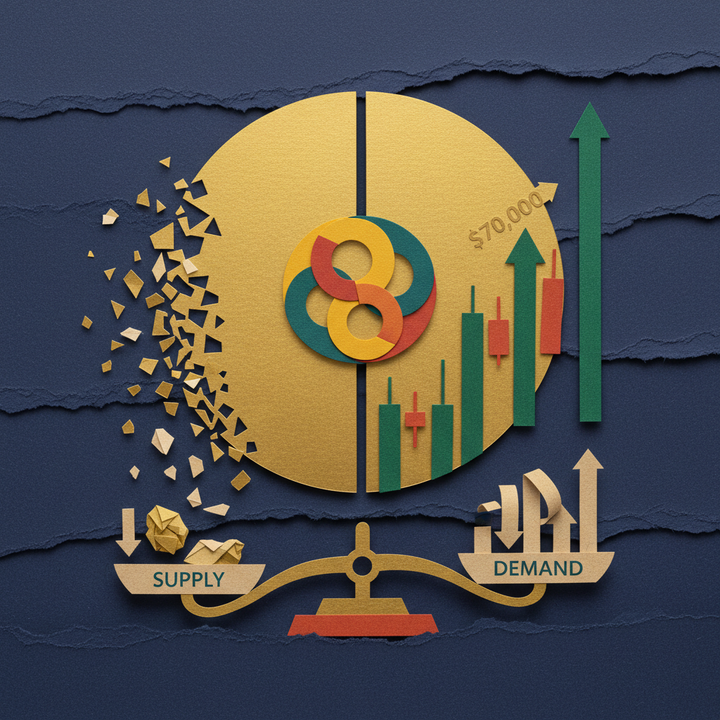
MORPHO Surges 45% in 30 Days as Apollo's $940B Asset Manager Makes Massive DeFi Bet
Apollo Global Management is acquiring 9% of MORPHO's token supply over 4 years. We break down why select DeFi altcoins are surging while the broader market sits in extreme fear.

Apollo Global Management, which oversees $940 billion in assets, has announced a deal to acquire 9% of DeFi lending protocol Morpho's token supply over four years — sending shockwaves through a crypto market gripped by extreme fear.
As of February 27, 2026, the Crypto Fear & Greed Index sits at 13/100, deep in "Extreme Fear" territory. The total crypto market cap has fallen to $2.40 trillion, roughly 45% below its all-time high. Yet in the middle of this panic, MORPHO has posted a stunning +45.9% gain over 30 days, while select DeFi and AI altcoins like Virtuals Protocol (VIRTUAL) and ether.fi (ETHFI) are also posting double-digit rallies.
That one of Wall Street's largest alternative asset managers is betting directly on DeFi infrastructure goes beyond a simple investment — it signals the walls between traditional finance and decentralized finance are collapsing. Here's a data-driven breakdown of what happened, why it matters, and what investors should be watching next.
Key Takeaways
Quick Answer: Apollo Global Management ($940B AUM) is acquiring 90 million MORPHO tokens — 9% of total supply — over 48 months. The deal triggered a +45.9% rally in 30 days, pushing MORPHO's market cap to $692M. The Ethereum Foundation, Coinbase, and SafePal have simultaneously deepened their Morpho integrations, signaling institutional convergence on DeFi lending infrastructure.
- Apollo Global Management ($940B AUM) signed a deal to purchase up to 90 million MORPHO tokens (9% of total supply) over 48 months via open-market buys, OTC trades, and negotiated transactions (CoinDesk, Feb 15).
- MORPHO surged +23.3% in 24 hours and +45.9% over 30 days to reach $1.94 with a $692M market cap (Blockchain Magazine, Feb 25).
- Ethereum Foundation deposited $6M into Morpho vaults; Coinbase expanded Morpho-based lending collateral past $1B (Bankless Times).
- Virtuals Protocol (VIRTUAL) rallied +23.5% in 24 hours to $0.71 after launching a $1M/month AI agent incentive program (Blockchain Magazine, Feb 25).
- Ether.fi (ETHFI) logged three consecutive days of gains above $0.50 as CEO Mike Silagadze signaled a neobank pivot and potential stablecoin launch (Phemex).
- Fear & Greed at 13/100 (Extreme Fear) — yet select DeFi altcoins are posting double-digit gains, creating a pattern of "selective strength."
- BTC dominance peaked at 61% on Feb 24 and has since fallen to 56.1%, showing early signs of altcoin capital rotation.
What Is Apollo's Morpho Token Deal?
Quick Answer: Apollo Global Management has secured the option to acquire 90 million MORPHO tokens (9% of supply) over 48 months. This makes it the largest traditional finance commitment to a single DeFi protocol's governance token to date.
Morpho is a next-generation decentralized lending protocol built on Ethereum that improves the capital-inefficient interest rate models used by Aave and Compound. As of February 27, 2026, Morpho's total value locked (TVL) stands at $5.8 billion, making it the second-largest DeFi lending protocol behind only Aave (DefiLlama). Apollo Global Management, one of the world's largest alternative investment firms with $940 billion in assets under management, signed a formal cooperation agreement with the Morpho Association. Under the deal, Apollo has the option to acquire up to 90 million MORPHO tokens over 48 months through a combination of open-market purchases, over-the-counter (OTC) trades, and other negotiated mechanisms (CoinDesk, Feb 15). Ninety million tokens represent 9% of MORPHO's total supply — a massive position that gives a traditional finance giant a direct seat at the DeFi governance table for the first time at this scale.
The deal is strategic, not speculative. Apollo's core business is private credit and real estate finance, and the firm sees Morpho's on-chain lending infrastructure as a bridge to tokenized real-world asset (RWA) lending. This is a bet that the next generation of credit markets will run on DeFi rails, not just traditional banking systems.
What makes this moment particularly significant is that multiple institutions are converging on Morpho simultaneously:
| Institution | Involvement | Scale | Significance |
|---|---|---|---|
| Apollo Global | Token acquisition (9%) | 90M MORPHO / 48 months | Largest alt-asset manager entering DeFi governance |
| Ethereum Foundation | Vault deposit | $6M | Ethereum's core org trusting Morpho as DeFi infra |
| Coinbase | Lending collateral expansion | $1B+ | Largest US exchange scaling Morpho-based lending |
| SafePal | Wallet integration | 25M user base | Retail DeFi access massively expanded |
This coordinated institutional interest suggests a structural shift in DeFi lending, not just a single event. When the largest alternative asset manager, Ethereum's own foundation, the top US exchange, and a major wallet provider all commit to the same protocol within weeks, it signals something beyond hype.
Why MORPHO Has Surged 45% in 30 Days
Quick Answer: MORPHO's +45.9% monthly rally was fueled by three catalysts stacking on top of each other: Apollo's $940B backing, institutional deposits from the Ethereum Foundation and Coinbase, and anticipation around the Morpho V2 protocol upgrade coming in 2026.
MORPHO's 30-day gain of +45.9% was not driven by a single catalyst but by a chain reaction of positive developments compounding on each other. On February 25, MORPHO surged +23.3% in 24 hours to reach $1.94, with trading volume hitting $55.6 million and market cap climbing to $692 million (Blockchain Magazine, Feb 25). While Apollo's token acquisition announcement was the primary trigger, the Ethereum Foundation's $6M vault deposit, Coinbase's expansion of Morpho-based lending collateral past $1 billion, and SafePal's integration across its 25-million-user wallet base created a layered buying pressure that sustained the rally well beyond the initial news spike. The upcoming Morpho V2 upgrade — which shifts from protocol-dictated interest rates to market-driven rate discovery — added a forward-looking catalyst that particularly resonated with institutional investors accustomed to traditional rate-setting mechanisms.
Catalyst 1 — Apollo's $940B trust signal. Bernstein's digital assets research lead Gautam Chhugani noted: "What we are experiencing is the weakest bitcoin bear case in its history," arguing that institutional capital inflows into crypto are now structural, not cyclical (The Block). Apollo's Morpho deal is the most concrete example of this thesis in action — a top-tier asset manager committing not just capital but governance participation to DeFi infrastructure.
Catalyst 2 — DeFi lending's structural growth. The total DeFi lending market TVL surpassed $55 billion in late 2025, hitting an all-time high (The Block). Morpho has been a primary beneficiary, with its TVL surging over 150% since its token listing. The protocol's efficiency advantage over legacy lending platforms has made it the go-to infrastructure for institutions looking to deploy capital on-chain.
Catalyst 3 — Morpho V2 upgrade expectations. After more than a year in development, Morpho V2 is set for a 2026 launch. The biggest innovation is a shift from protocol-dictated interest rate formulas to a market-driven rate model where participants set rates organically. This mirrors how traditional credit markets work, making it far more familiar for institutions like Apollo to participate confidently.
VIRTUAL and ETHFI Rally Alongside MORPHO — A DeFi Altcoin Revolt in Extreme Fear
Quick Answer: MORPHO isn't alone. Virtuals Protocol (VIRTUAL) surged +23.5% on a $1M/month AI agent incentive program, while ether.fi (ETHFI) rallied on neobank pivot news — all happening while the broader market sits at Fear & Greed 13/100.
MORPHO's rally is not an isolated event. Even as the Crypto Fear & Greed Index registers 13/100 — deep in Extreme Fear territory — select DeFi and AI altcoins are posting aggressive gains in what can only be described as a "selective strength" pattern. Virtuals Protocol (VIRTUAL) surged +23.5% in 24 hours on February 25, reaching $0.71 with a $426 million market cap and $88.94 million in daily volume (Blockchain Magazine, Feb 25). The catalyst was the protocol's announcement of a $1 million per month AI agent incentive program that rewards agents generating real revenue on the platform — a real-usage growth strategy rather than speculative token emissions. The Virtuals ecosystem has logged over 1.77 million completed jobs and $479 million in total aGDP (Agent GDP), with $2.63 million in monthly revenue, demonstrating tangible product-market fit in the AI agent economy (CoinMarketCap, Feb 25).
Ether.fi (ETHFI) has also been catching bids, posting three consecutive days of gains above $0.50. CEO Mike Silagadze stated: "The crypto neobank movement is a rapidly growing trend... My strong belief is that adoption will come from neobank-like entities" (Phemex). Ether.fi is pivoting from a pure restaking protocol to a full crypto neobank, with a Visa card launch, Apple Pay and Google Pay integration, and a potential stablecoin on the horizon.
| Token | 24h Change | 30d Change | Market Cap | Rally Catalyst |
|---|---|---|---|---|
| MORPHO | +23.3% | +45.9% | $692M | Apollo $940B token deal + Ethereum Foundation $6M |
| VIRTUAL | +23.5% | — | $426M | $1M/month AI agent incentive program |
| ETHFI | +10%+ | — | — | CEO signals neobank pivot + stablecoin launch |
| SOL | +4.5% | — | — | Short squeeze beneficiary ($470M liquidated) |
| ADA | +4.5% | — | — | Short squeeze beneficiary |
This pattern of selective strength suggests the market is transitioning from an indiscriminate sell-off into a fundamentals-driven capital reallocation phase. Money isn't flowing randomly — it's rotating into protocols with concrete institutional backing, real revenue, or clear product catalysts.
BTC Dominance Reverses From 61% Peak — Is Altcoin Season Starting?
Quick Answer: BTC dominance peaked at 61% on February 24 and has since dropped to 56.1%. Historically, every time dominance peaked above 60% and reversed, a major altcoin season followed — though the current Altcoin Season Index at ~30/100 suggests we're still in the early rotation phase.
Bitcoin dominance — the percentage of total crypto market cap held by BTC — is one of the most reliable indicators of altcoin market strength. On February 24, 2026, BTC dominance hit 61% and reversed, falling roughly 5 percentage points to 56.1% by February 27 (API market data). This pattern matters because every historical instance of BTC dominance peaking above 60% and reversing has preceded a significant altcoin season. The most dramatic example was November 2020, when BTC dominance reversed from 62% and the ensuing altcoin season produced returns of +1,150% for ETH and +11,000% for SOL (OpenPR). That said, the current Altcoin Season Index reads approximately 30/100, well below the 75+ threshold that confirms a full-blown altseason — so the correct interpretation is "early capital rotation," not confirmed alt season.
| Period | Peak Dominance | 6-Month Altcoin Performance | Top Beneficiaries |
|---|---|---|---|
| January 2017 | 87% | Explosive altseason | ETH +9,000% |
| November 2020 | 62% | Largest altseason in history | ETH +1,150%, SOL +11,000% |
| February 2026 | 61% | Early rotation signals | MORPHO +45.9%, VIRTUAL +23.5% |
Bernstein analyst Gautam Chhugani is watching this dynamic closely: "We expect the reversal to be swift and setting a new solid higher base for what could be the most consequential cycle for Bitcoin and potentially lay the foundation for the Bitcoin sovereign cycle" (Sherwood News). The selective surges in MORPHO, VIRTUAL, and ETHFI could be the opening act of this broader altcoin rotation.
Fear & Greed at 13: What Does Extreme Fear Historically Signal?
Quick Answer: The Crypto Fear & Greed Index hit an all-time low of 5/100 earlier in February before recovering to 13. Historically, readings at or below 10 have occurred only twice (2019 and 2022), and both marked the start of major recoveries.
The Crypto Fear & Greed Index aggregates six factors — volatility, volume, social media sentiment, surveys, BTC dominance, and trends — into a single 0-100 reading of market psychology. In early February 2026, the index hit 5/100 — the lowest reading since tracking began in 2018, a level never previously reached (Tekedia). It has since recovered modestly to 13/100 but remains firmly in Extreme Fear, with 19 consecutive days in the zone — the longest streak since July 2022. The immediate triggers were President Trump's 15% global tariff announcement, a cascading sell-off tied to US tech stocks, and a $2.56 billion weekend leverage liquidation event (CNBC, Feb 23). BTSE COO Jeff Mei explained: "We believe that the sudden uptick in tariff rates is causing investors to sell crypto assets in anticipation of a more serious market decline" (CNBC).
But historical data tells a different story about what happens next:
| Period | Fear & Greed | BTC Price | Next 3 Months | Outcome |
|---|---|---|---|---|
| August 2019 | ~10 | ~$9,500 | +40% | Entry into 2020 bull market |
| June 2022 | ~6 | ~$17,700 | +15% | 6-month bottoming, then recovery |
| February 2026 | 5 → 13 | ~$67,400 | ? | Bernstein: "Weakest bear case in history" |
Critically, the current drawdown (~45% from ATH) is significantly shallower than the 2022 crypto winter (~73% from ATH). Bernstein calls this "the weakest bitcoin bear case in history," attributing the relative resilience to structural institutional capital inflows that are providing downside support absent in previous cycles.
Current Market Snapshot
Quick Answer: As of February 27, BTC trades at $67,383 on Binance with the broader market in a holding pattern. Negative funding rates across BTC, SOL, XRP, and DOGE indicate bearish positioning — setting up potential short squeeze conditions if any positive catalyst emerges.
As of February 27, 11:28 KST, Bitcoin trades at $67,383 on Binance, down 0.90% in 24 hours within a range of $66,500 to $68,860. Ethereum sits at $2,025, down 1.10%, with its 24-hour range spanning $1,975 to $2,083. The total crypto market cap is $2.40 trillion with BTC dominance at 56.1% and ETH dominance at 10.2%. Trading volumes remain elevated, with BTC logging $1.4 billion in 24-hour volume on Binance alone. Notably, the broader market tone is subdued — most top-10 assets are in the red — while the selective DeFi rallies discussed above stand out as notable exceptions to the prevailing risk-off sentiment.
| # | Coin | Price | 24h Change | Volume (24h) | High | Low |
|---|---|---|---|---|---|---|
| 1 | BTC | $67,383 | -0.90% | $1.4B | $68,860 | $66,500 |
| 2 | USDC | $1.00 | +0.02% | $1.3B | $1.00 | $1.00 |
| 3 | ETH | $2,025 | -1.10% | $889.0M | $2,083 | $1,975 |
| 4 | SOL | $86 | -1.78% | $251.1M | $89.05 | $84.34 |
| 5 | XRP | $1.41 | -1.23% | $218.4M | $1.47 | $1.38 |
| 6 | USD1 | $1.00 | +0.01% | $156.6M | $1.00 | $1.00 |
| 7 | BNB | $628 | +0.33% | $73.2M | $632 | $614 |
| 8 | DOGE | $0.097 | -3.23% | $68.6M | $0.102 | $0.095 |
| 9 | PEPE | $0.00000386 | -4.93% | $61.6M | $0.00000415 | $0.00000377 |
| 10 | ZEC | $239 | -3.80% | $46.2M | $257 | $236 |
OKX data confirms similar pricing: BTC at $67,364, ETH at $2,024, and SOL at $86.24. Gold-backed XAUT ($5,167) is seeing elevated volume on OKX at $16.3 million — a sign that safe-haven demand remains present even within crypto-native markets.
Derivatives Data: Funding Rates, Open Interest & Long/Short Ratios
The derivatives market tells a nuanced story. Negative funding rates across BTC (-0.0010%), SOL (-0.0002%), XRP (-0.0054%), and DOGE (-0.0015%) indicate that shorts are paying longs — a sign of persistent bearish positioning. ETH is the exception with a mildly positive funding rate of +0.0014%. This negative funding environment is precisely what sets up short squeeze conditions: if a positive catalyst emerges, forced short covering can amplify upward moves rapidly, as we saw with the $470 million short squeeze earlier this month that liquidated 158,796 traders.
| Coin | Funding Rate | Open Interest | Long/Short Ratio |
|---|---|---|---|
| BTC | -0.0010% | $5.4B | 64.4% / 35.6% |
| ETH | +0.0014% | $3.7B | 63.9% / 36.1% |
| SOL | -0.0002% | $867.9M | 68.9% / 31.1% |
| XRP | -0.0054% | $376.1M | 70.0% / 30.0% |
| DOGE | -0.0015% | $156.0M | 68.6% / 31.4% |
| BNB | 0.0000% | $315.2M | N/A |
| ADA | -0.0015% | $104.5M | N/A |
| AVAX | +0.0077% | $82.8M | N/A |
| DOT | +0.0100% | $55.2M | N/A |
| LINK | +0.0034% | $80.2M | N/A |
Long/short ratios remain skewed bullish across the board — BTC at 1.81:1, SOL at 2.21:1, and XRP at 2.34:1 — suggesting retail traders remain optimistically positioned despite the fear reading. This divergence between retail positioning (long-biased) and institutional sentiment (extreme fear) often resolves in volatile moves in either direction. Total crypto futures open interest sits at $93.5 billion (+1.5%), while BTC implied volatility (BVIV) has cooled from 65% earlier in the week to 56% — still elevated but declining (CoinDesk, Feb 25).
Outlook and Scenario Analysis
Quick Answer: The most likely scenario is a barbell market — fundamentally strong DeFi projects like MORPHO and VIRTUAL outperform, while the broader market remains hostage to macro variables like tariffs, rate policy, and geopolitical risk.
Whether the selective strength in DeFi altcoins persists or gets dragged down by broader market pressure depends on several critical variables in the short term (1 month) and medium term (3-6 months). The macro backdrop remains hostile — Trump's 15% global tariff, US tech stock weakness, and geopolitical tensions provide persistent headwinds. But the institutional conviction in specific DeFi projects is a structural tailwind that didn't exist in previous downturns.
Bullish scenario: Apollo's MORPHO token acquisition enters its execution phase. Morpho V2 launches successfully. BTC dominance drops below 50%, triggering a full altcoin season. MORPHO could reach the $2.50–$3.00 range. Trigger points: tariff policy softening, BTC ETF net inflows resuming, and a Fed rate cut signal.
Bearish scenario: Trump tariffs escalate and geopolitical risk deepens, extending the extreme fear period. Altcoins broadly sell off further. Apollo's 48-month acquisition timeline means limited short-term price support — MORPHO could revisit $1.00 or below. The $2.56 billion weekend liquidation event shows leverage risk remains dangerously elevated.
Base case (most likely): Projects with strong fundamentals — MORPHO, VIRTUAL, ETHFI — outperform the market average, but overall market direction is dictated by macro variables: tariffs, interest rates, and employment data. This creates a barbell market where careful project selection matters far more than broad market exposure.
What Investors Should Watch
- Morpho V2 launch timeline: Expected in 2026 — monitor testnet results and specific release dates for the market-driven rate model upgrade.
- Apollo's actual purchasing activity: The 48-month option window means timing and volume of real buys will create price-moving events.
- BTC dominance below 50%: A drop from 56.1% to under 50% would be the clearest confirmation of full altcoin season.
- Fear & Greed recovery above 25: Moving from "Extreme Fear" to "Fear" territory would signal risk-on sentiment returning.
- US tariff policy changes: Trump's 15% global tariff remains the single largest macro risk factor for all risk assets.
- VIRTUAL ecosystem metrics: Track whether the $1M/month incentive translates into growth in aGDP and active agent count.
- Ethereum upgrade schedule: Vitalik Buterin's quantum-resistance roadmap (Strawmap) includes the Glamsterdam and Hegotá forks planned for 2026 (CoinDesk).
- Derivatives positioning: Negative funding rates across BTC, SOL, XRP, and DOGE create short squeeze potential — watch for cascading liquidations on any bullish catalyst.
Risk factors: The $2.56 billion weekend liquidation event demonstrates that leverage risk remains acute. Tariff escalation and geopolitical tensions (US-Iran) could trigger further sell-offs. Altcoins carry significantly higher volatility than BTC, so position sizing and risk management are critical in this environment.
Frequently Asked Questions
What is Morpho (MORPHO) and why is it surging?
Morpho is a next-generation decentralized lending protocol built on Ethereum that optimizes the inefficient interest rate structures of legacy platforms like Aave and Compound. It has reached $5.8 billion in TVL and surged +45.9% in 30 days after Apollo Global Management ($940B AUM) announced a deal to acquire 9% of its token supply. Additional catalysts include the Ethereum Foundation depositing $6M into Morpho vaults and Coinbase expanding Morpho-based lending collateral past $1 billion.
Why is Apollo Global Management investing in a DeFi protocol?
Apollo manages $940 billion in assets and is one of the world's largest alternative investment firms. The Morpho deal is part of Apollo's strategy to extend its core private credit and real estate finance operations onto blockchain infrastructure. Morpho's on-chain lending architecture is well-suited for integrating tokenized real-world assets (RWAs) with traditional financial products, and the upcoming V2 upgrade's market-driven rate model mirrors traditional credit market mechanics.
Should you buy altcoins when the Fear & Greed Index shows extreme fear?
Historically, the only times the Crypto Fear & Greed Index dropped to 10 or below were August 2019 (~10, followed by +40% in 3 months) and June 2022 (~6, followed by a bottoming and recovery). Both marked the start of strong recoveries. However, timing exact bottoms is impossible, so dollar-cost averaging (DCA) into fundamentally strong projects is the recommended approach rather than attempting to call the bottom precisely.
When will the 2026 altcoin season begin?
BTC dominance peaked at 61% on February 24 and has since dropped to 56.1%, showing early signs of capital rotation into altcoins. However, the Altcoin Season Index sits at roughly 30/100 — well below the 75+ threshold that confirms a full altseason. Past cycles suggest it takes 3-6 months from a BTC dominance peak reversal to a full-blown altcoin season, making H2 2026 the window to watch. Bernstein projects the broader cycle reversal for the second half of 2026.
Sources
- Wall Street Giant Apollo Deepens Crypto Push with Morpho Token Deal, CoinDesk
- Breaking: MORPHO Surges, Blockchain Magazine
- Here's Why the Morpho Crypto Price Is Going Vertical, Bankless Times
- Virtuals Protocol Rallies on $1M AI Agent Incentives, CoinMarketCap
- Weakest Bitcoin Bear Case in History — Bernstein, The Block
- Altcoin Season 2026: Bitcoin Dominance Peaked at 61%, OpenPR
- Crypto Fear & Greed Hits 5/100 — Lowest in History, Tekedia
- Bitcoin Falls as Trump Tariffs Shake Markets, CNBC
- Ether.fi CEO Predicts Crypto Banking to Propel Ethereum Growth, Phemex
- Crypto Rebounds from Oversold Levels, CoinDesk
- Vitalik Buterin Unveils Ethereum Quantum-Resistance Roadmap, CoinDesk
- Bernstein: Bitcoin Could Bottom at $60K, Sherwood News
This article is for informational purposes only and does not constitute investment advice. All investment decisions should be made based on your own judgment and due diligence. Cryptocurrency investments carry the risk of total loss, and past performance does not guarantee future results.