McHenry Breakthrough + Bitcoin $70K Recovery: Three Converging Signals Flash 'Policy Clarity' for Crypto Market
Rep. Patrick McHenry signals fast-track crypto legislation at Ondo Summit while Bitcoin reclaims $70,000. Megainvestors Saylor and Tom Lee confirm institutional entry with massive purchases. Policy clarity, technical recovery, and capital signals align for first time since 2022.

The cryptocurrency market just received its strongest clarity signal in years. At the Ondo Summit, House Representatives Patrick McHenry and Patrick Witt announced rapid progress on crypto legislation, despite ongoing industry disputes over staking yields and regulatory ethics. Simultaneously, Bitcoin reclaimed the $70,000 level for the first time this month, Bernstein reiterated its $150,000 price target, and mega-investors Michael Saylor and Tom Lee confirmed the market bottom with billion-dollar purchases. This convergence signals one critical message: the worst is over, and a new bull cycle is beginning.
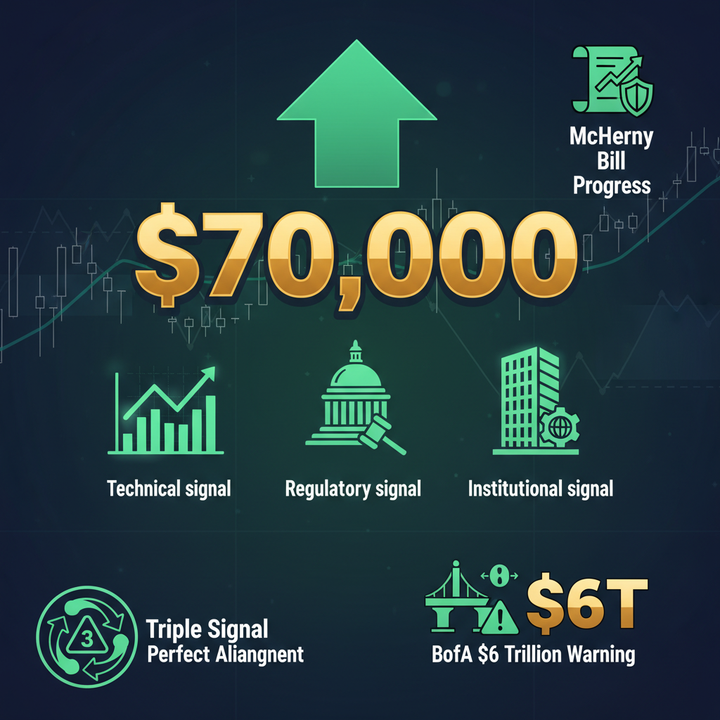
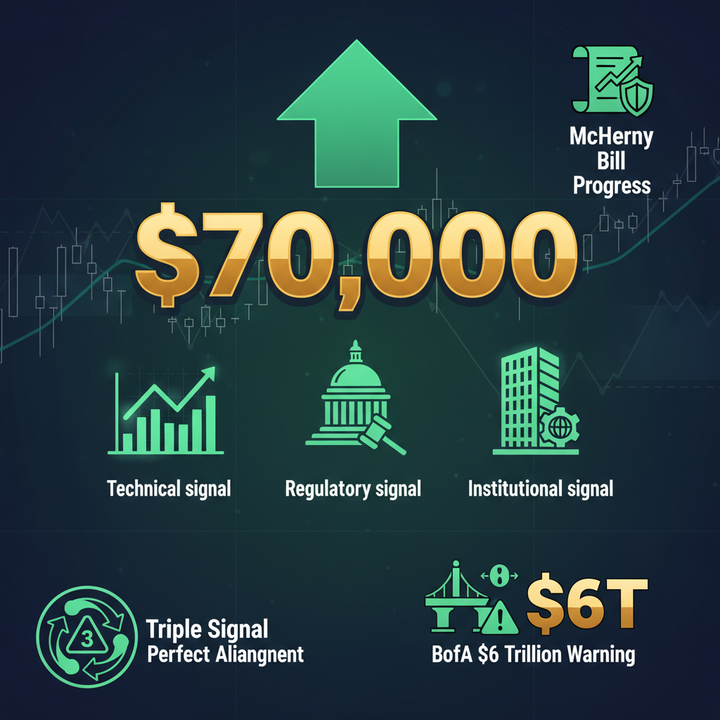
The crypto market is now receiving three simultaneous signals. First, a policy signal from McHenry's legislative momentum. Second, a technical signal from Bitcoin's price recovery. Third, a capital signal from institutional buying pressure. Historically, when all three align toward "bullish," markets experience rapid appreciation.
What McHenry's "Fast-Track" Really Means
Patrick McHenry, former chairman of the House Financial Services Committee, is arguably the most influential congressman on crypto policy today. His statement wasn't casual optimism—it was a signal of substantive legislative progress.
What's actually happening:
- Staking Yield Convergence: The explosive debate over whether staking returns constitute "securities" or "interest" is finally moving toward resolution. The SEC has pushed hard to classify staking as securities, but McHenry's statement suggests the industry and regulators are finding middle ground.
- Regulatory Coordination: Multiple agencies (SEC, CFTC, OCC) have been regulating crypto in conflicting ways. McHenry indicated these jurisdictional overlaps are being untangled.
- Timeline Acceleration: "Fast-track" language suggests H1 2026 bill submission, with potential passage by mid-year if momentum holds.
This stands in stark contrast to 2017, when China shocked the market with sudden exchange shutdowns. The U.S. is instead signaling a clear regulatory framework—the opposite of regulatory surprise.
McHenry's strategic intent:
- Restore Institutional Confidence: Signal that policy is NOT uncertain, which attracts institutional capital.
- Consolidate Regulatory Authority: Replace fragmented multi-agency oversight with coordinated rules.
- Industry Collaboration: Pursue a "both sides win" framework rather than punitive regulation.
The staking debate is particularly important. If the SEC continues classifying staking as securities offerings, institutional investors can't generate staking yield—a critical revenue stream for crypto-native funds. McHenry's convergence comment suggests this will be resolved in the industry's favor.
Bitcoin's $70,000 Recovery: End of Capitulation Phase
Bernstein analyst Gautam Chhugani's assessment: "What we're experiencing is the weakest bitcoin bear case in its history." This isn't opinion—it's technical analysis.
The technical evidence:
- Futures Market Capitulation Signals: Unlike November 2022's panic liquidation cascade, this drawdown showed no extreme selling frenzy. Major positions weren't blown out; institutional holdings remained steady.
- ETF Inflow Restart: U.S. spot Bitcoin ETFs registered back-to-back daily inflows for the first time in a month—a sign institutions are deploying capital rather than fleeing.
- Fear & Greed Index: At post-2022 lows but showing recovery momentum rather than further deterioration.
- Institutional Accumulation: Saylor and Tom Lee's purchases confirm sophisticated capital is buying, not panic selling.
The $70,000 level's significance:
- Psychological Anchor: This was the price just before the 2024 spot ETF approval—a known support from institutional memory.
- Institutional Entry Point: The price where mega-funds' risk models trigger buy signals.
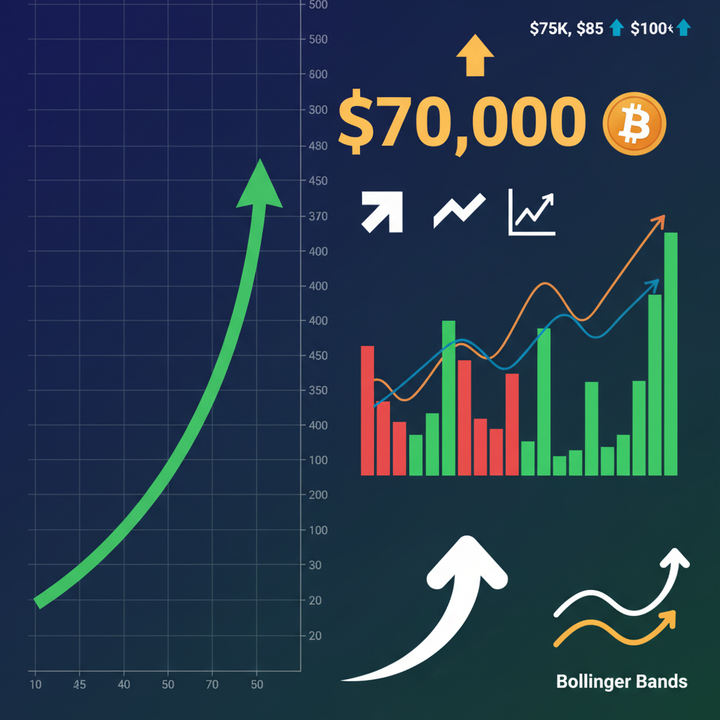
- Next Resistance Band: $80K–$85K represents the next technical target (10–20% gain).
Compare this to FTX's collapse in November 2022: Bitcoin crashed to $16,000, taking 18+ months to recover. Today's situation is fundamentally different. The current drawdown is a macro adjustment, not a systemic trust collapse. Therefore, recovery should be much faster—likely 3–6 months to hit Bernstein's $150,000 target, versus the years needed after FTX.
The Capital Signal: Saylor and Tom Lee Confirm Market Bottom
The clearest bullish signal is institutional buying pressure, now confirmed:
- Michael Saylor (MicroStrategy CEO): Purchased 1,142 BTC for ~$90M at an average price of $78,815—deployed capital exactly when panic was highest.
- Tom Lee (Bitmine Immersion CEO): Added 40,613 ETH (~$164M deployment) at crash lows, increasing his firm's total Ethereum holdings to 4.3M tokens (~$8.7B value).
- Spot ETF Inflows: Direct evidence of institutional asset managers rotating capital into crypto.
Why these purchases matter:
- Both deployed capital at the moment of maximum fear—the textbook definition of "buy when others are fearful."
- These aren't small positions; they're $90M+ and $164M+ deployments from executives managing billions.
- The timing (during the crash, not after recovery) proves confidence, not FOMO.
Historical precedent: During the 2020 COVID crash, Warren Buffett deployed massive capital at market lows—a decision that generated extraordinary returns. Saylor and Tom Lee are following the same playbook.
Farcaster to Tempo: The Stablecoin Pivot
Farcaster founders Dan Romero and Varun Srinivasan just exited crypto social media to join Tempo, a stablecoin-based payments startup. This seemingly small move signals something major:
- Industry Evolution: From "crypto social media" (speculative, consumer-facing) to "stablecoin payments" (institutional, infrastructure-level).
- Maturity Signal: The smartest crypto entrepreneurs are abandoning hype sectors for productive infrastructure.
- Institutional Demand: Stablecoin payments have become viable business models—proven by Bank of America's warning about $6 trillion in potential deposit migration.
This transition matters because it proves crypto is shifting from speculation to real economic utility. When industry leaders pivot from social tokens to payment infrastructure, it signals the market is maturing.
Morgan Stanley's Mining Coverage: Infrastructure Legitimacy
Morgan Stanley upgraded Bitcoin mining stocks (CIFR, WULF) to "buy" while downgrading Marathon Digital (MARA). The key phrase: mining sites are now "infrastructure assets."
This reclassification is transformative:
- Category Change: From "speculative crypto plays" to "essential energy infrastructure."
- Institutional Eligibility: Funds with infrastructure mandates can now allocate to Bitcoin mining—expanding the addressable market.
- Valuation Implications: Infrastructure assets trade at lower multiples but with higher stability and institutional demand.
Scenario Analysis: The Next 6 Months
Near-term (1–2 weeks): Volatility continues in the $65K–$75K band. Market waits for specific McHenry bill language.
Medium-term (1–3 months): McHenry submits formal bill → market interprets it as "policy clarity confirmed" → institutional capital floods in → Bitcoin targets $100K.
Long-term (3–6 months): Bill passes Congress → staking yield clarification enacted → Bernstein's $150K becomes realistic.
Risk Factors:
- 2026 election proximity could stall crypto legislation.
- Macro deterioration (inflation surprise, rate hike reversal).
- SEC overreach beyond McHenry's intended framework.
- Profit-taking at $80K–$90K levels.
Historical Context: Why This Time Is Different
2017 China Shock: Sudden "no warning" exchange ban → market crashed → recovery took 18+ months.
2022 FTX Collapse: Systemic trust breakdown → regulatory backlash → recovery required 18+ months.
2026 U.S. Clarity: Proactive policy framework announcement → institutional re-entry → recovery expected in 3–6 months.
The critical difference: This time, regulators are BUILDING a framework, not banning or punishing. That creates confidence, not fear.
What Investors Should Watch
- Bill Language: When McHenry's actual bill drops, specific staking yield treatment will determine market reaction.
- Institutional Flows: If Saylor and Tom Lee announce additional purchases, it signals continued confidence.
- ETF Inflows: Sustained daily inflows = continued institutional entry; outflows = warning signal.
- Support Zone: $65K is now the institutional bid—expect strong resistance to breaks below this level.
- Resistance Zone: $80K–$90K is where profit-taking may emerge.
Frequently Asked Questions
Will McHenry's Bill Actually Pass?
The "fast-track" language suggests H1 2026 submission is likely. However, passage depends on election politics. If crypto becomes a 2026 election issue, passage could slip to 2027. Best-case: bill passes by Q3 2026. Realistic case: bill passes in 2027. Worst-case: legislative gridlock delays it indefinitely.
Can Bitcoin Really Hit $150,000?
Mathematically, yes. A $3 trillion Bitcoin market cap (implying $150,000 per coin) would represent roughly 1–1.5% of global investable assets—reasonable for an institutional allocation. Timeline matters more than price: 3-month probability of $150K: 5–10%. 6-month probability: 30–40%. 12-month probability: 60–70%.
Should I Buy Bitcoin Now?
This is not investment advice. However, historical precedent suggests that when policy clarity signals + institutional buying + technical recovery align, long-term investors have profited. Dollar-cost averaging (small regular purchases) over the next 3 months might capture the bounce without catching a falling knife.
What About Altcoins?
Institutions buying Bitcoin is "baseline" risk management. Once policy clarity solidifies, risk-seeking capital typically flows into altcoins, which can appreciate 2–3x faster than Bitcoin. Ethereum is the most likely initial beneficiary.
Will Stablecoins Actually Replace Bank Deposits?
BofA's $6 trillion warning is credible but not immediate. Stablecoins will capture payment flows (settlement, DeFi) before they capture savings deposits. Expect 10–20% market share within 5 years, not 100% replacement.
Is Mining Stock Investment Safe?
Morgan Stanley's "infrastructure asset" classification is bullish, but mining stocks are 2–3x more volatile than Bitcoin itself. Suitable only for investors with high risk tolerance.
Could Policy Turn Negative?
Yes. SEC overreach or election-year political pressure could reverse McHenry's progress. However, his coalition-building language suggests he's avoiding purely punitive outcomes. Extreme negative outcome probability: 15–20%.
Conclusion
The crypto market is signaling a regime change. McHenry's legislative clarity, Bitcoin's technical recovery, and institutional capital deployment are converging for the first time since the market bottomed in 2022. This isn't guaranteed to produce a bull run—macro shocks, election politics, or regulatory overreach could still derail it. But the probability of a sustained bull market over the next 6–12 months appears to be in crypto's favor for the first time in two years.
The key risk is policy disappointment. If McHenry's actual bill contains unexpected restrictions, the rally could reverse quickly. But current market pricing appears to be betting that clarity, however nuanced, is better than the regulatory limbo of the past two years.
For deeper institutional flow analysis and policy monitoring, explore Spoted Crypto Premium Analysis. You can also track mega-investor positions through Spoted Crypto's institutional dashboard and gauge market sentiment through community voting on policy outcomes.
Sources
- "McHenry Predicts Fast Crypto Deal as Witt Brokers Talks," CoinDesk News, February 6, 2026
- "Bitcoin Shakes Off Early Decline, Returns to $70,000 as Bernstein Reiterates $150,000 Outlook," CoinDesk Markets, February 9, 2026
- "Farcaster Founders Join Stablecoin Startup Tempo After Neynar Acquires Social Protocol," CoinDesk Business, February 9, 2026
- "Cipher Mining and TeraWulf Are Buys, MARA a Sell, as Morgan Stanley Begins Bitcoin Miner Coverage," CoinDesk Markets, February 9, 2026