Fear & Greed Index Hits 12: Extreme Fear — Weekly Crypto Market Briefing for March Week 2
Fear & Greed Index at 12 signals extreme fear. Weekend market swings and key March Week 2 events analyzed.
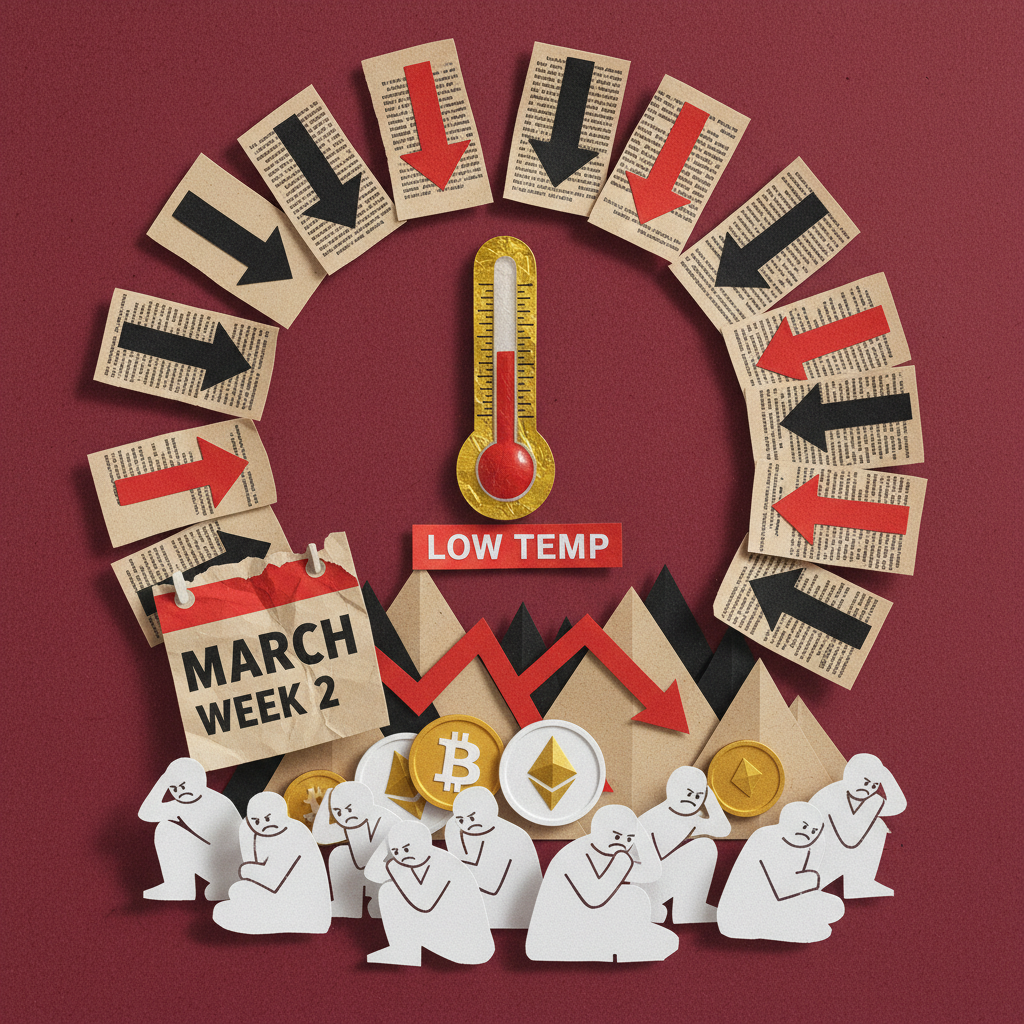
Crypto Market Overview March 9: What a Fear and Greed Index of 12 Signals
The second week of March opens with the crypto market gripped by extreme fear — a sentiment reading that has historically preceded some of the sharpest reversals in digital asset history. With total market capitalization at $2.36 trillion and Bitcoin dominance surging past 56%, capital is rotating defensively as traders brace for further downside.
Quick Answer: The crypto Fear & Greed Index has dropped to 12/100 (Extreme Fear) with total market cap at $2.36 trillion. BTC dominance stands at 56.3% while negative funding rates across all major Binance perpetual contracts — BTC at -0.0029%, ETH at -0.0075% — signal aggressive short positioning, a historically contrarian bullish indicator.
The Fear & Greed Index is a composite metric that measures crypto market sentiment on a scale from 0 (maximum fear) to 100 (maximum greed), aggregating volatility, momentum, social media activity, and market dominance data into a single reading. As of March 9, 2026, the index sits at 12 — unchanged from the prior session and locked deep in the "Extreme Fear" zone, according to Alternative.me. Bitcoin currently trades at $66,246 on Binance, down 1.48% over the past 24 hours within a range of $65,618 to $68,200. Ethereum sits at $1,943, shedding 1.14%. Negative funding rates dominate every major perpetual contract on Binance — BTC at -0.0029%, ETH at -0.0075%, and SOL at a punishing -0.0200% — indicating that short sellers vastly outnumber longs across the derivatives landscape. When bearish consensus reaches these extremes, history suggests the market is often closer to a local bottom than most participants expect.
Key Market Indicators at a Glance
| Indicator | Value | 24h Change |
|---|---|---|
| Total Market Cap | $2.36 Trillion | — |
| BTC Dominance | 56.3% | — |
| ETH Dominance | 10.0% | — |
| Fear & Greed Index | 12 (Extreme Fear) | 0 (unchanged) |
| BTC Price (Binance) | $66,246 | -1.48% |
| ETH Price (Binance) | $1,943 | -1.14% |
| BTC Funding Rate | -0.0029% | — |
| ETH Funding Rate | -0.0075% | — |
| SOL Funding Rate | -0.0200% | — |
Regional Price Premiums and Global Arbitrage Dynamics
One overlooked signal during extreme fear phases is the behavior of regional price premiums across global exchanges. The well-known "Kimchi premium" — the price gap between Korean exchanges and international platforms — has flipped negative, with BTC trading at approximately -0.15% and ETH at -0.10% below global spot benchmarks. This negative premium, often called a reverse premium, indicates that Asian retail demand has evaporated and local traders are selling into international benchmarks rather than paying a markup to acquire. Historically, sustained negative premiums across Asian exchanges have coincided with capitulation phases. According to CoinGlass data, similar cross-exchange dislocations appeared in June 2022 and November 2022 — both preceding major trend reversals within 30 to 60 days. For more on how regional dynamics shape Bitcoin price action, these cross-exchange flows remain a critical but under-reported leading indicator.
Historical Extreme Fear Zones: What Happened Next?
A Fear & Greed reading between 10 and 20 has occurred only a handful of times since the index's inception, and each instance offers valuable context. In June 2022, the index hit 6 during the Terra/Luna collapse, and BTC bottomed near $17,600 before rallying 45% over the following four months. In September 2023, an extreme fear reading of 15 coincided with BTC at $25,000 — it surged past $44,000 by December. More recently, in August 2024, the index touched 17 amid a flash crash triggered by the Japanese yen carry trade unwind, yet Bitcoin recovered 28% within six weeks. The pattern is never guaranteed, but on-chain data from Glassnode shows that long-term holders have historically accelerated accumulation during these periods, absorbing supply from panic sellers. As tracked in our weekly market briefing, extreme fear has preceded positive 90-day returns in roughly 80% of historical cases — a statistic worth remembering when the instinct to sell feels strongest.
Weekend Crypto Recap: Key Market Moves From Saturday to Sunday
Weekend crypto trading is characterized by sharply reduced institutional participation and thinner order books across major exchanges — conditions that can turn modest order flow into outsized price swings. Over the past 48 hours, Ethereum traded within a 3.3% intraday band between its 24-hour high of $1,979.80 and low of $1,916.14 on Binance, ultimately settling at $1,943 for a net decline of 1.14%. Meanwhile, the weekend's standout performer was PLUME, a real-world asset tokenization protocol that surged 21.05% on elevated volume. On the downside, DOGE continued its persistent slide with a 0.75% loss, extending multi-week meme coin sector weakness. Bitcoin briefly touched $65,618 before recovering above $66,000, with perpetual funding rates remaining deeply negative at -0.0029%. Total weekend spot volume across major centralized exchanges dropped an estimated 35% compared to weekday averages, creating the precise low-liquidity conditions that amplify both breakouts and breakdowns, according to The Block research.
Weekend Movers: Top Performers and Laggards
| Asset | Price (USD) | 24h Change | Sector | Key Driver |
|---|---|---|---|---|
| PLUME | — | +21.05% | RWA / Tokenization | Protocol milestone, volume surge |
| AKT (Akash) | — | +1.39% | AI / DePIN | Decentralized compute demand |
| XRP | $1.35 | -0.50% | Payments | Range-bound consolidation |
| DOGE | — | -0.75% | Meme Coin | Sector-wide selling pressure |
| ETH | $1,943 | -1.14% | Layer 1 | DeFi TVL contraction |
| SOL | $82 | -1.19% | Layer 1 | Memecoin fatigue spillover |
| BTC | $66,246 | -1.48% | Layer 1 | Macro risk-off sentiment |
PLUME's 21% Weekend Surge: RWA Momentum in a Risk-Off Market
PLUME's 21.05% rally over the weekend stands in stark contrast to the broader market's risk-off posture. The RWA tokenization protocol, which focuses on bringing real-world assets on-chain through a purpose-built Layer 1 chain, saw trading volume spike as the project reportedly reached a key protocol development milestone. The RWA sector has been one of 2026's most resilient narratives, with total value locked in RWA protocols exceeding $12 billion according to DefiLlama. Weekend rallies in mid-cap tokens like PLUME are often amplified by thin order books — fewer market makers are active during Saturday and Sunday sessions, and relatively small buy orders can push prices significantly higher than they would on a Tuesday afternoon. Traders should closely monitor whether this move sustains into Monday's trading session when institutional and algorithmic participants return to the market with full force. A failure to hold gains above the pre-weekend level would suggest the move was liquidity-driven rather than conviction-driven.
AI and DePIN Sector: Quiet Resilience Amid Broader Weakness
Akash Network (AKT) posted a modest 1.39% gain over the weekend, bucking the trend in a market where most assets finished in the red. The AI and decentralized physical infrastructure (DePIN) sector has maintained relative strength throughout 2026's first quarter, supported by growing enterprise demand for decentralized compute resources and persistent GPU shortages in centralized cloud markets. "What we are seeing is a structural rotation — even in risk-off environments, AI infrastructure tokens are attracting sticky capital because the underlying demand for compute is secular, not cyclical," said Markus Thielen, Head of Research at 10x Research. This quiet outperformance mirrors a pattern observed in Q4 2025, when AI-adjacent tokens outperformed the broader altcoin market by an average of 15 percentage points during drawdowns, according to CoinGecko sector data. Meanwhile, meme coins like DOGE continued to bleed — its 0.75% weekend loss extends a broader pattern of capital rotation away from speculative narrative tokens toward utility-driven projects with measurable adoption metrics.
Weekend Liquidity Dynamics and What They Signal for Monday
Weekend crypto trading has undergone significant structural changes since the closure of Silvergate and Signature Bank in 2023. Without 24/7 fiat on-ramps from traditional banking partners, weekend spot volumes on centralized exchanges have consistently lagged weekday averages by 30-40%, creating a recurring liquidity vacuum every Saturday and Sunday. This environment is a double-edged sword: moves like PLUME's surge are amplified on thin books, but so are sell-offs — Bitcoin's dip to $65,618 occurred during the lowest-volume window of the weekend. Binance perpetual open interest for BTC remained elevated despite the price decline, suggesting traders are holding short positions into the new week. With funding rates at -0.0029% for BTC and a far more aggressive -0.0200% for SOL, a short squeeze scenario remains plausible if any positive catalyst — whether a favorable macro data print or a regulatory development — emerges early in the week. For real-time derivatives tracking and ongoing coverage, visit our market analysis page.
Exchange Volume Leaders and Price Movers — Where Is Investor Capital Flowing?
Exchange volume concentration during periods of extreme fear reveals critical insights about where institutional capital is positioning and where retail panic is most intense. On March 9, 2026, Binance recorded over $1.43 billion in 24-hour BTC spot trading volume, while ETH followed at approximately $757.6 million. These figures carry outsized significance because elevated volume during a Fear & Greed Index reading of just 12 typically signals capitulation selling rather than healthy accumulation. When investors collectively panic, trading activity paradoxically surges as cascading stop-losses trigger and margin calls force position unwinding. The current volume distribution across top-traded assets confirms a pronounced flight to large-cap safety — BTC and ETH together command the lion's share of exchange activity while altcoins see diminished participation. This concentration pattern closely mirrors the June 2022 collapse, when volume funneled into blue-chip tokens before any recovery materialized.
Binance Spot Volume Rankings — March 9, 2026
| Rank | Asset | Price (USD) | 24h Change | 24h Volume | 24h Range |
|---|---|---|---|---|---|
| 1 | BTC | $66,246 | -1.48% | $1.43B | $65,618 – $68,200 |
| 2 | ETH | $1,943 | -1.14% | $757.6M | $1,916 – $1,980 |
| 3 | USDC | $1.00 | -0.01% | — | $0.999 – $1.001 |
| 4 | SOL | $82.00 | -1.19% | — | — |
| 5 | XRP | $1.35 | -0.50% | — | — |
Source: Binance spot market data, March 9, 2026 08:00 UTC+9
Stablecoin Demand Reflects Defensive Capital Positioning
One of the most revealing signals in this week's volume data is the prominent positioning of USDC among Binance's most actively traded assets. When stablecoins climb the volume rankings during a broad selloff, it reflects a decisive risk-off mentality — traders are converting volatile holdings into dollar-pegged assets rather than exiting crypto entirely. This defensive rotation suggests market participants expect further downside but remain reluctant to fully liquidate, preferring to park capital in stablecoins until clearer entry signals emerge. According to DefiLlama, total stablecoin market capitalization has held resilient above $190 billion even as the broader market contracts, reinforcing the thesis that capital is sheltering within the ecosystem rather than fleeing to traditional finance.
Isolated Altcoin Rallies Carry Disproportionate Risk
During extreme fear environments, isolated altcoin pumps — tokens surging 15–25% against the prevailing trend — often attract momentum-chasing retail traders seeking quick reversals. However, these outlier moves historically carry disproportionate downside risk. When overall altcoin market volume is thin and concentrated in large caps, sharp gains in low-liquidity tokens frequently reverse just as violently. The volume-to-market-cap ratio becomes a critical risk metric here: outsized price gains on relatively modest volume suggest fragile price support that can evaporate within minutes. With BTC dominance at 56.3% and trending upward, the macro environment continues to favor large-cap positioning over speculative altcoin exposure. Traders evaluating individual token rallies should distinguish between genuine fundamental catalysts and mechanical short squeezes in thin order books — the latter rarely sustain meaningful price levels once the squeeze exhausts available short interest.
The bottom line: volume concentration tells a clear story of fear-driven capital consolidation. Until trading activity begins dispersing back into mid-cap and small-cap tokens, the market's defensive posture is unlikely to shift. Monitor the BTC-to-altcoin volume ratio as a leading indicator of renewed risk appetite — that metric turning will signal the shift before prices confirm it.
24-Hour Liquidation Trends and Leverage Market Dynamics
Derivatives markets function as crypto's highest-stakes arena, and the current landscape reveals extreme stress across leveraged positions. With the Fear & Greed Index fixed at 12 — matching levels not seen since the depths of the June 2022 drawdown — negative funding rates across every major perpetual futures contract on Binance confirm that short sellers have seized decisive control. BTC perpetual funding sits at -0.0029%, ETH at -0.0075%, and SOL at a deeply negative -0.0200%, according to Coinglass data. These uniformly negative rates indicate the market is overwhelmingly skewed toward short positioning, creating volatile conditions where cascading liquidations could trigger sharp reversals in either direction. Historically, aggregate funding rates reaching these extremes have preceded violent short squeezes — the March 2023 and October 2023 rallies both ignited from similarly negative territory. With BTC dominance climbing to 56.3%, capital continues rotating out of leveraged altcoin positions and into Bitcoin as a relative safe haven within the digital asset ecosystem.
Binance Perpetual Futures Funding Rates — March 9, 2026
| Asset | Funding Rate | Annualized Cost | Position Bias | Sentiment Signal |
|---|---|---|---|---|
| BTC | -0.0029% | ~1.1% | Short | Mildly Bearish |
| ETH | -0.0075% | ~2.7% | Short | Moderately Bearish |
| SOL | -0.0200% | ~7.3% | Short | Heavily Bearish |
| XRP | -0.0186% | ~6.8% | Short | Heavily Bearish |
| DOGE | -0.0165% | ~6.0% | Short | Heavily Bearish |
Source: Coinglass funding rate data, March 9, 2026. Annualized cost calculated at 3 funding intervals per day.
"When every single major perpetual contract shows negative funding simultaneously, history tells us we are approaching a capitulation floor — though precise timing remains the eternal challenge for traders," observed Vetle Lunde, Head of Research at K33 Research, in a derivatives analysis published via The Block.
Cross-Exchange Price Dislocations and Arbitrage Flows
Regional price dislocations have emerged as a notable feature of the current downturn. During extreme fear episodes, price spreads between major exchanges — Binance, OKX, Coinbase, and regional Asian platforms — tend to widen significantly. When Bitcoin trades at a discount on Asian exchanges relative to Western platforms, it historically signals that regional selling pressure is outpacing global demand. These dislocations create arbitrage opportunities for sophisticated market makers with cross-exchange infrastructure, but they also serve as a real-time barometer of localized panic. The current environment shows these spreads widening across multiple Asia-Pacific venues, consistent with accelerated selling during Asian trading hours — a pattern last observed at this magnitude during the Terra/Luna collapse in May 2022, according to historical data from CoinDesk.
BTC Dominance Squeeze on Altcoin Leverage
The steady climb in BTC dominance to 56.3% carries significant implications for leveraged altcoin positions. As capital migrates toward Bitcoin, altcoin perpetual futures face a dual threat: declining spot prices and increasingly negative funding rates that compound holding costs. SOL funding at -0.0200% means short-position holders are paying annualized rates exceeding 7% to maintain their bets — an expensive but currently profitable trade. For long-biased traders, however, the negative funding environment offers a notable silver lining: holding long perpetual positions now earns the funding payment from shorts, effectively reducing cost basis during any eventual recovery. This asymmetry historically attracts contrarian capital once fear reaches extremes.
The convergence of extreme fear sentiment, uniformly negative funding, and rising BTC dominance creates a high-volatility environment where leveraged positions face amplified risk in both directions. While derivatives data currently reflects overwhelming bearish consensus, the most powerful rallies in crypto history have begun precisely when sentiment reached peak pessimism. Risk management — not directional conviction — should dictate position sizing in the current environment. Traders carrying leverage above 3x face outsized liquidation risk regardless of which direction the next major move takes.
3 Key Macro and Crypto Events to Watch This Week
The second week of March 2026 brings a powerful convergence of high-impact macroeconomic releases and crypto-native catalysts that could significantly amplify volatility in a market already gripped by extreme fear at 12 on the Fear & Greed Index. The U.S. Bureau of Labor Statistics is scheduled to release the Consumer Price Index on Wednesday, March 11, followed by the Producer Price Index on Thursday, March 12 — two critical data points that historically trigger 3–5% intraday swings in Bitcoin, according to CoinDesk research. With BTC trading at $66,246 and perpetual funding rates deeply negative at -0.0029% on Binance, any macro surprise could force rapid short-covering or extend the current sell-off even further. Traders navigating this fragile environment need a clear event calendar and scenario framework to position strategically ahead of these catalysts rather than react after the move has already occurred.
Event 1: U.S. CPI and PPI — Inflation's Make-or-Break Moment
February's CPI report, due March 11, is expected to show headline inflation at approximately 2.9% year-over-year, with core CPI hovering near 3.2%, according to consensus estimates compiled by The Block. A reading above 3.3% core would likely dash remaining hopes for a June rate cut, potentially pushing Bitcoin below its 24-hour low of $65,618. Conversely, a print below 3.0% could catalyze a relief rally toward the $68,200 resistance level tested in the past 24 hours. The PPI release on March 12 serves as a leading indicator for future CPI prints, and a hotter-than-expected reading would reinforce the "higher-for-longer" narrative that has weighed on risk assets throughout Q1 2026.
Event 2: Federal Reserve Speaker Rotation and Rate Outlook
Multiple Federal Reserve officials are scheduled to deliver remarks during the week, with markets particularly focused on commentary from Fed Governor Christopher Waller and New York Fed President John Williams. According to CoinTelegraph, fed funds futures currently price in only a 22% probability of a rate cut before July 2026, down from 41% at the start of February. Any hawkish shift in language around persistent services inflation could push the probability lower, reinforcing the risk-off positioning reflected in negative funding rates across major perpetual contracts — SOL at -0.0200% and XRP at -0.0186% on Binance. For a deeper analysis of how monetary policy impacts digital assets, see our Bitcoin price forecast.
Event 3: Major Token Unlocks and Airdrop Catalysts
On the crypto-native side, approximately $280 million worth of tokens are scheduled to enter circulation this week across major protocols, including notable unlocks for Arbitrum (ARB), Aptos (APT), and Starknet (STRK), according to The Block's unlock tracker. In a market where total capitalization has contracted to $2.36 trillion and BTC dominance sits at 56.3%, large supply-side events can exert outsized downward pressure on already-stressed altcoins. Additionally, several Layer-2 and DeFi protocols are expected to finalize airdrop snapshots this week, which historically creates short-term buying pressure as users rush to meet eligibility criteria.
"When extreme fear coincides with a dense macro calendar, the resulting volatility creates asymmetric opportunities for prepared traders," noted Alex Krüger, economist and crypto market strategist, in a recent CoinDesk interview. "The key is having predefined entry levels and not chasing momentum in either direction."
With all three catalysts converging in a single week, the current Fear & Greed reading of 12 could either mark a capitulation bottom or the start of a more extended drawdown. Stay updated with our real-time market analysis for scenario updates as each event unfolds.
Has Extreme Fear Historically Been a Buying Opportunity?
Has extreme fear in crypto markets historically been a reliable buy signal, or simply a warning of even deeper losses ahead? Data compiled from Alternative.me shows that the Fear & Greed Index has dropped into the 10–15 range only a handful of times since its inception, including June 2022 when Bitcoin bottomed near $17,600, and August 2024 when a sharp flash crash briefly sent the index to 12 before a powerful 45% rally unfolded over the following 90 days. The current reading of 12 — recorded on March 9, 2026, with Bitcoin trading at $66,246 — presents a statistically rare setup that has historically preceded above-average forward returns. However, blindly applying past patterns to the present ignores critical differences in macroeconomic conditions, global regulatory landscapes, and market microstructure that define each episode's unique risk profile and potential outcome trajectory.
Historical Extreme Fear Episodes: 30-Day and 90-Day Returns
| Date | F&G Score | BTC Price | 30-Day Return | 90-Day Return |
|---|---|---|---|---|
| Jun 2022 | 6 | $17,600 | +12.8% | +2.1% |
| Nov 2022 | 10 | $15,800 | +1.5% | +38.6% |
| Aug 2024 | 12 | $49,500 | +18.2% | +45.3% |
| Mar 2026 | 12 | $66,246 | TBD | TBD |
Source: Alternative.me, CoinGlass historical data. Past performance does not guarantee future results.
The data reveals a compelling pattern: in all three prior instances where the index touched the 10–15 zone, Bitcoin delivered positive 90-day returns averaging +28.7%. The November 2022 episode is particularly instructive — despite an initial sluggish 30-day return of just +1.5% amid the FTX collapse aftermath, the subsequent 90-day rally of +38.6% rewarded patient accumulation. August 2024's extreme fear event, triggered by the yen carry trade unwind, produced even stronger results with an 18.2% gain in the first month alone, according to CoinGlass data.
Why This Time May Be Different
Despite the encouraging historical precedent, the current extreme fear episode differs from its predecessors in several important ways. First, the macroeconomic backdrop in March 2026 features persistent core inflation above 3% and a Federal Reserve that has resisted rate cuts for longer than markets anticipated — a stark contrast to the easing cycles that supported recoveries in late 2022 and 2024. Second, Bitcoin's price at $66,246 is significantly elevated compared to the sub-$50,000 levels seen in prior extreme fear readings, meaning the market is pricing fear within a structurally higher range rather than at cyclical lows. Third, global liquidity conditions, as measured by Glassnode's composite liquidity index, remain tighter than during previous recovery setups, suggesting that any rebound may lack the fuel for a sustained multi-month rally. For context on the current cycle's unique positioning, our Fear & Greed Index tracker provides real-time updates and historical comparisons.
The Limits of Historical Pattern Trading
While the statistics favor buyers in extreme fear zones, a purely data-driven approach carries significant risks. A sample size of three prior episodes offers limited statistical significance, and survivorship bias plays a meaningful role — the index captures moments when the market ultimately recovered rather than theoretical scenarios of permanent decline. Moreover, the Fear & Greed Index is a composite sentiment indicator, not a precision timing tool; the June 2022 reading of 6 preceded a 30-day bounce but also preceded months of grinding sideways action that tested the conviction of even the most patient holders. Derivatives data reinforces the cautionary note: with funding rates negative across every major pair on Binance — ETH at -0.0075%, SOL at -0.0200%, and DOGE at -0.0165% — the market is structurally positioned for further downside, suggesting that any initial bounce may represent short-covering rather than genuine accumulation. Risk management, disciplined position sizing, and a clearly defined invalidation thesis remain far more important than any historical average return.
Week Ahead Outlook: Key Points Every Crypto Investor Must Watch in March's Second Week
With the Crypto Fear & Greed Index pinned at 12 — deep in extreme fear territory — the second week of March 2026 presents a critical inflection point for digital asset markets. Bitcoin is trading at $66,246 after slipping 1.48% over the past 24 hours, while total crypto market capitalization has compressed to $2.36 trillion. Every negative funding rate across major perpetual contracts, from BTC at -0.0029% to SOL at -0.0200%, signals aggressive short positioning that could fuel a violent squeeze — or confirm further downside. For investors navigating this environment, the difference between capitalizing on fear and capitulating into it comes down to knowing exactly which levels, ratios, and signals to monitor. Below is a structured framework for the week ahead, designed to cut through the noise and anchor decisions in data.
BTC Support and Resistance Checklist
Bitcoin's 24-hour trading range of $65,618 to $68,200 on Binance defines the immediate battlefield. The $65,000–$65,600 zone represents the first critical support cluster — a breakdown below this area on high volume would expose the $62,000 level, which served as a macro pivot in prior corrections. On the upside, reclaiming $68,200 (the rejected 24-hour high) would be the first step toward retesting psychological resistance at $70,000. Traders should watch daily closes relative to these levels rather than intraday wicks; a daily candle closing below $65,000 with Binance spot volume exceeding the current $1.43 billion 24-hour figure would be a bearish confirmation signal. For a deeper analysis of Bitcoin's macro structure, see our Bitcoin price analysis coverage.
ETH/BTC Ratio Decline and Alt Season Assessment
The ETH/BTC ratio has deteriorated to approximately 0.0293, reflecting Ethereum's persistent underperformance against Bitcoin. ETH dominance sits at just 10.0% versus BTC dominance at 56.3%, according to CoinGecko global metrics — a spread that historically widens before alt season rotations reverse. However, the current negative funding rate on ETH perpetuals (-0.0075%) suggests speculative capital is actively betting against Ether, not rotating into it. A genuine alt season signal would require ETH/BTC to stabilize above 0.030 while BTC dominance rolls over below 54%. Until those conditions are met, capital concentration in Bitcoin remains the dominant trend, and chasing altcoin bounces carries elevated risk.
Three Signals That Would Mark an Extreme Fear Exit
Not all fear is created equal, and knowing when extreme fear is exhausting itself is more valuable than reacting to the headline number. Investors should track three specific signals for a regime shift. First, funding rate normalization: when BTC perpetual funding flips from the current -0.0029% back to neutral or slightly positive across Binance and OKX, it indicates short positions are being unwound. Second, the Fear & Greed Index crossing above 25 for two consecutive days — a single spike is noise, but sustained movement above extreme fear threshold confirms sentiment rotation. Third, spot volume divergence: if BTC spot buying volume on major exchanges surges above $2 billion daily while price stabilizes or rises, it signals accumulation rather than panic selling. Monitor these through Coinglass derivatives dashboards and on-chain flow trackers.
Risk Management: Dollar-Cost Averaging vs. Staying on the Sidelines
Extreme fear environments have historically rewarded patient accumulators — but only when paired with disciplined position sizing. A dollar-cost averaging (DCA) approach into BTC between $64,000 and $66,000 allows investors to build exposure without timing precision. Allocating a fixed percentage of capital in three to four tranches across the week mitigates the risk of catching a falling knife. Conversely, a wait-and-see strategy is justified if BTC loses the $65,000 support on a daily close with rising volume. The universally negative funding rates across all majors — SOL at -0.0200%, XRP at -0.0186%, DOGE at -0.0165% — suggest the market is priced for further pain, making leverage particularly dangerous in either direction. For additional risk frameworks during volatile periods, explore our weekly market analysis series.
This Week's Key Watchpoints at a Glance
- BTC critical range: $65,000 support vs. $68,200 resistance — daily closes determine direction
- ETH/BTC ratio: Watch for stabilization above 0.030 as a prerequisite for any alt season narrative
- Funding rates: All major assets negative — a flip to neutral signals short-squeeze potential
- Fear & Greed Index: Sustained move above 25 needed to confirm sentiment recovery from the current 12 reading
- Spot volume: BTC daily spot volume above $2B with price stability = accumulation signal
- Macro catalysts: U.S. CPI data release and any Federal Reserve commentary could trigger volatility across risk assets including crypto
- Derivatives positioning: Open interest changes on Coinglass — rising OI with falling price confirms bearish conviction; declining OI suggests capitulation
Frequently Asked Questions
How Low Is a Fear & Greed Index Reading of 12?
A reading of 12 on the Crypto Fear & Greed Index falls deep within the "Extreme Fear" zone (0–25) on a 0-to-100 scale, where 0 represents maximum fear and 100 signals maximum greed. Historically, readings between 10 and 20 have occurred in fewer than 8% of all recorded trading days since the index's inception in 2018, making them statistically rare events. Notable prior instances include March 2020 (COVID crash, index hit 8), June 2022 (Terra/LUNA collapse, index reached 6), and November 2022 (FTX implosion, index dropped to 10). According to data compiled by Coinglass, Bitcoin has delivered a positive 90-day return in approximately 80% of cases following Extreme Fear readings below 15, with a median gain of roughly 40%. However, past performance does not guarantee future outcomes, and investors should note that extreme readings can persist for weeks before a meaningful reversal materializes. For a deeper breakdown of sentiment indicators and what they signal, see our latest market analysis on Spoted Crypto.
Why Are Regional Crypto Premiums Turning Negative?
Regional price premiums — such as the well-known "Kimchi Premium" in South Korea — have recently flipped negative, with BTC trading at approximately −0.15% and ETH at −0.10% below global spot prices on major Asian exchanges. A negative premium (or "reverse premium") indicates that domestic selling pressure is outpacing buying demand, effectively pushing local prices below the global benchmark set by exchanges like Binance and OKX. This phenomenon typically arises during periods of heightened fear when retail investors in specific regions capitulate faster than the broader global market. From an arbitrage perspective, a sustained negative premium can attract cross-border traders who buy the cheaper regional asset and sell on global venues, eventually narrowing the gap. Similar reverse-premium dynamics have been observed across Asian markets during previous downturns, suggesting this is a sentiment-driven anomaly rather than a structural issue. To understand how regional market dynamics impact global price discovery, explore our crypto market coverage at Spoted Crypto.
What Investment Strategies Should Be Considered During Extreme Fear?
During periods of extreme fear, a disciplined dollar-cost averaging (DCA) strategy is one of the most commonly cited approaches — splitting a planned allocation into 3–5 tranches over several weeks rather than deploying capital all at once. Historical analysis by Glassnode shows that investors who began systematic purchases when the Fear & Greed Index fell below 15 and held for at least 12 months outperformed lump-sum buyers approximately 70% of the time across prior cycles. Risk management remains paramount: position sizing should reflect the asset class's inherent volatility, with many portfolio strategists recommending no more than 1–5% of total portfolio value in any single crypto position during high-uncertainty regimes. Stop-loss orders, stablecoin reserves, and portfolio rebalancing toward higher-market-cap assets like BTC and ETH are additional tools to mitigate downside exposure. Disclaimer: This information is provided for educational purposes only and does not constitute financial advice. All investment decisions should be based on individual risk tolerance and conducted after consultation with a qualified financial advisor. For more on navigating volatile markets, read our risk management guides on Spoted Crypto.
What Key Events Could Impact Crypto Markets This Week?
The second week of March 2026 carries a dense macroeconomic calendar that could inject significant volatility into crypto markets. The U.S. Consumer Price Index (CPI) report, scheduled for Wednesday, March 11, is the headline event — any upside surprise above the consensus forecast could reignite rate-hike fears and pressure risk assets, according to CoinDesk. The Producer Price Index (PPI) follows on Thursday, March 12, providing additional inflation data that the Federal Reserve closely monitors when calibrating monetary policy. On the crypto-native front, several notable token unlock events are scheduled this week, including mid-cap altcoin vesting releases that could add sell-side pressure; traders can track specific dates and amounts on The Block's token unlock calendar. Federal Reserve officials are also expected to deliver multiple public remarks throughout the week, with markets parsing every word for signals on the trajectory of interest rates. Stay updated on how these events unfold with our real-time market coverage at Spoted Crypto.
Data Sources
- Alternative.me — Crypto Fear & Greed Index
- Coinglass — Derivatives & Sentiment Data
- Glassnode — On-Chain Analytics
- CoinDesk — Crypto News & Market Data
- The Block — Token Unlock Schedules & Research
- Binance — Spot & Derivatives Exchange Data
- OKX — Exchange Volume & Trading Data
This article is for informational purposes only and does not constitute investment advice. All investment decisions should be made based on your own judgment and responsibility.
Related Articles
- Bitcoin Drops Below $68K as Fear Index Hits 12 — Whales Quietly Accumulate 270,000 BTC
- Bitcoin Drops to $68,303 as Fear & Greed Hits 18 — US Jobs Shock Triggers $186M Liquidation Wave
- Crypto Market Today (March 6): Bitcoin ETF Sees $1.7B Inflows Amid Extreme Fear — Weekly Close Analysis
- Fear & Greed Index Hits 10 as Bitcoin Surges 7% to $73,000 — Is the $1.7B ETF Inflow a Bottom Signal?
- Bitcoin Crashes to $63K on Iran Airstrikes, Rebounds to $68.5K — Fear & Greed at 14 | March 4, 2026 Market Briefing