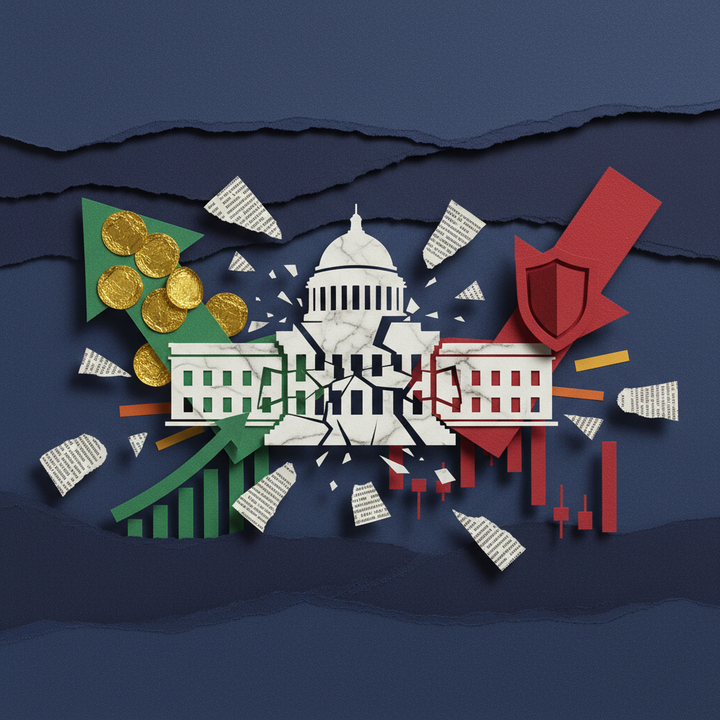
Political Money Floods in, But Regulatory Talks Stall: How Fairshake's $5M, Barclays' Stablecoin Move, and White House Collapse Reveal Crypto's Deepening Paradox
Crypto's political influence is soaring—Fairshake PAC just deployed $5M. Traditional banks are entering—Barclays invested in stablecoins. Yet regulatory negotiations just collapsed, and Coinbase is threatening to withdraw support. Three conflicting signals are creating maximum uncertainty in cryp...
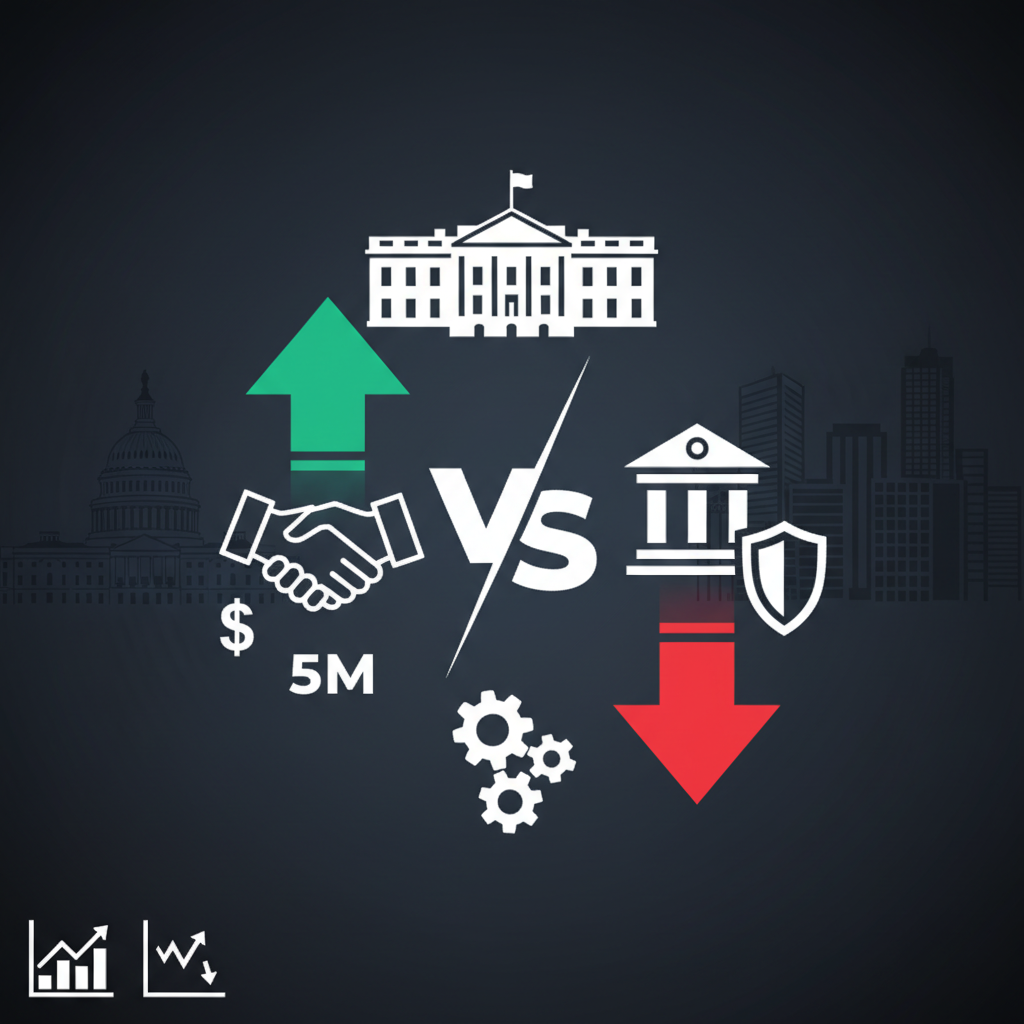
Political money is flowing in. Regulatory negotiations just stalled. Fairshake PAC deployed $5 million into Alabama's Senate race. Barclays—yes, the $2.3 trillion FTSE 100 bank—just invested in stablecoins. Meanwhile, White House negotiations between crypto and banking leaders collapsed this week. Coinbase is threatening to withdraw support for the Senate crypto bill.
These three signals seem contradictory. They appear to be pulling the crypto market in opposite directions. And that contradiction is exactly what makes the market so fragile right now.
On the surface, crypto looks stronger than ever. Political influence is real. Institutional money is flowing. But dig deeper and you'll find a dangerous mismatch: political momentum on one side, regulatory pressure intensifying on the other. Neither side is willing to genuinely compromise. The result? A market trapped in maximum uncertainty.
Let's break down what's happening, why it matters, and what comes next.
Signal One: Fairshake's $5M—Political Influence Enters Mainstream
Fairshake is crypto's PAC (political action committee). The numbers alone are staggering: $193 million in total capital backing pro-crypto candidates and opposing anti-crypto opponents. This is serious political money.
Last week, Fairshake deployed $5 million into Alabama's Senate race to support Barry Moore, a House congressman running to replace retiring Senator Tommy Tuberville. This isn't a side play—it's the PAC's entry into the 2026 midterm season, signaling a coordinated, systematic approach to reshaping Congress.
The message is clear: Crypto is no longer a peripheral industry. It's a major political player.
History shows what happens when a U.S. industry reaches this level of political mobilization:
- 2010s FinTech Revolution: When online lenders, payment processors, and digital banks began disrupting banking, they faced fierce regulatory resistance. Industry PACs mobilized political capital. Within 2-3 years, the industry secured regulatory clarity through the "regulatory sandbox" model. Banks got guardrails; FinTech got legitimacy.
- 2014-2018 Cannabis Industry: State-level legalization movements backed by industry money shifted federal policy. By 2018, the Farm Bill carved out space for hemp-derived products. Political pressure ultimately led to regulatory acceptance.
- 2015-2020 Autonomous Vehicle Industry: Tech companies and automakers lobbied aggressively for federal guidelines. Within 5 years, NHTSA issued AI/AV regulatory guidance. Political money accelerated regulatory clarity by 2-3 years.
In each case, serious political investment preceded—and often enabled—regulatory breakthroughs. By this historical standard, Fairshake's $5M signals that Congressional clarity on crypto is no longer years away; it's months away.
But here's the catch: political momentum and regulatory clarity are not the same thing.
Signal Two: Barclays' Stablecoin Investment—Institutional Acceptance With Conditions
Barclays just announced a direct investment in Ubyx, a stablecoin project. This matters more than headline readers might think.
Barclays is not a crypto startup investor. It's a $2.3 trillion systemically important bank, one of the world's oldest financial institutions. For Barclays to publicly invest in stablecoins signals a fundamental shift: stablecoins have moved from "experimental fintech" to "viable financial infrastructure."
The trajectory of institutional adoption tells the story:
- 2021-2023: Major banks refused crypto exposure. "Too risky, too unproven."
- 2024: Bitcoin ETF approval sparked institutional adoption. BlackRock, Fidelity, and other asset managers entered.
- 2025-2026: Stablecoins now attract direct investment from systemically important banks like Barclays.
This is the standard institutional adoption curve. What happened with the internet, mobile banking, and cloud computing follows the same pattern: derision → cautious investment → direct involvement.
But Barclays' move reveals something else: institutional adoption of crypto doesn't necessarily mean regulatory friendliness toward crypto companies.
Barclays simultaneously announced support for banning stablecoin yield—the revenue model that makes stablecoins profitable for crypto platforms. This is strategic: Barclays gets the technology; it blocks the crypto industry's competitive advantage. Institutional money is moving in, but on terms that constrain the industry's business model.
Signal Three: White House Negotiations Collapse—The Real Problem
Here's where the paradox deepens. The White House convened crypto industry leaders and banking representatives for compromise talks this week.
Attendees from crypto: Coinbase, Ripple, a16z Crypto Fund, Crypto Council for Innovation, Blockchain Association
Attendees from banking: Chase, Bank of America, Wells Fargo representatives; American Bankers Association
The White House directive was clear: both sides should come with compromise proposals.
What happened instead? Banking representatives submitted an even stronger proposal demanding a complete ban on stablecoin yields. Not a compromise. Not a middle ground. A hardening of position.
Crypto negotiators demonstrated flexibility. Banks did not.
This asymmetry is crucial. When one side shows willingness to concede and the other demands total victory, negotiations don't compromise—they collapse.
Coinbase responded by threatening to withdraw its support for the Senate Digital Asset Market Clarity Act—a bill the industry had been negotiating toward for months. This is a maximum credibility move: Coinbase is saying the current bill is so unfavorable that no bill is better than a bad bill.
The practical effect: Legislative progress on crypto regulation just hit a wall.
The Paradox: Growth and Uncertainty Accelerating Simultaneously
So we have:
Things getting stronger:
- Political influence (Fairshake $193M in capital, now entering midterms)
- Institutional adoption (Barclays, Citadel, Tom Lee's 4.3M ETH holdings all in buying mode)
- Technology momentum (LayerZero's $Zero blockchain, Tether's Scudo tokenized gold)
Things getting weaker:
- Regulatory clarity (stablecoin yield ban being tightened, not relaxed)
- Negotiation dynamics (White House talks revealing no genuine appetite for compromise from banking side)
- Legislative prospects (Coinbase's threat to withdraw support signals industry consensus is fraying)
This is what maximum paradox looks like: a market experiencing simultaneous growth and deepening uncertainty. Both trends are accelerating.
Historically, when growth and uncertainty accelerate together, market volatility surges. But that volatility is often followed by massive price moves in one direction or another—when uncertainty finally resolves.
Historical Parallels: How Other Industries Escaped This Trap
We've seen similar patterns before. Here's how they resolved:
FinTech (2008-2015): Banks were losing lending market share to online platforms. Regulators were unclear. Political pressure mounted. Resolution came via the "regulatory sandbox"—a bounded space where FinTech companies could operate under light-touch supervision. Banks got protection; FinTech got clarity. Within 2 years, the sandbox model spread globally.
Cannabis (2012-2018): State-level legalization created federal uncertainty. Banks couldn't serve legal businesses. Political money from industry and patient advocacy groups mounted pressure. Resolution came via the 2018 Farm Bill carving out hemp-derived products. Federal-state conflict remained, but a middle ground emerged.
Autonomous Vehicles (2012-2020): Companies wanted federal guidelines; traditionalists wanted bans; regulators were paralyzed. Political and lobbying pressure mounted. Resolution: NHTSA and NHTSA issued guidelines in 2016-2018. Not perfect, but clarity.
In each case, the pattern was: political pressure → regulatory clarity → market expansion.
Where is crypto in this cycle? The political pressure is now real (Fairshake $5M). Regulatory clarity is still missing. We're in the tension phase—the dangerous middle ground where political power and regulatory resistance are both high.
The most likely resolution: Senate may separate the "stablecoin yield" issue from the broader digital asset bill, or may limit yields to specific qualified institutions. Neither side wins; both claim partial victory. By Q3-Q4 2026, a compromise framework emerges. This is how regulatory standoffs usually end.
What This Means for Markets: Short-Term Volatility, Long-Term Direction
Next 2 Weeks: Regulatory news will dominate price action. Any announcement about renewed negotiations, or any statement from Coinbase or other major players about the Senate bill, will trigger 5-10% swings. Stablecoin yield-related projects face elevated volatility.
Next 1-3 Months: Three variables to watch: (1) Do Fairshake-backed candidates actually win elections? (2) Does Coinbase make good on its threat to withdraw support? (3) Does Senate leadership announce a new negotiation timeline?
3-6 Months Out: If political elections strengthen pro-crypto caucuses and regulatory clarity emerges, expect significant upside. If negotiations remain stalled, expect range-bound uncertainty to persist.
The key insight: regulatory clarity, not political money, is the true catalyst for price appreciation. Fairshake's $5M proves political money is flowing in. Barclays' investment proves institutional interest is real. But until regulatory uncertainty resolves, volatility will remain elevated.
Strategic Response for Investors
Given this paradoxical situation, what should investors do?
Risk Management First:
- Position size stablecoins and yield-bearing crypto projects with explicit regulatory risk premiums
- Monitor banking lobby announcements as closely as you monitor crypto company news
- Set stop-losses tighter than usual; regulatory volatility tends to trigger sharp reversals
Institutional Signal Tracking:
- Follow Barclays' crypto investments; if other tier-1 banks follow, regulatory acceptance is rising
- Watch Tom Lee and Michael Saylor's accumulation patterns; billionaire buyers often see regulatory clarity before markets do
- Monitor Coinbase earnings; if regulatory uncertainty hammers exchange revenue, it signals real market impact
Political Signal Monitoring:
- Track Fairshake's endorsed candidates; primary wins suggest November victories are likely
- Follow Senate Banking Committee statements; French Hill and allies will signal timing
- Watch for White House statements; they're likely to broker another round of negotiations by Q2
For deeper regulatory analysis and real-time capital flow tracking, Spoted Crypto Premium Analysis provides institutional-grade monitoring of both political developments and market microstructure. We track congressional statements, institutional trades, and regulatory filing timelines so you don't have to.
Frequently Asked Questions
Will Fairshake's $5M actually get Barry Moore elected?
Probably not—at least not single-handedly. Senate races are complex; $5M is significant but not determinative. What matters more is that Fairshake is signaling systematic, long-term commitment to crypto-friendly candidates. If Moore wins, Fairshake's political credibility soars and the industry commits more money. If Moore loses, the industry learns important lessons about state-level dynamics. Either way, this is the beginning of a multi-cycle political investment, not a one-off bet.
Does Barclays' investment mean regulatory approval is coming?
No. Barclays' investment means institutional money sees stablecoin technology as sound. But Barclays is simultaneously pushing for yield bans—a move designed to accept the technology while constraining competitors' profitability. Don't confuse institutional adoption of crypto technology with regulatory approval of crypto business models. They're moving on different timelines.
Is the White House deadline real, or will negotiations restart?
Negotiations will restart. The White House is too invested in showing deal-making ability to abandon these talks. But the failure of this round signals real structural tension: one side is willing to compromise; the other isn't. That asymmetry will persist until 2026 elections shift congressional balance. Expect a restart after primary season (mid-2026), with renewed pressure post-election.
If Coinbase pulls support, does the Senate bill die?
Probably stalls significantly. Coinbase's support was critical to industry unity. Its withdrawal signals industry consensus is breaking. Other exchanges and platforms may follow. This doesn't kill legislation forever, but it extends the timeline by 6-12 months and empowers bank lobbyists to demand harsher terms.
When should I expect regulatory clarity on stablecoins?
If political elections go pro-crypto (fall 2026), expect lame-duck session activity in Nov-Dec 2026 or a push in 2027. If midterms remain mixed, clarity likely pushes to 2027-2028. The timeline depends entirely on congressional composition, not fundamental merits.
Is this situation bullish or bearish for crypto prices?
It's directionally bullish long-term (regulatory clarity is coming), but highly volatile short-term (uncertainty persists). Traders should expect 5-15% swings on regulatory news. Long-term holders should view this as a 6-12 month window of elevated uncertainty before eventual clarity. Neither is wrong; they're on different timelines.
Which crypto assets benefit if regulatory clarity comes?
Bitcoin and Ethereum would appreciate moderately (they're already mostly mainstream). Stablecoins, yield-bearing DeFi tokens, and L1/L2 infrastructure play would see largest upside, as regulatory clarity removes their primary risk discount. Conversely, assets with aggressive tokenomics or speculative foundations would face pressure as regulation tightens standards.
Conclusion: The Paradox Persists Until It Breaks
Crypto is in a paradoxical moment. Political momentum is real. Institutional money is flowing. Regulatory pressure is simultaneously intensifying. Neither will yield to the other through talk alone.
The resolution will come through elections. 2026 midterms will determine congressional composition. If pro-crypto candidates win decisively, regulatory leverage shifts dramatically toward the industry. If anti-crypto or neutral candidates predominate, bank lobbies maintain regulatory upper hand.
Until then, expect volatility. Expect news-driven swings. Expect continued negotiation theater with minimal results. This is what happens when two powerful forces collide and neither is ready to genuinely compromise.
But history is clear: this phase doesn't last forever. Within 6-18 months, one of three things happens: (1) regulatory frameworks emerge through legislative compromise, (2) political elections shift power balance, or (3) market pressures force innovation around regulatory barriers.
The crypto market is uncomfortable now because the outcome is genuinely uncertain. That discomfort is the price of growth. The companies that survive this period—and the investors who position correctly—will be those who manage the paradox rather than betting everything on one side winning.
Sources
- CoinDesk - Fairshake's $5M Alabama deployment
- CoinDesk - White House negotiation breakdown
- Spoted Crypto - Real-time regulatory and capital flow analysis
- Bloomberg - 2026 U.S. midterm campaign finance analysis
- Reuters - Traditional finance sector digital assets policy positions
- Federal Reserve publications on stablecoin regulation proposals