DeFi TVL Hits $94B as Aave Crosses $1T in Cumulative Loans: March 2026 Airdrops and Staking APY Compared
DeFi TVL hits $94 billion while Aave surpasses $1 trillion in cumulative lending volume. We compare staking APY across 12 major cryptocurrencies including ETH, SOL, and ATOM, and map out March 2026's biggest airdrop opportunities from Berachain to EigenLayer Season 2.
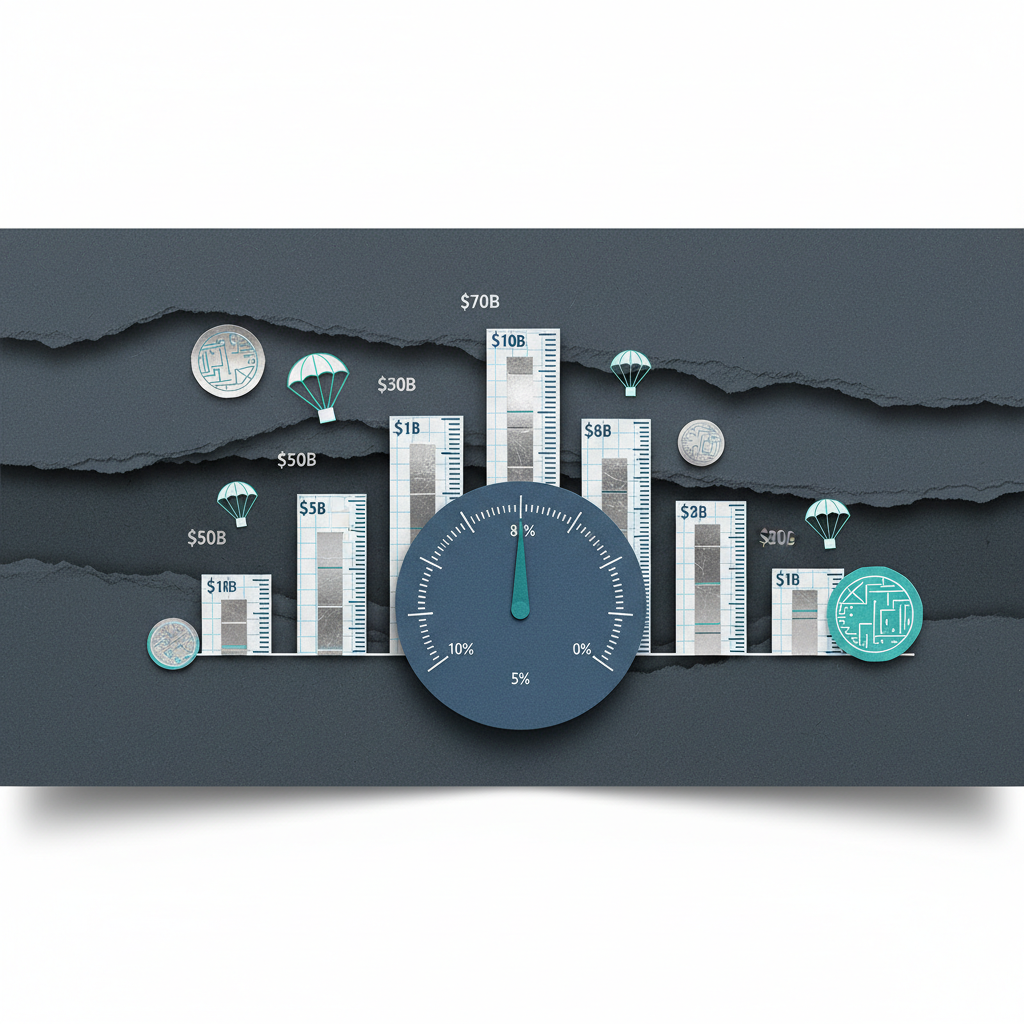
Decentralized finance continues to prove its staying power. Total value locked across DeFi protocols has climbed to $94 billion, while Aave — the sector's dominant lending platform — has quietly surpassed $1 trillion in cumulative loans since inception. These milestones arrive during a period of extreme market fear, with the Fear & Greed Index sitting at just 10 out of 100.
For yield-seekers and airdrop hunters, March 2026 presents a dense calendar of opportunities. Below, we break down where DeFi stands today, which staking yields actually deserve your attention, and which upcoming airdrops are worth positioning for.
DeFi TVL at $94 Billion: Where the Money Sits
The $94 billion TVL figure represents a mature DeFi ecosystem that has consolidated around a handful of battle-tested protocols. Unlike the speculative peaks of previous cycles, today's TVL is largely productive capital — deployed in lending markets, liquidity pools, and restaking layers.
Aave dominates the lending vertical. Its $1 trillion cumulative loan milestone means the protocol has facilitated more borrowing volume than many mid-sized national banking systems. Active borrows currently exceed $12 billion, with USDC, USDT, and ETH as the most-borrowed assets. Aave V3 deployments across Ethereum, Arbitrum, Optimism, Base, and Polygon account for the lion's share of activity.
Lido remains the largest single protocol by TVL, controlling roughly 28% of all staked ETH. MakerDAO (now Sky) continues to anchor the decentralized stablecoin market, while newer entrants like EigenLayer have carved out significant positions in the restaking narrative.
What's notable is the resilience of these numbers during extreme fear conditions. Bitcoin trades at $69,186 with modest gains of 1.83%, while ETH holds above $2,000 at $2,003. The broader market cap sits at $2.44 trillion with BTC dominance at 56.9% — suggesting capital remains concentrated in blue chips rather than rotating into altcoins.
Staking APY Comparison: 12 Coins Head-to-Head
Staking yields vary dramatically depending on the asset, the platform, and whether you're willing to accept lockup periods or liquid staking derivatives. Here's how the major options compare as of early March 2026:
| Asset | Native Staking APY | DeFi Yield (Best Platform) | Lock Period | Risk Level |
|---|---|---|---|---|
| ETH | 3.4% | 4.8% (Lido + DeFi) | None (liquid) | Low |
| SOL | 6.8% | 8.5% (Marinade + LP) | ~2 days unstake | Low-Medium |
| ATOM | 14.2% | 16.1% (Osmosis LP) | 21 days | Medium |
| DOT | 11.5% | 13.8% (Acala) | 28 days | Medium |
| ADA | 3.1% | 4.2% (SundaeSwap) | None | Low |
| AVAX | 7.9% | 9.6% (Benqi) | 14 days | Low-Medium |
| NEAR | 9.1% | 11.3% (Burrow) | 2-3 days | Medium |
| TIA | 12.6% | 15.4% (Milky Way) | 21 days | Medium-High |
| INJ | 14.8% | 17.2% (Helix LP) | 21 days | Medium-High |
| SUI | 3.8% | 6.2% (Aftermath) | None (liquid) | Medium |
| SEI | 5.4% | 8.0% (Silo) | 21 days | Medium |
| MATIC | 4.5% | 6.7% (Aave Polygon) | None | Low-Medium |
A few observations stand out. First, Cosmos ecosystem tokens (ATOM, TIA, INJ) consistently offer the highest native staking yields, but they also impose the longest unbonding periods — typically 21 days. During a market downturn with fear at extreme levels, that lockup represents real risk.
Second, liquid staking derivatives on ETH and SOL let you earn base yield while keeping capital deployable in DeFi. Stacking Lido's stETH into Aave as collateral, for example, can push effective ETH yields above 6% — though this introduces smart contract risk at each layer.
Third, the gap between native staking and optimized DeFi yields is widest for newer chains like SUI and SEI, suggesting their DeFi ecosystems still offer early-adopter premiums.
March 2026 Airdrop Calendar
Airdrop farming remains one of DeFi's most asymmetric strategies. Several major protocols are expected to distribute tokens in March or have snapshot windows that reward current activity. Here are the most significant opportunities:
| Protocol | Expected Date | Chain | Qualifying Activity | Est. Value |
|---|---|---|---|---|
| Scroll | Early March | Ethereum L2 | Bridge & transact on Scroll | Medium-High |
| Linea | Mid-March | Ethereum L2 | Use DeFi apps on Linea | Medium |
| Berachain | March TBA | Berachain | Provide liquidity, hold BGT | High |
| Monad | Late March (Testnet) | Monad | Testnet participation | Speculative |
| Hyperlane | March snapshot | Multi-chain | Cross-chain bridging | Medium |
| EigenLayer S2 | March claims | Ethereum | Restaking, operator delegation | High |
Berachain and EigenLayer Season 2 stand out as the highest-conviction opportunities. Berachain's proof-of-liquidity mechanism means early liquidity providers are directly rewarded with governance tokens. EigenLayer's second season expands eligibility to a broader set of restakers and operators, and the first season's generous payouts set high expectations.
For Scroll and Linea, both Ethereum L2s have been running point systems for months. Users who have consistently bridged assets and used native DeFi applications on these chains are best positioned. If you haven't started, there's still time — but the snapshot windows could close at any point.
Monad remains speculative. The high-performance L1 has generated enormous hype, but the testnet is still in early stages. Positioning here is a longer-term play, and the March testnet phase is about establishing on-chain history for a potential future drop.
Market Context: Extreme Fear Creates Opportunity
The Fear & Greed Index at 10 — Extreme Fear — is historically a strong contrarian signal. Looking at funding rates, the picture confirms cautious positioning: ETH funding is negative at -0.0071%, and DOGE sits at -0.0088%, meaning short sellers are paying to maintain positions. BTC funding is barely positive at 0.0025%.
This environment tends to benefit patient capital. DeFi yields become more attractive relative to speculative trading when volatility crushes leveraged positions. Staking and lending suddenly look appealing when the alternative is watching leveraged longs get liquidated.
SOL's 2.24% daily gain makes it the quiet outperformer among major assets, potentially reflecting ongoing developer activity and DeFi growth on Solana. At $87, it remains well below previous highs, which means staking at 6.8-8.5% yields comes with meaningful upside optionality.
Key Takeaways
DeFi's $94 billion TVL and Aave's $1 trillion lending milestone are not speculative froth — they represent genuine, sustained protocol usage. The staking landscape favors Cosmos-ecosystem tokens for raw yield and Ethereum/Solana liquid staking for capital flexibility. March's airdrop calendar is loaded, with Berachain and EigenLayer Season 2 offering the highest expected value.
In a market gripped by extreme fear, deploying capital into productive DeFi strategies — staking, lending, airdrop farming — offers a more rational approach than sitting idle or attempting to time the bottom.
Frequently Asked Questions
Is DeFi TVL at $94 billion a new all-time high?
No. DeFi TVL peaked above $170 billion during previous cycle highs. However, $94 billion represents a more mature and sustainable base, with the majority locked in audited, battle-tested protocols like Aave, Lido, and MakerDAO rather than speculative yield farms.
Which staking option offers the best risk-adjusted return?
For most investors, liquid staking ETH via Lido (stETH at ~3.4% base, extendable to 4.8%+ in DeFi) offers the best balance of yield, liquidity, and security. There's no lockup period, and ETH remains the most battle-tested smart contract platform. SOL staking via Marinade is the next strongest option for those comfortable with Solana's risk profile.
How do I qualify for the Berachain airdrop?
Berachain uses a proof-of-liquidity consensus mechanism. To qualify, you should provide liquidity to approved pools on the Berachain network, hold or delegate BGT (Bera Governance Token), and interact with core DeFi applications on the chain. Activity volume and consistency typically matter more than a single large deposit.
Are airdrops taxable?
In most jurisdictions, yes. Airdropped tokens are generally treated as ordinary income at the fair market value when received. Consult a tax professional familiar with crypto regulations in your country, as rules vary significantly across jurisdictions.
Why is the Fear & Greed Index so low, and what does it mean for DeFi?
The index at 10 reflects broad market anxiety driven by macroeconomic uncertainty and recent price declines. For DeFi specifically, extreme fear often means reduced competition for yields (fewer active farmers), better lending rates for suppliers, and historically favorable entry points for long-term positioning.