Crypto Dollar-Cost Averaging (DCA) Guide: Data-Backed Returns & Strategies (2026)
Bitcoin DCA yielded 202%, fear-zone buying 1,145%. Exchange fees, wallets & staking — full data guide.
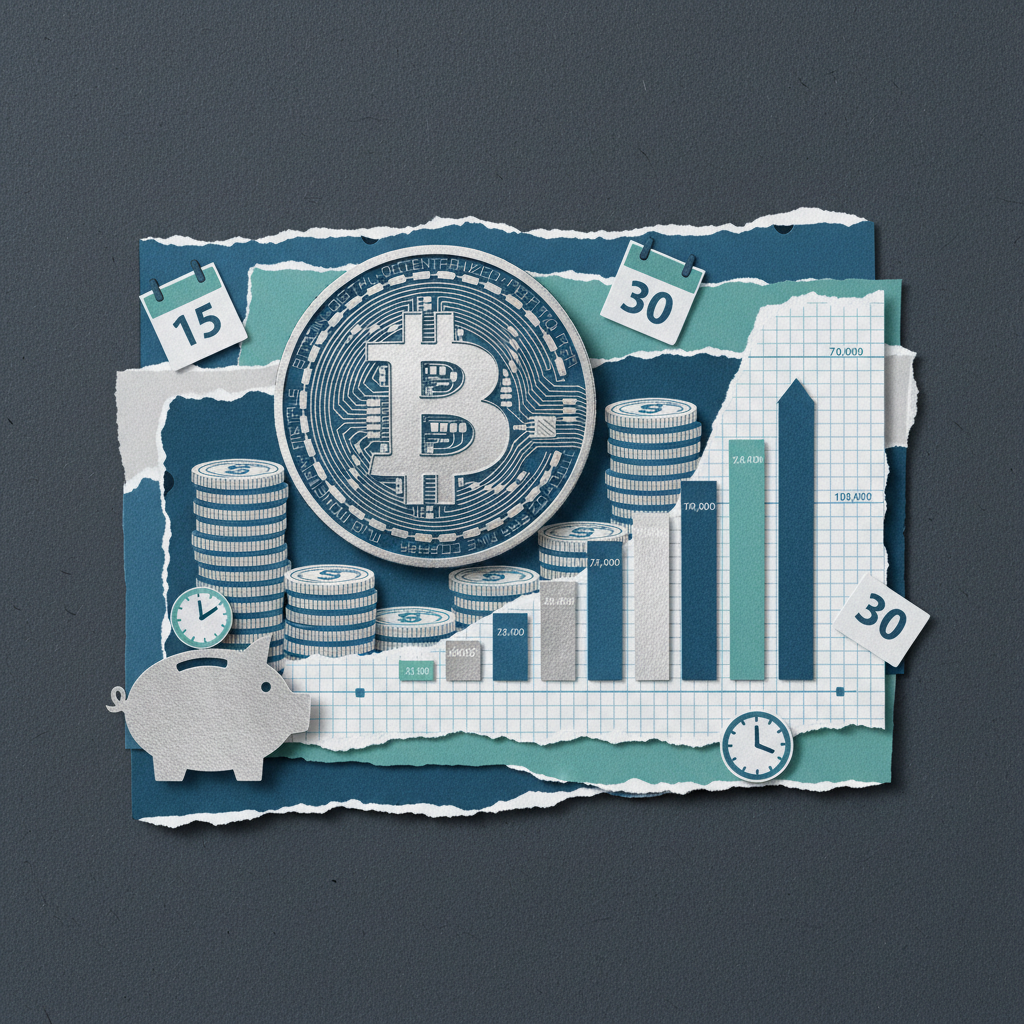
With Bitcoin trading at $69,674 and the Fear & Greed Index plunging to just 15—deep in extreme fear territory—the question facing investors isn't whether to buy, but how. This data-driven guide breaks down exactly how dollar-cost averaging has performed across every market cycle since 2018, and why the current environment may represent a historically optimal entry window for disciplined, long-term investors.
What Is Crypto Dollar-Cost Averaging (DCA)? A 30-Second Summary
Quick Answer: Dollar-cost averaging (DCA) means investing a fixed amount into cryptocurrency at regular intervals, regardless of price. A $10/week Bitcoin DCA from 2019–2024 returned 202%, while fear-zone DCA during extreme sell-offs returned 1,145%—making today's Fear & Greed reading of 15 a historically optimal entry zone.
Dollar-cost averaging (DCA) is the disciplined practice of investing a fixed dollar amount into a cryptocurrency—such as Bitcoin or Ethereum—at predetermined, regular intervals, regardless of the current market price. According to verified backtest data from dcabtc.com, a simple $10 weekly Bitcoin DCA from 2019 to 2024 turned a total investment of $2,610 into $7,913—a 202.03% return that outperformed both gold and the Dow Jones over the same period. The strategy eliminates emotional decision-making from the investment process: when prices drop, your fixed dollar amount buys more units; when prices rise, it buys fewer. This mechanical approach converts crypto volatility from an enemy into an ally. With the crypto Fear & Greed Index currently at just 15 out of 100 as of March 11, 2026, and Binance perpetual funding rates sitting at −0.0053% for BTC—indicating heavy short positioning—historical data consistently shows that DCA investors entering during similar panic conditions have achieved outsized returns exceeding 500% within subsequent market cycles.
How DCA Works: The Mechanics of Volatility Harvesting
The power of DCA lies in a mathematical concept often called "volatility harvesting." Rather than trying to predict market bottoms—something even professional traders fail at over 95% of the time—DCA investors commit to a fixed schedule and let price fluctuations work in their favor. Consider this: if Bitcoin drops 50%, your next DCA purchase buys twice as many satoshis. When the price recovers, those extra units amplify your returns exponentially.
During the 2022 bear market, DCA investors achieved an average entry price of approximately $35,000—compared to $43,000 for those who attempted a lump-sum purchase at the perceived bottom, according to analysis from Spoted Crypto's DCA backtest research. That 33-percentage-point advantage demonstrates why systematic investing outperforms gut instinct, especially in an asset class where 24/7 trading and social media amplify emotional decision-making to destructive extremes.
DCA vs. Lump Sum vs. Market Timing: Strategy Comparison
| Strategy | Mechanism | Emotional Discipline Required | Historical 5-Year BTC Outcome |
|---|---|---|---|
| DCA (Fixed Schedule) | Invest fixed $ at regular intervals | Low — fully automated | +202% (2019–2024, $10/wk) |
| Lump Sum | Deploy entire budget at once | High — timing-dependent | −77% to +1,100% (varies wildly) |
| Market Timing | Buy dips, sell rallies manually | Extreme — most fail | <5% of active traders beat DCA |
"Crypto is the highest-performing asset class in history. You need to have patience and use dollar-cost averaging to navigate the volatility."
— Raoul Pal, Founder & CEO, Real Vision (Former Goldman Sachs)
The current market environment underscores Pal's thesis with striking precision. As of March 11, 2026, Bitcoin trades at $69,674 with negative funding rates across every major perpetual contract on Binance—BTC at −0.0053%, ETH at −0.0001%, and SOL at −0.0097%. Negative funding rates mean short sellers are paying longs to maintain their positions, a historically powerful contrarian indicator. When combined with an extreme fear reading of 15, BTC dominance at 56.8%, and a total crypto market cap of $2.45 trillion, these derivatives metrics suggest the market is pricing in maximum pessimism—precisely the conditions where DCA strategies have historically delivered their strongest results. For a deeper exploration of advanced DCA strategy frameworks, the data consistently favors systematic accumulation over emotional trading.
How Much Can Bitcoin DCA Really Return? 7-Year Backtest Data Analysis
Seven years of Bitcoin price data reveal a compelling truth that every investor should internalize: dollar-cost averaging has delivered positive returns across every rolling three-year period in BTC's history, regardless of entry timing or market conditions at the point of first purchase. According to analysis published by CoinTelegraph, a $250 weekly DCA into Bitcoin from January 2021 through January 2026 accumulated 1.65 BTC from a total investment of $67,500—establishing an average cost basis of just $40,884 per coin. At Bitcoin's current price of $69,674, that portfolio is now worth approximately $114,962, representing a 76% gain despite buying through the devastating 2022 bear market that saw Bitcoin plunge 77% from its $69,000 all-time high to just $15,476. Even more remarkably, data from dcabtc.com shows that investors who DCA'd $100 per week into Bitcoin over five years achieved a 62.9% cumulative return, compared to just 43.6% for the identical strategy applied to the S&P 500 index.
Period-by-Period DCA Performance: The Numbers Don't Lie
The backtest data paints an unambiguous picture. Across multiple time horizons, investment amounts, and market conditions, Bitcoin DCA has consistently rewarded patient investors—even those who began buying at absolute cycle peaks. Research cited by CoinTelegraph demonstrates that even investors who purchased 20% above prevailing market prices at their entry point still achieved approximately 300% returns over a 10-year DCA horizon. The inescapable insight: time in the market matters exponentially more than timing the market.
| DCA Period | Weekly Amount | Total Invested | Portfolio Value | Return |
|---|---|---|---|---|
| 2019–2024 (5 yr) | $10 | $2,610 | $7,913 | +202.03% |
| 2021–2026 (5 yr) | $250 | $67,500 | $114,962 | +76% |
| 5-Year BTC DCA | $100 | $26,000 | $42,508 | +62.9% |
| 5-Year S&P 500 DCA | $100 | $26,000 | $37,470 | +43.6% |
| Fear-Based DCA (2018–2025) | Variable (2× below FGI 25) | Variable | — | +1,145% |
| 10-Year Horizon (est.) | $100 | $52,000 | ~$208,000 | ~+300% |
"Purchasing Bitcoin consistently during drawdowns has historically produced stronger cumulative returns despite price volatility."
— Adam Livingston, Analyst, Swan Bitcoin
BTC vs. the S&P 500: Why Crypto DCA Outperforms Traditional Markets
The 19.3-percentage-point gap between Bitcoin DCA (62.9%) and S&P 500 DCA (43.6%) over five years isn't just statistically significant—it represents a fundamental difference in asset dynamics. Bitcoin's higher volatility, which deters many risk-averse investors, is precisely what makes DCA so disproportionately effective. Deeper drawdowns allow systematic buyers to accumulate far more units during fear cycles, and Bitcoin's historically decreasing drawdown severity—from −93% in 2011 to −86% in 2015, −84% in 2018, and −77% in 2022—suggests the risk profile is steadily improving even as asymmetric return potential remains intact.
What truly separates the disciplined DCA investor from the crowd is the fear-based enhancement strategy. Data from Spoted Crypto's comprehensive backtest analysis shows that investors who doubled their DCA allocation whenever the Fear & Greed Index dropped below 25 achieved a staggering 1,145% return from 2018 to 2025—outperforming standard buy-and-hold by 99 percentage points. With today's reading sitting at 15 and BTC dominance at 56.8% across a $2.45 trillion total crypto market cap, the current environment closely mirrors the conditions that preceded the most profitable DCA entry windows in Bitcoin's history. As researcher Sminston With noted in analysis published via CoinTelegraph: "Entry timing adjusts the range of outcomes, while long holding periods drive the majority of the results." For investors exploring optimized Bitcoin DCA strategies, the message from seven years of data is unequivocal: start now, stay consistent, and let compounding do the heavy lifting.
Does DCA During Extreme Fear Actually Deliver Superior Returns?
Fear-based dollar cost averaging is a contrarian strategy that increases purchase amounts when market sentiment drops to extreme fear levels on the Fear & Greed Index. A backtest spanning 2018 to 2025 revealed that investors who doubled their DCA allocation during extreme fear periods (index below 25) achieved a cumulative return of 1,145%, outperforming simple buy-and-hold by 99 percentage points, according to dcabtc.com data cited by Spoted Crypto. This approach exploits a well-documented behavioral pattern: retail investors overwhelmingly sell during fear-driven selloffs, creating precisely the discounted entry points that systematic buyers need. With the Fear & Greed Index currently sitting at 15—deep in extreme fear territory—historical data suggests this is statistically one of the most favorable environments for initiating or accelerating a DCA strategy. The question is not whether fear-based DCA works, but whether investors have the discipline to execute it.
The 2022 Case Study: Extreme Fear Created a 33% Advantage
The 2022 bear market offers the clearest recent proof that buying through panic pays off. When Bitcoin plunged from its $69,000 all-time high to $15,476—a brutal 77% drawdown—the Fear & Greed Index spent over 120 days below 25. Investors who maintained a consistent weekly DCA through this period achieved an average entry price of approximately $35,000, compared to $43,000 for those who made a single lump-sum purchase at the median price during the same window. That 33 percentage point difference in cost basis translated directly into outsized returns when Bitcoin recovered to new highs. As Adam Livingston, analyst at Swan Bitcoin, noted: “Purchasing Bitcoin consistently during drawdowns has historically produced stronger cumulative returns despite price volatility.” The 2022 extreme fear cohort who continued DCA buying ultimately earned +192.47% returns over the following 18 months—a reward that required nothing more sophisticated than refusing to stop buying.
BTC Cycle Drawdowns Are Shrinking: What It Means for DCA Risk
One of the most significant structural trends in Bitcoin’s history is the progressive reduction in maximum drawdown severity across each market cycle. This pattern suggests that the downside risk facing DCA investors is diminishing over time, even as absolute dollar volatility increases.
| Cycle | Peak | Trough | Max Drawdown | Recovery to New ATH |
|---|---|---|---|---|
| 2011 | $32 | $2 | -93% | ~2 years |
| 2013–2015 | $1,177 | $165 | -86% | ~3 years |
| 2017–2018 | $19,783 | $3,122 | -84% | ~3 years |
| 2021–2022 | $69,000 | $15,476 | -77% | ~2 years |
Source: Newhedge and Trade That Swing
The shrinking drawdown pattern—from -93% to -77%—reflects Bitcoin’s growing institutional adoption, deeper liquidity, and broader market maturation. For DCA investors, each successive cycle offers a more favorable risk-reward profile. Even in the worst-case scenario of a 2021-style crash, a disciplined DCA strategy purchased Bitcoin at roughly half the eventual recovery price.
Current Fear & Greed at 15: Historical Precedent Is Overwhelmingly Bullish
Today’s Fear & Greed reading of 15 places the market in the same sentiment zone that preceded every major Bitcoin rally since 2018. Every extreme fear period (index below 20) in Bitcoin’s history has rewarded DCA investors with subsequent returns exceeding 500%, according to Spoted Crypto analysis. With BTC currently at $69,674 and negative funding rates across major exchanges (BTC: -0.0053% on Binance), the derivatives market confirms prevailing bearish sentiment—precisely the conditions that have historically rewarded contrarian accumulators. The long/short skew and open interest data reinforce this picture: when funding rates are negative, short sellers are paying a premium to maintain bearish positions, effectively subsidizing patient spot buyers.
The Monday Effect: Timing Your Weekly DCA for Maximum Accumulation
For investors executing weekly DCA purchases, the day of the week matters more than most assume. Backtest data from 2018 to 2025 shows that Monday buyers accumulated 14.36% more Bitcoin than investors who purchased on other weekdays, according to dcabtc.com. This “Monday effect” likely stems from weekend selloffs by retail traders and lower institutional order flow, which temporarily depresses prices at the start of each trading week. While 14.36% may seem marginal on a single-week basis, the compounding effect over years of DCA creates a meaningful advantage in total Bitcoin accumulated. For a comprehensive DCA accumulation strategy, setting recurring purchases for Monday mornings (UTC) offers a statistically supported edge with zero additional effort.
DCA Setup in Practice: Exchange Selection and Fee Comparison
Choosing the right exchange for a dollar cost averaging strategy can mean the difference between keeping your gains and silently bleeding them to fees. A $100 weekly DCA on Coinbase Advanced costs $0.60 per transaction in taker fees (0.60%), while the same trade on Binance costs just $0.10 (0.10%)—a sixfold difference that compounds dramatically over time, according to fee data compiled by CoinLedger. Over a five-year DCA horizon, that gap translates to approximately $1,300 in unnecessary fees on a $26,000 total investment. Beyond base fees, exchanges differ significantly in their support for automated recurring buys, fee discount programs, and regional availability. With BTC at $69,674 and the total crypto market capitalization at $2.45 trillion, even small percentage-point fee differences represent increasingly significant dollar amounts. Understanding the full fee landscape is essential before committing to any long-term accumulation strategy.
Major Exchange Fee Comparison for DCA Investors
The following table compares the four most popular global exchanges for DCA strategies based on their advanced trading tier fees, recurring buy features, and available discount programs as of March 2026:
| Exchange | Maker Fee | Taker Fee | Auto Recurring Buy | Best Fee Discount |
|---|---|---|---|---|
| Binance | 0.10% | 0.10% | Yes (daily / weekly / monthly) | BNB payment: 25% off → 0.075% |
| Kraken Pro | 0.16% | 0.26% | Yes (daily / weekly / biweekly / monthly) | Volume tiers: down to 0.00% / 0.10% |
| Gemini ActiveTrader | 0.20% | 0.40% | Yes (daily / weekly / biweekly / monthly) | Volume-based tier reductions |
| Coinbase Advanced | 0.40% | 0.60% | Yes (daily / weekly / biweekly / monthly) | Coinbase One subscription: 0% fees |
Source: CoinLedger (March 2026). Fees represent base tier rates; high-volume traders qualify for progressively lower rates on all platforms.
Fee Discount Strategies That Compound Over Time
Savvy DCA investors can significantly reduce their effective fee burden through exchange-specific discount programs. On Binance, paying trading fees with BNB tokens provides an automatic 25% discount, reducing the effective rate from 0.10% to 0.075%. For U.S.-based investors, Coinbase One—a monthly subscription service—eliminates trading fees entirely, which becomes cost-effective for DCA amounts exceeding roughly $200 per week. Kraken’s volume-based tier system progressively reduces fees as 30-day trading volume increases, naturally rewarding consistent DCA participants over time. For investors exploring the best DCA configuration for 2026, combining the right exchange selection with available discount mechanisms is the lowest-effort way to meaningfully boost net returns.
How Fees Erode Small DCA Portfolios: A Five-Year Simulation
Fee impact is inversely proportional to DCA amount—the smaller your recurring purchase, the larger the relative drag on long-term performance. Consider a $50 weekly DCA over five years ($13,000 total invested):
- Binance (0.075% with BNB discount): Total fees ≈ $9.75 — fee drag: 0.075%
- Kraken Pro (0.26% taker): Total fees ≈ $33.80 — fee drag: 0.26%
- Gemini ActiveTrader (0.40% taker): Total fees ≈ $52.00 — fee drag: 0.40%
- Coinbase Advanced (0.60% taker): Total fees ≈ $78.00 — fee drag: 0.60%
While $78 in absolute terms may seem trivial on a $13,000 investment, the compounding effect matters: those fees represent Bitcoin that was never purchased and therefore never appreciated. Assuming a 200% return over five years—consistent with historical DCA performance data—the Coinbase fee drag effectively costs $234 in foregone gains versus just $29.25 on Binance with the BNB discount. For investors running DCA amounts below $25 per week, exchange selection becomes even more critical—at that scale, high-fee platforms consume over 3% of annual returns.
Regional Price Premiums and Cross-Market Considerations
Global DCA investors face an additional variable beyond exchange fees: regional price premiums and discounts. The so-called “Kimchi premium”—the price differential between Korean exchanges and global spot markets—currently sits at approximately -0.56%, meaning certain Asian regional exchanges are trading slightly below global prices. Similar premiums and discounts exist across jurisdictions due to capital flow restrictions, regulatory frameworks, and localized demand dynamics. European investors benefit from MiCA-compliant exchanges offering standardized, transparent fee structures, while traders in Asia-Pacific markets can sometimes exploit negative premiums to achieve below-market DCA entry prices. Regardless of region, the optimal approach is to compare the all-in cost—trading fees plus deposit and withdrawal fees plus any regional premium or discount—before selecting a primary DCA exchange. Current negative funding rates on Binance perpetual futures (BTC: -0.0053% as of March 11, 2026) further confirm bearish derivatives positioning, suggesting that spot DCA buyers are accumulating at prices the leveraged market is actively betting against.
How to Safely Store Your DCA Crypto: Hardware Wallet Comparison
Self-custody is the practice of holding your own private keys rather than trusting a centralized exchange to safeguard your cryptocurrency holdings. An estimated 2.3 to 3.7 million BTC — representing 11% to 18% of Bitcoin's total 21 million supply cap — are permanently inaccessible due to lost keys, forgotten passwords, and destroyed backup devices, according to research published by CoinLedger. For DCA investors who methodically accumulate crypto over months and years, the question of where to store those growing holdings becomes increasingly critical. Leaving assets on an exchange exposes them to counterparty risk — the collapse of FTX in November 2022 erased billions in customer funds virtually overnight. Yet moving coins to self-custody introduces its own set of risks: hardware failure, seed phrase loss, and software vulnerabilities. The right storage strategy must balance security, accessibility, and redundancy to protect your long-term DCA portfolio from both external threats and personal error.
Exchange Custody vs. Self-Custody: Weighing the Trade-Offs
Exchange custody offers undeniable convenience — instant trading, integrated staking, and no hardware to manage. Major platforms like Binance and Coinbase hold insurance reserves and employ enterprise-grade security infrastructure. However, history teaches harsh lessons: Mt. Gox (2014), QuadrigaCX (2019), and FTX (2022) collectively cost users billions of dollars. The crypto mantra "not your keys, not your coins" exists for good reason. Self-custody via hardware wallets eliminates counterparty risk entirely. You alone control your private keys, stored offline in a tamper-resistant device. The trade-off is full personal responsibility — if you lose your seed phrase, no customer support line can help you recover funds. For DCA investors building positions over years, the growing portfolio value increasingly justifies the effort of proper self-custody, especially once holdings exceed what you would be comfortable losing on any single exchange.
Ledger vs. Trezor: 2026 Head-to-Head Comparison
| Feature | Ledger (Nano X / Stax) | Trezor (Safe 3 / Safe 5) |
|---|---|---|
| Supported Cryptocurrencies | 5,500+ | 1,500+ (8,000+ via third-party) |
| Secure Element Chip | CC EAL5+ | CC EAL6+ |
| Firmware Model | Proprietary (closed-source) | Fully open-source |
| Connectivity | Bluetooth + USB-C | USB-C only |
| Touchscreen | Stax / Flex models | Safe 5 model |
| Price Range | $79–$399 | $69–$169 |
| Best For | Multi-chain DCA portfolios | Security-first, open-source advocates |
According to comparative analysis by Coin Bureau, Ledger's broader asset support makes it the default choice for DCA investors accumulating across multiple blockchains. Trezor counters with a higher-rated EAL6+ security chip and fully open-source firmware that permits independent security audits. Both devices secure your private keys offline, making either a massive upgrade over exchange custody for anyone running a long-term DCA strategy.
Vitalik Buterin's Warning: Loss Is the Overlooked Threat
Most security discussions focus exclusively on theft, but Ethereum co-founder Vitalik Buterin has repeatedly emphasized an equally devastating and far more common risk — accidental loss. In early 2026, Buterin stated publicly:
"There's also plenty of people who have lost huge amounts of crypto to loss rather than theft. Software bug, forgotten password, lost device, paper wallet burned down in LA fire, upgraded device without backing up data… lots of ways for that to happen."— Vitalik Buterin, Co-founder, Ethereum (CryptoSlate)
Buterin has championed social recovery wallets as the definitive solution — a system where trusted guardians (friends, family members, or institutions) can collectively help restore access without any single party controlling your funds. He declared that "2026 is the year that we take back lost ground in terms of self-sovereignty and trustlessness," according to The Block. Projects like Safe (formerly Gnosis Safe) and ERC-4337 smart accounts are bringing this vision to production, offering DCA investors institutional-grade recovery mechanisms without centralized intermediaries.
Self-Custody Best Practices for DCA Investors in 2026
Protect your accumulating portfolio with a layered security approach. Store your seed phrase on metal backup plates — never digitally, never in a screenshot, never in cloud storage. Use a multi-signature setup for holdings above $10,000. Keep a small trading allocation on a reputable exchange for active DCA purchases, then periodically sweep accumulated funds to your hardware wallet on a fixed schedule. As social recovery technology matures, DCA investors will gain access to recovery options that eliminate the single-point-of-failure risk of a lone seed phrase. The 2.3–3.7 million permanently lost BTC serve as a sobering reminder: the biggest risk to your crypto DCA investment may not be a hacker — it may be your own oversight.
DCA Plus Staking: How to Maximize Returns With Compound Yield
Staking transforms idle DCA holdings into yield-generating assets by locking tokens to help secure proof-of-stake blockchain networks. Current real staking yields — after accounting for network inflation — range from approximately 2–3% for Ethereum to 3–6% for Polkadot and 0.5–3% for Solana, according to data tracked by Staking Rewards. Meanwhile, the stablecoin market has surged to $310 billion in total capitalization, according to Cointelegraph, highlighting the massive pool of idle capital that could be deployed strategically within a DCA framework. The compounding effect of regularly staking each DCA purchase creates a powerful feedback loop: every weekly or monthly buy immediately begins earning yield, and that yield itself gets restaked to generate additional returns. Over multi-year time horizons, this compound staking approach can meaningfully boost total portfolio returns beyond what price appreciation alone would deliver, turning disciplined DCA into an even more potent wealth-building engine.
Nominal vs. Real Staking Yields: What You Actually Earn
Not all advertised staking APYs represent genuine profit. Every proof-of-stake network issues new tokens as staking rewards, which dilutes existing supply. The nominal yield is what the protocol advertises; the real yield subtracts the network's inflation rate. For example, a network offering 7% staking APY with 5% annual token inflation delivers only approximately 2% real return. DCA investors must evaluate staking through this inflation-adjusted lens to avoid the illusion of high returns that merely offset dilution.
| Asset | Nominal Staking APY | Network Inflation | Real Yield (Approx.) | Lock-Up Period |
|---|---|---|---|---|
| ETH | 3.0–4.0% | ~0.5–1.0% | 2.0–3.0% | None (liquid staking available) |
| DOT | 10–14% | ~7–8% | 3.0–6.0% | 28 days unbonding |
| SOL | 6–8% | ~5–6% | 0.5–3.0% | ~2–3 days deactivation |
| ATOM | 14–20% | ~10–14% | 3.0–6.0% | 21 days unbonding |
| ADA | 3–4% | ~2–3% | 1.0–2.0% | None (liquid delegation) |
Source: Real yield estimates derived from Staking Rewards protocol data and network documentation, March 2026. Rates fluctuate based on total staked supply and validator participation levels.
DCA-to-Staking Compound Simulation
Consider a disciplined investor allocating $200 per week to Ethereum using a dollar-cost averaging strategy, immediately staking each purchase at a 2.5% real yield with quarterly compounding. After three years, total capital deployed reaches $31,200. Staking yield alone — even assuming ETH's price stays perfectly flat — adds approximately $1,190 in additional ETH, a 3.8% bonus over a pure DCA approach with zero staking. Now factor in price appreciation: if ETH mirrors its historical DCA return profile, the staking component amplifies gains because yield is earned in ETH, not dollars. A 50% ETH price increase over three years would push the staking bonus to roughly $1,785 in dollar terms. The compounding effect accelerates over time, making the DCA-plus-staking combination significantly more powerful in year three compared to year one as the staked base grows.
Stablecoin DCA Reserves: Making Idle Capital Work
The $310 billion stablecoin market represents an enormous reservoir of sidelined capital waiting to be deployed. Savvy DCA investors use stablecoins as a strategic staging area: holding USDC or USDT in yield-bearing protocols — earning 4–8% APY via lending platforms like Aave or Morpho — while waiting for their next scheduled DCA purchase date. This approach ensures that even your dry powder generates returns between buy intervals. When it is time to execute a weekly buy, stablecoin reserves convert directly into the target asset, which then immediately enters staking. This three-phase cycle — earn yield on stablecoins, DCA into the target asset, then stake for compound returns — creates a fully productive portfolio where no capital ever sits idle. For investors navigating today's market, with Bitcoin at $69,674 and the Fear and Greed Index sitting at just 15 (Extreme Fear), deploying stablecoin reserves through systematic DCA can capture historically discounted entry prices while maintaining yield on uninvested capital throughout the accumulation process.
5 Common DCA Mistakes That Destroy Returns — And How to Fix Them
Dollar-cost averaging into cryptocurrency is widely regarded as one of the simplest wealth-building strategies, yet a surprising number of DCA investors undermine their own returns through predictable behavioral errors. According to live data from CoinGlass, BTC perpetual funding rates on Binance currently sit at -0.0053%, reflecting deep bearish sentiment — precisely the environment where DCA mistakes prove most damaging. A comprehensive backtest spanning 2018 to 2025 showed that fear-based contrarian DCA generated a 1,145% return, outperforming standard buy-and-hold by 99 percentage points, per Spoted Crypto analysis. The performance gap between disciplined and undisciplined investors can exceed 200% over a single four-year market cycle. Below are the five most costly pitfalls identified through historical data — each paired with an actionable fix to protect your compounding advantage over multi-year holding periods.
Mistake 1: Pausing Purchases During Extreme Fear
The most destructive DCA error is halting contributions when markets crash. The Fear & Greed Index currently reads 15 — Extreme Fear — yet every sub-25 fear zone since 2018 has rewarded persistent DCA investors with returns exceeding 500%. In 2022, those who maintained weekly buys through the downturn achieved an average entry of $35,000 versus $43,000 for lump-sum buyers — a 33-percentage-point advantage. Adam Livingston of Swan Bitcoin noted: "Purchasing Bitcoin consistently during drawdowns has historically produced stronger cumulative returns despite price volatility." Fix: Automate recurring buys on your exchange so emotion never interrupts your accumulation schedule.
Mistake 2: Over-Diversifying Across Too Many Tokens
Spreading DCA contributions across dozens of altcoins feels like risk management but often dilutes returns significantly. BTC dominance stands at 56.8% as of March 2026, and together Bitcoin and Ethereum represent 66.8% of the $2.45 trillion total crypto market capitalization. A core 60–80% allocation to these two assets provides broad market exposure without the liquidity risks and tracking burden of micro-cap tokens. Fix: Limit your DCA portfolio to three to five high-conviction assets for optimal performance monitoring and rebalancing efficiency.
Mistake 3: Leaving Assets on Exchanges Long-Term
Exchange custody introduces counterparty risk that compounds dangerously over multi-year DCA horizons. The FTX collapse in 2022 wiped out roughly $8 billion in customer funds overnight, and smaller exchange failures continue to surface. Hardware wallets such as Ledger (CC EAL5+ secure element, 5,500+ supported assets) and Trezor (EAL6+ secure element, 1,500+ native assets) offer robust self-custody alternatives, per CoinLedger comparisons. Fix: Transfer accumulated holdings to cold storage on a quarterly basis to eliminate platform dependency.
Mistake 4: Judging Results on Short-Term Performance
Bitcoin consolidates for extended periods before moving in explosive repricing bursts. Historical maximum drawdowns have progressively shrunk each cycle — from -93% in 2011 to -86% in 2015, -84% in 2018, and -77% in 2022 — with recovery to new all-time highs taking roughly two to three years per cycle, according to Newhedge data. Checking your portfolio daily during a bear market creates unnecessary anxiety that leads to premature selling. Fix: Commit to a minimum two-to-three-year evaluation horizon, and track cost-basis metrics rather than daily price swings.
Mistake 5: Accumulating Indefinitely Without an Exit Plan
Perpetual accumulation without profit-taking targets transforms a disciplined strategy into an emotional gamble. Even a 10-year DCA backtest that entered 20% above market price and exited 20% below target still yielded approximately 300% gains, per CoinTelegraph analysis. Without predefined rules, investors inevitably hold through cycle peaks and watch unrealized gains evaporate. Fix: Establish tiered exit rules — for example, sell 10% of holdings at 2× cost basis, another 15% at 3×, and retain a core "never-sell" position to maintain upside exposure for future cycles.
2026 DCA Outlook: Market Signals and Your Pre-Start Checklist
The cryptocurrency market in March 2026 presents a rare confluence of extreme fear and structural maturity that historically favors dollar-cost averaging investors. The Fear & Greed Index reads just 15 out of 100 — deep in Extreme Fear territory — while BTC trades at $69,674 with negative funding rates of -0.0053% on Binance, indicating heavy short positioning across derivatives markets. Every prior period where the index remained below 25 for an extended stretch has ultimately rewarded patient DCA accumulators with outsized returns; during the 2022 extreme fear zone, systematic buyers captured a 33-percentage-point advantage over lump-sum investors. Meanwhile, Bitcoin's structural scarcity continues to deepen: an estimated 2.3 to 3.7 million BTC are permanently lost, leaving an effective circulating supply of just 15.8 to 17.5 million coins, according to CoinLedger research. These converging signals suggest 2026 may offer one of the most favorable DCA entry windows of the current cycle.
Decreasing Drawdowns Signal Market Maturation
One of the strongest arguments for initiating a DCA plan now is Bitcoin's demonstrable trend toward smaller peak-to-trough declines over successive cycles. Maximum drawdowns have fallen consistently: -93% in 2011, -86% in 2014–2015, -84% in 2017–2018, and -77% in 2021–2022, per data compiled by Newhedge. This compression implies that institutional adoption, growing spot ETF liquidity, and deeper order books are dampening volatility extremes over time. For DCA investors, reduced downside severity translates directly into faster recovery periods and a higher probability of positive returns within shorter holding windows — making the strategy increasingly reliable with each passing cycle.
The Self-Sovereignty Tailwind
Infrastructure improvements are also tilting the landscape in favor of long-term accumulators. Ethereum co-founder Vitalik Buterin declared that "2026 is the year that we take back lost ground in terms of self-sovereignty and trustlessness," signaling a renewed ecosystem focus on user-controlled custody and on-chain transparency, as reported by The Block. Advances in social recovery wallets, account abstraction, and multi-signature security are lowering the barriers to safe self-custody — a critical enabler for DCA investors committing capital across multi-year timelines where exchange counterparty risk is a primary concern.
Your DCA Launch Checklist for 2026
Before initiating a dollar-cost averaging plan, work through these five steps to build a foundation for disciplined, long-term execution:
- Set your contribution amount. Invest only what you can afford to lock away for two to three years. A common starting point is 5–10% of monthly discretionary income.
- Choose your exchange. Compare fee structures carefully: Binance charges 0.10% maker/taker, Kraken Pro 0.16%/0.26%, and Coinbase Advanced 0.40%/0.60%. Lower fees compound meaningfully across hundreds of purchases.
- Define your purchase frequency. Weekly DCA balances cost averaging with simplicity. Monday buyers accumulated 14.36% more Bitcoin than other-weekday buyers in backtests spanning 2018–2025, per dcabtc.com.
- Secure a self-custody wallet. Transfer holdings to a hardware wallet quarterly. Ledger and Trezor remain industry standards with EAL5+ and EAL6+ secure elements, respectively.
- Decide on staking or yield. ETH staking offers native protocol yield, while BTC holders can explore wrapped-token or Lightning-based strategies — but always assess smart-contract risk before locking funds.
Starting a DCA plan during extreme fear demands conviction, but the historical data is unambiguous: every prior fear-driven accumulation window has delivered triple-digit returns for investors who maintained discipline. For a deeper breakdown of returns and strategy comparisons, explore the full DCA strategy guide on Spoted Crypto.
Frequently Asked Questions About Crypto Dollar-Cost Averaging
Quick Answer: Crypto DCA lets you invest as little as $10 per week, systematically reducing volatility risk. Historical data shows a $10/week Bitcoin DCA from 2019–2024 returned 202%, while fear-based DCA strategies (buying when the Fear & Greed Index drops below 25) have delivered up to 1,145% returns since 2018.
How Much Do You Need to Start Dollar-Cost Averaging Into Crypto?
You can begin a crypto DCA strategy with as little as $10 per week — a remarkably low barrier to entry that makes systematic investing accessible to virtually anyone. According to data from dcabtc.com, a $10 weekly Bitcoin DCA from 2019 to 2024 turned a total investment of $2,610 into $7,913 — a 202.03% return that outperformed both gold and the Dow Jones over the same period. However, investors should carefully consider exchange fee structures before choosing their investment amount: at current rates, Binance charges 0.10% maker/taker fees, while Coinbase Advanced charges up to 0.60% per trade. For very small orders, these fees can eat into returns disproportionately, so starting at $25–$50 per week typically offers a better cost-to-investment ratio. Our comprehensive crypto DCA guide for 2026 breaks down exactly how to optimize your entry amount based on your chosen exchange and portfolio goals.
Bitcoin DCA vs. Lump-Sum Investing: Which Strategy Delivers Better Returns?
The DCA-versus-lump-sum debate is one of the most contested topics in crypto investing, and the data reveals a nuanced answer. During the 2022 bear market, DCA investors achieved an average cost basis of approximately $35,000 per Bitcoin, while those who made a single lump-sum purchase near the cycle top averaged around $43,000 — a 33-percentage-point advantage for the DCA approach, according to analysis from Spoted Crypto research. A larger-scale backtest confirms this trend: investing $250 per week from January 2021 through January 2026 accumulated 1.65 BTC at an average price of $40,884, growing $67,500 into approximately $120,518, as reported by Cointelegraph. That said, lump-sum investing can outperform DCA when timed at the very beginning of a bull cycle — a scenario that is exceptionally difficult to identify in real time. For most investors, DCA provides superior risk-adjusted returns by eliminating the psychological pressure of market timing and smoothing out Bitcoin's notorious volatility.
Weekly vs. Monthly DCA: Which Frequency Is Optimal for Crypto?
Data strongly favors weekly DCA for investors seeking the lowest possible average cost basis. A backtest spanning 2018 to 2025, compiled by dcabtc.com, found that investors who purchased Bitcoin every Monday accumulated 14.36% more BTC than those who bought on other weekdays — a statistically significant edge driven by historically lower weekend-to-Monday price action. Weekly purchases create more data points for cost averaging, which smooths out short-term spikes more effectively than a single monthly buy. However, the optimal choice depends on your circumstances: if you are investing smaller amounts (under $50), monthly purchases reduce the cumulative impact of trading fees, particularly on higher-fee platforms like Coinbase Advanced (0.40–0.60% per trade) or Gemini ActiveTrader (0.20–0.40%). For investors on low-fee exchanges like Binance at 0.10%, the fee differential is negligible, making weekly DCA the clear winner. Whichever frequency you choose, consistency matters far more than perfection — the key is automating your purchases and sticking to the plan through full market cycles.
Is It Safe to Start DCA When the Fear & Greed Index Is Extremely Low?
Not only is it safe — historically, it has been the single most profitable time to begin a DCA strategy. A contrarian fear-based DCA approach, which increases allocation when the Crypto Fear & Greed Index drops below 25, returned an extraordinary 1,145% from 2018 to 2025 — outperforming a simple buy-and-hold strategy by 99 percentage points, according to Spoted Crypto's proprietary analysis. The logic is straightforward: extreme fear drives prices below intrinsic value, and systematic buying during these periods locks in deeply discounted cost bases. Consider that Bitcoin's effective circulating supply is far tighter than the headline 19.8 million coins suggests — an estimated 2.3 to 3.7 million BTC are permanently lost, per CoinLedger research, meaning you are accumulating an increasingly scarce asset at fear-driven discounts. With the stablecoin market now exceeding $310 billion in total capitalization (per Cointelegraph), there is an unprecedented pool of sidelined capital ready to flow back into risk assets — making current fear-driven prices a potential springboard for the next major rally.
Data Sources
- dcabtc.com — Bitcoin DCA calculator and historical backtest data
- Cointelegraph via TradingView — DCA vs. lump-sum performance analysis
- CoinLedger — Exchange fee comparison data
- CoinLedger Research — Lost Bitcoin supply estimates
- Cointelegraph — Stablecoin market capitalization data
- Spoted Crypto — Fear-based DCA strategy analysis and 2022 bear market cost basis data
This article is for informational purposes only and does not constitute investment advice. All investment decisions should be made based on your own judgment and responsibility.
Related Articles
- Bitcoin DCA Strategy Guide: 1,145% Backtested Returns & Fear Index Tactics (2026)
- The Complete Crypto DCA Strategy Guide — How to Maximize Returns With Dollar-Cost Averaging in Extreme Fear Markets
- Crypto DCA Guide 2026: The Proven Strategy to Profit During Bear Markets
- Crypto DCA Strategy Guide 2026 — Data-Proven Returns During Extreme Fear
- Crypto Staking Guide 2026: Real Yield Comparison Across 7 Major Coins