Crypto DCA Strategy Guide 2026: How Dollar-Cost Averaging Turns Extreme Fear Into Long-Term Gains
Fear & Greed Index at 13, BTC weekly RSI at an all-time low of 25.7 — historical data shows DCA investors who started during extreme fear earned 150–200% average returns within 12 months.
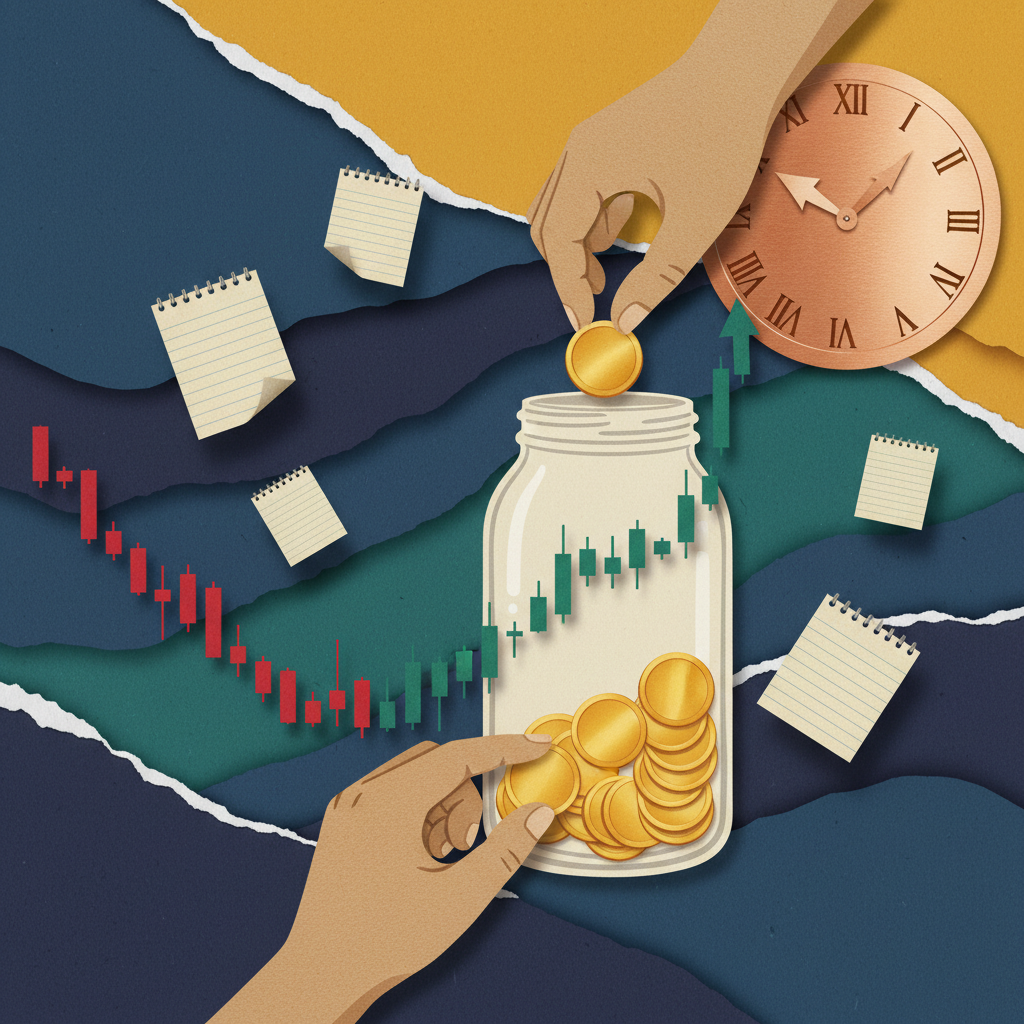
The Crypto Fear & Greed Index sits at 13 out of 100 on February 27, 2026, and Bitcoin's weekly RSI has plunged to an all-time low of 25.7. Markets are deep in extreme fear territory. But historical data tells a consistent story: investors who began dollar-cost averaging during periods exactly like this one went on to earn average returns of 150–200% within 12 months. Here is the complete, data-backed guide to executing a DCA strategy right now.
"Should I buy now, or will it drop further?" That is the question every investor faces when fear takes over. As of February 27, 2026 at 17:00 KST, total crypto market capitalization stands at $2.41 trillion, BTC dominance is 56.1%, and Bitcoin trades at $67,692 on Binance — down over 46% from its all-time high near $126,000 (Source: Binance API, Alternative.me). The Fear & Greed Index touched a record low of 5/100 on February 5 before recovering slightly to 13 today (Source: Tekedia). Bitcoin's 14-day RSI dropped below 30 for only the third time in its entire history — the previous two instances, January 2015 (~$200) and December 2018 (~$3,500), both preceded massive bull runs (Source: CoinDesk).
The catch? Calling the exact bottom is virtually impossible. That is precisely the problem DCA solves. Dollar-cost averaging removes the timing question entirely by spreading purchases across the entire fear zone. This guide uses 2026 live market data, historical backtests, and on-chain metrics to show why now may be the optimal window to start — and exactly how to do it.
Key Takeaways
Quick Answer: Dollar-cost averaging (DCA) means buying a fixed dollar amount of crypto at regular intervals regardless of price. Investors who started DCA during 2022's extreme fear earned +192.47% returns, outperforming lump-sum investors by 33 percentage points. With the Fear & Greed Index at 13 and BTC's weekly RSI at a record low 25.7, historical patterns strongly favor starting a long-term DCA strategy now.
- Fear & Greed Index: 13/100 — Recovering from a record-low 5/100 on February 5, but still firmly in Extreme Fear territory (Source: Alternative.me).
- Historical proof — Investors who began DCA when the index fell below 10 averaged 150–200% returns over 12 months (Source: Alternative.me historical data).
- DCA vs. lump-sum — During the 2022 extreme fear period, DCA investors earned +192.47%, outperforming lump-sum by 33 percentage points (Source: dcabtc.com).
- Optimal frequency — Weekly Monday purchases accumulated 14.36% more BTC than other frequencies in 2018–2025 backtests (Source: dcabtc.com).
- Short-term caution — The average 90-day return after entering extreme fear is just 2.4%. DCA requires a minimum 6–12 month horizon (Source: BitcoinEthereumNews).
- Altcoin risk — Roughly 80% of altcoins never recover their previous all-time highs after bear markets. BTC and ETH should form the core of any DCA portfolio.
- Strategy (formerly MicroStrategy) — Holds 717,722 BTC (~$54.56 billion), completing its 100th public purchase on February 23, 2026, continuing quarterly buys through extreme fear (Source: BingX).
What Is DCA and Why Does It Work So Well for Crypto?
Dollar-cost averaging (DCA) is an investment strategy where you invest a fixed dollar amount at regular intervals — weekly, biweekly, or monthly — regardless of the asset's current price. When Bitcoin trades at $67,692, your $100 buys 0.00148 BTC; if it drops to $50,000, that same $100 buys 0.00200 BTC. Over time, this mechanical approach lowers your average cost basis without requiring you to predict bottoms or tops. First systematized by Benjamin Graham in The Intelligent Investor (1949), DCA has been validated across more than seven decades of traditional markets. In crypto, where annual volatility runs 3–5x higher than equities, the strategy's advantage becomes even more pronounced. As of February 2026, Bitcoin has swung between a $66,500 low and a $68,722 high in the past 24 hours alone — a $2,222 range that illustrates why timing the market is a losing proposition for most investors (Source: Binance API).
Three factors make DCA especially powerful in crypto. First, it eliminates emotional decision-making. With the Fear & Greed Index at 13, most investors are frozen by fear or panic-selling. DCA investors simply execute their next scheduled purchase. Second, it removes the burden of calling the bottom. K33 Research head Vetle Lunde noted that "current conditions closely resemble late September and mid November 2022, periods near the bear market bottom that were followed by extended consolidation" (Source: CoinDesk). Rather than trying to pinpoint the exact low, DCA lets you accumulate throughout the entire bottom zone. Third, volatility itself becomes your ally. Deeper drops mean your fixed investment buys more coins, amplifying returns when prices recover.
Why February 2026 May Be the Optimal Time to Start DCA
The relationship between starting a DCA strategy during extreme fear and subsequent long-term returns is one of the most robust patterns in crypto market history. On February 27, 2026, the Fear & Greed Index reads 13/100 — Extreme Fear — after hitting an all-time record low of 5/100 on February 5 (Source: Tekedia). Bitcoin's weekly RSI has fallen to approximately 25.7, the most oversold reading in BTC's entire trading history (Source: AMBCrypto). The 14-day RSI dropped below 30 for only the third time ever — previous occurrences in January 2015 (~$200) and December 2018 (~$3,500) were both followed by months of consolidation and then sustained multi-year rallies (Source: CoinDesk).
The historical data backing DCA at extreme fear levels is remarkably consistent. Every time the Fear & Greed Index dropped below 10, investors who began dollar-cost averaging at that point earned average returns of 150–200% over the following 12 months (Source: Alternative.me). The table below shows Bitcoin's recovery from every extreme fear episode:
| Period | Event | Fear Index | BTC Low | Subsequent High | Rally | Recovery Time |
|---|---|---|---|---|---|---|
| Dec 2018 | Crypto Winter | <10 | ~$3,200 | $69,000 | +2,056% | ~3 years |
| Mar 2020 | COVID-19 Crash | <10 | ~$3,800 | $69,000 | +1,716% | ~1.5 years |
| Jun 2022 | Luna/3AC Collapse | 6 | ~$17,600 | $108,000 | +514% | ~2.5 years |
| Nov 2022 | FTX Bankruptcy | <15 | ~$15,500 | $108,000 | +597% | ~2 years |
| Feb 2026 | Current | 13 | ~$66,500 | ? | ? | In progress |
Galaxy Digital's head of firmwide research Alex Thorn reinforced this view: "Bitcoin is nearing all-time oversold territory. Weekly RSI is lower than any time except the darkest of bears. Only lower readings since 2016 are Nov/Dec 2018 when BTC dropped from $6K to $3K and Jun/Jul 2022 when 3AC collapsed" (Source: X/Twitter). However, patience is essential: the average 90-day return after entering extreme fear territory is just 2.4% (Source: BitcoinEthereumNews). DCA is not a short-term trade — it is a minimum 6–12 month commitment.
DCA vs. Lump-Sum Investing: What the Data Actually Shows
The debate between dollar-cost averaging and lump-sum investing is ultimately settled by market conditions, and the data strongly favors DCA during bear markets and periods of extreme fear. According to dcabtc.com backtests covering 2018–2025, lump-sum outperforms during sustained uptrends, but DCA delivers meaningfully superior results during downturns and sideways markets. The most striking data point: investors who started DCA during the 2022 extreme fear period (Luna/3AC/FTX collapses) earned +192.47% returns, outperforming lump-sum investors by 33 percentage points (Source: dcabtc.com). With the Fear & Greed Index currently at 13, this pattern positions DCA as the statistically superior approach for new capital deployment right now. Weekly Monday purchases produced the best results, accumulating 14.36% more BTC than other frequencies across the full 2018–2025 backtest period.
| Factor | DCA (Dollar-Cost Averaging) | Lump-Sum |
|---|---|---|
| Method | Fixed amount at regular intervals | Full amount invested at once |
| 2022 Extreme Fear Returns | +192.47% | +159% (33pp lower) |
| Emotional Risk | Low (mechanical execution) | High (entry timing stress) |
| Need to Call the Bottom | None | Critical (large losses if wrong) |
| Bear Market Performance | Strong (lower avg. cost) | Weak (immediate drawdown) |
| Bull Market Performance | Moderate (split exposure) | Strong (full immediate exposure) |
| Optimal Frequency | Weekly Mondays (+14.36% accumulation) | N/A |
| Minimum Recommended Period | 6–12 months | Depends on market timing skill |
Strategy (formerly MicroStrategy) is the most prominent institutional DCA practitioner. Executive Chairman Michael Saylor declared: "We won't be selling bitcoin, we'll be buying every quarter forever" (Source: CNBC). As of February 23, 2026, Strategy completed its 100th public Bitcoin purchase, bringing total holdings to 717,722 BTC acquired for approximately $54.56 billion (Source: BingX). In February alone, the company purchased 1,142 BTC for $90 million (avg. $78,815) followed by an additional 2,486 BTC for $168.4 million (Source: CoinDesk). When even institutions refuse to stop buying during extreme fear, it sends a powerful signal about the long-term thesis.
Current Market Snapshot: Where Prices Stand Right Now
Understanding the current market structure is essential context for any DCA strategy. As of February 27, 2026 at 17:00 KST, Bitcoin trades at $67,692 on Binance with $1.4 billion in 24-hour volume, while Ethereum sits at $2,032 with $887 million in volume. The total crypto market cap stands at $2.41 trillion with 18,774 active cryptocurrencies. BTC dominance at 56.1% remains elevated — historically a sign that capital is concentrating in the largest asset during risk-off conditions, which reinforces the case for BTC-heavy DCA portfolios. Across both Binance and OKX, the top assets by volume are BTC, stablecoins, ETH, and SOL, reflecting a market that has contracted to its core blue-chip assets as speculative altcoin trading fades.
| # | Coin | Price | 24h Change | Volume(24h) | High | Low |
|---|---|---|---|---|---|---|
| 1 | BTC | $67,692 | -0.24% | $1.4B | $68,722.64 | $66,500.00 |
| 2 | USDC | $1.00 | -0.01% | $1.2B | $1.00 | $1.00 |
| 3 | ETH | $2,032 | -1.11% | $887.4M | $2,083.33 | $1,975.35 |
| 4 | SOL | $87 | -0.03% | $241.4M | $88.71 | $84.34 |
| 5 | XRP | $1.42 | -1.23% | $213.3M | $1.46 | $1.38 |
| 6 | USD1 | $1.00 | +0.04% | $138.6M | $1.00 | $1.00 |
| 7 | BNB | $627 | +0.21% | $81.0M | $633.65 | $614.20 |
| 8 | DOGE | $0.10 | -1.19% | $70.1M | $0.10 | $0.10 |
| 9 | PEPE | $0.0000039 | -3.71% | $60.3M | $0.0000041 | $0.0000038 |
| 10 | PAXG | $5,193 | -0.08% | $45.3M | $5,212.06 | $5,143.00 |
(Source: Binance API, February 27, 2026 17:00 KST)
The derivatives market reveals further clues about positioning. BTC funding rates on Binance are negative at -0.0081%, with SOL even more negative at -0.0084%, indicating that short sellers are paying longs — a classic sign of bearish crowding that often precedes reversals. BTC open interest stands at $5.4 billion with a long/short ratio of 64.4%/35.6% (1.81x long bias), suggesting retail traders are beginning to position for a recovery even as funding rates remain negative. ETH open interest is $3.7 billion with a similar 64.2%/35.8% long/short split. The divergence between negative funding and long-heavy positioning creates a compressed spring — either shorts will be squeezed on a rally, or longs will be liquidated on further decline. For DCA investors, this noise is irrelevant: you buy regardless.
| Coin | Funding Rate | Open Interest | Long/Short |
|---|---|---|---|
| BTC | -0.0081% | $5.4B | 64.4% / 35.6% |
| ETH | 0.0003% | $3.7B | 64.2% / 35.8% |
| SOL | -0.0084% | $872.1M | 70.1% / 29.9% |
| XRP | -0.0027% | $383.6M | 70.3% / 29.7% |
| DOGE | -0.0003% | $156.4M | 69.1% / 30.9% |
| BNB | 0.0000% | $314.6M | N/A |
| ADA | 0.0049% | $101.2M | N/A |
| AVAX | 0.0100% | $82.6M | N/A |
| DOT | 0.0064% | $52.3M | N/A |
| LINK | 0.0083% | $81.2M | N/A |
(Source: Binance Futures API, February 27, 2026 17:00 KST)
On OKX, BTC volume registered $677 million with a slight positive 24h change of +0.31%, while ETH volume hit $368 million. SOL showed relative strength on OKX at +1.66%. The fact that stablecoins (USDC at $1.2B on Binance, $88M on OKX) dominate the volume charts signals capital sitting on the sidelines waiting to deploy — exactly the kind of dry powder that fuels recoveries and makes consistent DCA during this window so valuable.
How to Start Crypto DCA: A 5-Step Practical Guide
Executing a dollar-cost averaging strategy requires discipline and structure, not complexity. The five steps below are designed for a global audience and use 2026 exchange data to help you set up a system that runs mechanically once configured. The entire point of DCA is that after initial setup, you do not make decisions — you follow the plan. Exchanges like Binance (Auto-Invest), Kraken (DCA Bot), and Coinbase (Recurring Buy) all offer automated purchase features that eliminate the need for manual execution, which is critical for maintaining consistency during periods when emotions might otherwise cause you to skip a buy.
Step 1: Set Your Investment Budget
Allocate 5–15% of your monthly income exclusively for DCA, using only money you can afford to commit for at least 6–12 months without needing it. If you earn $4,000/month, that means $200–$600/month or roughly $50–$150/week. The absolute rule: never DCA with your emergency fund. DCA works because it is mechanical and consistent — if you need to pause due to financial pressure, the strategy breaks down.
Step 2: Choose Your Frequency
Backtesting data from dcabtc.com (2018–2025) shows that weekly purchases on Mondays accumulated 14.36% more BTC than other frequencies. This is partially because weekend trading volumes drop, leading to slightly lower Monday prices on average. If weekly isn't practical, biweekly or monthly still works — but weekly captures the most volatility-smoothing benefit. Set up automatic recurring purchases on your exchange to remove yourself from the equation entirely.
Step 3: Build Your Portfolio Allocation
The core principle is "blue-chip heavy." Given that roughly 80% of altcoins fail to recover their previous highs after bear markets, the recommended allocation is BTC 50–60% + ETH 20–30% + large-cap alts 10–20%. With BTC dominance at 56.1% and still rising, tilting even heavier toward BTC is defensible. ETH at $2,032 (10.2% of total market cap) remains the second-most battle-tested asset for DCA.
Step 4: Select an Exchange and Enable Auto-Buy
Exchange fees compound significantly over long-term DCA. If you're buying 48 times per year for 3 years (144 transactions), even small fee differences matter. The table below compares major global exchanges:
| Exchange | Maker Fee | Taker Fee | Auto-DCA Feature | DCA Coins | Notes |
|---|---|---|---|---|---|
| Binance | 0.10% | 0.10% | Auto-Invest | 200+ | Largest global volume ($1.4B BTC/24h) |
| Kraken | 0.25% | 0.40% | DCA Bot | 200+ | Strong security, U.S. regulated |
| Coinbase | 0.40% | 0.60% | Recurring Buy | 250+ | Publicly listed, beginner-friendly |
| OKX | 0.08% | 0.10% | Recurring Buy | 300+ | Low fees, $677M BTC daily volume |
(Source: Bleap Finance, exchange websites, February 2026)
Step 5: Track and Rebalance
Keep a simple spreadsheet logging each purchase: date, amount, quantity, and running average cost. Review your portfolio allocation quarterly. If any asset drifts more than ±10% from its target weight, rebalance. For example, if BTC rallies and grows to 75% of your portfolio against a 60% target, redirect new DCA purchases to ETH until balance is restored. Do not sell to rebalance during accumulation — simply adjust new purchase allocations.
Best Cryptocurrencies for DCA and Staking Yield Comparison
When selecting DCA targets, long-term survivability and liquidity matter more than short-term price action. Bitcoin and Ethereum are the only large-cap cryptocurrencies that have recovered from every single historical extreme fear period — including the 2018 crypto winter, the 2020 COVID crash, the 2022 Luna/3AC/FTX cascade, and every correction in between. Together, BTC ($67,692) and ETH ($2,032) account for 66.3% of the total $2.41 trillion crypto market cap (Source: Binance/OKX API, February 27). For DCA investors who hold long-term, staking provides a compounding layer on top of price appreciation. The table below compares staking yields for the most liquid proof-of-stake assets that are viable DCA candidates:
| Coin | Current Price | Staking APY | Key Feature | DCA Suitability | Risk Level |
|---|---|---|---|---|---|
| ETH | $2,032 | 3–4% | Largest smart contract platform | ★★★★★ | Low |
| SOL | $87 | 5–6% (Jito MEV: 7–9%) | High-speed L1, growing DeFi | ★★★★ | Medium |
| ADA | $0.29* | 4–5% | Research-driven, Africa focus | ★★★ | Medium |
| DOT | $1.61* | 12–14% nominal / 2–5% real | Multi-chain infra (10% inflation) | ★★★ | High (inflation) |
(Source: Paybis, February 2026. APYs fluctuate. *OI-derived pricing from Binance Futures data.)
A critical warning on DOT: while its nominal 12–14% APY looks attractive, annual token inflation of approximately 10% erodes the real yield to just 2–5%. Always evaluate staking returns on a real (inflation-adjusted) basis. For most DCA portfolios, ETH as the core staking asset and SOL as a satellite position offers the best balance of yield, security, and long-term viability.
5 Mistakes Every DCA Investor Must Avoid
Dollar-cost averaging is simple in concept but demanding in execution, and specific behavioral mistakes can severely undermine its effectiveness. James Check, on-chain analyst and co-founder of Checkonchain, captured the core challenge: "Bitcoin does nothing most of the time, and then tends to move in sharp repricing bursts rather than steady trends" (Source: CoinDesk). This means DCA demands patience through long stretches of seeming inactivity — and the discipline not to abandon the strategy just before one of those repricing bursts arrives. Below are the five most common mistakes, each backed by specific data.
- Mistake 1: Stopping DCA during fear spikes. This is the single most destructive error. Historically, investors who abandoned DCA did so near the bottom. The Fear & Greed Index is 13 today — still extreme fear — but already recovering from 5 on February 5. The worst time to stop buying is when fear is highest.
- Mistake 2: Overweighting altcoins. Roughly 80% of altcoins never recover their previous all-time highs after bear markets. On today's Binance volume chart, PEPE is down -3.71% while BTC is only -0.24%. Limit altcoin exposure to 20% or less of your DCA portfolio.
- Mistake 3: Ignoring fees. At Coinbase's 0.60% taker fee, 144 purchases over 3 years costs you 86.4% of one full monthly investment in fees alone. At Binance's 0.10%, the same 144 purchases costs just 14.4%. Choose low-fee exchanges and use limit orders (maker fees) when possible.
- Mistake 4: Judging results too early. The average 90-day return after the Fear & Greed Index drops below 25 is just 2.4% (Source: BitcoinEthereumNews). If you check your portfolio weekly and react to short-term performance, you will likely abandon the strategy before it pays off. Set a 12-month minimum review window.
- Mistake 5: Neglecting security. DCA is a long-term accumulation strategy, which means exchange hacks or lost keys are catastrophic. Once your holdings exceed $5,000–$10,000, transfer to a hardware wallet. Ledger supports 5,500+ cryptocurrencies; Trezor supports 8,000+ (Source: Koinly).
A note on global tax implications: South Korea has delayed its 20% crypto capital gains tax to 2027 (Source: The Paypers), Italy raised its rate to 33% in 2026, Japan is shifting toward a 20% separate taxation model, and India maintains a 30% flat tax (Source: MEXC). Your DCA exit strategy should account for your jurisdiction's tax calendar — accumulate now, plan exits around tax efficiency later.
Forward Outlook and DCA Scenario Analysis
K33 Research's Vetle Lunde provided the clearest institutional framework for what comes next: "Bitcoin is likely near, or at, a global bottom but set for a prolonged consolidation between $60,000 and $75,000" (Source: CoinDesk). For DCA investors, extended sideways action at depressed prices is actually the ideal scenario — it provides a wide window to accumulate at low average costs. Spot trading volumes have already fallen 59% week-over-week, and perpetual futures open interest hit a 4-month low, both signals that selling pressure is exhausting itself. Meanwhile, U.S. Bitcoin ETFs have experienced a record peak-to-trough outflow of 103,113 BTC since early October, suggesting the bulk of institutional deleveraging may already be behind us.
Bullish scenario (est. 40% probability): BTC consolidates between $60,000–$75,000 for 3–6 months, then rebounds above $100,000 in H2 2026. DCA investors starting now could expect +47–80% returns over 12 months. Catalysts include renewed U.S. Bitcoin ETF inflows and Strategy's continued quarterly purchases.
Bearish scenario (est. 30% probability): A deepening global recession pushes BTC to $50,000–$55,000 before a 6–12 month sideways grind. Even here, DCA investors benefit by accumulating at lower average prices — and with 103,113 BTC already flushed from ETFs, additional selling pressure may be limited.
Base case (est. 30% probability): BTC oscillates within the current $65,000–$75,000 range for 3–6 months. This is the "boring but productive" scenario for DCA — steady accumulation at prices well below the ~$126,000 all-time high. The spot volume collapse and 4-month low in futures open interest support this exhaustion thesis.
Key Points for Investors
- Start window: Fear & Greed below 20 (currently 13) has historically been the optimal DCA entry zone. Set up weekly Monday auto-buys now.
- Allocation: BTC 60% + ETH 25% + large-cap alts 15% as a baseline. Rebalance quarterly.
- Time horizon: DCA under 6 months has limited effectiveness. Plan for at least 12 months; 24 months is ideal.
- Derivatives signal: BTC funding at -0.0081% with 64.4% long positioning creates a compressed market. DCA investors should ignore this noise and buy regardless.
- Security threshold: Move holdings to hardware wallets (Ledger or Trezor) once they exceed $5,000–$10,000.
- RSI context: BTC weekly RSI at 25.7 (all-time low) is an extreme oversold signal. The two previous times RSI was this depressed — 2015 and 2018 — multi-year bull markets followed.
- Tax planning: Build your DCA exit strategy around your country's tax timeline. Accumulate during fear; optimize exits for tax efficiency.
Risk factors include tightening global regulation (Italy's 33% crypto tax increase), further macroeconomic deterioration, and a potentially longer-than-expected consolidation period. The fundamental thesis of DCA is that none of these short-term risks matter if your time horizon is long enough — and the data from four previous extreme fear episodes overwhelmingly supports that view.
FAQ
What is DCA (Dollar-Cost Averaging) in crypto?
DCA (Dollar-Cost Averaging) is an investment strategy where you buy a fixed dollar amount of cryptocurrency at regular intervals — weekly, biweekly, or monthly — regardless of price. When prices are low you accumulate more coins; when prices are high you buy fewer. This mechanically lowers your average cost basis over time and removes the need to predict market bottoms. Backtesting from 2018–2025 confirms weekly DCA as the most effective frequency for Bitcoin accumulation.
Is weekly or monthly DCA better for crypto?
According to dcabtc.com backtests covering 2018–2025, weekly DCA on Mondays accumulated 14.36% more BTC than other frequencies. Weekly purchases capture more volatility-averaging opportunities than monthly buys. However, if transaction fees eat into very small purchases (under $25–$50), biweekly or monthly DCA may be more cost-efficient. The most important factor is consistency — choose a frequency you can maintain for at least 12 months.
Does starting DCA during extreme fear produce higher returns?
Yes, significantly. According to Alternative.me historical data, investors who began DCA when the Fear & Greed Index dropped below 10 earned average returns of 150–200% over 12 months. DCA investors who started during the 2022 extreme fear period achieved +192.47% returns, beating lump-sum by 33 percentage points. However, 90-day returns averaged only 2.4%, so patience is essential — commit to a minimum 6–12 month time horizon.
Which cryptocurrencies are best for DCA?
Bitcoin (BTC) and Ethereum (ETH) are the strongest DCA candidates. Both have recovered from every historical extreme fear period and together represent over 66% of total crypto market capitalization. Roughly 80% of altcoins fail to recover their previous all-time highs after bear markets, which is why DCA portfolios should allocate at least 70–80% to BTC and ETH, with altcoins capped at 20% or less.
Sources
- Crypto Fear & Greed Index, Alternative.me — Real-time fear and greed data
- Bitcoin Echoes Late 2022 Bear Market Bottom, CoinDesk — K33 Research analysis
- Bitcoin's 14-Day RSI Falls Below 30 for Third Time Ever, CoinDesk — Historical RSI analysis
- Bitcoin's Weekly RSI Hits an All-Time Low, AMBCrypto — BTC weekly RSI analysis
- Crypto Fear & Greed Hits 5/100, Tekedia — Record low fear index
- DCA Bitcoin Calculator, dcabtc.com — DCA backtest data (2018–2025)
- Strategy Marks 100th Bitcoin Purchase, BingX — Strategy BTC holdings
- Michael Saylor Interview, CNBC — DCA strategy statement
- Is Extreme Fear a Buy Signal?, BitcoinEthereumNews — 90-day return analysis
- Highest APY Crypto Staking, Paybis — Staking yield comparison
- Trezor vs Ledger, Koinly — Hardware wallet comparison
- South Korea Delays Crypto Tax to 2027, The Paypers — Tax policy
- Crypto Tax by Country, MEXC — Global tax comparison
- Binance & OKX API — Real-time spot, volume, and derivatives data (February 27, 2026 17:00 KST)
This article is for informational purposes only and does not constitute investment advice. All investment decisions should be made based on your own judgment and risk tolerance. Cryptocurrency investments carry the risk of loss, and past performance does not guarantee future results.