February 2026 Crypto Market Deep Dive: Mining Crisis and the Institutional Accumulation Paradox
Bitcoin crashed 45%, yet institutions keep buying. Miners face worst profitability in years, yet on-chain whales accumulate aggressively. The market bottom signals of 2026 differ fundamentally from 2022.
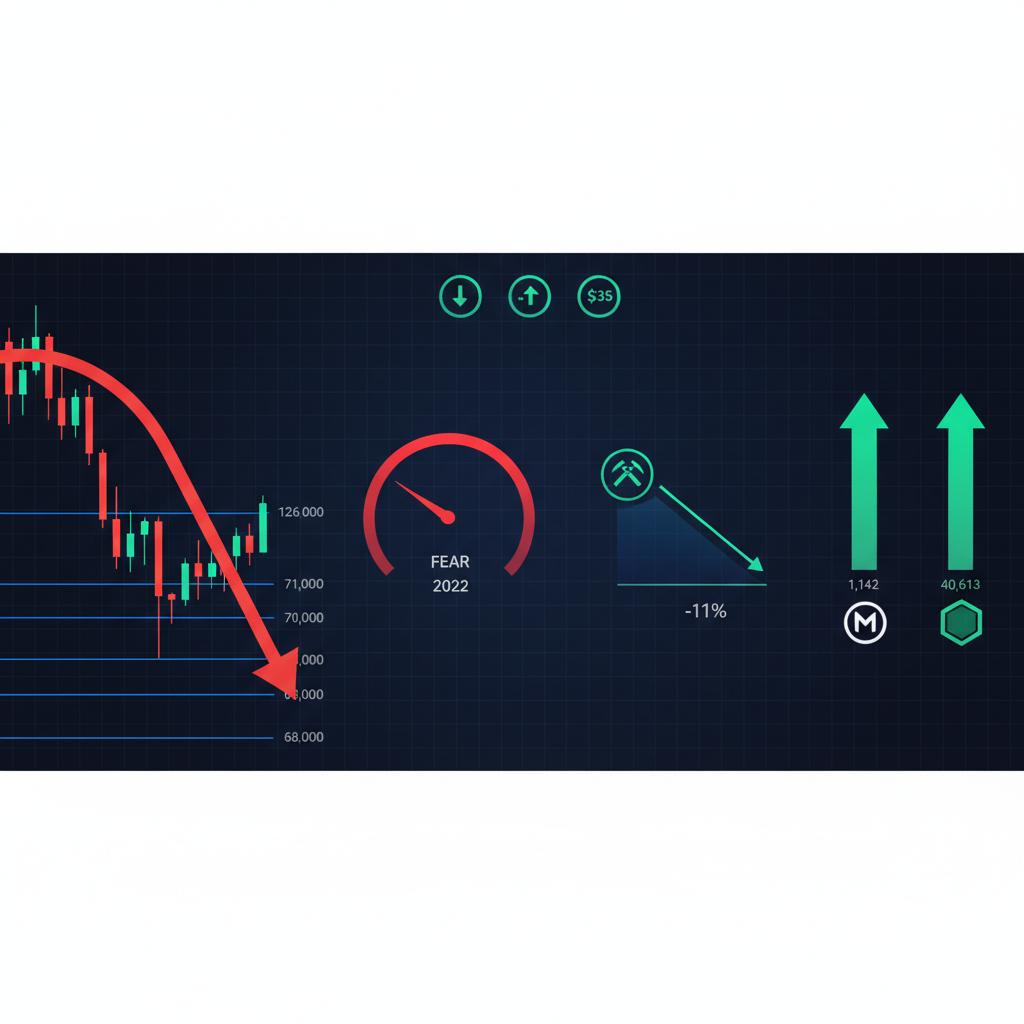
February 10, 2026: The cryptocurrency market presents a fundamental contradiction. Bitcoin has plummeted from $126,000 to $68,000 in recent weeks—a devastating 45% decline. The Fear and Greed Index hit its highest level since 2022. Spot trading volumes dropped 30%. By every traditional metric, the market appears to be in crisis. Yet institutional investors are doing something unexpected: they're buying aggressively. MicroStrategy purchased 1,142 Bitcoin at an average price of $78,815—a $90 million deployment. Tom Lee's Bitmine Immersion holds 43 million Ethereum, worth $8.7 billion, after accumulating 40,613 ETH during the crash. U.S. Bitcoin spot ETFs registered consecutive inflows for the first time in a month. Mining difficulty has collapsed 11%—the steepest drop since 2021. While miners surrender, why is the smartest institutional capital buying? This paradox contains the real signal hidden in February 2026's market data.
Mining Difficulty Collapse: The Supply Shock Begins
Bitcoin's mining difficulty fell 11%—from 141.6 trillion to 125.86 trillion. This represents the largest single adjustment decline since 2021. To understand what this means, you must understand miner economics.
Miners are the most economically rational actors in the blockchain ecosystem. Unlike speculators driven by emotion, miners perform daily break-even calculations. When profitability drops below operating costs, they shut down. That's exactly what's happening now. Hashprice (revenue per unit of hashing power) has collapsed from a $70-per-terahash peak to just $35—a 50% destruction of mining profitability. Winter storms in Texas exacerbated the situation, forcing grid curtailment requests that temporarily reduced mining output by over 60%.
Why does this matter? History provides the answer. When China's 2021 mining ban triggered a 50% difficulty drop, Bitcoin rallied from $30,000 to $65,000 within two months. During the deepest phase of the 2018 bear market, mining capitulation preceded a subsequent 50x bull-cycle return. Charles Schwab's Jim Ferraioli noted: "Previous selloffs have usually bottomed near Bitcoin's cost of production. When less efficient miners shut down temporarily, we see this play out in real-time through mining difficulty. Once it starts rising again, that confirms the bottom is in."
But there's something more important than the rebound: supply shock. When difficulty declines, network hashpower decreases, meaning fewer Bitcoin are mined. Reduced supply + maintained demand = natural price appreciation. This is mechanical. It's divorced from sentiment.
The Accumulation Paradox: Institutions Buy During Fear
While miners surrender, institutional capital sends an inverse signal.
MicroStrategy's Calculated Conviction
Michael Saylor has been accumulating Bitcoin consistently for years. When Bitcoin fell 45% in early February 2026, Saylor did not hesitate. MicroStrategy purchased 1,142 Bitcoin for $90 million at $78,815 average price. This isn't panic buying or emotional accumulation. This is conviction. Saylor has stated repeatedly: "Bitcoin is tomorrow's gold. We buy when weak hands sell." His actions match his thesis. MicroStrategy now holds over $40 billion in Bitcoin, making it the largest publicly-traded company Bitcoin holder on Earth.
Bitmine's Ethereum Assault
Tom Lee's Bitmine Immersion executed an even more aggressive strategy. During the crash last week, this fund accumulated 40,613 ETH. Bitmine now holds 4.3 million Ethereum—approximately 3.6% of Ethereum's total circulating supply—worth $8.7 billion. This makes Bitmine one of Earth's largest individual Ethereum holders. The timing is crucial: this accumulation happened during maximum market panic, not during bull markets.
Bitcoin Spot ETF Inflows Resume
Since January 2024 approval, Bitcoin spot ETFs have been the most transparent gauge of institutional capital inflows. After one month of net outflows, February 2026 marks the first return to consecutive inflows. This is unambiguous institutional demand during price weakness—precisely the opposite of retail behavior.
The historical contrast is striking. During 2022's extreme bear market, institutional bulk buying never materialized. 2022 included systemic risk: FTX collapse, Celsius bankruptcy, Voyager failure. Institutions feared contagion. But 2026 presents a different scenario. There's no systemic collapse. This is sentiment-driven fear, not fundamental breakdown. Institutions understand this distinction—and they're pricing it accordingly.
On-Chain Data: Following the Whales
Glassnode and CryptoQuant data reveal a consistent accumulation pattern.
Whale Address Movements
Bitcoin addresses holding 1,000+ BTC ("whale" holders) have been accumulating consistently over the past two weeks. On-chain data shows tens of thousands of Bitcoin accumulated during the price decline. This is the classic whale behavior pattern: large holders buy during panic selling. They acquire the Bitcoin that retail investors are forced to liquidate due to fear.
Strategic Non-Distribution
Conversely, exchange inflows (which typically signal upcoming sales) remain relatively subdued for Bitcoin. While Ethereum shows some exchange inflow, Bitcoin inflow is constrained—suggesting medium-to-long-term holding intent rather than quick profit-taking. Institutions are not trying to flip quick gains. They're positioning for extended holds.
The Sentiment-vs-Fundamentals Divide: 2022 vs. 2026
2022: Systemic Fear, Justified
In November 2022, FTX collapsed. Celsius and Voyager filed for bankruptcy. The entire institutional crypto ecosystem appeared to be unraveling. Derivatives experts declared: "The market has entered extreme capitulation." Bitcoin crashed below $19,000. Institutional trust evaporated. This was genuine systemic risk—not mere sentiment.
2026: Psychological Fear, No Systemic Risk
February 2026 is fundamentally different. A Bernstein derivatives analyst stated explicitly: "I am not confident we have hit true capitulation." Why? Because systemic risk is absent. Miners are struggling, but that's a business-cycle phenomenon, not system failure. Institutions clearly recognize this distinction.
Retail trader 2022: "Institutions are fleeing. Everything is ending."
Retail trader 2026: "The market is scary. I should sell everything."
Institutions: "Weak hands are selling. This is our best buying opportunity."
Forward Catalysts: Why Institutions Buy Now
Supply Reduction in Motion
Mining difficulty collapse signals imminent supply reduction. Since Bitcoin's April 2024 halving, newly-mined Bitcoin supply already declined 50%. Now mining difficulty collapse introduces additional supply pressure. Lower difficulty = fewer Bitcoin entering circulation. Less supply + stable demand = natural upward price pressure.
Institutional Normalization Signals
Bernstein maintaining its $150,000 year-end price target despite 45% decline. Morgan Stanley initiating analyst coverage of mining stocks for the first time. Bitcoin spot ETF inflows resuming. These signals indicate institutions are "normalizing" the market—treating it as a standard financial asset subject to cyclical volatility rather than existential threat.
Halving Cycle Positioning
Most importantly: Bitcoin's four-year halving cycle suggests we're still in early cycle stages. The April 2024 halving was roughly ten months ago. Historically, 18-24 months of upside follow each halving. We're currently in the expansion phase of that window. There's zero evidence the market has peaked within the cycle. Institutions understand this timing.
Expert Perspectives
Anatoly Crachilov, Nickel Digital CEO: "During market stress, traditional approaches matter. AI models don't have all the answers. Human judgment and experience remain critical. This is exactly such a period."
Gautam Chhugani, Bernstein: "This is Bitcoin's weakest bear case in history. There's no systemic collapse. The media is simply resurrecting Bitcoin's obituary. The fundamentals remain sound."
Jim Ferraioli, Charles Schwab: "Previous major drawdowns have always bottomed near Bitcoin's production cost. We're seeing those signals now."
Frequently Asked Questions
Q1: Has the market reached true capitulation?
A: Even derivatives experts express uncertainty. The Fear Index is elevated, but it differs from 2022's extreme panic during systemic collapse. Miner capitulation exists, but this is normal business-cycle adjustment, not market failure. True capitulation involves prolonged sideways movement and investor desperation. The current market experienced sharp declines but maintains solid fundamentals. No evidence points to final capitulation.
Q2: When should we expect recovery?
A: Short-term (days to weeks): technical bounces are likely given institutional accumulation, ETF inflows resuming, and mining difficulty decline—all creating near-term upside pressure. But short-term bounces differ from sustained recovery. Reaching Bernstein's $150,000 target requires months. The pathway exists, but the timeline is measured in quarters, not weeks.
Q3: What risks accompany current buying?
A: Regulatory acceleration (as seen in South Korea's Bithumb incident), macroeconomic deterioration, and potential new systemic risks all pose threats. Extended global monetary tightening could pressure risk assets further. However, as long as institutional buying continues, these risks appear transitory rather than terminal.
Q4: Is miner capitulation actually positive?
A: Decidedly yes. When inefficient miners exit, surviving miners' profitability improves. Network security remains robust while marginal producers disappear. Historically, mining difficulty collapses precede 2-8 week recoveries. We're seeing those early signals now. This is market self-correction, not market breakdown.
Q5: What's the six-to-twelve-month outlook?
A: Optimistic. From halving-cycle perspective, we're still early. Institutional capital continues flowing in. Mining supply decreases. Regulatory uncertainty gradually resolves. These factors collectively suggest significant price appreciation in mid-to-late 2026. The technical structure remains constructive; sentiment is merely depressed.
Track Institutional Flows on Spoted Crypto
For real-time institutional accumulation data and on-chain whale tracking, explore Spoted Crypto Premium Analysis. Our institutional-grade research tracks every major player movement. Additionally, visit Spoted Crypto's market intelligence platform for daily on-chain flow analysis and expert consensus forecasts that help contextualize price action with capital movement.
Conclusion: Fear vs. Smart Money Behavior
February 10, 2026's market tells a coherent story. Retail investors quake with fear. Institutional investors see opportunity. Miners surrender; institutions accumulate. Price collapsed 45%; fundamentals strengthened. Supply decreases, institutional capital flows in, network security remains robust.
Warren Buffett's famous maxim applies perfectly: "Be fearful when others are greedy and greedy when others are fearful." This moment embodies that principle. Market sentiment is at extremes. Institutional capital flows suggest opposite conviction. History has repeatedly shown that when institutional behavior diverges this sharply from retail sentiment, institutions are right.
The miners are capitulating. The institutions are accumulating. The choice between following panic or following capital is yours—but history suggests the latter outperforms.
Sources
- CoinDesk Markets Coverage and Analysis
- Bernstein Research Reports and Analyst Commentary
- Glassnode On-Chain Data and Intelligence
- Charles Schwab Cryptocurrency Research
- CryptoQuant Transaction Flow Analysis